Overview
Syntax is a fundamental component of language that governs how words are organized and combined to form meaningful sentences and phrases. In the context of Psychology and the MCAT, syntax represents the set of rules, principles, and processes that determine the structure of sentences in a language. While semantics deals with the meaning of words and sentences, syntax focuses exclusively on the arrangement and order of linguistic elements. Understanding syntax is crucial for comprehending how humans process, produce, and understand language—a core aspect of Cognition and Consciousness.
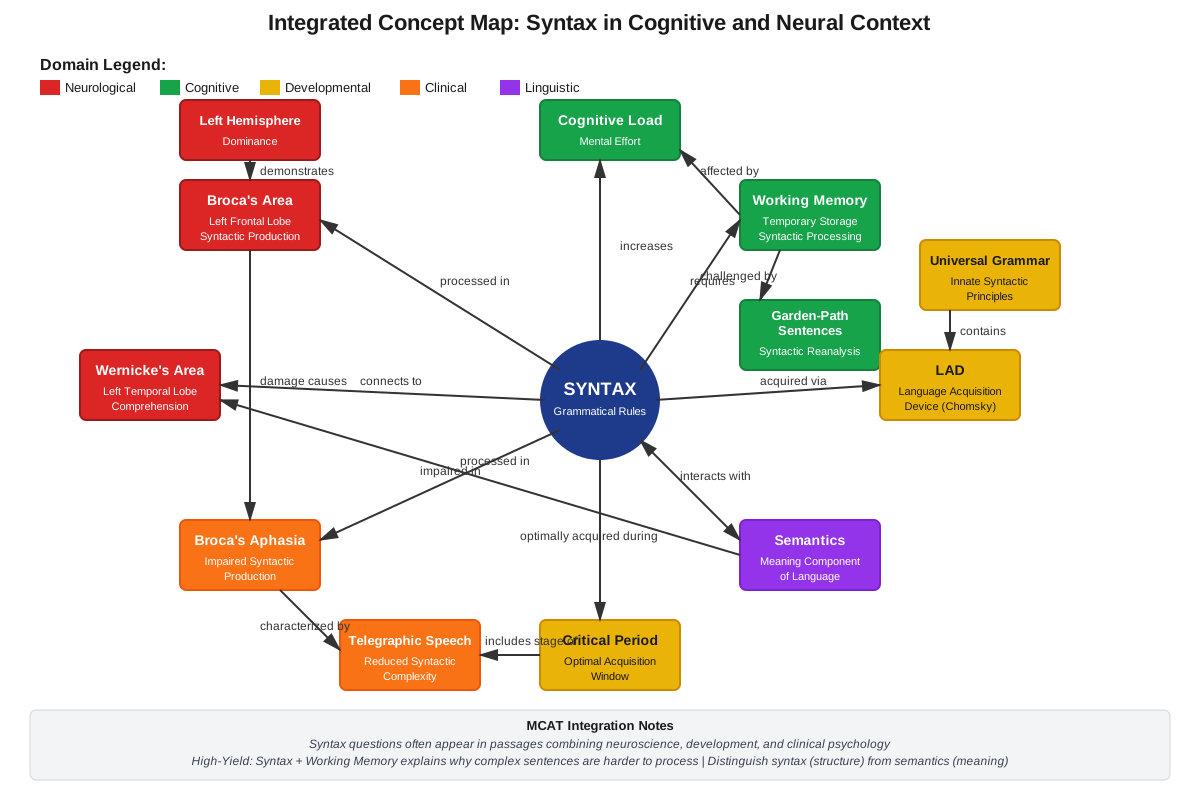
For MCAT preparation, syntax serves as a bridge between multiple psychological domains. It connects to cognitive psychology through language processing, to developmental psychology through language acquisition, and to neuropsychology through brain regions responsible for language production and comprehension. The MCAT frequently tests syntax within passages discussing Broca's aphasia, language development in children, or cognitive processing of complex sentences. Questions may ask students to identify which aspect of language is impaired in a clinical scenario or to distinguish between syntactic and semantic processing deficits.
Mastery of syntax enables students to tackle interdisciplinary MCAT questions that integrate linguistics, cognitive neuroscience, and developmental psychology. This topic frequently appears in Psychology/Sociology passages that discuss language disorders, brain lateralization, critical periods for language acquisition, or the relationship between thought and language. Understanding syntax also provides essential context for related concepts such as language acquisition theories (Chomsky's universal grammar), the Sapir-Whorf hypothesis, and the neurological basis of language processing in the left hemisphere.
Learning Objectives
- [ ] Define Syntax using accurate Psychology terminology
- [ ] Explain why Syntax matters for the MCAT
- [ ] Apply Syntax to exam-style questions
- [ ] Identify common mistakes related to Syntax
- [ ] Connect Syntax to related Psychology concepts
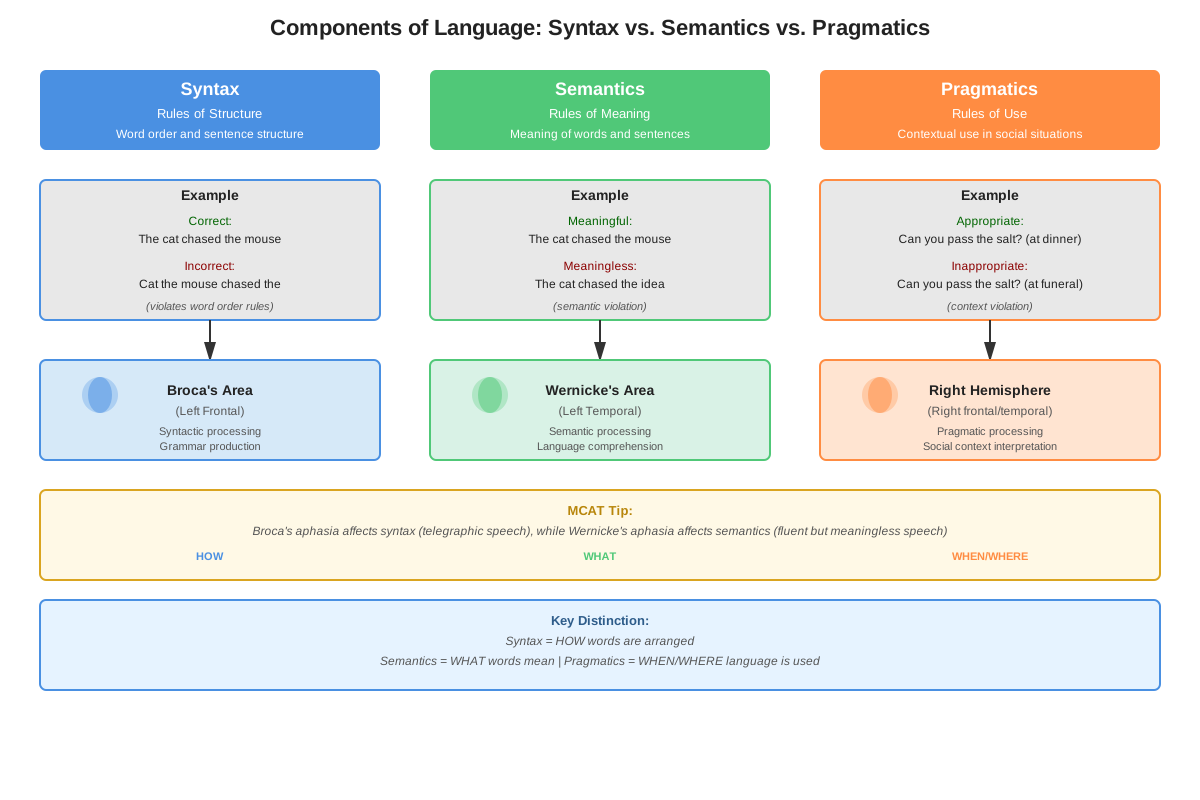
- [ ] Distinguish between syntax, semantics, and pragmatics in language processing
- [ ] Analyze how syntactic deficits manifest in different types of aphasia
- [ ] Evaluate the role of syntax in language development across the lifespan
Prerequisites
- Basic understanding of language components: Necessary to differentiate syntax from other linguistic elements like phonology, morphology, and semantics
- Familiarity with brain structure: Required to understand which neural regions (Broca's area, Wernicke's area) are involved in syntactic processing
- Knowledge of cognitive processing: Essential for comprehending how syntax relates to working memory and information processing
- Awareness of developmental stages: Needed to understand how syntactic abilities emerge and mature from infancy through adulthood
Why This Topic Matters
Clinical and Real-World Significance
Syntax has profound clinical implications in diagnosing and treating language disorders. Patients with Broca's aphasia exhibit characteristic syntactic deficits, producing telegraphic speech that lacks grammatical structure while retaining content words. For example, a patient might say "Walk dog park" instead of "I walked the dog to the park." Clinicians use syntactic analysis to differentiate between various aphasias, developmental language disorders, and cognitive decline associated with dementia. Understanding syntax also informs educational interventions for children with specific language impairment (SLI) and helps speech-language pathologists design targeted therapies.
MCAT Exam Statistics
Syntax appears in approximately 3-5% of Psychology/Sociology section questions, typically integrated within passages about language processing, cognitive development, or neuropsychology. The MCAT most commonly tests syntax through:
- Clinical vignette questions describing patients with language impairments
- Research passage questions analyzing studies on language acquisition or processing
- Standalone questions requiring differentiation between linguistic components
- Graph interpretation questions showing developmental trajectories of language abilities
Common Exam Appearances
MCAT passages featuring syntax often present scenarios involving stroke patients with aphasia, children at different developmental stages, or neuroimaging studies of language processing. Questions may ask students to identify which language component is impaired, predict outcomes based on lesion location, or interpret experimental results about sentence processing. The exam frequently pairs syntax with concepts like critical periods, brain lateralization, or the relationship between language and thought.
Core Concepts
Definition and Fundamental Principles
Syntax refers to the set of rules and principles that govern the structure and formation of sentences in a language. It determines word order, sentence structure, and the relationships between different grammatical elements. In Syntax Psychology, researchers study how the human mind represents, processes, and applies these rules during language comprehension and production. Unlike semantics (meaning) or phonology (sound), syntax focuses exclusively on structural arrangement.
The core principle of syntax is that language has a hierarchical structure. Sentences are not simply linear strings of words but organized into nested constituents (phrases and clauses). For example, in "The tall student read the book," syntax organizes words into a noun phrase ("The tall student"), a verb ("read"), and another noun phrase ("the book"). This hierarchical organization allows for recursive embedding, enabling humans to create infinitely complex sentences from finite rules.
Syntactic Rules and Structures
Syntactic rules vary across languages but share universal properties. In English, the basic sentence structure follows Subject-Verb-Object (SVO) order, while other languages may use SOV (Japanese) or VSO (Irish) patterns. Key syntactic structures include:
| Structure Type | Description | Example |
|---|---|---|
| Simple sentence | Single independent clause | "The cat sleeps." |
| Compound sentence | Two independent clauses joined by conjunction | "The cat sleeps, and the dog barks." |
| Complex sentence | Independent clause + dependent clause | "The cat sleeps when it's tired." |
| Passive construction | Object becomes grammatical subject | "The mouse was chased by the cat." |
Syntactic rules also govern agreement (subject-verb agreement, pronoun-antecedent agreement), tense consistency, and proper clause embedding. These rules operate largely unconsciously in native speakers, demonstrating the automaticity of syntactic processing.
Syntax in Language Processing
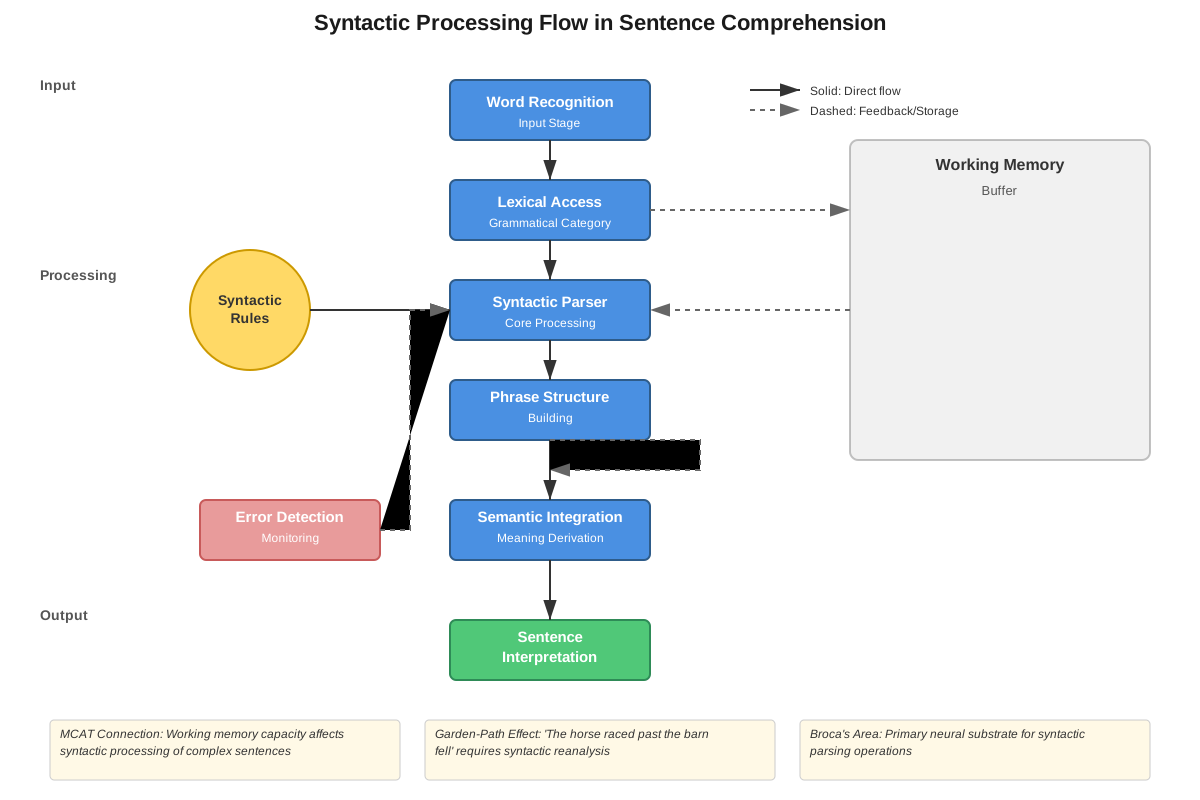
During language comprehension, the brain performs syntactic parsing—the process of analyzing sentence structure to extract meaning. This occurs in real-time as words are encountered sequentially. The brain uses syntactic cues (word order, function words, inflections) to build a structural representation of the sentence. Research using eye-tracking and EEG demonstrates that syntactic violations (like "The books was heavy") trigger immediate neural responses, indicating automatic syntactic processing.
Working memory plays a crucial role in syntactic processing, particularly for complex sentences with embedded clauses. Sentences like "The reporter who the senator attacked admitted the error" require holding multiple syntactic relationships in memory simultaneously. Individual differences in working memory capacity correlate with ability to process syntactically complex sentences.
Neural Basis of Syntax
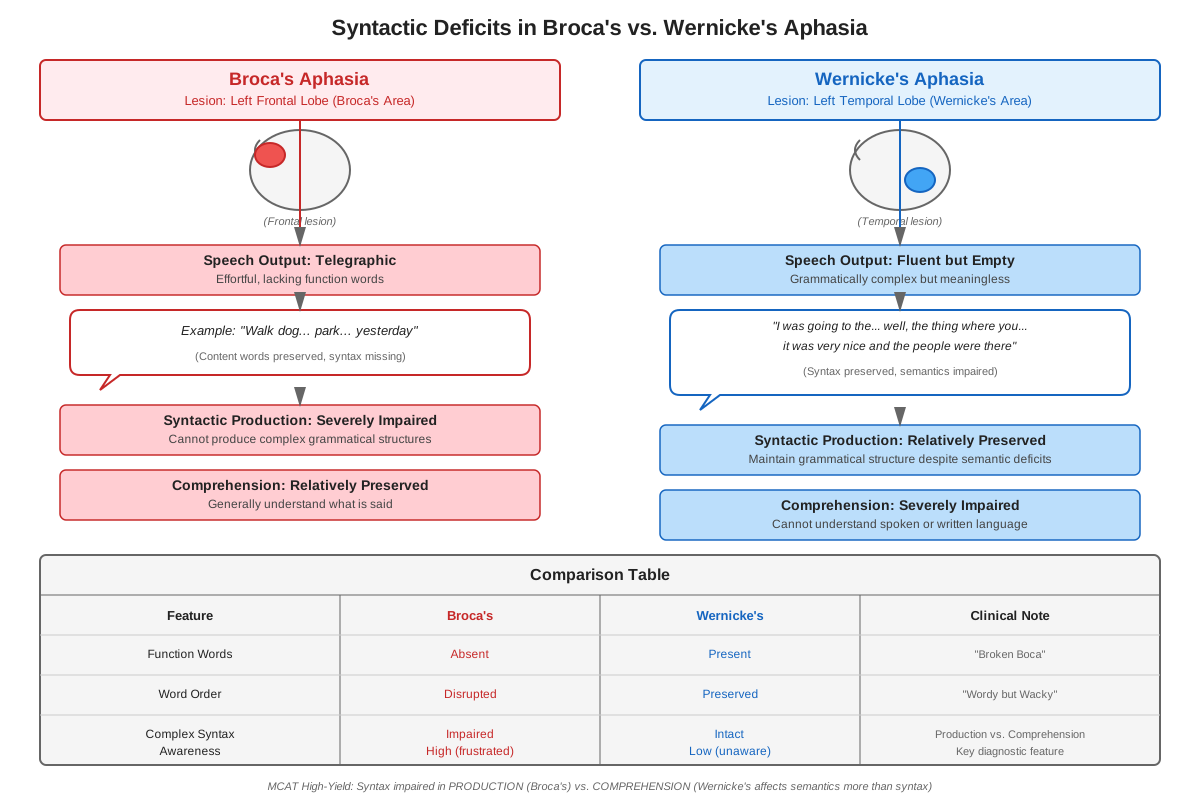
Broca's area (left inferior frontal gyrus) is critically involved in syntactic processing and production. Damage to this region produces Broca's aphasia, characterized by:
- Telegraphic speech lacking grammatical morphemes
- Difficulty producing complex syntactic structures
- Preserved content words but missing function words
- Relatively intact comprehension (though complex syntax may be impaired)
In contrast, Wernicke's area (left superior temporal gyrus) is more involved in semantic processing. Patients with Wernicke's aphasia produce fluent speech with intact syntax but meaningless content. This dissociation demonstrates that syntax and semantics are partially separable cognitive systems with distinct neural substrates.
Syntax in Language Development
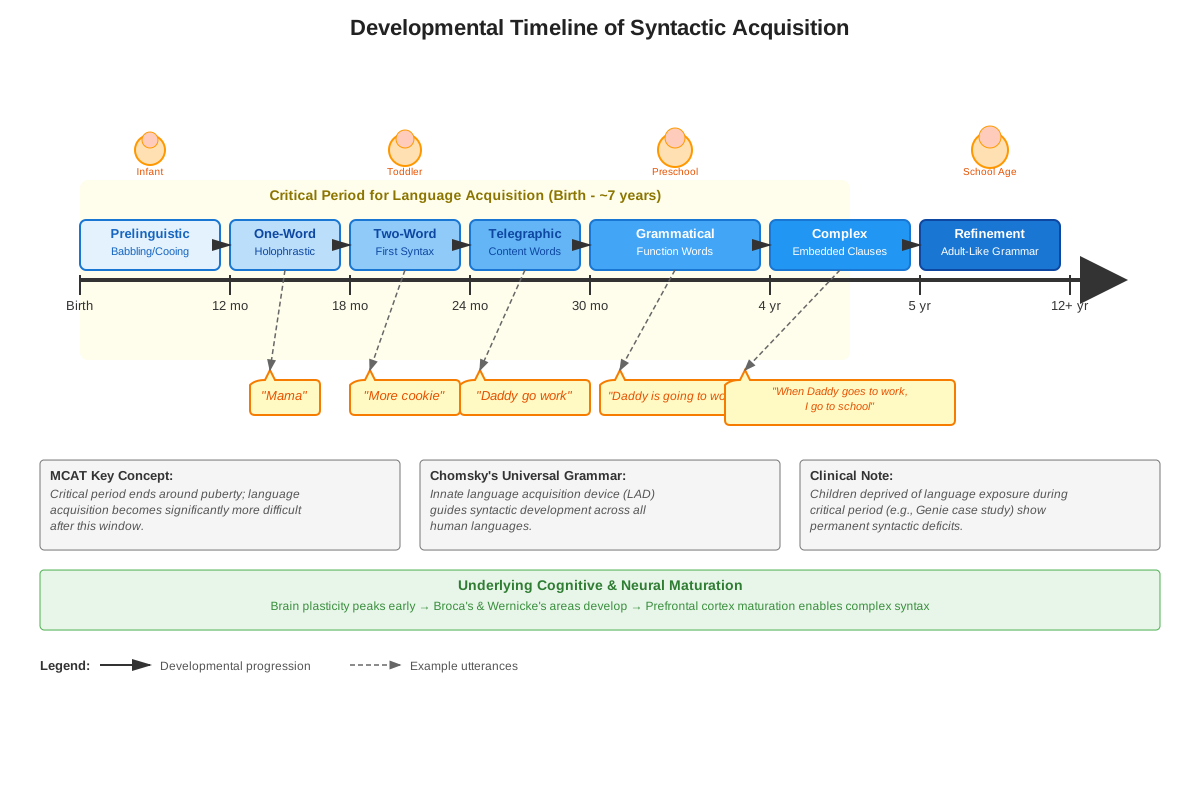
Children acquire syntactic knowledge through predictable developmental stages:
- Holophrastic stage (12-18 months): Single-word utterances
- Two-word stage (18-24 months): Simple combinations like "more juice"
- Telegraphic speech (24-30 months): Multi-word utterances lacking grammatical morphemes
- Grammatical morpheme acquisition (30-36 months): Adding -ing, -ed, plural -s
- Complex syntax (3-5 years): Embedded clauses, passive constructions, complex questions
Noam Chomsky's theory of universal grammar proposes that humans possess an innate language acquisition device (LAD) containing universal syntactic principles. This explains how children acquire complex syntactic rules rapidly with limited input. The critical period hypothesis suggests that syntactic acquisition is most efficient before puberty, after which neural plasticity for language decreases.
Syntax Versus Related Concepts
Understanding syntax requires distinguishing it from related linguistic components:
Syntax vs. Semantics: Syntax concerns structure; semantics concerns meaning. The sentence "Colorless green ideas sleep furiously" is syntactically correct but semantically nonsensical. Conversely, "Dog the chased cat the" has clear semantic content but violates English syntax.
Syntax vs. Pragmatics: Pragmatics involves language use in social context. A syntactically correct sentence like "Can you pass the salt?" is pragmatically a request, not a question about ability.
Syntax vs. Morphology: Morphology studies word structure (prefixes, suffixes, roots), while syntax studies how complete words combine into sentences. However, these interact—morphological markers (like -ed for past tense) provide syntactic information.
Concept Relationships
Syntax connects to multiple psychological domains through intricate relationships. At the foundational level, phonology (sound structure) provides the acoustic input that syntactic processing operates upon. When hearing speech, the brain must first segment the sound stream into words before applying syntactic analysis. This demonstrates the sequential nature of language processing: phonology → morphology → syntax → semantics.
Within cognitive psychology, syntax relates directly to working memory and attention. Processing syntactically complex sentences (particularly those with center-embedded clauses) taxes working memory resources. This connection explains why individuals with limited working memory capacity struggle with complex syntax, and why cognitive load impairs syntactic processing even in healthy adults.
The relationship between syntax and brain lateralization is particularly high-yield for the MCAT. Syntax processing predominantly occurs in the left hemisphere, specifically in Broca's area and surrounding regions. This lateralization connects syntax to broader concepts of hemispheric specialization and demonstrates how specific cognitive functions localize to particular brain regions.
Developmentally, syntax acquisition relates to critical periods and neural plasticity. Children who lack language exposure during critical developmental windows (like feral children or deaf children without sign language exposure) show permanent syntactic deficits. This connects syntax to fundamental principles of developmental neuroscience and demonstrates the importance of environmental input during sensitive periods.
Relationship Map:
Phonological processing → Lexical access → Syntactic parsing → Semantic integration → Pragmatic interpretation
Broca's area damage → Syntactic production deficits → Telegraphic speech → Preserved comprehension (relatively)
Language exposure during critical period → Syntactic rule acquisition → Native-like grammatical competence
Quick check — test yourself on Syntax so far.
Try Flashcards →High-Yield Facts
⭐ Syntax refers to the rules governing sentence structure and word order, distinct from semantics (meaning) and pragmatics (social use)
⭐ Broca's aphasia results from damage to Broca's area and produces telegraphic speech with syntactic deficits but relatively preserved comprehension
⭐ Broca's area (left inferior frontal gyrus) is the primary neural region responsible for syntactic processing and grammatical production
⭐ Children acquire syntax through predictable stages: holophrastic → two-word → telegraphic → grammatical morphemes → complex syntax
⭐ Wernicke's aphasia produces fluent speech with intact syntax but impaired semantics, demonstrating dissociation between these language components
- Syntactic processing occurs automatically and unconsciously in native speakers, as demonstrated by immediate neural responses to grammatical violations
- Universal grammar (Chomsky) proposes that humans possess innate syntactic knowledge that guides language acquisition
- Working memory capacity correlates with ability to process syntactically complex sentences, particularly those with embedded clauses
- The critical period for syntax acquisition extends from infancy through early adolescence, after which syntactic learning becomes significantly more difficult
- Syntactic parsing occurs in real-time during sentence comprehension, with the brain building structural representations incrementally as words are encountered
Common Misconceptions
Misconception: Syntax and grammar are completely different concepts.
Correction: Syntax is a component of grammar. Grammar encompasses all linguistic rules (phonology, morphology, syntax, semantics), while syntax specifically refers to sentence structure rules. On the MCAT, these terms are sometimes used interchangeably when discussing sentence structure.
Misconception: Patients with Broca's aphasia cannot understand language at all.
Correction: Broca's aphasia primarily affects production and syntactic processing. Comprehension is relatively preserved, especially for simple sentences. However, understanding syntactically complex sentences (like passives or embedded clauses) may be impaired because comprehension also requires syntactic processing.
Misconception: Syntax is the same across all languages.
Correction: While Chomsky's universal grammar proposes some universal syntactic principles, specific syntactic rules vary dramatically across languages. Word order (SVO vs. SOV vs. VSO), agreement patterns, and grammatical structures differ. However, all languages have hierarchical syntactic structure.
Misconception: Semantic errors indicate syntactic deficits.
Correction: Semantics and syntax are dissociable. A patient might produce syntactically correct but semantically meaningless sentences (Wernicke's aphasia) or semantically appropriate but syntactically deficient utterances (Broca's aphasia). The MCAT frequently tests this distinction.
Misconception: Children learn syntax primarily through explicit instruction.
Correction: Syntax acquisition occurs largely implicitly through exposure to language. Children extract syntactic patterns from input without explicit teaching, supporting nativist theories of language acquisition. This implicit learning demonstrates the specialized nature of language acquisition mechanisms.
Misconception: Syntax only matters for spoken language.
Correction: Syntax applies equally to signed languages (like ASL), written language, and even some aspects of inner speech. Signed languages have complete syntactic systems that are structurally equivalent to spoken languages, demonstrating that syntax is a property of language itself, not the modality of expression.
Worked Examples
Example 1: Identifying Language Deficits in Clinical Vignettes
Question: A 67-year-old patient suffered a stroke affecting the left inferior frontal gyrus. During assessment, the patient says "Wife... hospital... yesterday" when trying to explain that his wife visited him yesterday. He appears frustrated and aware of his difficulties. His comprehension of simple commands is intact. Which language component is primarily impaired?
Step 1 - Identify the symptoms: The patient produces telegraphic speech (content words only, missing function words and grammatical morphemes), shows awareness of deficits (frustration), and has preserved comprehension.
Step 2 - Localize the lesion: Left inferior frontal gyrus corresponds to Broca's area, which is responsible for syntactic processing and language production.
Step 3 - Match symptoms to syndrome: These characteristics (telegraphic speech, preserved comprehension, awareness, Broca's area damage) indicate Broca's aphasia.
Step 4 - Identify the language component: Broca's aphasia primarily affects syntax—the patient cannot produce grammatically structured sentences. The content (semantics) is appropriate ("wife," "hospital," "yesterday" convey the intended meaning), but the syntactic structure is absent.
Answer: Syntax is primarily impaired. This demonstrates the dissociation between syntactic and semantic processing, a high-yield concept for the MCAT.
Example 2: Developmental Language Acquisition
Question: A researcher observes three children at different developmental stages. Child A (18 months) says "more cookie." Child B (30 months) says "I eating cookie." Child C (4 years) says "I ate the cookie that mommy baked." Which child demonstrates the most advanced syntactic development, and what syntactic feature distinguishes this stage?
Step 1 - Analyze each utterance syntactically:
- Child A: Two-word combination, no grammatical morphemes
- Child B: Multi-word utterance with grammatical morpheme (-ing) but incorrect auxiliary verb usage
- Child C: Complex sentence with embedded relative clause ("that mommy baked")
Step 2 - Map to developmental stages:
- Child A: Two-word stage (18-24 months)
- Child B: Grammatical morpheme acquisition stage (30-36 months)
- Child C: Complex syntax stage (3-5 years)
Step 3 - Identify the distinguishing feature: Child C demonstrates recursive embedding—a clause embedded within another clause. This represents the most sophisticated syntactic ability because it requires understanding hierarchical structure and maintaining multiple syntactic relationships simultaneously.
Step 4 - Connect to broader concepts: This progression demonstrates that syntactic development follows predictable stages and that complex syntactic structures (like relative clauses) emerge later because they require greater cognitive resources and linguistic experience.
Answer: Child C demonstrates the most advanced syntactic development, distinguished by the use of recursive embedding (relative clause). This exemplifies how syntactic complexity increases developmentally and requires sophisticated cognitive processing.
Exam Strategy
Approaching MCAT Questions on Syntax
When encountering syntax questions on the MCAT, first determine whether the question asks about structure (syntax) or meaning (semantics). Many incorrect answer choices deliberately confuse these concepts. Look for keywords that signal syntactic issues: "grammatical structure," "word order," "sentence formation," "telegraphic speech," or "grammatical morphemes."
Exam Tip: If a passage describes a patient producing meaningless but grammatically correct sentences, think Wernicke's aphasia (semantic deficit). If the patient produces meaningful words in incorrect order without grammar, think Broca's aphasia (syntactic deficit).
Trigger Words and Phrases
Watch for these high-yield trigger phrases that indicate syntax is being tested:
- "Grammatical structure"
- "Word order"
- "Sentence formation"
- "Telegraphic speech"
- "Function words" (articles, prepositions, conjunctions)
- "Grammatical morphemes" (-ing, -ed, -s)
- "Broca's area" or "left inferior frontal gyrus"
- "Hierarchical structure"
- "Syntactic parsing"
Process of Elimination Tips
When eliminating answer choices:
- Eliminate semantic answers if the question describes structural problems
- Eliminate phonological answers if the issue isn't about sound production or perception
- Eliminate pragmatic answers if the issue isn't about social language use
- Choose syntax when the problem involves word order, grammatical structure, or telegraphic speech
For aphasia questions, remember this quick decision tree:
- Fluent speech + meaningless content = Wernicke's (semantic)
- Non-fluent speech + telegraphic structure = Broca's (syntactic)
- Both fluent and meaningful but with paraphasias = conduction aphasia (different issue)
Time Allocation
Syntax questions typically require 60-90 seconds. Spend 30 seconds identifying whether the question tests syntax versus other language components, then 30-60 seconds applying your knowledge. Don't overthink—the MCAT tests fundamental distinctions (syntax vs. semantics, Broca's vs. Wernicke's) rather than nuanced linguistic theory.
Memory Techniques
Mnemonic for Language Components
"Some People Speak Properly"
- Semantics (meaning)
- Phonology (sound)
- Syntax (structure)
- Pragmatics (social use)
Mnemonic for Broca's vs. Wernicke's Aphasia
"Broca's is Broken, Wernicke's is Wordy"
- Broca's: Broken speech (telegraphic, non-fluent), Bad production, Broca's area in Back of frontal lobe
- Wernicke's: Wordy but meaningless (fluent but nonsensical), Wernicke's area, Words don't make sense
Visualization Strategy
Visualize syntax as the skeleton of language—it provides structure and support. Semantics is the organs and tissues—it provides meaning and substance. Phonology is the skin—it's the surface form you perceive. Pragmatics is the clothing—it's how language is dressed up for social situations. This metaphor helps distinguish these components and remember that syntax is fundamentally about structure.
Acronym for Syntactic Development Stages
"HoTTy Gets Complex"
- Holophrastic (12-18 months)
- Two-word (18-24 months)
- Telegraphic (24-30 months)
- Grammatical morphemes (30-36 months)
- Complex syntax (3-5 years)
Summary
Syntax represents the structural foundation of language, encompassing the rules and principles that govern how words combine to form grammatically correct sentences. For the MCAT, understanding syntax requires distinguishing it from semantics (meaning), phonology (sound), and pragmatics (social use), while recognizing its neural basis in Broca's area and its role in language disorders like Broca's aphasia. Syntactic processing occurs automatically and unconsciously in native speakers, involving real-time parsing that builds hierarchical representations of sentence structure. Developmentally, children acquire syntax through predictable stages from holophrastic utterances to complex embedded clauses, supporting theories of innate language capacity and critical periods. The MCAT tests syntax primarily through clinical vignettes involving aphasia, developmental scenarios showing language acquisition stages, and questions requiring differentiation between language components. Mastery requires recognizing that syntactic deficits manifest as telegraphic speech with preserved meaning, contrasting with semantic deficits that produce fluent but meaningless utterances. Success on syntax questions depends on quickly identifying whether a scenario involves structural versus meaning-based language problems and applying knowledge of brain-behavior relationships in language processing.
Key Takeaways
- Syntax is the set of rules governing sentence structure and word order, distinct from semantics (meaning), phonology (sound), and pragmatics (social use)
- Broca's area (left inferior frontal gyrus) is the primary neural substrate for syntactic processing; damage produces telegraphic speech with syntactic deficits but relatively preserved comprehension
- Broca's aphasia (syntactic deficit) produces non-fluent, telegraphic speech, while Wernicke's aphasia (semantic deficit) produces fluent but meaningless speech—a critical distinction for MCAT questions
- Syntactic development follows predictable stages from holophrastic utterances through complex embedded clauses, demonstrating both innate language capacity and the importance of critical periods
- MCAT questions test syntax through clinical vignettes (aphasia), developmental scenarios (language acquisition), and questions requiring differentiation between language components
- Working memory capacity correlates with syntactic processing ability, particularly for complex sentences with embedded clauses
- The dissociation between syntax and semantics demonstrates that language comprises separable cognitive systems with distinct neural substrates
Related Topics
Semantics: The study of meaning in language, complementing syntax by focusing on content rather than structure. Understanding semantics enables differentiation between Wernicke's and Broca's aphasia.
Language Acquisition Theories: Including Chomsky's universal grammar, Skinner's behaviorist approach, and social interactionist perspectives. Mastering syntax provides foundation for evaluating these competing theories.
Brain Lateralization: The specialization of language functions in the left hemisphere. Syntax knowledge connects to broader understanding of hemispheric specialization and localization of function.
Aphasia Types: Comprehensive understanding of Broca's, Wernicke's, global, and conduction aphasia. Syntax mastery enables differentiation between these syndromes based on linguistic deficits.
Critical Periods in Development: The time-sensitive windows for optimal learning. Syntax acquisition exemplifies critical period effects and connects to neural plasticity concepts.
Working Memory: The cognitive system for temporary information storage and manipulation. Understanding syntax's relationship to working memory illuminates cognitive constraints on language processing.
Practice CTA
Now that you've mastered the fundamentals of syntax and its role in cognition and consciousness, it's time to solidify your understanding through active practice. Challenge yourself with MCAT-style practice questions that test your ability to distinguish syntax from other language components, identify syntactic deficits in clinical scenarios, and apply developmental principles to language acquisition questions. Use flashcards to reinforce the distinctions between Broca's and Wernicke's aphasia, the stages of syntactic development, and the neural substrates of language processing. Remember: understanding syntax isn't just about memorizing definitions—it's about recognizing how structural language deficits manifest in real clinical and developmental contexts. Your ability to quickly identify syntactic versus semantic issues will directly translate to points on test day. Keep pushing forward—you're building the comprehensive psychology knowledge that will set you apart on the MCAT!
Sign up free to keep reading
Create a free AnvayaPrep account to finish this MCAT guide on Syntax — plus flashcards and practice questions.