Overview
Working memory is a fundamental cognitive system that temporarily holds and manipulates information necessary for complex tasks such as reasoning, comprehension, and learning. Unlike simple short-term memory, which passively stores information for brief periods, working memory actively processes and transforms information while maintaining it in an accessible state. This dynamic system serves as the mental workspace where conscious thought occurs, allowing individuals to hold relevant information in mind while performing cognitive operations on that content.
For the MCAT Psychology section, working memory represents a high-yield topic that appears frequently in both discrete questions and passage-based items. Understanding working memory is essential because it bridges multiple psychological domains: it connects sensory processing to long-term memory formation, underlies executive function and decision-making, and plays a critical role in language comprehension and problem-solving. The MCAT regularly tests working memory through scenarios involving cognitive load, multitasking limitations, age-related cognitive changes, and the neurobiological substrates of memory systems.
Within the broader context of Learning and Memory, working memory occupies a central position in information processing models. It serves as the gateway between sensory memory and long-term memory, determining which information receives sufficient processing to be encoded permanently. Working memory capacity limitations explain why humans can only juggle a finite amount of information simultaneously, and understanding these constraints helps explain phenomena ranging from educational outcomes to clinical conditions like ADHD and dementia. Mastering working memory concepts enables students to understand how information flows through cognitive systems and how various factors enhance or impair this critical mental function.
Learning Objectives
- [ ] Define Working memory using accurate Psychology terminology
- [ ] Explain why Working memory matters for the MCAT
- [ ] Apply Working memory to exam-style questions
- [ ] Identify common mistakes related to Working memory
- [ ] Connect Working memory to related Psychology concepts
- [ ] Differentiate between working memory and short-term memory models
- [ ] Describe the components of Baddeley's working memory model and their functions
- [ ] Analyze how working memory capacity affects cognitive performance and learning
- [ ] Evaluate the neural substrates underlying working memory processes
Prerequisites
- Sensory memory: Understanding how information first enters the memory system through iconic and echoic memory provides the foundation for how working memory receives input
- Attention: Working memory requires selective attention to filter relevant information from sensory input and maintain focus on task-relevant content
- Long-term memory types: Distinguishing between explicit and implicit memory helps clarify how working memory interfaces with permanent storage systems
- Basic neuroanatomy: Familiarity with brain regions, particularly the prefrontal cortex, enables understanding of working memory's biological basis
- Information processing model: Knowledge of the stage model of memory (sensory → short-term → long-term) provides context for working memory's role in cognition
Why This Topic Matters
Working memory has profound clinical and real-world significance across multiple domains. In educational settings, working memory capacity strongly predicts academic achievement, particularly in mathematics and reading comprehension. Students with limited working memory capacity struggle to follow multi-step instructions, solve complex problems, and learn new material efficiently. Clinically, working memory deficits characterize numerous conditions including ADHD, schizophrenia, traumatic brain injury, and age-related cognitive decline. Assessing working memory function helps clinicians diagnose cognitive impairments and track disease progression in conditions like Alzheimer's disease.
On the MCAT, working memory appears in approximately 3-5% of Psychology/Sociology section questions, making it a moderately high-yield topic. Questions typically present in three formats: (1) discrete questions testing definitional knowledge and component identification, (2) passage-based questions requiring application of working memory principles to experimental designs or clinical scenarios, and (3) questions integrating working memory with other cognitive processes like attention, executive function, or learning strategies. The MCAT particularly favors questions that require distinguishing working memory from related constructs or applying capacity limitations to real-world scenarios.
Common exam passage contexts include: research studies manipulating cognitive load, clinical vignettes describing patients with memory complaints, educational interventions designed to reduce working memory demands, neuroimaging studies showing brain activation during working memory tasks, and developmental or aging studies examining how working memory changes across the lifespan. Understanding working memory enables students to analyze these passages effectively and predict how manipulations will affect cognitive performance.
Core Concepts
Definition and Characteristics of Working Memory
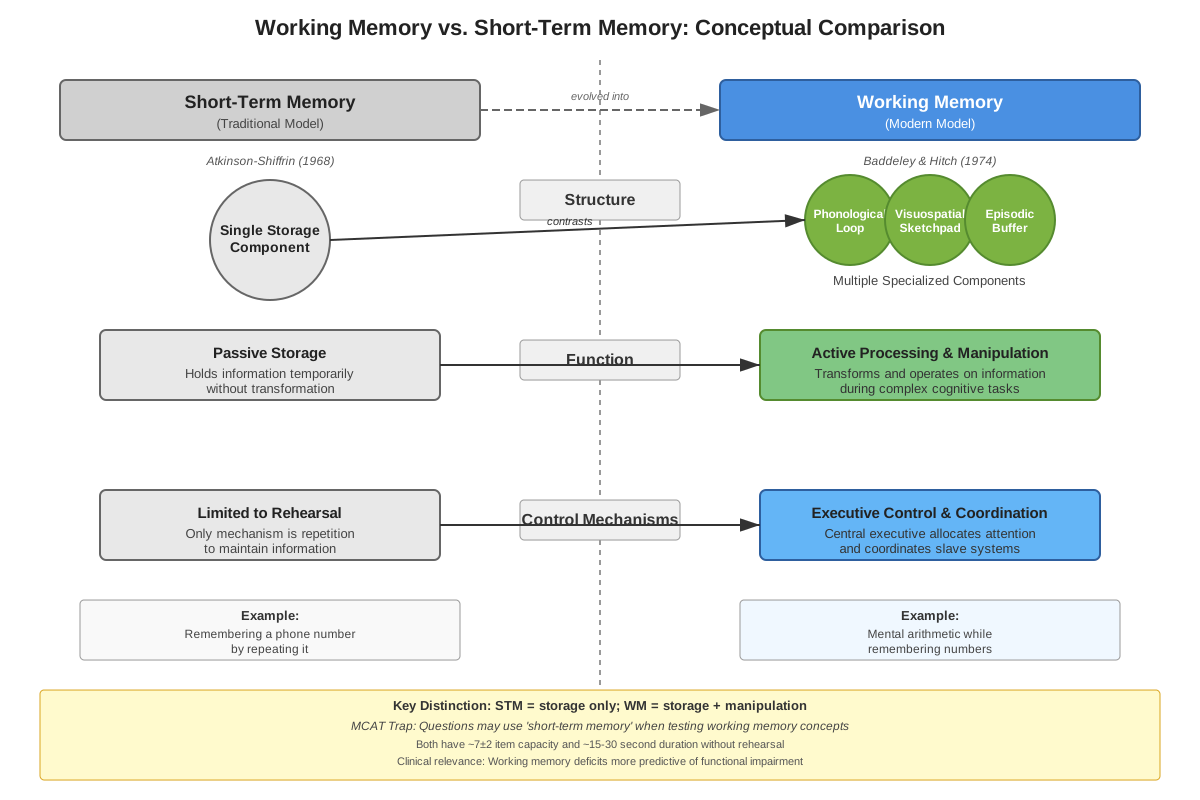
Working memory is defined as a limited-capacity cognitive system responsible for temporarily storing and actively manipulating information needed for ongoing cognitive tasks. This system differs fundamentally from earlier conceptualizations of short-term memory by emphasizing active processing rather than passive storage. While short-term memory simply holds information briefly (typically 15-30 seconds without rehearsal), working memory actively transforms, reorganizes, and operates on that information to support complex cognition.
The key characteristics of working memory include:
- Limited capacity: Typically 7±2 items (Miller's magic number), though more recent research suggests 4±1 chunks for complex information
- Active processing: Information is manipulated, not just maintained
- Temporary storage: Information decays rapidly without active maintenance
- Attention-dependent: Requires conscious focus and executive control
- Domain-specific subsystems: Separate systems handle different types of information (verbal, visual, spatial)
Baddeley's Working Memory Model
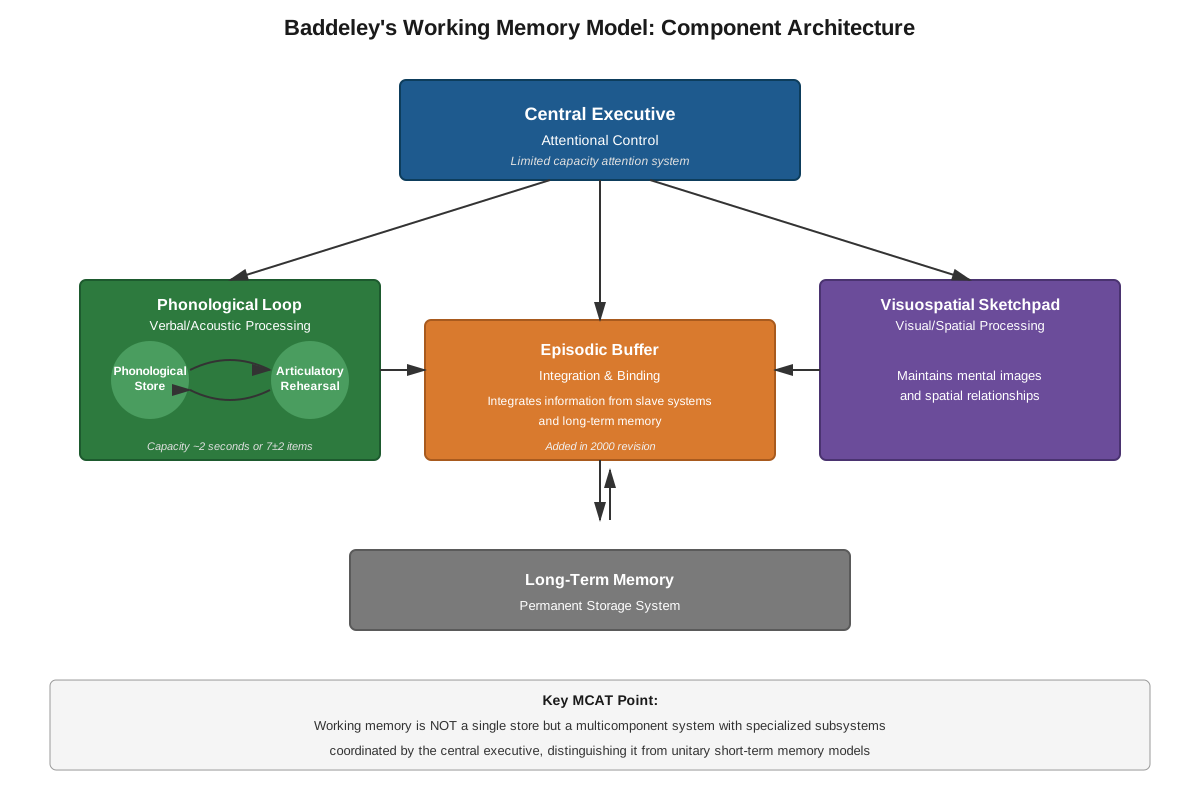
The most influential framework for understanding working memory comes from Alan Baddeley and Graham Hitch (1974), who proposed a multi-component model that has become the standard for Working memory Psychology. This model consists of four primary components:
Central Executive
The central executive serves as the supervisory system that controls attention, coordinates the slave systems, and manages cognitive resources. This component functions as the "boss" of working memory, deciding which information receives processing priority, switching attention between tasks, and inhibiting irrelevant information. The central executive has limited capacity and becomes overwhelmed when cognitive demands exceed available resources. Neurologically, the central executive relies heavily on the prefrontal cortex, particularly the dorsolateral prefrontal cortex.
Phonological Loop
The phonological loop handles verbal and acoustic information through two subcomponents:
- Phonological store: Passively holds speech-based information for 1-2 seconds
- Articulatory rehearsal process: Actively refreshes information through subvocal repetition (inner speech)
The phonological loop explains why people can remember phone numbers by repeating them mentally and why similar-sounding words are harder to remember together (phonological similarity effect). This system has a time-based capacity of approximately 2 seconds of speech, meaning capacity depends on how quickly items can be articulated. The word length effect demonstrates this principle: people remember more short words than long words because more short words fit within the 2-second window.
Visuospatial Sketchpad
The visuospatial sketchpad processes visual and spatial information, serving as the "inner eye" that maintains mental images and spatial relationships. This component allows individuals to visualize objects, navigate mentally through environments, and manipulate visual information. The visuospatial sketchpad operates independently from the phonological loop, enabling simultaneous processing of verbal and visual information without interference. This explains why people can listen to directions while visualizing a route more easily than listening to two verbal messages simultaneously.
Episodic Buffer
Added to the model in 2000, the episodic buffer serves as a limited-capacity temporary storage system that integrates information from the phonological loop, visuospatial sketchpad, and long-term memory into coherent episodes. This component binds together different types of information (verbal, visual, spatial, temporal) into unified representations. The episodic buffer explains how people can remember complex scenes or stories that exceed the capacity of individual subsystems by creating integrated chunks of information.
Working Memory Capacity and Chunking
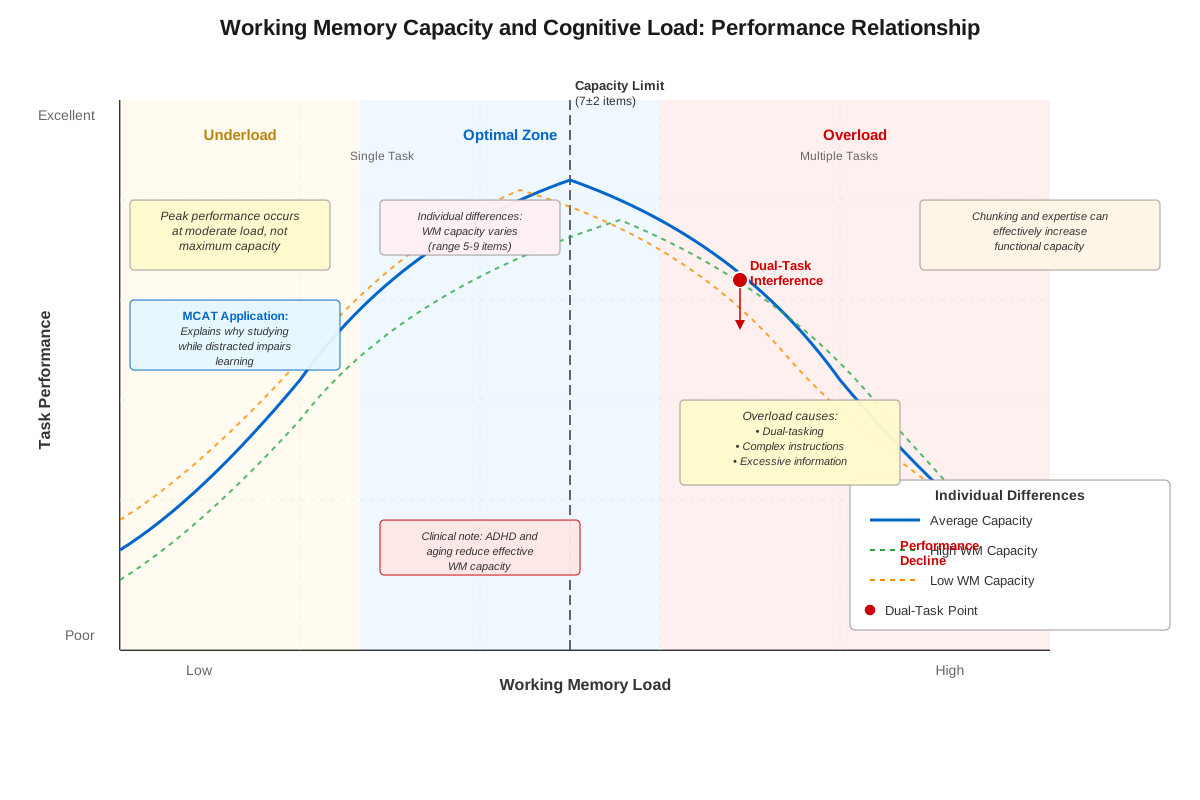
Working memory capacity refers to the amount of information that can be simultaneously maintained and processed. Individual differences in working memory capacity correlate strongly with fluid intelligence, reading comprehension, and academic achievement. Capacity limitations explain why multitasking often impairs performance—the central executive cannot adequately manage multiple demanding tasks simultaneously.
Chunking represents the primary strategy for overcoming capacity limitations by organizing individual items into meaningful units. For example, the letter sequence "FBINSACIAIBM" exceeds typical capacity, but reorganizing it as "FBI NSA CIA IBM" creates four manageable chunks. Expertise in any domain largely reflects the ability to create larger, more efficient chunks. Chess masters, for instance, perceive board positions as meaningful patterns rather than individual pieces, dramatically expanding their effective working memory capacity for chess-related information.
Cognitive Load Theory
Cognitive load theory applies working memory principles to learning and instruction, distinguishing three types of cognitive load:
| Load Type | Definition | Example | Instructional Implication |
|---|---|---|---|
| Intrinsic load | Inherent difficulty of the material | Calculus is more complex than arithmetic | Cannot be reduced; requires prerequisite knowledge |
| Extraneous load | Unnecessary cognitive demands from poor instruction | Confusing diagrams, unclear explanations | Should be minimized through good design |
| Germane load | Productive effort devoted to learning | Creating schemas, making connections | Should be optimized to promote deep learning |
Effective instruction minimizes extraneous load while optimizing germane load without exceeding total working memory capacity. This principle explains why worked examples often facilitate learning better than problem-solving for novices—worked examples reduce cognitive load by eliminating search processes.
Neural Basis of Working Memory
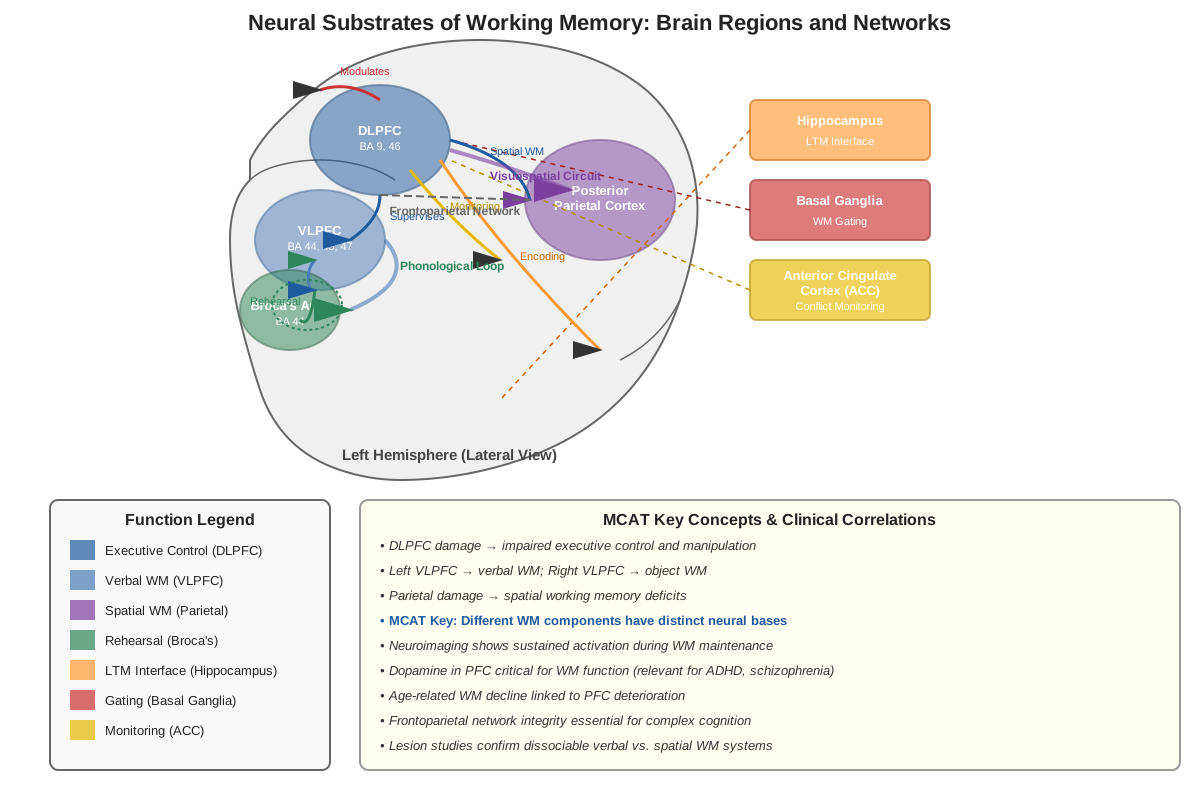
Working memory relies on a distributed neural network, with the prefrontal cortex playing the central role. Different regions support specific functions:
- Dorsolateral prefrontal cortex (DLPFC): Maintains and manipulates information; supports central executive functions
- Ventrolateral prefrontal cortex (VLPFC): Encodes and retrieves information; interfaces with long-term memory
- Posterior parietal cortex: Stores sensory information temporarily; supports visuospatial processing
- Anterior cingulate cortex: Monitors conflicts and errors; supports attention control
Neuroimaging studies consistently show sustained activation in these regions during working memory tasks, with activation levels correlating with task difficulty and individual capacity. The prefrontal cortex shows particularly prolonged development, not fully maturing until the mid-20s, which explains why working memory capacity improves throughout childhood and adolescence.
Working Memory Across the Lifespan
Working memory capacity shows characteristic developmental patterns:
Childhood: Working memory capacity increases steadily from early childhood through adolescence, driven by prefrontal cortex maturation, increased processing speed, and development of more efficient strategies. Young children have dramatically limited capacity (2-3 items), which constrains their learning and problem-solving abilities.
Adulthood: Working memory peaks in early adulthood (ages 20-30) and remains relatively stable through middle age for healthy individuals. Individual differences remain substantial, with capacity predicting performance across numerous cognitive domains.
Aging: Working memory shows significant decline in older adulthood, particularly for tasks requiring manipulation rather than simple maintenance. The central executive appears most vulnerable to age-related decline, while the phonological loop remains relatively preserved. These changes contribute to older adults' difficulties with multitasking, learning new information, and following complex instructions.
Concept Relationships
Working memory occupies a central position in cognitive architecture, serving as the nexus connecting multiple psychological processes. The relationships can be mapped as follows:
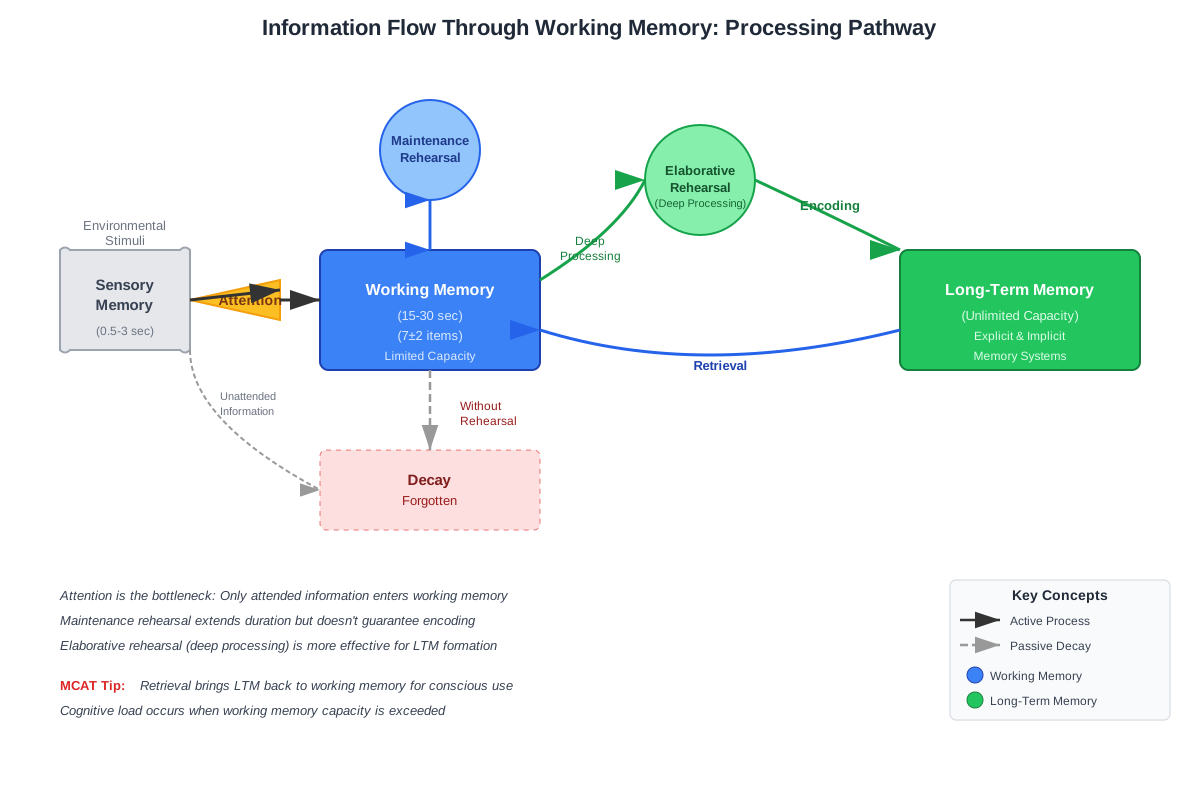
Sensory Memory → Attention → Working Memory → Long-term Memory
This linear flow represents the basic information processing sequence. Sensory memory briefly holds incoming stimuli, attention selects relevant information for further processing, working memory actively processes that information, and successful encoding transfers information to long-term memory. However, the relationship is bidirectional: long-term memory continuously influences working memory by providing schemas, expectations, and retrieval cues that shape how new information is processed.
Working Memory ↔ Executive Functions: Working memory and executive functions are deeply intertwined, with some theorists considering working memory a core executive function. The central executive component directly implements executive control processes including inhibition (suppressing irrelevant information), updating (refreshing working memory contents), and shifting (switching between tasks or mental sets).
Working Memory → Fluid Intelligence: Working memory capacity strongly predicts fluid intelligence (the ability to reason and solve novel problems). This relationship likely reflects shared reliance on prefrontal cortex function and the fact that complex reasoning requires maintaining and manipulating multiple pieces of information simultaneously.
Cognitive Load ← Working Memory Capacity: An individual's working memory capacity determines how much cognitive load they can handle before performance deteriorates. This relationship explains individual differences in learning efficiency and why instructional methods must consider learner capacity.
Chunking → Expanded Working Memory: Chunking strategies effectively increase working memory capacity by reorganizing information into larger units, demonstrating how strategic processing can overcome inherent capacity limitations.
Within the topic itself, the components of Baddeley's model interact continuously: the central executive coordinates the phonological loop and visuospatial sketchpad, while the episodic buffer integrates their outputs with information from long-term memory. These subsystems can operate in parallel without interference when processing different types of information, but compete for central executive resources when both require active manipulation.
Quick check — test yourself on Working memory so far.
Try Flashcards →High-Yield Facts
⭐ Working memory actively processes and manipulates information, distinguishing it from short-term memory which passively stores information
⭐ Baddeley's model includes four components: central executive, phonological loop, visuospatial sketchpad, and episodic buffer
⭐ Working memory capacity is limited to approximately 7±2 items (Miller) or 4±1 chunks for complex information
⭐ The phonological loop demonstrates the word length effect: shorter words are remembered better because more fit within the 2-second rehearsal window
⭐ The dorsolateral prefrontal cortex is the primary neural substrate for working memory, particularly for central executive functions
- The phonological similarity effect shows that similar-sounding items interfere with each other in the phonological loop
- Chunking increases effective working memory capacity by organizing individual items into meaningful units
- Working memory capacity predicts fluid intelligence, reading comprehension, and academic achievement
- Cognitive load theory distinguishes intrinsic, extraneous, and germane load, all of which tax working memory resources
- Working memory capacity increases throughout childhood and adolescence, peaks in early adulthood, and declines in older age
- The visuospatial sketchpad and phonological loop can operate simultaneously without interference because they process different types of information
- Dual-task interference occurs when two tasks compete for the same working memory resources (e.g., two verbal tasks)
- The episodic buffer integrates information from multiple sources into coherent representations
- Working memory deficits characterize ADHD, schizophrenia, and early Alzheimer's disease
- Maintenance rehearsal keeps information in working memory but doesn't necessarily promote long-term encoding
Common Misconceptions
Misconception: Working memory and short-term memory are identical concepts.
Correction: While related, working memory emphasizes active processing and manipulation of information, whereas short-term memory refers primarily to temporary storage. Working memory is a more comprehensive system that includes short-term storage as one component but adds executive control and active processing capabilities.
Misconception: Working memory capacity is fixed and cannot be improved.
Correction: While basic capacity has biological constraints, effective capacity can be enhanced through strategies like chunking, reducing cognitive load, and developing domain expertise. Additionally, working memory training may produce modest improvements, though transfer to unrelated tasks remains controversial.
Misconception: The 7±2 capacity limit applies to all types of information equally.
Correction: The capacity limit depends on the complexity and familiarity of information. Simple, familiar items may approach the upper limit (9 items), while complex, unfamiliar information may be limited to 3-4 items. Chunking and expertise dramatically affect functional capacity.
Misconception: Information automatically transfers from working memory to long-term memory after sufficient time.
Correction: Time alone doesn't ensure encoding into long-term memory. Effective encoding requires elaborative processing, meaningful connections, and attention. Information can remain in working memory indefinitely through maintenance rehearsal without ever being encoded into long-term storage.
Misconception: The phonological loop only processes spoken language.
Correction: The phonological loop processes all verbal information, including written words, which are automatically recoded into phonological form. This explains why reading silently still activates speech-related brain areas and why phonological similarity affects memory for written words.
Misconception: Working memory decline in aging is inevitable and untreatable.
Correction: While some decline is typical, the extent varies greatly among individuals. Cognitive engagement, physical exercise, and strategic training can help maintain working memory function. Additionally, older adults can compensate for reduced capacity through expertise and strategic use of external memory aids.
Misconception: Multitasking improves working memory capacity through practice.
Correction: Multitasking typically impairs performance because it exceeds working memory capacity. While people may become more efficient at switching between specific tasks, this doesn't expand fundamental capacity. The appearance of successful multitasking usually reflects rapid task-switching rather than true simultaneous processing.
Worked Examples
Example 1: Analyzing a Working Memory Experiment
Scenario: Researchers conduct an experiment where participants perform two tasks simultaneously: (1) remembering a sequence of digits while (2) either tapping a spatial pattern or repeating "the, the, the" continuously. Results show that spatial tapping interferes more with digit recall than verbal repetition.
Question: Explain these results using Baddeley's working memory model.
Solution:
Step 1: Identify the working memory components involved in each task.
- Remembering digits primarily engages the phonological loop (verbal information)
- Spatial tapping engages the visuospatial sketchpad (spatial patterns)
- Verbal repetition ("the, the, the") engages the phonological loop (articulatory rehearsal)
Step 2: Predict interference patterns based on the model.
According to Baddeley's model, tasks using the same subsystem should interfere with each other (dual-task interference), while tasks using different subsystems should show minimal interference because they can operate in parallel.
Step 3: Analyze the unexpected result.
The results show spatial tapping interferes MORE with digit memory than verbal repetition, which seems counterintuitive since digits are verbal and spatial tapping is visuospatial.
Step 4: Explain the paradox.
The key is understanding that both tasks require central executive resources for coordination and control. Spatial tapping is a novel, attention-demanding task that heavily taxes the central executive. In contrast, repeating "the, the, the" is automatic and requires minimal executive control. Therefore, spatial tapping interferes with digit memory not because it uses the same storage system, but because it competes for limited central executive resources needed to maintain and rehearse the digits.
Step 5: Connect to learning objectives.
This example demonstrates how working memory components interact, why understanding the multi-component model matters for predicting cognitive performance, and how the central executive serves as a bottleneck that limits multitasking ability even when tasks use different storage systems.
Example 2: Clinical Application of Working Memory Concepts
Scenario: A 68-year-old patient complains of difficulty following conversations in noisy environments and frequently losing track of what she intended to do when moving between rooms. Neuropsychological testing reveals normal long-term memory and language abilities but impaired performance on working memory tasks, particularly those requiring manipulation of information. Brain imaging shows age-appropriate prefrontal cortex atrophy.
Question: Explain how working memory deficits account for this patient's symptoms and what compensatory strategies might help.
Solution:
Step 1: Connect symptoms to working memory functions.
- Following conversations in noise: Requires maintaining previous statements in working memory while processing new incoming speech and filtering out irrelevant background noise—all central executive functions
- Losing track of intentions: Requires maintaining goals in working memory while executing intermediate steps—a prospective memory task dependent on working memory
- Manipulation deficits: Suggests central executive impairment rather than simple storage problems
Step 2: Identify the neural basis.
Prefrontal cortex atrophy directly affects the central executive component of working memory, which relies heavily on dorsolateral prefrontal cortex. This explains why manipulation tasks (requiring executive control) are more impaired than simple storage tasks.
Step 3: Explain the pattern of preserved vs. impaired abilities.
- Preserved: Long-term memory and language suggest intact temporal lobe and language networks
- Impaired: Working memory tasks, especially manipulation, indicate prefrontal dysfunction
- This dissociation is typical of normal aging and early executive dysfunction
Step 4: Recommend evidence-based compensatory strategies.
- Reduce cognitive load: Minimize distractions during conversations; use quiet environments when possible
- External memory aids: Write down intentions immediately; use smartphone reminders
- Chunking strategies: Group information into meaningful units to reduce working memory demands
- Simplify multitasking: Complete one task before starting another rather than switching between tasks
- Structured routines: Reduce working memory demands by automating frequent activities
Step 5: Connect to broader concepts.
This case illustrates how working memory interfaces with real-world functioning, why the central executive is particularly vulnerable to aging and neurological damage, and how understanding working memory components enables targeted interventions. It also demonstrates the clinical relevance of distinguishing working memory from long-term memory systems.
Exam Strategy
Approaching MCAT Questions on Working Memory
Step 1: Identify the question type
- Definitional: Asks for characteristics, components, or distinctions between memory types
- Application: Presents a scenario requiring application of working memory principles
- Experimental: Describes research and asks for interpretation or predictions
Step 2: Activate the Baddeley model
Most Working memory MCAT questions can be answered by systematically considering which component(s) of Baddeley's model are involved. Ask yourself:
- Does this involve verbal information? → Phonological loop
- Does this involve visual/spatial information? → Visuospatial sketchpad
- Does this require coordination or manipulation? → Central executive
- Does this require integrating different types of information? → Episodic buffer
Step 3: Watch for trigger words and phrases
Exam Tip: These phrases signal working memory questions: - "Temporarily maintain and manipulate" - "Limited capacity" - "Active processing" - "Dual-task interference" - "Cognitive load" - "Prefrontal cortex" - "Rehearsal" or "maintenance" - "Chunking"
Step 4: Apply process of elimination strategically
Common wrong answer patterns for working memory questions:
- Confusing working memory with long-term memory: Eliminate answers suggesting permanent storage or unlimited capacity
- Confusing working memory with sensory memory: Eliminate answers suggesting very brief (< 1 second) storage or automatic, pre-attentive processing
- Ignoring capacity limitations: Eliminate answers suggesting unlimited multitasking or processing
- Misidentifying components: Eliminate answers that assign functions to the wrong subsystem (e.g., spatial processing to phonological loop)
Step 5: Consider developmental and clinical contexts
If the question involves age or clinical populations:
- Children: Expect limited capacity, less efficient strategies
- Older adults: Expect central executive decline, preserved phonological loop
- ADHD: Expect central executive deficits, distractibility
- Schizophrenia: Expect working memory impairments, particularly manipulation
Time Allocation Advice
For discrete questions on working memory: 60-75 seconds
- These typically test straightforward definitional knowledge or simple application
- If you know Baddeley's model well, these should be quick points
For passage-based questions: 90-120 seconds per question
- Budget time to understand the experimental design or clinical scenario
- Identify which working memory principles apply before looking at answer choices
- Passage-based questions often require integrating working memory with other concepts (attention, learning, executive function)
Exam Tip: If a question seems to require choosing between working memory and another memory system, focus on the presence or absence of active processing and the time scale involved. Working memory = active processing + seconds to minutes; Long-term memory = storage + minutes to lifetime; Sensory memory = automatic + milliseconds to seconds.
Memory Techniques
Mnemonic for Baddeley's Components
"CEVP" - Central Executive, Visuospatial sketchpad, Phonological loop (plus Episodic buffer added later)
Alternative: "Every Phonological Sketch Centralizes" - Episodic buffer, Phonological loop, Sketchpad (visuospatial), Central executive
Visualization for the Working Memory System
Imagine working memory as a mental workbench:
- The workbench surface = limited workspace (capacity limitation)
- The left hand = phonological loop (handling verbal tools/materials)
- The right hand = visuospatial sketchpad (handling visual/spatial tools/materials)
- The craftsperson = central executive (deciding what to work on, coordinating hands)
- The blueprint = episodic buffer (integrating information into coherent plans)
This metaphor captures the limited capacity (finite workbench space), parallel processing (two hands working simultaneously), executive control (craftsperson making decisions), and integration function (blueprint bringing it all together).
Acronym for Capacity Limitations
"SLIM" - Seven (±2), Limited, Individual differences, Modifiable through chunking
Distinguishing Memory Types
"SAW" helps distinguish the three main memory stages:
- Sensory: Seconds (actually milliseconds-seconds), Sensory-specific, Small processing
- Active (Working): Active processing, Attention-dependent, About 7 items
- Warehouse (Long-term): Weeks to lifetime, Wide capacity, Well-organized
Remembering Cognitive Load Types
"I'm Extra German" = Intrinsic, Extraneous, Germane
Or remember: Inherent difficulty, Eliminate unnecessary load, Good productive effort
Summary
Working memory represents a limited-capacity cognitive system that temporarily maintains and actively manipulates information necessary for complex cognitive tasks. Unlike passive short-term storage, working memory emphasizes active processing through multiple specialized components. Baddeley's influential model describes four components: the central executive (supervisory control system), phonological loop (verbal/acoustic processing), visuospatial sketchpad (visual/spatial processing), and episodic buffer (integration of information). Working memory capacity is limited to approximately 4-7 chunks of information, though chunking strategies can effectively expand functional capacity. The prefrontal cortex, particularly the dorsolateral region, provides the primary neural substrate for working memory functions. Individual differences in working memory capacity predict fluid intelligence, academic achievement, and real-world cognitive performance. Working memory shows characteristic developmental patterns, increasing throughout childhood, peaking in early adulthood, and declining with aging, particularly for executive functions. Understanding working memory is essential for the MCAT because it connects multiple psychological domains, appears frequently in exam questions, and provides a framework for understanding cognitive limitations, learning processes, and clinical conditions affecting cognition.
Key Takeaways
- Working memory actively processes information, distinguishing it from passive short-term storage through manipulation and transformation of content
- Baddeley's four-component model (central executive, phonological loop, visuospatial sketchpad, episodic buffer) provides the standard framework for understanding working memory organization
- Capacity limitations (7±2 items or 4±1 chunks) represent a fundamental constraint on human cognition that affects learning, problem-solving, and multitasking
- The central executive serves as the supervisory system controlling attention and coordinating subsystems, relying primarily on prefrontal cortex function
- Dual-task interference occurs when tasks compete for the same working memory resources, while tasks using different subsystems can proceed in parallel
- Chunking strategies overcome capacity limitations by organizing individual items into meaningful units, with expertise enabling larger, more efficient chunks
- Working memory deficits characterize numerous clinical conditions and normal aging, particularly affecting central executive functions while phonological loop remains relatively preserved
Related Topics
Executive Functions: Working memory serves as a core executive function alongside inhibition and cognitive flexibility. Mastering working memory enables deeper understanding of how the prefrontal cortex coordinates complex goal-directed behavior and how executive dysfunction manifests in clinical populations.
Long-term Memory Encoding: Working memory serves as the gateway to long-term memory, with elaborative processing in working memory determining encoding success. Understanding this relationship clarifies how learning strategies like spacing and elaboration enhance retention.
Attention: Working memory and attention are intimately connected, with attention determining what enters working memory and working memory maintaining attention on task-relevant information. This relationship explains phenomena like change blindness and inattentional blindness.
Cognitive Development: Working memory capacity increases throughout childhood and adolescence, driving improvements in reasoning, learning, and academic achievement. Understanding this developmental trajectory clarifies age-appropriate expectations and educational practices.
Intelligence and Individual Differences: Working memory capacity correlates strongly with fluid intelligence and predicts performance across cognitive domains. This relationship provides insight into the nature of intelligence and sources of individual differences in cognitive ability.
Neuropsychological Assessment: Working memory tasks form a core component of neuropsychological test batteries used to diagnose cognitive impairments. Understanding working memory enables interpretation of clinical assessments and differential diagnosis.
Practice CTA
Now that you've mastered the core concepts of working memory, it's time to solidify your understanding through active practice. Challenge yourself with MCAT-style practice questions that require applying these concepts to novel scenarios—this is where true mastery develops. Use flashcards to drill the high-yield facts, particularly the components of Baddeley's model and their functions, until you can recall them instantly under test conditions. Remember: working memory itself has limited capacity, so distributed practice across multiple study sessions will serve you better than marathon cramming sessions. Your investment in understanding this foundational topic will pay dividends not only on working memory questions but across the entire Psychology section, as working memory principles appear in contexts ranging from cognitive development to clinical disorders. You've got this—now prove it through practice!
Sign up free to keep reading
Create a free AnvayaPrep account to finish this MCAT guide on Working memory — plus flashcards and practice questions.