Overview
Vygotsky theory represents one of the most influential frameworks in developmental psychology, offering a sociocultural perspective on how children acquire knowledge and cognitive skills. Developed by Russian psychologist Lev Vygotsky in the early 20th century, this theory fundamentally differs from other developmental approaches by emphasizing the critical role of social interaction, cultural tools, and language in cognitive development. Unlike Piaget's theory, which views the child as a solitary scientist constructing knowledge independently, Vygotsky theory Psychology positions learning as an inherently social process where more knowledgeable others guide cognitive growth through collaborative activities.
For the MCAT, understanding Vygotsky's framework is essential because it appears frequently in passages examining child development, educational psychology, and social influences on cognition. The exam tests not only definitional knowledge but also the ability to apply Vygotskian concepts to novel scenarios involving teaching methods, cultural differences in learning, and the relationship between language and thought. Questions may present research studies comparing different instructional approaches or clinical vignettes describing children's problem-solving behaviors in social contexts.
Vygotsky theory MCAT content connects to broader themes in Development and Personality and Psychology, including theories of cognitive development, social psychology, language acquisition, and cultural influences on behavior. This theory provides a counterpoint to stage-based developmental models and introduces concepts that explain individual differences in learning trajectories based on social and cultural factors. Mastering Vygotsky's principles enables students to analyze how environmental contexts shape psychological processes—a recurring theme across multiple MCAT psychology topics.
Learning Objectives
- [ ] Define Vygotsky theory using accurate Psychology terminology
- [ ] Explain why Vygotsky theory matters for the MCAT
- [ ] Apply Vygotsky theory to exam-style questions
- [ ] Identify common mistakes related to Vygotsky theory
- [ ] Connect Vygotsky theory to related Psychology concepts
- [ ] Distinguish between the Zone of Proximal Development and actual developmental level
- [ ] Compare and contrast Vygotsky's sociocultural approach with Piaget's constructivist theory
- [ ] Analyze how scaffolding facilitates learning within the Zone of Proximal Development
Prerequisites
- Piaget's stages of cognitive development: Understanding Piaget's theory provides essential context for appreciating how Vygotsky's approach differs in emphasizing social factors over individual construction
- Basic developmental psychology terminology: Familiarity with terms like cognitive development, maturation, and learning enables comprehension of Vygotsky's specialized vocabulary
- Social psychology fundamentals: Knowledge of social influence and group dynamics helps contextualize how others shape individual cognitive growth
- Language development basics: Understanding typical language acquisition patterns is necessary for grasping Vygotsky's claims about language's role in thought
Why This Topic Matters
Vygotsky theory has profound real-world applications in educational settings, clinical interventions, and cross-cultural psychology. Educators use Vygotskian principles to design effective instructional strategies, such as peer tutoring, collaborative learning, and differentiated instruction tailored to students' developmental levels. Clinicians apply these concepts when assessing developmental delays, designing therapeutic interventions, and understanding how cultural contexts influence psychological assessment. The theory also explains why children from different cultural backgrounds may demonstrate varying cognitive skills—not due to inherent ability differences but because of different cultural tools and social practices.
On the MCAT, Vygotsky-related content appears in approximately 5-8% of psychology passages, particularly in questions addressing developmental psychology, educational psychology, and sociocultural influences on behavior. The exam frequently presents research passages comparing teaching methods, describing children's problem-solving in social versus solitary contexts, or examining cultural variations in cognitive development. Questions may ask students to identify which theoretical framework best explains observed phenomena, predict outcomes based on Vygotskian principles, or critique research designs from a sociocultural perspective.
Common question formats include: identifying examples of scaffolding or the Zone of Proximal Development in vignettes; distinguishing between Vygotsky's and Piaget's predictions about specific developmental scenarios; analyzing how cultural tools mediate cognitive processes; and evaluating the effectiveness of educational interventions based on sociocultural principles. Understanding this theory is also crucial for interdisciplinary passages that integrate developmental psychology with sociology, anthropology, or education research.
Core Concepts
Sociocultural Theory of Cognitive Development
Vygotsky theory fundamentally proposes that cognitive development results from social interactions within a cultural context. Unlike theories emphasizing biological maturation or individual exploration, Vygotsky argued that higher mental functions originate in social relationships and are mediated by cultural tools, particularly language. This sociocultural approach views development as the transformation of socially shared activities into internalized mental processes.
The theory rests on three foundational principles: (1) cognitive development varies across cultures because different societies provide different tools and social practices; (2) learning precedes development, meaning social instruction can pull cognitive abilities forward; and (3) language serves as the primary tool for cognitive development, transforming thought processes as children internalize speech patterns.
Zone of Proximal Development (ZPD)
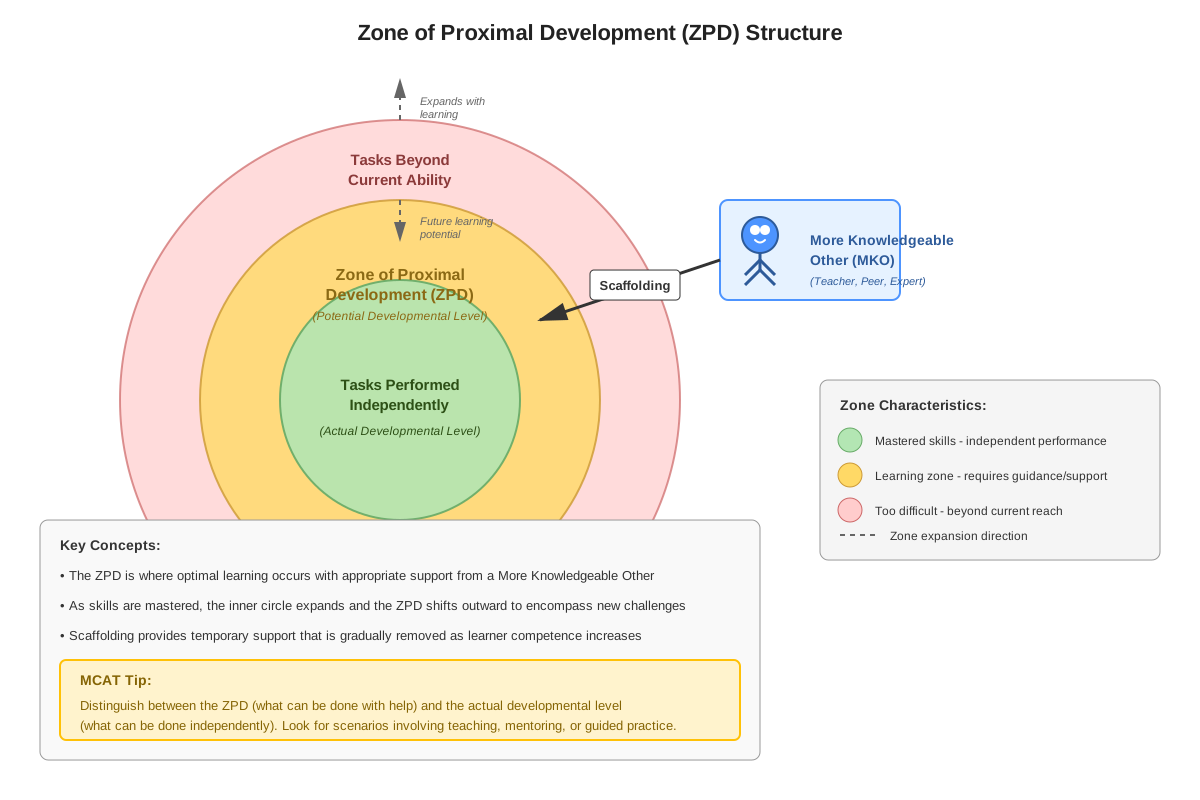
The Zone of Proximal Development represents Vygotsky's most influential concept—the distance between what a learner can accomplish independently (actual developmental level) and what they can achieve with guidance from a more knowledgeable other (potential developmental level). This zone represents the optimal target for instruction because tasks within it are challenging enough to promote growth but not so difficult as to be frustrating.
Three developmental levels define this framework:
- Tasks below the ZPD: Activities the child can complete independently without assistance
- Tasks within the ZPD: Activities the child can complete with guidance, representing the "sweet spot" for learning
- Tasks above the ZPD: Activities too difficult even with assistance, requiring further development before attempting
The ZPD is dynamic and constantly shifting as the child masters new skills. What requires assistance today becomes independent performance tomorrow, and the zone advances to encompass new, more complex challenges. This concept explains why effective instruction must be individualized—each learner has a unique ZPD based on their current abilities and experiences.
Scaffolding
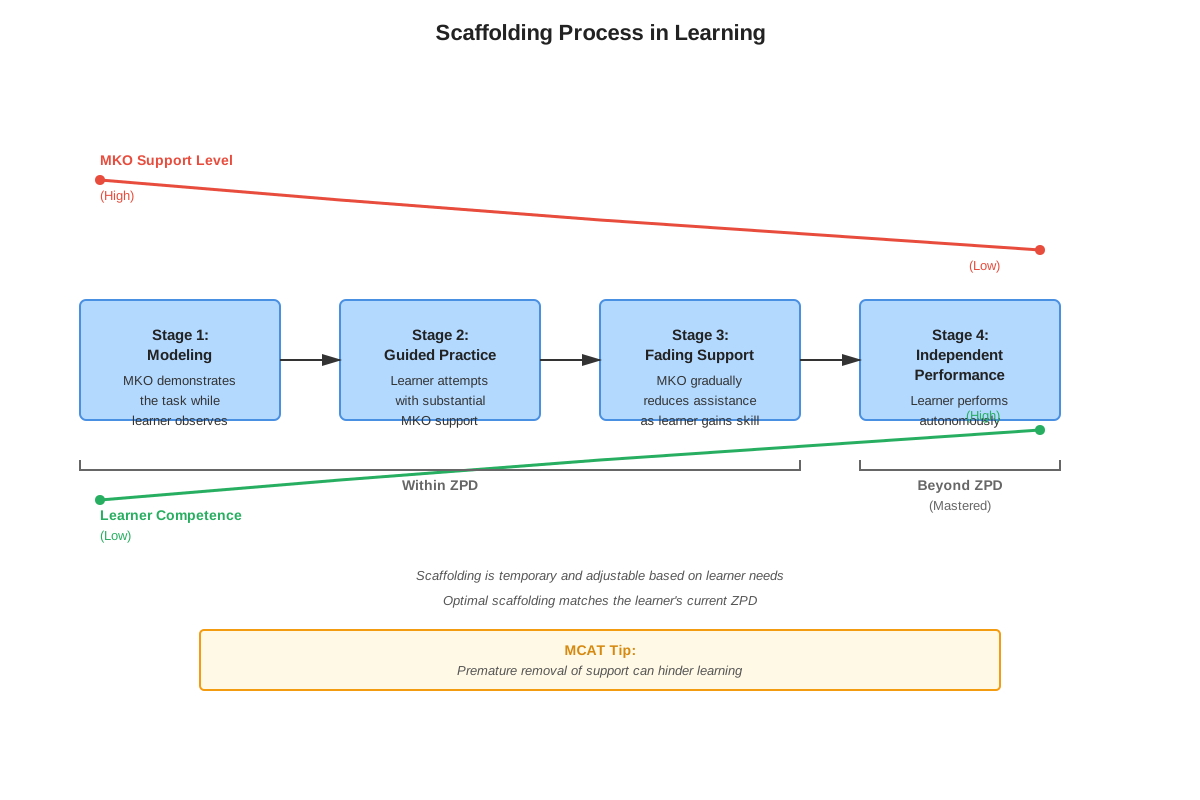
Scaffolding describes the temporary support provided by a more knowledgeable other (teacher, parent, peer, or expert) to help a learner accomplish tasks within their Zone of Proximal Development. Like construction scaffolding that supports workers at heights they couldn't otherwise reach, instructional scaffolding enables learners to perform at levels beyond their independent capabilities.
Effective scaffolding has several characteristics:
- Graduated support: Assistance is substantial initially and gradually withdrawn as competence increases
- Contingent responsiveness: Support adjusts dynamically based on the learner's performance
- Temporary nature: The goal is always to remove support once independence is achieved
- Just-right challenge: Tasks are calibrated to be achievable with current support levels
Examples of scaffolding techniques include breaking complex tasks into manageable steps, providing hints rather than answers, modeling problem-solving strategies, asking guiding questions, and offering encouragement. The process follows a pattern: the expert demonstrates, the learner attempts with support, support gradually decreases, and finally the learner performs independently.
More Knowledgeable Other (MKO)
The More Knowledgeable Other refers to anyone with greater understanding or skill in a particular domain—not necessarily an adult or teacher. The MKO could be a peer, older sibling, coach, or even technology (like educational software). What matters is relative expertise in the specific skill being learned.
This concept challenges traditional hierarchical views of education by recognizing that expertise is domain-specific and contextual. A child might serve as the MKO for a peer in mathematics while simultaneously being the learner in a social skills context. This reciprocal nature of teaching and learning roles aligns with Vygotsky's emphasis on social interaction as the engine of development.
Cultural Tools and Mediation
Vygotsky distinguished between elementary mental functions (basic biological capacities like sensation and attention) and higher mental functions (complex cognitive abilities like abstract thinking and self-regulation). The transformation from elementary to higher functions occurs through mediation—the use of cultural tools that reshape cognitive processes.
Cultural tools include both physical tools (writing systems, calculators, maps) and psychological tools (language, number systems, mnemonic strategies, symbols). These tools don't just help us think; they fundamentally change how we think. For example, literacy doesn't merely allow information storage—it transforms memory, attention, and reasoning processes.
Language represents the most important cultural tool because it serves multiple functions:
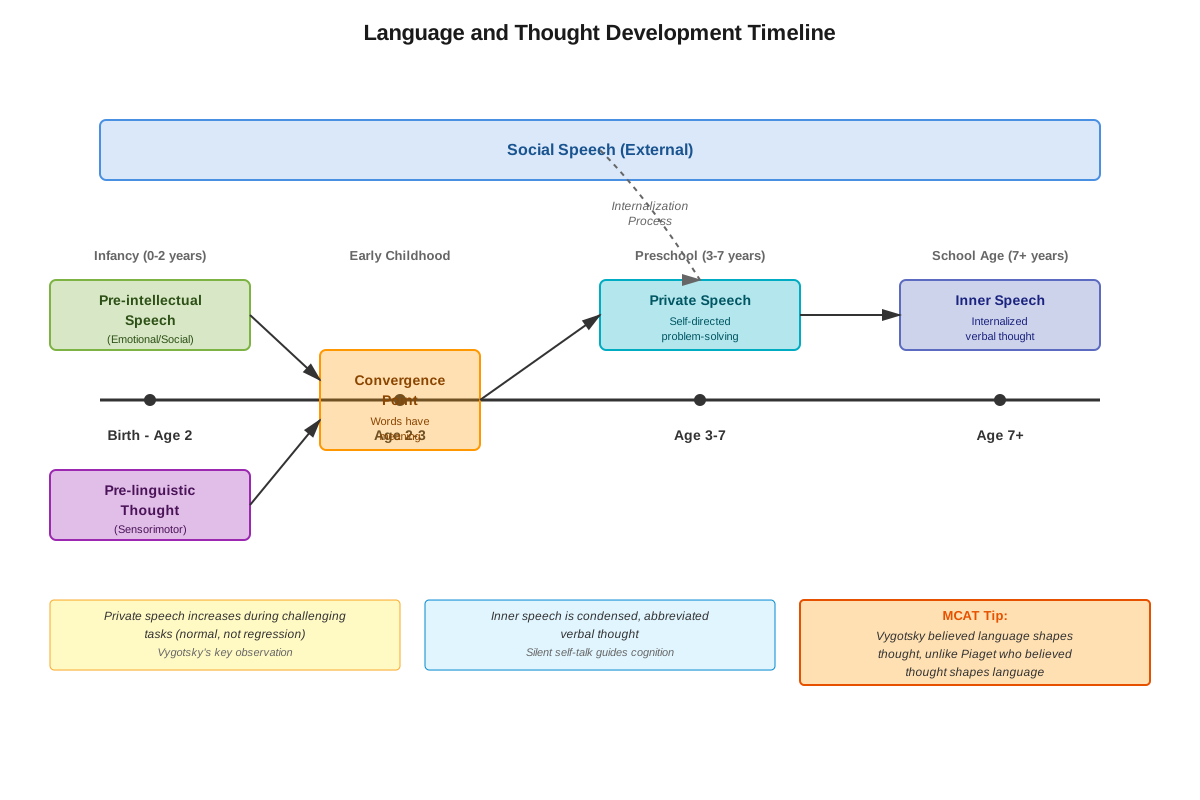
- Social speech (external communication with others)
- Private speech (self-directed speech that guides behavior)
- Inner speech (internalized verbal thought)
Private Speech and Internalization
Private speech—children's self-directed talking during activities—exemplifies Vygotsky's internalization process. Young children frequently talk themselves through tasks, using language to guide their actions and regulate behavior. Vygotsky viewed this not as immature egocentrism (as Piaget suggested) but as a crucial developmental mechanism.
The developmental progression follows this pattern:
- Social speech: Communication with others (early childhood)
- Private speech: Audible self-talk during problem-solving (peaks around ages 3-7)
- Inner speech: Silent verbal thought (emerges in middle childhood)
Private speech increases when tasks become challenging, demonstrating its functional role in cognitive self-regulation. As children master skills, private speech becomes abbreviated, whispered, and eventually internalized as silent inner speech. This internalization process transforms socially learned strategies into individual cognitive tools.
Comparison with Piaget's Theory
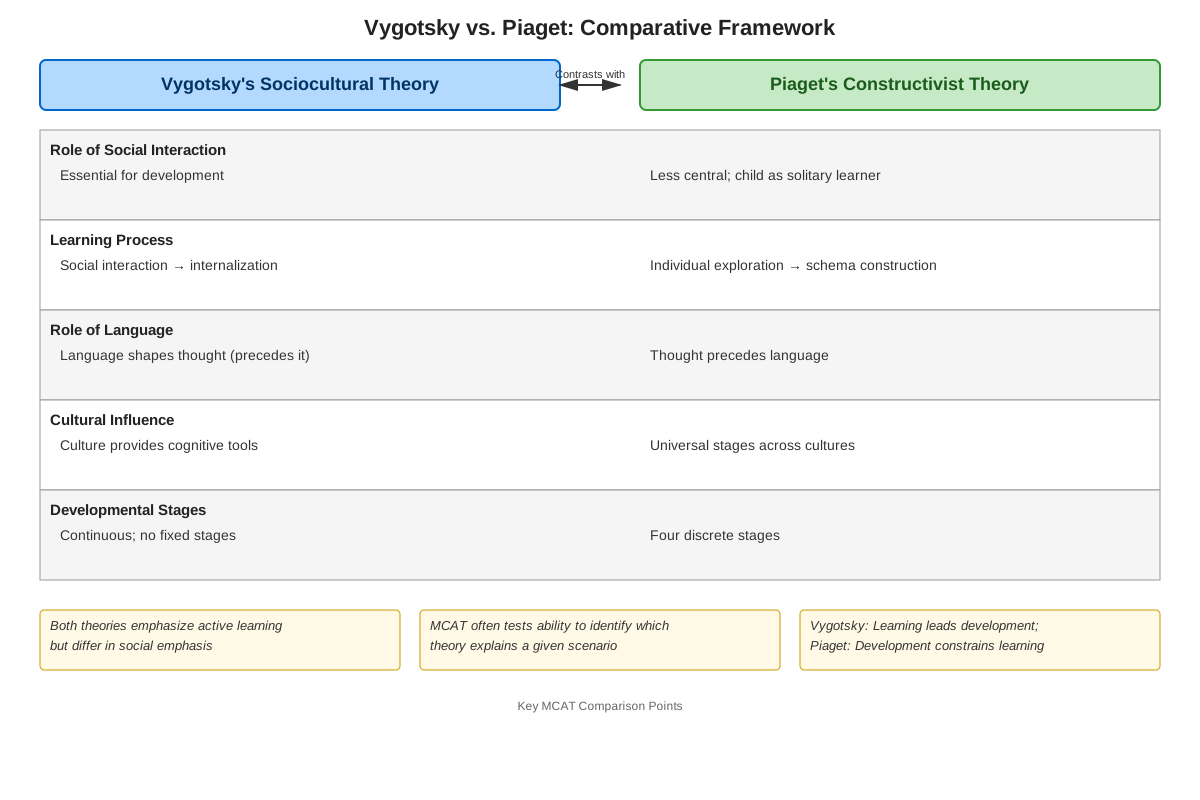
Understanding how Vygotsky's approach differs from Piaget's theory is crucial for MCAT success:
| Aspect | Piaget | Vygotsky |
|---|---|---|
| Primary mechanism | Individual exploration and discovery | Social interaction and instruction |
| Role of language | Reflects existing thought | Transforms and creates thought |
| Development vs. learning | Development precedes learning | Learning precedes development |
| Private speech | Egocentric and immature | Functional self-regulation tool |
| Cultural influence | Minimal; universal stages | Central; development varies by culture |
| Optimal instruction | Match to developmental stage | Target the Zone of Proximal Development |
| Social interaction | Can interfere with learning | Essential for learning |
Both theorists agreed that children actively construct knowledge, but they disagreed fundamentally about the role of social and cultural factors in this construction process.
Concept Relationships
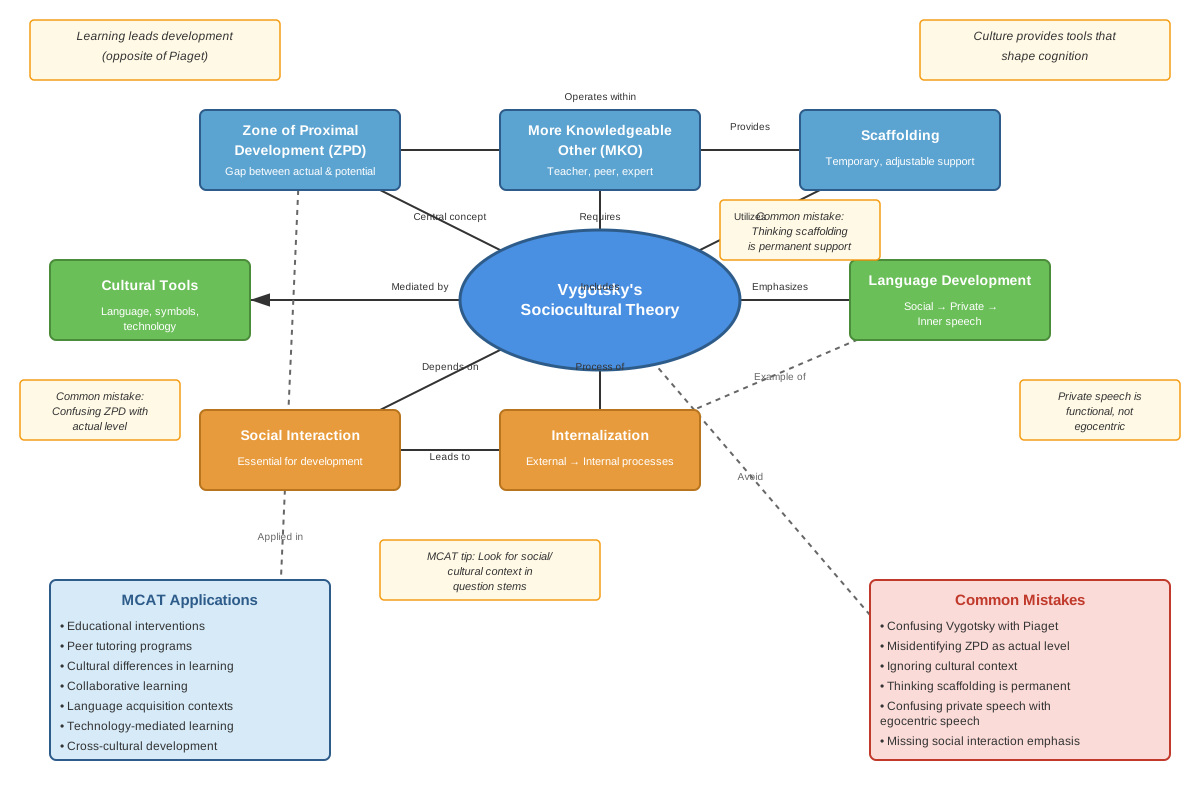
The core concepts within Vygotsky theory form an interconnected system where each element supports and depends on others. The Zone of Proximal Development serves as the central organizing principle, defining where learning optimally occurs. Scaffolding represents the mechanism through which More Knowledgeable Others facilitate learning within this zone. Cultural tools, especially language, mediate this learning process, with private speech exemplifying how external social interactions become internalized cognitive functions.
The relationship flows as follows: Cultural context provides tools and practices → More Knowledgeable Others use these tools to provide scaffolding → Scaffolding enables learners to perform within their ZPD → Successful performance with support leads to internalization → Internalized processes become independent capabilities → The ZPD shifts upward to encompass new challenges.
Connections to prerequisite knowledge include contrasts with Piaget's theory (highlighting different assumptions about development), links to social psychology (explaining how social influence shapes cognition), and relationships to language development (showing how linguistic abilities transform thought). The theory also connects forward to topics like social learning theory (Bandura), attachment theory (explaining caregiver roles in development), and cultural psychology (examining how culture shapes psychological processes).
Quick check — test yourself on Vygotsky theory so far.
Try Flashcards →High-Yield Facts
⭐ The Zone of Proximal Development is the gap between independent performance and performance with guidance, representing the optimal target for instruction
⭐ Scaffolding is temporary, adjustable support that is gradually withdrawn as learner competence increases
⭐ Vygotsky believed learning precedes development, whereas Piaget believed development precedes learning
⭐ Private speech (self-directed talking) serves a functional role in self-regulation and problem-solving, eventually becoming internalized as inner speech
⭐ Cultural tools, especially language, mediate cognitive development and transform elementary mental functions into higher mental functions
- The More Knowledgeable Other can be anyone with greater expertise in a specific domain, including peers, not just adults or teachers
- Vygotsky's theory emphasizes cultural variation in cognitive development, whereas Piaget proposed universal stages
- Effective instruction should target the ZPD—tasks that are challenging but achievable with support
- Social interaction is essential for cognitive development in Vygotsky's framework, not merely helpful
- Internalization is the process by which external social activities become internal mental processes
- Vygotsky viewed cognitive development as continuous rather than stage-based
- Language development and cognitive development are deeply intertwined, with language transforming thought processes
Common Misconceptions
Misconception: The Zone of Proximal Development is a fixed characteristic of a child at a particular age.
Correction: The ZPD is dynamic and domain-specific, constantly shifting as the child develops and varying across different skill areas. A child might have a wide ZPD in language but a narrow ZPD in mathematical reasoning.
Misconception: Scaffolding means doing the task for the learner or making it easier.
Correction: Scaffolding involves providing strategic support that enables the learner to accomplish the authentic task, not simplifying the task itself. The goal is to maintain appropriate challenge while offering just enough support for success.
Misconception: Vygotsky and Piaget had completely opposite theories with no common ground.
Correction: Both theorists agreed that children actively construct knowledge and that development involves qualitative changes in thinking. They differed primarily on the role of social interaction and whether development or learning comes first.
Misconception: Private speech indicates developmental immaturity or cognitive problems.
Correction: Private speech is a normal, functional aspect of cognitive development that helps children regulate behavior and solve problems. Its presence during challenging tasks demonstrates healthy self-regulation development.
Misconception: The More Knowledgeable Other must be significantly more advanced than the learner.
Correction: The MKO needs only slightly more expertise in the specific skill being learned. Peer tutoring can be highly effective because the peer's recent mastery provides relevant insights into the learning process.
Misconception: Vygotsky's theory only applies to childhood development.
Correction: While Vygotsky focused on child development, his principles apply across the lifespan. Adults learning new skills also benefit from scaffolding, operate within zones of proximal development, and internalize socially learned strategies.
Misconception: Cultural tools are only physical objects like books or computers.
Correction: Cultural tools include psychological tools like language, number systems, memory strategies, and symbolic systems. These psychological tools are actually more central to Vygotsky's theory than physical tools.
Worked Examples
Example 1: Identifying the Zone of Proximal Development
Vignette: A researcher observes 5-year-old Emma attempting three puzzle types. With 10-piece puzzles, Emma completes them quickly without help. With 25-piece puzzles, Emma struggles initially but succeeds when her mother asks guiding questions like "What pieces have straight edges?" and "Which colors match?" With 50-piece puzzles, Emma becomes frustrated and cannot complete them even with extensive help.
Question: Which puzzle type represents Emma's Zone of Proximal Development?
Analysis:
- Step 1: Identify what Emma can do independently. The 10-piece puzzles represent tasks below her ZPD—she has already mastered this level.
- Step 2: Identify what Emma can accomplish with guidance. The 25-piece puzzles fall within her ZPD because she cannot complete them alone but succeeds with scaffolding from her mother.
- Step 3: Identify what remains too difficult even with support. The 50-piece puzzles exceed her ZPD—they require cognitive abilities she hasn't yet developed.
Answer: The 25-piece puzzles represent Emma's ZPD. This is the optimal level for promoting her cognitive development because it provides appropriate challenge while remaining achievable with support.
Connection to learning objectives: This example demonstrates how to apply Vygotsky theory to identify the ZPD in practical scenarios, a common MCAT question format. It also illustrates the three-level framework (below ZPD, within ZPD, above ZPD) essential for distinguishing appropriate instructional targets.
Example 2: Distinguishing Vygotsky from Piaget
Vignette: Researchers compare two preschool programs. Program A allows children to explore materials freely, intervening only when children show readiness for new concepts. Program B pairs children with slightly older peers who demonstrate skills and provide guidance during activities. After one year, Program B children show greater gains in problem-solving abilities.
Question: Which theoretical framework best explains Program B's superior outcomes?
Analysis:
- Step 1: Identify Program A's theoretical basis. The emphasis on individual exploration, waiting for readiness, and minimal adult intervention reflects Piaget's constructivist approach, where development must precede learning.
- Step 2: Identify Program B's theoretical basis. The use of more knowledgeable others (older peers), guided instruction, and social interaction reflects Vygotsky's sociocultural approach, where learning can pull development forward.
- Step 3: Connect outcomes to theory. Program B's superior results align with Vygotsky's prediction that appropriately scaffolded social learning accelerates cognitive development beyond what individual exploration achieves.
Answer: Vygotsky's sociocultural theory best explains Program B's outcomes. The program's structure—pairing children with more knowledgeable peers who provide scaffolding—directly applies Vygotskian principles. The superior results support Vygotsky's claim that learning precedes development when instruction targets the ZPD.
Connection to learning objectives: This example requires comparing theoretical frameworks, identifying which theory predicts specific outcomes, and applying concepts like scaffolding and the More Knowledgeable Other to evaluate educational interventions—all high-yield MCAT skills.
Exam Strategy
When approaching MCAT questions on Vygotsky theory, first identify whether the question asks about mechanisms (how development occurs), predictions (what outcomes to expect), or comparisons (distinguishing from other theories). Trigger words that signal Vygotskian content include "social interaction," "guidance," "cultural context," "scaffolding," "zone of proximal," and "more knowledgeable other."
Exam Tip: If a passage describes children performing better with assistance than alone, immediately think Zone of Proximal Development. If it describes gradually reducing support, think scaffolding.
For comparison questions contrasting Vygotsky with Piaget, create a mental checklist:
- Does the scenario emphasize social interaction? → Vygotsky
- Does it emphasize individual exploration? → Piaget
- Does instruction precede ability? → Vygotsky
- Does ability precede instruction? → Piaget
- Is private speech functional? → Vygotsky
- Is private speech egocentric? → Piaget
Process-of-elimination strategy: When answer choices include both Vygotsky and Piaget, eliminate options that misattribute concepts. For example, eliminate any choice claiming Piaget emphasized cultural variation or that Vygotsky proposed universal stages.
Time allocation: Vygotsky questions typically require 60-90 seconds. Spend 30 seconds identifying the theoretical framework being tested, 30 seconds analyzing the scenario against theory predictions, and 30 seconds selecting and confirming your answer. Don't overthink—these questions usually test straightforward application of core concepts.
Watch for distractor patterns: Incorrect answers often confuse Vygotsky with Piaget, mischaracterize the ZPD as a fixed trait, or suggest scaffolding means simplifying tasks. Correct answers typically emphasize social interaction, cultural mediation, or the dynamic nature of development.
Memory Techniques
Mnemonic for Vygotsky's key concepts: "SCOOP"
- Social interaction drives development
- Cultural tools mediate cognition
- Others (More Knowledgeable) provide guidance
- Optimal learning occurs in the ZPD
- Private speech becomes internalized
Visualization for ZPD: Picture three concentric circles:
- Inner circle (smallest): Independent performance—"I can do this alone"
- Middle ring: Zone of Proximal Development—"I can do this with help"
- Outer circle: Beyond current reach—"I can't do this yet, even with help"
Acronym for scaffolding characteristics: "TGIF"
- Temporary (eventually removed)
- Graduated (reduced progressively)
- Individualized (adjusted to learner needs)
- Facilitative (enables success, doesn't replace effort)
Memory hook for Vygotsky vs. Piaget: "Vygotsky values VOICES" (emphasizing social speech and interaction), while "Piaget prefers PRIVATE exploration" (emphasizing individual discovery).
Sequence for private speech development: Remember "Social → Private → Inner" or think of speech moving from "Out loud → Whispered → Silent."
Summary
Vygotsky theory provides a sociocultural framework for understanding cognitive development, emphasizing that learning occurs through social interaction within cultural contexts. The Zone of Proximal Development defines the optimal space for learning—tasks achievable with guidance but not independently—while scaffolding describes the temporary support that enables performance within this zone. More Knowledgeable Others facilitate development by providing culturally appropriate tools and strategies, with language serving as the primary mediator transforming external social processes into internal cognitive functions. Unlike Piaget's stage-based, individual-focused approach, Vygotsky argued that learning precedes development and that social interaction is essential rather than supplementary. Private speech exemplifies the internalization process, progressing from social communication to self-regulation to inner thought. For MCAT success, students must distinguish Vygotskian predictions from other developmental theories, identify ZPD and scaffolding in scenarios, and understand how cultural tools mediate cognitive processes.
Key Takeaways
- The Zone of Proximal Development represents the gap between independent and assisted performance, defining where optimal learning occurs
- Scaffolding is temporary, adjustable support that gradually decreases as learner competence increases
- Vygotsky emphasized that learning precedes development, contrasting with Piaget's view that development precedes learning
- Cultural tools, especially language, mediate cognitive development and transform elementary into higher mental functions
- Private speech serves a functional role in self-regulation, eventually becoming internalized as inner speech
- Social interaction is essential for cognitive development in Vygotsky's framework, not merely helpful
- The More Knowledgeable Other can be anyone with greater expertise in a specific domain, enabling peer learning
Related Topics
Piaget's Theory of Cognitive Development: Understanding Piaget's stage-based approach provides essential contrast to Vygotsky's continuous, socially-mediated model. Mastering both theories enables sophisticated analysis of developmental questions.
Bandura's Social Learning Theory: Builds on Vygotskian principles by examining observational learning and modeling, extending social learning concepts beyond childhood development.
Information Processing Theory: Offers a complementary perspective on cognitive development, focusing on attention, memory, and processing speed changes that occur alongside the social learning Vygotsky emphasized.
Language Development: Vygotsky's emphasis on language as a cognitive tool connects directly to theories of language acquisition and the relationship between linguistic and cognitive abilities.
Cultural Psychology: Extends Vygotsky's insights about cultural mediation to examine how cultural contexts shape all psychological processes, not just development.
Practice CTA
Now that you've mastered the core concepts of Vygotsky theory, challenge yourself with practice questions that require applying these principles to novel scenarios. Focus especially on distinguishing Vygotsky from Piaget, identifying the Zone of Proximal Development in vignettes, and recognizing scaffolding techniques. The flashcards will help solidify key definitions and relationships, while practice passages will develop your ability to quickly identify which theoretical framework best explains research findings. Remember: Vygotsky questions reward understanding the social, cultural nature of learning—keep that lens active as you practice, and you'll recognize these questions immediately on test day!
Sign up free to keep reading
Create a free AnvayaPrep account to finish this MCAT guide on Vygotsky theory — plus flashcards and practice questions.