Overview
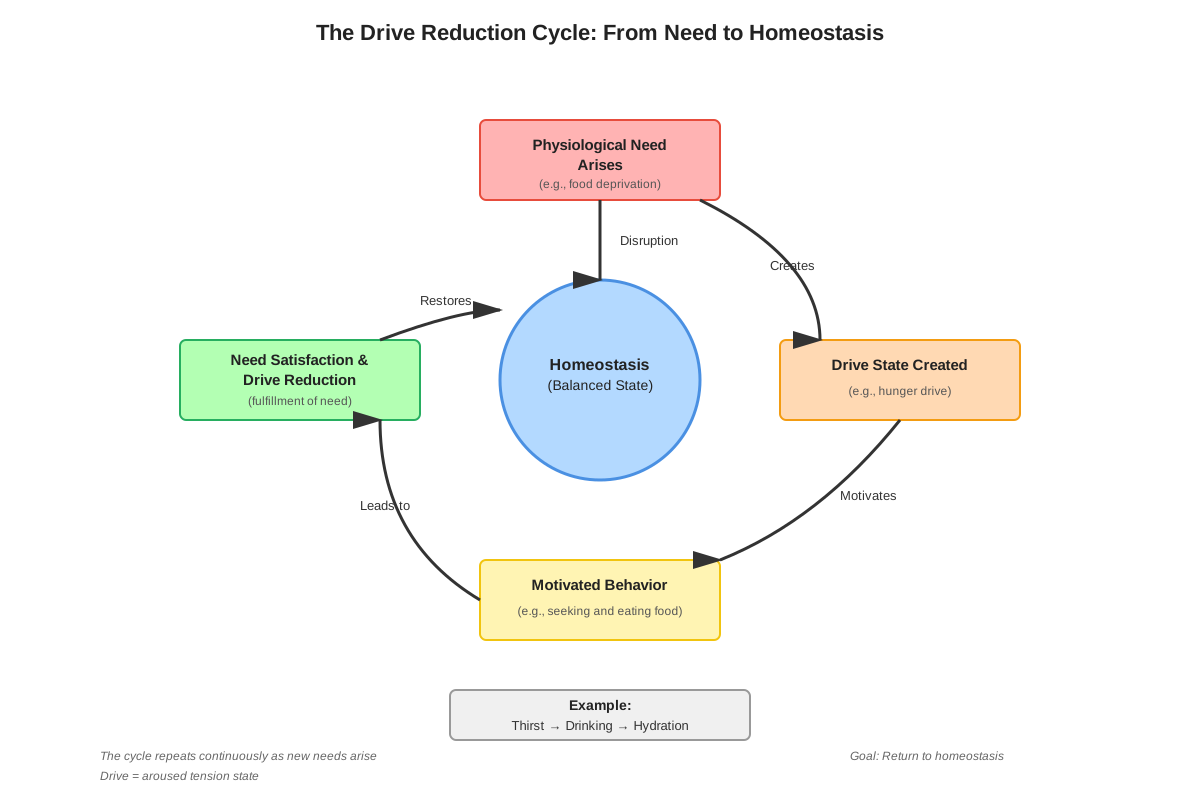
Drive reduction theory is a foundational motivational framework in Psychology that explains how organisms are driven to satisfy physiological needs and restore internal equilibrium. Developed by Clark Hull in the 1940s and 1950s, this theory proposes that biological needs create aroused tension states called drives, which motivate behavior aimed at reducing these drives and returning the organism to homeostasis. When a need arises—such as hunger, thirst, or temperature regulation—it creates an uncomfortable drive state that pushes the organism to engage in behaviors that will satisfy the need and eliminate the tension. This cyclical process of need → drive → behavior → need satisfaction → drive reduction forms the core mechanism of Hull's theory.
For the MCAT, Drive reduction theory represents a critical component of understanding Emotion Motivation and Stress, particularly within the Psychological, Social, and Biological Foundations of Behavior section. The theory bridges biological processes with behavioral outcomes, making it essential for analyzing passages that integrate physiological states with psychological responses. MCAT questions frequently test the ability to distinguish between primary drives (biological needs like hunger) and secondary drives (learned associations like money), as well as to identify situations where drive reduction theory successfully predicts behavior versus scenarios where it falls short.
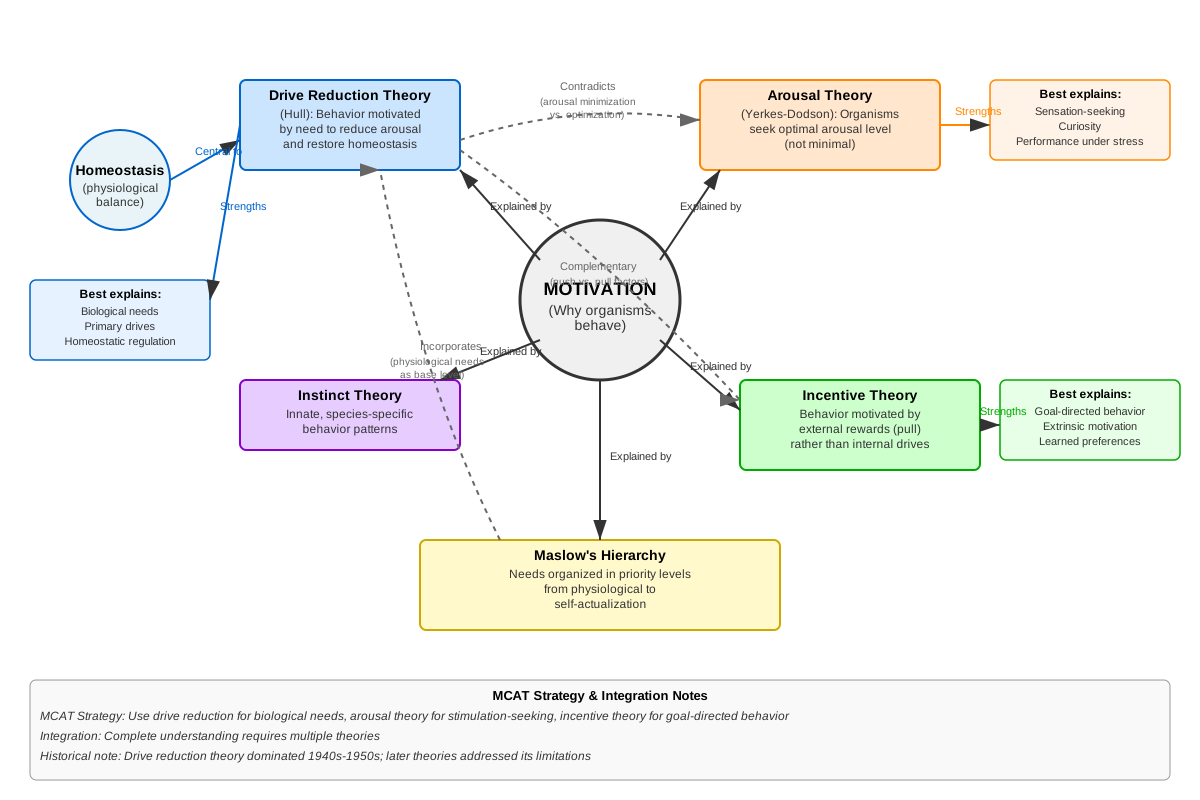
Understanding drive reduction theory provides the conceptual foundation for grasping more complex motivational theories tested on the MCAT, including arousal theory, incentive theory, and Maslow's hierarchy of needs. The theory's emphasis on homeostasis connects directly to biological concepts in physiology, while its limitations highlight the importance of cognitive and social factors in human motivation. This integration across multiple domains makes drive reduction theory a high-yield topic that appears in both discrete questions and passage-based items, often requiring students to apply the theory to novel scenarios or critique its explanatory power in specific contexts.
Learning Objectives
- [ ] Define Drive reduction theory using accurate Psychology terminology
- [ ] Explain why Drive reduction theory matters for the MCAT
- [ ] Apply Drive reduction theory to exam-style questions
- [ ] Identify common mistakes related to Drive reduction theory
- [ ] Connect Drive reduction theory to related Psychology concepts
- [ ] Distinguish between primary drives and secondary (learned) drives with specific examples
- [ ] Analyze scenarios where drive reduction theory successfully predicts behavior versus situations where it fails
- [ ] Evaluate the relationship between drive reduction theory and homeostatic regulation
- [ ] Compare and contrast drive reduction theory with competing motivational theories (arousal, incentive, instinct)
Prerequisites
- Homeostasis: The body's tendency to maintain stable internal conditions; essential for understanding why drives arise when physiological balance is disrupted
- Classical and operant conditioning: Learning mechanisms that explain how secondary drives develop through association and reinforcement
- Basic physiological needs: Understanding of hunger, thirst, temperature regulation, and other biological requirements that generate primary drives
- Arousal and activation: General concepts of physiological and psychological activation states that underlie the experience of drives
- Reinforcement principles: Knowledge of how behaviors that reduce drives become strengthened through negative reinforcement
Why This Topic Matters
Drive reduction theory holds significant clinical and real-world relevance for understanding both normal and pathological behavior. The theory helps explain addiction, where substances that reduce negative drive states (anxiety, pain, withdrawal) become powerfully reinforcing. It illuminates eating disorders, where disrupted hunger and satiety signals lead to maladaptive drive-reduction behaviors. The framework also applies to understanding stress responses, as organisms are motivated to reduce the uncomfortable arousal associated with stressors. In therapeutic contexts, recognizing that certain behaviors serve drive-reduction functions allows clinicians to address underlying needs rather than merely suppressing symptoms.
On the MCAT, drive reduction theory appears with moderate frequency, typically in 2-4 questions per Psychology/Sociology section. Questions most commonly take three forms: (1) discrete items asking students to identify which scenario best exemplifies drive reduction versus other motivational theories, (2) passage-based questions requiring application of the theory to experimental findings about motivated behavior, and (3) critical analysis questions asking students to identify limitations of the theory or situations where it fails to predict behavior. The theory frequently appears in passages discussing eating behavior, addiction, stress responses, or animal learning experiments.
Common exam contexts include passages describing homeostatic regulation experiments, studies on learned drives and secondary reinforcement, research on optimal arousal levels that challenge drive reduction predictions, and clinical vignettes involving behaviors that seem to increase rather than decrease arousal. The MCAT particularly favors questions that require distinguishing drive reduction theory from incentive theory (pull vs. push motivation) and identifying behaviors that cannot be explained by drive reduction alone, such as curiosity-driven exploration or sensation-seeking.
Core Concepts
Definition and Basic Mechanism
Drive reduction theory posits that motivation arises from biological needs that create psychological drive states, which in turn energize behavior directed toward satisfying those needs and reducing the drive. The theory operates through a four-stage cycle: (1) a physiological need develops (e.g., cellular dehydration), (2) this need creates an uncomfortable psychological drive state (thirst), (3) the organism engages in drive-reducing behavior (drinking water), and (4) the need is satisfied, the drive is reduced, and the organism returns to homeostatic balance. This process exemplifies negative reinforcement—the behavior is strengthened because it removes an aversive state.
Clark Hull formalized this theory mathematically, proposing that behavior potential (the likelihood of a behavior occurring) equals drive multiplied by habit strength. Drive refers to the intensity of the need state, while habit strength reflects how well-learned the drive-reducing behavior is. According to this formulation, even strong drives won't produce behavior without learned associations between specific actions and drive reduction, and well-learned behaviors won't occur without sufficient drive to energize them.
Primary Drives vs. Secondary Drives
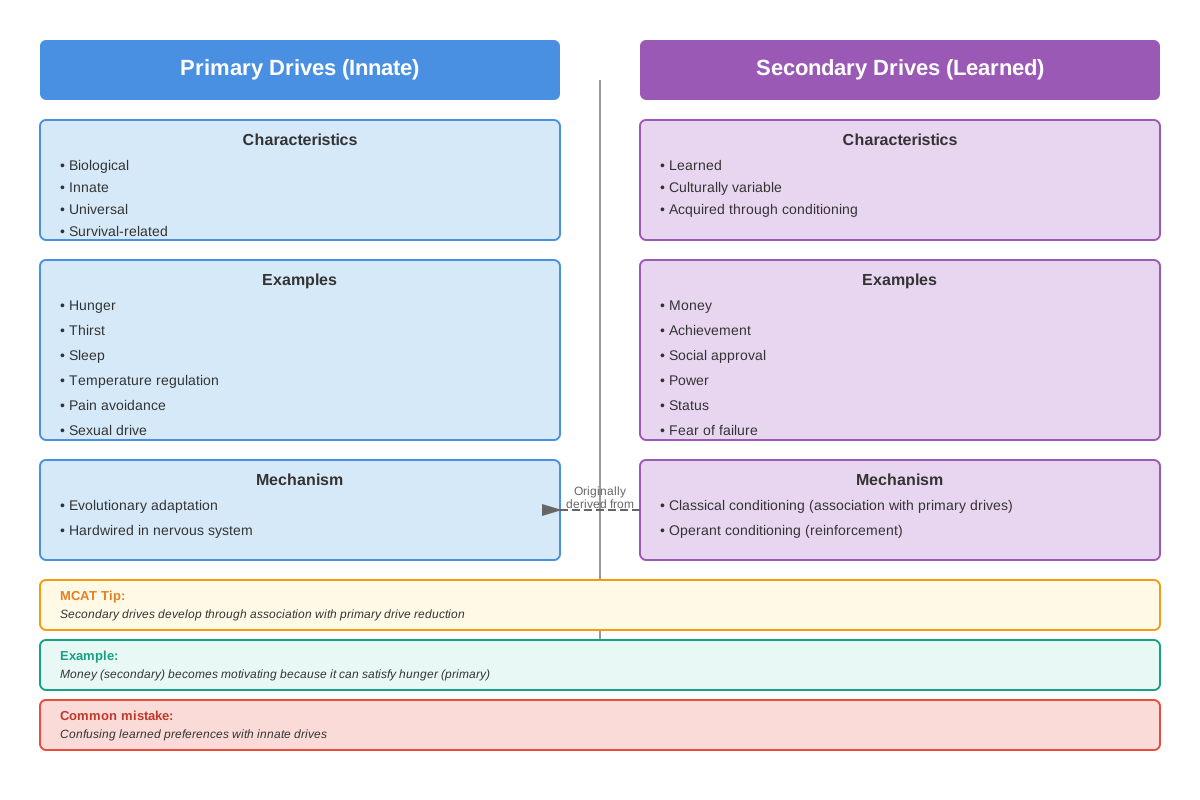
Primary drives are innate, biologically-based motivational states that arise directly from physiological needs essential for survival. These include:
- Hunger: Drive arising from energy depletion and metabolic needs
- Thirst: Drive resulting from cellular dehydration and fluid imbalance
- Temperature regulation: Drive to maintain optimal body temperature
- Pain avoidance: Drive to escape or prevent tissue damage
- Sleep: Drive arising from accumulated sleep debt and circadian pressure
Secondary drives (also called acquired drives or learned drives) develop through classical conditioning and operant learning when neutral stimuli become associated with primary drive reduction. Money represents the quintessential secondary drive—it has no inherent biological value but becomes motivating because it has been repeatedly paired with obtaining primary reinforcers (food, shelter, comfort). Other secondary drives include:
- Achievement motivation: Learned association between accomplishment and social rewards
- Affiliation needs: Conditioned drive for social connection based on early attachment experiences
- Status seeking: Acquired motivation for social rank and recognition
- Fear and anxiety: Conditioned emotional drives that motivate avoidance behavior
| Feature | Primary Drives | Secondary Drives |
|---|---|---|
| Origin | Innate, biological | Learned through experience |
| Basis | Physiological needs | Classical/operant conditioning |
| Universality | Present across all humans | Vary by culture and individual history |
| Examples | Hunger, thirst, pain | Money, achievement, status |
| Survival necessity | Directly related to survival | Indirectly related through association |
Homeostasis and Drive States
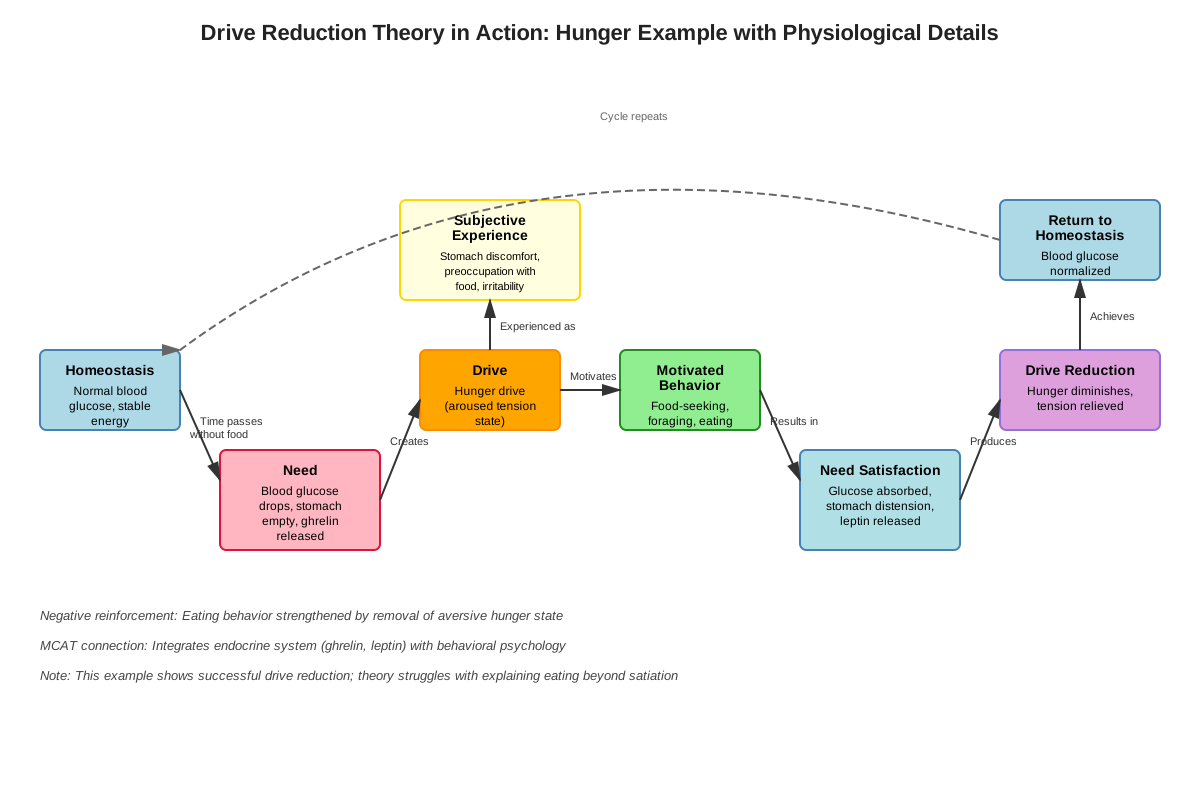
The connection between drive reduction theory and homeostasis is fundamental. Homeostasis refers to the body's regulatory processes that maintain stable internal conditions (temperature, blood glucose, fluid balance, etc.). When homeostatic balance is disrupted, the deviation from the optimal set point creates a physiological need. This need state activates neural and hormonal systems that generate the subjective experience of a drive—an uncomfortable tension that motivates corrective behavior.
For example, when blood glucose drops below optimal levels, glucoreceptors in the hypothalamus detect this deviation from homeostasis. This detection triggers both physiological responses (glucagon release, glycogen breakdown) and psychological responses (the hunger drive). The hunger drive motivates food-seeking and eating behaviors. Once food is consumed and blood glucose returns to the optimal range, the drive diminishes, and eating behavior ceases. This negative feedback loop exemplifies how drive reduction serves homeostatic regulation.
Drive Reduction as Negative Reinforcement
Drive reduction theory fundamentally relies on the principle of negative reinforcement. Behaviors that successfully reduce drives are strengthened and become more likely to occur when similar drive states arise in the future. The removal of the aversive drive state (the negative reinforcer) increases the probability of the drive-reducing behavior. This differs from positive reinforcement, where adding a pleasant stimulus increases behavior.
Consider a rat in a Skinner box that learns to press a lever to obtain food when hungry. According to drive reduction theory, the lever-pressing behavior is reinforced not primarily by the positive addition of food, but by the reduction of the aversive hunger drive. The uncomfortable tension of hunger is removed, which strengthens the lever-pressing response. This mechanism explains why organisms develop strong, persistent behaviors that eliminate uncomfortable states—the relief itself is powerfully reinforcing.
Limitations and Criticisms
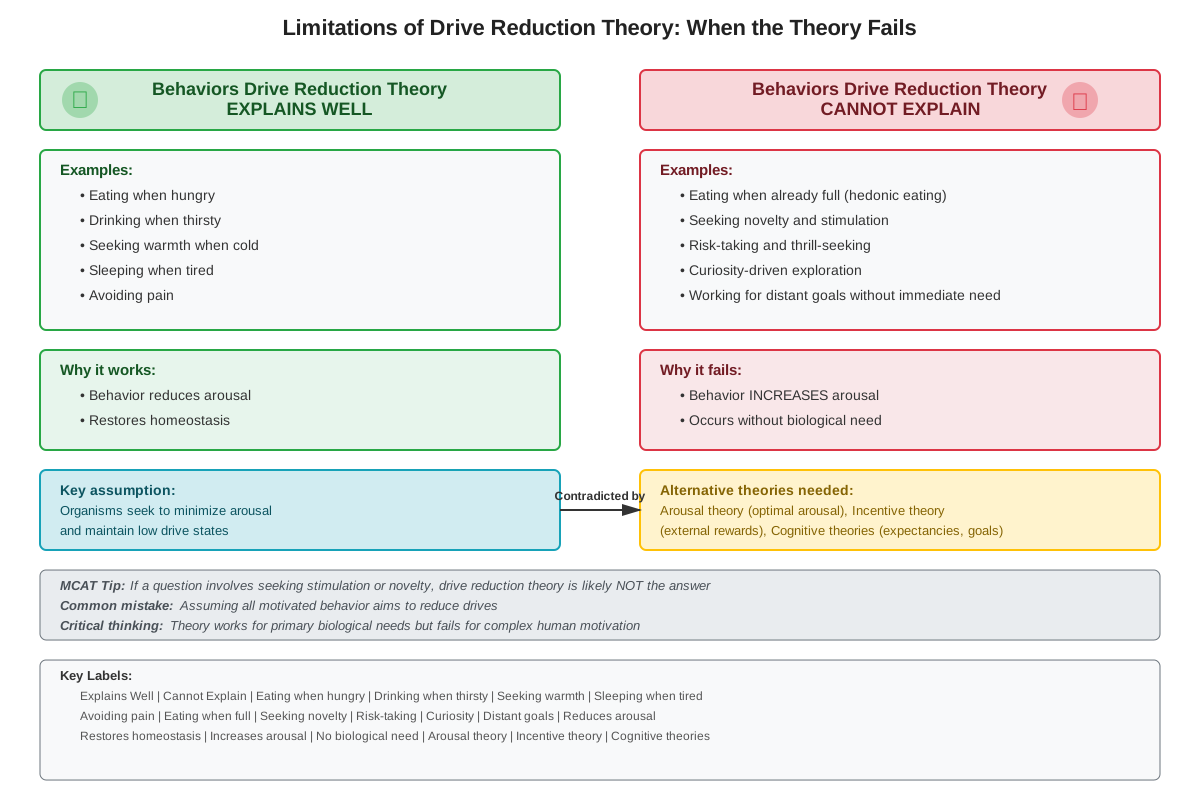
While drive reduction theory successfully explains many motivated behaviors, particularly those related to basic physiological needs, it faces significant limitations that are frequently tested on the MCAT:
- Behaviors that increase arousal: The theory cannot explain why organisms engage in behaviors that increase rather than decrease arousal, such as curiosity-driven exploration, sensation-seeking, risk-taking, or playing challenging games. These behaviors suggest that organisms sometimes seek optimal arousal levels rather than minimal arousal.
- Incentive motivation: Drive reduction emphasizes "push" motivation (internal drives pushing behavior), but many behaviors are better explained by "pull" motivation (external incentives attracting behavior). A person might eat dessert despite having no hunger drive, motivated purely by the appealing taste.
- Timing issues: Drive reduction occurs after the behavior is completed, yet learning often occurs before the drive is fully reduced. A thirsty animal begins learning which behaviors lead to water before the water is consumed and the thirst drive eliminated.
- Non-homeostatic motivations: Many human motivations (achievement, self-actualization, aesthetic appreciation, altruism) have no clear connection to physiological needs or homeostatic imbalance.
- Individual differences: The theory struggles to explain why different individuals with similar drive states choose different drive-reducing behaviors, or why drive intensity varies among individuals with equivalent physiological needs.
Concept Relationships
Drive reduction theory connects internally through a hierarchical structure: physiological needs form the foundation, generating drive states, which energize behaviors, leading to drive reduction and reinforcement. Primary drives serve as the basis for secondary drives through associative learning—neutral stimuli paired with primary drive reduction acquire motivational properties themselves. This creates a chain: primary need → primary drive → behavior → primary drive reduction + neutral stimulus → neutral stimulus becomes secondary drive → behavior motivated by secondary drive.
The theory connects to prerequisite concepts through multiple pathways. Homeostasis provides the biological foundation—disruptions in homeostatic balance create the needs that generate drives. Classical conditioning explains how secondary drives develop when neutral stimuli are paired with primary drive reduction. Operant conditioning and negative reinforcement explain how drive-reducing behaviors are strengthened and maintained. The relationship flows: homeostatic disruption → need state → drive → behavior → drive reduction (negative reinforcement) → behavior strengthening.
Drive reduction theory relates to other motivational theories through comparison and contrast. Arousal theory emerged partly as a response to drive reduction's limitations, proposing that organisms seek optimal (not minimal) arousal levels. Incentive theory complements drive reduction by emphasizing external "pull" factors rather than internal "push" factors. Maslow's hierarchy incorporates drive reduction principles at the physiological level but extends beyond to include motivations unexplained by drive reduction. The conceptual map: Drive Reduction Theory (push, internal, reduction) ↔ Incentive Theory (pull, external, approach) ↔ Arousal Theory (optimization, not reduction) → Integrated understanding of motivation.
Within Emotion Motivation and Stress, drive reduction theory specifically addresses the motivation component. Stress can be understood as a state of heightened drive (arousal) that motivates coping behaviors aimed at drive reduction. Emotions often accompany drive states (hunger creates irritability, thirst creates discomfort) and their reduction (satisfaction, relief). The integration: Stress (heightened arousal/drive) → Motivation (drive reduction) → Behavior (coping) → Emotion (relief).
High-Yield Facts
⭐ Drive reduction theory proposes that biological needs create psychological drives that motivate behavior aimed at reducing those drives and restoring homeostasis.
⭐ Primary drives are innate and biologically-based (hunger, thirst, pain avoidance), while secondary drives are learned through association with primary drive reduction (money, achievement).
⭐ Drive reduction operates through negative reinforcement—behaviors are strengthened by the removal of aversive drive states.
⭐ The theory successfully explains homeostatic behaviors but fails to account for behaviors that increase arousal (curiosity, exploration, sensation-seeking).
⭐ Incentive theory differs from drive reduction by emphasizing external "pull" factors rather than internal "push" factors as primary motivators.
- Clark Hull formalized drive reduction theory, proposing that behavior potential equals drive multiplied by habit strength.
- Drive reduction connects directly to homeostatic regulation—deviations from optimal set points create needs that generate drives.
- Secondary drives develop when neutral stimuli are repeatedly paired with primary drive reduction through classical conditioning.
- The theory cannot explain why organisms sometimes eat without hunger, explore without need, or engage in risky behaviors that increase arousal.
- Drive reduction timing presents a theoretical problem: reinforcement occurs after behavior completion, yet learning often happens before full drive reduction.
- The theory applies clinically to understanding addiction (substances reduce negative drive states) and eating disorders (disrupted hunger/satiety drives).
- MCAT questions frequently ask students to identify scenarios where drive reduction theory fails to predict behavior or to distinguish it from competing theories.
Quick check — test yourself on Drive reduction theory so far.
Try Flashcards →Common Misconceptions
Misconception: Drive reduction theory states that all motivation comes from biological needs.
Correction: While the theory emphasizes biological needs as the foundation, it acknowledges secondary (learned) drives that develop through association with primary drive reduction. However, the theory's limitation is that it cannot adequately explain motivations with no connection to biological needs, such as aesthetic appreciation or self-actualization.
Misconception: Drive reduction and positive reinforcement are the same thing.
Correction: Drive reduction operates through negative reinforcement (removing an aversive state), not positive reinforcement (adding a pleasant stimulus). The key is that the uncomfortable drive state is eliminated, which strengthens behavior, rather than a reward being added.
Misconception: According to drive reduction theory, organisms always seek to minimize arousal to zero.
Correction: The theory proposes that organisms seek to reduce uncomfortable drive states to restore homeostasis, not to eliminate all arousal. The target is optimal homeostatic balance, not zero arousal. This misconception highlights one of the theory's limitations—it doesn't account for optimal arousal seeking.
Misconception: If someone eats when not hungry, this contradicts drive reduction theory entirely.
Correction: This behavior is better explained by incentive theory (external pull motivation) rather than drive reduction (internal push motivation). Rather than contradicting drive reduction theory, this example illustrates its limitations and the need for complementary theories. Drive reduction theory still accurately explains eating when hungry; it simply doesn't explain all eating behavior.
Misconception: Secondary drives are less powerful than primary drives because they're learned.
Correction: Secondary drives can become extremely powerful motivators, sometimes even overriding primary drives. For example, the secondary drive for money or status can motivate people to skip meals (ignoring hunger) or endure physical discomfort. The strength of a drive depends on learning history and context, not solely on whether it's primary or secondary.
Misconception: Drive reduction theory and arousal theory are completely incompatible.
Correction: These theories address different aspects of motivation and can be complementary. Drive reduction explains behaviors aimed at satisfying physiological needs and reducing uncomfortable states, while arousal theory explains behaviors aimed at achieving optimal stimulation levels. Both can be true in different contexts—organisms reduce drives when needs arise and seek stimulation when understimulated.
Worked Examples
Example 1: Distinguishing Drive Reduction from Incentive Motivation
Scenario: A researcher observes two rats in separate conditions. Rat A has been food-deprived for 24 hours and presses a lever to obtain food pellets. Rat B is fully satiated but presses a lever to obtain highly palatable sugar pellets that it has learned taste pleasant. Which rat's behavior is best explained by drive reduction theory, and why?
Analysis:
Step 1: Identify the presence or absence of a biological need/drive state.
- Rat A: Has a clear biological need (energy depletion from 24-hour food deprivation) that creates a hunger drive
- Rat B: Has no biological need (fully satiated) and therefore no hunger drive
Step 2: Determine whether behavior is "pushed" by internal drive or "pulled" by external incentive.
- Rat A: Behavior is pushed by the internal hunger drive; the rat is motivated to reduce the uncomfortable drive state
- Rat B: Behavior is pulled by the external incentive (pleasant taste); the rat is motivated by the appealing properties of the sugar pellets, not by reducing a drive
Step 3: Apply drive reduction theory criteria.
Drive reduction theory requires: (1) a biological need creating a drive state, (2) behavior motivated by the uncomfortable drive, and (3) reinforcement through drive reduction.
- Rat A meets all criteria: biological need → hunger drive → lever pressing → food consumption → hunger drive reduction
- Rat B fails criterion 1: no biological need or drive state exists
Answer: Rat A's behavior is best explained by drive reduction theory because it involves a biological need (energy depletion) creating a drive state (hunger) that motivates behavior (lever pressing) aimed at reducing that drive (obtaining food). Rat B's behavior is better explained by incentive theory because it is motivated by the external appeal of the sugar pellets rather than by an internal drive state. This distinction—internal push versus external pull—is a high-yield concept for MCAT questions.
Connection to Learning Objectives: This example demonstrates the application of drive reduction theory to exam-style scenarios and highlights the importance of distinguishing drive reduction from competing motivational theories.
Example 2: Identifying Limitations of Drive Reduction Theory
Scenario: A psychology student reviews four behaviors and must identify which one is LEAST consistent with drive reduction theory:
A) A dehydrated hiker drinks water from a stream
B) A person seeks shade on a hot day to cool down
C) A well-fed child explores a new playground despite some anxiety
D) A sleep-deprived student goes to bed early
Analysis:
Step 1: Evaluate each option against drive reduction theory's core principle—behavior is motivated by the need to reduce uncomfortable drive states arising from biological needs.
Option A:
- Biological need: Dehydration (fluid imbalance)
- Drive state: Thirst (uncomfortable drive)
- Behavior: Drinking water
- Outcome: Thirst drive reduced, homeostasis restored
- Consistency: HIGH—perfectly exemplifies drive reduction
Option B:
- Biological need: Overheating (temperature dysregulation)
- Drive state: Discomfort from heat
- Behavior: Seeking shade
- Outcome: Temperature drive reduced, thermal homeostasis restored
- Consistency: HIGH—exemplifies drive reduction for temperature regulation
Option C:
- Biological need: None apparent (child is well-fed, not in danger)
- Drive state: Mild anxiety (which the child approaches rather than avoids)
- Behavior: Exploration despite anxiety
- Outcome: Increased arousal and stimulation, not drive reduction
- Consistency: LOW—this behavior increases rather than decreases arousal and serves curiosity/exploration rather than reducing a biological drive
Option D:
- Biological need: Sleep deprivation (accumulated sleep debt)
- Drive state: Sleepiness/fatigue
- Behavior: Going to bed
- Outcome: Sleep drive reduced, homeostasis restored
- Consistency: HIGH—exemplifies drive reduction for sleep need
Step 2: Identify which behavior drive reduction theory cannot adequately explain.
Option C represents exploratory behavior motivated by curiosity and novelty-seeking. This behavior:
- Occurs without a clear biological need or homeostatic imbalance
- Increases rather than decreases arousal
- Involves approaching mild anxiety rather than reducing it
- Is better explained by arousal theory (seeking optimal stimulation) or intrinsic motivation
Answer: Option C is LEAST consistent with drive reduction theory. The theory cannot adequately explain why organisms engage in exploratory, curiosity-driven behaviors that increase arousal rather than reduce it, especially when these behaviors occur in the absence of biological needs. This represents a key limitation of drive reduction theory and highlights why complementary theories (arousal theory, incentive theory) are necessary for a complete understanding of motivation.
Connection to Learning Objectives: This example requires identifying situations where drive reduction theory fails to predict behavior, a critical skill for MCAT questions that test understanding of theoretical limitations.
Exam Strategy
When approaching MCAT questions on drive reduction theory, begin by identifying whether the scenario involves a biological need creating an uncomfortable drive state. Look for explicit mentions of physiological imbalance (hunger, thirst, pain, temperature dysregulation, sleep deprivation) or descriptions of uncomfortable internal states that push behavior. If the scenario describes behavior motivated primarily by external appeal or attraction rather than internal discomfort, consider incentive theory instead.
Trigger words and phrases that signal drive reduction theory include:
- "Biological need," "physiological imbalance," "homeostasis"
- "Uncomfortable state," "tension," "arousal reduction"
- "Satisfy the need," "restore balance," "reduce the drive"
- "Negative reinforcement," "removal of aversive state"
- "Primary drive" (hunger, thirst, pain, temperature, sleep)
- "Secondary drive" (money, achievement) when linked to primary drive reduction
Red flag phrases that suggest drive reduction theory does NOT apply:
- "Despite being satiated," "in the absence of need"
- "Seeking excitement," "exploring," "curiosity-driven"
- "Attracted by," "appealing," "incentive" (suggests incentive theory)
- "Optimal arousal," "stimulation-seeking" (suggests arousal theory)
- "Self-actualization," "aesthetic appreciation" (suggests humanistic theories)
For process-of-elimination, systematically evaluate each answer choice by asking: (1) Is there a biological need? (2) Does this need create a drive? (3) Is behavior motivated by reducing this drive? (4) Does the behavior restore homeostasis? If any answer is "no," that choice likely doesn't exemplify drive reduction theory. When questions ask for limitations or exceptions, eliminate choices that perfectly fit drive reduction and select the option involving arousal-increasing behavior, behavior without biological needs, or purely incentive-driven behavior.
Time allocation: Drive reduction theory questions typically require 60-90 seconds. Spend 20-30 seconds identifying the presence or absence of biological needs and drive states, 20-30 seconds evaluating whether behavior aims to reduce drives or achieve other goals, and 20-30 seconds confirming your answer against the theory's core principles. Don't overthink—if a clear biological need and drive-reducing behavior are present, drive reduction theory applies; if not, it doesn't.
Memory Techniques
Mnemonic for Drive Reduction Theory Components: "NEED DRIVES BEHAVIOR BACK"
- Need (biological/physiological)
- Energizes
- Effort (behavior)
- Diminishes
- Discomfort
- Returns to
- Internal
- Value (homeostasis)
- Equilibrium
- Strengthens
- Behavior (through negative reinforcement)
- Again
- Cycle
- Keeps repeating
Mnemonic for Primary Drives: "HATS PT" (think: wearing HATS for Physical/Temperature needs)
- Hunger
- Air (breathing/oxygen)
- Thirst
- Sleep
- Pain avoidance
- Temperature regulation
Visualization Strategy: Picture a car's fuel gauge (representing homeostasis). When the gauge drops into the red zone (biological need), a warning light flashes (drive state), motivating you to find a gas station (behavior) and refuel (drive reduction), returning the gauge to the normal range (homeostasis restored). This concrete image captures the entire drive reduction cycle.
Contrast Memory Aid: Remember "PUSH vs. PULL"
- Drive reduction = PUSH (internal drives push behavior)
- Incentive theory = PULL (external incentives pull behavior)
- If the question emphasizes internal discomfort → PUSH → drive reduction
- If the question emphasizes external appeal → PULL → incentive theory
Limitation Memory Device: "Drive reduction CAN'T RISE" (can't explain behaviors that increase arousal)
- Curiosity
- Adventure-seeking
- Novelty exploration
- Thrills
- Risk-taking
- Increasing stimulation
- Sensation-seeking
- Excitement-driven behavior
Summary
Drive reduction theory represents a foundational motivational framework proposing that biological needs create uncomfortable psychological drives that energize behavior aimed at satisfying those needs and reducing the drives. The theory operates through a cyclical process: physiological need → drive state → motivated behavior → need satisfaction → drive reduction → homeostasis restored. Primary drives arise directly from biological needs (hunger, thirst, pain, temperature, sleep), while secondary drives develop through learned associations with primary drive reduction (money, achievement, status). The theory fundamentally relies on negative reinforcement—behaviors that successfully reduce drives are strengthened because they remove aversive states. While drive reduction theory successfully explains many homeostatic behaviors and basic physiological motivations, it faces significant limitations, particularly its inability to account for behaviors that increase arousal (exploration, sensation-seeking, curiosity) or motivations unconnected to biological needs (aesthetic appreciation, self-actualization). For the MCAT, students must be able to identify scenarios where drive reduction theory applies, distinguish it from competing theories (especially incentive and arousal theories), recognize its limitations, and understand the distinction between primary and secondary drives.
Key Takeaways
- Drive reduction theory explains motivation through a cycle: biological need → uncomfortable drive → behavior → drive reduction → homeostasis, reinforced through negative reinforcement
- Primary drives (hunger, thirst, pain, temperature, sleep) are innate and biological; secondary drives (money, achievement) are learned through association with primary drive reduction
- The theory successfully predicts homeostatic behaviors but fails to explain arousal-increasing behaviors (exploration, sensation-seeking) or non-biological motivations
- Drive reduction emphasizes internal "push" motivation, contrasting with incentive theory's external "pull" motivation
- MCAT questions frequently test the ability to identify drive reduction theory's limitations and distinguish it from competing motivational frameworks
- Understanding drive reduction theory requires recognizing its connection to homeostasis, negative reinforcement, and classical/operant conditioning
- The theory's clinical applications include understanding addiction (substances reduce negative drives) and eating disorders (disrupted hunger/satiety drives)
Related Topics
Arousal Theory: Proposes that organisms seek optimal arousal levels rather than minimal arousal, explaining behaviors that drive reduction theory cannot (exploration, sensation-seeking). Mastering drive reduction theory provides the foundation for understanding why arousal theory emerged as a complementary framework.
Incentive Theory: Emphasizes external "pull" factors (rewards, goals, appealing stimuli) rather than internal "push" factors (drives) as primary motivators. Understanding the contrast between drive reduction and incentive theory is essential for comprehensive MCAT preparation on motivation.
Maslow's Hierarchy of Needs: Incorporates drive reduction principles at the physiological level (base of the pyramid) but extends to psychological and self-actualization needs that drive reduction cannot explain. Drive reduction theory provides the foundation for understanding the lowest tier of Maslow's hierarchy.
Homeostasis and Regulatory Mechanisms: The biological processes that maintain internal stability and generate the needs that create drives. Deep understanding of homeostatic regulation enhances comprehension of why drives arise and how drive reduction restores balance.
Theories of Emotion: Drive states often generate emotional experiences (hunger creates irritability, drive reduction creates relief), connecting motivation and emotion. Understanding drive reduction enhances comprehension of how physiological states influence emotional experiences.
Practice CTA
Now that you've mastered the core concepts of drive reduction theory, it's time to solidify your understanding through active practice. Challenge yourself with MCAT-style practice questions that require you to apply the theory to novel scenarios, identify its limitations, and distinguish it from competing motivational frameworks. Use flashcards to reinforce the distinction between primary and secondary drives, memorize high-yield facts, and internalize common misconceptions. Remember: understanding drive reduction theory isn't just about memorizing definitions—it's about developing the analytical skills to recognize when the theory applies, when it doesn't, and why. Your ability to think critically about motivational theories will serve you well not only on test day but throughout your medical career as you work to understand what drives human behavior in clinical contexts. You've got this!
Sign up free to keep reading
Create a free AnvayaPrep account to finish this MCAT guide on Drive reduction theory — plus flashcards and practice questions.