Overview
Decay theory is a foundational concept in the study of Learning and Memory within Psychology, proposing that memory traces naturally fade over time when they are not accessed or rehearsed. This theory suggests that forgetting occurs passively as a function of time elapsed since encoding, with memories weakening and eventually disappearing from storage if not periodically retrieved or reinforced. Originally proposed by early memory researchers, decay theory represents one of the earliest systematic attempts to explain the phenomenon of forgetting and remains a critical framework for understanding memory loss, particularly in short-term and sensory memory systems.
For the MCAT, understanding Decay theory Psychology is essential because it frequently appears in passages and discrete questions testing memory systems, forgetting mechanisms, and the distinction between different explanations for memory failure. The MCAT Psychological, Social, and Biological Foundations of Behavior section regularly presents experimental scenarios requiring students to differentiate between decay-based forgetting and interference-based forgetting, or to identify which memory system is most susceptible to decay processes. Questions may present research studies examining memory retention over time intervals, clinical vignettes involving memory complaints, or theoretical scenarios requiring application of decay principles to predict memory performance.
The significance of Decay theory MCAT extends beyond isolated memorization—it connects intimately with broader concepts including the multi-store model of memory, encoding specificity, consolidation processes, and competing theories of forgetting such as interference theory and retrieval failure. Understanding decay theory provides the foundation for comprehending why certain memory systems (particularly sensory and short-term memory) have limited duration, why rehearsal strategies prove effective for retention, and how the passage of time interacts with other factors to influence memory accessibility. This topic bridges cognitive psychology with neuroscience, as decay processes have neurobiological correlates in synaptic weakening and neural pathway degradation.
Learning Objectives
- [ ] Define Decay theory using accurate Psychology terminology
- [ ] Explain why Decay theory matters for the MCAT
- [ ] Apply Decay theory to exam-style questions
- [ ] Identify common mistakes related to Decay theory
- [ ] Connect Decay theory to related Psychology concepts
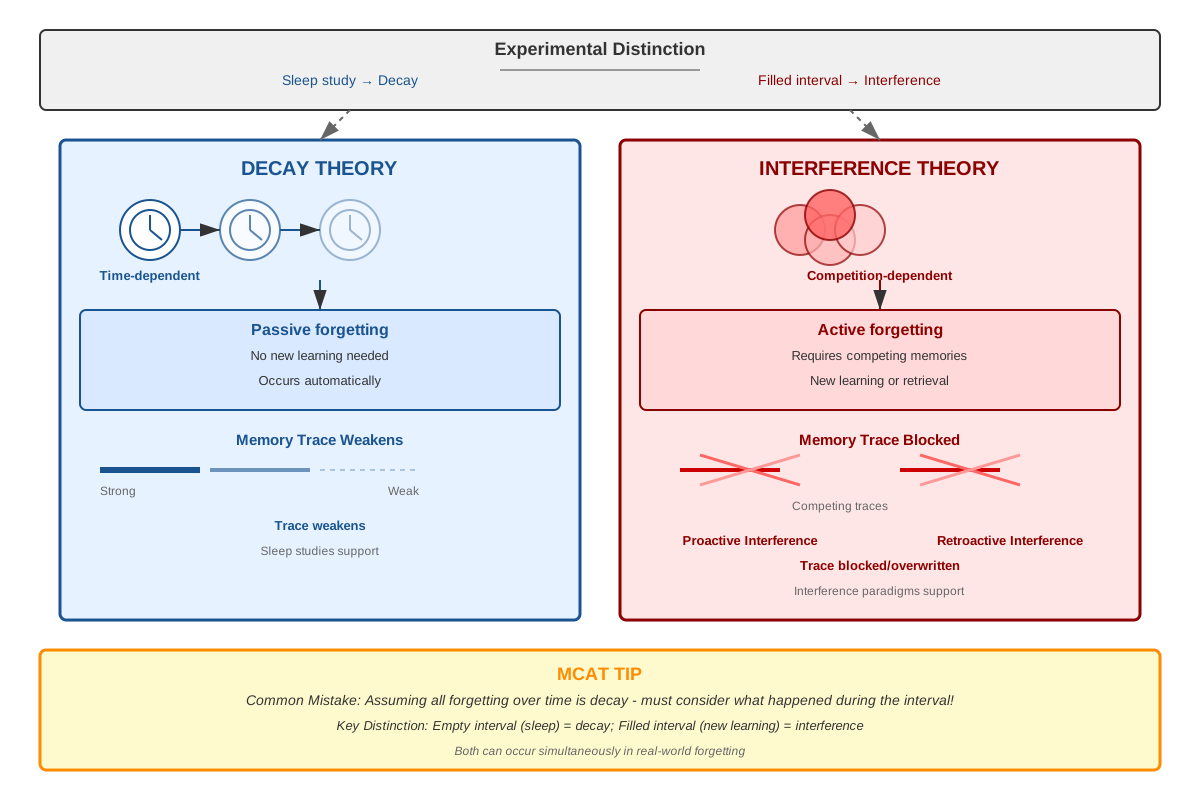
- [ ] Distinguish between decay theory and interference theory in experimental contexts
- [ ] Analyze the differential applicability of decay theory across memory systems (sensory, short-term, long-term)
- [ ] Evaluate evidence supporting and challenging decay theory from classic memory research
Prerequisites
- Multi-store model of memory (Atkinson-Shiffrin model): Understanding the distinction between sensory, short-term, and long-term memory is essential because decay operates differently across these systems
- Encoding, storage, and retrieval processes: Decay theory specifically addresses the storage phase, so distinguishing these three stages clarifies where decay occurs in the memory process
- Basic neuroscience of memory formation: Familiarity with synaptic connections and neural pathways helps understand the biological basis for memory trace weakening
- Concept of memory traces (engrams): Decay theory assumes memories exist as physical traces that can degrade, making this foundational concept necessary
- Rehearsal and maintenance strategies: Understanding how active processing prevents forgetting provides contrast to passive decay processes
Why This Topic Matters
Clinical and Real-World Significance: Decay theory has profound implications for educational practices, clinical interventions, and everyday memory function. In educational settings, understanding decay informs spacing effects and distributed practice—students who space their study sessions combat decay more effectively than those who cram. Clinically, decay processes contribute to normal age-related memory changes and must be distinguished from pathological memory loss in conditions like Alzheimer's disease. Healthcare providers use decay principles when designing medication adherence protocols, recognizing that information about dosing schedules decays rapidly without reinforcement. In legal contexts, eyewitness testimony reliability decreases over time partly due to decay, affecting how courts evaluate evidence based on retention intervals.
Exam Statistics and Frequency: Decay theory appears in approximately 15-20% of MCAT Psychology passages involving memory, making it a high-yield topic. Questions typically present experimental designs with varying retention intervals, requiring students to predict outcomes based on decay principles. The MCAT frequently tests decay theory through:
- Experimental passage analysis comparing memory performance across different time delays
- Discrete questions asking students to identify which forgetting mechanism best explains a scenario
- Graph interpretation showing memory retention curves over time
- Application questions requiring students to design interventions that minimize decay
Common Exam Presentations: The MCAT presents decay theory through several recurring formats. Research passages may describe experiments manipulating retention intervals between encoding and retrieval, asking students to interpret results through decay versus interference frameworks. Clinical vignettes might present patients with memory complaints, requiring differentiation between normal decay processes and pathological conditions. Theoretical questions often present competing explanations for forgetting, testing whether students can identify decay-specific characteristics. Passages may also present neurobiological findings about synaptic changes over time, connecting decay theory to its neural substrates.
Core Concepts
Definition and Fundamental Principles
Decay theory (also called trace decay theory) posits that memory traces—the physical and neurological representations of memories—spontaneously deteriorate over time when not accessed. The theory makes several key assumptions: (1) memories exist as physical changes in the nervous system, (2) these changes naturally weaken with time passage, (3) forgetting results from this passive degradation rather than active interference, and (4) the probability of successful retrieval decreases as decay progresses. The decay process operates automatically and continuously, independent of whether new information is learned or whether the individual attempts retrieval.
The memory trace concept is central to decay theory. When information is encoded, it creates a neurological representation involving synaptic connections, neurotransmitter changes, and neural pathway modifications. According to decay theory, these physical changes are inherently unstable and require periodic reactivation to maintain their strength. Without such reactivation through rehearsal or retrieval, the trace weakens progressively until it becomes inaccessible or disappears entirely. This process parallels physical phenomena like radioactive decay or the fading of a photograph exposed to light—the degradation follows a predictable time course.
Time Course and Decay Functions
Decay follows a negatively accelerated curve, meaning memory loss occurs most rapidly immediately after encoding and slows progressively over time. This pattern, described by Ebbinghaus's forgetting curve, shows that approximately 50-60% of newly learned information may be lost within the first hour, with the rate of loss decreasing substantially thereafter. The mathematical function often used to model decay is exponential: Memory Strength = Initial Strength × e^(-kt), where k represents the decay rate constant and t represents time elapsed.
The decay rate varies based on several factors:
- Initial encoding strength: Deeply processed information decays more slowly than superficially processed information
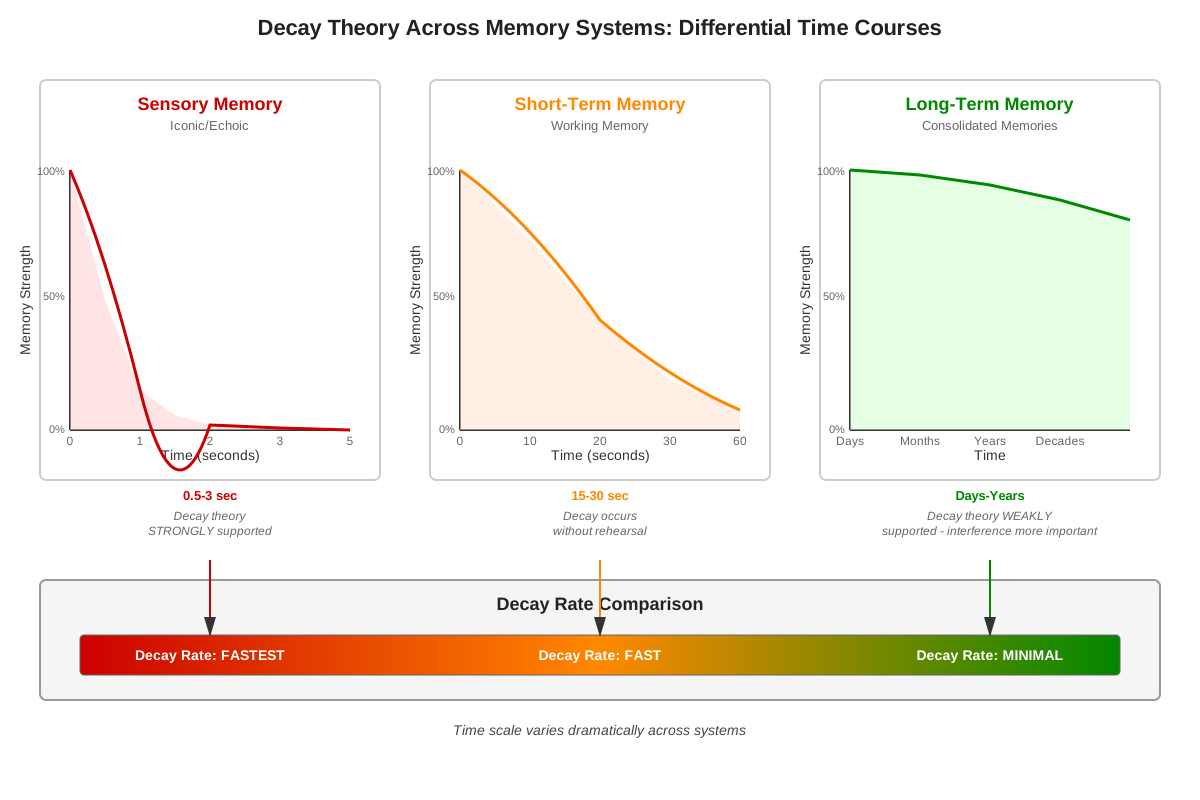
- Memory system involved: Sensory memory decays within milliseconds to seconds, short-term memory within seconds to minutes, and long-term memory potentially over years
- Type of information: Procedural memories show greater resistance to decay than declarative memories
- Individual differences: Age, neurological health, and genetic factors influence decay rates
Decay Across Memory Systems
| Memory System | Decay Duration | Decay Characteristics | Evidence Strength |
|---|---|---|---|
| Sensory Memory | 0.25-4 seconds | Rapid, complete decay without attention | Strong support |
| Short-Term Memory | 15-30 seconds | Moderate decay without rehearsal | Moderate support |
| Long-Term Memory | Years to lifetime | Slow decay; confounded with interference | Weak/controversial support |
Sensory memory provides the strongest evidence for pure decay. Iconic memory (visual sensory memory) decays within approximately 0.5 seconds, while echoic memory (auditory sensory memory) persists for 3-4 seconds. Sperling's partial report experiments demonstrated that information available immediately after presentation becomes inaccessible within seconds, supporting time-based decay. The rapid, automatic nature of sensory memory decay and the minimal opportunity for interference make this the clearest example of decay processes.
Short-term memory (or working memory) shows decay over approximately 15-30 seconds without rehearsal. Peterson and Peterson's classic experiments using consonant trigrams demonstrated that recall accuracy dropped from 90% at 3-second retention intervals to below 10% at 18-second intervals when rehearsal was prevented through distractor tasks. However, controversy exists regarding whether this represents pure decay or interference from the distractor task, illustrating the difficulty of isolating decay from other forgetting mechanisms.
Long-term memory presents the most controversial application of decay theory. While some forgetting from long-term memory occurs over extended periods, distinguishing decay from interference, retrieval failure, and motivated forgetting proves extremely difficult. Some researchers argue that long-term memories may not decay at all, with apparent forgetting resulting entirely from retrieval problems or interference. Others propose that consolidation processes can protect long-term memories from decay, particularly for emotionally significant or frequently accessed information.
Neurobiological Basis
At the neural level, decay corresponds to the weakening and elimination of synaptic connections formed during encoding. Long-term potentiation (LTP)—the strengthening of synapses through repeated activation—represents the biological basis for memory formation. Without periodic reactivation, these potentiated synapses undergo synaptic depression or depotentiation, returning to baseline strength. Neurotransmitter receptor density decreases, dendritic spines retract, and the efficiency of neural transmission diminishes.
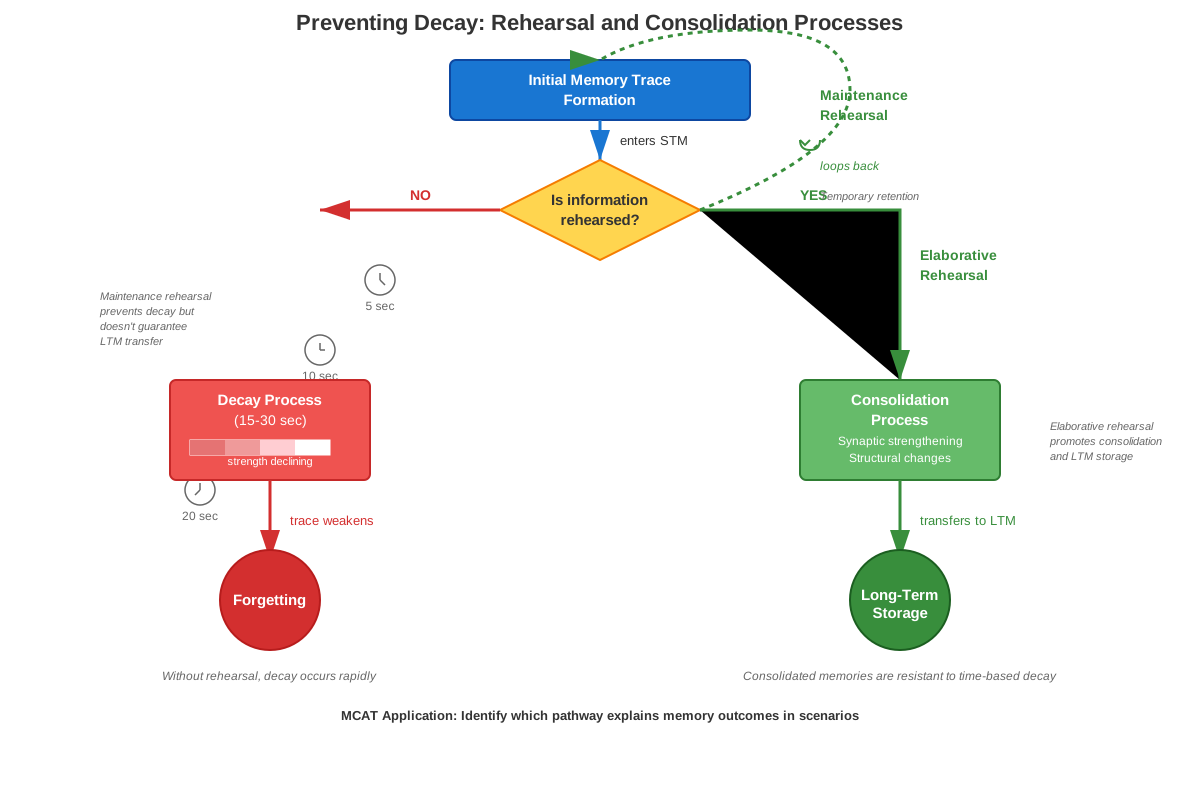
The consolidation process, whereby memories transition from fragile to stable states, interacts with decay. Newly formed memories remain vulnerable to decay during the consolidation window (hours to days), but successfully consolidated memories show greater resistance. Sleep plays a crucial role in consolidation, and sleep deprivation accelerates decay by preventing consolidation completion. The hippocampus-dependent consolidation of declarative memories involves gradual transfer to cortical storage sites, with decay potentially affecting memories that fail to complete this transfer.
Factors That Modify Decay
Several factors influence decay rate beyond simple time passage:
- Rehearsal and retrieval: Each retrieval episode reactivates the memory trace, resetting the decay clock and potentially strengthening the trace beyond its original strength (testing effect)
- Emotional arousal: Emotionally charged memories show reduced decay due to amygdala involvement and stress hormone effects on consolidation
- Sleep: Sleep protects memories from decay through active consolidation processes during slow-wave and REM sleep
- Interference: While theoretically distinct from decay, interference can accelerate apparent decay by disrupting consolidation or creating retrieval competition
- Distributed practice: Spacing learning episodes over time combats decay more effectively than massed practice, likely by providing multiple consolidation opportunities
Concept Relationships
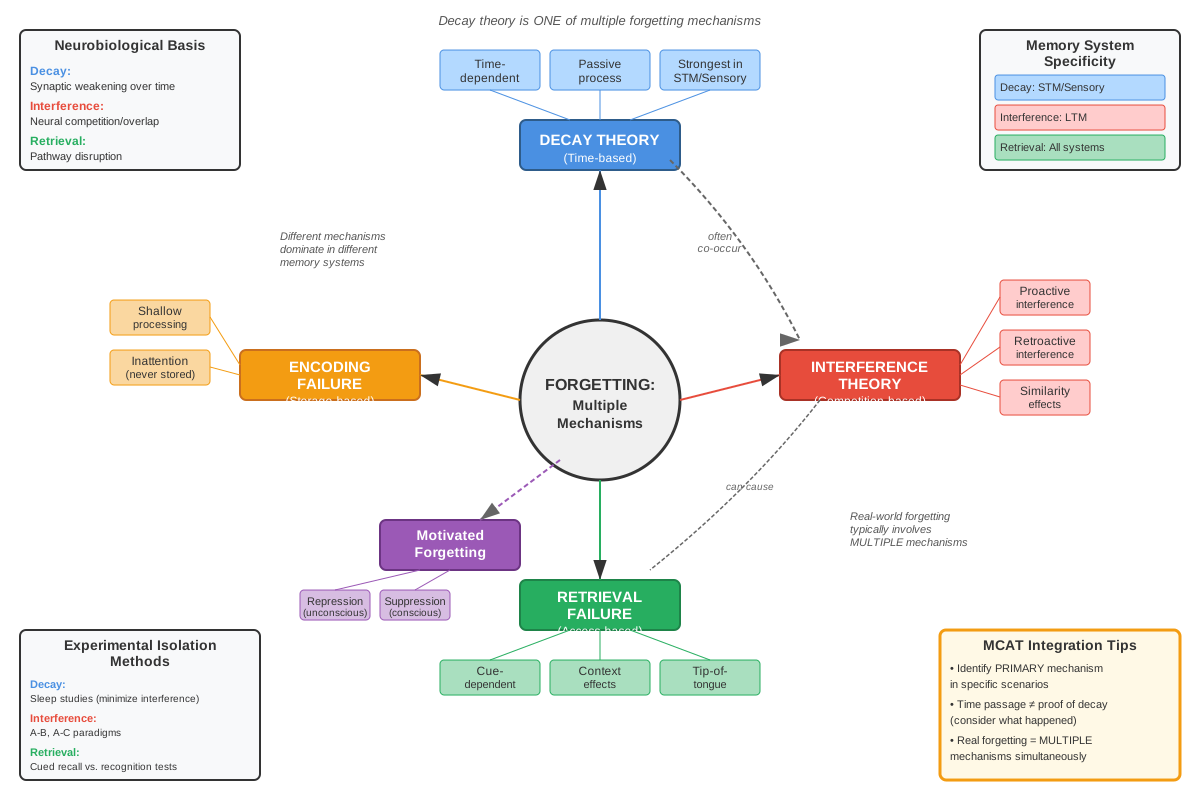
Decay theory connects to multiple memory concepts in an integrated network. The multi-store model provides the framework within which decay operates, with decay affecting each memory store differently based on its temporal characteristics and consolidation status. Encoding processes determine initial trace strength, which influences subsequent decay rate—elaborative encoding creates stronger traces that resist decay better than shallow encoding. Consolidation represents the biological process that counteracts decay, stabilizing memory traces and reducing their vulnerability to time-based degradation.
The relationship between decay theory and interference theory is particularly important for the MCAT. These theories represent competing (though not mutually exclusive) explanations for forgetting. Decay emphasizes passive time-based processes, while interference emphasizes active disruption from competing memories. Proactive interference (old memories interfering with new) and retroactive interference (new memories interfering with old) can produce forgetting patterns similar to decay, making experimental differentiation challenging. Modern perspectives suggest both processes contribute to forgetting, with their relative importance varying by memory system and circumstances.
Retrieval failure theories propose that memories remain intact but become inaccessible due to inadequate retrieval cues, contrasting with decay's assumption of trace degradation. The encoding specificity principle suggests that matching retrieval context to encoding context improves access, implying that apparent decay might actually reflect retrieval problems. However, decay and retrieval failure can coexist—weak traces (from decay) may require stronger retrieval cues for successful access.
Relationship map: Encoding strength → determines initial trace strength → influences decay rate → interacts with consolidation processes → modulated by sleep and rehearsal → produces forgetting → must be distinguished from interference and retrieval failure → affects memory system performance → informs learning strategies
Quick check — test yourself on Decay theory so far.
Try Flashcards →High-Yield Facts
⭐ Decay theory proposes that memory traces spontaneously weaken over time without rehearsal or retrieval, representing a passive forgetting mechanism
⭐ Sensory memory provides the strongest evidence for pure decay, with iconic memory decaying in ~0.5 seconds and echoic memory in ~3-4 seconds
⭐ The forgetting curve shows negatively accelerated decay: most forgetting occurs rapidly after encoding, with the rate slowing over time
⭐ Peterson and Peterson's consonant trigram experiments demonstrated short-term memory decay over 15-30 seconds when rehearsal was prevented
⭐ Decay theory is most controversial for long-term memory, where distinguishing decay from interference and retrieval failure proves difficult
- Decay follows an exponential function, with memory strength decreasing proportionally to time elapsed since encoding
- Rehearsal and retrieval reset the decay process by reactivating memory traces and potentially strengthening them
- Consolidation processes protect memories from decay by stabilizing synaptic changes, particularly during sleep
- Distributed practice combats decay more effectively than massed practice by providing multiple consolidation opportunities
- The neurobiological basis for decay involves synaptic depression and the weakening of long-term potentiation without reactivation
- Emotional arousal reduces decay rate through amygdala-mediated consolidation enhancement
- Decay theory assumes memories exist as physical traces that can degrade, distinguishing it from theories emphasizing retrieval problems
Common Misconceptions
Misconception: Decay theory and interference theory are mutually exclusive, and only one can explain forgetting → Correction: Both decay and interference likely contribute to forgetting simultaneously. Decay represents passive time-based degradation while interference represents active disruption from competing memories. Modern research suggests their relative contributions vary by memory system, with decay dominating in sensory memory and interference playing larger roles in long-term memory.
Misconception: All memory systems decay at the same rate → Correction: Decay rates vary dramatically across memory systems. Sensory memory decays within seconds, short-term memory within minutes without rehearsal, and long-term memory potentially over years or decades. Additionally, within each system, decay rates vary based on encoding strength, emotional significance, and consolidation success.
Misconception: Once information enters long-term memory, it becomes permanent and cannot decay → Correction: While long-term memories show greater stability than short-term memories, evidence suggests some long-term forgetting occurs over extended periods. However, whether this represents true decay or other mechanisms (interference, retrieval failure) remains debated. Consolidated memories show greater resistance to decay but are not necessarily permanent.
Misconception: Decay only affects memory strength, not memory accuracy → Correction: As memories decay, both accessibility and accuracy can be affected. Partial decay may leave fragmented memory traces that are vulnerable to reconstruction errors, potentially producing false memories when gaps are filled with plausible but incorrect information. Decay can thus affect both whether memories are retrieved and how accurately they are retrieved.
Misconception: Preventing rehearsal in experiments provides pure measures of decay → Correction: Most experiments attempting to measure decay use distractor tasks to prevent rehearsal, but these tasks may introduce interference that confounds decay measurement. The Peterson and Peterson experiments, for example, used backward counting as a distractor, which may have caused interference in addition to allowing decay. Isolating pure decay from interference remains a significant methodological challenge.
Worked Examples
Example 1: Experimental Design Analysis
Scenario: A researcher presents participants with a list of 20 words. Group A is tested immediately after presentation. Group B performs a distractor task (counting backward by threes) for 30 seconds before testing. Group C simply waits 30 seconds in silence before testing. Group A recalls 18 words, Group B recalls 8 words, and Group C recalls 12 words.
Question: Which group's performance best isolates decay from interference, and what do the results suggest about forgetting mechanisms?
Analysis:
- Identify the manipulation: The key difference is the retention interval and activity during that interval
- Consider Group A: Immediate testing provides a baseline with minimal decay or interference
- Analyze Group B: The distractor task prevents rehearsal (allowing decay) but also introduces potential interference from the counting task
- Analyze Group C: Silent waiting prevents rehearsal (allowing decay) with minimal interference opportunity
- Compare outcomes: Group C's superior performance to Group B (12 vs. 8 words) suggests the distractor task caused additional forgetting beyond what occurred in silence
- Interpret the difference: The 4-word difference between Groups B and C likely represents interference from the distractor task
- Calculate decay effect: The difference between Groups A and C (18 vs. 12 words = 6 words lost) better approximates pure decay over 30 seconds
- Conclusion: Group C best isolates decay from interference. The results suggest both decay and interference contribute to forgetting, with approximately 6 words lost to decay and an additional 4 words lost to interference in the distractor condition.
MCAT Connection: This example demonstrates how to analyze experimental designs testing forgetting mechanisms, a common MCAT passage type. The key skill is identifying which conditions isolate specific processes and interpreting performance differences to infer underlying mechanisms.
Example 2: Clinical Application
Scenario: A 68-year-old patient complains that she frequently forgets where she placed her keys and glasses, usually finding them within 30 minutes of searching. She reports no difficulty recognizing family members, remembering childhood events, or performing familiar tasks like cooking. Neurological examination reveals no abnormalities.
Question: Is decay theory the most appropriate explanation for this patient's memory complaints? What alternative explanations should be considered?
Analysis:
- Identify the memory problem: The patient experiences difficulty retrieving recent spatial information (object locations)
- Consider the time course: Information is forgotten within minutes to hours, suggesting short-term or working memory involvement rather than long-term memory
- Evaluate decay theory applicability: Pure decay would predict that memories simply fade with time, making retrieval impossible regardless of effort or cues
- Note the successful eventual retrieval: The patient finds the items after searching, suggesting the memory trace still exists but is temporarily inaccessible
- Consider retrieval failure: The eventual successful retrieval better fits retrieval failure theory—the memory exists but requires appropriate cues (seeing the location) to access
- Evaluate interference: The patient may encode multiple similar episodes (placing keys in various locations), creating interference that makes retrieving the specific recent episode difficult
- Consider attention factors: Placing objects while distracted may result in weak encoding, making traces vulnerable to rapid decay or difficult to retrieve
- Age-related factors: Normal aging affects working memory and attention, potentially reducing encoding strength and increasing vulnerability to both decay and interference
Conclusion: While decay may contribute to this patient's memory problems, retrieval failure and interference provide better explanations for the pattern of forgetting followed by successful retrieval. The intact long-term memory (childhood events, familiar skills) and eventual successful retrieval suggest the traces are not completely decayed but rather temporarily inaccessible. This represents normal age-related memory changes rather than pathological decay.
MCAT Connection: This example illustrates how to apply memory theories to clinical scenarios, distinguishing between different forgetting mechanisms based on symptom patterns. The MCAT frequently presents clinical vignettes requiring students to identify which memory theory best explains observed phenomena.
Exam Strategy
Approaching Decay Theory Questions: When encountering MCAT questions involving decay theory, first identify the memory system involved (sensory, short-term, or long-term), as decay's applicability varies across systems. Look for temporal information—questions emphasizing time elapsed since encoding often test decay concepts. Distinguish between scenarios where memories become completely inaccessible (suggesting decay) versus scenarios where appropriate cues enable retrieval (suggesting retrieval failure rather than decay).
Trigger Words and Phrases: Watch for these decay-related terms:
- "Time elapsed," "retention interval," "delay between encoding and retrieval"
- "Without rehearsal," "prevented from practicing," "distractor task"
- "Spontaneous forgetting," "passive memory loss," "trace degradation"
- "Immediate versus delayed testing"
- "Sensory memory duration," "short-term memory capacity"
Conversely, these phrases suggest alternative theories:
- "Similar memories," "competing information" (interference)
- "Lack of appropriate cues," "context mismatch" (retrieval failure)
- "Motivated to forget," "traumatic memory" (repression/motivated forgetting)
Process of Elimination Strategy: When choosing between forgetting mechanisms:
- Eliminate interference if no competing or similar information is mentioned
- Eliminate retrieval failure if the question emphasizes time passage rather than cue availability
- Eliminate decay if successful retrieval occurs with appropriate cues, suggesting the trace still exists
- Choose decay when time passage is emphasized, rehearsal is prevented, and no interference or retrieval cues are mentioned
For questions asking about memory systems, remember: sensory memory = strong decay evidence; short-term memory = moderate decay evidence; long-term memory = weak decay evidence, consider alternatives.
Time Allocation: Decay theory questions typically require 60-90 seconds. Spend 20-30 seconds identifying the memory system and forgetting mechanism being tested, 20-30 seconds analyzing the experimental design or scenario, and 20-30 seconds eliminating incorrect answers and confirming your choice. Don't overthink—if time passage and lack of rehearsal are emphasized without mention of interference or retrieval cues, decay is likely correct.
Memory Techniques
Mnemonic for Decay Characteristics: "TIME FADES"
- Time-dependent (forgetting increases with elapsed time)
- Involuntary (passive process, not active interference)
- Memory trace weakening (physical degradation of neural connections)
- Exponential function (rapid initial loss, slowing over time)
- Fastest in sensory memory (seconds)
- Affects short-term memory (minutes without rehearsal)
- Debated for long-term memory (years, controversial)
- Ebbinghaus curve (negatively accelerated forgetting)
- Synaptic depression (neurobiological mechanism)
Visualization Strategy: Picture memory traces as footprints in sand on a beach. Fresh footprints (newly encoded memories) are clear and detailed. As time passes without someone walking the same path again (without rehearsal), waves gradually erode the footprints (decay). Walking the path again (retrieval/rehearsal) refreshes the footprints and makes them deeper (strengthening). Different types of sand represent different memory systems: wet sand near the water (sensory memory) erodes within seconds, dry sand further up (short-term memory) lasts minutes, and footprints in concrete (consolidated long-term memory) resist erosion much longer.
Acronym for Memory Systems and Decay: "SSL" (like the security protocol, suggesting protection from decay)
- Sensory: Seconds (strongest decay evidence)
- Short-term: Seconds to minutes (moderate decay evidence)
- Long-term: Lifetime (weakest decay evidence, most protected)
Distinguishing Decay from Interference: Remember "DECAY = TIME, INTERFERENCE = COMPETITION". If the question emphasizes time passage, think decay. If it emphasizes similar or competing memories, think interference.
Summary
Decay theory represents a foundational explanation for forgetting, proposing that memory traces spontaneously weaken over time without rehearsal or retrieval. The theory applies most clearly to sensory memory (decaying within seconds) and short-term memory (decaying within minutes), with controversial applicability to long-term memory where interference and retrieval failure provide competing explanations. The neurobiological basis involves synaptic depression and weakening of long-term potentiation without reactivation. Decay follows a negatively accelerated curve described by Ebbinghaus's forgetting curve, with most forgetting occurring rapidly after encoding and slowing progressively. For the MCAT, students must distinguish decay from interference (competing memories) and retrieval failure (inaccessible but intact traces), recognize decay's differential applicability across memory systems, and analyze experimental designs that attempt to isolate decay from other forgetting mechanisms. Understanding decay theory enables prediction of memory performance across retention intervals and informs effective learning strategies like distributed practice and regular retrieval that combat decay processes.
Key Takeaways
- Decay theory proposes passive, time-based weakening of memory traces, distinguishing it from active interference or retrieval problems
- Evidence for decay is strongest in sensory memory (seconds), moderate in short-term memory (minutes), and controversial in long-term memory (years)
- The forgetting curve shows negatively accelerated decay: rapid initial forgetting that slows over time, following an exponential function
- Rehearsal, retrieval, consolidation, and sleep protect memories from decay by reactivating and strengthening neural traces
- Distinguishing decay from interference requires analyzing whether time passage alone (decay) or competing information (interference) best explains forgetting patterns
- Experimental designs attempting to measure pure decay must prevent rehearsal without introducing interference, a significant methodological challenge
- For MCAT questions, identify the memory system involved and look for temporal emphasis (decay) versus competition emphasis (interference) or cue availability (retrieval failure)
Related Topics
Interference Theory: Explores how competing memories disrupt retention through proactive and retroactive interference, providing an alternative explanation for forgetting that often must be distinguished from decay on the MCAT.
Consolidation and Reconsolidation: Examines how memories stabilize over time and how retrieval can make memories temporarily vulnerable again, connecting to decay through the concept of memory trace stability.
Working Memory Models: Baddeley's working memory model expands on short-term memory concepts, providing a more detailed framework for understanding how information is maintained and how decay affects different working memory components.
Retrieval Cues and Encoding Specificity: Explores how memory accessibility depends on cue availability, offering an alternative to decay for explaining apparent forgetting when memories remain intact but inaccessible.
Neurobiological Basis of Memory: Deeper exploration of long-term potentiation, synaptic plasticity, and consolidation mechanisms provides the biological foundation for understanding decay at the neural level.
Mastering decay theory provides essential foundation for understanding these related topics, as they all address different aspects of memory persistence, accessibility, and forgetting mechanisms that frequently appear together in MCAT passages.
Practice CTA
Now that you've mastered the core concepts of decay theory, it's time to solidify your understanding through active practice. Attempt the practice questions and flashcards associated with this topic, focusing on distinguishing decay from other forgetting mechanisms and applying decay principles to experimental scenarios. Remember that the MCAT rewards not just knowledge but the ability to apply concepts to novel situations—practice analyzing passages that present memory research and clinical vignettes requiring you to identify which forgetting mechanism best explains observed patterns. Each practice question you complete strengthens your memory traces for this material (combating decay!) and builds the pattern recognition skills essential for test day success. You've got this!
Sign up free to keep reading
Create a free AnvayaPrep account to finish this MCAT guide on Decay theory — plus flashcards and practice questions.