Overview
Observational learning is a fundamental psychological process through which individuals acquire new behaviors, skills, and knowledge by watching and imitating others rather than through direct personal experience. This form of learning, also called social learning or modeling, represents a cornerstone concept in Psychology that bridges behavioral and cognitive approaches to understanding human development and behavior change. Unlike classical or operant conditioning, which require direct reinforcement or punishment, observational learning demonstrates that humans can learn vicariously by observing the consequences of others' actions and mentally processing these observations before performing the behavior themselves.
For the MCAT, observational learning is a high-yield topic that appears frequently in both discrete questions and passage-based items within the Psychological, Social, and Biological Foundations of Behavior section. The exam tests not only definitional knowledge but also the ability to apply observational learning principles to clinical scenarios, developmental contexts, and social situations. Understanding this concept is essential because it connects to broader themes in Learning and Memory, developmental psychology, social psychology, and even neuroscience (particularly mirror neuron systems). Questions may present scenarios involving children acquiring language, medical students learning procedures, patients adopting health behaviors, or individuals developing phobias through observation.
The significance of observational learning extends beyond isolated memorization—it integrates with classical conditioning, operant conditioning, cognitive development theories, and social influence processes. Albert Bandura's pioneering research established observational learning as a distinct learning mechanism that requires cognitive processing, attention, memory, and motivation. This topic frequently appears in MCAT passages discussing behavioral interventions, educational strategies, media effects on behavior, and the transmission of cultural practices across generations.
Learning Objectives
- [ ] Define observational learning using accurate Psychology terminology
- [ ] Explain why observational learning matters for the MCAT
- [ ] Apply observational learning to exam-style questions
- [ ] Identify common mistakes related to observational learning
- [ ] Connect observational learning to related Psychology concepts
- [ ] Describe the four essential processes required for observational learning according to Bandura's social learning theory
- [ ] Distinguish between observational learning and other forms of learning (classical and operant conditioning)
- [ ] Analyze how vicarious reinforcement and vicarious punishment influence observational learning outcomes
- [ ] Evaluate factors that enhance or inhibit the likelihood of imitation following observation
Prerequisites
- Classical conditioning: Understanding stimulus-response associations provides contrast to observational learning, which doesn't require direct pairing of stimuli
- Operant conditioning: Knowledge of reinforcement and punishment helps distinguish direct learning from vicarious learning through observation
- Basic memory processes: Familiarity with encoding, storage, and retrieval is necessary because observational learning requires remembering observed behaviors
- Attention and perception: Understanding selective attention explains why not all observed behaviors are learned or imitated
- Cognitive development stages: Basic knowledge of Piaget's stages helps contextualize when children can engage in complex observational learning
Why This Topic Matters
Observational learning has profound clinical and real-world significance across multiple domains. In medical education, physicians and healthcare professionals acquire complex procedural skills through observation and modeling of experienced practitioners. Behavioral interventions for conditions like phobias, anxiety disorders, and autism spectrum disorder frequently employ modeling techniques based on observational learning principles. Public health campaigns leverage observational learning by presenting role models engaging in healthy behaviors, understanding that viewers may adopt these behaviors vicariously. The concept also explains how children develop language, social skills, gender roles, and even aggressive behaviors through watching parents, peers, and media figures.
From an exam perspective, observational learning MCAT questions appear with high frequency—approximately 2-4 questions per exam directly test this concept, with additional questions incorporating it indirectly. The MCAT presents observational learning in multiple question formats: discrete questions testing definitional knowledge and Bandura's four processes, passage-based questions analyzing research studies on modeling effects, and application questions requiring students to identify observational learning in clinical or social scenarios. Common passage themes include media violence research, educational interventions, behavioral therapy techniques, and developmental psychology studies.
The exam particularly favors questions that require distinguishing observational learning from classical and operant conditioning, identifying which of Bandura's four processes is disrupted in a scenario, and predicting when observed behaviors will or won't be imitated based on vicarious consequences. Questions may present video-based learning in medical education, children acquiring fears by watching parental reactions, or social learning of health behaviors. Understanding this topic enables students to quickly identify learning mechanisms in complex passages and eliminate incorrect answer choices that confuse different learning types.
Core Concepts
Definition and Fundamental Principles
Observational learning (also termed social learning, modeling, or vicarious learning) is the process of acquiring new behaviors, attitudes, or emotional responses by watching and encoding the actions of others (models) and the consequences those models experience. This learning occurs without the observer directly performing the behavior or receiving reinforcement. The key distinction from other learning forms is that observational learning is inherently social and cognitive—it requires mental representation of observed events and doesn't depend on personal trial-and-error experience.
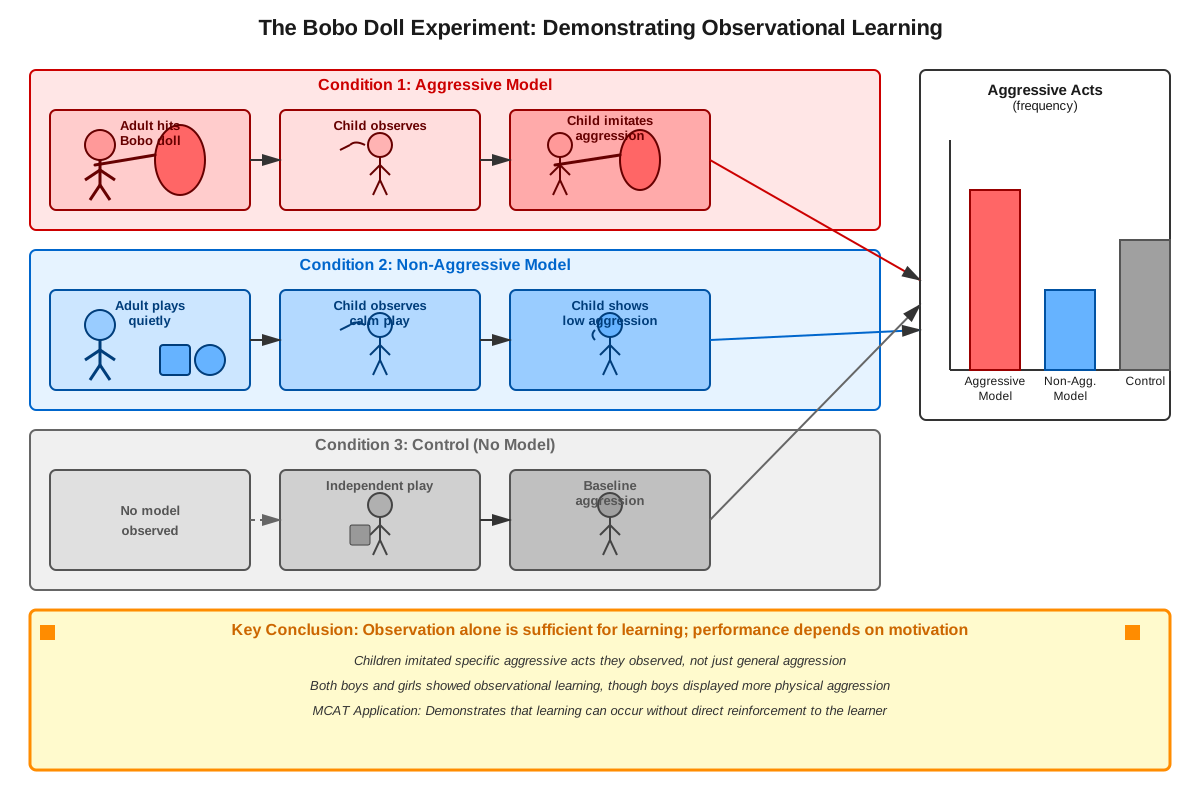
Albert Bandura's groundbreaking Bobo doll experiments (1961-1963) established observational learning as a distinct learning mechanism. In these studies, children who observed adults behaving aggressively toward an inflatable doll subsequently imitated those aggressive behaviors, even though the children received no direct reinforcement for aggression. This demonstrated that learning could occur through observation alone, challenging strict behaviorist views that all learning required direct reinforcement.
Bandura's Four Essential Processes
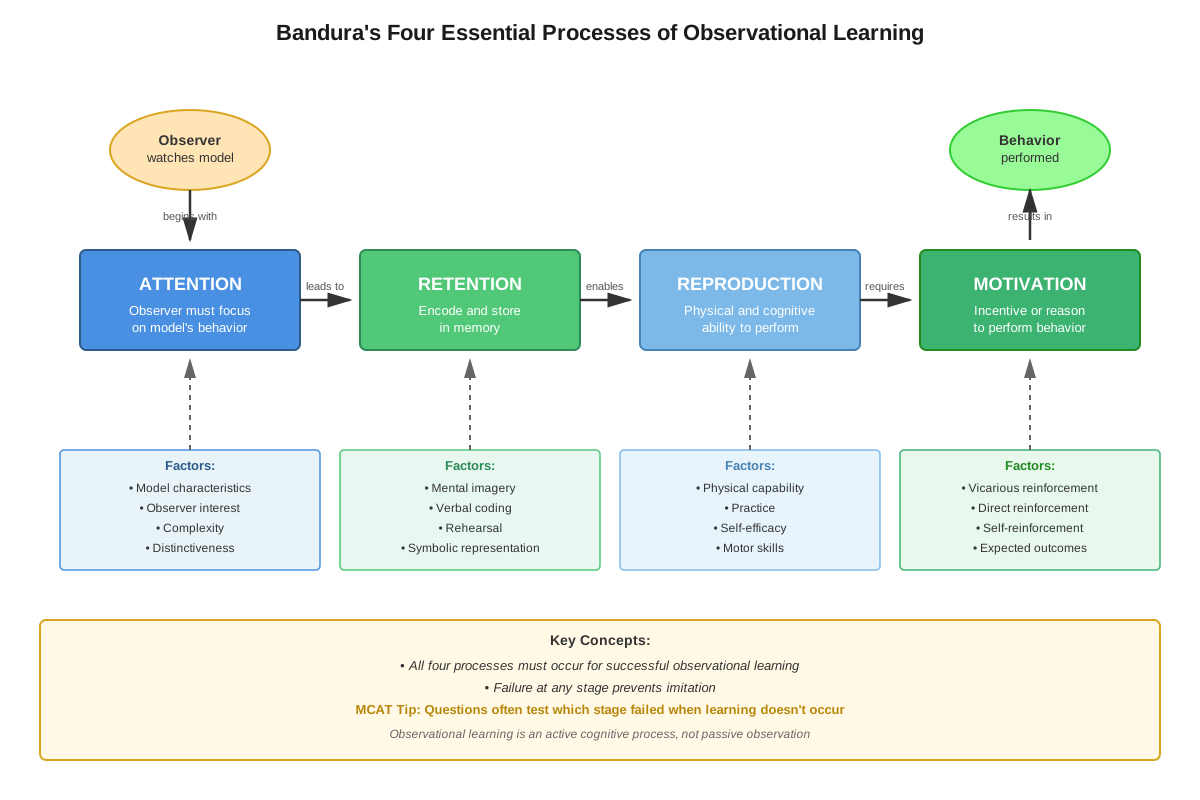
Bandura identified four cognitive processes necessary for observational learning to occur. All four must be present for successful learning and performance of observed behaviors:
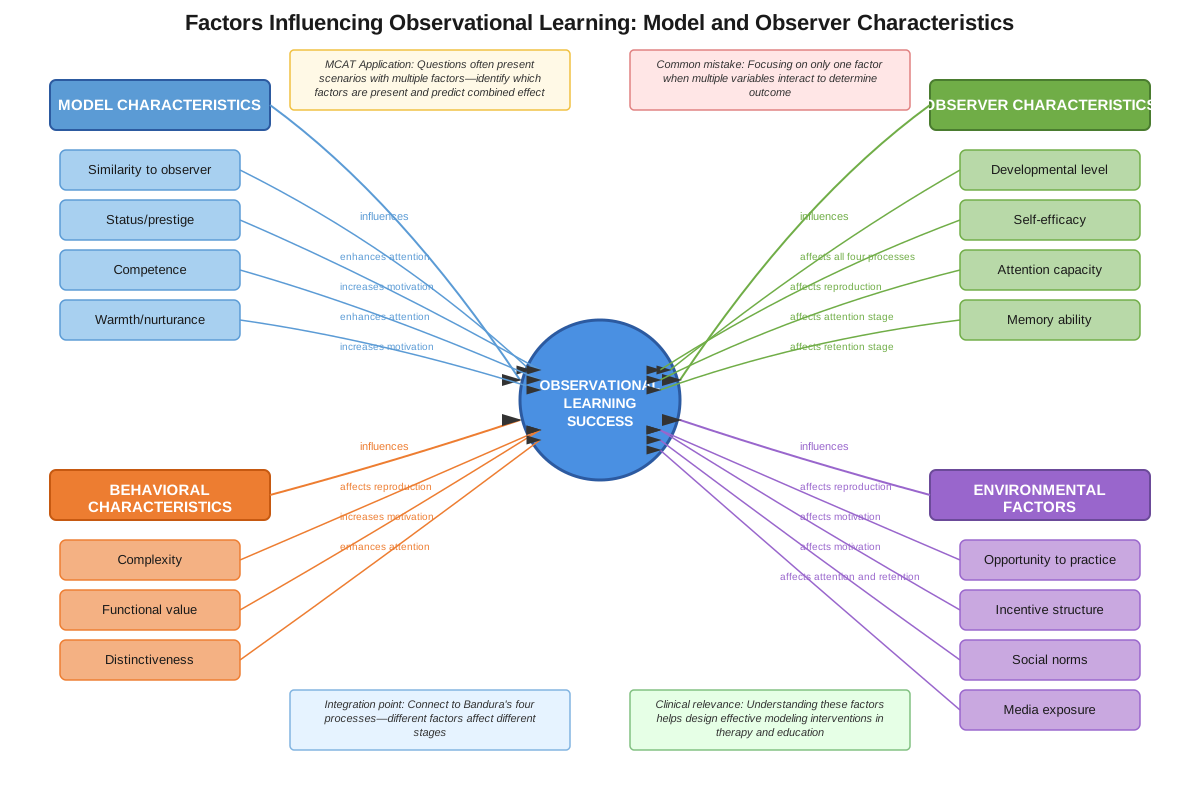
- Attention: The observer must actively focus on the model's behavior. Factors affecting attention include:
- Model characteristics (attractiveness, status, competence, similarity to observer)
- Observer characteristics (arousal level, perceptual abilities, past reinforcement)
- Behavior characteristics (distinctiveness, complexity, functional value)
- Situational factors (distractions, competing stimuli)
- Retention (Memory): The observer must encode and store a mental representation of the observed behavior in long-term memory. This involves:
- Symbolic coding (verbal or visual representations)
- Cognitive organization (chunking related actions)
- Mental rehearsal (imagining performing the behavior)
- Physical rehearsal (covert practice)
- Reproduction (Motor Skills): The observer must possess the physical and cognitive capabilities to reproduce the observed behavior. This includes:
- Physical ability to perform the actions
- Coordination and motor skills
- Self-observation during initial attempts
- Feedback and correction mechanisms
- Motivation: The observer must have sufficient incentive to perform the learned behavior. Motivation sources include:
- Direct reinforcement (receiving rewards for performing the behavior)
- Vicarious reinforcement (seeing the model rewarded)
- Self-reinforcement (internal satisfaction from performing the behavior)
Vicarious Reinforcement and Punishment
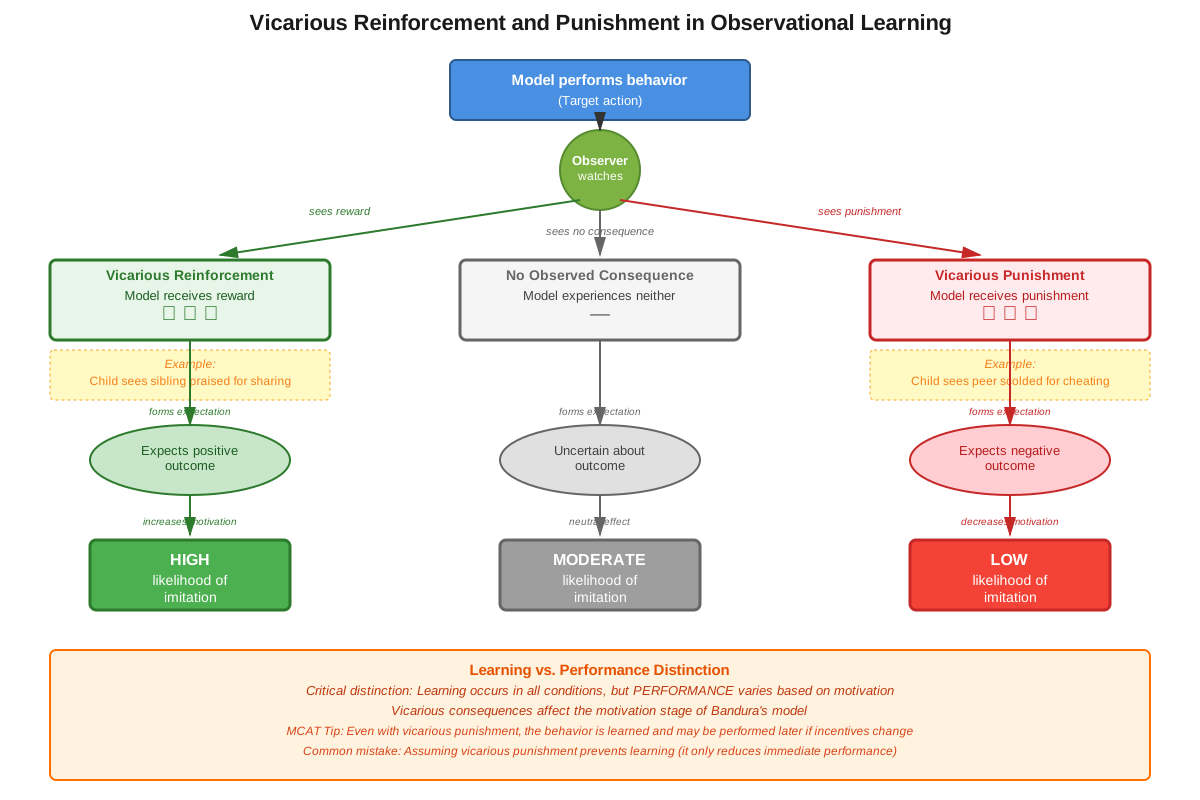
Vicarious reinforcement occurs when an observer witnesses a model receiving positive consequences for a behavior, increasing the likelihood the observer will imitate that behavior. Conversely, vicarious punishment occurs when an observer sees a model experiencing negative consequences, decreasing imitation likelihood. These vicarious consequences don't directly affect the observer but influence behavior through cognitive processing of expected outcomes.
Bandura distinguished between learning and performance: observers may learn a behavior through observation but only perform it when motivated by expected positive consequences. In the Bobo doll studies, children who observed a model being punished for aggression learned the aggressive behaviors (demonstrated when later offered rewards for showing what they remembered) but were less likely to spontaneously perform them compared to children who saw the model rewarded or experiencing no consequences.
Types of Models
Different model types influence observational learning effectiveness:
- Live models: Real people demonstrating behaviors in person (most powerful for complex skills)
- Symbolic models: Behaviors demonstrated through media, books, or verbal descriptions
- Verbal instruction models: Descriptions of behaviors without visual demonstration
- Synthesized models: Computer-generated or virtual reality demonstrations
Model characteristics significantly impact learning outcomes. Observers more readily imitate models who are:
- Similar to themselves (age, gender, ethnicity)
- High in status or prestige
- Perceived as competent or expert
- Warm and nurturing (especially for children)
- Rewarded for their behaviors
Comparison with Other Learning Forms
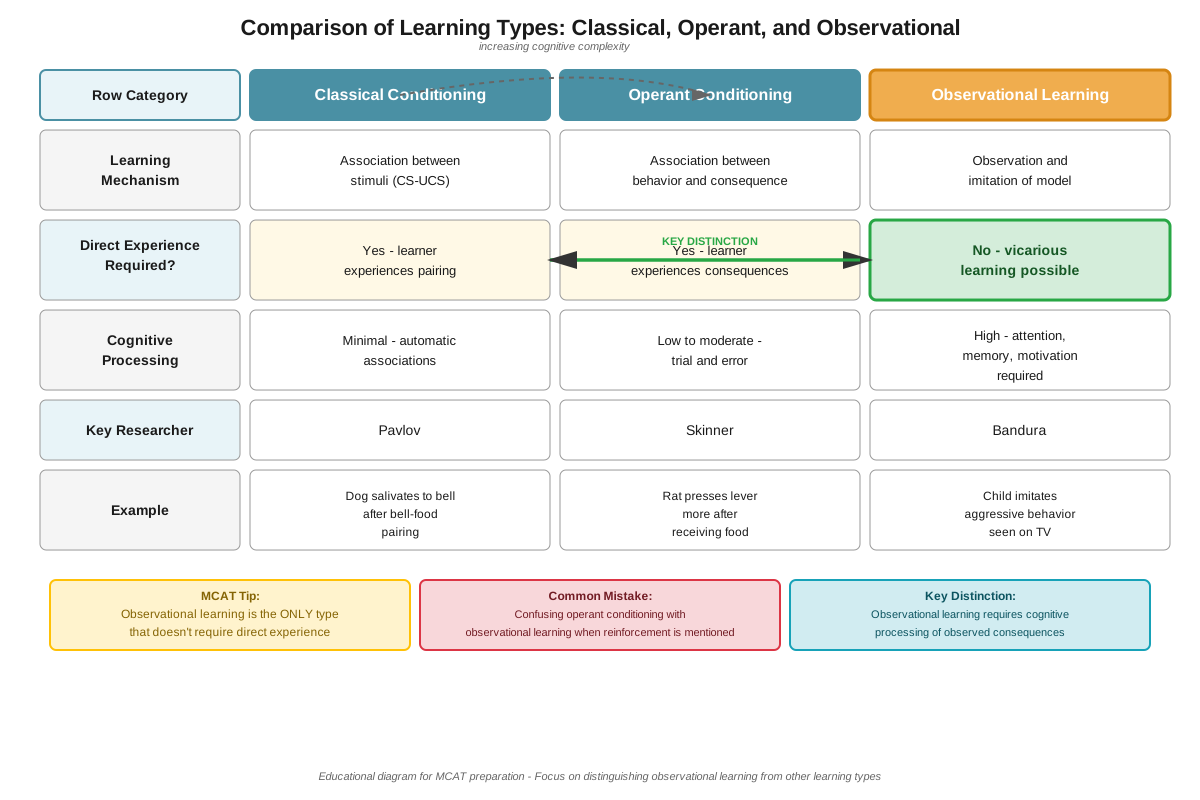
| Feature | Observational Learning | Classical Conditioning | Operant Conditioning |
|---|---|---|---|
| Learning mechanism | Watching others | Stimulus association | Consequences of own behavior |
| Reinforcement required | No (for learning) | No | Yes |
| Cognitive processing | Essential | Minimal | Variable |
| Social component | Required | Not required | Not required |
| Trial-and-error | Not necessary | Not applicable | Necessary |
| Timing | Can be delayed | Contiguous pairing needed | Immediate consequences most effective |
Applications and Real-World Examples
Observational learning manifests across numerous contexts:
- Language acquisition: Children learn vocabulary, grammar, and pronunciation by observing and imitating speakers
- Skill development: Medical students learn surgical techniques by observing experienced surgeons
- Fear acquisition: Children may develop phobias by observing parental fear reactions to stimuli (e.g., dogs, heights)
- Prosocial behavior: Observing charitable giving or helping behaviors increases likelihood of similar actions
- Aggressive behavior: Exposure to violent models (in person or media) can increase aggressive responses
- Health behaviors: Patients adopt medication adherence or exercise routines after observing successful peer models
- Cultural transmission: Social norms, traditions, and practices pass across generations through observation
Mirror Neurons and Biological Basis
Neuroscience research has identified mirror neurons—brain cells that activate both when performing an action and when observing another individual perform the same action. These neurons, discovered in primate motor cortex and later identified in human brains, provide a biological mechanism for observational learning. Mirror neuron systems may facilitate:
- Understanding others' intentions
- Empathy development
- Imitation and skill acquisition
- Language learning
This neurological substrate supports the cognitive-behavioral understanding that observational learning involves active mental processing rather than passive reception of information.
Concept Relationships
Observational learning connects to multiple psychological domains, creating an integrated understanding of human behavior and cognition. Within Learning and Memory, observational learning represents a distinct mechanism alongside classical and operant conditioning, yet it incorporates elements from both: like classical conditioning, it can produce emotional responses without direct experience; like operant conditioning, it's influenced by consequences (though vicariously experienced).
The relationship flows as follows: Attention (prerequisite cognitive process) → Observational learning (encoding observed behaviors) → Memory consolidation (retention process) → Behavioral performance (when motivated) → Potential reinforcement (which may strengthen future performance). This sequence demonstrates how observational learning bridges perception, memory, and behavior.
Observational learning connects bidirectionally with social psychology concepts. Social influence processes (conformity, obedience, compliance) often operate through observational mechanisms—individuals observe others' behaviors and consequences before conforming. Similarly, attitude formation can occur through observing others' expressed attitudes and resulting social outcomes. The concept of social facilitation (performance changes in others' presence) relates to observational learning through the awareness of being a potential model for observers.
In developmental psychology, observational learning explains critical aspects of socialization. Children's acquisition of gender roles, moral reasoning, and emotional regulation all involve observing and imitating models (parents, peers, media figures). Bandura's theory integrates with Piaget's cognitive development stages—as children develop more sophisticated cognitive abilities, their capacity for complex observational learning increases, including delayed imitation and abstract rule learning.
The connection to neuroscience through mirror neuron systems demonstrates how psychological processes have biological substrates. This relationship is particularly relevant for MCAT questions integrating multiple disciplines: Mirror neurons (biological) → Enable observational learning (psychological) → Facilitate social behavior (sociological).
High-Yield Facts
⭐ Observational learning can occur without the observer performing the behavior or receiving any direct reinforcement—learning and performance are distinct processes.
⭐ Bandura's four essential processes for observational learning are: attention, retention, reproduction, and motivation (remember: ARRM).
⭐ Vicarious reinforcement increases the likelihood of imitation, while vicarious punishment decreases it, even though the observer experiences no direct consequences.
⭐ The Bobo doll experiments demonstrated that children readily imitate aggressive behaviors observed in adult models, establishing observational learning as a distinct mechanism.
⭐ Observers are more likely to imitate models who are similar to themselves, have high status, demonstrate competence, or are rewarded for their behaviors.
- Mirror neurons provide a neurological basis for observational learning by activating during both action performance and action observation.
- Observational learning differs from classical conditioning because it doesn't require stimulus pairing and differs from operant conditioning because it doesn't require the learner to perform the behavior initially.
- Children can acquire fears and phobias through observational learning by watching others' fearful reactions, without direct negative experiences with the feared stimulus.
- Modeling is most effective when the observed behavior is clearly demonstrated, the model is perceived as credible, and the observer has opportunities for practice with feedback.
- Observational learning plays a crucial role in cultural transmission, allowing complex behaviors, traditions, and social norms to pass across generations without each individual requiring direct trial-and-error experience.
Quick check — test yourself on Observational learning so far.
Try Flashcards →Common Misconceptions
Misconception: Observational learning requires the observer to immediately perform the behavior they've observed.
Correction: Learning and performance are separate processes. An individual can learn a behavior through observation and retain it in memory without ever performing it. Performance depends on motivation, which may arise much later than the initial observation. Bandura demonstrated this by showing that children who observed punished aggression had learned the behaviors (revealed when offered rewards) but didn't spontaneously perform them.
Misconception: Observational learning is the same as operant conditioning because both involve learning behaviors.
Correction: Operant conditioning requires the learner to perform a behavior and experience direct consequences (reinforcement or punishment), while observational learning occurs through watching others without personal performance or direct consequences. Observational learning is inherently social and cognitive, whereas operant conditioning can occur in isolation through trial-and-error.
Misconception: If someone observes a behavior, they will automatically imitate it.
Correction: Imitation depends on all four of Bandura's processes being present. Even if attention, retention, and reproduction capabilities exist, without motivation (often influenced by vicarious consequences), the behavior won't be performed. Additionally, factors like the model's characteristics and the observer's values influence whether imitation occurs.
Misconception: Observational learning only applies to children and doesn't affect adult behavior.
Correction: Observational learning operates throughout the lifespan. Adults learn professional skills through mentorship and modeling, adopt health behaviors by observing peers, and modify social behaviors based on observed consequences to others. Medical education, professional training, and behavioral interventions all leverage observational learning principles with adult populations.
Misconception: Vicarious reinforcement means the observer receives the same reward as the model.
Correction: Vicarious reinforcement means the observer witnesses the model being rewarded, which increases the observer's likelihood of imitation through cognitive processing of expected outcomes. The observer doesn't receive any direct reward during the observation phase—the effect is entirely cognitive, based on anticipated consequences if they perform the behavior.
Misconception: Observational learning is purely behavioral and doesn't involve cognitive processes.
Correction: Observational learning is fundamentally cognitive, requiring mental representation, symbolic encoding, memory storage, and decision-making about whether to perform observed behaviors. Bandura's social learning theory explicitly challenged strict behaviorism by demonstrating that learning involves cognitive mediation between observation and behavior.
Worked Examples
Example 1: Identifying Observational Learning Components
Scenario: A medical student watches an experienced surgeon perform a laparoscopic appendectomy. The student pays close attention to the hand movements, instrument positioning, and procedural sequence. Later, the student mentally rehearses the steps while reviewing surgical videos. During the next surgery, the attending surgeon praises the student's technique when they successfully perform a similar procedure. However, when the student attempts a more complex procedure they've only briefly observed once, they struggle with the technique.
Analysis:
Step 1: Identify the learning type. This scenario involves learning through observation of a model (experienced surgeon), making it observational learning rather than classical or operant conditioning.
Step 2: Apply Bandura's four processes:
- Attention: Present—the student "pays close attention" to specific aspects of the procedure
- Retention: Present—the student encodes the information and engages in "mental rehearsal," demonstrating memory storage
- Reproduction: Present for the first procedure (student "successfully performs"), but limited for the complex procedure
- Motivation: Present—the attending's praise provides reinforcement, increasing likelihood of future performance
Step 3: Explain the differential outcomes. The student successfully performs the appendectomy because all four processes were adequately present. The struggle with the complex procedure likely reflects insufficient attention during the single observation and inadequate retention, demonstrating that brief exposure may not provide sufficient encoding for complex skills.
Step 4: Identify additional factors. The experienced surgeon serves as a high-status, competent model, enhancing observational learning effectiveness. The praise represents direct reinforcement for performance, which differs from vicarious reinforcement but still motivates continued practice.
Connection to learning objectives: This example demonstrates how to apply observational learning principles to clinical scenarios, identify when each of Bandura's four processes is present or absent, and distinguish observational learning from other learning types.
Example 2: Distinguishing Learning Types in a Complex Scenario
Scenario: A 6-year-old child accompanies their parent to the dentist. The parent appears calm and relaxed during the dental cleaning. The child observes the dentist using various instruments and the parent's positive reactions. Two weeks later, during the child's own dental appointment, the child remains calm and cooperative. The dentist gives the child a sticker afterward, and the child looks forward to future appointments.
Analysis:
Step 1: Identify multiple learning mechanisms operating simultaneously.
Observational learning components:
- Model: The parent serves as a model demonstrating calm behavior
- Attention: The child observes the parent's reactions and the dental procedures
- Retention: The child remembers the observed calm behavior
- Reproduction: The child imitates the calm, cooperative behavior
- Motivation: Vicarious reinforcement occurs through observing the parent's positive experience (no pain, successful completion)
Step 2: Identify the operant conditioning component. The sticker represents direct positive reinforcement for the child's cooperative behavior, increasing the likelihood of future cooperation. This is operant conditioning because the child receives a direct consequence for their own behavior.
Step 3: Consider what's NOT present. Classical conditioning would involve pairing a neutral stimulus with an unconditioned stimulus to produce a conditioned response. While the dental office (neutral stimulus) might become associated with positive experiences, the primary learning mechanism here is observational learning from the parent model, not automatic stimulus-response pairing.
Step 4: Predict outcomes under different conditions. If the child had observed the parent showing fear and pain (vicarious punishment), the child would likely have learned the same behaviors but been less motivated to perform them, possibly showing anxiety or resistance. This demonstrates how vicarious consequences influence performance even when the behavior is learned.
Step 5: Explain the developmental appropriateness. At age 6, children have sufficient cognitive development for observational learning, including the ability to encode behaviors, retain them over time (two weeks), and understand cause-effect relationships between behaviors and consequences.
Connection to learning objectives: This example requires distinguishing between observational learning and operant conditioning, understanding how vicarious reinforcement operates, and applying observational learning principles to predict behavior in modified scenarios—all high-yield skills for MCAT questions.
Exam Strategy
When approaching observational learning MCAT questions, employ these strategic approaches:
Trigger word identification: Watch for phrases indicating observational learning: "watched," "observed," "modeled after," "imitated," "saw someone else," "witnessed," "role model," "demonstration," or "vicarious." These signal that the question involves social learning rather than direct experience. Conversely, phrases like "experienced directly," "received reinforcement," "was punished," or "paired with" suggest operant or classical conditioning.
Process of elimination strategy: When answer choices list different learning types, systematically eliminate based on key distinctions:
- Does the scenario involve watching another person? If no, eliminate observational learning.
- Does learning occur without the individual performing the behavior? If yes, eliminate operant conditioning.
- Are there two stimuli being paired? If no, eliminate classical conditioning.
- Is there a social/model component? If yes, favor observational learning.
Bandura's four processes as a checklist: For questions asking what's missing or what would enhance observational learning, mentally check each process:
- Attention: Are there distractions? Is the model salient?
- Retention: Is there opportunity for rehearsal? Is the behavior complex?
- Reproduction: Does the observer have necessary skills?
- Motivation: Are there vicarious or direct consequences?
The process most commonly disrupted in MCAT scenarios is motivation—observers learn behaviors but don't perform them due to lack of incentive or presence of vicarious punishment.
Passage-based question approach: When passages describe research studies on modeling or social learning:
- Identify the independent variable (often model characteristics or consequences)
- Identify the dependent variable (usually imitation rate or behavior frequency)
- Determine which of Bandura's processes the study manipulates
- Consider alternative explanations (could it be operant conditioning instead?)
Time allocation: Discrete observational learning questions should take 60-75 seconds. They typically test definitional knowledge or straightforward application. Passage-based questions may require 90-120 seconds as they involve integrating passage information with observational learning principles.
Common question formats to expect:
- "Which of the following best exemplifies observational learning?" (requires distinguishing from other learning types)
- "According to Bandura's social learning theory, which process is most likely impaired?" (requires identifying missing ARRM component)
- "The child's behavior is best explained by..." (requires recognizing observational learning in a scenario)
- "Which factor would most increase the likelihood of imitation?" (tests knowledge of model characteristics and vicarious consequences)
Exam Tip: If a question describes someone learning without performing and without direct consequences, observational learning is almost certainly the answer. The absence of personal experience is the key distinguishing feature.
Memory Techniques
ARRM Mnemonic for Bandura's four processes:
- Attention: Must focus on the model
- Retention: Remember what was observed
- Reproduction: Replicate the motor skills
- Motivation: Must want to perform it
Visualization: Imagine your ARM reaching out to grab knowledge from a model, with the extra R representing the mental "recording" (retention) that happens.
"See-Store-Show-So What?" for the process sequence:
- See: Attention to the model
- Store: Retention in memory
- Show: Reproduction of behavior
- So What?: Motivation (what's in it for me?)
Vicarious Consequences Mnemonic: "Viewing Others' Outcomes Modifies My Behavior"
- Vicarious reinforcement → Observe Others getting rewards → Motivates My imitation
- Vicarious punishment → Observe Others getting punished → Blocks My imitation
Model Characteristics - "SSCREW" (models that are most imitated):
- Similar to observer
- Status (high)
- Competent
- Rewarded
- Expert
- Warm/nurturing
Distinguishing Learning Types - "DOP" test:
- Direct experience required? → If NO, likely observational learning
- Own behavior performed? → If NO, definitely observational learning
- Paired stimuli? → If YES, classical conditioning; if consequences follow behavior, operant conditioning
Bobo Doll Study Memory Aid: "Bandura Observed Behavior Occurs without direct reinforcement" - The study name itself reminds you of the key finding.
Summary
Observational learning represents a fundamental mechanism through which individuals acquire behaviors, skills, and knowledge by watching and encoding others' actions and their consequences, without requiring direct personal experience or reinforcement. Albert Bandura's social learning theory established that this process requires four essential cognitive components—attention, retention, reproduction, and motivation—all of which must be present for successful learning and performance. Unlike classical conditioning (which requires stimulus pairing) or operant conditioning (which requires direct consequences for one's own behavior), observational learning is inherently social and cognitive, involving mental representation and vicarious processing of observed outcomes. Vicarious reinforcement increases imitation likelihood when observers see models rewarded, while vicarious punishment decreases it when models experience negative consequences. Model characteristics significantly influence learning effectiveness, with observers more readily imitating similar, high-status, competent, and rewarded models. This learning mechanism operates throughout the lifespan, explaining phenomena from childhood language acquisition and fear development to adult professional skill learning and health behavior adoption, making it essential for understanding human development, social influence, behavioral interventions, and cultural transmission.
Key Takeaways
- Observational learning occurs through watching others without requiring the observer to perform the behavior or receive direct reinforcement—learning and performance are distinct processes
- Bandura's four essential processes (ARRM: Attention, Retention, Reproduction, Motivation) must all be present for successful observational learning and behavioral performance
- Vicarious reinforcement and vicarious punishment influence imitation likelihood through cognitive processing of observed consequences, not through direct experience
- Observational learning differs fundamentally from classical conditioning (no stimulus pairing required) and operant conditioning (no direct behavioral consequences required)
- Model characteristics—particularly similarity, status, competence, and whether the model is rewarded—significantly affect the likelihood and effectiveness of observational learning
- Mirror neurons provide a biological substrate for observational learning, activating during both action performance and observation
- The Bobo doll experiments definitively established observational learning as a distinct mechanism, demonstrating that children imitate aggressive behaviors observed in models even without reinforcement
Related Topics
Classical Conditioning: Understanding Pavlovian learning through stimulus association provides essential contrast to observational learning and helps distinguish these mechanisms on the MCAT. Mastering observational learning enables recognition of when learning occurs without stimulus pairing.
Operant Conditioning: Knowledge of reinforcement and punishment schedules complements observational learning, particularly in understanding how direct consequences differ from vicarious consequences and how both can shape behavior.
Social Influence: Conformity, obedience, and compliance often operate through observational mechanisms. Understanding observational learning provides the foundation for analyzing how social pressures modify behavior through modeling.
Cognitive Development: Piaget's stages and information processing theories explain how observational learning capabilities change across development, particularly the increasing sophistication of attention, retention, and symbolic representation.
Mirror Neuron Systems: Neuroscience research on the biological basis of imitation and empathy extends observational learning into the biological foundations of behavior, a common MCAT integration point.
Behavioral Therapy Techniques: Systematic desensitization, modeling therapy, and social skills training all apply observational learning principles, making this topic essential for understanding clinical interventions.
Media Effects on Behavior: Research on how television, video games, and social media influence behavior through modeling directly applies observational learning theory to contemporary social issues frequently tested on the MCAT.
Practice CTA
Now that you've mastered the core concepts of observational learning, it's time to solidify your understanding through active practice. Challenge yourself with MCAT-style practice questions that require you to distinguish observational learning from other learning types, identify which of Bandura's four processes is operating in complex scenarios, and apply vicarious reinforcement principles to predict behavior. Work through flashcards focusing on high-yield distinctions, model characteristics, and the ARRM mnemonic until you can instantly recognize observational learning in any context. Remember: understanding the theory is just the first step—exam success comes from repeatedly applying these concepts to varied scenarios until pattern recognition becomes automatic. You've built a strong foundation; now transform that knowledge into test-day confidence through deliberate practice!
Sign up free to keep reading
Create a free AnvayaPrep account to finish this MCAT guide on Observational learning — plus flashcards and practice questions.