Overview
Operant conditioning is a fundamental learning theory in Psychology that explains how behaviors are acquired, maintained, or eliminated through consequences. Developed by B.F. Skinner, this paradigm demonstrates that organisms learn to associate voluntary behaviors with outcomes—either reinforcements that increase behavior frequency or punishments that decrease it. Unlike classical conditioning, which involves involuntary reflexive responses to stimuli, operant conditioning focuses on voluntary behaviors that "operate" on the environment to produce specific consequences. This distinction is critical for MCAT success, as test-makers frequently present scenarios requiring students to differentiate between these two learning mechanisms.
For the MCAT, operant conditioning represents one of the highest-yield topics within Learning and Memory. The exam consistently features passages and discrete questions requiring students to identify reinforcement schedules, distinguish between positive and negative reinforcement, recognize punishment types, and apply these principles to behavioral modification scenarios. Understanding operant conditioning provides the foundation for comprehending more complex psychological phenomena, including habit formation, addiction, therapeutic interventions, and social learning processes that appear throughout the Psychology/Sociology section.
The significance of operant conditioning extends beyond isolated learning theory questions. This concept integrates with motivation, emotion, social psychology, and even biological bases of behavior. For instance, the dopaminergic reward pathways in the brain provide the neurobiological substrate for reinforcement learning, connecting operant conditioning to neuroscience. Similarly, understanding how behaviors are shaped through successive approximations helps explain skill acquisition in medical training contexts—a theme the MCAT explores through clinical vignettes. Mastering operant conditioning equips students to analyze behavioral patterns across diverse contexts, from patient compliance with medication regimens to organizational behavior in healthcare settings.
Learning Objectives
- [ ] Define Operant conditioning using accurate Psychology terminology
- [ ] Explain why Operant conditioning matters for the MCAT
- [ ] Apply Operant conditioning to exam-style questions
- [ ] Identify common mistakes related to Operant conditioning
- [ ] Connect Operant conditioning to related Psychology concepts
- [ ] Distinguish between the four types of operant conditioning consequences (positive reinforcement, negative reinforcement, positive punishment, negative punishment)
- [ ] Analyze and compare different reinforcement schedules and predict their effects on behavior
- [ ] Evaluate real-world scenarios to determine which operant conditioning principles are being applied
Prerequisites
- Basic understanding of learning theory: Necessary to distinguish operant conditioning from other learning mechanisms like classical conditioning
- Familiarity with stimulus-response relationships: Provides the foundation for understanding how consequences modify behavior
- Knowledge of behavioral terminology: Essential for interpreting terms like "acquisition," "extinction," and "spontaneous recovery" in the operant context
- Understanding of experimental design: Helps interpret Skinner box experiments and other operant conditioning research paradigms
Why This Topic Matters
Clinical and Real-World Significance
Operant conditioning principles underpin numerous therapeutic interventions and behavioral health strategies. Applied Behavior Analysis (ABA), widely used for autism spectrum disorders, relies entirely on operant conditioning techniques. Token economies in psychiatric facilities use positive reinforcement to encourage adaptive behaviors. Substance abuse treatment programs incorporate extinction and punishment principles to reduce drug-seeking behaviors. Medical professionals apply these principles when designing patient adherence programs—for example, providing positive reinforcement (praise, rewards) when patients consistently take medications or attend physical therapy sessions.
Beyond clinical settings, operant conditioning explains everyday phenomena from workplace productivity systems (bonuses as positive reinforcement) to parenting strategies (time-outs as negative punishment). Understanding these principles allows healthcare providers to design more effective interventions, communicate behavioral expectations clearly, and troubleshoot when behavioral change efforts fail.
MCAT Examination Statistics
Operant conditioning appears in approximately 3-5 questions per MCAT Psychology/Sociology section, making it one of the most frequently tested topics within Learning and Memory. Questions typically fall into three categories:
- Discrete questions (40%): Direct testing of definitions, reinforcement schedules, or distinguishing reinforcement from punishment
- Passage-based application questions (50%): Scenarios describing behavioral interventions, animal learning experiments, or clinical cases requiring identification of operant principles
- Research interpretation questions (10%): Analysis of experimental designs testing operant conditioning hypotheses
The MCAT particularly favors questions that require distinguishing positive from negative reinforcement (a common confusion point) and identifying reinforcement schedules from behavioral response patterns. Expect to see operant conditioning integrated with topics like motivation, emotion, social processes, and biological bases of behavior.
Common Exam Presentation Formats
- Animal learning experiments: Passages describing rats in Skinner boxes, pigeons pecking keys, or other laboratory paradigms
- Clinical vignettes: Behavioral therapy scenarios, patient compliance programs, or addiction treatment protocols
- Educational settings: Teacher-student interactions demonstrating reinforcement or punishment
- Workplace scenarios: Employee motivation systems, performance management, or organizational behavior
- Developmental contexts: Parenting strategies, child behavior modification, or socialization processes
Core Concepts
Fundamental Definition and Mechanism
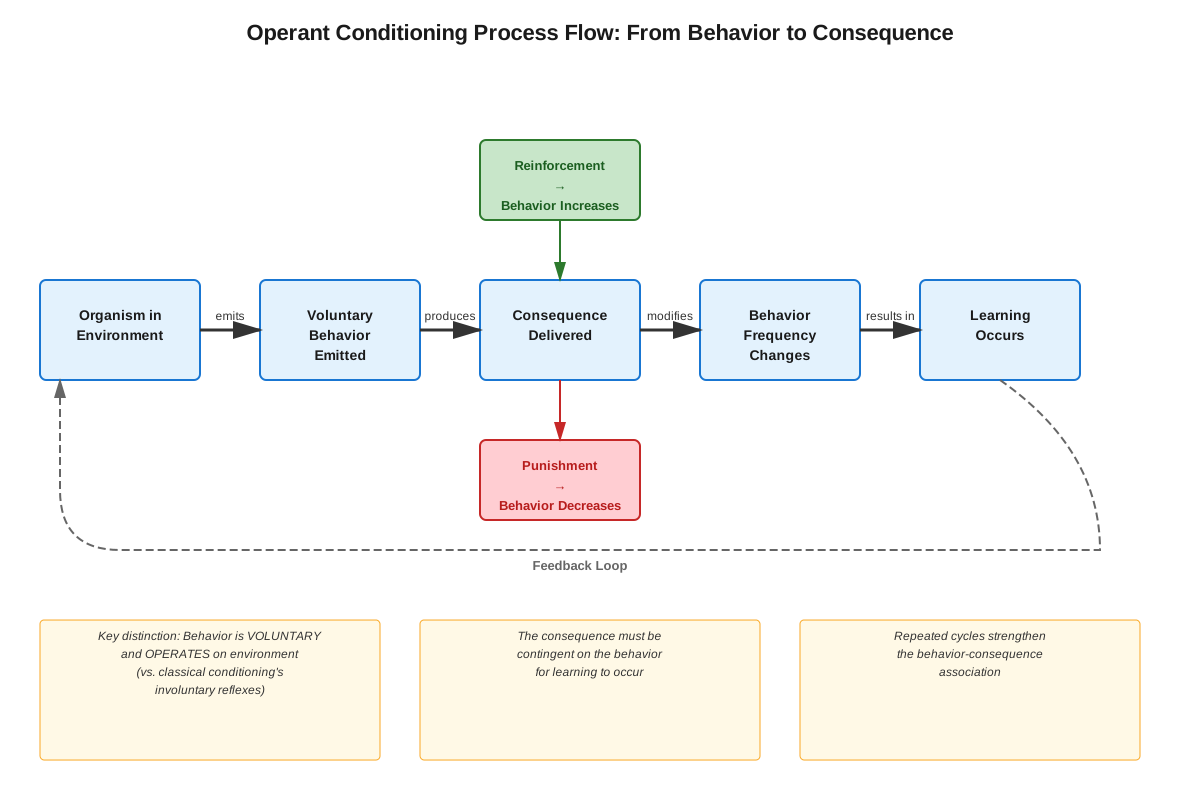
Operant conditioning (also called instrumental conditioning) is a learning process through which the strength of a behavior is modified by its consequences. The term "operant" emphasizes that the organism actively "operates" on the environment—the behavior is voluntary rather than reflexive. B.F. Skinner, building on Edward Thorndike's Law of Effect, systematically studied how consequences shape behavior using controlled laboratory environments, most famously the Skinner box (operant conditioning chamber).
The fundamental mechanism involves three components:
- Antecedent: The environmental context or discriminative stimulus signaling that a behavior will have consequences
- Behavior: The voluntary action performed by the organism
- Consequence: The outcome following the behavior that influences future probability of that behavior
This ABC model (Antecedent-Behavior-Consequence) provides the framework for analyzing all operant conditioning scenarios on the MCAT.
The Four Types of Consequences
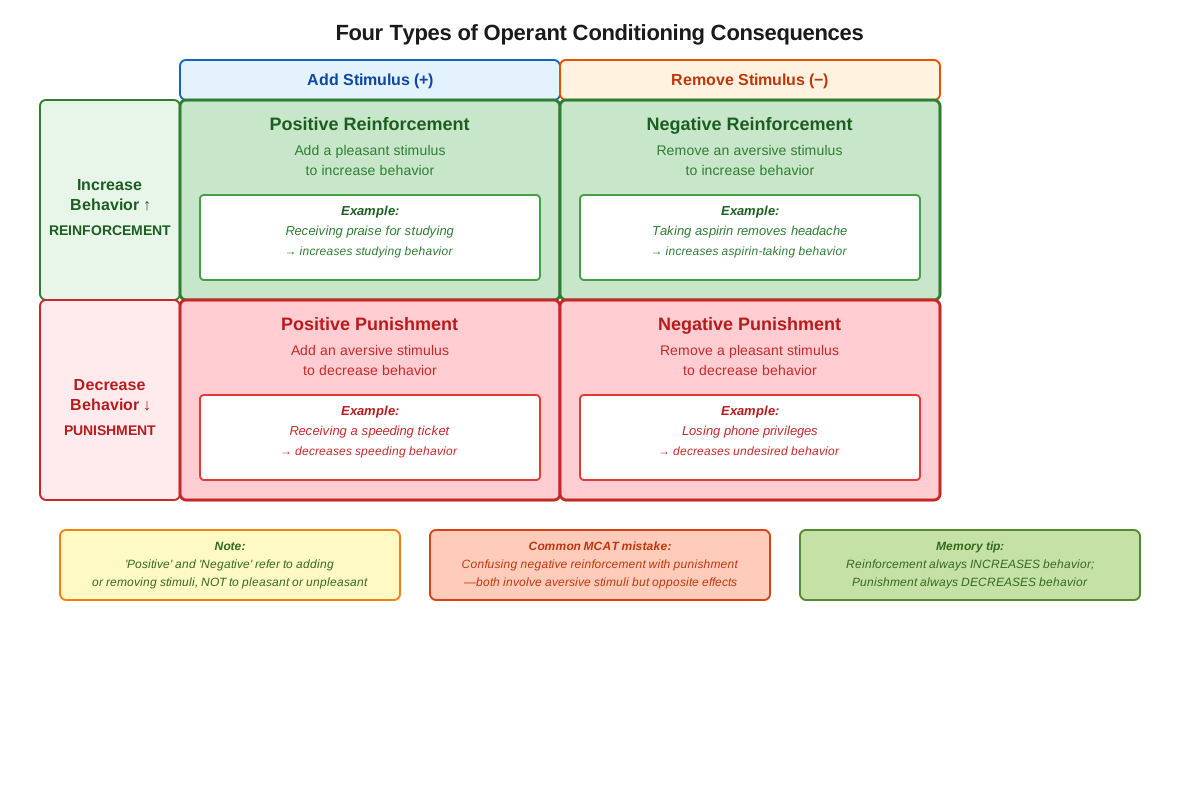
Operant conditioning consequences fall into four categories based on two dimensions: whether something is added or removed (positive vs. negative) and whether the behavior increases or decreases (reinforcement vs. punishment).
| Consequence Type | Definition | Effect on Behavior | Example |
|---|---|---|---|
| Positive Reinforcement | Adding a desirable stimulus | Increases behavior | Giving a child candy for completing homework |
| Negative Reinforcement | Removing an aversive stimulus | Increases behavior | Taking aspirin removes headache pain, increasing aspirin-taking |
| Positive Punishment | Adding an aversive stimulus | Decreases behavior | Scolding a dog for jumping on furniture |
| Negative Punishment | Removing a desirable stimulus | Decreases behavior | Taking away video game privileges for poor grades |
Critical distinction: "Positive" and "negative" refer to adding (+) or subtracting (−) stimuli, NOT to whether the consequence is pleasant or unpleasant. "Reinforcement" always increases behavior; "punishment" always decreases behavior. This terminology confusion represents the single most common error on MCAT questions.
Positive Reinforcement
Positive reinforcement occurs when a behavior is followed by the presentation of a desirable stimulus, increasing the likelihood of that behavior recurring. The reinforcer must be contingent on the behavior (occur because of it) and must actually increase behavior frequency to qualify as reinforcement.
Primary reinforcers satisfy biological needs (food, water, warmth) and require no learning to be effective. Secondary reinforcers (conditioned reinforcers) acquire reinforcing properties through association with primary reinforcers—money, praise, grades, and tokens are common examples. The most powerful secondary reinforcer is often social approval.
The Premack Principle states that high-probability behaviors can reinforce low-probability behaviors. For example, "First eat your vegetables (low-probability), then you can have dessert (high-probability)" uses dessert as a reinforcer for vegetable consumption.
Negative Reinforcement
Negative reinforcement strengthens behavior through the removal or avoidance of an aversive stimulus. This concept is frequently misunderstood as punishment, but remember: reinforcement always increases behavior. Two subtypes exist:
- Escape learning: The organism performs a behavior to terminate an ongoing aversive stimulus (taking pain medication to stop a headache)
- Avoidance learning: The organism performs a behavior to prevent an aversive stimulus from occurring (studying to avoid failing an exam)
Negative reinforcement explains many persistent behaviors, including maladaptive ones. For instance, a person with social anxiety who avoids parties experiences negative reinforcement—the avoidance behavior is strengthened because it removes anxiety. This mechanism maintains phobias and anxiety disorders, making negative reinforcement clinically significant.
Positive Punishment
Positive punishment (punishment by application) decreases behavior by presenting an aversive stimulus following the behavior. Examples include spanking, verbal reprimands, electric shocks in animal studies, or receiving a speeding ticket. While punishment can rapidly suppress behavior, it has significant limitations:
- Does not teach alternative appropriate behaviors
- May produce emotional side effects (fear, anxiety, aggression)
- Effects often temporary; behavior may resume when punisher is absent
- Can damage relationships between punisher and punished individual
- May lead to learned helplessness if inescapable
For these reasons, behavioral psychologists generally recommend reinforcement-based strategies over punishment when possible.
Negative Punishment
Negative punishment (punishment by removal) decreases behavior by removing a desirable stimulus. Common examples include time-outs (removing access to reinforcing activities), response cost systems (losing points or privileges), and grounding teenagers (removing social opportunities).
Omission training is a specific negative punishment procedure where a positive reinforcer is withheld if an undesired behavior occurs. For example, a child loses dessert privileges if they misbehave at dinner.
Negative punishment tends to produce fewer negative emotional side effects than positive punishment and is often preferred in applied settings. However, it still shares punishment's limitation of not teaching what to do instead.
Reinforcement Schedules
Reinforcement schedules determine the pattern and timing of reinforcement delivery. These schedules profoundly affect acquisition rate, response rate, and resistance to extinction. The MCAT frequently tests schedule identification and prediction of behavioral patterns.
Continuous Reinforcement
Continuous reinforcement (CRF) provides reinforcement after every correct response. This schedule produces rapid initial learning but also rapid extinction when reinforcement stops. CRF is ideal for establishing new behaviors but impractical for maintaining them long-term.
Partial (Intermittent) Reinforcement
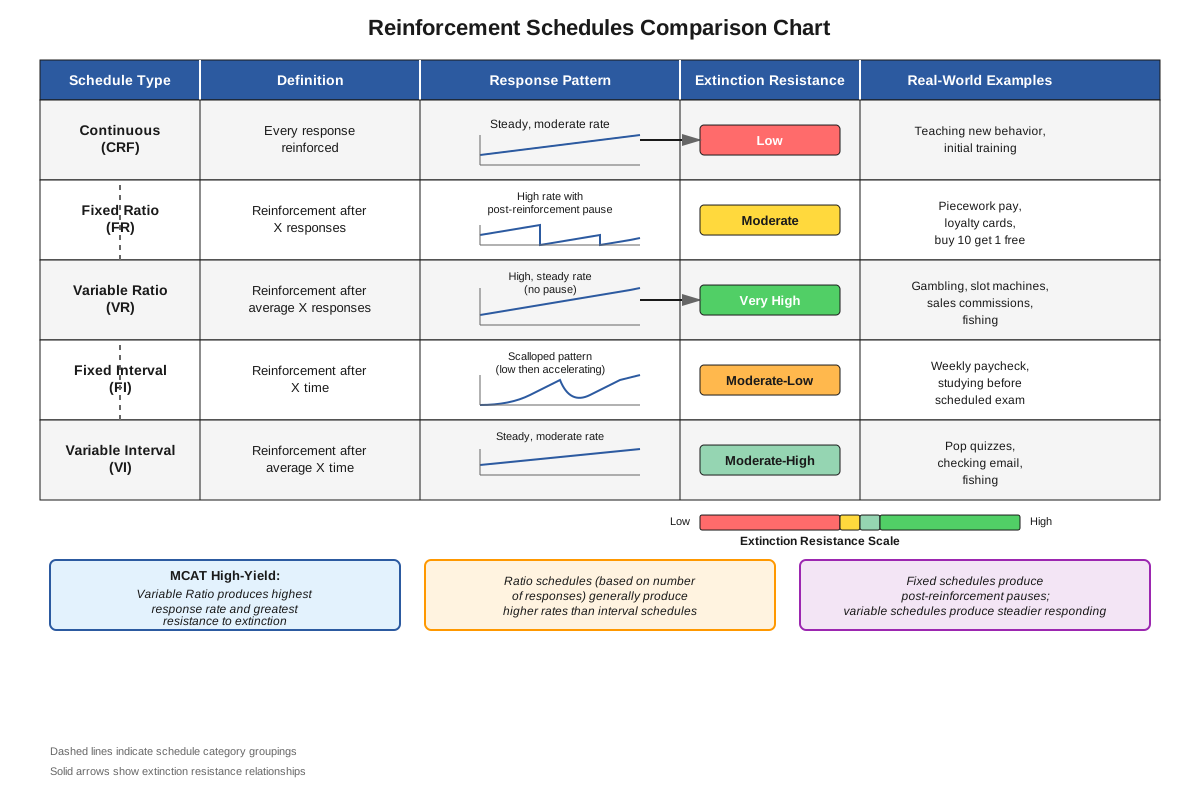
Partial reinforcement provides reinforcement only some of the time. These schedules produce slower initial acquisition but much greater resistance to extinction—the partial reinforcement effect. Four main types exist:
Fixed-Ratio (FR) Schedule: Reinforcement occurs after a set number of responses (e.g., FR-5 means reinforcement after every 5 responses). This produces high, steady response rates with a brief pause after reinforcement (post-reinforcement pause). Example: Piecework pay systems where workers earn money for every 10 items produced.
Variable-Ratio (VR) Schedule: Reinforcement occurs after an unpredictable number of responses averaging around a set value (e.g., VR-10 means reinforcement after an average of 10 responses, but could be 3, then 15, then 8). This produces the highest, most consistent response rates with no pausing and extreme resistance to extinction. Example: Slot machines and gambling—the unpredictability maintains persistent behavior.
Fixed-Interval (FI) Schedule: Reinforcement is available after a set time period, but only if the response occurs (e.g., FI-30s means the first response after 30 seconds is reinforced). This produces a characteristic "scalloped" response pattern—low responding immediately after reinforcement, then accelerating as the interval ends. Example: Checking email—if you check every 30 minutes, you'll find new messages, but checking more frequently doesn't produce more reinforcement.
Variable-Interval (VI) Schedule: Reinforcement becomes available after unpredictable time intervals averaging around a set value (e.g., VI-60s means reinforcement available after an average of 60 seconds, but varying). This produces moderate, steady response rates without pausing. Example: Fishing—you don't know when a fish will bite, so you maintain consistent attention.
| Schedule | Response Rate | Pattern | Extinction Resistance | Example |
|---|---|---|---|---|
| Continuous | Moderate | Steady | Low | Training a new behavior |
| Fixed-Ratio | High | Pause after reinforcement | Moderate | Piecework pay |
| Variable-Ratio | Very High | Steady, no pausing | Very High | Gambling |
| Fixed-Interval | Low to Moderate | Scalloped (accelerating) | Moderate | Weekly quizzes |
| Variable-Interval | Moderate | Steady | High | Pop quizzes |
Shaping and Successive Approximations
Shaping is the process of reinforcing successive approximations toward a target behavior. This technique allows training of complex behaviors that would never occur spontaneously. The trainer reinforces behaviors increasingly similar to the desired final behavior, gradually raising the criterion for reinforcement.
For example, teaching a rat to press a lever might involve:
- Reinforcing the rat for facing the lever
- Reinforcing only when approaching the lever
- Reinforcing only when touching the lever
- Reinforcing only when pressing the lever
Shaping explains skill acquisition in humans, from learning to speak (parents reinforce increasingly accurate word approximations) to mastering surgical techniques (instructors reinforce progressively more precise movements).
Extinction and Spontaneous Recovery
Extinction in operant conditioning occurs when a previously reinforced behavior no longer produces reinforcement, leading to decreased behavior frequency. Unlike classical conditioning extinction (which involves breaking stimulus associations), operant extinction involves the behavior-consequence relationship.
During extinction, several phenomena occur:
- Extinction burst: Temporary increase in behavior frequency and intensity when reinforcement first stops (a child throws a bigger tantrum when tantrums stop working)
- Variability: The organism tries variations of the behavior
- Emotional responding: Frustration, aggression, or other emotional reactions
- Spontaneous recovery: After a rest period, the extinguished behavior may briefly reappear
The partial reinforcement effect means behaviors learned on intermittent schedules resist extinction much longer than those learned on continuous reinforcement—the organism cannot easily distinguish between extinction and a long interval between reinforcements.
Discriminative Stimuli and Stimulus Control
Discriminative stimuli (SD) are environmental cues signaling that a behavior will be reinforced. The organism learns to perform the behavior in the presence of the SD but not in its absence. This process, called stimulus discrimination, allows behavior to come under stimulus control.
For example, a "OPEN" sign is a discriminative stimulus signaling that entering a store will be reinforced (you can shop), while a "CLOSED" sign signals that entering will not be reinforced. A child learns that asking for candy is reinforced when parents are in a good mood (SD) but not when they're stressed (SΔ, or S-delta, signaling non-reinforcement).
Generalization occurs when stimuli similar to the SD also control the behavior. A child reinforced for saying "dog" when seeing the family pet might generalize and call all four-legged animals "dog."
Biological Constraints and Preparedness
While operant conditioning is powerful, biological factors constrain what can be learned. Instinctive drift occurs when an animal's innate behavioral patterns interfere with learned operant behaviors. For example, raccoons trained to deposit coins in a piggy bank for food reinforcement began "washing" the coins (a natural food-preparation behavior) instead of depositing them, despite this delaying reinforcement.
Preparedness suggests organisms are biologically predisposed to learn certain behavior-consequence associations more easily than others. Rats easily learn to press levers for food but struggle to learn to press levers to avoid shock, while they readily learn to jump or run to avoid shock. These constraints reflect evolutionary adaptations—behaviors that were adaptive in ancestral environments are easier to condition.
Quick check — test yourself on Operant conditioning so far.
Try Flashcards →Concept Relationships
Operant conditioning concepts form an interconnected system where understanding one element facilitates understanding others. The foundational distinction between reinforcement (increasing behavior) and punishment (decreasing behavior) branches into four consequence types based on adding or removing stimuli. These consequences operate according to reinforcement schedules, which determine response patterns and extinction resistance.
Relationship map:
- Operant Conditioning → divides into → Reinforcement and Punishment
- Reinforcement → subdivides into → Positive Reinforcement (add desirable) and Negative Reinforcement (remove aversive)
- Punishment → subdivides into → Positive Punishment (add aversive) and Negative Punishment (remove desirable)
- Reinforcement delivery → follows → Reinforcement Schedules (continuous or partial)
- Partial Schedules → include → Ratio (based on responses) and Interval (based on time)
- Each schedule type → produces characteristic → Response Patterns and Extinction Resistance
- Complex behaviors → acquired through → Shaping (reinforcing successive approximations)
- Environmental cues → become → Discriminative Stimuli → establish → Stimulus Control
- Reinforcement cessation → leads to → Extinction → may show → Spontaneous Recovery
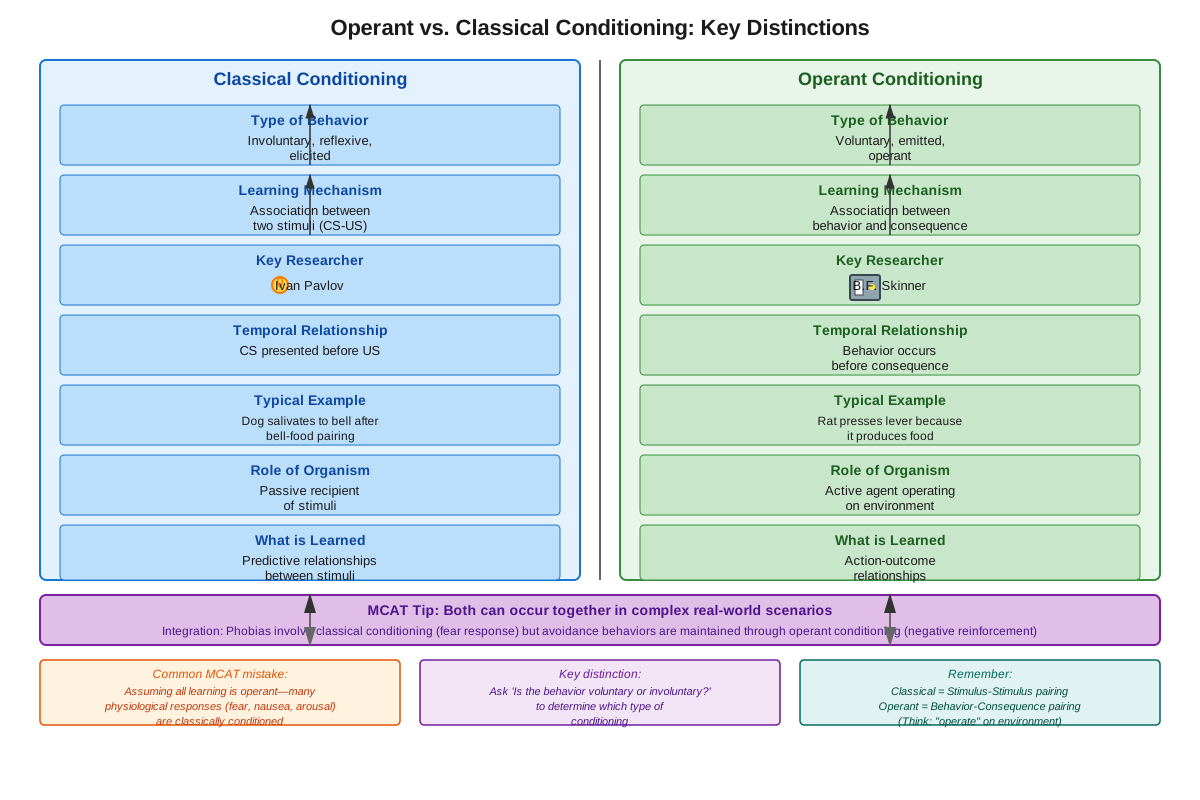
Operant conditioning connects to prerequisite knowledge of basic learning principles and stimulus-response relationships. It relates to classical conditioning (both are learning mechanisms, but operant involves voluntary behavior and consequences while classical involves involuntary responses and associations). Operant principles underlie more complex topics including observational learning (where observed consequences affect behavior), motivation (reinforcers serve as motivators), habit formation (behaviors reinforced on variable schedules become habitual), and addiction (substance use is powerfully reinforced, often on variable schedules).
The biological basis of operant conditioning involves dopaminergic reward pathways, particularly the mesolimbic pathway connecting the ventral tegmental area to the nucleus accumbens. Reinforcers activate these pathways, creating the neurological substrate for learning. This connection links operant conditioning to neuroscience topics on the MCAT.
High-Yield Facts
⭐ Reinforcement always increases behavior frequency; punishment always decreases behavior frequency—this is definitional and the most fundamental distinction.
⭐ Positive means adding a stimulus; negative means removing a stimulus—these terms do NOT indicate whether the stimulus is pleasant or unpleasant.
⭐ Negative reinforcement is NOT punishment—it increases behavior by removing something aversive (taking aspirin removes headache, increasing aspirin-taking behavior).
⭐ Variable-ratio schedules produce the highest response rates and greatest resistance to extinction—this explains gambling addiction and other persistent behaviors.
⭐ Fixed-interval schedules produce a characteristic scalloped response pattern with low responding after reinforcement and accelerating responding as the interval ends.
- Continuous reinforcement produces fastest initial learning but weakest resistance to extinction.
- The partial reinforcement effect means intermittently reinforced behaviors resist extinction longer than continuously reinforced behaviors.
- Shaping involves reinforcing successive approximations toward a target behavior, allowing training of complex behaviors.
- Discriminative stimuli signal when a behavior will be reinforced, bringing behavior under stimulus control.
- Primary reinforcers satisfy biological needs; secondary reinforcers acquire value through association with primary reinforcers.
- Extinction bursts involve temporary increases in behavior frequency and intensity when reinforcement first stops.
- The Premack Principle states that high-probability behaviors can reinforce low-probability behaviors.
- Instinctive drift occurs when innate behavioral patterns interfere with learned operant responses.
- Escape learning terminates ongoing aversive stimuli; avoidance learning prevents aversive stimuli from occurring.
- Omission training is a negative punishment procedure where reinforcement is withheld if undesired behavior occurs.
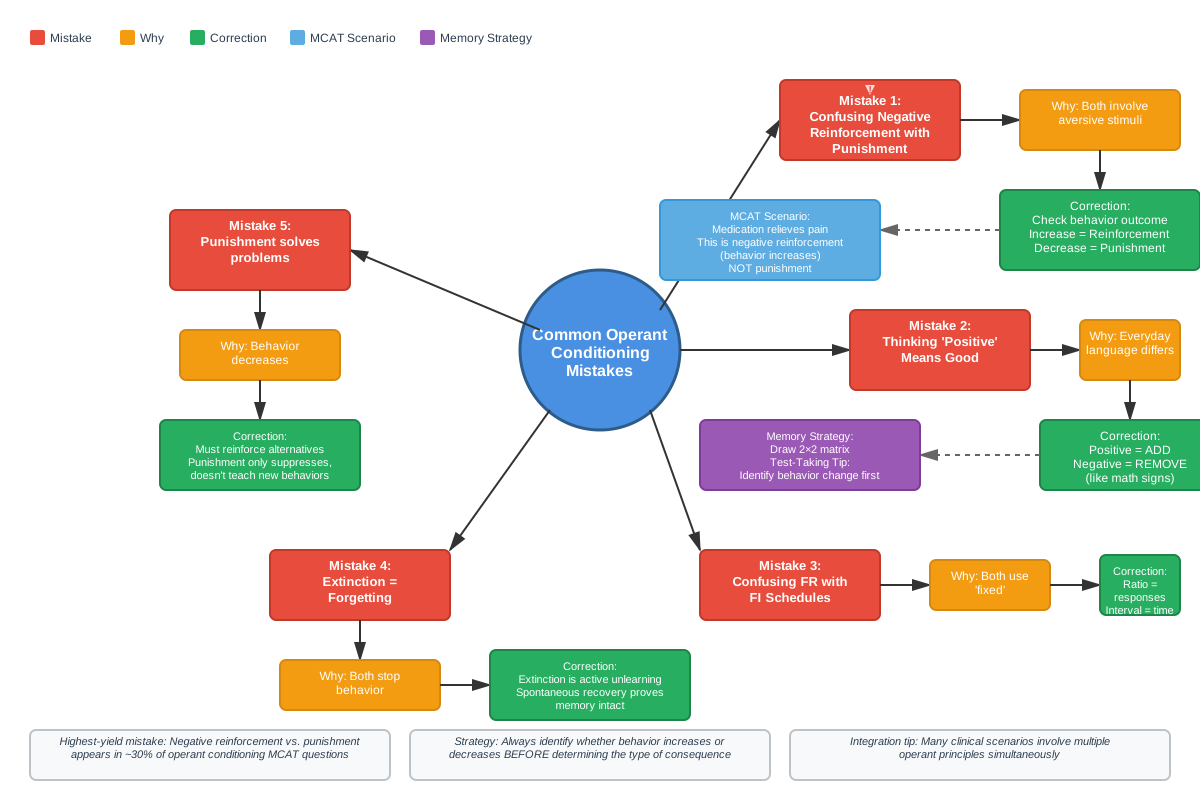
Common Misconceptions
Misconception: Negative reinforcement is the same as punishment.
Correction: Negative reinforcement increases behavior by removing an aversive stimulus, while punishment (positive or negative) decreases behavior. Taking pain medication is negatively reinforced because removing pain increases medication-taking behavior.
Misconception: "Positive" means good and "negative" means bad in operant conditioning terminology.
Correction: "Positive" means adding a stimulus (positive reinforcement adds something desirable; positive punishment adds something aversive). "Negative" means removing a stimulus (negative reinforcement removes something aversive; negative punishment removes something desirable). The terms are mathematical (+/−), not evaluative (good/bad).
Misconception: All consequences that follow behavior are reinforcers.
Correction: A consequence only qualifies as a reinforcer if it actually increases the behavior's future frequency. If a teacher praises a student but the student's behavior doesn't increase, the praise wasn't a reinforcer for that individual. Reinforcement is defined functionally by its effect, not by the stimulus itself.
Misconception: Fixed-ratio schedules produce the most persistent behavior.
Correction: Variable-ratio schedules produce the most persistent behavior and greatest resistance to extinction. The unpredictability of when reinforcement will occur maintains high, steady responding (as seen in gambling).
Misconception: Punishment is an effective long-term behavior change strategy.
Correction: While punishment can rapidly suppress behavior, it has significant limitations: it doesn't teach alternative behaviors, may produce negative emotional side effects, effects are often temporary, and it can damage relationships. Reinforcement-based approaches generally produce more durable behavior change.
Misconception: Shaping and chaining are the same process.
Correction: Shaping involves reinforcing successive approximations toward a single target behavior. Chaining involves linking together a sequence of already-learned behaviors, where completing one behavior serves as the discriminative stimulus for the next (though both are used to develop complex behaviors).
Misconception: Extinction means the behavior is permanently eliminated.
Correction: Extinction reduces behavior frequency, but spontaneous recovery demonstrates the behavior can reappear after a rest period. Additionally, the behavior-consequence association isn't completely erased; it can be rapidly reacquired with minimal reinforcement.
Misconception: Operant and classical conditioning are completely separate processes.
Correction: While distinct, these processes often occur simultaneously. For example, a rat pressing a lever (operant) may also develop classically conditioned emotional responses to the Skinner box environment. Many real-world behaviors involve both mechanisms.
Worked Examples
Example 1: Identifying Operant Conditioning Principles
Scenario: A clinical psychologist is treating a 7-year-old child who frequently throws tantrums in the grocery store. The psychologist discovers that the parents typically give the child candy to stop the tantrum. The psychologist recommends that parents instead ignore tantrums completely while praising and providing attention when the child behaves appropriately in the store.
Question: Identify the operant conditioning principles in both the original parent behavior and the recommended intervention.
Solution:
Step 1: Analyze the original situation from the child's perspective.
- Behavior: Throwing tantrums
- Consequence: Receiving candy (desirable stimulus added)
- Effect: Tantrums continue/increase
- Principle: Positive reinforcement—the child's tantrum behavior is positively reinforced by receiving candy
Step 2: Analyze the original situation from the parents' perspective.
- Behavior: Giving candy
- Consequence: Tantrum stops (aversive stimulus removed)
- Effect: Parents continue giving candy
- Principle: Negative reinforcement—the parents' candy-giving behavior is negatively reinforced by the removal of the aversive tantrum
Step 3: Analyze the recommended intervention—ignoring tantrums.
- Behavior: Throwing tantrums
- Consequence: No candy, no attention (previously reinforcing stimuli withheld)
- Expected effect: Tantrums should decrease over time
- Principle: Extinction—removing reinforcement for previously reinforced behavior
- Prediction: Expect an extinction burst (tantrums may temporarily worsen before improving)
Step 4: Analyze the recommended intervention—praising appropriate behavior.
- Behavior: Appropriate store behavior
- Consequence: Praise and attention (desirable stimuli added)
- Expected effect: Appropriate behavior should increase
- Principle: Positive reinforcement—reinforcing an alternative, desirable behavior
Key insight: This scenario demonstrates how the same situation involves multiple operant conditioning processes simultaneously, affecting different individuals' behaviors. It also illustrates the recommended behavioral approach: extinguish undesired behavior while reinforcing desired alternative behavior (differential reinforcement).
Example 2: Reinforcement Schedule Analysis
Scenario: A researcher conducts an experiment with four groups of pigeons, each trained to peck a key for food reinforcement on different schedules:
- Group A: Reinforced after every 10 pecks
- Group B: Reinforced after an average of 10 pecks (varying from 1 to 20)
- Group C: Reinforced for the first peck after every 30 seconds
- Group D: Reinforced for the first peck after an average of 30 seconds (varying from 10 to 50 seconds)
After training, all reinforcement is discontinued. The researcher measures how long each group continues pecking before the behavior extinguishes.
Question: Identify each reinforcement schedule and predict the extinction resistance ranking from most to least resistant.
Solution:
Step 1: Identify each schedule.
- Group A: Fixed-Ratio 10 (FR-10)—reinforcement after a fixed number of responses
- Group B: Variable-Ratio 10 (VR-10)—reinforcement after a variable number of responses averaging 10
- Group C: Fixed-Interval 30 seconds (FI-30s)—reinforcement available after a fixed time period
- Group D: Variable-Interval 30 seconds (VI-30s)—reinforcement available after variable time intervals averaging 30 seconds
Step 2: Recall extinction resistance principles.
- Variable schedules produce greater extinction resistance than fixed schedules (unpredictability makes it harder to detect that reinforcement has stopped)
- Ratio schedules generally produce higher response rates than interval schedules
- The partial reinforcement effect means all these schedules will show greater extinction resistance than continuous reinforcement
Step 3: Rank extinction resistance.
- Group B (VR-10): Most resistant—variable-ratio schedules produce the greatest extinction resistance and highest response rates
- Group D (VI-30s): Second—variable-interval schedules show strong extinction resistance due to unpredictability
- Group A (FR-10): Third—fixed-ratio schedules show moderate extinction resistance; the post-reinforcement pause makes it somewhat easier to detect reinforcement cessation
- Group C (FI-30s): Least resistant—fixed-interval schedules produce the lowest response rates and characteristic scalloped pattern makes reinforcement absence more detectable
Step 4: Explain the reasoning.
Variable schedules create ambiguity about whether reinforcement has truly stopped or whether the organism is simply in a longer-than-usual interval between reinforcements. This ambiguity maintains responding longer during extinction. The VR schedule combines this unpredictability with response-based (rather than time-based) reinforcement, producing the most persistent behavior.
Application to MCAT: This type of analysis is exactly what the MCAT tests—identifying schedules from descriptions and predicting behavioral outcomes. Remember that variable-ratio schedules always produce the most persistent behavior, which explains real-world phenomena like gambling addiction.
Exam Strategy
Question Approach Framework
When encountering operant conditioning questions on the MCAT, use this systematic approach:
- Identify the behavior: What specific action is being performed?
- Identify the consequence: What happens immediately after the behavior?
- Determine the effect: Does the behavior increase (reinforcement) or decrease (punishment)?
- Classify the consequence: Is something added (positive) or removed (negative)?
- Combine information: Apply the 2×2 matrix (reinforcement/punishment × positive/negative)
For schedule questions:
- Determine the basis: Is reinforcement based on number of responses (ratio) or time elapsed (interval)?
- Determine predictability: Is the requirement fixed or variable?
- Predict the pattern: Match to characteristic response patterns and extinction resistance
Trigger Words and Phrases
Reinforcement indicators:
- "Increases," "strengthens," "maintains," "encourages"
- "More likely to occur in the future"
- "Continues the behavior"
Punishment indicators:
- "Decreases," "reduces," "suppresses," "discourages"
- "Less likely to occur in the future"
- "Stops the behavior"
Positive (addition) indicators:
- "Gives," "provides," "presents," "adds," "receives"
- "Introduces," "applies"
Negative (removal) indicators:
- "Removes," "takes away," "eliminates," "stops," "terminates"
- "Avoids," "escapes," "prevents"
Schedule indicators:
- "Every X responses" → Fixed-Ratio
- "On average every X responses" or "unpredictable number" → Variable-Ratio
- "Every X seconds/minutes" → Fixed-Interval
- "On average every X seconds" or "unpredictable times" → Variable-Interval
Process of Elimination Tips
When distinguishing reinforcement from punishment:
- Eliminate options that contradict the behavioral outcome (if behavior increases, eliminate punishment options)
- Watch for negative reinforcement disguised as punishment—if something aversive is removed AND behavior increases, it's negative reinforcement
When distinguishing positive from negative:
- Focus on what happens to the environment, not how the organism feels
- If the question describes something being given/added, eliminate "negative" options
- If the question describes something being removed/taken away, eliminate "positive" options
When identifying schedules:
- If the passage mentions specific numbers without variation, eliminate variable schedules
- If the passage emphasizes unpredictability or averages, eliminate fixed schedules
- If reinforcement depends on behavior count, eliminate interval schedules
- If reinforcement depends on time passing, eliminate ratio schedules
Time Allocation Advice
Operant conditioning questions are typically straightforward if you've mastered the core concepts. Allocate:
- 30-45 seconds for discrete questions asking for definitions or simple identifications
- 60-90 seconds for application questions requiring analysis of scenarios
- 90-120 seconds for complex passage-based questions integrating multiple concepts
If you find yourself spending more than 2 minutes on an operant conditioning question, you may be overthinking it. These questions test fundamental principles—trust your systematic approach and move forward.
Exam Tip: The MCAT loves testing negative reinforcement vs. punishment. If you see an answer choice with "negative reinforcement," immediately check whether the behavior increases (reinforcement) or decreases (punishment). This single check eliminates many wrong answers.
Memory Techniques
The Reinforcement/Punishment Matrix Mnemonic
"PNPN" (Positive-Negative-Positive-Negative)
- Positive Reinforcement: Present something Pleasant → behavior Rises
- Negative Reinforcement: Nix something Nasty → behavior Rises
- Positive Punishment: Present something Painful → behavior Plummets
- Negative Punishment: Nix something Nice → behavior Plummets
Schedule Characteristics Mnemonic
"VRIP" (Very Rapid, Intense, Persistent) for Variable-Ratio schedules—the highest response rate and most resistant to extinction.
"FI-Scallop": Fixed-Interval produces a scallop pattern (visualize a scalloped edge accelerating upward).
"Variable = Valuable": Variable schedules are more valuable for maintaining behavior (greater extinction resistance).
Reinforcement vs. Punishment Memory Aid
"Reinforcement = Repeat": Both start with "R"—reinforcement makes behavior repeat.
"Punishment = Prevent": Both start with "P"—punishment prevents behavior from continuing.
Positive vs. Negative Memory Aid
Think mathematically:
- Positive (+): Addition—something is added to the situation
- Negative (−): Subtraction—something is removed from the situation
Visualization Strategy
Create a mental 2×2 grid:
                ADD (+)              REMOVE (−)
              ___________________________________________
             |                    |                     |
INCREASE (R) | Positive           | Negative            |
             | Reinforcement      | Reinforcement       |
             | (give treat)       | (remove shock)      |
             |____________________|_____________________|
             |                    |                     |
DECREASE (P) | Positive           | Negative            |
             | Punishment         | Punishment          |
             | (give shock)       | (remove treat)      |
             |____________________|_____________________|
Visualize placing scenarios into the appropriate quadrant based on what's added/removed and whether behavior increases/decreases.
Summary
Operant conditioning represents a fundamental learning mechanism whereby voluntary behaviors are modified through consequences. The core principle distinguishes reinforcement (which increases behavior) from punishment (which decreases behavior), with each category subdividing into positive (adding stimuli) and negative (removing stimuli) types. Positive reinforcement adds desirable stimuli, negative reinforcement removes aversive stimuli, positive punishment adds aversive stimuli, and negative punishment removes desirable stimuli. Reinforcement schedules—continuous, fixed-ratio, variable-ratio, fixed-interval, and variable-interval—determine response patterns and extinction resistance, with variable-ratio schedules producing the most persistent behavior. Complex behaviors develop through shaping (reinforcing successive approximations), and environmental cues become discriminative stimuli that signal when behaviors will be reinforced. When reinforcement ceases, extinction occurs, often preceded by an extinction burst and potentially followed by spontaneous recovery. Understanding these principles allows analysis of behavioral modification in clinical, educational, and everyday contexts—exactly what the MCAT requires for high-yield Psychology questions.
Key Takeaways
- Operant conditioning modifies voluntary behavior through consequences—reinforcement increases behavior, punishment decreases behavior
- The positive/negative distinction is mathematical, not evaluative—positive means adding stimuli, negative means removing stimuli
- Negative reinforcement is NOT punishment—it increases behavior by removing aversive stimuli (e.g., taking aspirin removes headache)
- Variable-ratio schedules produce the highest response rates and greatest extinction resistance—explaining gambling and other persistent behaviors
- Shaping allows training of complex behaviors by reinforcing successive approximations toward the target behavior
- Discriminative stimuli signal when behaviors will be reinforced, bringing behavior under stimulus control
- The MCAT frequently tests the ability to distinguish between the four consequence types and identify reinforcement schedules from behavioral patterns
Related Topics
Classical Conditioning: Understanding the distinction between operant (voluntary behavior, consequences) and classical (involuntary responses, associations) conditioning is essential, as the MCAT frequently requires differentiating these mechanisms.
Observational Learning: Builds on operant principles by demonstrating that organisms can learn through watching others experience consequences, without direct reinforcement.
Motivation and Emotion: Reinforcers serve as motivators, and understanding what makes stimuli reinforcing connects to drive-reduction theory, incentive theory, and arousal theory.
Biological Bases of Behavior: The neurological substrates of reinforcement (dopaminergic pathways, nucleus accumbens) connect operant conditioning to neuroscience.
Psychological Disorders: Many disorders involve maladaptive operant conditioning (phobias maintained by negative reinforcement, substance use disorders involving powerful reinforcement), and treatments often apply operant principles.
Social Processes: Social reinforcement, modeling, and group behavior all involve operant conditioning principles operating in social contexts.
Practice CTA
Now that you've mastered the core concepts of operant conditioning, it's time to solidify your understanding through active practice. Work through the practice questions to test your ability to identify reinforcement types, distinguish schedules, and apply these principles to MCAT-style scenarios. Use the flashcards to drill the high-yield distinctions that appear most frequently on the exam. Remember: operant conditioning is one of the most testable topics in Psychology—investing time in practice now will pay dividends on test day. You've built the foundation; now strengthen it through application. You've got this!
Sign up free to keep reading
Create a free AnvayaPrep account to finish this MCAT guide on Operant conditioning — plus flashcards and practice questions.