Overview
Semantic memory is a critical component of the long-term memory system that stores general knowledge about the world, including facts, concepts, and meanings that are independent of personal experience. Unlike episodic memory, which records specific autobiographical events, semantic memory encompasses the vast repository of information that forms our understanding of language, objects, people, and abstract concepts. This includes knowing that Paris is the capital of France, understanding what a "dog" is, recognizing that 2+2=4, and comprehending the meaning of words like "justice" or "democracy."
For the MCAT, semantic memory represents a high-yield topic within the Psychology section, particularly under Learning and Memory. The exam frequently tests students' ability to distinguish between different memory systems, understand how semantic knowledge is acquired and organized, and apply these concepts to experimental designs and clinical scenarios. Questions may present research studies examining memory deficits, ask students to identify which type of memory is being tested in a given scenario, or require analysis of how semantic networks facilitate information retrieval.
Understanding semantic memory is essential for grasping the broader architecture of human cognition. It connects intimately with language processing, concept formation, decision-making, and problem-solving. The topic bridges multiple MCAT domains, appearing not only in psychology passages but also in sociology contexts (cultural knowledge transmission) and biological contexts (neuroanatomical substrates of memory). Mastery of semantic memory enables students to tackle complex passages that integrate cognitive psychology with neuroscience, developmental psychology, and even social psychology concepts.
Learning Objectives
- [ ] Define semantic memory using accurate Psychology terminology
- [ ] Explain why semantic memory matters for the MCAT
- [ ] Apply semantic memory to exam-style questions
- [ ] Identify common mistakes related to semantic memory
- [ ] Connect semantic memory to related Psychology concepts
- [ ] Distinguish semantic memory from episodic memory and other memory systems using specific examples
- [ ] Describe the neural substrates and brain regions associated with semantic memory processing
- [ ] Analyze how semantic networks organize conceptual knowledge and facilitate retrieval
Prerequisites
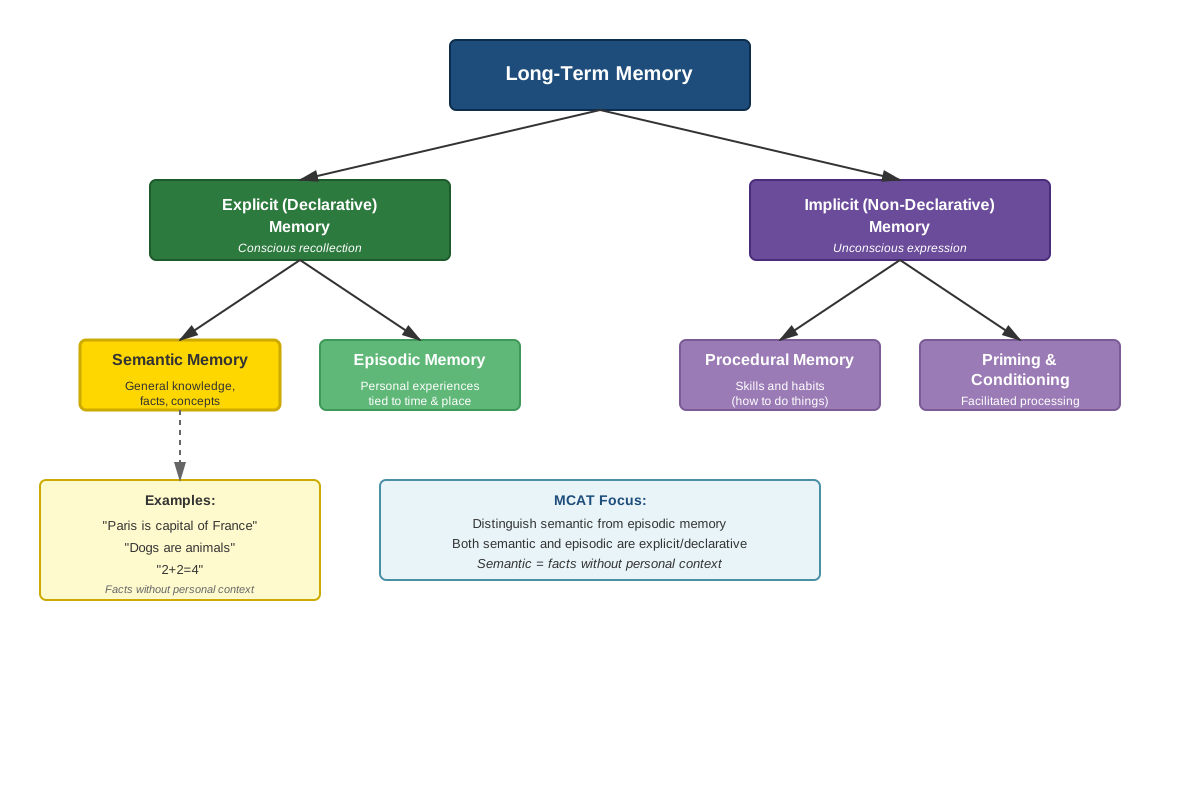
- Long-term memory systems: Understanding the basic division between explicit (declarative) and implicit (non-declarative) memory provides the framework within which semantic memory operates as a subcategory of explicit memory.
- Encoding, storage, and retrieval processes: Knowledge of these fundamental memory stages is essential for understanding how semantic information is acquired, maintained, and accessed.
- Basic neuroanatomy: Familiarity with brain structures like the hippocampus, temporal lobes, and cortical regions helps contextualize where semantic memory processing occurs.
- Attention and perception: These processes determine what information enters memory systems and becomes available for semantic encoding.
Why This Topic Matters
Clinical and Real-World Significance
Semantic memory dysfunction appears in numerous neurological and psychiatric conditions that MCAT students must understand for medical practice. Patients with semantic dementia progressively lose their knowledge of word meanings, object concepts, and general facts while initially preserving episodic memory for recent personal events. Alzheimer's disease affects both semantic and episodic memory systems, though episodic memory typically deteriorates first. Stroke patients with damage to specific temporal lobe regions may develop category-specific semantic deficits, losing knowledge about living things while retaining information about tools and artifacts, or vice versa.
Understanding semantic memory is crucial for comprehending how humans acquire expertise, learn languages, develop cultural knowledge, and navigate social environments. Educational interventions, rehabilitation strategies for brain injury, and cognitive enhancement techniques all depend on principles of semantic memory organization and retrieval.
MCAT Exam Statistics
Semantic memory appears in approximately 15-20% of Psychology/Sociology section passages, making it a high-yield topic. Questions typically fall into three categories:
- Definitional questions (30%): Identifying which scenario exemplifies semantic versus episodic memory
- Application questions (50%): Analyzing experimental designs, interpreting research findings, or predicting outcomes based on semantic memory principles
- Integration questions (20%): Connecting semantic memory to language, development, social cognition, or neurological conditions
Common Exam Appearances
MCAT passages frequently present semantic memory in these contexts:
- Research studies comparing memory performance across different age groups or clinical populations
- Neuroimaging studies showing brain activation patterns during semantic versus episodic retrieval
- Developmental psychology passages examining how children acquire conceptual knowledge
- Cognitive psychology experiments testing priming effects or semantic network activation
- Clinical vignettes describing patients with selective memory impairments
Core Concepts
Definition and Characteristics of Semantic Memory
Semantic memory refers to the component of long-term explicit memory that stores general world knowledge, facts, concepts, and meanings that are not tied to specific personal experiences or temporal-spatial contexts. This memory system was first distinguished from episodic memory by Endel Tulving in 1972, establishing a fundamental division within declarative memory.
Key characteristics distinguish semantic memory from other memory types:
- Context-independence: Semantic memories lack the "when" and "where" tags that characterize episodic memories. You know that water freezes at 0°C without remembering when or where you learned this fact.
- Generalized knowledge: Information is abstracted from specific learning episodes into general principles and concepts.
- Relatively stable: Once consolidated, semantic memories are less susceptible to forgetting than episodic memories and remain accessible across contexts.
- Shared cultural knowledge: Much semantic memory content is common across individuals within a culture (e.g., knowing what a "birthday" is).
- Propositional structure: Information is often stored as networks of related concepts and facts rather than as sensory-perceptual experiences.
Semantic Memory versus Episodic Memory
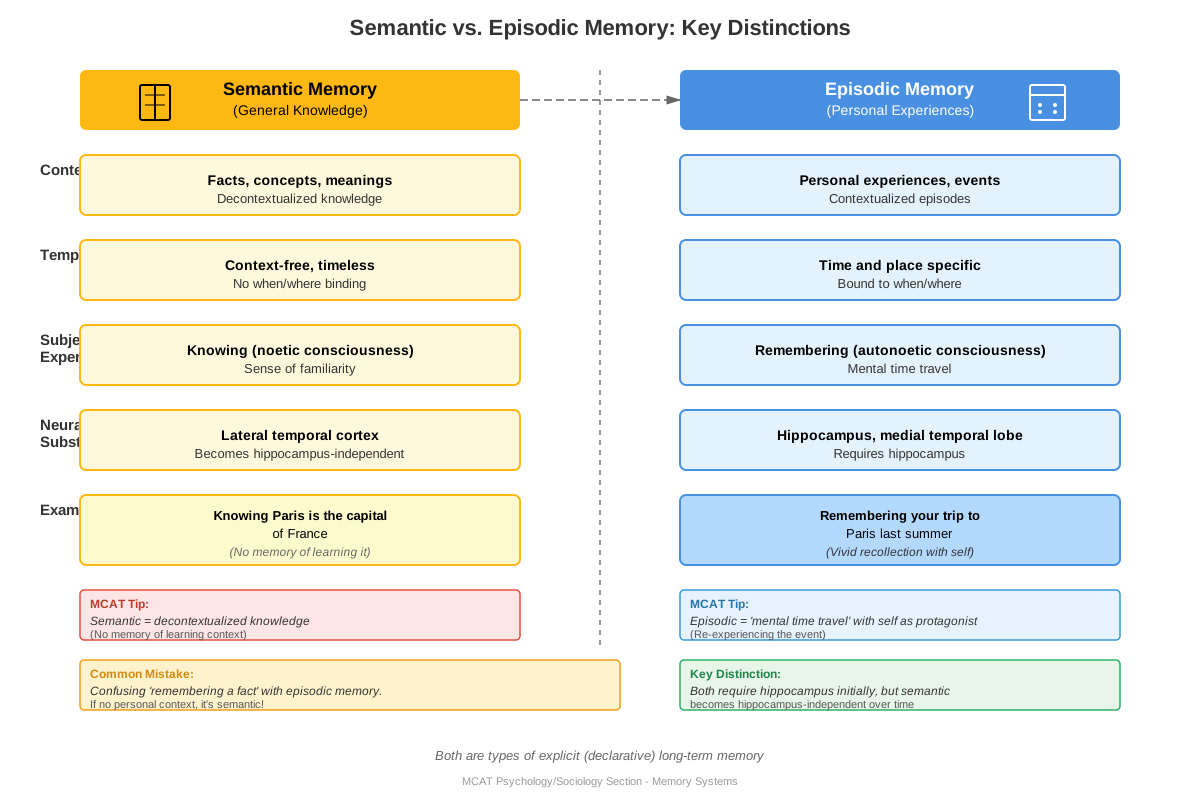
The distinction between semantic and episodic memory represents one of the most tested concepts on the MCAT. Both are subtypes of explicit (declarative) memory—memory that can be consciously recalled and verbally expressed—but they differ fundamentally:
| Feature | Semantic Memory | Episodic Memory |
|---|---|---|
| Content | General facts, concepts, meanings | Personal experiences, specific events |
| Context | Context-free, timeless | Context-dependent, temporally dated |
| Retrieval experience | "Knowing" (noetic consciousness) | "Remembering" (autonoetic consciousness) |
| Example | Knowing that dogs are mammals | Remembering when you adopted your dog |
| Brain regions | Lateral temporal cortex, anterior temporal lobes | Hippocampus, medial temporal lobes |
| Developmental onset | Emerges early in childhood | Develops later (age 3-4 years) |
| Vulnerability | More resistant to damage | More vulnerable to early damage |
MCAT Exam Tip: When a question asks about "remembering" with personal context and temporal details, think episodic. When it asks about "knowing" facts without personal context, think semantic.
Semantic Networks and Organization
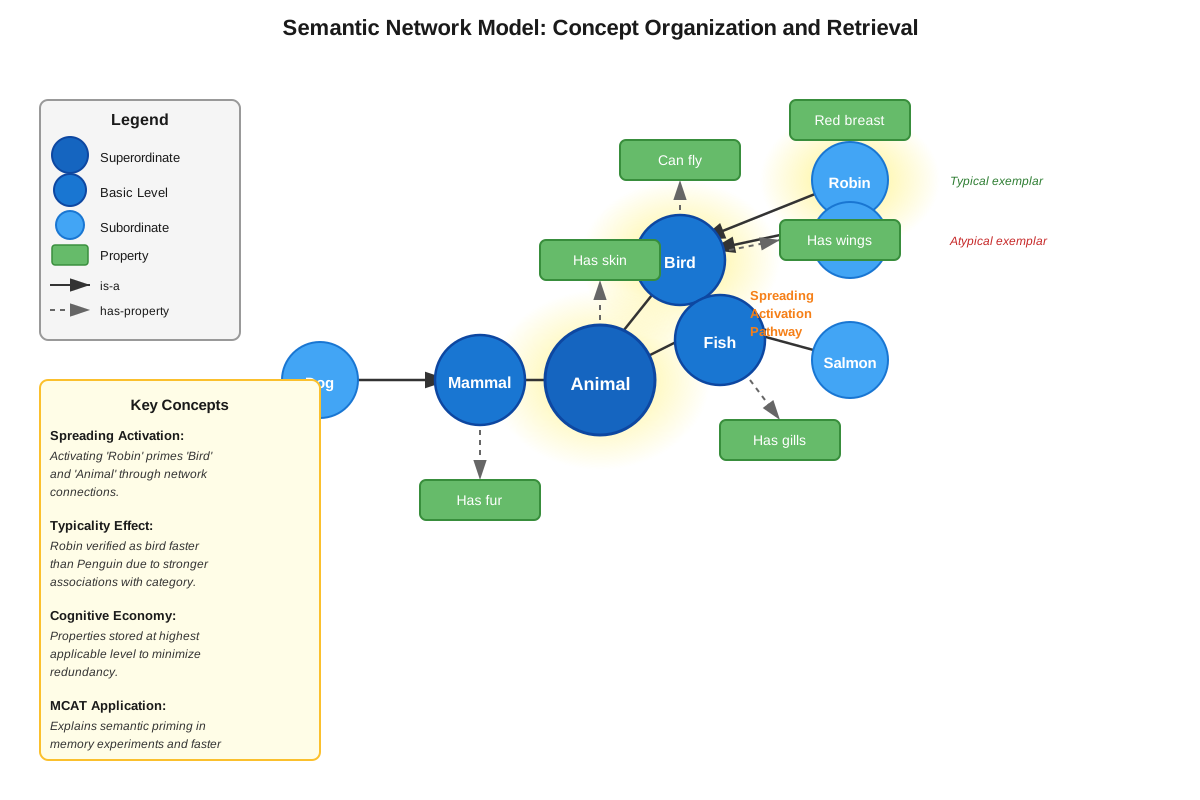
Semantic memory is not stored as isolated facts but organized into semantic networks—interconnected webs of concepts linked by meaningful relationships. The spreading activation model explains how accessing one concept activates related concepts, facilitating retrieval and enabling inference.
Key organizational principles include:
- Hierarchical organization: Concepts are arranged in taxonomic hierarchies (e.g., animal → mammal → dog → golden retriever)
- Feature-based representation: Concepts are defined by their characteristic features and properties
- Associative links: Concepts connect through various relationships (category membership, functional associations, perceptual similarity)
- Typicality effects: More typical category members (robin for "bird") are accessed faster than atypical members (penguin)
The Collins and Quillian hierarchical network model (1969) proposed that semantic memory is organized hierarchically with properties stored at the highest applicable level to minimize redundancy. For example, "can breathe" is stored with "animal" rather than redundantly with every animal type. While this model has limitations, it introduced crucial concepts about semantic organization tested on the MCAT.
Priming and Semantic Memory
Semantic priming occurs when exposure to one concept (the prime) facilitates processing of a related concept (the target). For example, seeing the word "doctor" speeds recognition of "nurse" compared to an unrelated word like "butter." This phenomenon demonstrates the interconnected nature of semantic networks and the spreading activation process.
Types of semantic priming include:
- Associative priming: Based on learned associations (bread → butter)
- Categorical priming: Based on category membership (robin → sparrow)
- Functional priming: Based on functional relationships (broom → sweep)
Priming effects are automatic and implicit, occurring even when individuals are unaware of the prime. This makes priming a valuable tool for studying semantic memory organization without relying on conscious recall.
Neural Substrates of Semantic Memory
Understanding the neuroanatomy of semantic memory is essential for MCAT passages involving brain imaging or neurological patients. Key brain regions include:
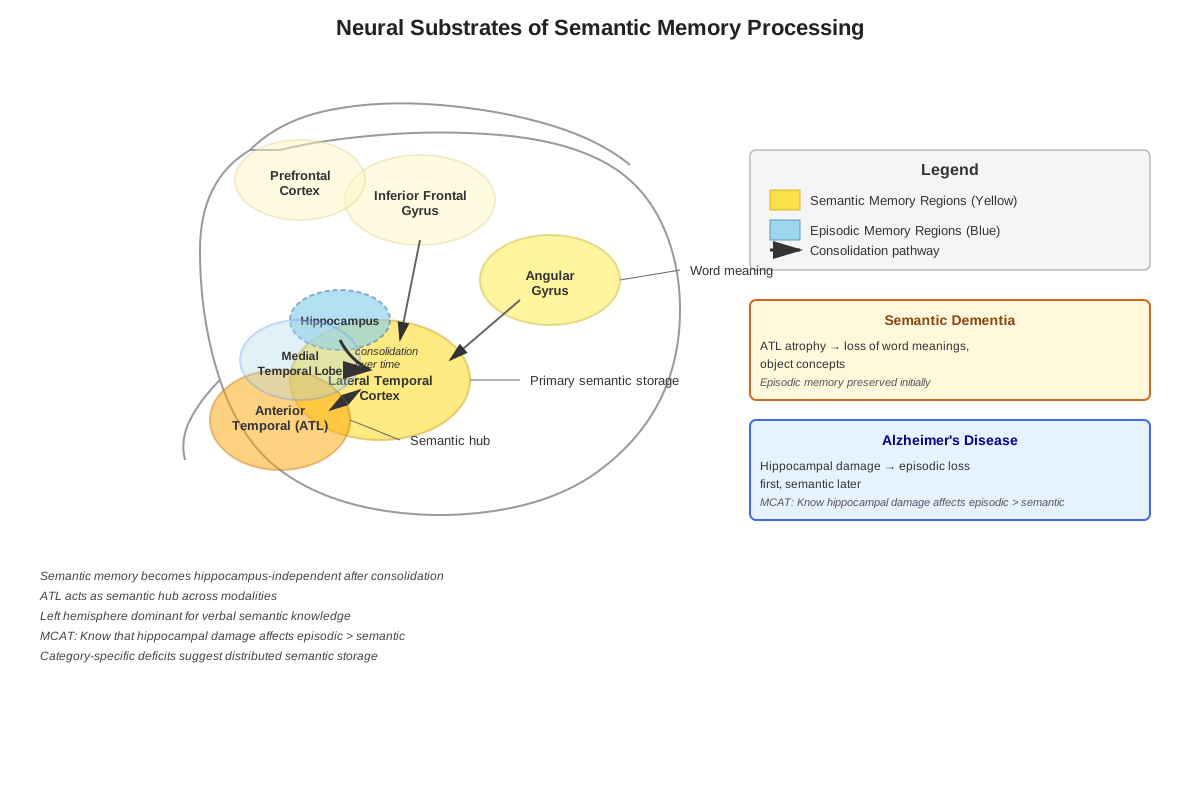
Anterior temporal lobes (ATL): The ATL, particularly in the left hemisphere, serves as a critical hub for semantic memory. Damage to this region produces semantic dementia, characterized by progressive loss of conceptual knowledge. The ATL is thought to integrate information from different sensory modalities into unified conceptual representations.
Lateral temporal cortex: Specific regions process different semantic categories. The fusiform gyrus responds preferentially to faces and body parts, while more posterior temporal regions process tool and object knowledge. This suggests some degree of category-specific organization.
Inferior frontal gyrus: The left inferior frontal gyrus (Broca's area and surrounding regions) is involved in semantic retrieval and selection, particularly when choosing among competing semantic representations.
Angular gyrus: This parietal region integrates semantic information with other cognitive processes and is particularly important for conceptual combinations and abstract semantic processing.
Unlike episodic memory, which critically depends on the hippocampus for encoding and initial consolidation, semantic memory relies more heavily on neocortical regions. However, the hippocampus may play a role in initially encoding semantic information before it becomes fully consolidated in cortical networks.
Acquisition and Development of Semantic Memory
Semantic memory develops throughout childhood and continues expanding across the lifespan. Key developmental considerations include:
Early childhood (ages 2-5): Rapid vocabulary acquisition and concept formation occur. Children learn basic categories, object properties, and simple facts. This period shows the transition from episodic-like memories tied to specific experiences toward more generalized semantic knowledge.
Middle childhood (ages 6-12): Formal education dramatically expands semantic knowledge. Children acquire reading, mathematical concepts, scientific facts, and cultural knowledge. Semantic networks become more elaborate and hierarchically organized.
Adolescence and adulthood: Semantic memory continues growing, with expertise development in specific domains. Abstract concepts, complex relationships, and nuanced meanings are refined.
The process of semanticization describes how episodic memories can transform into semantic knowledge over time. Initially, you might remember learning that Paris is the capital of France in a specific classroom (episodic). Eventually, you simply know this fact without remembering the learning episode (semantic).
Semantic Memory in Special Populations
Aging: Healthy aging typically preserves semantic memory relatively well compared to episodic memory. Older adults may show slower retrieval and occasional word-finding difficulties but maintain their knowledge base. This preservation contrasts with the episodic memory decline commonly seen in aging.
Amnesia: Patients with hippocampal damage and severe episodic memory impairment (anterograde amnesia) can still access previously acquired semantic knowledge and, in some cases, acquire new semantic information despite being unable to remember the learning episodes. This dissociation provides strong evidence for separate semantic and episodic systems.
Semantic dementia: This progressive neurodegenerative condition selectively targets semantic memory, causing loss of word meanings, object knowledge, and conceptual understanding while initially sparing episodic memory for recent events. This striking dissociation further demonstrates the independence of these memory systems.
Concept Relationships
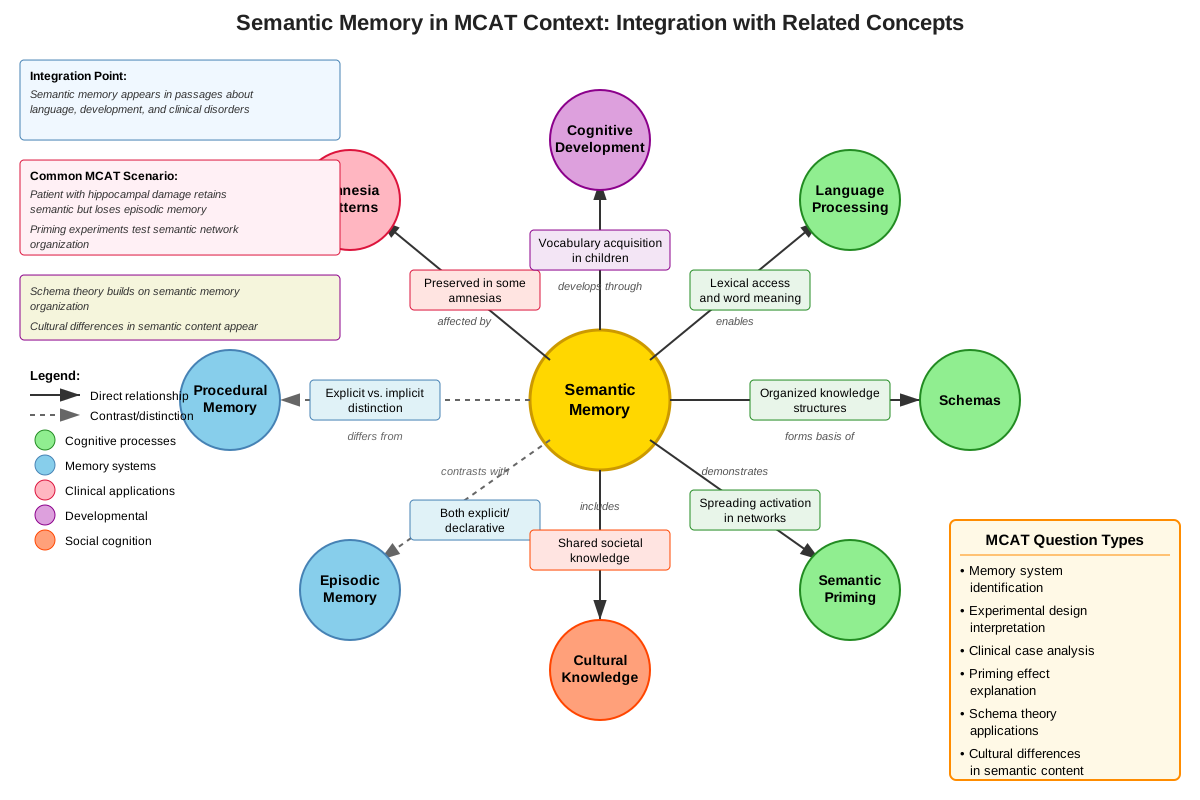
Semantic memory sits within a hierarchical organization of memory systems. At the broadest level, memory divides into explicit (declarative) and implicit (non-declarative) systems. Semantic memory, along with episodic memory, comprises the explicit memory system—memories that can be consciously recalled and verbally described.
The relationship between semantic and episodic memory is complex and bidirectional:
Episodic → Semantic: Through repeated experiences and consolidation, episodic memories can become semanticized, losing their contextual details and transforming into general knowledge. This process explains how personal experiences contribute to our knowledge base.
Semantic ↔ Episodic interaction: Semantic knowledge provides the framework for encoding and interpreting episodic experiences. Your semantic knowledge about "restaurants" shapes how you encode and remember a specific dining experience.
Semantic memory connects to multiple cognitive processes:
- Language processing: Word meanings, grammar rules, and linguistic knowledge are stored in semantic memory. Language comprehension and production depend on rapid semantic retrieval.
- Concept formation: The process of categorization and abstraction that builds semantic knowledge connects to perceptual and cognitive development.
- Problem-solving and reasoning: Semantic knowledge provides the factual foundation for logical reasoning, decision-making, and problem-solving.
- Social cognition: Understanding social roles, norms, and cultural knowledge involves semantic memory for social concepts.
The neural relationship shows that while episodic memory critically depends on the hippocampus and medial temporal lobe structures, semantic memory relies more on lateral temporal cortex and anterior temporal regions. However, both systems interact during encoding and retrieval, with the hippocampus potentially playing a role in initially encoding semantic information before cortical consolidation.
Quick check — test yourself on Semantic memory so far.
Try Flashcards →High-Yield Facts
⭐ Semantic memory stores general world knowledge, facts, and concepts that are independent of personal experience and temporal-spatial context.
⭐ Semantic memory is a subtype of explicit (declarative) memory, distinguished from episodic memory by its lack of contextual details.
⭐ The anterior temporal lobes, particularly in the left hemisphere, serve as the primary neural substrate for semantic memory, unlike episodic memory which depends on the hippocampus.
⭐ Semantic priming demonstrates that semantic memory is organized as interconnected networks where activating one concept facilitates access to related concepts.
⭐ Semantic dementia selectively impairs semantic memory while initially preserving episodic memory, demonstrating the dissociability of these systems.
- Semantic memory retrieval involves "knowing" (noetic consciousness) rather than "remembering" (autonoetic consciousness).
- Semantic networks organize concepts hierarchically with typicality effects—typical category members are accessed faster than atypical members.
- The spreading activation model explains how activation flows through semantic networks from one concept to related concepts.
- Healthy aging preserves semantic memory better than episodic memory, with older adults maintaining their knowledge base despite slower retrieval.
- Patients with hippocampal damage and severe anterograde amnesia can still access previously acquired semantic knowledge and sometimes acquire new semantic information.
- Category-specific semantic deficits can occur with focal brain damage, with dissociations between knowledge of living things versus artifacts.
- The process of semanticization transforms episodic memories into semantic knowledge over time through consolidation and repeated retrieval.
Common Misconceptions
Misconception: Semantic memory and episodic memory are completely independent systems that never interact.
Correction: While semantic and episodic memory are distinct systems with different characteristics and neural substrates, they interact extensively. Semantic knowledge provides the framework for encoding episodic experiences, and episodic memories can become semanticized over time. The systems work together during many memory tasks.
Misconception: All factual knowledge is semantic memory, including remembering facts about your own life.
Correction: Personal facts about your own life (autobiographical facts like "I graduated from college in 2020") represent a gray area called "personal semantics." While these are facts, they relate to personal history and may retain some episodic qualities. Pure semantic memory refers to general world knowledge shared across individuals.
Misconception: The hippocampus is not involved in semantic memory at all.
Correction: While semantic memory primarily depends on neocortical regions (especially anterior temporal lobes), the hippocampus may play a role in initially encoding semantic information before it becomes fully consolidated in cortical networks. The hippocampus is less critical for semantic memory than for episodic memory, but it's not entirely uninvolved.
Misconception: Semantic memory is always conscious and requires effortful retrieval.
Correction: While semantic memory is classified as explicit memory (consciously accessible), much semantic retrieval is automatic and effortless. Semantic priming effects occur automatically without conscious awareness. Understanding word meanings during conversation happens rapidly and automatically without deliberate effort.
Misconception: Semantic memory declines significantly with normal aging, similar to episodic memory.
Correction: Healthy aging typically preserves semantic memory quite well. Older adults maintain their vocabulary, general knowledge, and conceptual understanding. While retrieval speed may slow and word-finding difficulties may occur, the semantic knowledge base remains largely intact, contrasting with the more pronounced episodic memory decline in aging.
Misconception: Semantic memory is stored in one specific brain location.
Correction: Semantic memory is distributed across multiple cortical regions, with different areas processing different types of semantic information. The anterior temporal lobes serve as a hub integrating information, but category-specific knowledge (faces, tools, animals) involves different temporal and parietal regions. Semantic memory is a network-level phenomenon, not localized to a single structure.
Worked Examples
Example 1: Distinguishing Memory Types in a Clinical Vignette
Question: A 68-year-old patient presents with progressive difficulty naming objects and understanding word meanings. When shown a picture of a dog, she cannot name it or describe what it is used for, but she can accurately describe a recent family gathering she attended last week, including who was there and what they discussed. Which memory system is primarily affected?
Step 1 - Identify the symptoms: The patient shows impaired object naming and loss of word meanings (semantic knowledge) but preserved memory for a recent personal event (episodic memory).
Step 2 - Match symptoms to memory systems:
- Difficulty naming objects and understanding meanings = semantic memory impairment
- Accurate recall of recent personal event with contextual details = preserved episodic memory
Step 3 - Consider the dissociation: The selective impairment of semantic memory with preserved episodic memory is characteristic of semantic dementia, which primarily affects anterior temporal lobe regions.
Step 4 - Eliminate alternatives: This is not typical Alzheimer's disease (which affects episodic memory first) or general amnesia (which would impair episodic memory more severely).
Answer: The patient's semantic memory is primarily affected, consistent with semantic dementia. This demonstrates the dissociability of semantic and episodic memory systems and their different neural substrates.
Learning objective connection: This example applies semantic memory concepts to a clinical scenario, requires distinguishing semantic from episodic memory, and connects to neurological conditions—all high-yield MCAT skills.
Example 2: Analyzing a Semantic Priming Experiment
Question: Researchers conduct an experiment where participants see a word (prime) for 150ms, followed by a target word. Participants must decide whether the target is a real word or a nonword. Results show that participants respond faster when the prime and target are related (e.g., "doctor" → "nurse") compared to unrelated pairs (e.g., "doctor" → "butter"). The effect occurs even when participants report not consciously seeing the prime. What does this demonstrate about semantic memory organization?
Step 1 - Identify the phenomenon: This describes a semantic priming effect where related words facilitate processing.
Step 2 - Explain the mechanism: The faster response to related word pairs demonstrates spreading activation in semantic networks. When "doctor" is processed, activation spreads to related concepts like "nurse," pre-activating them and speeding recognition.
Step 3 - Address the unconscious aspect: The effect occurring without conscious awareness of the prime demonstrates that semantic network activation is automatic and does not require conscious processing.
Step 4 - Connect to semantic memory organization: This provides evidence that semantic memory is organized as interconnected networks rather than isolated facts, with meaningful relationships linking related concepts.
Answer: This experiment demonstrates that semantic memory is organized as interconnected networks with spreading activation. Related concepts are linked, and activating one concept automatically facilitates access to related concepts, even without conscious awareness. This supports network models of semantic organization.
Learning objective connection: This example requires applying semantic memory principles to interpret experimental results, understanding semantic priming and network organization, and recognizing automatic versus controlled processes—all critical for MCAT passage analysis.
Exam Strategy
Approaching MCAT Questions on Semantic Memory
Step 1 - Identify the memory type being tested: Look for key distinguishing features:
- Context-free facts and general knowledge → semantic memory
- Personal experiences with "when" and "where" details → episodic memory
- Skills and procedures performed without conscious awareness → procedural memory
Step 2 - Watch for trigger words and phrases:
- Semantic memory: "knows that," "understands," "general knowledge," "facts," "concepts," "meanings," "world knowledge"
- Episodic memory: "remembers when," "recalls the experience," "can describe the event," "personal memory"
- Priming: "facilitated," "faster recognition," "automatic activation," "spreading activation"
Step 3 - Consider neural substrates when mentioned:
- Anterior temporal lobes, lateral temporal cortex → semantic memory
- Hippocampus, medial temporal lobes → episodic memory (especially encoding)
- Selective impairments suggest dissociable systems
Step 4 - Apply process-of-elimination strategies:
- If a question describes remembering specific personal events with contextual details, eliminate semantic memory
- If a question describes general knowledge without personal context, eliminate episodic memory
- If a question involves unconscious influence on behavior, consider priming or implicit memory rather than explicit recall
Time Allocation Advice
Semantic memory questions typically appear in two formats:
- Discrete questions (30 seconds): Quick definitional or application questions. These should be answered rapidly using trigger words and key distinctions.
- Passage-based questions (90 seconds per question): These require careful passage analysis. Spend adequate time understanding the experimental design or clinical scenario before attempting questions. Look for clues about which memory system is being tested based on task demands and patient symptoms.
MCAT Exam Tip: When a passage describes a patient with selective memory impairment, create a quick mental table comparing what's impaired versus preserved. This helps identify which memory system is affected and predict answers to multiple questions.
Common Question Formats
- Definitional: "Which of the following best describes semantic memory?"
- Application: "Based on the passage, the patient's inability to name objects while remembering recent events suggests damage to which brain region?"
- Experimental interpretation: "The faster response times to related word pairs in the experiment demonstrate which principle of semantic memory organization?"
- Prediction: "If a patient has damage to the anterior temporal lobes, which ability would most likely be impaired?"
Memory Techniques
Mnemonic for Semantic vs. Episodic
"SEMANTIC = SHARED"
- Shared knowledge across people
- Enduring and stable
- Meanings and concepts
- Abstract from specific experiences
- No temporal context
- Timeless facts
- Independent of personal experience
- Context-free
"EPISODIC = EVENTS"
- Experiences that are personal
- Vivid sensory details
- Emotional context included
- Noted in time and place
- Temporally dated
- Specific autobiographical memories
Visualization Strategy
Imagine semantic memory as a library where books (concepts) are organized on shelves (categories) with cross-references (semantic links) connecting related topics. You can access any book's information without remembering when you read it or where you were.
Imagine episodic memory as a personal photo album where each picture captures a specific moment with details about when and where it occurred, who was there, and how you felt.
Acronym for Brain Regions
"ATL = All The Learning" (Anterior Temporal Lobes for semantic memory)
"HIP = History Is Personal" (Hippocampus for episodic memory)
Priming Concept
Remember: "PRIME = Pre-activation Readies Information for Memory Extraction"
When you see "doctor," your semantic network pre-activates related concepts like "nurse," "hospital," "stethoscope," making them easier to recognize or retrieve.
Summary
Semantic memory represents the long-term memory system storing general world knowledge, facts, concepts, and meanings independent of personal experience and temporal-spatial context. As a subtype of explicit (declarative) memory, semantic memory differs fundamentally from episodic memory through its context-free nature, stability, and reliance on anterior temporal lobe structures rather than hippocampal systems. The organization of semantic memory as interconnected networks with spreading activation explains phenomena like semantic priming and typicality effects. For the MCAT, understanding semantic memory requires mastering its distinguishing characteristics, neural substrates, developmental trajectory, and clinical presentations. The ability to differentiate semantic from episodic memory in experimental and clinical scenarios represents a high-yield skill tested across multiple question formats. Semantic memory connects broadly to language processing, concept formation, social cognition, and cognitive development, making it a foundational topic for integrating multiple psychology domains.
Key Takeaways
- Semantic memory stores context-free general knowledge, facts, and concepts, distinguished from episodic memory's personal, contextually-bound experiences
- The anterior temporal lobes serve as the primary neural substrate for semantic memory, contrasting with the hippocampal dependence of episodic memory
- Semantic networks organize concepts through hierarchical and associative relationships, with spreading activation explaining priming effects
- Semantic dementia selectively impairs semantic memory while preserving episodic memory, demonstrating system dissociability
- Healthy aging preserves semantic memory better than episodic memory, with maintained knowledge bases despite slower retrieval
- Semantic priming occurs automatically without conscious awareness, revealing the interconnected network structure of semantic memory
- The process of semanticization transforms episodic memories into semantic knowledge through consolidation and abstraction over time
Related Topics
Episodic Memory: The complementary explicit memory system storing personal experiences with temporal-spatial context. Mastering semantic memory provides the foundation for understanding how these systems differ, interact, and dissociate in clinical conditions.
Procedural Memory: The implicit memory system for skills and procedures. Understanding semantic memory's explicit nature helps distinguish it from this unconscious memory system, a common MCAT comparison.
Memory Consolidation: The process by which memories stabilize over time. This topic explains how semantic memories become cortically consolidated and how episodic memories can transform into semantic knowledge.
Language Processing: Semantic memory provides the knowledge base for language comprehension and production. Understanding semantic memory enables deeper analysis of how word meanings are accessed and how language disorders arise.
Cognitive Development: How semantic memory develops from childhood through adulthood connects to broader developmental psychology topics, including Piaget's stages and knowledge acquisition.
Neuropsychology of Memory Disorders: Clinical conditions like semantic dementia, Alzheimer's disease, and amnesia demonstrate memory system dissociations. Semantic memory knowledge is essential for analyzing these clinical presentations.
Practice CTA
Now that you've mastered the core concepts of semantic memory, it's time to solidify your understanding through active practice. Attempt the practice questions and flashcards to test your ability to distinguish memory types, analyze experimental designs, and apply semantic memory principles to clinical scenarios. Remember, the MCAT rewards not just knowledge but the ability to apply concepts flexibly across contexts. Each practice question you work through strengthens your neural networks for this material—much like the spreading activation in semantic networks you've just learned about! Your investment in understanding semantic memory will pay dividends across multiple Psychology/Sociology passages. You've got this!
Sign up free to keep reading
Create a free AnvayaPrep account to finish this MCAT guide on Semantic memory — plus flashcards and practice questions.