Overview
Shaping is a fundamental operant conditioning technique in which successive approximations of a desired behavior are reinforced until the target behavior is achieved. This powerful learning mechanism, first systematically studied by B.F. Skinner, represents one of the most practical applications of behavioral psychology and appears frequently on the MCAT Psychology/Sociology section. Shaping explains how complex behaviors that would never occur spontaneously can be taught through strategic reinforcement of progressively closer attempts at the final behavior. Unlike simple reinforcement of existing behaviors, shaping creates entirely new behavioral repertoires by breaking down complex actions into manageable steps.
Understanding shaping is essential for MCAT success because it bridges multiple high-yield concepts within Learning and Memory, including operant conditioning, reinforcement schedules, and behavioral modification. The MCAT frequently tests shaping through experimental design passages, clinical vignettes involving behavioral therapy, and discrete questions requiring students to identify which learning principle best explains a described scenario. Questions may present animal training studies, therapeutic interventions for developmental disorders, or skill acquisition in educational settings—all contexts where shaping principles apply.
Shaping Psychology connects to broader themes in the MCAT curriculum, including developmental psychology (how children acquire complex skills), clinical psychology (behavioral interventions for autism spectrum disorder and phobias), and even social psychology (how cultural norms are gradually learned). Mastery of Shaping MCAT concepts enables students to differentiate between various learning mechanisms, analyze experimental designs involving behavioral modification, and apply conditioning principles to novel scenarios—all critical skills for achieving a competitive score on the Psychological, Social, and Biological Foundations of Behavior section.
Learning Objectives
- [ ] Define Shaping using accurate Psychology terminology
- [ ] Explain why Shaping matters for the MCAT
- [ ] Apply Shaping to exam-style questions
- [ ] Identify common mistakes related to Shaping
- [ ] Connect Shaping to related Psychology concepts
- [ ] Distinguish shaping from other operant conditioning techniques (chaining, fading, prompting)
- [ ] Analyze experimental scenarios to determine whether shaping is the appropriate learning mechanism
- [ ] Predict the outcomes of shaping procedures given specific reinforcement parameters
Prerequisites
- Operant Conditioning Basics: Understanding reinforcement (positive and negative) and punishment is essential because shaping relies exclusively on reinforcement principles to modify behavior
- Classical vs. Operant Conditioning: Distinguishing between these two learning types prevents confusion, as shaping is an operant (not classical) conditioning technique
- Reinforcement Schedules: Knowledge of continuous and partial reinforcement helps explain how shaping procedures maintain behaviors during the training process
- Behavioral Terminology: Familiarity with terms like stimulus, response, and contingency provides the vocabulary framework for understanding shaping mechanisms
Why This Topic Matters
Clinical and Real-World Significance
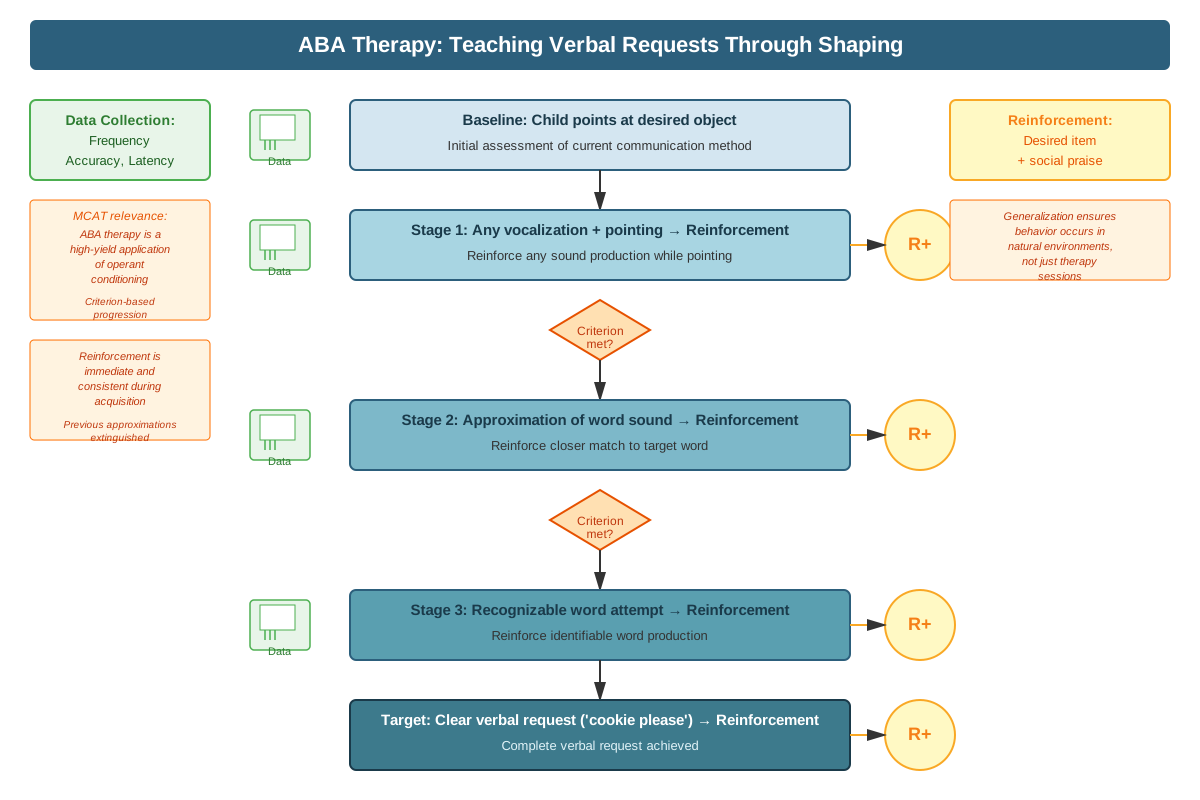
Shaping represents one of the most widely applied behavioral techniques in clinical psychology, education, and animal training. Applied Behavior Analysis (ABA) therapy for autism spectrum disorder relies heavily on shaping to teach communication, social, and self-care skills that individuals might never develop spontaneously. Physical rehabilitation specialists use shaping principles to help stroke patients relearn motor skills by reinforcing incremental improvements in movement. Parents and educators naturally employ shaping when teaching children complex behaviors like toilet training, writing, or playing musical instruments—breaking these skills into achievable steps and praising progressive improvements.
MCAT Exam Statistics
Shaping appears in approximately 3-5% of MCAT Psychology/Sociology questions, making it a moderate-to-high-yield topic. Questions typically appear in three formats: (1) passage-based questions describing behavioral experiments requiring identification of the learning mechanism, (2) discrete questions presenting scenarios and asking which conditioning principle applies, and (3) research design questions asking students to predict outcomes or identify flaws in shaping procedures. The AAMC has consistently included shaping in official practice materials, particularly in passages involving animal learning studies and clinical interventions.
Common Exam Contexts
The MCAT presents shaping in several recurring contexts. Animal training passages describe teaching rats to press levers or pigeons to peck specific targets, requiring students to identify shaping as the mechanism. Clinical vignettes present therapists working with children with developmental delays, gradually reinforcing closer approximations to speech or social interaction. Educational research passages describe teaching complex academic or athletic skills through progressive reinforcement. Students must recognize shaping when behaviors are built gradually through reinforcement of successive approximations, distinguishing it from simple reinforcement of existing behaviors or classical conditioning of reflexive responses.
Core Concepts
Definition and Fundamental Mechanism
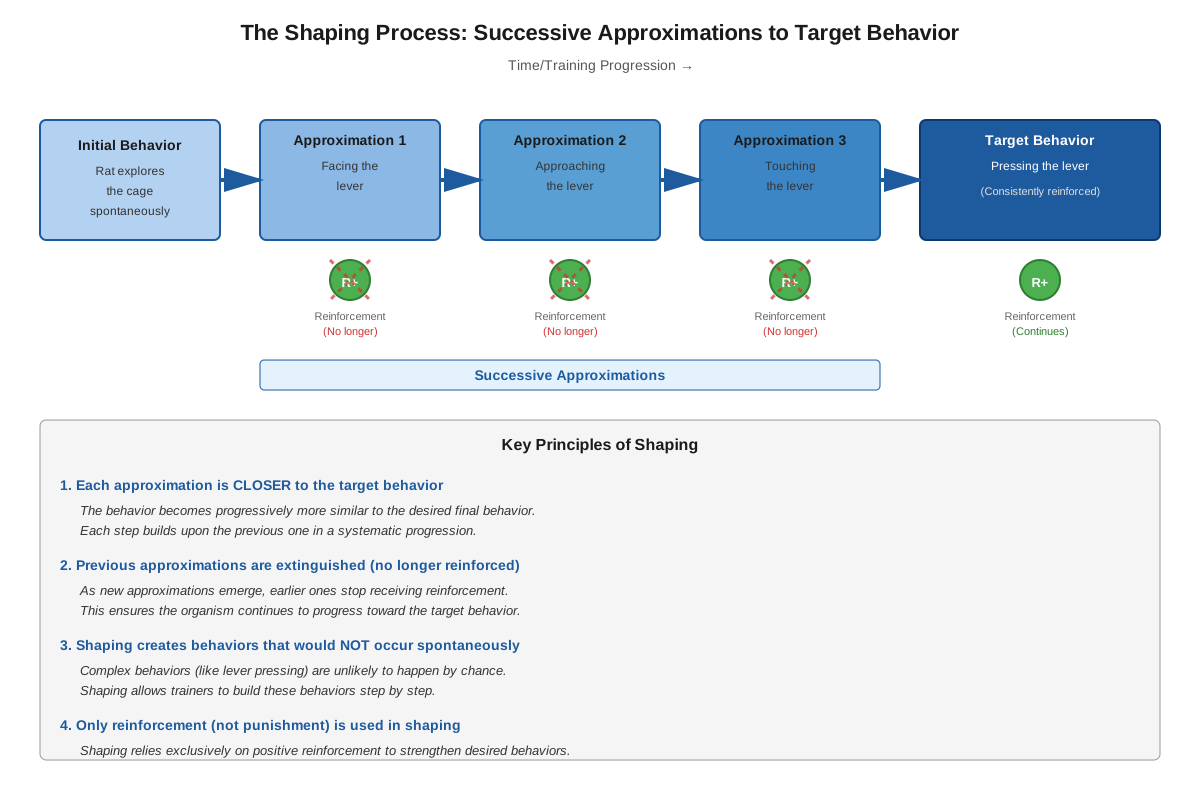
Shaping (also called successive approximation) is an operant conditioning procedure in which reinforcement is delivered for behaviors that progressively approximate a desired target behavior. The process involves reinforcing responses that increasingly resemble the final goal while extinguishing (withholding reinforcement from) earlier, less accurate approximations. This technique enables the establishment of behaviors that have zero or near-zero baseline probability—behaviors that would never occur spontaneously and therefore could never be reinforced directly.
The fundamental mechanism of shaping involves four key components:
- Identification of the target behavior: The final, desired behavior must be clearly defined and observable
- Establishment of a starting point: The trainer identifies an existing behavior in the organism's repertoire that resembles the target behavior, even remotely
- Differential reinforcement: Reinforcement is provided for responses that move closer to the target while being withheld from responses that do not progress toward the goal
- Gradual criterion shifting: As each approximation becomes established, the criterion for reinforcement becomes more stringent, requiring closer resemblance to the target behavior
The Shaping Process: Step-by-Step
The shaping procedure follows a systematic progression:
- Baseline observation: Observe the organism's natural behavioral repertoire to identify a starting behavior
- Reinforce initial approximation: Deliver reinforcement whenever the organism displays any behavior remotely resembling the target
- Establish the approximation: Continue reinforcement until this behavior occurs reliably and frequently
- Raise the criterion: Stop reinforcing the current approximation and wait for a behavior that more closely resembles the target
- Reinforce the improved approximation: Deliver reinforcement only for this better approximation
- Repeat the process: Continue raising criteria and reinforcing progressively better approximations until the target behavior is achieved
- Maintain the target behavior: Once achieved, maintain the behavior through an appropriate reinforcement schedule
Critical Features Distinguishing Shaping
Several features distinguish shaping from other learning mechanisms:
| Feature | Shaping | Simple Reinforcement | Chaining |
|---|---|---|---|
| Target complexity | Complex behaviors unlikely to occur spontaneously | Existing behaviors in the repertoire | Sequence of already-learned behaviors |
| Reinforcement timing | For successive approximations | For complete target behavior | For completing each link in sequence |
| Process | Gradual refinement of single behavior | Strengthening existing response | Connecting multiple discrete behaviors |
| Criterion changes | Progressively more stringent | Remains constant | Each step has fixed criterion |
Differential Reinforcement in Shaping
Differential reinforcement is the engine that drives shaping. This principle involves reinforcing some responses while extinguishing others based on how closely they approximate the target. Three types of differential reinforcement operate during shaping:
- Differential Reinforcement of Successive Approximations (the core of shaping): Reinforcing behaviors that are progressively closer to the target
- Differential Reinforcement of Other Behavior (DRO): Reinforcing any behavior except the previous approximation once a better one emerges
- Extinction of earlier approximations: Actively withholding reinforcement from behaviors that were previously reinforced but are now superseded by better approximations
The timing of criterion shifts is critical. Shifting criteria too quickly (before the current approximation is well-established) can cause the behavior to deteriorate or disappear entirely—a phenomenon called behavioral breakdown. Shifting too slowly wastes time and may allow undesired variations to become entrenched.
Examples Across Contexts
Animal Training Example: Teaching a dolphin to jump through a hoop suspended above water illustrates classic shaping. The trainer begins by reinforcing the dolphin for swimming near the hoop location. Once established, reinforcement requires the dolphin to surface near the hoop. Next, only touching the hoop with its rostrum earns reinforcement. Subsequently, the dolphin must lift its head above water near the hoop, then jump partially out of water, then jump completely out of water, and finally jump through the hoop. Each step represents a successive approximation reinforced until established, then superseded by a more stringent criterion.
Clinical Application Example: A speech therapist working with a nonverbal child with autism might use shaping to establish word production. Initially, any vocalization (even random sounds) receives reinforcement (praise, preferred toy). Once vocalizations increase, only sounds resembling speech phonemes earn reinforcement. Next, only approximations of specific target sounds (like "mmm" for "mama") are reinforced. Gradually, the criterion shifts to require closer approximations until the child produces recognizable words. This application demonstrates how shaping creates entirely new behavioral capabilities.
Educational Example: Teaching a child to write the letter "A" involves shaping. Initially, any mark on paper receives praise. Then, only vertical lines earn reinforcement. Next, the child must make two vertical lines, then two lines that meet at the top, then adding the horizontal crossbar, and finally producing a recognizable "A" with proper proportions. Each step builds on the previous one through differential reinforcement.
Factors Affecting Shaping Success
Several variables influence shaping effectiveness:
- Reinforcer potency: Stronger reinforcers (more preferred rewards) facilitate faster shaping
- Reinforcement immediacy: Shorter delays between response and reinforcement produce clearer learning
- Step size: Smaller increments between successive approximations generally produce more reliable learning
- Individual differences: Organisms vary in learning speed, requiring individualized pacing
- Environmental consistency: Stable training conditions prevent confusion and facilitate discrimination of which behaviors earn reinforcement
- Trainer skill: Experienced trainers recognize appropriate approximations and time criterion shifts optimally
Concept Relationships
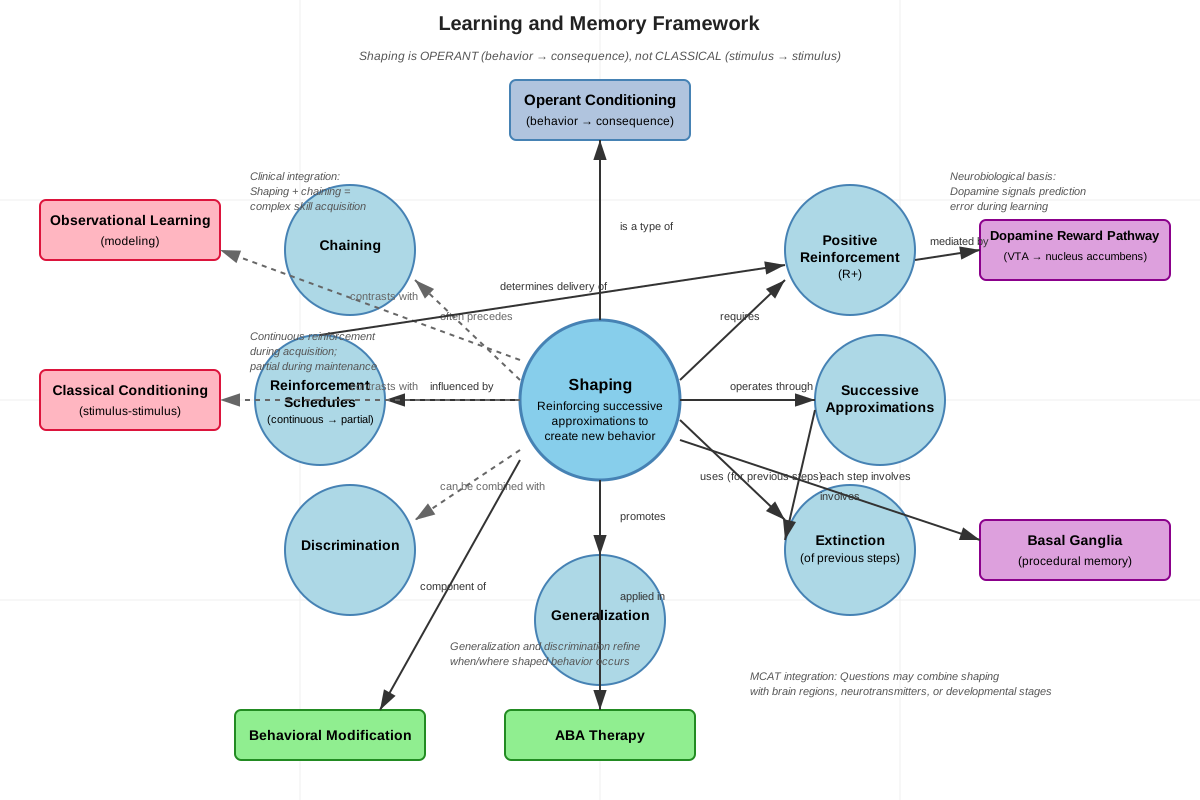
Shaping exists within a network of interconnected behavioral concepts. At the foundation, operant conditioning provides the theoretical framework—shaping is simply a sophisticated application of reinforcement principles. Specifically, shaping relies on positive reinforcement (adding a desirable stimulus following behavior) to increase the frequency of successive approximations. The relationship flows: Operant Conditioning → Reinforcement Principles → Differential Reinforcement → Shaping.
Shaping connects closely to extinction, as each criterion shift involves extinguishing previously reinforced approximations while reinforcing better ones. This creates a dynamic: Shaping = Reinforcement of new approximations + Extinction of old approximations. Understanding extinction helps predict that if criterion shifts occur too rapidly, the entire behavioral chain may extinguish.
Reinforcement schedules determine how shaping procedures maintain behaviors. During initial shaping, continuous reinforcement (reinforcing every correct response) is typically used to establish each approximation quickly. Once the target behavior is achieved, shifting to partial reinforcement schedules (intermittent reinforcement) maintains the behavior more durably and prevents rapid extinction.
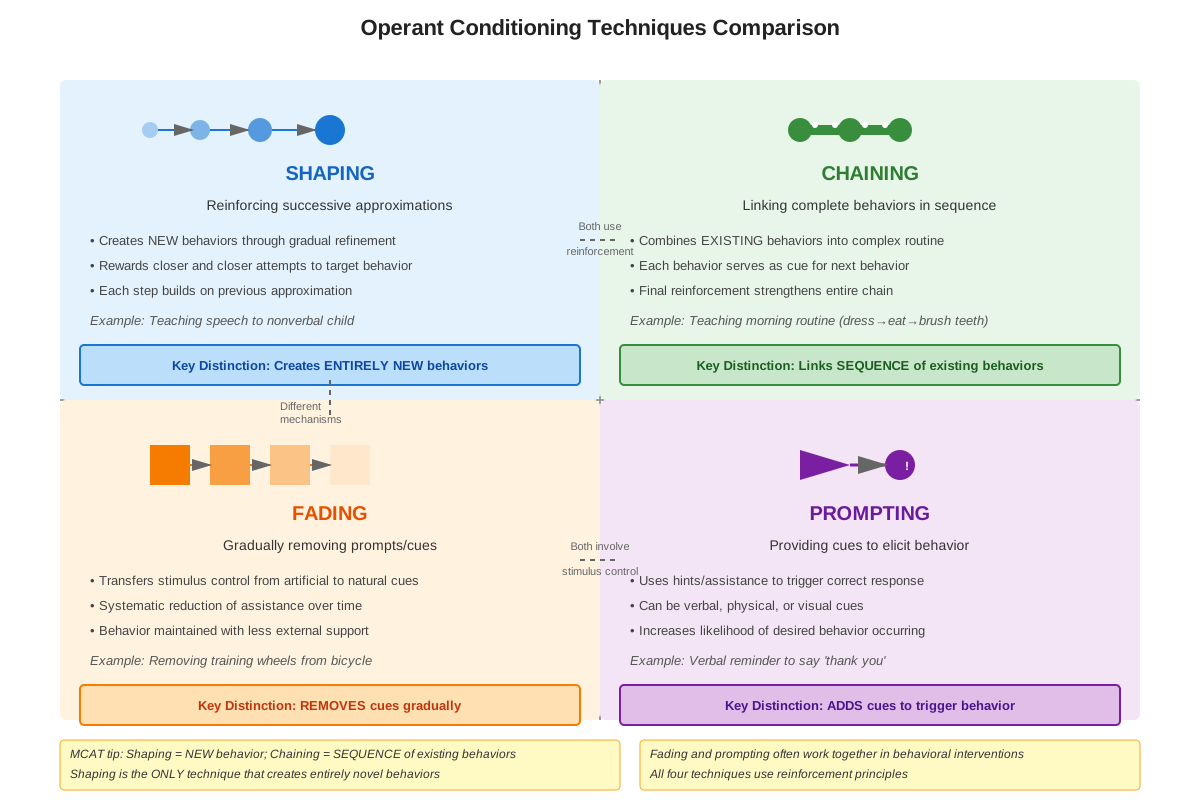
Shaping differs from but relates to chaining, another technique for teaching complex behaviors. While shaping gradually refines a single behavior, chaining connects multiple already-learned discrete behaviors into a sequence. However, shaping may be used to establish individual links before chaining them together, creating a hierarchical relationship: Shaping establishes components → Chaining connects components into sequences.
The concept also connects to stimulus control and discrimination learning. As shaping progresses, organisms learn to discriminate which variations of behavior produce reinforcement, bringing behavior under the control of specific criteria. This relationship flows: Shaping → Differential Reinforcement → Discrimination Learning → Stimulus Control.
In clinical contexts, shaping relates to Applied Behavior Analysis (ABA) and behavioral modification programs. These therapeutic approaches use shaping as one tool among many (including prompting, fading, and token economies) to teach adaptive behaviors and reduce maladaptive ones.
High-Yield Facts
⭐ Shaping involves reinforcing successive approximations of a target behavior until the desired behavior is achieved
⭐ Shaping is used to establish behaviors that would never occur spontaneously and therefore could never be directly reinforced
⭐ Differential reinforcement is the core mechanism of shaping—reinforcing closer approximations while extinguishing less accurate ones
⭐ Criterion shifts must occur after each approximation is well-established; shifting too quickly causes behavioral breakdown
⭐ Shaping differs from chaining: shaping refines a single behavior through approximations, while chaining connects multiple discrete behaviors into sequences
- Shaping relies exclusively on reinforcement (not punishment) to modify behavior
- B.F. Skinner systematically studied and popularized shaping through his work with operant conditioning chambers
- Continuous reinforcement is typically used during shaping to establish each approximation quickly
- Once the target behavior is achieved, partial reinforcement schedules maintain it more effectively
- Shaping is a primary technique in Applied Behavior Analysis (ABA) therapy for autism spectrum disorder
- The starting point for shaping must be a behavior already in the organism's repertoire
- Shaping can be used to teach both simple motor behaviors and complex cognitive or social skills
- Behavioral breakdown occurs when criteria are advanced too rapidly before approximations are firmly established
- Shaping requires careful observation to identify appropriate successive approximations
- The same shaping principles apply across species, from invertebrates to humans
Quick check — test yourself on Shaping so far.
Try Flashcards →Common Misconceptions
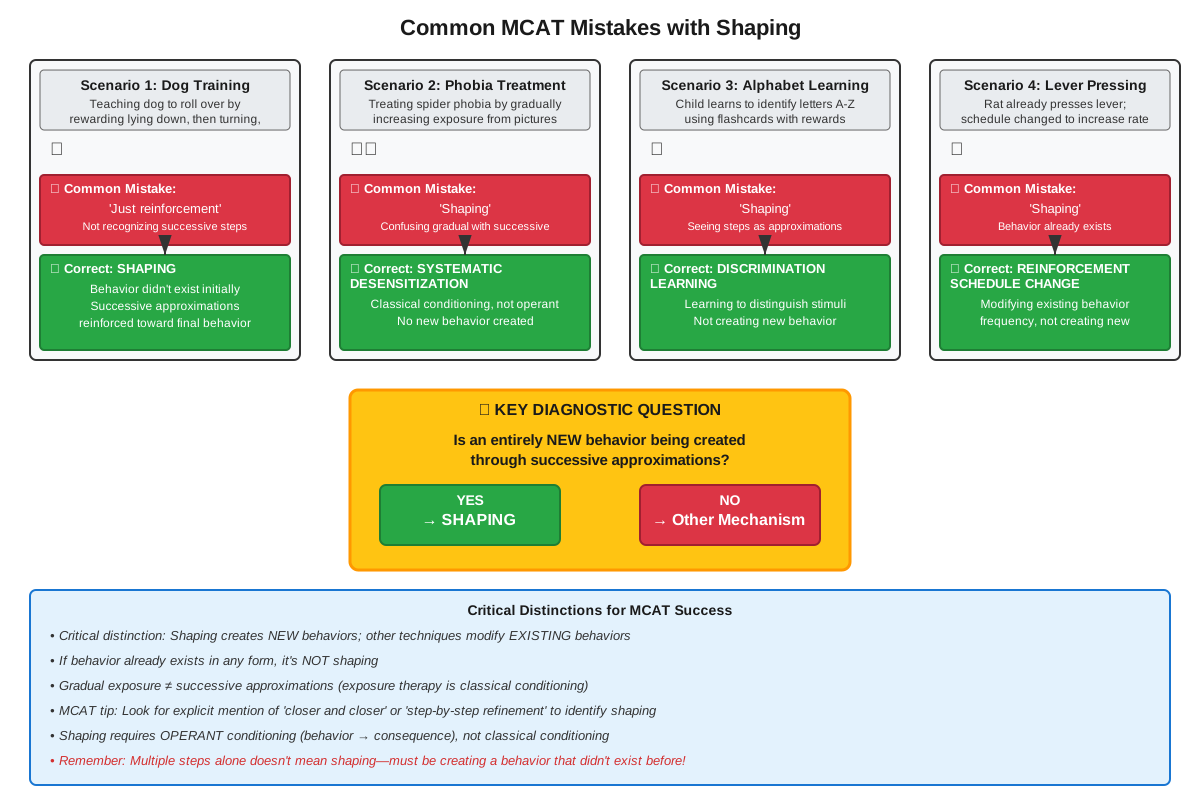
Misconception: Shaping and chaining are the same thing because both teach complex behaviors.
Correction: Shaping gradually refines a single behavior through successive approximations, while chaining connects multiple already-learned discrete behaviors into a sequence. Shaping creates new behaviors; chaining organizes existing ones.
Misconception: Shaping can be accomplished through punishment of incorrect responses.
Correction: Shaping relies exclusively on reinforcement of progressively better approximations. Punishment is not used in shaping procedures because it doesn't provide information about which direction behavior should change, only that the current behavior is wrong.
Misconception: Once a better approximation emerges, the trainer should immediately stop reinforcing the previous approximation.
Correction: Criterion shifts should occur only after the current approximation is well-established and occurring reliably. Premature criterion shifts cause behavioral breakdown, where the entire behavior chain deteriorates or disappears.
Misconception: Shaping only applies to animal training and has limited relevance to human behavior.
Correction: Shaping is extensively used in clinical psychology (especially ABA therapy), education, rehabilitation medicine, sports training, and organizational behavior management. Humans learn complex skills through shaping just as other animals do.
Misconception: Any behavior can be shaped equally easily in any organism.
Correction: Biological preparedness and species-specific behavioral repertoires constrain what can be shaped. Behaviors consistent with an organism's natural tendencies (instinctive drift) are easier to shape than those that contradict evolutionary predispositions.
Misconception: Shaping requires the target behavior to eventually occur spontaneously before it can be reinforced.
Correction: The entire purpose of shaping is to establish behaviors that would never occur spontaneously. By reinforcing successive approximations, shaping creates behaviors that have zero baseline probability.
Misconception: Shaping is a fast process that quickly establishes target behaviors.
Correction: Shaping is typically gradual and time-intensive, requiring patience and careful observation. The process may take days, weeks, or even months depending on behavior complexity and individual learning rates.
Worked Examples
Example 1: Identifying Shaping in an Experimental Passage
Passage Summary: Researchers want to teach laboratory rats to press a lever located high on the chamber wall, a behavior rats never perform spontaneously. Initially, rats receive a food pellet whenever they rear up on their hind legs anywhere in the chamber. After this behavior becomes frequent, food is delivered only when rats rear up near the wall with the lever. Subsequently, food is delivered only when rats touch the wall while rearing. Next, only touching the area near the lever produces food. Finally, only pressing the lever itself delivers food pellets.
Question: Which learning principle best explains the procedure described?
Analysis:
- Identify the learning category: The procedure involves consequences (food pellets) following behavior, indicating operant conditioning rather than classical conditioning
- Examine the target behavior: Pressing a high lever is described as a behavior rats never perform spontaneously—this signals shaping rather than simple reinforcement
- Trace the progression: The passage describes a clear sequence of successive approximations: rearing anywhere → rearing near wall → touching wall → touching near lever → pressing lever
- Identify differential reinforcement: Each step involves reinforcing a closer approximation while (implicitly) extinguishing the previous, less accurate approximation
- Note criterion shifts: The reinforcement criterion becomes progressively more stringent as each approximation is established
Answer: This procedure exemplifies shaping (successive approximation). The researchers systematically reinforce behaviors that progressively approximate the target behavior of lever pressing, which would never occur spontaneously. Each approximation is established before the criterion shifts to require a closer match to the target behavior.
Connection to Learning Objectives: This example demonstrates application of shaping to exam-style experimental passages, requiring students to identify the learning mechanism from a behavioral description and distinguish shaping from other operant conditioning techniques.
Example 2: Clinical Application Analysis
Scenario: A behavioral therapist works with a 4-year-old child with autism who does not make eye contact. The therapist's goal is to establish sustained eye contact during social interactions. The intervention proceeds as follows:
- Week 1: The child receives a preferred toy whenever he orients his head toward the therapist's face, even briefly
- Week 2: The toy is delivered only when the child's gaze moves toward the therapist's face
- Week 3: Reinforcement requires the child to make momentary eye contact (less than 1 second)
- Week 4: Eye contact must last at least 2 seconds to earn reinforcement
- Week 5: Eye contact must last at least 4 seconds
- Week 6: The child must maintain eye contact for 5+ seconds during social interaction
Question: Explain why this represents shaping and identify one potential problem with the procedure as described.
Analysis of Shaping Elements:
- Target behavior: Sustained eye contact during social interaction—a behavior this child never displays spontaneously
- Starting point: Head orientation toward therapist's face—a behavior that occasionally occurs and remotely resembles the target
- Successive approximations: Clear progression from head orientation → gaze movement → brief eye contact → progressively longer eye contact
- Differential reinforcement: Each week, the criterion for reinforcement becomes more stringent, requiring closer approximation to the target
- Gradual progression: The procedure breaks down a complex social behavior into manageable steps
Potential Problem: The procedure description doesn't indicate how well each approximation is established before advancing criteria. If the therapist advances from Week 1 to Week 2 before head orientation is occurring reliably and frequently, behavioral breakdown may occur. The procedure should specify that criterion shifts occur only when the current approximation reaches a predetermined frequency (e.g., 80% of opportunities) rather than following a fixed time schedule.
Additional Consideration: The procedure appropriately uses positive reinforcement (adding preferred toy) rather than punishment. However, the therapist should eventually fade from tangible reinforcers (toys) to natural social reinforcers (smiles, praise) to ensure eye contact generalizes beyond the training context.
Connection to Learning Objectives: This example demonstrates application of shaping to clinical scenarios, identification of shaping components, analysis of potential procedural problems, and connection to related concepts (reinforcement schedules, generalization, and fading).
Exam Strategy
Approaching MCAT Questions on Shaping
When encountering potential shaping questions, use this systematic approach:
- Identify the learning category first: Determine whether the question involves operant conditioning (consequences following behavior) or classical conditioning (pairing of stimuli). Shaping is always operant.
- Look for the "spontaneous occurrence" clue: Questions often state or imply that the target behavior would never occur naturally. This phrase strongly suggests shaping rather than simple reinforcement.
- Trace the behavioral progression: If the passage or question stem describes a sequence of increasingly accurate behaviors, shaping is likely involved. Map out the approximations to verify they progress toward a target.
- Check for differential reinforcement: Confirm that reinforcement criteria change over time, becoming more stringent as training progresses.
Trigger Words and Phrases
Watch for these high-yield phrases that signal shaping:
- "Successive approximations"
- "Gradually reinforcing closer attempts"
- "Behavior that would never occur spontaneously"
- "Progressively more stringent criteria"
- "Differential reinforcement"
- "Breaking down complex behavior into steps"
- "Each step builds on the previous one"
- "Reinforcement for increasingly accurate responses"
Conversely, these phrases suggest concepts other than shaping:
- "Pairing a neutral stimulus with..." (classical conditioning)
- "Connecting a sequence of behaviors..." (chaining)
- "Gradually removing prompts..." (fading)
- "Reinforcing a behavior that already occurs..." (simple reinforcement)
Process-of-Elimination Tips
When shaping appears among answer choices:
- Eliminate classical conditioning options if the question involves voluntary behavior and consequences (not reflexes and stimulus pairing)
- Eliminate simple reinforcement if the target behavior is described as complex or unlikely to occur spontaneously
- Eliminate chaining if the question describes refining a single behavior rather than connecting multiple discrete behaviors
- Eliminate punishment-based options since shaping uses only reinforcement
- Eliminate modeling/observational learning if no demonstration or observation of others is described
Time Allocation
Shaping questions typically require 60-90 seconds:
- 15-20 seconds: Read the question stem and identify what's being asked
- 30-40 seconds: Analyze the passage or scenario for shaping elements
- 15-20 seconds: Evaluate answer choices and eliminate incorrect options
- 10-15 seconds: Confirm the correct answer matches all shaping criteria
For passage-based questions, annotate the passage during initial reading by marking behavioral progressions and reinforcement points, saving time when questions reference specific procedures.
Memory Techniques
Mnemonic for Shaping Steps: "SHAPES"
Select the target behavior
Hunt for a starting behavior in the current repertoire
Apply reinforcement to the initial approximation
Progressively raise criteria as each step is established
Extinguish earlier approximations when better ones emerge
Sustain the final behavior with appropriate reinforcement schedules
Visualization Strategy
Imagine a sculptor shaping clay into a statue. The sculptor doesn't start with the final form—they gradually refine the clay through successive modifications, each bringing the sculpture closer to the intended design. Just as the sculptor wouldn't jump from a clay block to a finished statue in one step, behavioral shaping requires gradual refinement through successive approximations. This metaphor captures both the gradual nature of shaping and the idea that each step builds on the previous one.
Acronym for Distinguishing Learning Techniques: "SCFP"
When differentiating operant conditioning techniques:
- Shaping: Successive approximations of a single behavior
- Chaining: Connecting multiple discrete behaviors in sequence
- Fading: Gradually removing prompts or cues
- Prompting: Providing cues to trigger desired behavior
Rhyme for Criterion Timing
"Don't shift too quick or the behavior will break; establish each step for the learning's sake."
This reminds students that premature criterion shifts cause behavioral breakdown, a common trap in MCAT questions about flawed shaping procedures.
Summary
Shaping is a fundamental operant conditioning technique that establishes complex behaviors through systematic reinforcement of successive approximations toward a target behavior. Unlike simple reinforcement of existing behaviors, shaping creates entirely new behavioral repertoires by differentially reinforcing progressively closer attempts at the desired response while extinguishing less accurate approximations. The procedure requires careful observation to identify appropriate starting behaviors, strategic timing of criterion shifts to prevent behavioral breakdown, and consistent application of reinforcement principles. Shaping differs from related techniques like chaining (which connects discrete behaviors) and fading (which removes prompts), though these methods often work together in comprehensive behavioral interventions. On the MCAT, shaping appears in experimental passages involving animal learning, clinical vignettes describing behavioral therapy, and educational scenarios involving skill acquisition. Success requires recognizing key features: behaviors that wouldn't occur spontaneously, progressive refinement through differential reinforcement, and gradual criterion shifts. Understanding shaping provides essential foundation for analyzing behavioral modification procedures and distinguishing among operant conditioning techniques.
Key Takeaways
- Shaping establishes behaviors that would never occur spontaneously through reinforcement of successive approximations
- Differential reinforcement drives shaping: reinforce closer approximations while extinguishing less accurate ones
- Criterion shifts must occur only after each approximation is well-established to prevent behavioral breakdown
- Shaping differs from chaining (refines single behavior vs. connects multiple behaviors) and simple reinforcement (creates new behaviors vs. strengthens existing ones)
- MCAT questions test shaping through experimental designs, clinical applications, and scenario analysis requiring identification of the learning mechanism
- Trigger phrases include "successive approximations," "would never occur spontaneously," and "progressively more stringent criteria"
- Shaping relies exclusively on reinforcement (never punishment) and typically uses continuous reinforcement during training, shifting to partial reinforcement for maintenance
Related Topics
Operant Conditioning Fundamentals: Mastering shaping requires solid understanding of reinforcement types, schedules, and basic operant principles. Shaping represents an advanced application of these foundational concepts.
Chaining and Task Analysis: After understanding shaping, explore how chaining connects multiple discrete behaviors into complex sequences, often using shaping to establish individual links before connecting them.
Applied Behavior Analysis (ABA): Clinical applications of shaping appear extensively in ABA therapy for developmental disorders, providing real-world context for behavioral principles.
Discrimination and Generalization: Shaping procedures inherently involve discrimination learning (which behaviors earn reinforcement) and raise questions about generalization (will shaped behaviors occur in new contexts).
Biological Constraints on Learning: Understanding instinctive drift and preparedness explains why some behaviors are easier to shape than others, connecting behavioral and evolutionary psychology.
Observational Learning and Modeling: Contrasting shaping (direct reinforcement of approximations) with observational learning (learning through watching others) clarifies different learning mechanisms and their applications.
Practice CTA
Now that you've mastered the core concepts of shaping, it's time to solidify your understanding through active practice. Complete the practice questions and flashcards associated with this topic to test your ability to identify shaping in various contexts, distinguish it from related learning mechanisms, and apply these principles to novel MCAT-style scenarios. Active retrieval through practice is the most effective way to ensure this high-yield content is accessible during your exam. Remember: understanding shaping opens doors to comprehending more complex behavioral interventions and learning theories that build on these foundational principles. Your investment in mastering this topic will pay dividends across multiple Psychology/Sociology questions on test day!
Sign up free to keep reading
Create a free AnvayaPrep account to finish this MCAT guide on Shaping — plus flashcards and practice questions.