Overview
The difference threshold, also known as the just noticeable difference (JND), represents a fundamental concept in sensation and perception that bridges the gap between physical stimuli in the environment and our psychological experience of those stimuli. This concept addresses a deceptively simple question: how much must a stimulus change before we can detect that change? Understanding the difference threshold is essential for comprehending how our sensory systems translate physical energy into meaningful perceptual experiences, and it forms the foundation for understanding more complex perceptual phenomena.
For the MCAT, the difference threshold is a medium-yield topic that appears regularly in the Psychology and Sociology section, particularly within questions addressing sensory processing, psychophysics, and perceptual adaptation. The concept frequently appears in experimental passages where students must interpret data about sensory discrimination or apply Weber's Law to novel scenarios. Mastery of this topic requires not only memorizing definitions but also understanding the mathematical relationships that govern sensory discrimination and the ability to apply these principles to real-world and clinical contexts.
The difference threshold connects intimately with other core psychology concepts including absolute threshold, signal detection theory, sensory adaptation, and the broader framework of psychophysics. It provides the quantitative foundation for understanding how we perceive changes in our environment—from noticing when music gets louder to detecting subtle changes in a patient's symptoms. This topic exemplifies how psychology can be studied scientifically through precise measurement and mathematical relationships, making it a favorite for MCAT test writers who want to assess both conceptual understanding and quantitative reasoning.
Learning Objectives
- [ ] Define difference threshold using accurate Psychology terminology
- [ ] Explain why difference threshold matters for the MCAT
- [ ] Apply difference threshold to exam-style questions
- [ ] Identify common mistakes related to difference threshold
- [ ] Connect difference threshold to related Psychology concepts
- [ ] Calculate just noticeable differences using Weber's Law and interpret the results
- [ ] Distinguish between difference threshold and absolute threshold in experimental contexts
- [ ] Analyze how difference thresholds vary across different sensory modalities
- [ ] Evaluate the practical implications of difference thresholds in clinical and real-world settings
Prerequisites
- Absolute threshold: The minimum stimulus intensity required to detect a stimulus 50% of the time; relevant because difference threshold builds on the concept of detection limits but focuses on change detection rather than initial detection
- Basic sensory systems anatomy: Understanding of the five primary senses (vision, hearing, touch, taste, smell); relevant because difference thresholds apply differently across sensory modalities
- Psychophysics fundamentals: The study of relationships between physical stimuli and psychological experiences; relevant because difference threshold is a core psychophysical measurement
- Basic algebra and proportional reasoning: Ability to work with ratios and percentages; relevant because Weber's Law involves mathematical calculations
Why This Topic Matters
Clinical and Real-World Significance
The difference threshold has profound implications across medical practice and everyday life. Clinically, understanding difference thresholds helps healthcare providers assess sensory function in patients with neurological conditions, diabetes-related neuropathy, or age-related sensory decline. For example, a patient's ability to detect small changes in pressure or temperature can indicate the progression of peripheral neuropathy. In pain management, the difference threshold helps clinicians understand why patients may not notice gradual increases in pain medication effectiveness or why sudden changes in pain intensity are more noticeable than gradual ones.
In practical applications, difference thresholds explain why we might not notice gradual weight gain (small changes below the JND) but immediately detect when someone adds weight to a backpack we're already carrying. This principle underlies product design decisions—from how much companies can reduce product sizes before consumers notice, to how audio engineers adjust volume levels in music production.
MCAT Examination Context
On the MCAT, difference threshold questions appear in approximately 3-5% of Psychology and Sociology passages, making it a medium-yield topic that students cannot afford to ignore. Questions typically fall into three categories:
- Conceptual questions asking students to identify or define the difference threshold in various scenarios
- Calculation questions requiring application of Weber's Law to determine JNDs
- Experimental interpretation questions presenting research data about sensory discrimination and asking students to draw conclusions
The topic most commonly appears in passages about sensory processing, psychophysics experiments, or clinical assessments of sensory function. Test writers favor this topic because it allows them to assess both conceptual understanding and quantitative reasoning within a psychology context. Students who master difference threshold concepts gain an advantage in questions about sensory adaptation, perceptual constancy, and signal detection theory—all related high-yield topics.
Core Concepts
Defining the Difference Threshold
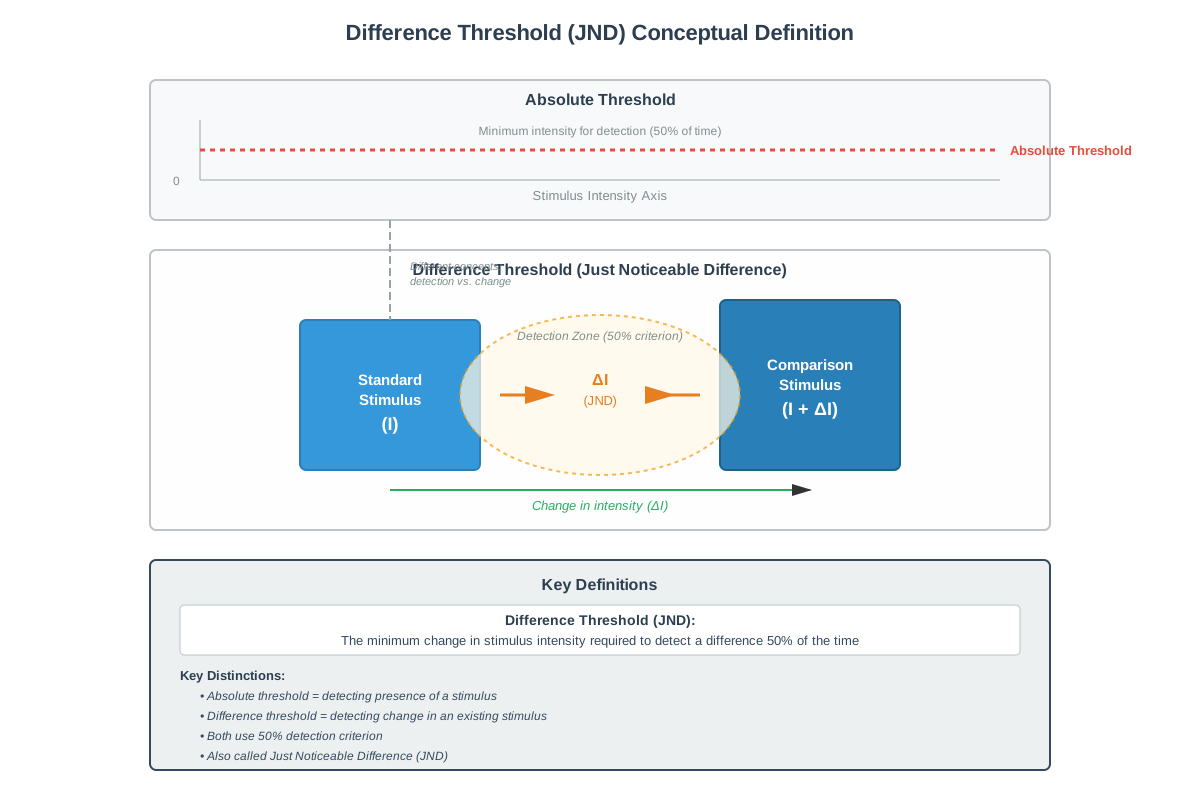
The difference threshold (also called the just noticeable difference or JND) is defined as the minimum amount of change in a stimulus that can be detected 50% of the time. This operational definition is crucial: like the absolute threshold, the difference threshold is probabilistic rather than absolute. We don't detect every small change consistently; rather, the difference threshold represents the point at which we're equally likely to detect or miss a change.
The 50% detection criterion reflects the inherent variability in sensory systems. Neural noise, attention fluctuations, and other factors mean that our ability to detect changes varies from moment to moment. By defining the threshold at 50% detection, researchers establish a reliable, reproducible measurement that accounts for this variability.
Difference threshold measurements apply across all sensory modalities—vision, hearing, touch, taste, and smell—though the specific values and measurement techniques differ. For example, in vision, we might measure the JND for brightness by determining how much we must increase light intensity before observers notice the change. In audition, we measure how much frequency or amplitude must change before listeners detect a difference in pitch or loudness.
Weber's Law: The Mathematical Foundation
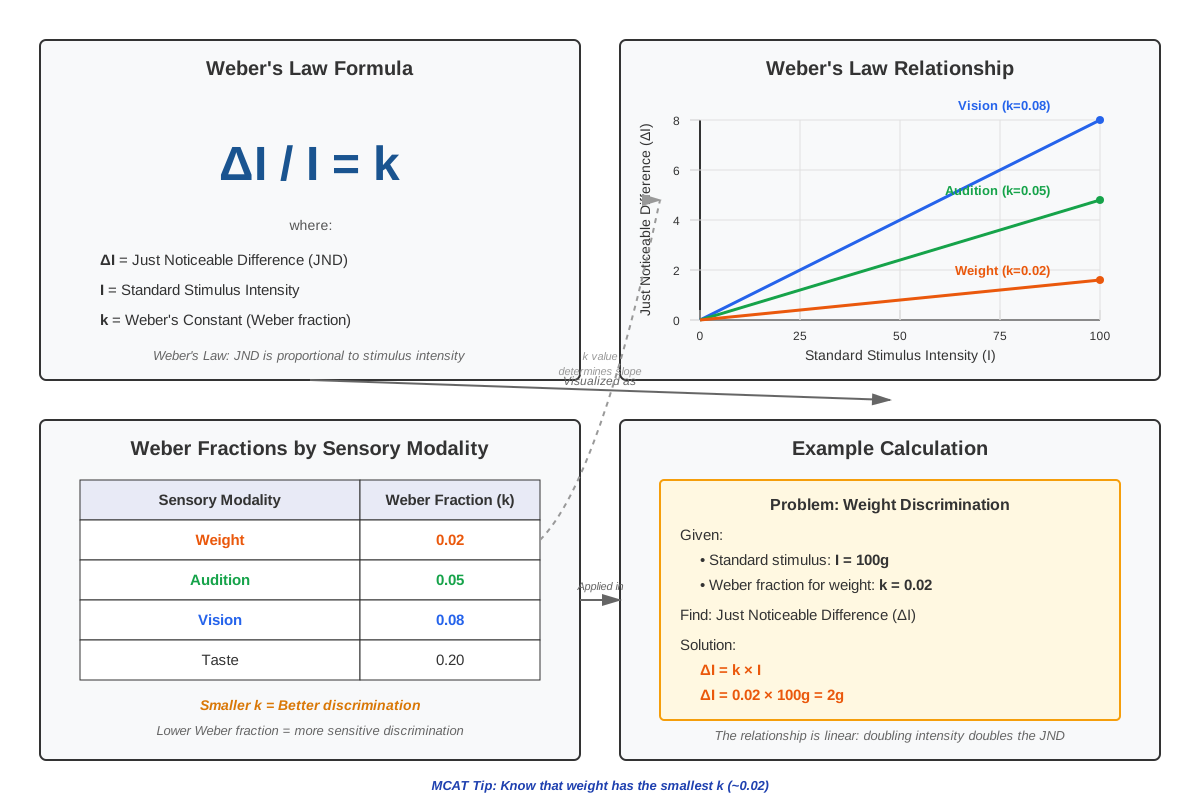
Weber's Law provides the mathematical relationship governing difference thresholds and represents one of the most important principles in psychophysics. The law states that the difference threshold is proportional to the magnitude of the original stimulus. Mathematically:
ΔI / I = kWhere:
- ΔI = the difference threshold (change in intensity)
- I = the original stimulus intensity
- k = Weber's constant (specific to each sensory modality)
This equation reveals a profound insight: the JND is not a fixed amount but rather a constant proportion of the original stimulus. This means that detecting a change in a weak stimulus requires a smaller absolute change than detecting the same proportional change in a strong stimulus.
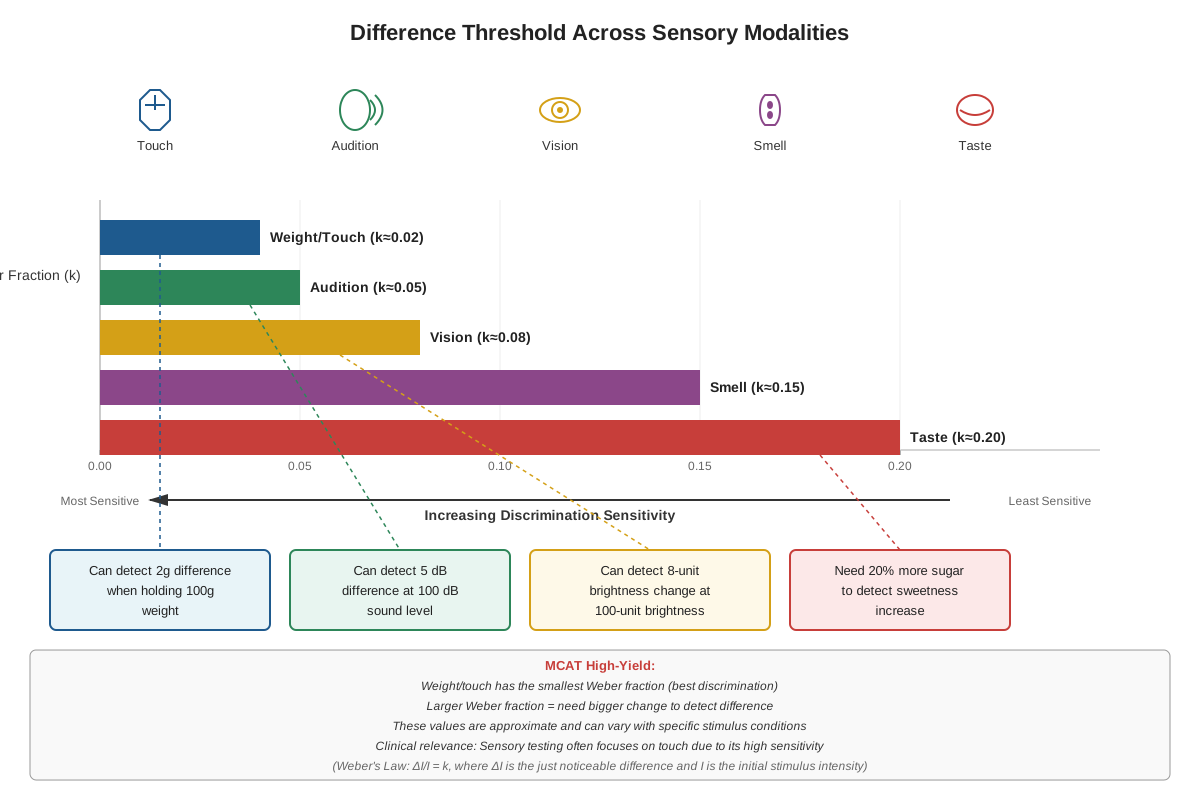
Weber's constant (k) varies across sensory modalities, reflecting the relative sensitivity of different sensory systems:
| Sensory Modality | Weber's Constant (k) | Interpretation |
|---|---|---|
| Vision (brightness) | 0.08 (8%) | Must change brightness by ~8% to notice |
| Hearing (pitch) | 0.003 (0.3%) | Must change frequency by ~0.3% to notice |
| Touch (pressure) | 0.14 (14%) | Must change pressure by ~14% to notice |
| Taste (salt) | 0.20 (20%) | Must change concentration by ~20% to notice |
| Smell | 0.10-0.20 (10-20%) | Must change concentration by ~10-20% to notice |
These values indicate that hearing (particularly pitch discrimination) is our most sensitive modality for detecting changes, while taste is relatively insensitive. This explains why we can easily detect when someone sings slightly off-key but might not notice when food is slightly less salty than usual.
Practical Application of Weber's Law
To apply Weber's Law in problem-solving:
- Identify the original stimulus intensity (I)
- Determine the appropriate Weber's constant (k) for the sensory modality
- Calculate the difference threshold: ΔI = k × I
- Interpret the result in context
For example, if you're holding a 100-gram weight (I = 100g) and Weber's constant for weight discrimination is 0.02 (2%), the difference threshold would be:
ΔI = 0.02 × 100g = 2g
This means you would need to add or remove at least 2 grams before you'd notice a change in weight 50% of the time. If you were holding a 200-gram weight, you'd need to add or remove 4 grams to notice the change—twice the absolute amount but the same proportion.
Difference Threshold vs. Absolute Threshold
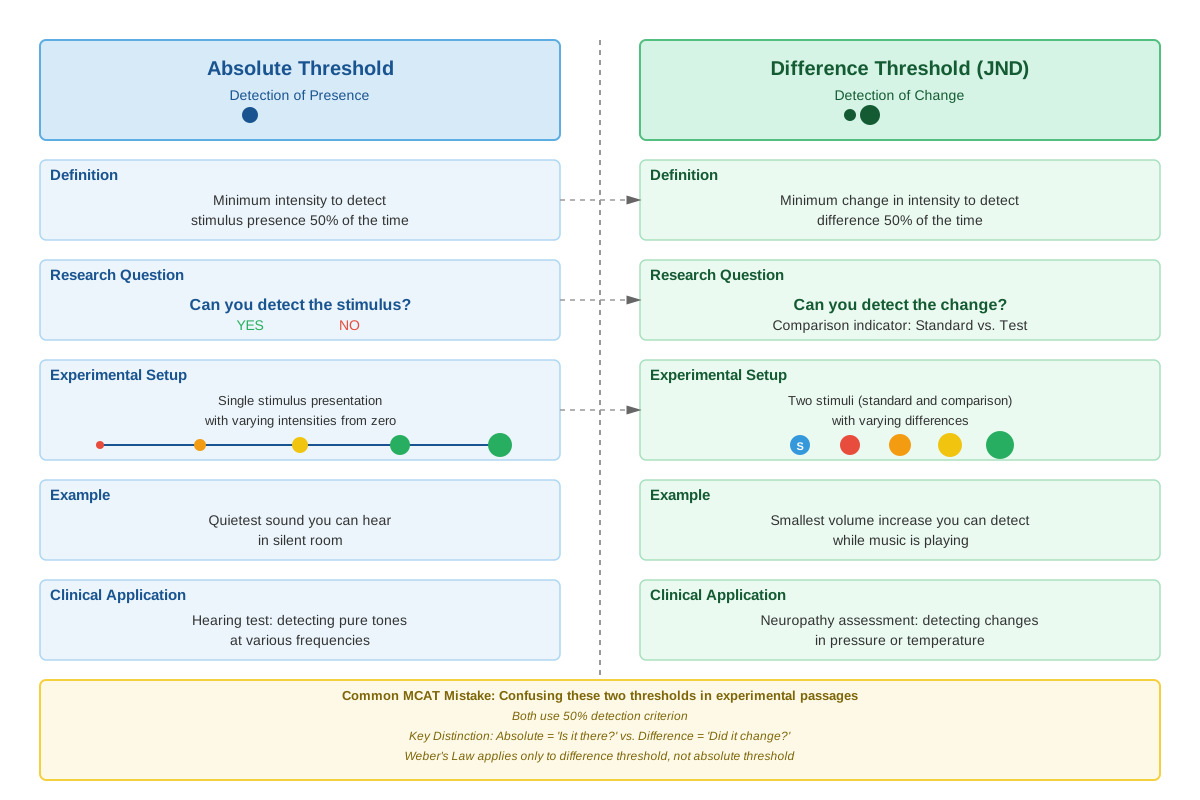
Understanding the distinction between difference threshold and absolute threshold is critical for MCAT success:
| Feature | Absolute Threshold | Difference Threshold |
|---|---|---|
| Definition | Minimum stimulus intensity to detect presence | Minimum change to detect difference |
| Question answered | "Is something there?" | "Did something change?" |
| Starting point | No stimulus (zero) | Existing stimulus present |
| Example | Quietest sound you can hear | Smallest volume increase you notice |
| Clinical relevance | Screening for sensory loss | Assessing discrimination ability |
Both thresholds use the 50% detection criterion, but they measure fundamentally different aspects of sensory function. A patient might have a normal absolute threshold (can detect when a stimulus is present) but an elevated difference threshold (cannot detect small changes in that stimulus), suggesting specific types of sensory processing deficits.
Factors Affecting Difference Thresholds
Several factors influence difference thresholds beyond the basic stimulus intensity:
Sensory adaptation: Prolonged exposure to a stimulus can alter difference thresholds. For example, after adapting to a bright environment, we become less sensitive to small changes in brightness, effectively raising the difference threshold.
Attention and expectation: When we actively attend to a stimulus or expect a change, our difference thresholds decrease—we can detect smaller changes. This relates to signal detection theory and the role of cognitive factors in perception.
Individual differences: Age, genetics, training, and health status all affect difference thresholds. Musicians typically have lower difference thresholds for pitch than non-musicians, reflecting both innate ability and training effects.
Stimulus context: The presence of other stimuli can affect difference thresholds through phenomena like masking (in audition) or contrast effects (in vision). A change that would be noticeable in isolation might be undetectable in a complex sensory environment.
Fechner's Law: Beyond Weber
While Weber's Law describes the relationship between stimulus intensity and the JND, Fechner's Law extends this to describe the relationship between physical stimulus intensity and perceived intensity. Fechner proposed that perceived intensity increases logarithmically with physical intensity:
S = k × log(I)Where S is perceived intensity and I is physical intensity. This law, built on Weber's work, explains why doubling the physical intensity of a stimulus doesn't double our perception of its intensity. While less commonly tested than Weber's Law on the MCAT, understanding Fechner's Law provides deeper insight into the nonlinear relationship between physical and psychological reality.
Stevens' Power Law: A Modern Refinement
Stevens' Power Law offers a more accurate description for many sensory modalities, proposing that perceived intensity is related to physical intensity by a power function:
S = k × I^nThe exponent (n) varies by modality and determines whether perception grows faster or slower than the physical stimulus. For the MCAT, recognizing that multiple mathematical models exist for describing sensory relationships demonstrates sophisticated understanding, though detailed calculations using Stevens' Law are unlikely to appear.
Concept Relationships
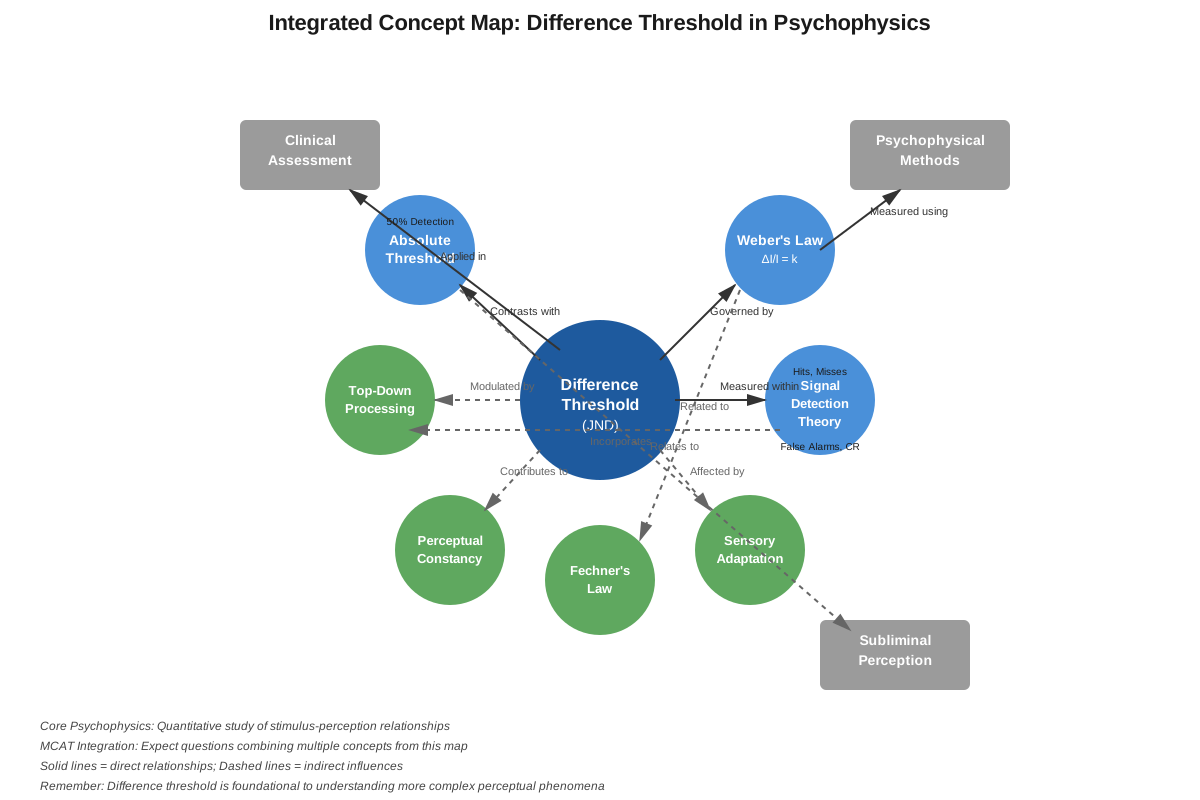
The difference threshold sits at the center of a network of interconnected psychophysical and perceptual concepts. Understanding these relationships enhances both conceptual mastery and the ability to tackle complex MCAT passages.
Difference threshold → Weber's Law: The difference threshold is quantified and predicted by Weber's Law, which provides the mathematical framework for understanding how JNDs scale with stimulus intensity. This relationship is direct and foundational—you cannot fully understand difference thresholds without understanding Weber's Law.
Absolute threshold ↔ Difference threshold: These two threshold concepts are parallel measurements of sensory sensitivity. Absolute threshold measures detection of presence; difference threshold measures detection of change. Both use the 50% detection criterion and both reflect the probabilistic nature of sensory processing. Together, they provide a complete picture of sensory sensitivity.
Difference threshold → Signal detection theory: Signal detection theory extends threshold concepts by incorporating decision-making factors (motivation, expectation, consequences) into perceptual judgments. While difference threshold focuses on sensory sensitivity, signal detection theory acknowledges that detecting changes involves both sensory and cognitive components.
Sensory adaptation → Difference threshold: Prolonged exposure to stimuli (sensory adaptation) can alter difference thresholds. After adaptation, we may require larger changes to detect differences, effectively raising the JND. This relationship explains why we stop noticing constant stimuli but remain sensitive to changes.
Difference threshold → Perceptual constancy: Our ability to maintain stable perceptions despite changing sensory input (perceptual constancy) relies partly on difference thresholds. Small changes below the JND don't disrupt our perception of object identity, contributing to perceptual stability.
Bottom-up processing ↔ Difference threshold: Difference thresholds represent a bottom-up sensory limit—the minimum change our sensory receptors and neural pathways can reliably detect. However, top-down factors (attention, expectation) can modulate these thresholds, illustrating the interaction between bottom-up and top-down processing.
Textual relationship map:
Stimulus Change → Sensory Receptors → Neural Processing →
Difference Threshold (JND) → Weber's Law (quantification) →
Perceptual Experience → Behavioral Response
     ↑                                    ↑
     |                                    |
Sensory Adaptation                  Signal Detection
(modulates threshold)              (adds decision factors)
High-Yield Facts
⭐ The difference threshold (JND) is the minimum stimulus change detectable 50% of the time, not 100% of the time
⭐ Weber's Law states that ΔI/I = k, meaning the JND is a constant proportion of the original stimulus intensity
⭐ Weber's constant (k) varies by sensory modality, with hearing having the smallest k (~0.003) and taste having the largest (~0.20)
⭐ The difference threshold increases proportionally with stimulus intensity—detecting change in a strong stimulus requires a larger absolute change than detecting the same proportional change in a weak stimulus
⭐ Difference threshold measures change detection while absolute threshold measures presence detection
- The 50% criterion for both absolute and difference thresholds reflects the probabilistic nature of sensory processing and accounts for neural noise
- Fechner's Law (S = k × log I) describes how perceived intensity relates to physical intensity, building on Weber's work
- Sensory adaptation can increase difference thresholds, making us less sensitive to changes in stimuli we've been exposed to for extended periods
- Individual differences in difference thresholds can result from genetics, training, age, and health status
- The concept of JND applies to all sensory modalities but is measured differently for each (brightness for vision, loudness/pitch for hearing, pressure for touch, etc.)
- In clinical contexts, elevated difference thresholds can indicate sensory processing deficits even when absolute thresholds remain normal
- The relationship between physical and psychological reality is nonlinear, as demonstrated by Weber's Law and its extensions
Quick check — test yourself on Difference threshold so far.
Try Flashcards →Common Misconceptions
Misconception: The difference threshold is the smallest change that can ever be detected.
Correction: The difference threshold is the change detected 50% of the time, not 100% of the time. Changes smaller than the JND can sometimes be detected, and changes larger than the JND can sometimes be missed due to the probabilistic nature of sensory processing.
Misconception: Weber's constant is the same across all sensory modalities.
Correction: Weber's constant varies significantly across sensory modalities, reflecting different levels of sensitivity. Hearing has a much smaller k (~0.003) than taste (~0.20), meaning we can detect much smaller proportional changes in sound than in taste intensity.
Misconception: The difference threshold is a fixed amount that doesn't change with stimulus intensity.
Correction: According to Weber's Law, the difference threshold is proportional to the original stimulus intensity. A stronger stimulus requires a larger absolute change to reach the JND, though the proportional change remains constant (k).
Misconception: Difference threshold and absolute threshold are the same thing.
Correction: These are distinct concepts. Absolute threshold measures the minimum stimulus intensity needed to detect presence (starting from zero), while difference threshold measures the minimum change needed to detect a difference (starting from an existing stimulus).
Misconception: If you can detect a stimulus (absolute threshold is normal), you can automatically detect changes in it (difference threshold is normal).
Correction: These are independent aspects of sensory function. A person can have normal absolute thresholds but impaired difference thresholds, indicating they can detect when something is present but struggle to notice when it changes—a pattern seen in certain neurological conditions.
Misconception: Weber's Law applies perfectly to all stimulus intensities.
Correction: Weber's Law works best for moderate stimulus intensities. At very low intensities (near absolute threshold) and very high intensities (near sensory maximum), the law breaks down and the relationship between stimulus intensity and JND becomes more complex.
Misconception: Difference thresholds are purely sensory phenomena unaffected by cognitive factors.
Correction: While difference thresholds reflect sensory sensitivity, they can be modulated by attention, expectation, motivation, and other cognitive factors. Signal detection theory incorporates these factors into a more complete model of perceptual decision-making.
Worked Examples
Example 1: Calculating JND for Weight Discrimination
Scenario: A researcher is studying weight perception. A participant is holding a 200-gram weight. Weber's constant for weight discrimination is 0.02 (2%). How much weight must be added for the participant to notice the difference 50% of the time? If the participant were instead holding a 400-gram weight, how much would need to be added?
Solution:
Step 1: Identify the given information
- Original stimulus intensity (I₁) = 200g
- Weber's constant (k) = 0.02
- Original stimulus intensity (I₂) = 400g
Step 2: Apply Weber's Law formula
Weber's Law: ΔI = k × I
Step 3: Calculate for 200g weight
ΔI₁ = 0.02 × 200g = 4g
Step 4: Calculate for 400g weight
ΔI₂ = 0.02 × 400g = 8g
Step 5: Interpret the results
For the 200g weight, the participant would need to add at least 4 grams to detect a change 50% of the time. For the 400g weight, they would need to add 8 grams—twice the absolute amount but the same proportion (2%). This demonstrates the key principle of Weber's Law: the JND scales proportionally with stimulus intensity.
Connection to learning objectives: This example demonstrates how to apply Weber's Law to calculate difference thresholds and illustrates why the absolute change needed to detect a difference increases with stimulus intensity while the proportional change remains constant.
Example 2: Interpreting Experimental Data
Scenario: An MCAT passage describes an experiment measuring brightness discrimination. Participants view a reference light of 100 candelas (cd) and must detect when a comparison light differs in brightness. The data show:
- At 107 cd: 45% detection
- At 108 cd: 50% detection
- At 109 cd: 55% detection
- At 110 cd: 62% detection
Question: What is the difference threshold for this task, and what is the approximate Weber's constant for brightness discrimination in this experiment?
Solution:
Step 1: Identify the difference threshold
The difference threshold is defined as the change detected 50% of the time. According to the data, 50% detection occurs at 108 cd.
Step 2: Calculate the change from the reference
ΔI = 108 cd - 100 cd = 8 cd
Step 3: Calculate Weber's constant
Using Weber's Law: k = ΔI / I
k = 8 cd / 100 cd = 0.08 or 8%
Step 4: Interpret in context
The difference threshold is 8 cd, meaning participants need an 8-candela increase in brightness to detect the change 50% of the time. The Weber's constant of 0.08 (8%) matches the typical value for brightness discrimination, confirming the validity of the experimental results.
Step 5: Consider implications
If the reference light were 200 cd instead of 100 cd, we would predict a difference threshold of 16 cd (0.08 × 200 cd), maintaining the same proportional relationship.
Connection to learning objectives: This example demonstrates how to interpret experimental data about difference thresholds, apply Weber's Law to real data, and verify that results align with known values for sensory modalities—all critical skills for MCAT passage-based questions.
Example 3: Clinical Application
Scenario: A neurologist is assessing a patient with suspected peripheral neuropathy. The patient can detect when a 10-gram monofilament touches their foot (normal absolute threshold) but cannot detect when the pressure increases from 10 grams to 15 grams, even though healthy individuals can detect this change. What does this suggest about the patient's sensory function?
Solution:
Step 1: Analyze absolute threshold
The patient has a normal absolute threshold—they can detect when the stimulus is present.
Step 2: Analyze difference threshold
The patient has an elevated difference threshold—they cannot detect a 50% increase in pressure (from 10g to 15g) that healthy individuals would notice.
Step 3: Calculate the implied Weber's constant
For healthy individuals, if they can detect a change from 10g to 15g:
ΔI = 5g, I = 10g
k = 5/10 = 0.50 or 50%
This is much higher than the typical Weber's constant for pressure (~0.14 or 14%), suggesting the patient needs much larger proportional changes to detect differences.
Step 4: Clinical interpretation
This pattern—normal absolute threshold but elevated difference threshold—suggests the patient has impaired sensory discrimination despite preserved basic detection. This is consistent with early peripheral neuropathy, where fine discrimination is affected before basic sensation is lost.
Step 5: Implications for assessment and treatment
The neurologist should conduct more detailed sensory testing, focusing on discrimination tasks. This finding might prompt earlier intervention than if only absolute thresholds were tested, potentially preventing further sensory deterioration.
Connection to learning objectives: This example illustrates the clinical relevance of difference thresholds, demonstrates the distinction between absolute and difference thresholds, and shows how understanding these concepts aids in medical diagnosis and patient care.
Exam Strategy
Approaching MCAT Questions on Difference Threshold
When encountering difference threshold questions on the MCAT, follow this systematic approach:
- Identify the question type: Determine whether the question asks for conceptual understanding, calculation, or experimental interpretation
- Locate key information: Find stimulus intensities, Weber's constants, or detection percentages in the passage or question stem
- Recall the 50% criterion: Remember that thresholds are defined at 50% detection, not 100%
- Apply Weber's Law when appropriate: Use ΔI = k × I for calculation questions
- Consider the sensory modality: Different modalities have different Weber's constants
Trigger Words and Phrases
Watch for these high-yield phrases that signal difference threshold concepts:
- "Just noticeable difference" or "JND" (direct terminology)
- "Minimum change detected" (definition of difference threshold)
- "50% of the time" or "half the trials" (threshold criterion)
- "Proportional to the original stimulus" (Weber's Law)
- "Detect a difference" or "notice a change" (discrimination task)
- "Weber's constant" or "Weber fraction" (quantitative measure)
- "Sensory discrimination" (general category including difference threshold)
Red flag phrases that indicate related but distinct concepts:
- "Minimum intensity to detect" → This describes absolute threshold, not difference threshold
- "100% detection" → Thresholds are defined at 50%, not 100%
- "Sensory adaptation" → Related but distinct from difference threshold
Process of Elimination Tips
When using process of elimination on difference threshold questions:
Eliminate answers that:
- Confuse absolute threshold with difference threshold
- Suggest Weber's constant is the same across all modalities
- Claim the JND is a fixed amount regardless of stimulus intensity
- State that thresholds require 100% detection
- Ignore the proportional relationship in Weber's Law
Favor answers that:
- Acknowledge the 50% detection criterion
- Recognize that JND scales with stimulus intensity
- Distinguish between different sensory modalities
- Apply Weber's Law correctly (ΔI = k × I)
- Consider both sensory and cognitive factors when appropriate
Time Allocation Advice
For difference threshold questions:
- Conceptual questions (30-45 seconds): Quick recall and application of definitions
- Calculation questions (60-90 seconds): Time to set up Weber's Law, calculate, and verify
- Passage-based questions (90-120 seconds): Time to locate relevant data, integrate with passage content, and reason through answer choices
Exam Tip: If a calculation seems too complex or time-consuming, check whether you can eliminate wrong answers conceptually without completing the full calculation. For example, if you know the JND must increase with stimulus intensity, you can eliminate answers that show the opposite pattern.
Memory Techniques
Mnemonics for Key Concepts
"Just Notice Differences" = JND
- Just = 50% detection (just barely)
- Notice = awareness of change
- Differences = comparing two stimuli
"Weber's Wonderful Proportions" for remembering Weber's Law:
- Weber's Law involves proportions
- Wonderful = constant ratio (k)
- Proportions = ΔI/I = k
"HATS" for Weber's constant ranking (smallest to largest):
- Hearing (0.003) - smallest k, most sensitive
- Appearance/vision (0.08)
- Touch (0.14)
- Savory/taste (0.20) - largest k, least sensitive
Visualization Strategies
The Weight Lifting Analogy: Imagine holding a small dumbbell (5 lbs). Adding 1 pound is very noticeable. Now imagine holding a heavy barbell (100 lbs). Adding 1 pound is imperceptible—you'd need to add 20 pounds to notice the same proportional change. This visceral image captures Weber's Law: the absolute change needed increases with the original stimulus, but the proportional change stays constant.
The Volume Knob Visualization: Picture a volume knob at different starting positions. When volume is low (position 2), turning the knob one notch (to position 3) is very noticeable—a 50% increase. When volume is high (position 20), turning the knob one notch (to position 21) is barely perceptible—only a 5% increase. To get the same proportional change, you'd need to turn it to position 30. This illustrates why the same absolute change has different perceptual effects depending on the starting intensity.
Acronym for Problem-Solving
"FIND" the difference threshold:
- Find the original stimulus intensity (I)
- Identify Weber's constant for the modality (k)
- Note the formula: ΔI = k × I
- Determine the answer and interpret
Summary
The difference threshold or just noticeable difference (JND) represents the minimum stimulus change detectable 50% of the time, forming a cornerstone concept in psychophysics and sensation and perception. Weber's Law mathematically describes this phenomenon, establishing that the JND is proportional to the original stimulus intensity (ΔI/I = k), where Weber's constant varies by sensory modality. This proportional relationship explains why detecting changes in weak stimuli requires smaller absolute changes than detecting equivalent proportional changes in strong stimuli. Understanding the distinction between difference threshold (change detection) and absolute threshold (presence detection) is essential for both conceptual mastery and clinical application. The concept integrates with broader Psychology topics including signal detection theory, sensory adaptation, and perceptual constancy, while providing quantitative tools for analyzing sensory function. For MCAT success, students must be able to define the difference threshold accurately, apply Weber's Law to calculate JNDs, interpret experimental data, and recognize how this concept appears in clinical and research contexts.
Key Takeaways
- The difference threshold (JND) is the minimum change in a stimulus that can be detected 50% of the time, reflecting the probabilistic nature of sensory processing
- Weber's Law (ΔI/I = k) establishes that the JND is a constant proportion of the original stimulus intensity, not a fixed absolute amount
- Weber's constant varies significantly across sensory modalities, with hearing being most sensitive (k ≈ 0.003) and taste being least sensitive (k ≈ 0.20)
- Difference threshold measures change detection while absolute threshold measures presence detection—these are distinct but related aspects of sensory function
- Clinical applications include assessing sensory discrimination in neurological conditions, where patients may have normal absolute thresholds but elevated difference thresholds
- For MCAT questions, remember the 50% criterion, apply Weber's Law correctly, and distinguish between absolute and difference thresholds
- The concept connects to broader topics including signal detection theory, sensory adaptation, and the nonlinear relationship between physical stimuli and psychological experience
Related Topics
Absolute Threshold: The minimum stimulus intensity required for detection 50% of the time. Mastering difference threshold provides the foundation for understanding absolute threshold, as both concepts share the 50% criterion and probabilistic framework while measuring different aspects of sensory sensitivity.
Signal Detection Theory: A framework that incorporates both sensory sensitivity and decision-making factors (motivation, expectation, consequences) into perceptual judgments. Understanding difference threshold provides the sensory foundation upon which signal detection theory builds by adding cognitive components.
Sensory Adaptation: The decreased sensitivity to constant stimuli over time. This topic connects directly to difference threshold because adaptation can alter JNDs, making us less sensitive to changes in stimuli we've been exposed to for extended periods.
Psychophysics: The broader field studying relationships between physical stimuli and psychological experiences. Difference threshold is a fundamental psychophysical measurement, and mastering it enables deeper understanding of other psychophysical concepts like magnitude estimation and cross-modal matching.
Perceptual Constancy: The ability to maintain stable perceptions despite changing sensory input. Difference thresholds contribute to perceptual constancy by filtering out small changes below the JND, allowing us to perceive objects as stable despite minor variations in sensory input.
Practice CTA
Now that you've mastered the core concepts of difference threshold, it's time to solidify your understanding through active practice. Challenge yourself with practice questions that require you to apply Weber's Law, interpret experimental data, and distinguish between related concepts. Work through flashcards to reinforce key definitions and values for Weber's constants across different sensory modalities. Remember, the difference between passive reading and active mastery lies in deliberate practice—each question you work through strengthens your ability to recognize and solve difference threshold problems quickly and accurately on test day. Your investment in practice now will pay dividends when you encounter these concepts on the MCAT!
Sign up free to keep reading
Create a free AnvayaPrep account to finish this MCAT guide on Difference threshold — plus flashcards and practice questions.