Overview
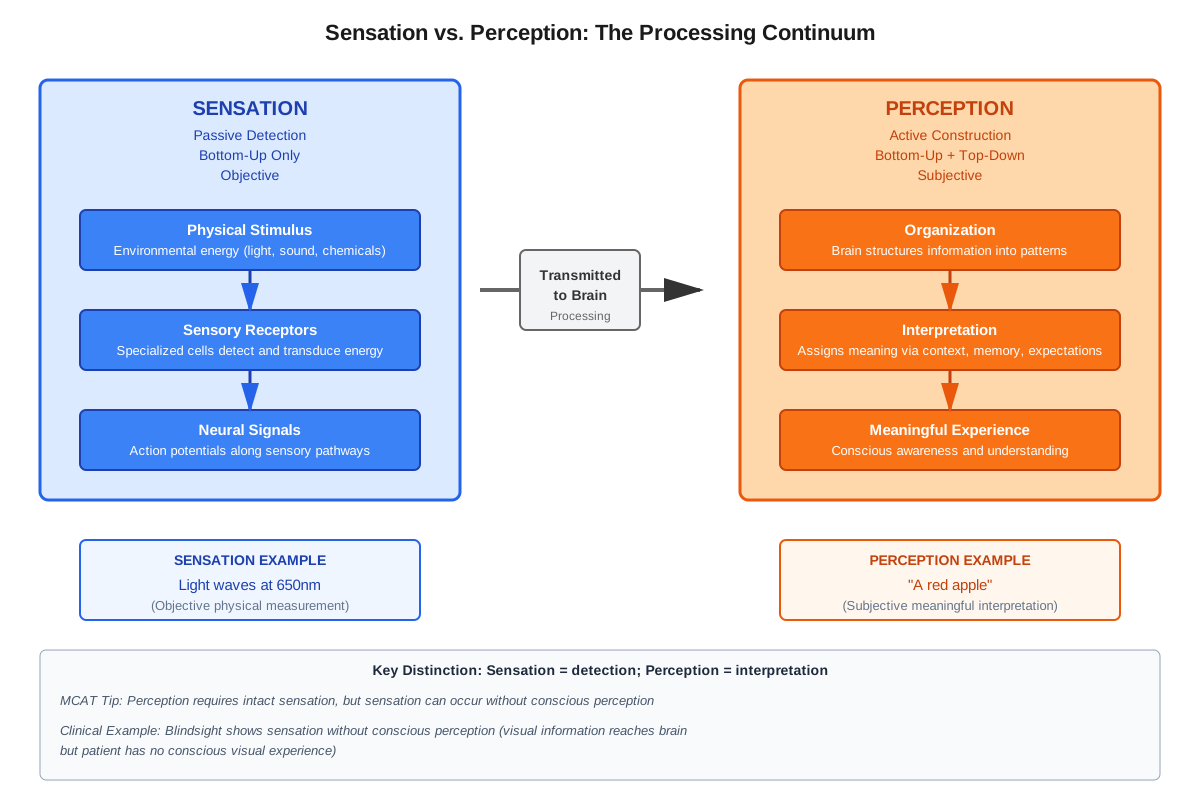
Perception is the active process by which the brain organizes and interprets sensory information to create meaningful experiences of the world. While sensation involves the detection of physical stimuli by sensory receptors, perception transforms these raw sensory signals into coherent representations that guide behavior, decision-making, and understanding. This distinction between sensation and perception forms a foundational concept in Psychology and represents a critical area of emphasis for the MCAT, particularly within the Sensation and Perception content category.
Understanding Perception Psychology is essential for MCAT success because it bridges biological processes (neural pathways, sensory organs) with cognitive phenomena (attention, memory, expectation). The exam frequently tests how bottom-up processing (data-driven sensory input) interacts with top-down processing (knowledge-driven interpretation), how context influences perceptual experiences, and how perceptual organization principles shape our understanding of complex stimuli. Questions may appear in discrete format or embedded within passages discussing clinical conditions (agnosia, phantom limb), psychological experiments, or real-world applications of perceptual principles.
Perception MCAT content connects intimately with multiple psychology domains: cognitive psychology (attention, memory), social psychology (person perception, stereotyping), developmental psychology (perceptual development in infants), and biological psychology (neural processing pathways). Mastering perception provides the conceptual foundation for understanding how humans construct reality from sensory data, how perceptual errors occur, and how individual differences and experiences shape subjective experience—all themes that appear repeatedly across MCAT psychology passages.
Learning Objectives
- [ ] Define Perception using accurate Psychology terminology
- [ ] Explain why Perception matters for the MCAT
- [ ] Apply Perception to exam-style questions
- [ ] Identify common mistakes related to Perception
- [ ] Connect Perception to related Psychology concepts
- [ ] Distinguish between bottom-up and top-down processing with specific examples
- [ ] Analyze how Gestalt principles organize perceptual information
- [ ] Evaluate the role of attention, expectation, and context in shaping perceptual experiences
- [ ] Apply perceptual constancy principles to novel scenarios
Prerequisites
- Basic neuroanatomy: Understanding sensory pathways from receptors to cortical processing areas is necessary to comprehend where sensation ends and perception begins
- Sensory transduction: Knowledge of how physical stimuli convert to neural signals provides the foundation for understanding what raw data perception must organize
- Action potential and neural communication: Familiarity with how neurons transmit information explains the biological substrate underlying perceptual processing
- Basic cognitive processes: Awareness of attention and memory concepts helps explain top-down influences on perception
Why This Topic Matters
Clinical and Real-World Significance: Perception underlies virtually all human interaction with the environment. Clinical conditions affecting perception—such as visual agnosia (inability to recognize objects despite intact vision), prosopagnosia (face blindness), phantom limb sensations, and synesthesia—demonstrate how perception can dissociate from sensation. Understanding perception is crucial for diagnosing neurological conditions, designing effective human-computer interfaces, improving eyewitness testimony reliability, and developing treatments for perceptual disorders. Healthcare providers must recognize that patients' perceptual experiences may differ substantially from objective sensory input, affecting diagnosis and treatment compliance.
MCAT Exam Statistics: Perception appears in approximately 10-15% of Psychology/Sociology section questions, either as discrete items or within research-based passages. The MCAT particularly emphasizes the sensation-perception distinction, Gestalt principles, perceptual constancies, depth perception cues, and the interaction between bottom-up and top-down processing. Questions frequently require students to analyze experimental designs studying perception, interpret data about perceptual phenomena, or apply perceptual principles to clinical vignettes.
Common Exam Presentations: Perception content typically appears in passages describing: (1) psychological experiments manipulating context or expectation to alter perception; (2) neurological case studies of patients with perceptual deficits following brain injury; (3) developmental studies examining infant perception; (4) social psychology research on person perception and bias; (5) discussions of sensory substitution devices or prosthetics. Discrete questions often test Gestalt principles, depth cues, or the distinction between sensation and perception through scenario-based items.
Core Concepts
Defining Perception
Perception is the cognitive process of selecting, organizing, and interpreting sensory information to construct meaningful representations of the environment. Unlike sensation—the passive detection of physical energy by sensory receptors—perception actively constructs experience through neural processing, prior knowledge, expectations, and context. This constructive nature means perception is inherently subjective; two individuals receiving identical sensory input may perceive different experiences based on their unique cognitive frameworks.
The perceptual process involves multiple stages: (1) sensory input arrives at receptors; (2) transduction converts physical energy to neural signals; (3) transmission carries signals through neural pathways; (4) selection determines which information receives attention; (5) organization structures information according to principles and schemas; (6) interpretation assigns meaning based on memory, context, and expectation. The MCAT emphasizes that perception is not a passive recording but an active construction.
Bottom-Up vs. Top-Down Processing
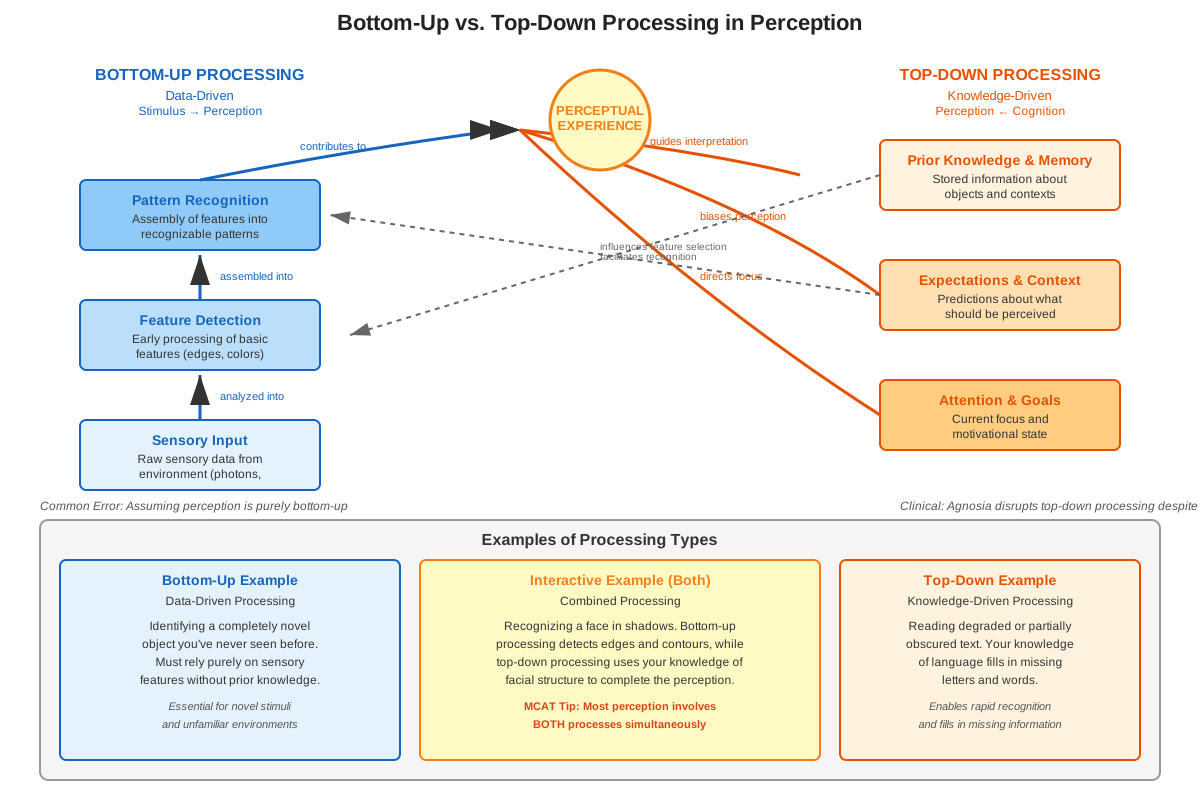
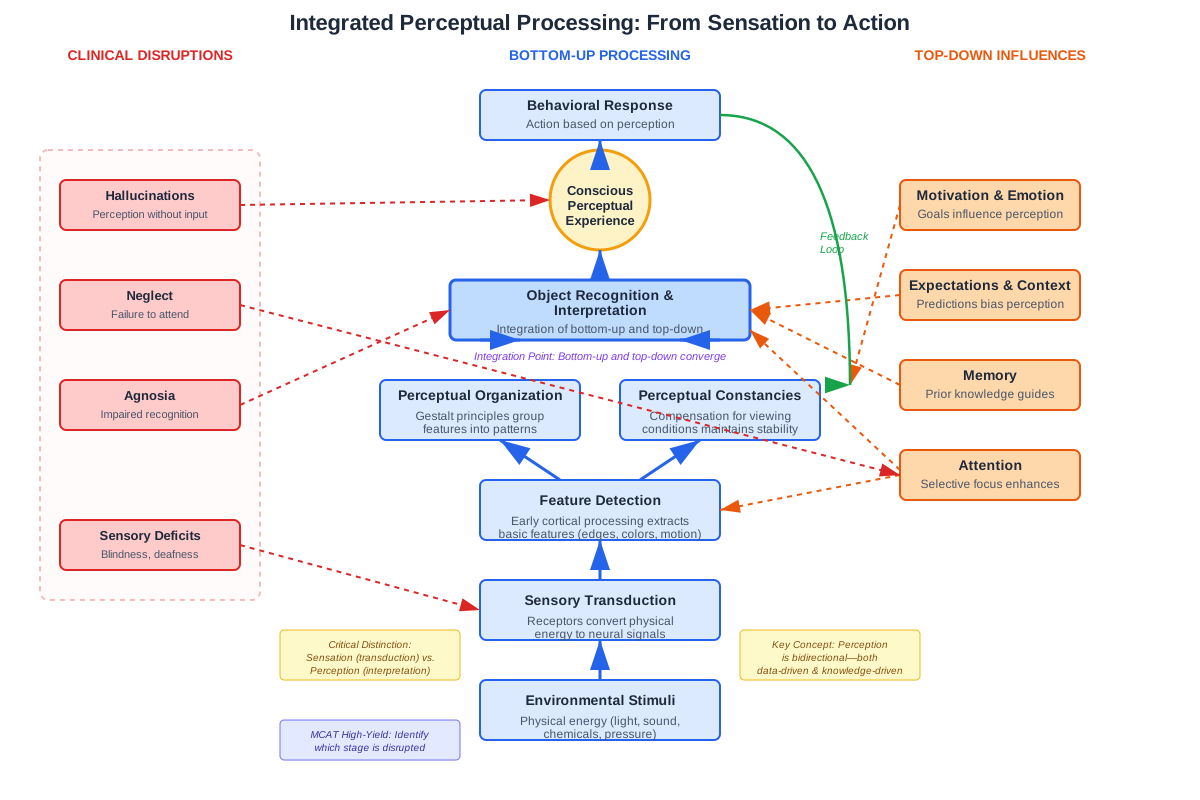
Bottom-up processing (data-driven processing) begins with sensory receptors and builds toward cognitive interpretation. Raw sensory data flows upward through increasingly complex neural processing stages, with each level extracting more sophisticated features. For example, visual processing progresses from detecting edges and lines in primary visual cortex to recognizing shapes in secondary areas to identifying objects in higher association areas. Bottom-up processing is stimulus-driven and operates without preconceptions.
Top-down processing (conceptually-driven processing) uses prior knowledge, expectations, context, and cognitive schemas to interpret sensory information. The brain generates predictions about incoming sensory data and compares actual input against these expectations. Top-down influences explain why context affects perception: the same ambiguous stimulus may be perceived differently depending on surrounding information. For instance, the middle letter in "THE CAT" appears identical to the middle number in "12 14 16," yet readers perceive one as "H" and the other as "A" based on contextual expectations.
| Processing Type | Direction | Driven By | Example |
|---|---|---|---|
| Bottom-Up | Sensory → Cognitive | Stimulus features | Detecting individual letters when reading unfamiliar text |
| Top-Down | Cognitive → Sensory | Knowledge, expectation | Reading quickly by recognizing word shapes rather than individual letters |
Most perceptual experiences involve parallel processing of both bottom-up and top-down information, with the brain continuously comparing sensory input against predictions and updating interpretations accordingly.
Gestalt Principles of Perceptual Organization
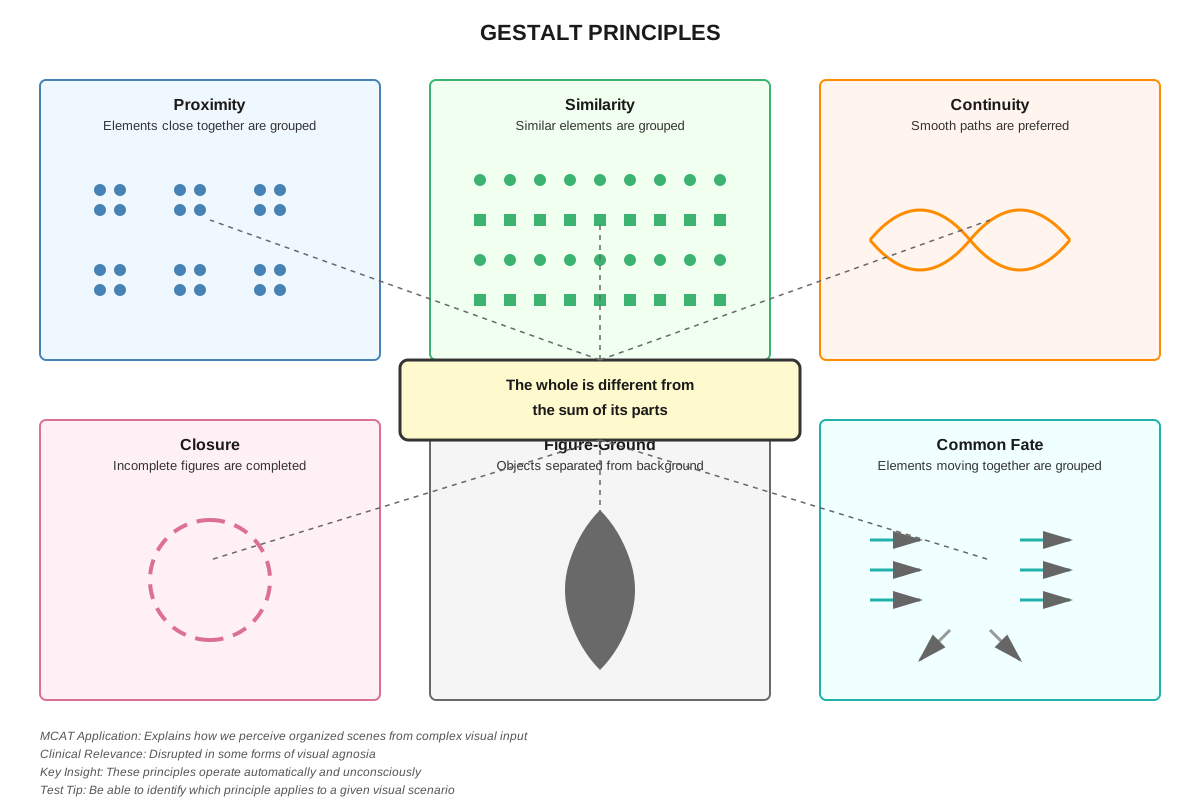
Gestalt psychology emphasizes that "the whole is greater than the sum of its parts"—humans naturally organize sensory information into coherent wholes rather than perceiving isolated elements. These organizational principles are innate tendencies that operate automatically and unconsciously:
Proximity: Elements close together are perceived as belonging to the same group. Dots arranged in clusters are seen as separate groups rather than individual dots.
Similarity: Elements sharing visual characteristics (color, shape, size, orientation) are grouped together. A pattern of alternating circles and squares is perceived as two separate groups rather than a random collection.
Continuity: The visual system prefers smooth, continuous paths over abrupt directional changes. Intersecting curved lines are perceived as two continuous curves crossing rather than four separate line segments meeting at a point.
Closure: Incomplete figures are perceived as complete by mentally "filling in" missing information. A circle with small gaps is still perceived as a circle rather than disconnected arcs.
Figure-ground: Perceptual systems organize visual fields into objects (figures) that stand out from backgrounds (ground). This organization is dynamic—ambiguous images like the Rubin vase can alternate between different figure-ground interpretations.
Common fate: Elements moving in the same direction are perceived as a unified group. A flock of birds moving together is perceived as a single entity rather than individual birds.
These principles reflect the brain's tendency toward perceptual organization—imposing structure and meaning on sensory input to create coherent, predictable experiences.
Perceptual Constancies
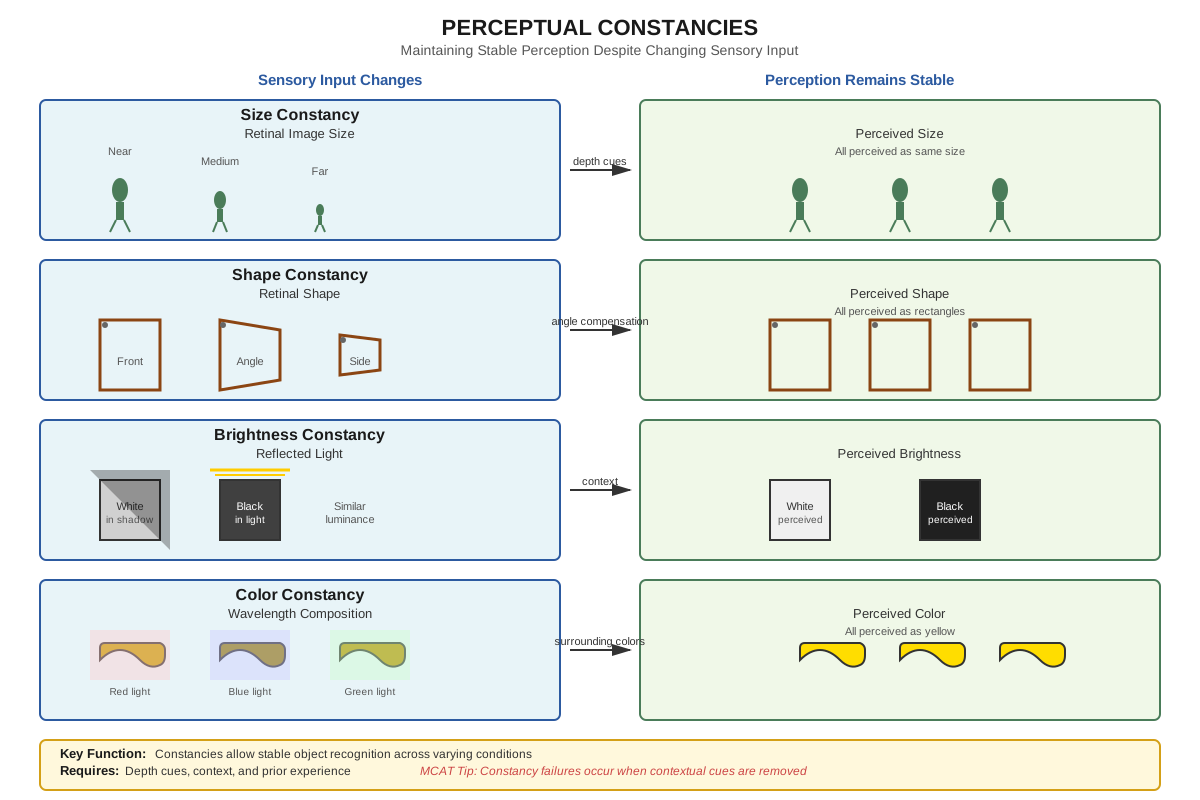
Perceptual constancy refers to the tendency to perceive objects as unchanging despite variations in sensory input. These constancies allow stable object recognition across changing viewing conditions:
Size constancy: Objects are perceived as maintaining constant size despite changes in retinal image size with distance. A person walking away appears to remain the same size even though their retinal image shrinks, because the brain accounts for distance information.
Shape constancy: Objects are perceived as maintaining constant shape despite changes in viewing angle. A door appears rectangular whether viewed straight-on or at an angle, even though the retinal projection changes from rectangle to trapezoid.
Color constancy: Objects are perceived as maintaining constant color despite changes in illumination. A white shirt appears white in both sunlight and indoor lighting, even though the wavelengths reflected differ substantially, because the brain adjusts for ambient lighting conditions.
Brightness constancy: Objects are perceived as maintaining constant brightness despite changes in illumination. A piece of coal in sunlight reflects more light than a snowball in shadow, yet the coal still appears dark and the snow appears bright because the brain considers the lighting context.
These constancies demonstrate top-down processing—the brain uses contextual information (distance cues, lighting conditions, surrounding objects) to maintain stable perceptions despite variable sensory input.
Depth Perception and Cues
Depth perception is the ability to perceive three-dimensional space and judge distances using two-dimensional retinal images. The visual system uses multiple cues to construct depth information:
Binocular cues require both eyes and exploit the slightly different views each eye receives:
- Retinal disparity (binocular disparity): The difference between the two retinal images increases with object proximity. The brain computes depth by comparing these disparate images.
- Convergence: The inward rotation of eyes to focus on near objects provides proprioceptive feedback about distance. Greater convergence indicates closer objects.
Monocular cues operate with one eye and include:
- Relative size: Smaller retinal images suggest greater distance when objects are known to be similar size
- Interposition (occlusion): Objects blocking the view of other objects are perceived as closer
- Relative height: Objects higher in the visual field appear more distant (on flat terrain)
- Linear perspective: Parallel lines appear to converge with distance
- Texture gradient: Texture appears denser and less detailed with distance
- Motion parallax: Closer objects appear to move faster across the visual field during observer movement
- Atmospheric perspective: Distant objects appear hazier and less distinct due to atmospheric interference
The MCAT frequently tests the distinction between monocular and binocular cues and asks students to identify which cues are present in described scenarios.
Attention and Selective Perception
Attention acts as a filter determining which sensory information receives perceptual processing. Given limited cognitive resources, attention selects relevant information while filtering irrelevant stimuli. This selective nature means perception is incomplete—much sensory information never reaches conscious awareness.
Selective attention focuses cognitive resources on particular stimuli while ignoring others. The classic cocktail party effect demonstrates this: individuals can focus on a single conversation in a noisy environment, filtering out competing voices. However, personally relevant information (like hearing one's name) can capture attention even from unattended channels, suggesting some processing occurs outside focal attention.
Inattentional blindness occurs when attention is focused elsewhere, rendering even obvious stimuli imperceptible. In the famous invisible gorilla experiment, participants counting basketball passes often fail to notice a person in a gorilla suit walking through the scene. This demonstrates that perception requires attention—without attention, sensory information may not be consciously perceived.
Change blindness is the failure to detect changes in visual scenes when attention is diverted or during brief interruptions. Large changes can go unnoticed if they occur during eye movements, blinks, or scene cuts, revealing that perception constructs a sparse representation rather than a complete, detailed model of the environment.
Perceptual Set and Expectation
Perceptual set is a predisposition to perceive stimuli in particular ways based on expectations, context, emotions, and culture. Perceptual sets demonstrate top-down processing—what we expect to perceive influences what we actually perceive.
Context effects show how surrounding information shapes perception. The same ambiguous stimulus is interpreted differently depending on context: "13" appears as the letter B in "A B C" but as the number 13 in "12 13 14." Context provides interpretive frameworks that guide perceptual organization.
Schemas are cognitive frameworks organizing knowledge about concepts, events, or categories. Perceptual schemas guide interpretation by providing templates for recognizing patterns. For example, a "face schema" helps rapidly identify faces by highlighting relevant features (two eyes above a nose above a mouth).
Motivation and emotion influence perception through perceptual set. Hungry individuals more readily perceive food-related stimuli; anxious individuals show attentional bias toward threatening stimuli. These effects demonstrate that internal states shape perceptual experiences.
Cultural differences in perception reveal learned components of perceptual organization. For instance, individuals from Western cultures show greater susceptibility to the Müller-Lyer illusion (lines with inward vs. outward arrows appearing different lengths) than individuals from cultures with less exposure to "carpentered" environments with right angles.
Quick check — test yourself on Perception so far.
Try Flashcards →Concept Relationships
The concepts within perception form an interconnected system where each element influences others. Bottom-up processing provides the raw sensory data that top-down processing interprets using perceptual sets and schemas. This bidirectional flow creates perception: sensory input → neural processing → attention selection → Gestalt organization → constancy adjustments → interpretation via schemas → conscious perception.
Gestalt principles represent automatic organizational processes that operate early in perceptual processing, structuring sensory input before conscious interpretation. These principles interact with attention—grouped elements are more likely to capture attention as unified objects. Perceptual constancies build upon Gestalt organization, using contextual information to maintain stable object representations despite sensory variation.
Depth perception integrates multiple cues through both bottom-up processing (retinal disparity, convergence) and top-down processing (familiar size, learned perspective rules). Attention determines which depth cues receive processing resources, while perceptual set influences depth judgments (expecting an object to be near makes it appear closer).
The relationship to prerequisite topics flows logically: sensation (prerequisite) → transduction → neural transmission → perception (current topic) → cognition (subsequent topics like memory, decision-making). Perception transforms sensory signals into meaningful representations that feed into higher cognitive processes. Understanding this progression clarifies that perception is the bridge between biological sensory systems and psychological cognitive processes.
Connections to related topics include: attention (determines what gets perceived), memory (provides schemas for interpretation), learning (shapes perceptual sets through experience), consciousness (perception brings information to awareness), social cognition (person perception applies perceptual principles to social stimuli), and psychological disorders (perceptual disturbances in schizophrenia, agnosia following brain damage).
High-Yield Facts
⭐ Perception is the active organization and interpretation of sensory information, distinct from sensation which is passive detection of stimuli
⭐ Bottom-up processing is data-driven (stimulus → perception), while top-down processing is knowledge-driven (expectations → perception)
⭐ Gestalt principles (proximity, similarity, continuity, closure, figure-ground) describe innate tendencies to organize sensory information into coherent wholes
⭐ Perceptual constancies (size, shape, color, brightness) maintain stable object perception despite varying sensory input by incorporating contextual information
⭐ Depth perception uses binocular cues (retinal disparity, convergence) requiring both eyes and monocular cues (interposition, linear perspective, motion parallax) working with one eye
- Selective attention filters sensory information, determining what reaches conscious perception; inattentional blindness demonstrates that unattended stimuli may not be perceived
- Perceptual set is a predisposition to perceive stimuli in particular ways based on expectations, context, emotions, and culture
- Context effects show that identical stimuli are perceived differently depending on surrounding information, demonstrating top-down processing
- Change blindness reveals that perception constructs sparse representations rather than complete detailed models of the environment
- The cocktail party effect demonstrates selective attention—focusing on one conversation while filtering others, though personally relevant information can capture attention
- Motion parallax (closer objects moving faster across visual field during observer movement) is a powerful monocular depth cue
- Schemas are cognitive frameworks that guide perceptual interpretation by providing templates for pattern recognition
Common Misconceptions
Misconception: Perception is simply receiving sensory information passively, like a camera recording images.
Correction: Perception is an active, constructive process that organizes and interprets sensory input using prior knowledge, expectations, and context. The brain generates perceptual experiences rather than passively recording reality.
Misconception: Bottom-up and top-down processing are mutually exclusive—perception uses one or the other.
Correction: Most perceptual experiences involve parallel processing of both bottom-up sensory data and top-down expectations simultaneously. The brain continuously compares incoming sensory information against predictions, integrating both sources.
Misconception: Gestalt principles are learned through experience and vary across cultures.
Correction: Gestalt principles are largely innate organizational tendencies that operate automatically and appear across cultures. While experience can influence some aspects of perceptual organization, basic Gestalt principles reflect fundamental properties of neural processing.
Misconception: Perceptual constancies mean we always perceive objects accurately regardless of conditions.
Correction: Perceptual constancies help maintain stable perceptions across varying conditions, but they can be fooled. Visual illusions often exploit constancy mechanisms, causing systematic perceptual errors. Constancies are adaptive approximations, not perfect accuracy guarantees.
Misconception: Binocular depth cues are always more important than monocular cues for depth perception.
Correction: While binocular cues provide precise depth information for nearby objects, monocular cues dominate for distant objects and are sufficient for functional depth perception (as demonstrated by individuals with monocular vision). Motion parallax is particularly powerful for depth perception.
Misconception: If sensory information reaches the eyes (or other receptors), it will be perceived consciously.
Correction: Attention is necessary for conscious perception. Inattentional blindness and change blindness demonstrate that sensory information can reach receptors without being consciously perceived if attention is directed elsewhere.
Misconception: Perceptual experiences directly reflect objective reality.
Correction: Perception is inherently subjective, shaped by individual differences in attention, expectations, prior knowledge, emotional state, and cultural background. Two people receiving identical sensory input may have different perceptual experiences.
Worked Examples
Example 1: Distinguishing Sensation from Perception
Scenario: A patient reports seeing "flashing lights" following a blow to the head. A neurologist explains that mechanical pressure on the retina can trigger photoreceptor activation even without light present. Is this phenomenon better classified as sensation or perception?
Analysis:
- Step 1: Define the key distinction. Sensation involves receptor activation and transduction of physical energy into neural signals. Perception involves organizing and interpreting those signals to create meaningful experiences.
- Step 2: Identify what's occurring. Mechanical pressure (physical stimulus) → photoreceptor activation (transduction) → neural signals sent to brain → experience of "light."
- Step 3: Determine the classification. The photoreceptors are being activated (sensation is occurring), but the interpretation of these signals as "light" involves perceptual processing. The brain interprets photoreceptor activation as light regardless of whether actual photons caused the activation.
- Step 4: Recognize the complexity. This example illustrates that sensation and perception are interconnected. The sensory system responds to mechanical pressure, but the perceptual system interprets this as light because it uses the same neural pathways as light-induced activation.
Answer: This phenomenon involves both sensation (photoreceptor activation) and perception (interpretation as light). The experience demonstrates that perception interprets neural signals based on their source pathway rather than the actual physical stimulus, showing the constructive nature of perceptual experience.
MCAT Connection: This type of scenario tests understanding that perception can occur without appropriate sensory stimulation (phantom limb sensations, tinnitus) and that the brain interprets neural activity based on which pathways are active rather than what actually caused the activity.
Example 2: Applying Gestalt Principles and Depth Cues
Scenario: A researcher presents participants with a visual display containing 20 dots arranged in four clusters of five dots each. The clusters are positioned at different heights on the screen, with higher clusters appearing smaller. Participants report seeing "four groups of dots at different distances." Which perceptual principles explain this experience?
Analysis:
- Step 1: Identify relevant Gestalt principles. The dots are organized into groups—which principle explains this? Proximity causes dots close together to be perceived as belonging to the same group, creating four distinct clusters.
- Step 2: Identify depth cues. Participants perceive different distances—which cues create this impression? Relative size (smaller clusters appear more distant) and relative height (higher clusters appear more distant on a flat plane) are monocular depth cues operating here.
- Step 3: Recognize the interaction. Gestalt organization first groups the dots into four clusters (proximity), then depth cues are applied to these organized units to create three-dimensional spatial perception.
- Step 4: Consider processing types. Bottom-up processing detects dot positions and sizes (sensory features). Top-down processing applies learned rules about size-distance relationships and height-distance relationships to interpret the display as three-dimensional.
Answer: The Gestalt principle of proximity organizes the 20 dots into four perceptual groups. The monocular depth cues of relative size and relative height create the impression of different distances, with smaller, higher clusters appearing more distant. This demonstrates how perceptual organization (Gestalt) and depth perception work together to construct three-dimensional spatial experiences from two-dimensional retinal images.
MCAT Connection: This scenario type requires integrating multiple perceptual concepts and distinguishing between organizational principles (Gestalt) and depth perception mechanisms. The MCAT frequently presents visual displays or experimental descriptions requiring identification of which specific principles or cues are operating.
Exam Strategy
Approaching MCAT Perception Questions:
- Identify whether the question asks about sensation or perception. Look for keywords: "detection," "receptor activation," "transduction" suggest sensation; "interpretation," "organization," "experience," "recognition" suggest perception.
- Distinguish bottom-up from top-down processing. Bottom-up questions emphasize stimulus features, sensory data, or feature detection. Top-down questions emphasize expectations, context, prior knowledge, or schemas.
- For Gestalt principle questions, visualize or sketch the described stimulus. Identify spatial relationships (proximity), shared features (similarity), or missing information (closure). Eliminate principles that don't apply to the specific stimulus arrangement.
- For depth cue questions, determine if both eyes are involved (binocular: retinal disparity, convergence) or if the cue works with one eye (monocular: all others). Eliminate binocular cues if the scenario involves photographs, paintings, or monocular viewing.
- Watch for attention-related scenarios. Keywords like "focused on," "distracted by," "failed to notice," or "unaware of" suggest inattentional blindness or selective attention concepts.
Trigger Words and Phrases:
- "Organize," "interpret," "meaningful" → perception (not just sensation)
- "Expect," "context," "prior knowledge" → top-down processing
- "Stimulus features," "sensory data" → bottom-up processing
- "Group," "cluster," "unified" → Gestalt principles
- "Despite changes in," "appears constant" → perceptual constancies
- "Distance," "three-dimensional," "depth" → depth perception cues
- "Both eyes," "binocular" → retinal disparity or convergence
- "One eye," "photograph," "painting" → monocular cues only
Process-of-Elimination Tips:
- Eliminate sensation when interpretation or meaning is involved
- Eliminate bottom-up when expectations or context are mentioned
- Eliminate binocular cues for two-dimensional displays or monocular viewing
- Eliminate Gestalt principles that don't match the spatial arrangement described
- Eliminate perceptual constancy if the question asks about actual sensory changes rather than perceived stability
Time Allocation: Perception questions typically require 60-90 seconds. Spend 20-30 seconds identifying the specific concept being tested, 20-30 seconds analyzing the scenario, and 20-30 seconds eliminating wrong answers and confirming the correct choice.
Exam Tip: When passages describe perceptual experiments, focus on the independent variable (what's being manipulated) and dependent variable (what's being measured). Perception research often manipulates context, expectations, or attention while measuring perceptual judgments or recognition accuracy.
Memory Techniques
Mnemonic for Gestalt Principles - "Pretty Silly Children Can't Focus Constantly":
- Proximity - close together = grouped together
- Similarity - look alike = grouped together
- Continuity - smooth paths preferred
- Closure - complete incomplete figures
- Figure-ground - objects vs. background
- Common fate - moving together = grouped together
Mnemonic for Monocular Depth Cues - "RIRL TLAM":
- Relative size
- Interposition (occlusion)
- Relative height
- Linear perspective
- Texture gradient
- Light and shadow
- Atmospheric perspective
- Motion parallax
Visualization for Bottom-Up vs. Top-Down:
Picture a bottom-up arrow starting at your feet (sensory receptors) pointing up to your head (brain): data flows upward from senses to cognition. Picture a top-down arrow starting at your head (brain/knowledge) pointing down to your eyes: expectations flow downward to interpret sensory input.
Acronym for Perceptual Constancies - "SSCB" (think "Super Special Constant Brain"):
- Size constancy
- Shape constancy
- Color constancy
- Brightness constancy
Memory Hook for Binocular Cues: "BInocular needs TWO eyes" - Both binocular cues (retinal disparity and convergence) require two eyes. Everything else is monocular.
Summary
Perception is the active cognitive process of organizing and interpreting sensory information to construct meaningful experiences of the world, distinct from sensation which passively detects physical stimuli. The perceptual process integrates bottom-up processing (data-driven sensory input) with top-down processing (knowledge-driven interpretation using expectations, context, and schemas). Gestalt principles describe innate tendencies to organize sensory information into coherent wholes through proximity, similarity, continuity, closure, figure-ground organization, and common fate. Perceptual constancies maintain stable object recognition despite varying sensory input by incorporating contextual information about size, shape, color, and brightness. Depth perception constructs three-dimensional spatial understanding using binocular cues (retinal disparity, convergence) and monocular cues (relative size, interposition, linear perspective, texture gradient, motion parallax). Attention selectively filters sensory information, determining what reaches conscious perception, as demonstrated by inattentional blindness and change blindness. Perceptual set—shaped by expectations, context, emotions, and culture—predisposes individuals to perceive stimuli in particular ways, revealing perception's subjective and constructive nature.
Key Takeaways
- Perception actively constructs meaningful experiences from sensory data through organization and interpretation, fundamentally differing from passive sensory detection
- Bottom-up processing builds from sensory features to interpretation, while top-down processing uses expectations and knowledge to guide sensory interpretation; most perception involves both simultaneously
- Gestalt principles (proximity, similarity, continuity, closure, figure-ground, common fate) are innate organizational tendencies that structure sensory information into coherent wholes
- Perceptual constancies (size, shape, color, brightness) maintain stable object perception across varying viewing conditions by incorporating contextual information
- Depth perception integrates binocular cues requiring both eyes (retinal disparity, convergence) and monocular cues working with one eye (interposition, linear perspective, motion parallax, relative size)
- Attention is necessary for conscious perception; inattentional blindness demonstrates that unattended sensory information may not reach awareness
- Perceptual set, shaped by expectations, context, emotions, and culture, demonstrates that perception is subjective and influenced by individual differences and experiences
Related Topics
Attention and Consciousness: Explores how attentional mechanisms select information for perceptual processing and how perception relates to conscious awareness. Mastering perception provides the foundation for understanding what information enters consciousness and why.
Memory Systems: Examines how perceptual experiences are encoded into memory and how memory schemas influence perceptual interpretation through top-down processing. Understanding perception clarifies what information is available for memory encoding.
Social Cognition and Person Perception: Applies perceptual principles to understanding how people perceive and interpret social information, including impression formation, attribution, and stereotyping. Perception concepts transfer directly to social perception.
Cognitive Development: Investigates how perceptual abilities develop from infancy through adulthood, including depth perception development and perceptual learning. Understanding mature perception enables comprehension of developmental trajectories.
Neurological Disorders and Agnosia: Examines clinical conditions where perception is impaired despite intact sensation, revealing the neural substrates of perceptual processing. Perception knowledge is essential for understanding these dissociations.
Psychophysics: Studies the relationship between physical stimuli and perceptual experiences, including thresholds and signal detection. Perception concepts extend naturally into quantitative psychophysical relationships.
Practice CTA
Now that you've mastered the core concepts of perception, it's time to solidify your understanding through active practice. Challenge yourself with MCAT-style practice questions that test your ability to distinguish sensation from perception, apply Gestalt principles to novel scenarios, identify depth cues in experimental designs, and analyze how attention and perceptual set influence experience. Use flashcards to drill high-yield facts about perceptual constancies, depth cues, and Gestalt principles until recall becomes automatic. Remember: understanding perception conceptually is the first step, but MCAT success requires applying these concepts rapidly and accurately under timed conditions. Your investment in practice now will pay dividends when you encounter perception questions on test day—you'll recognize the patterns, eliminate wrong answers confidently, and select correct responses efficiently. You've built the foundation; now strengthen it through deliberate practice!
Sign up free to keep reading
Create a free AnvayaPrep account to finish this MCAT guide on Perception — plus flashcards and practice questions.