Overview
Causation is a fundamental concept in Sociology and Research Methods and Statistics that examines the relationship between variables where one factor (the cause) directly produces or influences another factor (the effect). Understanding causation is critical for the MCAT because it forms the foundation for interpreting research studies, evaluating experimental designs, and distinguishing between mere associations and true cause-and-effect relationships. The ability to identify causal relationships versus correlational patterns appears frequently in the Psychological, Social, and Biological Foundations of Behavior section, where test-takers must analyze research passages and determine whether study designs support causal claims.
Causation in Sociology extends beyond simple cause-and-effect relationships to encompass complex social phenomena where multiple factors interact to produce outcomes. The MCAT tests whether students can critically evaluate research methodologies, recognize the limitations of different study designs, and understand when researchers can legitimately claim that one variable causes changes in another. This skill is essential not only for exam success but also for future medical practice, where physicians must interpret clinical research, understand treatment efficacy studies, and make evidence-based decisions about patient care.
The concept of causation connects intimately with other sociology and research methodology topics including correlation, experimental design, confounding variables, validity, and statistical inference. Mastering causation enables students to navigate complex research passages, identify flaws in study designs, and understand how social scientists establish evidence for causal relationships in both laboratory and naturalistic settings. This topic serves as a gateway to understanding how sociological knowledge is generated and validated through rigorous scientific inquiry.
Learning Objectives
- [ ] Define Causation using accurate Sociology terminology
- [ ] Explain why Causation matters for the MCAT
- [ ] Apply Causation to exam-style questions
- [ ] Identify common mistakes related to Causation
- [ ] Connect Causation to related Sociology concepts
- [ ] Distinguish between causation and correlation in research contexts
- [ ] Evaluate whether a research design supports causal inferences
- [ ] Identify the three criteria necessary to establish causation (temporal precedence, covariation, elimination of alternative explanations)
Prerequisites
- Correlation: Understanding that two variables can be associated without one causing the other is essential for distinguishing correlation from causation
- Variables (independent and dependent): Recognizing how researchers manipulate independent variables and measure dependent variables provides the framework for understanding causal relationships
- Basic research design: Familiarity with experimental versus observational studies helps students evaluate which designs can support causal claims
- Confounding variables: Knowledge of third variables that might explain apparent relationships is necessary for understanding the challenges in establishing causation
Why This Topic Matters
Understanding causation has profound real-world significance in medicine and public health. Physicians must determine whether treatments actually cause improvements in patient outcomes or whether observed benefits result from placebo effects, natural disease progression, or other factors. Public health officials need to establish whether interventions (such as vaccination campaigns or smoking cessation programs) truly cause reductions in disease rates before implementing costly population-wide programs. The ability to distinguish causal relationships from mere associations prevents medical errors, guides treatment decisions, and shapes health policy.
On the MCAT, causation appears in approximately 10-15% of Psychological, Social, and Biological Foundations of Behavior questions, making it a medium-yield but consistently tested topic. Questions typically present research passages describing studies with various designs (experimental, correlational, longitudinal, cross-sectional) and ask students to evaluate whether the findings support causal conclusions. The MCAT frequently tests whether students can identify when researchers have overstepped their data by claiming causation from correlational studies, or whether they can recognize the strengths of randomized controlled trials in establishing cause-and-effect relationships.
Common question formats include: (1) passage-based questions asking what conclusions can be drawn from a described study, (2) discrete questions presenting a research scenario and asking which design would best establish causation, and (3) questions requiring students to identify confounding variables that threaten causal inferences. The exam often presents subtle scenarios where temporal order is ambiguous or where third variables might explain observed relationships, testing students' ability to think critically about research limitations.
Core Concepts
Defining Causation
Causation refers to a relationship between two variables where changes in one variable (the cause or independent variable) directly produce changes in another variable (the effect or dependent variable). In Causation Sociology, researchers seek to establish that social factors, behaviors, or interventions genuinely produce outcomes rather than simply being associated with them. This distinction is crucial because many variables in social science research are correlated without having a causal relationship.
The concept of causation in research methodology requires more than simply observing that two things occur together. True causal relationships must meet rigorous criteria that distinguish them from spurious associations or coincidental patterns. Understanding these criteria enables researchers and MCAT test-takers to evaluate the strength of evidence supporting causal claims in scientific literature.
The Three Criteria for Establishing Causation
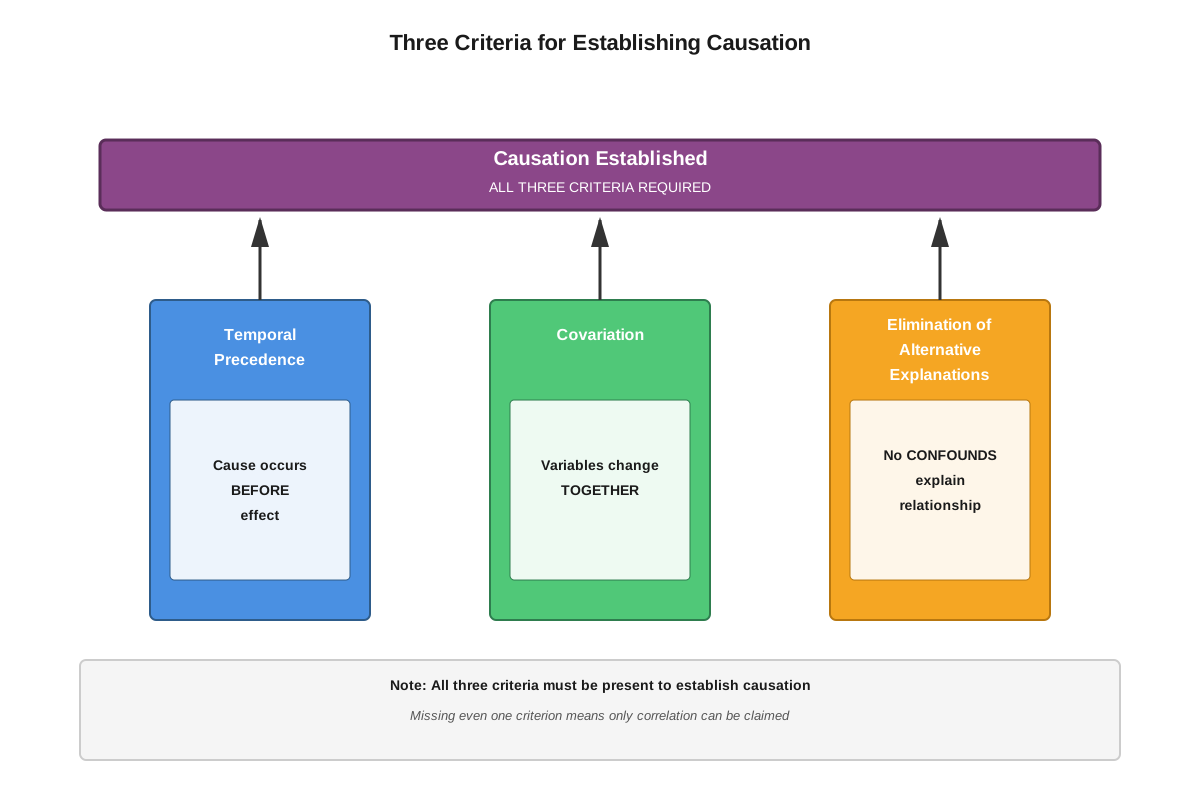
To establish that Variable A causes Variable B, researchers must demonstrate three essential criteria:
- Temporal Precedence (Time Order): The cause must occur before the effect. If Variable A causes Variable B, then changes in A must precede changes in B. This criterion seems obvious but can be challenging to establish in observational research. For example, if researchers find that depression is associated with social isolation, they must determine whether depression leads to isolation or isolation leads to depression—the temporal sequence matters for establishing causation.
- Covariation (Correlation): The cause and effect must be statistically related. When the independent variable changes, the dependent variable must also change in a predictable way. This relationship can be positive (both increase together) or negative (one increases as the other decreases), but there must be a systematic association. However, covariation alone is insufficient for causation—this is why the phrase "correlation does not imply causation" is fundamental in research methodology.
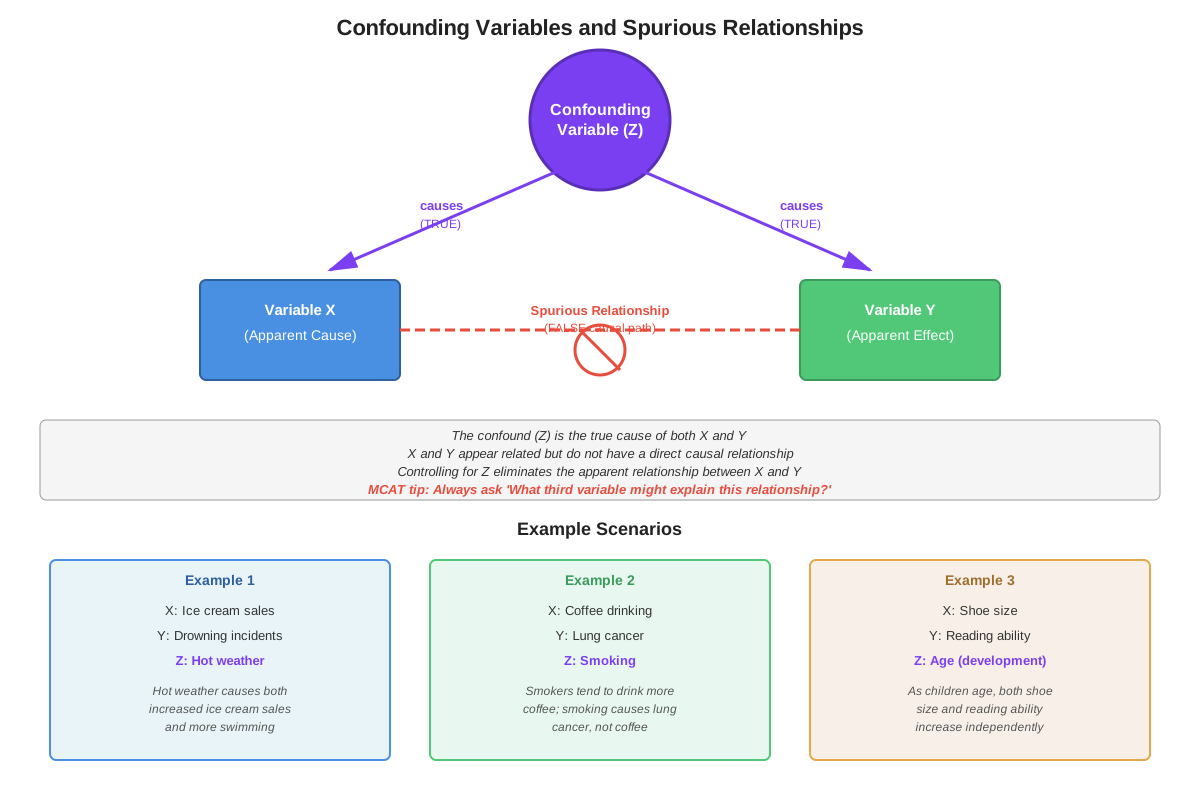
- Elimination of Alternative Explanations (Internal Validity): Researchers must rule out other plausible explanations for the observed relationship. This is often the most challenging criterion because numerous confounding variables (third variables that influence both the independent and dependent variables) might explain an apparent causal relationship. For example, the relationship between coffee consumption and heart disease might be confounded by smoking if coffee drinkers are more likely to smoke.
Experimental Designs and Causation
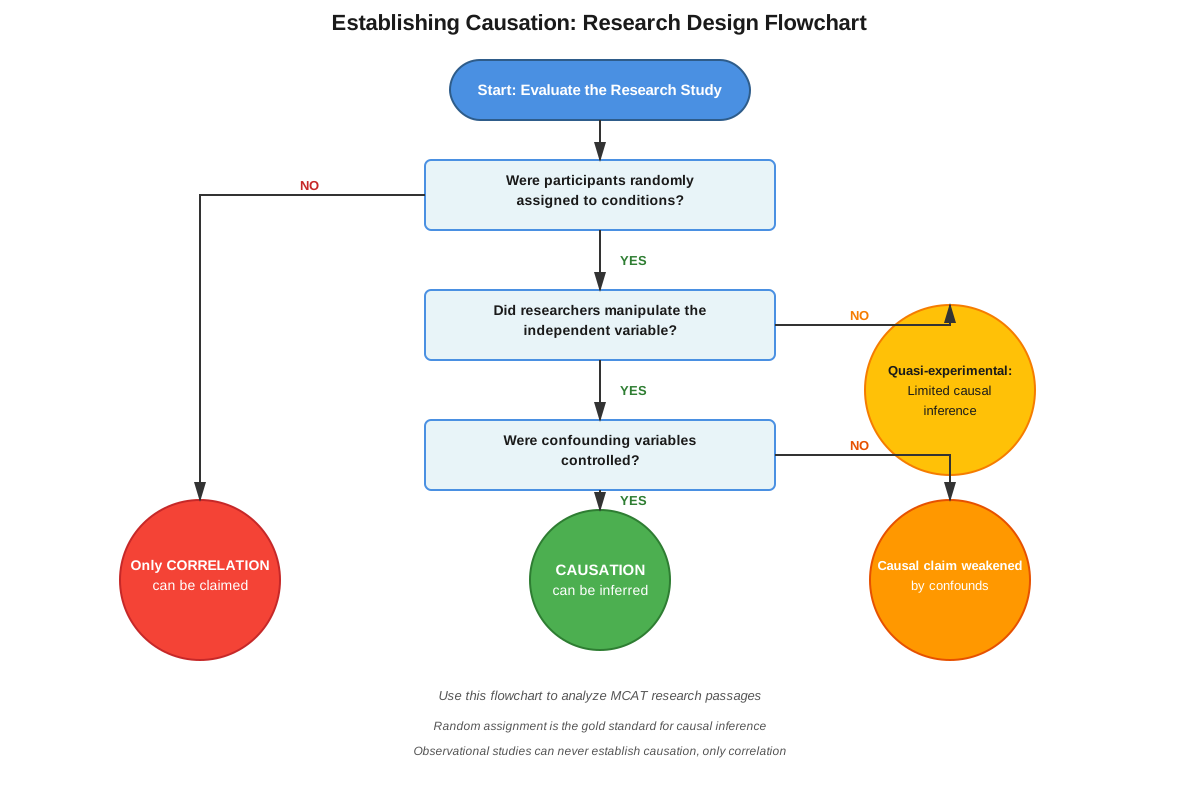
Randomized controlled experiments represent the gold standard for establishing causation because they systematically address all three criteria. In a true experiment, researchers:
- Randomly assign participants to conditions (experimental vs. control groups), which distributes confounding variables evenly across groups
- Manipulate the independent variable directly, establishing temporal precedence
- Control extraneous variables through standardization and experimental protocols
- Measure the dependent variable to assess covariation
Random assignment is particularly powerful because it addresses the third criterion (eliminating alternative explanations) by ensuring that groups are equivalent on average before the manipulation occurs. Any differences observed after the manipulation can therefore be attributed to the independent variable rather than pre-existing group differences.
Observational Studies and Causal Inference
Many important questions in sociology and medicine cannot be studied experimentally due to ethical or practical constraints. Researchers cannot randomly assign people to smoke cigarettes, experience poverty, or develop mental illness. Instead, they must rely on observational studies (correlational designs, longitudinal studies, case-control studies) that observe naturally occurring variation in variables.
Observational studies can establish temporal precedence and covariation but struggle with the third criterion—eliminating alternative explanations. Longitudinal studies that follow participants over time are stronger than cross-sectional studies (single time point) because they can establish temporal order. However, even longitudinal observational studies cannot definitively rule out all confounding variables, limiting causal claims.
Threats to Causal Inference
Several factors can undermine researchers' ability to establish causation:
| Threat | Description | Example |
|---|---|---|
| Confounding variables | Third variables that influence both the independent and dependent variables | Ice cream sales and drowning deaths are correlated, but both are caused by warm weather |
| Reverse causation | The presumed effect actually causes the presumed cause | Does mental illness cause substance abuse, or does substance abuse cause mental illness? |
| Selection bias | Non-random assignment creates systematic differences between groups | People who choose to exercise may be healthier for other reasons unrelated to exercise |
| Spurious correlation | Two variables are correlated only because both are caused by a third variable | Number of firefighters at a fire correlates with fire damage, but both are caused by fire size |
Establishing Causation in Non-Experimental Research
When experiments are impossible, researchers use several strategies to strengthen causal inferences from observational data:
- Statistical controls: Using regression analysis or matching techniques to account for known confounding variables
- Natural experiments: Exploiting naturally occurring events that approximate random assignment (e.g., policy changes that affect some regions but not others)
- Dose-response relationships: Demonstrating that larger "doses" of the cause produce larger effects strengthens causal claims
- Consistency across studies: When multiple studies using different methods find the same relationship, causation becomes more plausible
- Biological plausibility: A theoretical mechanism explaining how the cause produces the effect strengthens causal arguments
Causation vs. Correlation
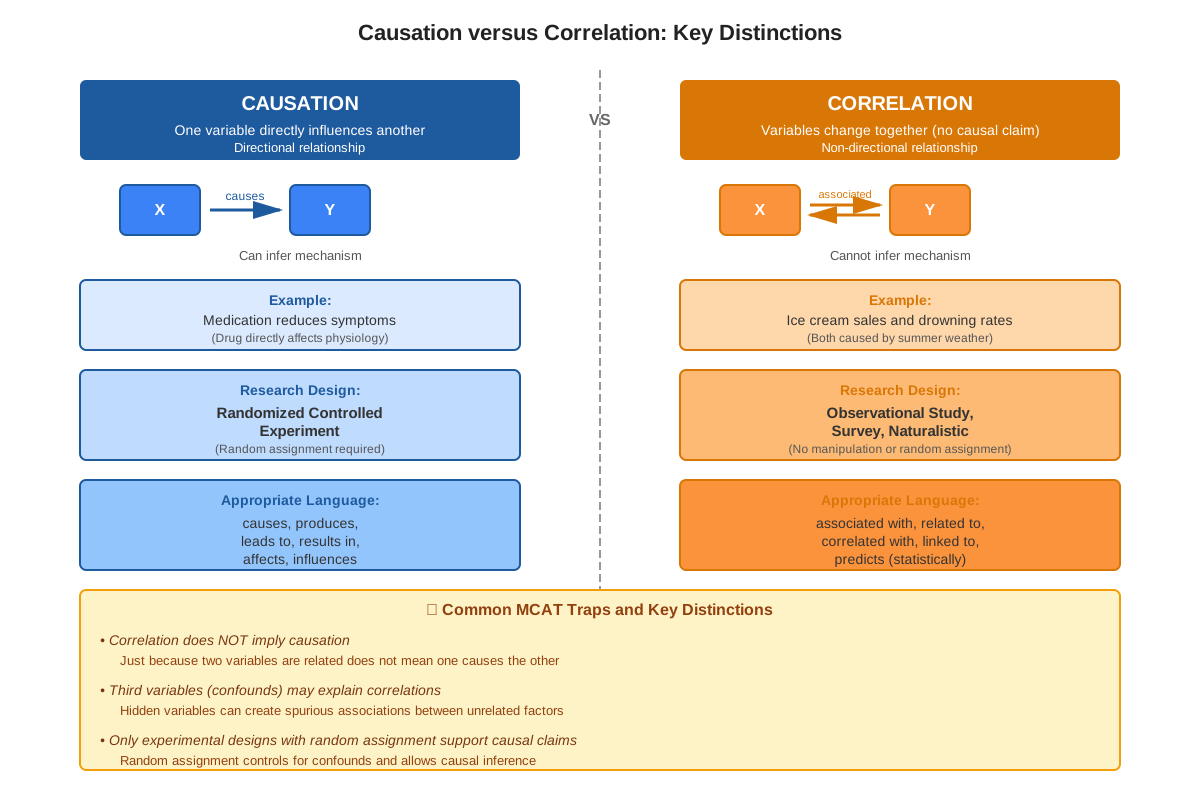
The distinction between causation and correlation is perhaps the most frequently tested concept related to this topic on the MCAT. Correlation simply means that two variables are statistically related—they tend to vary together. Causation means that one variable actually produces changes in the other. All causal relationships involve correlation, but most correlations do not reflect causation.
The MCAT frequently presents scenarios where students must recognize that a correlational finding does not support a causal conclusion. For example, a study might find that students who eat breakfast perform better academically. This correlation does not establish that eating breakfast causes better performance—perhaps more organized students both eat breakfast and study more effectively, or perhaps family socioeconomic status influences both breakfast habits and academic resources.
Concept Relationships
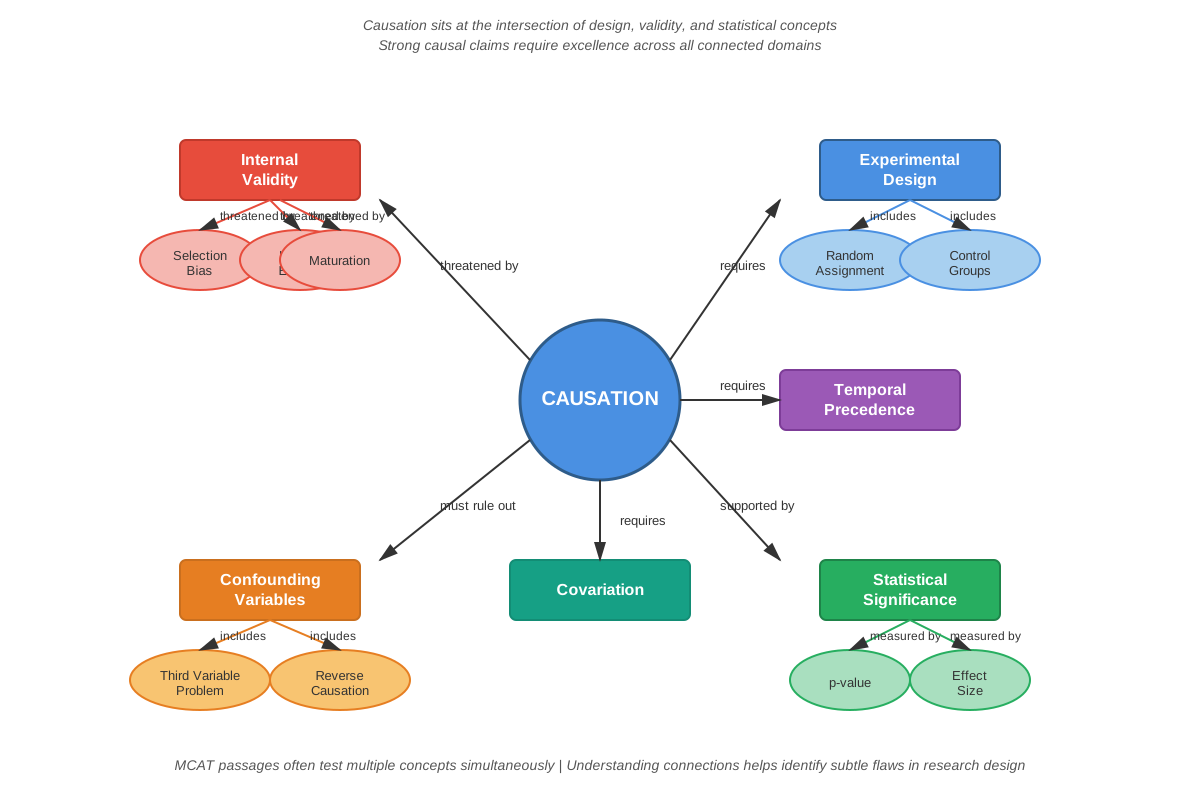
The concept of causation sits at the center of a network of interconnected research methodology concepts. Causation requires correlation as a necessary but insufficient condition—two variables must covary for one to cause the other, but covariation alone does not prove causation. This relationship is unidirectional: causation implies correlation, but correlation does not imply causation.
Experimental design → enables → causal inference: The structure of a study determines whether researchers can make causal claims. True experiments with random assignment and manipulation of independent variables provide the strongest evidence for causation, while correlational designs can only suggest associations.
Confounding variables → threaten → causal conclusions: The presence of unmeasured or uncontrolled third variables undermines researchers' ability to eliminate alternative explanations, weakening causal claims. Effective research design aims to identify and control potential confounds.
Temporal precedence + covariation + elimination of alternatives → establish → causation: These three criteria work together as necessary and sufficient conditions for causal inference. Missing any one criterion means causation cannot be established.
Internal validity → supports → causal inference: Studies with high internal validity (good control of extraneous variables, appropriate design) provide stronger evidence for causation than studies with threats to internal validity.
The relationship between causation and related sociology concepts extends to social determinants of health, where researchers must establish whether factors like poverty, education, or discrimination actually cause health disparities or merely correlate with them. Understanding causation also connects to theory development in sociology, as theories propose causal mechanisms explaining social phenomena.
Quick check — test yourself on Causation so far.
Try Flashcards →High-Yield Facts
⭐ Correlation does not imply causation—two variables can be statistically related without one causing the other
⭐ Three criteria must be met to establish causation: temporal precedence, covariation, and elimination of alternative explanations
⭐ Randomized controlled experiments are the gold standard for establishing causation because random assignment eliminates confounding variables
⭐ Observational studies (correlational designs) can demonstrate associations but cannot definitively establish causation
⭐ Confounding variables are third variables that influence both the independent and dependent variables, creating spurious relationships
- Temporal precedence means the cause must occur before the effect in time
- Longitudinal studies are stronger than cross-sectional studies for establishing temporal order
- Reverse causation occurs when the presumed effect actually causes the presumed cause
- Internal validity refers to the degree to which a study can support causal conclusions
- Natural experiments exploit naturally occurring events to approximate random assignment when true experiments are unethical or impractical
- Dose-response relationships (where larger amounts of the cause produce larger effects) strengthen causal arguments
- Selection bias occurs when non-random assignment creates systematic differences between groups that confound causal interpretation
Common Misconceptions
Misconception: If two variables are strongly correlated, one must cause the other.
Correction: Strong correlations can result from confounding variables, reverse causation, or coincidence. Correlation strength does not determine causation—the research design and ability to meet the three causal criteria determine whether causal claims are justified.
Misconception: Longitudinal studies that follow participants over time can establish causation just as well as experiments.
Correction: While longitudinal studies can establish temporal precedence better than cross-sectional studies, they still cannot eliminate all alternative explanations because they lack random assignment and experimental manipulation. Unmeasured confounding variables may still explain observed relationships.
Misconception: If researchers control for confounding variables statistically, they have established causation.
Correction: Statistical controls can only account for measured confounding variables. Unmeasured or unknown confounds may still explain the relationship. Additionally, statistical control assumes the confounding variable is measured without error and that the relationship between variables is correctly specified.
Misconception: The independent variable is always the cause and the dependent variable is always the effect.
Correction: In correlational research, the labels "independent" and "dependent" are somewhat arbitrary—researchers cannot definitively establish which variable causes the other without experimental manipulation. The terminology reflects the researcher's hypothesis, not proven causation.
Misconception: If Variable A causes Variable B, then A and B must always occur together.
Correction: Causal relationships can be probabilistic rather than deterministic. Smoking causes lung cancer, but not all smokers develop lung cancer and some non-smokers do. A cause increases the probability of an effect without guaranteeing it in every case.
Worked Examples
Example 1: Evaluating a Correlational Study
Scenario: Researchers conduct a study examining the relationship between social media use and depression among adolescents. They survey 500 teenagers, measuring hours spent on social media per day and depression symptoms using a validated scale. They find a significant positive correlation (r = 0.45, p < 0.001) between social media use and depression scores. The researchers conclude that "social media use causes depression in adolescents."
Question: Is the causal conclusion justified? Why or why not?
Analysis:
Let's evaluate this study against the three criteria for causation:
- Temporal precedence: This cross-sectional study measures both variables at the same time point. We cannot determine whether social media use preceded depression or whether depressed adolescents subsequently increased their social media use. This criterion is NOT met.
- Covariation: The significant positive correlation (r = 0.45) demonstrates that the variables covary—as social media use increases, depression scores tend to increase. This criterion IS met.
- Elimination of alternative explanations: This observational study cannot rule out numerous confounding variables. For example:
- Loneliness might cause both increased social media use (seeking connection) and depression
- Family conflict might lead to both social media escapism and depressive symptoms
- Reverse causation is possible—depression might cause increased social media use rather than vice versa
Conclusion: The causal conclusion is NOT justified. This correlational design can only support the claim that social media use and depression are associated. To establish causation, researchers would need an experimental design (randomly assigning participants to different levels of social media use) or at minimum a longitudinal study that measures social media use at Time 1 and depression at Time 2, while controlling for baseline depression and potential confounds.
MCAT Connection: This example illustrates a common MCAT trap—presenting correlational data with causal language. The correct answer would identify that the study design (cross-sectional, observational) cannot support causal claims, regardless of statistical significance.
Example 2: Comparing Research Designs
Scenario: A research team wants to determine whether meditation causes reduced anxiety. They are considering three possible study designs:
Design A: Survey 1,000 adults, asking about their meditation habits and measuring anxiety levels. Compare anxiety scores between regular meditators and non-meditators.
Design B: Recruit 200 adults with moderate anxiety. Randomly assign half to an 8-week meditation program and half to a waitlist control group. Measure anxiety before and after the intervention period.
Design C: Follow 500 adults over 5 years, measuring meditation frequency and anxiety levels annually. Examine whether changes in meditation predict subsequent changes in anxiety.
Question: Which design provides the strongest evidence for causation? Explain your reasoning.
Analysis:
Design A (Cross-sectional correlational):
- Temporal precedence: Cannot establish—both variables measured simultaneously
- Covariation: Can demonstrate if meditation and anxiety are related
- Alternative explanations: Cannot eliminate—many confounds possible (personality differences, socioeconomic status, health consciousness)
- Causal inference strength: Weakest—can only show association
Design B (Randomized controlled experiment):
- Temporal precedence: Established—meditation intervention occurs before anxiety measurement
- Covariation: Can demonstrate if the meditation group shows greater anxiety reduction
- Alternative explanations: Random assignment distributes confounds evenly across groups; any group differences can be attributed to the intervention
- Causal inference strength: Strongest—meets all three criteria for causation
Design C (Longitudinal observational):
- Temporal precedence: Partially established—can show whether meditation changes precede anxiety changes
- Covariation: Can demonstrate if changes in meditation predict changes in anxiety
- Alternative explanations: Cannot fully eliminate—unmeasured confounds might explain both meditation adoption and anxiety reduction (e.g., life circumstances improving)
- Causal inference strength: Moderate—stronger than cross-sectional but weaker than experimental
Conclusion: Design B (randomized controlled experiment) provides the strongest evidence for causation because it is the only design that meets all three causal criteria. Random assignment is the key feature that eliminates alternative explanations by ensuring groups are equivalent before the intervention.
MCAT Connection: The MCAT frequently asks students to compare research designs and identify which would best establish causation. The correct answer almost always involves random assignment and experimental manipulation when those are options. Understanding why experiments are superior to observational studies for causal inference is essential.
Exam Strategy
When approaching MCAT questions about causation, follow this systematic strategy:
Step 1: Identify the research design. Quickly determine whether the passage describes an experiment (with random assignment and manipulation) or an observational study (measuring naturally occurring variables). This immediately tells you whether causal conclusions are potentially justified.
Step 2: Look for causal language. Watch for trigger words like "causes," "produces," "leads to," "results in," or "is responsible for." These signal causal claims that you must evaluate against the study design. If the study is correlational but uses causal language, that's likely a trap answer.
Step 3: Check the three criteria. Systematically evaluate:
- Can temporal order be established? (Look for longitudinal designs or experimental manipulation)
- Is there covariation? (Usually stated in the passage)
- Are alternative explanations ruled out? (Look for random assignment, control groups, or discussion of confounds)
Step 4: Consider confounding variables. If the question asks why a causal conclusion isn't justified, think about plausible third variables that might explain the relationship. Common confounds in MCAT passages include socioeconomic status, age, health status, and personality factors.
Process of elimination tips:
- Eliminate answers that claim causation from correlational data
- Eliminate answers that confuse correlation with causation
- Eliminate answers that ignore obvious confounding variables
- Keep answers that appropriately match the strength of conclusions to the research design
Time allocation: Causation questions typically require 60-90 seconds. Spend 30 seconds identifying the design and 30-60 seconds evaluating the specific question. Don't overthink—if the design is correlational, causation cannot be established, regardless of how compelling the relationship seems.
Exam Tip: When a passage presents correlational data but answer choices include causal language, the causal answer is almost always wrong. The MCAT rewards students who recognize the limitations of research designs.
Memory Techniques
Mnemonic for the three criteria for causation: "TCE"
- Temporal precedence (Time order)
- Covariation (Correlation)
- Elimination of alternatives (Excluding confounds)
Visualization strategy: Picture a domino chain where one domino (cause) must physically knock over the next domino (effect). For causation to be real:
- The first domino must fall BEFORE the second (temporal precedence)
- The first domino must actually TOUCH the second (covariation)
- There must be NO OTHER HAND pushing the second domino (elimination of alternatives)
Acronym for remembering why correlation ≠ causation: "CRRSS"
- Confounding variables
- Reverse causation
- Random chance
- Spurious correlation
- Selection bias
Memory hook: "Random Assignment Removes Rival Explanations" (RARRE) helps remember why experiments with random assignment are superior for establishing causation—they eliminate alternative explanations by distributing confounds evenly across groups.
Phrase to remember: "Correlation is necessary but not sufficient for causation"—this captures the relationship between the two concepts and reminds you that correlation must be present for causation but doesn't prove it.
Summary
Causation represents a fundamental concept in research methodology that distinguishes true cause-and-effect relationships from mere associations between variables. Establishing causation requires meeting three essential criteria: temporal precedence (the cause must precede the effect), covariation (the variables must be statistically related), and elimination of alternative explanations (confounding variables must be ruled out). Randomized controlled experiments provide the strongest evidence for causation because random assignment distributes confounds evenly across groups, allowing researchers to attribute group differences to the manipulated independent variable. Observational studies, while valuable for examining relationships that cannot be studied experimentally, can only demonstrate associations and cannot definitively establish causation due to the inability to eliminate all alternative explanations. The MCAT frequently tests students' ability to distinguish between correlation and causation, evaluate whether research designs support causal claims, and identify confounding variables that threaten causal inferences. Success on causation questions requires recognizing the limitations of different research designs and matching the strength of conclusions to the quality of evidence provided by the study methodology.
Key Takeaways
- Causation requires three criteria: temporal precedence, covariation, and elimination of alternative explanations—all three must be met to establish cause-and-effect relationships
- Correlation does not imply causation—variables can be statistically related without one causing the other due to confounding variables, reverse causation, or spurious relationships
- Randomized controlled experiments are the gold standard for establishing causation because random assignment eliminates confounding variables as alternative explanations
- Observational studies (correlational, cross-sectional) can demonstrate associations but cannot definitively prove causation regardless of statistical significance
- Confounding variables are third variables that influence both the independent and dependent variables, creating apparent relationships that are not causal
- Temporal precedence is often the most challenging criterion to establish in observational research—longitudinal designs are stronger than cross-sectional designs for determining time order
- MCAT questions frequently present correlational data with causal language in wrong answer choices—recognizing this mismatch between design and conclusions is essential for exam success
Related Topics
Correlation and Correlation Coefficients: Understanding the statistical measurement of relationships between variables provides the foundation for distinguishing correlation from causation. Mastering causation enables deeper understanding of when correlational findings can and cannot support causal claims.
Experimental Design: Detailed knowledge of experimental methodology, including random assignment, control groups, and manipulation of independent variables, builds directly on causation concepts by explaining how researchers establish cause-and-effect relationships.
Confounding Variables and Internal Validity: These concepts extend causation by examining specific threats to causal inference and strategies researchers use to strengthen causal claims in both experimental and observational research.
Longitudinal vs. Cross-Sectional Studies: Understanding different research designs in terms of their ability to establish temporal precedence and support causal inferences represents a natural progression from mastering causation fundamentals.
Statistical Inference and Hypothesis Testing: These topics build on causation by examining how researchers determine whether observed relationships are statistically significant and likely to represent true effects rather than chance findings.
Practice CTA
Now that you've mastered the core concepts of causation, it's time to solidify your understanding through active practice. Work through the practice questions and flashcards to test your ability to distinguish causation from correlation, evaluate research designs, and identify confounding variables in exam-style scenarios. Remember, the MCAT rewards students who can think critically about research methodology—your ability to recognize when causal claims are and aren't justified will serve you well not only on test day but throughout your medical career. You've built a strong foundation; now apply it with confidence!
Sign up free to keep reading
Create a free AnvayaPrep account to finish this MCAT guide on Causation — plus flashcards and practice questions.