Overview
The median is a fundamental measure of central tendency in statistics that represents the middle value in an ordered dataset. Within the context of Sociology and Research Methods and Statistics, the median serves as a critical tool for describing and analyzing social phenomena, particularly when dealing with skewed distributions or data containing outliers. Unlike the mean, which can be heavily influenced by extreme values, the median provides a robust measure of the "typical" value in a dataset, making it especially valuable when examining income distributions, educational attainment levels, or other social variables that often display asymmetric patterns.
For the MCAT, understanding the median is essential because it appears frequently in the Psychological, Social, and Biological Foundations of Behavior section, particularly in passages involving research design, data interpretation, and statistical analysis of social science studies. The exam expects test-takers to not only calculate the median but also to understand when it is the most appropriate measure of central tendency to use, how it compares to other statistical measures, and what it reveals about the underlying distribution of social data. Questions may present research scenarios where students must identify which measure best represents the data or interpret what a given median value indicates about a population.
The median connects to broader sociological concepts including social stratification, inequality measurement, and research methodology. It is particularly relevant when examining socioeconomic disparities, as median household income often provides a more accurate representation of typical economic conditions than mean income, which can be inflated by extremely wealthy outliers. Understanding the median also supports comprehension of percentiles, quartiles, and other distributional measures that frequently appear in sociological research and MCAT passages.
Learning Objectives
- [ ] Define Median using accurate Sociology terminology
- [ ] Explain why Median matters for the MCAT
- [ ] Apply Median to exam-style questions
- [ ] Identify common mistakes related to Median
- [ ] Connect Median to related Sociology concepts
- [ ] Calculate the median for both odd and even-numbered datasets
- [ ] Compare and contrast median with mean and mode to determine the most appropriate measure for different data distributions
- [ ] Interpret the relationship between median position and data skewness in sociological research contexts
Prerequisites
- Basic arithmetic operations: Necessary for ordering data and calculating middle positions in datasets
- Understanding of data types: Required to distinguish when median is applicable (ordinal and interval/ratio data only)
- Concept of central tendency: Provides the framework for understanding median as one of several ways to describe the "center" of a distribution
- Basic research design principles: Helps contextualize when and why researchers choose specific statistical measures
Why This Topic Matters
In real-world sociological research and public policy, the median plays a crucial role in accurately representing populations and informing decisions. Government agencies report median household income rather than mean income because it better reflects the economic reality of the typical family, unaffected by billionaires or extreme poverty. Healthcare researchers use median survival times in clinical studies because a few patients with exceptionally long or short survival can skew the mean. Educational researchers examine median test scores to understand typical student performance while accounting for both struggling and exceptional learners.
On the MCAT, median-related content appears in approximately 5-8% of Psychological, Social, and Biological Foundations questions, particularly in passages presenting research findings or asking students to interpret statistical data. The exam frequently tests this concept through:
- Data interpretation passages where students must identify which measure of central tendency best represents skewed data
- Research design questions asking why a researcher chose median over mean for a particular study
- Graph and table analysis requiring calculation or estimation of median values from visual representations
- Comparative questions testing understanding of how median relates to mean in different distribution shapes
Common MCAT scenarios include passages about socioeconomic research, health disparities, educational outcomes, and behavioral studies where understanding the median is essential for correctly interpreting the researchers' findings and conclusions. The exam may also present scenarios where students must recognize that using mean instead of median would lead to misleading conclusions about a population.
Core Concepts
Definition and Calculation of Median
The median is defined as the middle value in an ordered dataset when values are arranged from lowest to highest. In Median Sociology contexts, this measure represents the point at which exactly half of the observations fall below and half fall above, making it the 50th percentile of a distribution. The median is a positional measure rather than a calculated average, which fundamentally distinguishes it from the mean.
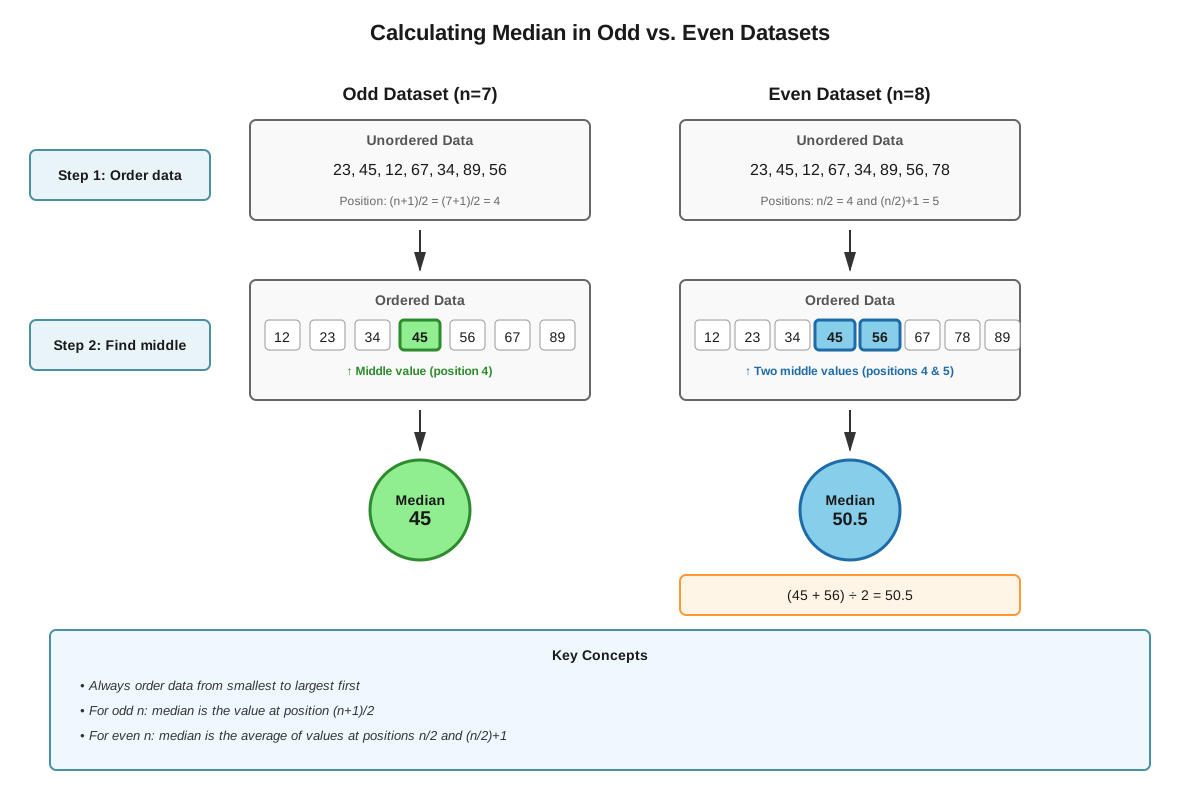
For datasets with an odd number of observations, the median is simply the middle value. For example, in the dataset {3, 7, 9, 15, 21}, the median is 9 because it occupies the third position out of five values. The formula for locating the median position is: (n+1)/2, where n is the number of observations.
For datasets with an even number of observations, the median is calculated as the average of the two middle values. In the dataset {4, 8, 12, 16, 20, 24}, the two middle values are 12 and 16 (positions 3 and 4 out of 6), so the median is (12+16)/2 = 14. This value may not actually appear in the original dataset, but it represents the mathematical midpoint.
Median in Skewed Distributions
Understanding the relationship between median and distribution shape is crucial for Median MCAT questions. In a positively skewed (right-skewed) distribution, where a tail extends toward higher values, the median is typically less than the mean. This occurs because extreme high values pull the mean upward while the median remains anchored at the middle position. Income distributions exemplify this pattern: a few extremely wealthy individuals raise the mean income substantially above the median income.
In a negatively skewed (left-skewed) distribution, the median exceeds the mean because extreme low values pull the mean downward. This might occur in datasets like age at retirement, where most people retire around 65-67, but some retire much earlier due to disability or other factors.
In a symmetric distribution, the median and mean are approximately equal, both located at the center of the distribution. The normal distribution represents the ideal symmetric case where mean, median, and mode all coincide.
Advantages and Limitations of Median
The median offers several advantages in sociological research:
- Resistance to outliers: Extreme values do not affect the median's position, making it ideal for datasets with outliers
- Interpretability: The concept of "middle value" is intuitive and easily communicated to non-technical audiences
- Applicability to ordinal data: Unlike the mean, median can be calculated for ordinal variables (e.g., education level: high school, bachelor's, master's)
- Accurate representation of skewed data: Provides a better sense of "typical" values when distributions are asymmetric
However, the median has limitations:
- Less mathematical tractability: More difficult to use in advanced statistical calculations compared to the mean
- Ignores actual values: Only considers position, not the magnitude of differences between values
- Requires ordering: Cannot be calculated for nominal data (e.g., race, religion)
- Sample variability: Can be less stable than the mean in small samples from symmetric distributions
Median in Sociological Research Contexts
In Research Methods and Statistics for sociology, the median appears frequently in studies of:
Socioeconomic variables: Median household income, median wealth, and median education levels provide more accurate pictures of typical conditions than means, which are inflated by extreme wealth concentration. The U.S. Census Bureau reports median household income as the primary economic indicator for this reason.
Health outcomes: Median survival time in epidemiological studies, median recovery time from illness, and median age at disease onset are standard measures because health data often contains outliers (some patients recover much faster or slower than typical).
Demographic characteristics: Median age of a population, median family size, and median years of education help researchers understand central tendencies in population characteristics without distortion from extreme cases.
Behavioral measures: Median response time in psychological experiments, median number of social connections, and median hours of media consumption provide robust measures of typical behavior.
Comparison with Other Measures of Central Tendency
| Measure | Best Used When | Affected by Outliers | Data Type Required | Calculation Method |
|---|---|---|---|---|
| Median | Distribution is skewed or contains outliers | No | Ordinal, Interval, Ratio | Middle position value |
| Mean | Distribution is symmetric with no outliers | Yes | Interval, Ratio only | Sum divided by count |
| Mode | Identifying most common category | No | All types including Nominal | Most frequent value |
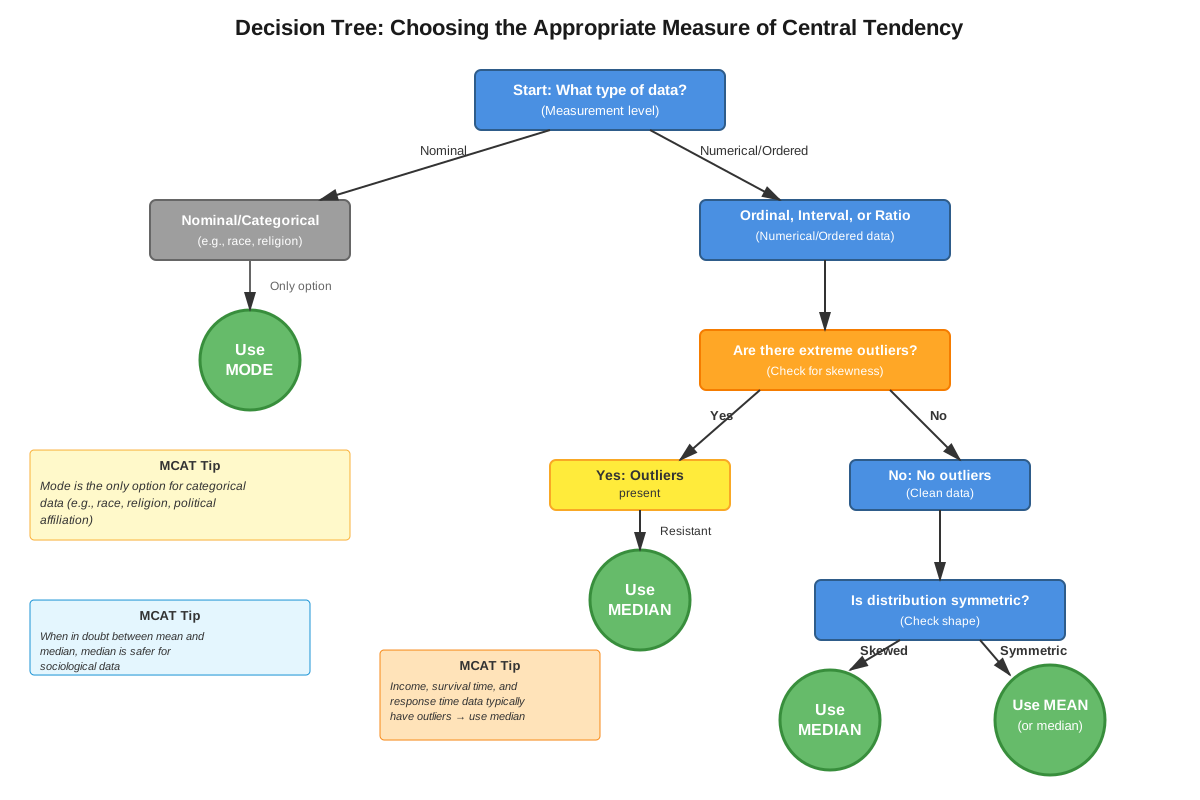
Understanding when to use each measure is critical for Sociology research interpretation on the MCAT. A researcher studying income inequality would choose median income; a researcher studying average caloric intake in a controlled experiment might choose mean; a researcher studying religious affiliation would use mode.
Concept Relationships
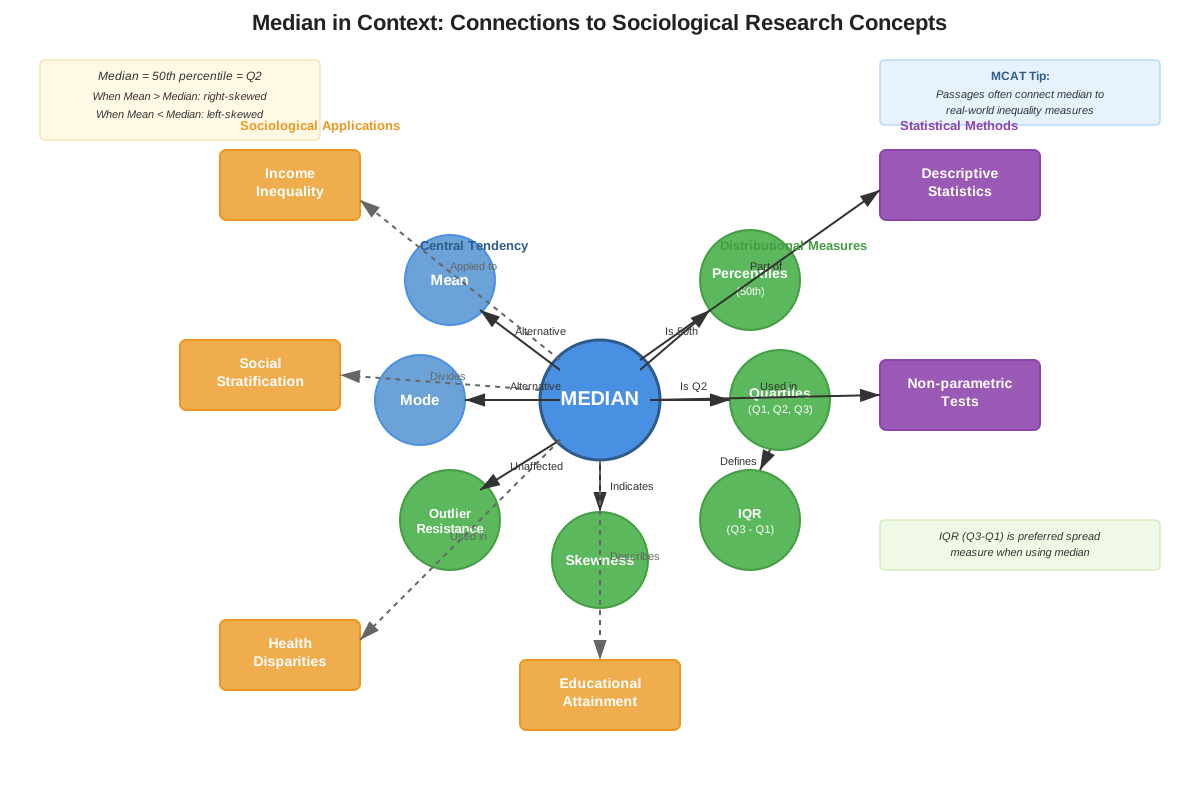
The median exists within a network of interconnected statistical and sociological concepts. At the foundational level, measures of central tendency (mean, median, mode) all attempt to describe the "typical" or "central" value in a dataset, but each does so differently. The median specifically connects to percentiles and quartiles, as it represents the 50th percentile. The first quartile (Q1) is the median of the lower half of data, while the third quartile (Q3) is the median of the upper half, creating a direct conceptual link.
The relationship between median and distribution shape is bidirectional: the median helps describe the distribution, while the distribution shape determines the median's relationship to other measures. This connects to skewness, a measure of distribution asymmetry. When analyzing social inequality, the gap between median and mean income directly reflects the degree of positive skew in the income distribution, which itself indicates wealth concentration.
The median's resistance to outliers connects it to concepts of data quality and robust statistics in research methodology. When sociologists encounter measurement errors or extreme cases, the median provides a more stable estimate than the mean, linking to broader discussions of validity and reliability in research design.
Conceptual flow: Data collection → Data ordering → Median calculation → Distribution characterization → Comparison with mean → Interpretation of skewness → Understanding of social phenomena → Research conclusions
The median also connects to social stratification concepts, as it helps identify the "middle class" or "typical" member of a population. When examining educational attainment, the median years of education indicates the level that divides the population in half, directly relating to concepts of social mobility and opportunity structure.
High-Yield Facts
⭐ The median is the middle value in an ordered dataset and represents the 50th percentile of a distribution
⭐ In positively skewed distributions (like income), median < mean; in negatively skewed distributions, median > mean
⭐ The median is resistant to outliers, making it the preferred measure for skewed data or data with extreme values
⭐ For odd-numbered datasets, the median is the middle value; for even-numbered datasets, it's the average of the two middle values
⭐ The median can be calculated for ordinal, interval, and ratio data, but NOT for nominal data
- The median divides a distribution into two equal halves, with 50% of observations above and 50% below
- In a perfectly symmetric distribution, the mean, median, and mode are all equal
- Median household income is the standard economic indicator used by government agencies because it better represents typical economic conditions
- The interquartile range (IQR) is calculated using medians: Q3 - Q1, where Q1 and Q3 are medians of data subsets
- When researchers report "median survival time" in medical studies, they're indicating the time point at which half the subjects have experienced the outcome
Quick check — test yourself on Median so far.
Try Flashcards →Common Misconceptions
Misconception: The median is always a value that actually appears in the dataset.
Correction: For even-numbered datasets, the median is calculated as the average of the two middle values and may not be an actual data point. For example, in {2, 4, 6, 8}, the median is 5, which doesn't appear in the original data.
Misconception: The median can be calculated for any type of data, including nominal categories.
Correction: The median requires data that can be meaningfully ordered. Nominal data like race, religion, or favorite color cannot be ordered, so median is undefined. Only ordinal, interval, and ratio data can have medians calculated.
Misconception: The median is less accurate or less important than the mean.
Correction: Neither measure is inherently more accurate; they measure different aspects of central tendency. The median is actually more appropriate and informative for skewed distributions, which are common in sociological data. Median income, for instance, is more representative of typical economic conditions than mean income.
Misconception: If the median is higher than the mean, the data must contain errors or outliers.
Correction: A median higher than the mean simply indicates negative skew in the distribution, which is a normal characteristic of certain types of data. For example, test scores on an easy exam might show negative skew, with most students scoring high but a few scoring very low.
Misconception: The median always falls exactly in the middle of the range (halfway between minimum and maximum).
Correction: The median is the middle value by count (position), not by numerical range. In the dataset {1, 2, 3, 4, 100}, the median is 3, which is nowhere near the midpoint of the range (1 to 100). This distinction is crucial for understanding how median differs from midrange.
Misconception: Changing extreme values in a dataset will change the median.
Correction: As long as the middle position(s) remain unchanged, altering extreme values doesn't affect the median. In {1, 5, 10, 15, 20}, the median is 10. Changing this to {1, 5, 10, 15, 1000} keeps the median at 10, demonstrating its resistance to outliers.
Worked Examples
Example 1: Calculating Median and Interpreting Distribution Shape
Scenario: A sociologist studying income inequality in a small community collects annual household income data (in thousands) from 11 families: {25, 30, 32, 35, 38, 42, 45, 48, 52, 95, 180}. Calculate the median income and explain what the relationship between median and mean reveals about income distribution.
Solution:
Step 1: Verify the data is ordered from lowest to highest. ✓ (already ordered)
Step 2: Determine the number of observations: n = 11 (odd number)
Step 3: Calculate the median position: (n+1)/2 = (11+1)/2 = 6th position
Step 4: Identify the value at the 6th position: $42,000
Step 5: Calculate the mean for comparison: Sum = 622, Mean = 622/11 = $56,545
Interpretation: The median income ($42,000) is substantially lower than the mean income ($56,545), indicating a positively skewed distribution. This pattern is typical of income data and reveals that a few high-income households (particularly the $95,000 and $180,000 earners) are pulling the mean upward while not affecting the median. The median better represents the "typical" household income in this community because it isn't inflated by the wealthy outliers. This demonstrates why sociologists and policymakers prefer median income when describing economic conditions—it more accurately reflects the experience of the middle household.
Connection to Learning Objectives: This example demonstrates calculation of median (odd-numbered dataset), comparison with mean, interpretation of distribution shape, and application to sociological research contexts.
Example 2: Choosing Appropriate Measures for Research Design
Scenario: A health researcher is designing a study to examine recovery time (in days) from a surgical procedure. Pilot data from 8 patients shows: {5, 6, 7, 7, 8, 9, 10, 45}. The researcher must decide whether to report mean or median recovery time in the study results. Which measure should be used and why?
Solution:
Step 1: Calculate the median:
- n = 8 (even number)
- Middle positions: 4th and 5th values
- Values: 7 and 8
- Median = (7+8)/2 = 7.5 days
Step 2: Calculate the mean:
- Sum = 5+6+7+7+8+9+10+45 = 97
- Mean = 97/8 = 12.125 days
Step 3: Identify the outlier:
- The value 45 is dramatically higher than other values (possibly a patient with complications)
Step 4: Compare measures:
- Median (7.5 days) represents the typical recovery time for 7 of 8 patients
- Mean (12.125 days) is inflated by the single outlier and doesn't represent any patient's actual experience well
Recommendation: The researcher should report the median recovery time of 7.5 days as the primary measure because:
- The data contains an obvious outlier that distorts the mean
- The median better represents the typical patient's experience
- Medical literature conventionally uses median survival/recovery times for this reason
- The researcher could additionally report the range or note that one patient had an extended recovery, providing complete information without letting the outlier dominate the central tendency measure
MCAT Application: This type of scenario frequently appears in MCAT passages where students must evaluate research design decisions. The exam might ask: "Why did the researchers choose to report median rather than mean recovery time?" The correct answer would reference the presence of outliers and the median's resistance to extreme values.
Connection to Learning Objectives: This example demonstrates application to exam-style questions, identification of when median is most appropriate, and connection to research methodology concepts.
Exam Strategy
When approaching Median MCAT questions, employ a systematic strategy to maximize accuracy and efficiency:
Trigger Words to Recognize: Watch for phrases like "middle value," "50th percentile," "typical household," "resistant to outliers," "skewed distribution," or "extreme values present." These signal that median is likely the focus or the appropriate measure to consider. Questions asking about "central tendency in the presence of outliers" almost always point toward median as the answer.
Quick Decision Framework:
- Identify the data type: If nominal → median cannot be calculated (eliminate median options)
- Check for outliers or skew: If present → median is likely preferred over mean
- Note distribution shape: If symmetric → mean and median are similar; if skewed → they differ predictably
- Consider the research context: Income, survival time, recovery time → typically use median
Process of Elimination Tips:
- Eliminate answer choices that confuse median with mean (e.g., "median is calculated by summing all values")
- Eliminate options suggesting median is affected by outliers
- Eliminate choices that claim median can be calculated for nominal data
- Be suspicious of answers that suggest median is "less accurate" than mean without context
Calculation Efficiency: If asked to calculate median from a list, quickly count the number of values first. For odd n, you only need to find the middle position. For even n, identify the two middle values before calculating their average. Don't waste time calculating the mean unless specifically asked.
Time Allocation: Median questions typically require 60-90 seconds. Spend 20 seconds reading and identifying what's being asked, 30-40 seconds on any calculations or data analysis, and 20-30 seconds selecting and confirming your answer. If a question requires extensive calculation, consider flagging it and returning if time permits.
Common Question Types:
- Direct calculation: "What is the median of the following dataset?"
- Measure selection: "Which measure of central tendency is most appropriate for this data?"
- Interpretation: "The median income is $45,000 while mean income is $62,000. What does this suggest?"
- Research design: "Why did the researchers report median rather than mean?"
Memory Techniques
MEDIAN Mnemonic:
- Middle value
- Even numbers need averaging
- Divides data in half
- Immune to outliers
- Applicable to ordinal data
- Not affected by extremes
Visualization Strategy: Picture a line of people arranged by height. The median is literally the middle person—if you add an extremely tall person at the end, the middle person doesn't change (median stays same), but if you calculated average height, it would increase (mean changes). This concrete image helps remember median's resistance to outliers.
Skew Direction Memory Aid: "Mean follows the tail" or "Mean gets pulled by extremes"
- Positive skew (right tail) → Mean > Median (mean pulled right)
- Negative skew (left tail) → Mean < Median (mean pulled left)
- Symmetric → Mean = Median (no pull)
Odd vs. Even Calculation:
- ODD = One Direct value (just pick the middle)
- EVEN = Exact Value Emerged from Neighbors (average the two middle values)
Data Type Acronym - NOIR:
- Nominal - NO median
- Ordinal - OK for median
- Interval - Ideal for median
- Ratio - Right for median
Summary
The median is a fundamental measure of central tendency that represents the middle value in an ordered dataset, dividing the distribution into two equal halves. As a positional measure resistant to outliers, the median provides crucial advantages when analyzing skewed distributions common in sociological research, particularly for variables like income, wealth, education, and health outcomes. Understanding how to calculate the median for both odd and even-numbered datasets, interpret its relationship to the mean as an indicator of distribution shape, and recognize when it is the most appropriate measure are essential skills for MCAT success. The median's relationship to percentiles, quartiles, and measures of spread connects it to broader statistical concepts, while its practical applications in research design and data interpretation make it a high-yield topic for exam preparation. Students must be able to distinguish median from mean and mode, recognize scenarios where median is preferred, and avoid common misconceptions about its calculation and interpretation.
Key Takeaways
- The median is the middle value in an ordered dataset and represents the 50th percentile, dividing data into two equal halves
- Median is resistant to outliers and extreme values, making it the preferred measure for skewed distributions common in sociological research
- In positively skewed distributions (like income), median < mean; in negatively skewed distributions, median > mean; in symmetric distributions, median ≈ mean
- Median can be calculated for ordinal, interval, and ratio data but NOT for nominal data, and requires ordering values from lowest to highest
- For odd-numbered datasets, median is the middle value; for even-numbered datasets, median is the average of the two middle values
- The relationship between median and mean reveals important information about distribution shape and the presence of outliers
- Median is the standard measure for reporting household income, survival times, and other sociological variables prone to extreme values
Related Topics
Mean (Arithmetic Average): The sum of all values divided by the number of observations; understanding mean is essential for comparing it with median and recognizing when each measure is appropriate. Mastering median provides the foundation for understanding why mean can be misleading in skewed distributions.
Mode: The most frequently occurring value in a dataset; completing the trio of central tendency measures. Understanding all three measures enables comprehensive data description and appropriate measure selection.
Standard Deviation and Variance: Measures of spread that describe variability around the mean; these concepts build on central tendency understanding and are often tested alongside median in MCAT passages.
Percentiles and Quartiles: Extensions of the median concept that divide distributions into more specific segments; the median is the 50th percentile, and quartiles are medians of data subsets, making median mastery prerequisite to understanding these concepts.
Distribution Shapes and Skewness: Formal measures of asymmetry in distributions; understanding median's relationship to mean provides the foundation for interpreting skewness coefficients and distribution characteristics.
Interquartile Range (IQR): A measure of spread calculated using Q3 - Q1, where both quartiles are medians; this concept directly builds on median calculation skills.
Practice CTA
Now that you've mastered the core concepts of median and its applications in sociological research, it's time to solidify your understanding through active practice. Challenge yourself with the practice questions and flashcards designed specifically for this topic—they'll help you recognize the subtle ways the MCAT tests median concepts and build the pattern recognition skills essential for exam success. Remember, understanding the theory is just the first step; applying it under timed conditions is what translates knowledge into points on test day. You've built a strong foundation—now prove it to yourself through deliberate practice!
Sign up free to keep reading
Create a free AnvayaPrep account to finish this MCAT guide on Median — plus flashcards and practice questions.