Overview
The mode is a fundamental measure of central tendency in statistics that represents the most frequently occurring value or category in a dataset. Within the context of Sociology and Research Methods and Statistics, understanding the mode is essential for analyzing social phenomena, demographic data, and behavioral patterns that appear on the MCAT. Unlike the mean and median, which require numerical data, the mode can be applied to any level of measurement—nominal, ordinal, interval, or ratio—making it particularly valuable when analyzing categorical social data such as religious affiliation, political party preference, or ethnic identity.
For the MCAT, the mode appears regularly in the Psychological, Social, and Biological Foundations of Behavior section, particularly within passages that present research findings, survey data, or experimental results. Test-makers frequently use the mode to assess whether students can correctly interpret data distributions, identify appropriate statistical measures for different data types, and recognize when the mode provides more meaningful information than other measures of central tendency. Questions may present frequency distributions, histograms, or raw datasets and ask students to identify the modal value or explain why the mode is the most appropriate statistical measure for a given research scenario.
The mode connects intimately with broader sociological concepts including data analysis, research methodology, population demographics, and the interpretation of social trends. Understanding the mode enables students to critically evaluate research studies, recognize patterns in social behavior, and make informed judgments about the validity and applicability of statistical claims—skills that are tested both directly through statistics questions and indirectly through passage-based reasoning questions throughout the MCAT.
Learning Objectives
- [ ] Define Mode using accurate Sociology terminology
- [ ] Explain why Mode matters for the MCAT
- [ ] Apply Mode to exam-style questions
- [ ] Identify common mistakes related to Mode
- [ ] Connect Mode to related Sociology concepts
- [ ] Distinguish between unimodal, bimodal, and multimodal distributions
- [ ] Determine when the mode is the most appropriate measure of central tendency
- [ ] Calculate and interpret the mode from various data presentation formats (tables, graphs, raw data)
Prerequisites
- Basic statistical terminology: Understanding terms like "frequency," "distribution," and "central tendency" provides the foundation for comprehending how the mode functions within statistical analysis
- Levels of measurement: Knowledge of nominal, ordinal, interval, and ratio scales is essential because the mode's unique applicability across all measurement levels distinguishes it from other central tendency measures
- Data interpretation skills: The ability to read tables, charts, and graphs is necessary for identifying modal values in MCAT passages
- Research design fundamentals: Understanding how data is collected and organized helps contextualize when and why researchers would report modal values
Why This Topic Matters
In real-world sociological research, the mode serves critical functions that extend beyond academic statistics. Public health officials use modal values to identify the most common age group affected by a disease outbreak, enabling targeted intervention strategies. Market researchers identify modal consumer preferences to guide product development. Sociologists analyzing census data use the mode to describe the most common household size, educational attainment level, or occupational category within populations. These applications demonstrate how the mode translates abstract data into actionable insights about social patterns and human behavior.
On the MCAT, questions involving the mode appear with moderate frequency, typically 1-3 times per exam administration. These questions most commonly appear in two formats: direct calculation questions that present a dataset and ask students to identify the mode, and interpretation questions embedded within research passages that require students to evaluate whether researchers appropriately used the mode or to predict what the modal response would be given certain conditions. The mode frequently appears alongside other descriptive statistics, requiring students to compare and contrast different measures of central tendency.
MCAT passages commonly present the mode when discussing survey research, demographic studies, or any investigation involving categorical variables. For example, a passage might describe a study examining the most common coping mechanism among college students facing academic stress, or identify the modal response on a Likert scale measuring attitudes toward healthcare policy. The mode also appears in passages discussing bimodal distributions, which may indicate the presence of distinct subgroups within a population—a concept with important implications for understanding social stratification, health disparities, and group differences.
Core Concepts
Definition and Calculation of Mode
The mode is defined as the value that appears most frequently in a dataset. Unlike the mean (arithmetic average) or median (middle value), the mode identifies which specific value or category occurs with the greatest frequency. To calculate the mode, one must count the frequency of each unique value in the dataset and identify which value appears most often. For example, in the dataset {2, 3, 3, 4, 5, 5, 5, 6, 7}, the mode is 5 because it appears three times, more than any other value.
The mode possesses several distinctive characteristics that differentiate it from other measures of central tendency. First, a dataset may have no mode if all values appear with equal frequency. Second, a dataset may have multiple modes if two or more values tie for the highest frequency. Third, the mode is the only measure of central tendency that can be used with nominal data, making it indispensable for analyzing categorical variables in sociological research.
Types of Distributions Based on Modality
Distributions are classified based on the number of modes they contain, and this classification provides important information about the underlying population structure:
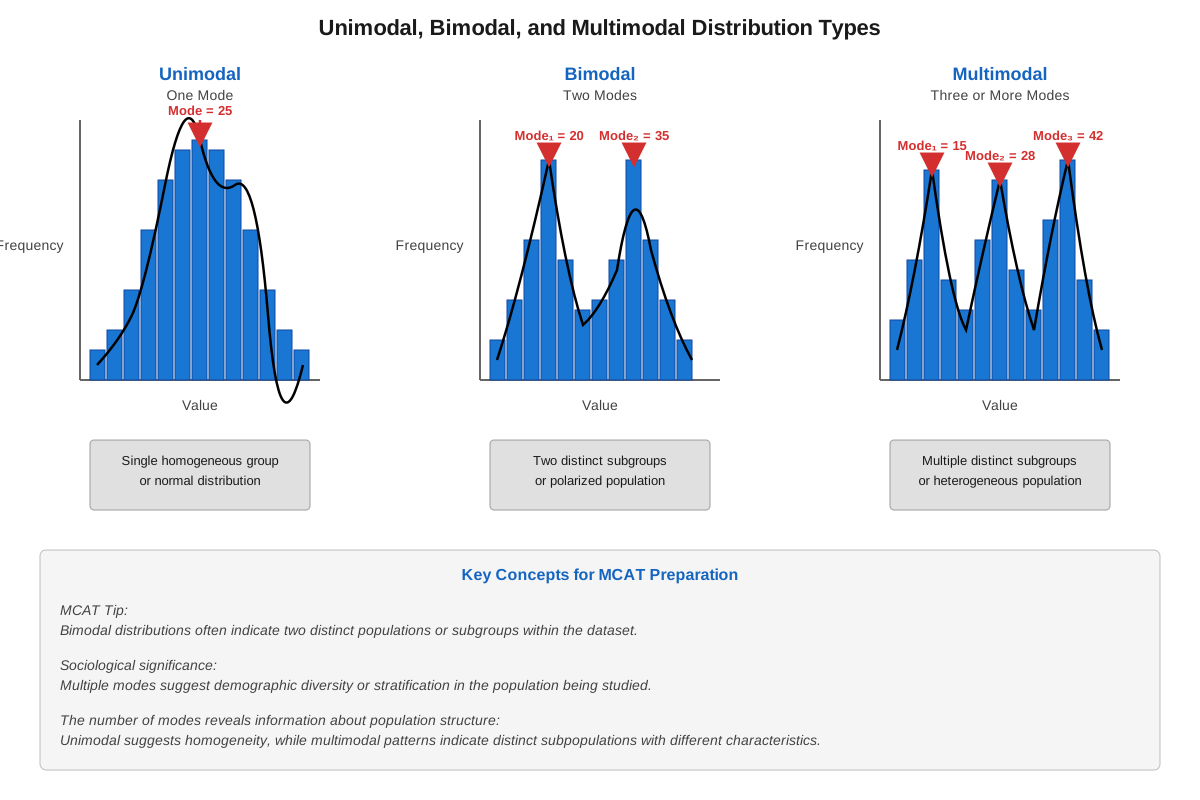
Unimodal distributions contain a single mode and represent populations with one dominant characteristic or response pattern. Most standardized test scores, heights within a single gender, and many naturally occurring phenomena follow unimodal distributions. In sociological research, a unimodal distribution of political attitudes might suggest a relatively homogeneous population with consensus around certain values.
Bimodal distributions contain two distinct modes and often indicate the presence of two separate subgroups within the population. For example, a bimodal distribution of income might reveal distinct working-class and upper-class populations with few middle-income individuals. Bimodal distributions are particularly important in sociology because they can reveal social stratification, gender differences, or other meaningful population divisions that might be obscured by examining only the mean or median.
Multimodal distributions contain three or more modes and suggest even greater population heterogeneity. These distributions are less common but may appear when analyzing diverse populations with multiple distinct subgroups. A multimodal distribution of religious service attendance might reflect different religious traditions with varying practices (e.g., weekly Christian services, daily Muslim prayers, and secular non-attendance).
Mode Across Different Levels of Measurement
The mode's applicability across all measurement levels represents one of its most valuable properties:
| Measurement Level | Mode Applicability | Example |
|---|---|---|
| Nominal | Fully applicable; often the ONLY appropriate measure | Most common religious affiliation in a sample |
| Ordinal | Fully applicable; preserves rank order | Most frequent education level (high school, bachelor's, etc.) |
| Interval | Applicable but may be less informative than mean | Most common temperature reading |
| Ratio | Applicable but often supplemented with mean/median | Most common number of children per family |
For nominal data, which consists of categories without inherent order (gender, ethnicity, political party), the mode is the only measure of central tendency that makes logical sense. One cannot calculate a meaningful "average" gender or "middle" religious affiliation, but identifying the most common category provides valuable descriptive information.
For ordinal data, which has ordered categories but unequal intervals (education levels, Likert scale responses), the mode identifies the most frequent rank or category. While the median can also be used with ordinal data, the mode may be more informative when the distribution is not symmetric.
For interval and ratio data, which have equal intervals and (in the case of ratio data) a true zero point, the mode can be calculated but may be less informative than the mean or median, particularly when the data is continuous and values rarely repeat exactly. However, the mode remains valuable for identifying the most typical value and for describing distributions with multiple peaks.
Advantages and Limitations of the Mode
The mode offers several distinct advantages in statistical analysis. It is easy to understand and communicate, making it accessible to non-technical audiences. It is unaffected by extreme values or outliers, unlike the mean which can be dramatically skewed by a single extreme observation. It works with any data type, including categorical data where other measures fail. It identifies the most typical or common value, which may be more practically useful than an average that no actual observation matches.
However, the mode also has important limitations that MCAT test-takers must recognize. It may not exist if all values appear with equal frequency, leaving researchers without a measure of central tendency. It may not be unique, with multiple modes making interpretation more complex. It ignores most of the data, focusing only on frequency rather than considering the magnitude of values. It can be unstable in small samples, where adding or removing a single observation might change the mode entirely. It provides no information about spread or variability, requiring supplementation with measures of dispersion.
Mode in Research Contexts
In survey research, the mode frequently represents the most common response to questions about preferences, behaviors, or attitudes. When researchers report that "the modal response was 'agree,'" they indicate that more respondents selected "agree" than any other option. This information helps identify dominant opinions or typical behaviors within a population.
In demographic analysis, the mode describes the most common characteristics of populations. Census reports might identify the modal age group, household size, or occupational category. These modal values help policymakers and researchers understand typical population characteristics and plan accordingly.
In experimental research, the mode can identify the most frequent outcome or response pattern. If an intervention study finds that the modal number of therapy sessions attended is zero, this suggests a serious engagement problem despite what the mean attendance might indicate.
Concept Relationships
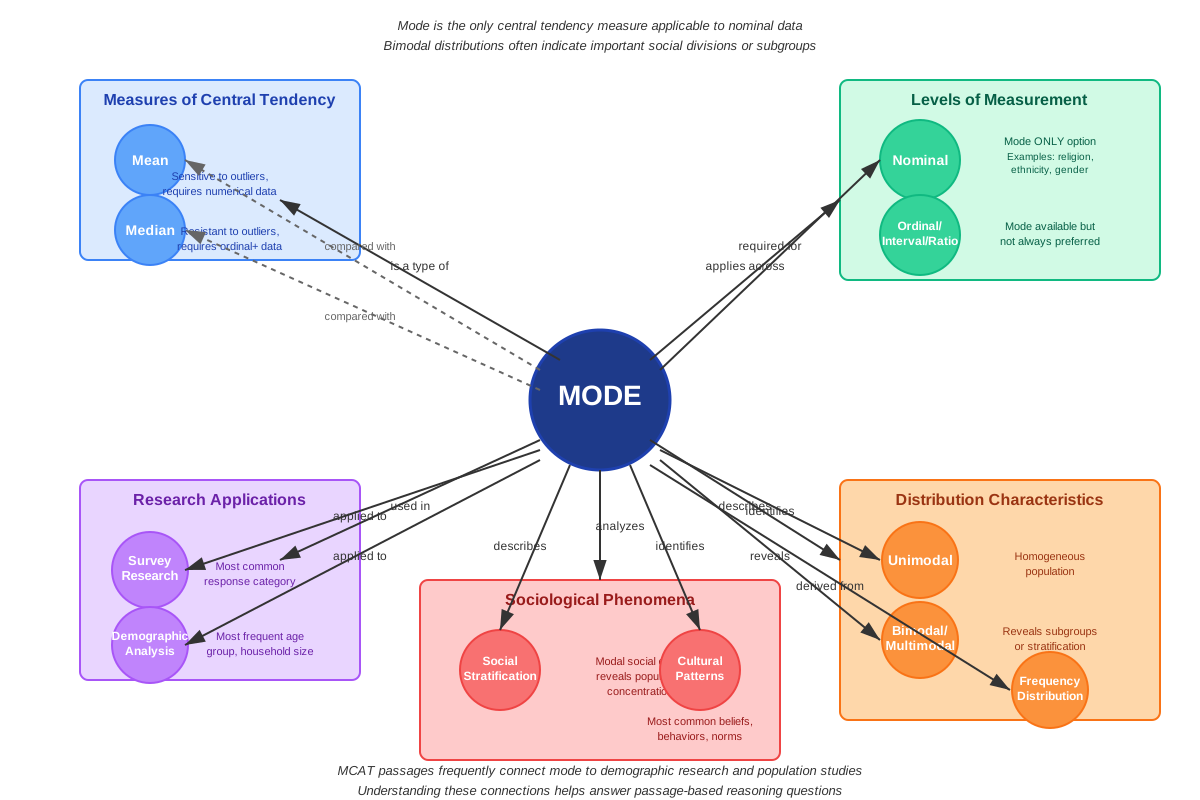
The mode exists within a broader framework of descriptive statistics and connects to multiple related concepts. The mode, mean, and median form the three primary measures of central tendency, each providing different information about the "typical" value in a dataset. These three measures relate to each other in predictable ways depending on the distribution's shape: in perfectly symmetric distributions, all three measures converge at the same value; in right-skewed distributions, the mode < median < mean; in left-skewed distributions, the mean < median < mode.
The mode connects directly to frequency distributions, as identifying the mode requires counting how often each value appears. Frequency tables and histograms visually represent these counts, with the mode corresponding to the tallest bar or highest frequency count. This relationship means that understanding how to read frequency distributions is prerequisite to identifying modes in MCAT passages.
The concept of modality (unimodal, bimodal, multimodal) links to population heterogeneity and social stratification. Bimodal and multimodal distributions often signal the presence of distinct subgroups with different characteristics, which connects to sociological concepts of social class, demographic categories, and group differences. This relationship enables test-takers to make inferences about population structure based on distribution shape.
The mode's applicability across measurement levels connects it to research design and variable selection. Researchers must choose appropriate statistical measures based on their data type, and recognizing when the mode is the only appropriate measure (nominal data) or when it provides unique insights (identifying typical categories) is essential for valid statistical inference.
Relationship Map:
Data Collection → Frequency Distribution → Mode Identification → Distribution Classification (unimodal/bimodal/multimodal) → Population Structure Inference → Research Conclusions
Quick check — test yourself on Mode so far.
Try Flashcards →High-Yield Facts
⭐ The mode is the only measure of central tendency that can be applied to nominal (categorical) data
⭐ A dataset can have no mode, one mode, or multiple modes, unlike the mean and median which are always unique
⭐ Bimodal distributions often indicate the presence of two distinct subgroups within a population
⭐ The mode is unaffected by extreme values or outliers, making it robust in skewed distributions
⭐ In a perfectly symmetric, unimodal distribution, the mean, median, and mode are all equal
- The mode identifies the most frequently occurring value but provides no information about the magnitude of other values
- Multimodal distributions suggest population heterogeneity and may warrant subgroup analysis
- The mode can be determined from frequency tables, histograms, and raw data presentations
- When data is continuous with no repeated values, the mode may not exist or may be meaningless
- The mode is particularly useful for describing categorical variables like religious affiliation, political party, or diagnostic category
Common Misconceptions
Misconception: The mode is always the best measure of central tendency to use.
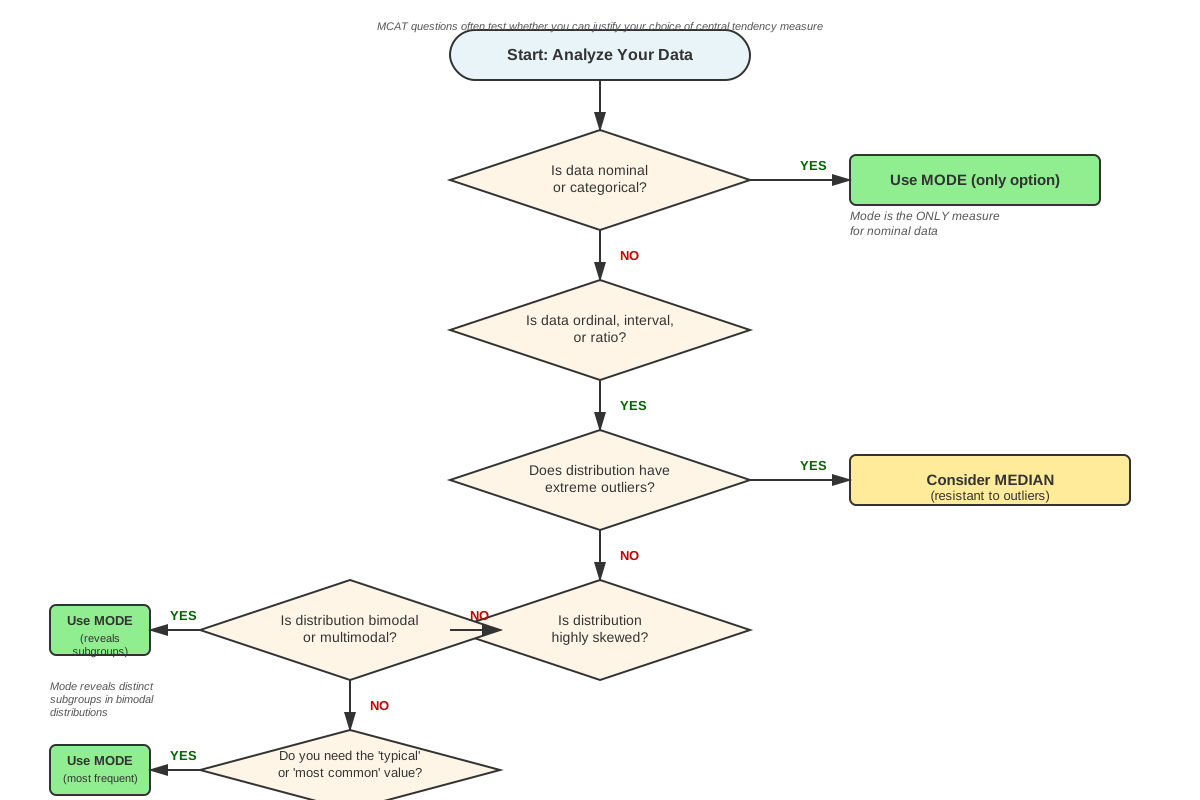
Correction: The mode is most appropriate for nominal data and when identifying the most typical category is important, but the mean or median may be more informative for interval and ratio data, particularly when the distribution is symmetric and unimodal.
Misconception: Every dataset has exactly one mode.
Correction: Datasets can have no mode (all values equally frequent), one mode (unimodal), two modes (bimodal), or multiple modes (multimodal). The number of modes provides important information about population structure.
Misconception: The mode must be near the center of the distribution.
Correction: The mode simply identifies the most frequent value, which could be at either extreme of the distribution. In highly skewed distributions, the mode may be far from the mean or median.
Misconception: A bimodal distribution means there are exactly two values in the dataset.
Correction: Bimodal means there are two peaks or two values that appear with equal highest frequency, but the dataset contains many other values as well. Bimodality describes the distribution's shape, not the number of unique values.
Misconception: The mode and the mean are interchangeable terms.
Correction: The mode is the most frequent value, while the mean is the arithmetic average. These are distinct measures that often yield different values and serve different analytical purposes. The mode can be used with any data type, while the mean requires numerical data.
Misconception: If the mode is 5, then 5 appears in the dataset more than 50% of the time.
Correction: The mode is simply the most frequent value relative to other values; it does not need to appear in the majority of observations. In a dataset with many different values, the mode might appear in only 10-15% of cases but still be more frequent than any other single value.
Worked Examples
Example 1: Identifying Mode from Survey Data
Question: A sociologist surveys 50 college students about their primary stress-coping mechanism and obtains the following results: Exercise (18 students), Social support (15 students), Meditation (8 students), Substance use (5 students), Avoidance (4 students). What is the mode, and why is it the appropriate measure of central tendency for this data?
Solution:
Step 1: Identify the data type. The variable "primary stress-coping mechanism" is nominal (categorical) data because the categories have no inherent numerical order or ranking.
Step 2: Count the frequency of each category:
- Exercise: 18
- Social support: 15
- Meditation: 8
- Substance use: 5
- Avoidance: 4
Step 3: Identify the most frequent category. Exercise appears most frequently with 18 students selecting it.
Step 4: State the mode. The mode is "Exercise."
Step 5: Justify why the mode is appropriate. Because this is nominal data, neither the mean nor median can be calculated (one cannot average categories or find a middle category when there is no inherent order). The mode is the only measure of central tendency that can be applied to nominal data, making it not just appropriate but necessary for describing the central tendency of this distribution.
Connection to Learning Objectives: This example demonstrates how to define and calculate the mode, apply it to exam-style data, and connect it to the broader concept of measurement levels in research methods.
Example 2: Interpreting Bimodal Distribution
Question: Researchers measure the age at which individuals in a community first marry and create a histogram showing the distribution. The histogram reveals two distinct peaks: one at age 22 and another at age 38. Both ages appear with equal frequency (n=45 each), while all other ages appear less frequently. What does this bimodal distribution suggest about the population, and how should researchers interpret this finding?
Solution:
Step 1: Identify the distribution type. The presence of two distinct peaks with equal frequency indicates a bimodal distribution with modes at ages 22 and 38.
Step 2: State both modes. The distribution has two modes: 22 years and 38 years.
Step 3: Interpret the sociological significance. A bimodal distribution of marriage age suggests the presence of two distinct subgroups within the population with different marriage patterns. This could indicate:
- A population containing both traditional early-marriage individuals and those who delay marriage for career or education
- Possible cohort effects, with different generations following different marriage timing norms
- Cultural or socioeconomic divisions within the community
Step 4: Consider research implications. The bimodal distribution suggests that reporting only the mean marriage age (which would be approximately 30) would be misleading because it represents neither group well. The mean would fall between the two peaks where relatively few people actually marry. Researchers should analyze the two subgroups separately to understand factors associated with each marriage timing pattern.
Step 5: Connect to broader concepts. This example illustrates how the mode connects to concepts of social stratification, population heterogeneity, and the importance of examining distribution shape rather than relying solely on measures of central tendency.
Connection to Learning Objectives: This example demonstrates how to identify and interpret multiple modes, recognize common mistakes (over-relying on the mean), and connect the mode to broader sociological concepts about population structure and social patterns.
Exam Strategy
When approaching MCAT questions involving the mode, begin by identifying the level of measurement of the variable in question. If the data is nominal (categories without order), the mode is likely the correct answer for any question asking about central tendency. This recognition can quickly eliminate incorrect answer choices that reference the mean or median.
Trigger words and phrases that signal mode-related questions include: "most common," "most frequent," "typical," "predominant," "modal response," and "which category appeared most often." When passages describe survey results or demographic data, watch for these phrases as indicators that you'll need to identify or interpret modal values.
For questions presenting frequency distributions or histograms, quickly scan for the tallest bar or highest frequency count—this represents the mode. Be cautious with continuous data where multiple values might appear with equal low frequency; in such cases, the mode may not be meaningful or may not exist. If answer choices include "the mode cannot be determined" or "no mode exists," consider whether all values appear with equal frequency.
When questions ask you to compare measures of central tendency, remember the relationship between mean, median, and mode in different distribution shapes:
- Symmetric distribution: mean = median = mode
- Right-skewed distribution: mode < median < mean
- Left-skewed distribution: mean < median < mode
Use process of elimination by recognizing that the mode must be an actual value that appears in the dataset, while the mean and median might be values that don't actually occur. If an answer choice presents a value that couldn't possibly appear in the dataset (e.g., 2.7 children when only whole numbers are possible), it cannot be the mode.
Time allocation: Mode questions are typically straightforward and should take 30-60 seconds once you've identified the relevant data. Don't overthink these questions—if you're spending more than a minute, you may be missing a simple pattern or misunderstanding what the question asks.
Memory Techniques
Mnemonic for when to use the mode: "Mode for Most common" - The mode identifies the most frequently occurring value, making it ideal when you want to know what's most typical or common.
Mnemonic for distribution relationships: "Mean Moves Most" - In skewed distributions, the mean is pulled most strongly toward the tail, followed by the median, while the mode stays at the peak. This helps remember the order: mode < median < mean (right skew) or mean < median < mode (left skew).
Visualization strategy: Picture a histogram or bar chart when thinking about the mode. The mode is always the tallest bar—the peak of the distribution. This visual makes it easy to identify modes and recognize bimodal distributions (two tall bars) versus unimodal distributions (one tall bar).
Acronym for mode advantages: "NEAT"
- Nominal data compatible
- Easy to understand
- Any data type works
- Tolerant of outliers
Memory aid for modality types: "Unicycle has 1 wheel = Unimodal has 1 mode; Bicycle has 2 wheels = Bimodal has 2 modes; Multi-wheel vehicle = Multimodal distribution"
Summary
The mode represents the most frequently occurring value in a dataset and serves as one of three primary measures of central tendency alongside the mean and median. Its unique applicability to all levels of measurement, including nominal data, makes it indispensable for sociological research involving categorical variables. The mode provides robust information about typical values without being influenced by extreme observations, though it may not exist in all datasets and can appear multiple times in bimodal or multimodal distributions. Understanding the mode enables MCAT test-takers to correctly interpret research findings, recognize appropriate statistical measures for different data types, and make inferences about population structure based on distribution shape. The presence of multiple modes often signals population heterogeneity and the existence of distinct subgroups, connecting statistical analysis to broader sociological concepts of social stratification and demographic diversity. Mastery of the mode requires recognizing when it provides more meaningful information than other measures of central tendency and understanding its limitations in describing data distributions.
Key Takeaways
- The mode is the only measure of central tendency applicable to nominal (categorical) data, making it essential for analyzing many sociological variables
- Datasets can have zero, one, or multiple modes; the number of modes provides important information about population structure and heterogeneity
- Bimodal and multimodal distributions often indicate distinct subgroups within a population, connecting to concepts of social stratification and demographic diversity
- The mode is unaffected by outliers and extreme values, providing a robust measure of the most typical value in skewed distributions
- In symmetric distributions, the mean, median, and mode converge; in skewed distributions, they diverge in predictable patterns
- The mode must be an actual value that appears in the dataset, unlike the mean or median which may represent values that don't actually occur
- Understanding when to use the mode versus other measures of central tendency is critical for correctly interpreting research findings on the MCAT
Related Topics
Measures of Central Tendency (Mean and Median): Understanding how the mode compares to and complements the mean and median provides a complete picture of data distribution. Mastering the mode enables more sophisticated analysis of when each measure is most appropriate.
Measures of Dispersion (Range, Variance, Standard Deviation): While the mode describes central tendency, measures of dispersion describe data spread. Together, these provide comprehensive descriptive statistics for any dataset.
Frequency Distributions and Histograms: Visual representations of data directly display modal values through peak heights. Understanding these graphical methods enhances mode identification skills.
Levels of Measurement: The mode's unique applicability across all measurement levels (nominal, ordinal, interval, ratio) makes understanding these levels essential for selecting appropriate statistical measures.
Sampling and Population Parameters: The mode of a sample estimates the population mode, connecting descriptive statistics to inferential statistics and research generalizability.
Practice CTA
Now that you've mastered the concept of mode and its applications in sociological research, test your understanding with practice questions and flashcards. Focus on identifying modes from various data presentations, distinguishing between unimodal and multimodal distributions, and recognizing when the mode provides more meaningful information than other measures of central tendency. Remember that consistent practice with exam-style questions is the key to achieving confidence and speed on test day. You've built a strong foundation—now reinforce it through active application!
Sign up free to keep reading
Create a free AnvayaPrep account to finish this MCAT guide on Mode — plus flashcards and practice questions.