Overview
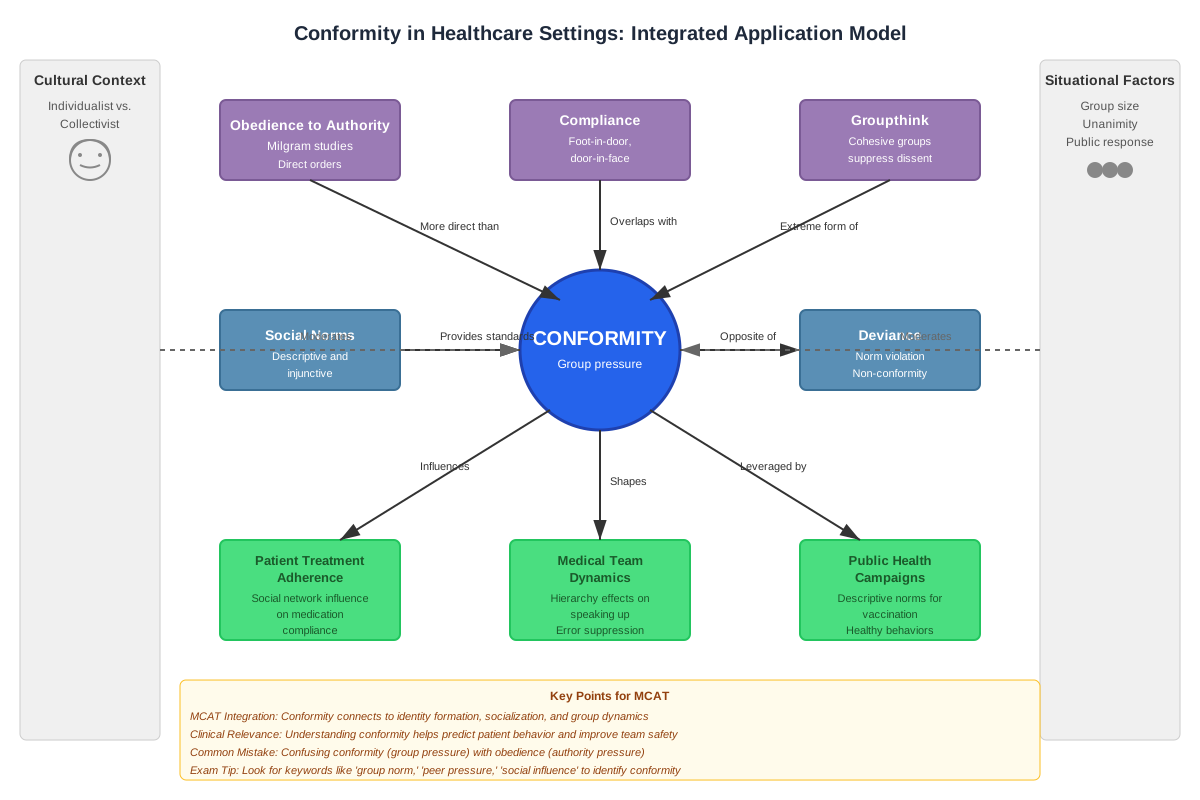
Conformity is a fundamental concept in Sociology that describes the process by which individuals adjust their attitudes, beliefs, or behaviors to align with group norms or social expectations. This phenomenon represents one of the most powerful forces shaping human Social Interaction and Identity, influencing everything from fashion choices to moral decisions. Understanding conformity is essential for comprehending how social pressures operate in healthcare settings, patient compliance, group dynamics in medical teams, and public health campaigns.
For the MCAT, Conformity Sociology appears frequently in the Psychological, Social, and Biological Foundations of Behavior section, particularly within passages examining group behavior, social influence, and identity formation. The exam tests not only definitional knowledge but also the ability to distinguish between different types of conformity, identify the factors that increase or decrease conforming behavior, and apply these concepts to experimental scenarios and real-world situations. Questions may present research studies examining peer pressure, cultural adaptation, or organizational behavior, requiring students to analyze variables affecting conformity rates.
Conformity MCAT questions integrate seamlessly with broader themes in Social Interaction and Identity, including socialization, group dynamics, social norms, deviance, and cultural transmission. Mastering conformity provides the foundation for understanding more complex phenomena such as groupthink, obedience to authority, social facilitation, and the formation of collective identity. This topic bridges individual psychology with sociological analysis, making it a high-yield area where interdisciplinary thinking is rewarded.
Learning Objectives
- [ ] Define Conformity using accurate Sociology terminology
- [ ] Explain why Conformity matters for the MCAT
- [ ] Apply Conformity to exam-style questions
- [ ] Identify common mistakes related to Conformity
- [ ] Connect Conformity to related Sociology concepts
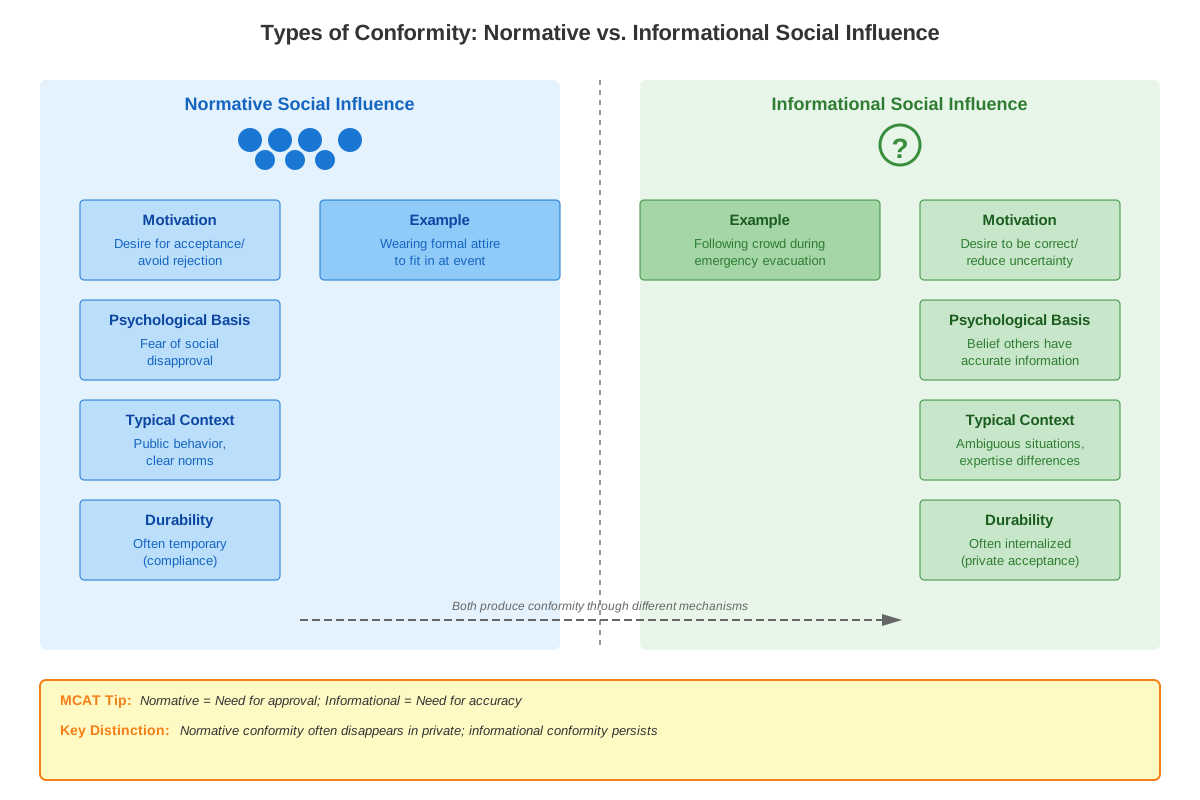
- [ ] Distinguish between normative and informational social influence
- [ ] Analyze factors that increase or decrease conformity in various contexts
- [ ] Evaluate classic conformity experiments and their implications for modern healthcare settings
Prerequisites
- Social norms: Understanding the difference between formal and informal rules governing behavior is essential because conformity represents adherence to these norms
- Group dynamics: Basic knowledge of how groups form and function provides context for why individuals feel pressure to conform
- Socialization: Familiarity with how individuals learn cultural values helps explain the developmental origins of conforming behavior
- Identity formation: Understanding how self-concept develops clarifies why conformity can threaten or reinforce personal identity
Why This Topic Matters
Clinical and Real-World Significance
Conformity profoundly impacts healthcare delivery and patient outcomes. Medical professionals must recognize how conformity influences patient adherence to treatment regimens, particularly when social networks either support or undermine medical advice. Physicians working with adolescents encounter conformity pressures related to substance use, sexual behavior, and risk-taking. Public health campaigns leverage conformity by establishing new social norms around vaccination, smoking cessation, and healthy eating. Within medical teams, conformity can promote standardized protocols but may also suppress dissenting opinions that could prevent medical errors.
Exam Statistics and Question Types
Conformity appears in approximately 8-12% of MCAT Sociology questions, making it a high-yield topic. Questions typically fall into three categories: (1) passage-based questions describing conformity experiments requiring interpretation of methodology and results, (2) discrete questions testing definitional knowledge and the ability to distinguish conformity from related concepts, and (3) application questions presenting scenarios where students must identify factors affecting conformity or predict behavioral outcomes. The MCAT particularly favors questions that integrate conformity with cultural differences, identity development, or group decision-making.
Common Exam Passage Contexts
MCAT passages frequently present conformity through: classic experiments (Asch line studies, Sherif's autokinetic effect), cross-cultural comparisons of conformity rates, healthcare compliance studies, organizational behavior in medical settings, adolescent peer influence research, social media and online behavior studies, and public health intervention evaluations. Recognizing these contexts allows rapid identification of conformity as the central concept being tested.
Core Concepts
Definition and Types of Conformity
Conformity is the act of matching attitudes, beliefs, and behaviors to group norms or expectations. Unlike obedience, which involves following direct commands from authority figures, conformity occurs in response to implicit or explicit group pressure without direct orders. The concept encompasses both conscious decisions to fit in and unconscious adoption of group standards.
Conformity manifests in two primary forms based on underlying motivation:
Normative social influence occurs when individuals conform to gain social approval or avoid social rejection. This type of conformity is driven by the desire to be liked, accepted, or to avoid standing out negatively. The individual may privately disagree with the group but publicly complies. For example, a medical student might laugh at jokes they find offensive to fit in with peers, or a patient might claim to follow dietary restrictions to please their physician while privately not adhering.
Informational social influence occurs when individuals conform because they believe the group possesses accurate information or superior judgment. This type reflects genuine belief change, not just public compliance. When facing ambiguous situations or lacking confidence in personal judgment, individuals look to others for guidance. A new nurse might adopt senior nurses' patient care techniques believing their experience provides valid information, or a patient might choose a treatment because "everyone says it works."
Levels of Conformity
Conformity operates at different depths of acceptance:
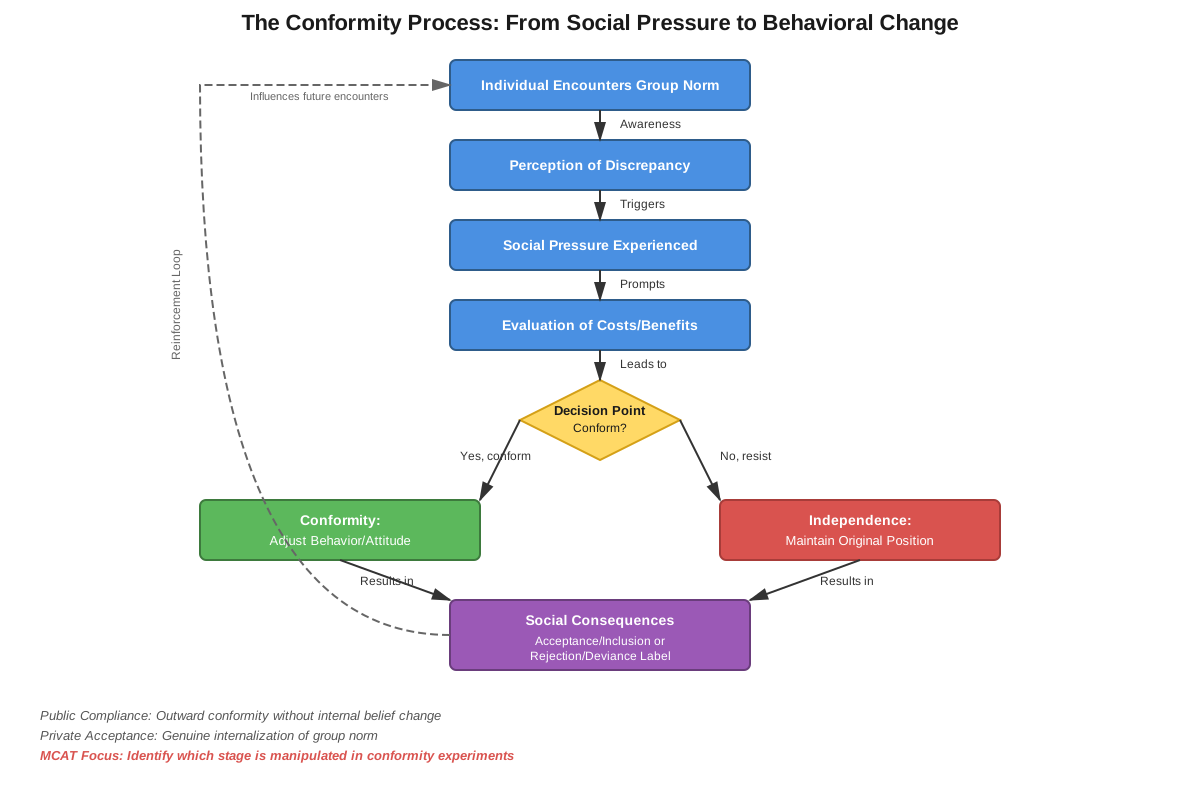
Compliance represents the shallowest level—publicly conforming while privately maintaining different beliefs. The behavior changes but attitudes remain unchanged. This temporary conformity disappears when group surveillance ends.
Identification occurs when individuals adopt group behaviors because they value membership in that group. The person conforms to maintain a satisfying relationship with the group or individual. Medical students might adopt the communication style of admired attending physicians.
Internalization represents the deepest level—genuine acceptance of group norms as personally valid. The individual's private beliefs align with public behavior, and conformity persists even without group presence. A physician who initially followed evidence-based guidelines due to institutional pressure might internalize these practices after witnessing positive patient outcomes.
Classic Conformity Research
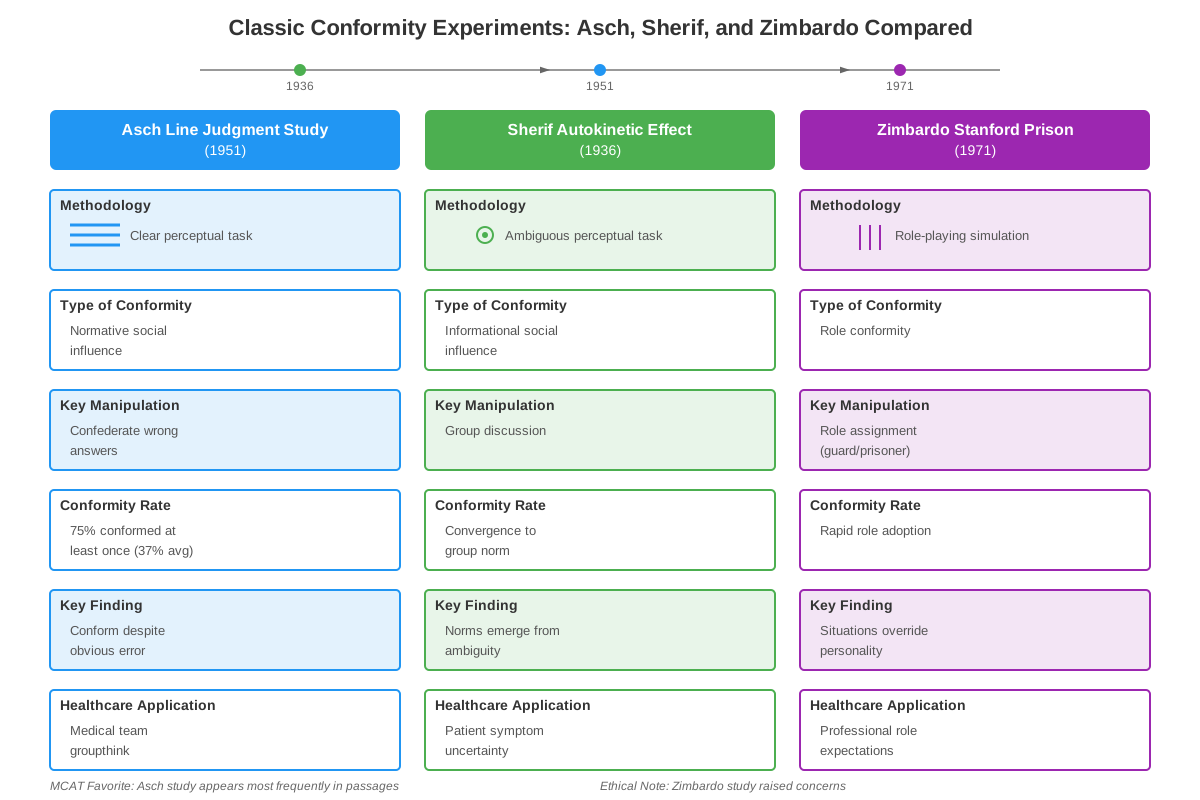
Solomon Asch's line studies (1951-1956) demonstrated conformity in unambiguous situations. Participants judged which of three comparison lines matched a standard line's length. Confederate participants deliberately gave incorrect answers. Approximately 75% of participants conformed at least once, and about 33% of all responses conformed to the incorrect majority. This research revealed that conformity occurs even when the correct answer is obvious, primarily due to normative social influence.
Muzafer Sherif's autokinetic effect studies (1935) examined conformity in ambiguous situations. Participants estimated how far a stationary point of light appeared to move in a dark room (an optical illusion). Individual estimates varied widely initially, but when participants made judgments in groups, their estimates converged toward a group norm. This demonstrated informational social influence—people conform when uncertain, using others' judgments to define reality.
Factors Affecting Conformity Rates
Multiple variables systematically influence conformity likelihood:
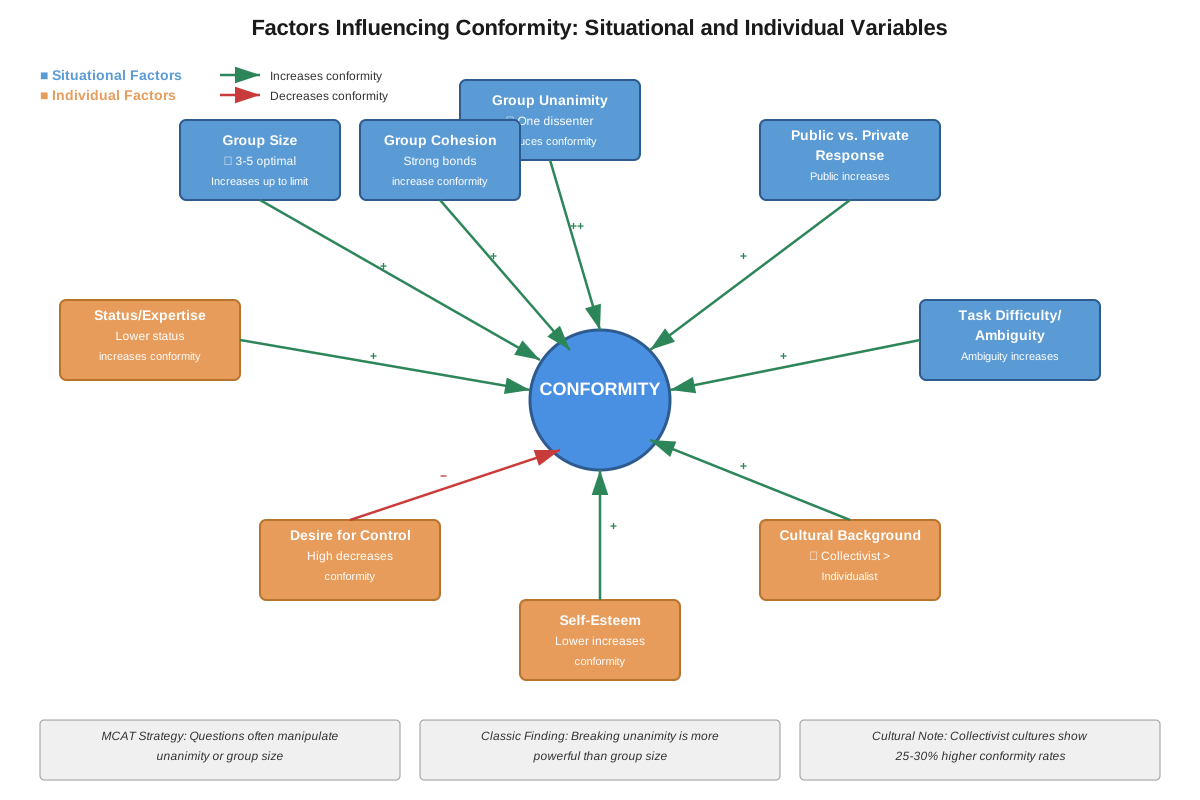
| Factor | Effect on Conformity | Mechanism |
|---|---|---|
| Group size | Increases up to 3-5 members, then plateaus | Larger groups provide more social pressure but diminishing returns occur |
| Unanimity | Decreases dramatically with even one dissenter | Breaking unanimity reduces normative pressure and validates non-conformity |
| Public vs. private response | Higher conformity when public | Normative influence requires visibility; private responses reduce social pressure |
| Task difficulty/ambiguity | Increases conformity | Informational influence strengthens when correct answer is unclear |
| Group cohesion | Increases conformity | Stronger bonds increase desire for acceptance and value of group opinion |
| Status/expertise | Increases conformity to high-status members | Informational influence stronger from perceived experts |
| Prior commitment | Decreases conformity | Public commitment to position creates consistency pressure |
| Cultural values | Collectivist cultures show higher conformity | Cultural emphasis on group harmony vs. individualism |
Self-esteem and self-confidence inversely correlate with conformity—individuals with lower self-esteem or less confidence in their judgment conform more readily. Gender shows minimal consistent effects in modern research, though earlier studies suggested women conformed more (likely reflecting historical power dynamics rather than inherent differences).
Cultural Dimensions of Conformity
Cross-cultural research reveals significant variation in conformity rates. Collectivist cultures (emphasizing group goals, interdependence, and social harmony) demonstrate higher conformity rates than individualist cultures (emphasizing personal goals, independence, and uniqueness). Studies replicating Asch's paradigm in various countries show conformity rates ranging from 14% in Belgium to 58% in Fiji.
This variation reflects different cultural values regarding the appropriate balance between individual expression and group cohesion. In collectivist societies, conformity represents a positive social value—maintaining harmony and fulfilling social obligations. In individualist societies, excessive conformity may be viewed negatively as lacking authenticity or independence. Healthcare providers must recognize these cultural differences when interpreting patient behavior and designing interventions.
Conformity vs. Related Concepts
Distinguishing conformity from similar phenomena is essential for MCAT success:
Obedience involves following direct commands from authority figures, whereas conformity responds to implicit group pressure from peers or equals. Stanley Milgram's famous experiments studied obedience, not conformity.
Compliance (in social psychology) refers to agreeing to requests, often involving specific persuasion techniques (foot-in-the-door, door-in-the-face). While compliance can be a level of conformity, the term also describes a broader category of social influence.
Groupthink represents a specific dysfunction where conformity pressures within cohesive groups suppress critical thinking and lead to poor decisions. Groupthink is a consequence of excessive conformity combined with other factors.
Social facilitation describes performance changes in the presence of others but doesn't necessarily involve matching group behavior—the core element of conformity.
Concept Relationships
Conformity serves as a central hub connecting multiple sociological concepts. Social norms provide the standards toward which conformity directs behavior—without established norms, conformity cannot occur. The relationship flows: social norms exist → individuals perceive these norms → conformity pressure emerges → behavior aligns with norms → norms are reinforced.
Socialization represents the developmental process through which conformity tendencies develop. Early socialization teaches children to recognize and respond to social expectations, creating the psychological foundation for later conformity. Primary socialization in families establishes baseline conformity patterns, while secondary socialization in schools and peer groups refines these tendencies.
Group dynamics and conformity interact bidirectionally. Group cohesion increases conformity, while conformity strengthens group cohesion by reducing internal conflict and establishing shared identity. Social identity theory explains this connection—individuals conform to in-group norms to maintain positive social identity and clear group boundaries.
Deviance represents the opposite of conformity—violating social norms rather than adhering to them. Understanding conformity illuminates why deviance is relatively rare and socially costly. The same factors that increase conformity (group cohesion, surveillance, sanctions) decrease deviance.
Cultural transmission relies heavily on conformity mechanisms. Cultural practices, values, and beliefs spread through populations as individuals conform to observed patterns. Informational social influence drives cultural learning, while normative social influence maintains cultural practices across generations.
The relationship map: Socialization → Conformity tendencies develop → Social norms provide standards → Group dynamics create pressure → Conformity occurs → Social identity strengthened → Cultural transmission achieved → Deviance suppressed → Social order maintained.
High-Yield Facts
⭐ Conformity is the act of matching attitudes, beliefs, and behaviors to group norms, occurring without direct commands from authority figures
⭐ Normative social influence drives conformity through desire for acceptance and fear of rejection, while informational social influence drives conformity through belief that the group possesses accurate information
⭐ Asch's line studies demonstrated that approximately 75% of participants conformed at least once even in unambiguous situations with obviously correct answers
⭐ Conformity increases with group size up to 3-5 members, then plateaus; even one dissenting voice dramatically reduces conformity rates
⭐ Collectivist cultures show significantly higher conformity rates than individualist cultures due to different values regarding group harmony versus individual expression
- Compliance represents public conformity without private belief change, identification involves conforming to maintain group relationships, and internalization represents genuine acceptance of group norms
- Sherif's autokinetic effect studies demonstrated that conformity increases in ambiguous situations where informational social influence is strongest
- Task difficulty and ambiguity increase conformity as individuals rely more heavily on others' judgments when uncertain
- Group cohesion and perceived expertise of group members both increase conformity rates
- Conformity differs from obedience (following direct authority commands), groupthink (dysfunctional decision-making from conformity pressure), and social facilitation (performance changes in others' presence)
Quick check — test yourself on Conformity so far.
Try Flashcards →Common Misconceptions
Misconception: Conformity always involves conscious decision-making and awareness of social pressure → Correction: Much conformity occurs automatically and unconsciously through informational social influence. Individuals often genuinely believe they are making independent judgments while actually being influenced by group norms. The internalization level of conformity involves complete acceptance without awareness of external influence.
Misconception: Conformity is inherently negative or represents weakness → Correction: Conformity serves essential social functions including coordination, cultural transmission, and social cohesion. In many contexts (following traffic laws, adopting evidence-based medical practices, maintaining hygiene standards), conformity produces positive outcomes. The MCAT tests neutral, scientific understanding of conformity, not moral judgments.
Misconception: Conformity and obedience are interchangeable terms → Correction: Conformity involves adjusting to peer or group pressure without direct commands, while obedience involves following explicit orders from authority figures. Asch studied conformity; Milgram studied obedience. The MCAT frequently tests this distinction through scenario-based questions.
Misconception: Only people with low self-esteem conform → Correction: While self-esteem correlates with conformity rates, even confident individuals conform under certain conditions (high group cohesion, ambiguous situations, unanimous groups, public responses). Situational factors often override personality variables in determining conformity.
Misconception: Conformity rates are consistent across all cultures → Correction: Cross-cultural research demonstrates substantial variation, with collectivist cultures showing conformity rates up to four times higher than individualist cultures. Cultural values regarding individualism versus collectivism fundamentally shape conformity tendencies. The MCAT often includes cultural context in conformity questions.
Misconception: Breaking group unanimity has minimal effect on conformity → Correction: Research consistently shows that even a single dissenting voice dramatically reduces conformity rates, often by 75% or more. This occurs because unanimity breaking reduces normative pressure (others won't conform either) and validates alternative judgments (informational influence).
Worked Examples
Example 1: Experimental Design Analysis
Passage Summary: Researchers investigated conformity in medical decision-making. Physicians reviewed patient cases and recommended treatments individually, then discussed cases in groups before making final recommendations. Researchers manipulated whether groups contained a senior physician who voiced an opinion first.
Question: The study found that when a senior physician spoke first, 68% of junior physicians changed their initial recommendations to match the senior physician's opinion, even when the senior physician's recommendation contradicted evidence-based guidelines. This finding best illustrates which concept?
A) Obedience to authority
B) Informational social influence
C) Groupthink
D) Social facilitation
Reasoning Process:
First, identify the core behavior: junior physicians changing their medical opinions to match a senior colleague's opinion. This involves adjusting behavior/beliefs to align with another person—the definition of conformity.
Next, distinguish between answer choices:
Choice A (Obedience): This would require the senior physician giving direct orders or commands. The passage states the senior physician "voiced an opinion," not issued commands. Eliminate.
Choice B (Informational social influence): This occurs when individuals conform because they believe others possess superior information or expertise. Junior physicians likely changed recommendations because they perceived the senior physician as having greater expertise and knowledge. The passage notes they changed opinions "even when contradicting evidence-based guidelines," suggesting they trusted the senior physician's judgment over their own initial assessment. This fits informational social influence.
Choice C (Groupthink): This requires a cohesive group suppressing dissent and critical thinking to maintain harmony. While conformity occurred, the passage doesn't indicate group cohesion, pressure to maintain unanimity, or suppression of alternatives. The behavior is better explained by deference to expertise.
Choice D (Social facilitation): This describes performance changes in others' presence, not matching others' opinions or behaviors. Eliminate.
Answer: B - The scenario exemplifies informational social influence, where junior physicians conformed to the senior physician's opinion due to perceived expertise, even overriding evidence-based guidelines.
Connection to Learning Objectives: This example demonstrates applying conformity concepts to exam-style questions, distinguishing between types of social influence, and connecting conformity to healthcare contexts.
Example 2: Factor Analysis
Scenario: A public health campaign aims to increase vaccination rates in a community with low uptake. Campaign designers are considering four strategies:
- Showing statistics that 85% of community members support vaccination
- Having individual conversations with community members in private
- Featuring testimonials from a single respected community leader
- Organizing small group discussions where participants publicly state their vaccination intentions
Question: Based on conformity research, rank these strategies from most to least likely to increase vaccination rates through conformity mechanisms.
Reasoning Process:
Analyze each strategy using conformity principles:
Strategy 1 (85% support statistics): This leverages both normative influence (most people approve, creating social pressure) and informational influence (majority opinion suggests vaccination is correct choice). The high percentage (85%) creates strong perceived group consensus. However, this is somewhat abstract and impersonal.
Strategy 2 (private individual conversations): Privacy eliminates normative social influence, which requires public visibility and concern about others' judgments. This strategy removes a major conformity mechanism. Least effective for conformity.
Strategy 3 (single respected leader): This provides informational influence through perceived expertise but lacks the group pressure element. One person, even respected, provides weaker conformity pressure than group consensus.
Strategy 4 (small group public statements): This combines multiple conformity-enhancing factors: public response (increases normative influence), group setting (creates social pressure), and public commitment (reduces later non-conformity). As participants hear others commit to vaccination, both normative and informational influence operate. Group size (small groups) is optimal for conformity.
Ranking: 4 > 1 > 3 > 2
Most effective (Strategy 4): Public group commitments maximize both normative and informational influence while creating optimal group size conditions.
Second (Strategy 1): Strong majority statistics create conformity pressure but lack the personal, interactive element of group settings.
Third (Strategy 3): Single authority provides informational influence but lacks group pressure and consensus.
Least effective (Strategy 2): Private settings eliminate normative influence, the primary driver of conformity.
Connection to Learning Objectives: This example applies conformity principles to real-world public health scenarios, analyzes factors affecting conformity rates, and demonstrates how multiple variables interact to influence conformity likelihood.
Exam Strategy
Question Recognition
MCAT conformity questions typically include trigger phrases: "group pressure," "matching behavior," "social norms," "peer influence," "going along with," "adjusting to fit in," or "following the crowd." Passages describing experiments with confederates, majority opinions, or group judgments almost always test conformity concepts. Watch for scenarios involving individuals changing opinions after group exposure or behaving differently in group versus individual settings.
Approach Process
- Identify the social influence type: First determine whether the question involves conformity (peer pressure), obedience (authority commands), or compliance (specific requests). This eliminates wrong answer categories immediately.
- Determine the conformity mechanism: Decide whether normative influence (desire for acceptance) or informational influence (belief in group accuracy) drives the behavior. Look for clues about motivation—fear of rejection suggests normative, uncertainty or ambiguity suggests informational.
- Analyze situational factors: Identify which variables are present (group size, unanimity, public/private response, task ambiguity, cultural context) and predict their effects on conformity rates.
- Consider depth of acceptance: Determine whether the scenario describes compliance (public only), identification (relationship-based), or internalization (genuine belief change).
Process of Elimination
When answers include both conformity and obedience options, check whether authority figures give direct commands (obedience) or peers create implicit pressure (conformity). Eliminate obedience if no commands exist.
When distinguishing normative from informational influence, eliminate informational if the situation is unambiguous with clearly correct answers (normative more likely). Eliminate normative if the scenario emphasizes uncertainty, ambiguity, or expertise (informational more likely).
For questions about factors affecting conformity, eliminate answers suggesting linear relationships beyond 3-5 group members (conformity plateaus) or answers claiming unanimity doesn't matter (it dramatically affects conformity).
Time Allocation
Conformity questions typically require 60-90 seconds. Definitional questions should take 45-60 seconds. Passage-based questions analyzing experimental results may require 90-120 seconds to identify variables and predict outcomes. Don't overthink—conformity questions usually test straightforward application of core principles rather than obscure details.
Exam Tip: If a question describes someone changing their opinion after hearing a group's consensus, and you must choose between normative and informational influence, look for emotional language (embarrassment, acceptance, rejection) suggesting normative influence versus cognitive language (uncertainty, correctness, accuracy) suggesting informational influence.
Memory Techniques
Normative vs. Informational Mnemonic
"NORMAL people want to FIT IN" - Normative influence is about being normal and fitting in socially (acceptance/rejection)
"INFORMATION helps when UNCERTAIN" - Informational influence provides information when you're uncertain about correctness
Asch vs. Sherif Distinction
"Asch had CLEAR lines" - Asch's study used clear, unambiguous stimuli, demonstrating normative influence (people conformed despite knowing the correct answer)
"Sherif's light was UNCLEAR" - Sherif's autokinetic effect was unclear and ambiguous, demonstrating informational influence (people genuinely didn't know the answer)
Conformity Factors Acronym: "CUPS"
Cohesion - Higher group cohesion increases conformity
Unanimity - Unanimous groups produce more conformity; breaking unanimity reduces it
Public - Public responses increase conformity more than private
Size - Group size increases conformity up to 3-5 members
Levels of Conformity: "CII"
Compliance - Changes behavior only (shallowest)
Identification - Identifies with group
Internalization - Internal belief change (deepest)
Visualize these as layers, with compliance on the surface and internalization at the core.
Visualization Strategy
Picture conformity as a magnetic force pulling individuals toward a group center. Factors that increase conformity strengthen the magnetic pull (larger magnet for cohesive groups, multiple magnets for larger groups). A dissenting voice acts as a shield blocking the magnetic force. This concrete image helps remember that conformity involves directional pressure toward group norms and that certain factors can block or enhance this pressure.
Summary
Conformity represents the fundamental sociological process by which individuals adjust their attitudes, beliefs, and behaviors to align with group norms and expectations. Operating through two primary mechanisms—normative social influence (driven by desire for acceptance) and informational social influence (driven by belief in group accuracy)—conformity shapes behavior across contexts from healthcare compliance to cultural transmission. Classic research by Asch and Sherif established that conformity occurs even in unambiguous situations and increases dramatically in ambiguous contexts. Multiple factors systematically affect conformity rates, including group size (optimal at 3-5 members), unanimity (dramatically reduced by even one dissenter), public versus private responses, task ambiguity, group cohesion, and cultural values. Collectivist cultures demonstrate significantly higher conformity than individualist cultures, reflecting different values regarding group harmony versus individual expression. For MCAT success, students must distinguish conformity from related concepts (particularly obedience), identify which type of social influence operates in given scenarios, and predict how situational variables affect conformity likelihood. Understanding conformity provides essential foundation for analyzing group dynamics, social identity, cultural processes, and healthcare behaviors.
Key Takeaways
- Conformity is adjusting attitudes, beliefs, or behaviors to match group norms without direct authority commands, operating through normative influence (desire for acceptance) or informational influence (belief in group accuracy)
- Asch's line studies demonstrated that 75% of participants conformed at least once even with obviously correct answers, revealing the power of normative social influence
- Conformity increases with group size up to 3-5 members then plateaus, decreases dramatically when unanimity breaks, and increases with public (versus private) responses and task ambiguity
- The three levels of conformity—compliance (public behavior change only), identification (conforming to maintain relationships), and internalization (genuine belief change)—represent increasing depths of acceptance
- Collectivist cultures show significantly higher conformity rates than individualist cultures due to different values regarding group harmony versus individual expression
- Distinguishing conformity from obedience (following authority commands), groupthink (dysfunctional group decision-making), and compliance (agreeing to requests) is essential for MCAT success
- Conformity serves as a central mechanism for socialization, cultural transmission, social cohesion, and maintenance of social order, connecting to broader themes in social interaction and identity
Related Topics
Obedience to Authority: While conformity involves peer pressure, obedience examines compliance with direct commands from authority figures. Milgram's famous experiments revealed disturbing levels of obedience. Understanding conformity provides contrast for analyzing obedience mechanisms and distinguishing these related but distinct phenomena.
Groupthink: This dysfunction occurs when conformity pressures within cohesive groups suppress critical thinking, leading to poor decisions. Mastering basic conformity concepts enables analysis of how excessive conformity combines with other factors (illusion of invulnerability, self-censorship) to produce groupthink.
Social Identity Theory: This framework explains how individuals derive self-concept from group memberships. Conformity to in-group norms strengthens social identity and maintains group boundaries. Understanding conformity mechanisms illuminates how social identities form and persist.
Cultural Dimensions: Hofstede's cultural dimensions, particularly individualism-collectivism, explain cross-cultural variation in conformity rates. Mastering conformity provides concrete examples of how abstract cultural values manifest in observable behavior.
Deviance and Social Control: As the opposite of conformity, deviance involves violating social norms. Understanding conformity mechanisms clarifies why deviance is relatively rare and how societies maintain social order through formal and informal sanctions.
Socialization: This developmental process establishes the psychological foundations for conformity. Understanding how conformity operates in adults illuminates the goals and mechanisms of childhood socialization.
Practice CTA
Now that you've mastered the core concepts of conformity, test your understanding with practice questions and flashcards. Focus on distinguishing normative from informational influence, identifying factors that increase or decrease conformity, and applying these principles to healthcare scenarios. Remember that conformity appears frequently on the MCAT, often integrated with passages about group dynamics, cultural differences, or medical decision-making. Your ability to quickly recognize conformity mechanisms and predict their effects will directly translate to points on test day. Challenge yourself with timed practice to build the speed and accuracy needed for MCAT success. You've built a strong foundation—now reinforce it through active application!
Sign up free to keep reading
Create a free AnvayaPrep account to finish this MCAT guide on Conformity — plus flashcards and practice questions.