Overview
Social behavior represents one of the foundational pillars of Sociology tested on the MCAT, encompassing the ways individuals act, react, and interact within social contexts. This topic examines how human behavior is shaped by the presence of others, social norms, group dynamics, and cultural expectations. Understanding social behavior is critical for medical professionals because patient care inherently involves navigating complex social interactions—from physician-patient communication to interdisciplinary team collaboration and understanding how social factors influence health outcomes. The MCAT Psychological, Social, and Biological Foundations of Behavior section dedicates substantial attention to social behavior because it bridges individual psychology with broader sociological phenomena.
Social behavior extends beyond simple interpersonal exchanges to include conformity, obedience, group decision-making, altruism, aggression, and the influence of social structures on individual actions. These concepts form the backbone of Social Interaction and Identity, helping explain how individuals develop their sense of self through social engagement and how society maintains order through shared behavioral expectations. The MCAT frequently tests social behavior through passage-based questions that present research studies, clinical scenarios, or theoretical frameworks requiring students to analyze human interactions through a sociological lens.
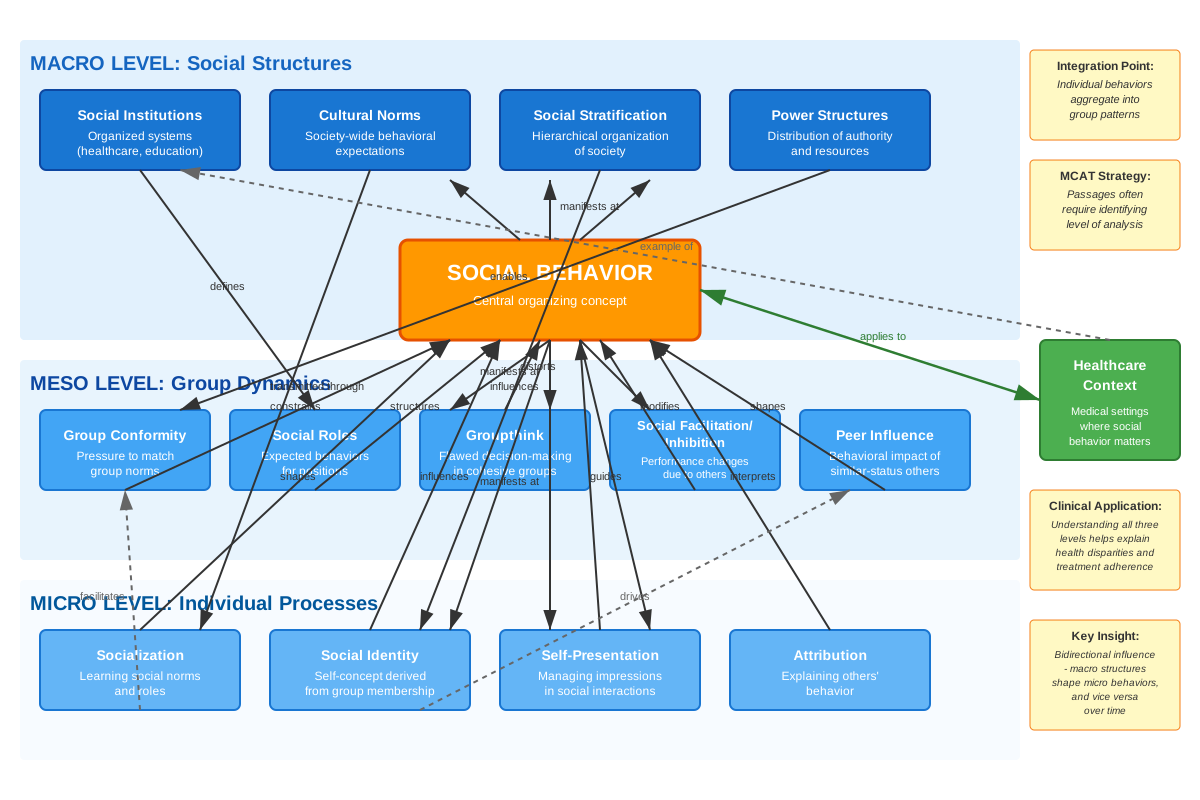
Mastery of social behavior connects directly to other high-yield MCAT topics including social identity theory, socialization, deviance, social institutions, and group dynamics. This topic serves as a conceptual bridge between micro-level psychological processes and macro-level sociological structures, making it essential for understanding how individual actions aggregate into social patterns and how social contexts shape individual choices. Students who thoroughly understand social behavior can more effectively analyze MCAT passages involving healthcare disparities, patient compliance, medical ethics, and public health interventions.
Learning Objectives
- [ ] Define Social behavior using accurate Sociology terminology
- [ ] Explain why Social behavior matters for the MCAT
- [ ] Apply Social behavior to exam-style questions
- [ ] Identify common mistakes related to Social behavior
- [ ] Connect Social behavior to related Sociology concepts
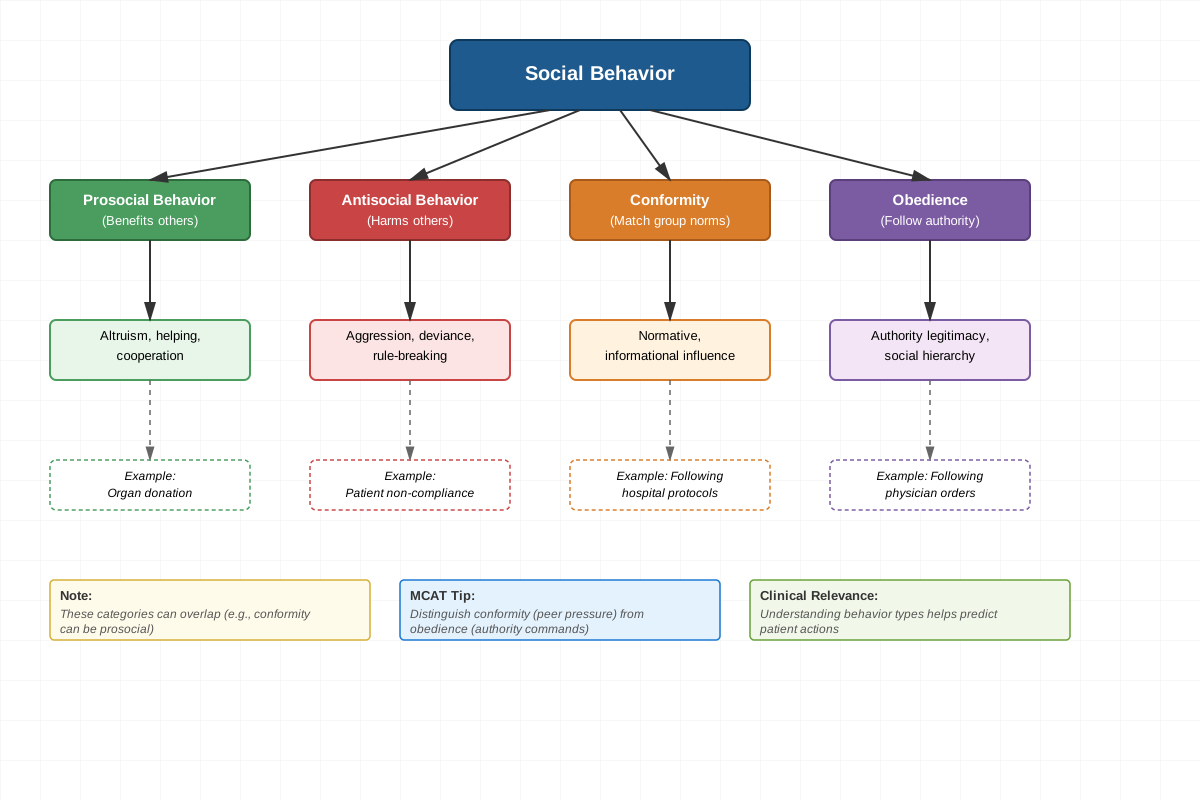
- [ ] Distinguish between different types of social behavior (prosocial, antisocial, conformity, obedience)
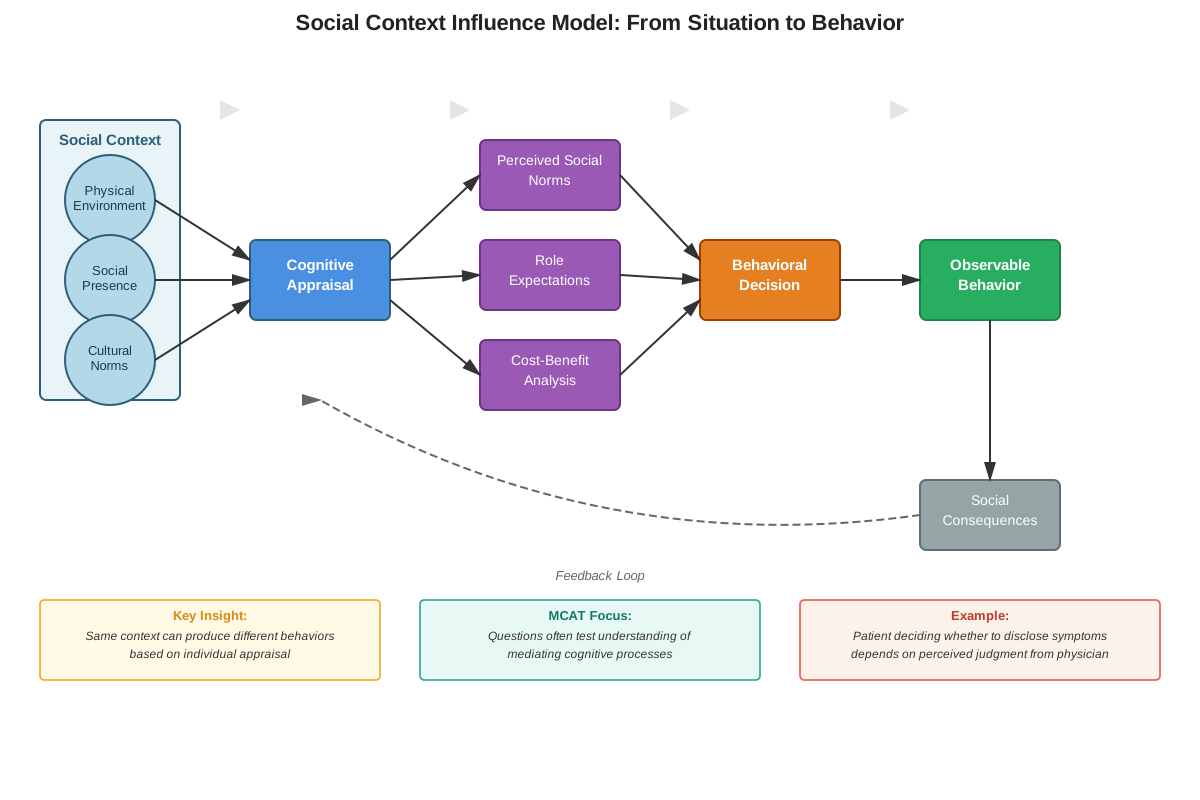
- [ ] Analyze how social context and situational factors influence behavioral choices
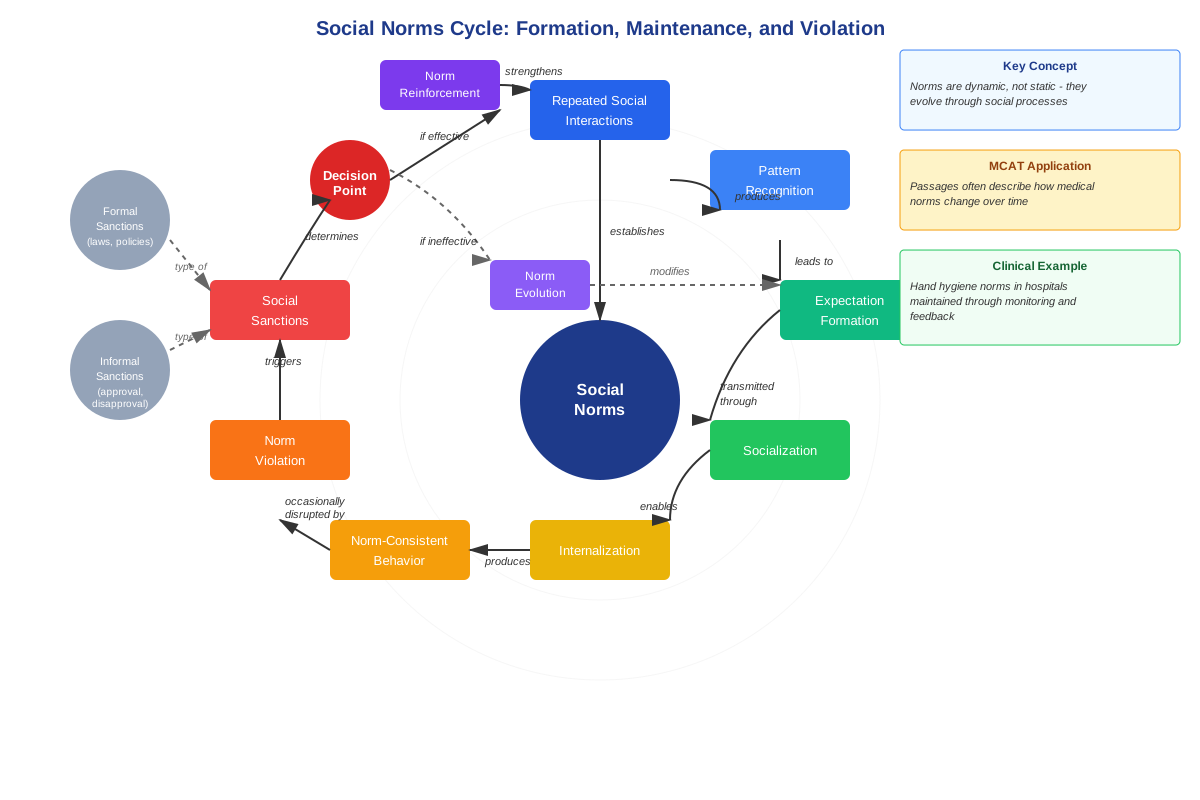
- [ ] Evaluate the role of social norms, roles, and expectations in shaping behavior patterns
Prerequisites
- Basic psychology concepts: Understanding individual cognition and motivation provides the foundation for examining how social contexts modify behavior
- Introduction to sociology: Familiarity with sociological perspective and the distinction between individual and social-level analysis is necessary
- Social structures: Knowledge of how societies organize themselves helps contextualize why certain behaviors emerge in specific settings
- Cultural concepts: Understanding culture as shared beliefs and practices explains variation in social behavior across groups
Why This Topic Matters
Social behavior is clinically significant because healthcare delivery occurs within complex social environments. Physicians must understand how patients' social contexts influence health behaviors, treatment adherence, and health outcomes. For example, recognizing how social support networks affect recovery rates or how cultural norms shape attitudes toward mental health treatment directly impacts clinical effectiveness. Medical professionals who understand social behavior can better navigate difficult conversations, build therapeutic alliances, and design interventions that account for social influences on health.
From an exam perspective, social behavior appears in approximately 15-20% of MCAT Psychological, Social, and Biological Foundations of Behavior questions, making it a high-yield topic. Questions typically present research studies examining conformity, obedience, helping behavior, or group dynamics, requiring students to identify independent and dependent variables, interpret results through sociological frameworks, or predict behavioral outcomes based on social psychological theories. The MCAT particularly favors questions that integrate social behavior with research methodology, asking students to evaluate study designs or identify confounding variables in social experiments.
Common passage types include classic social psychology experiments (Milgram obedience studies, Asch conformity experiments, bystander effect research), healthcare scenarios involving patient-provider interactions, and public health interventions targeting behavioral change. Discrete questions often test definitions, theoretical frameworks, or the ability to distinguish between related concepts like conformity versus obedience or altruism versus prosocial behavior. Understanding social behavior also enables students to tackle interdisciplinary questions that connect sociology with biology (evolutionary explanations for cooperation) or psychology (cognitive dissonance in social contexts).
Core Concepts
Definition and Scope of Social Behavior
Social behavior refers to any behavior that is influenced by or directed toward other individuals or groups. This encompasses actions performed in the presence of others, behaviors shaped by social norms and expectations, and interactions that involve communication or coordination between people. Social behavior exists on a continuum from simple social facilitation (performance changes due to others' presence) to complex collective action (coordinated group efforts toward shared goals).
The sociological study of social behavior examines patterns across populations rather than focusing solely on individual psychology. While psychology might ask "Why did this person help?", Sociology asks "Under what social conditions do people help?" This distinction is crucial for MCAT success, as questions often require identifying whether an explanation is psychological (individual-level) or sociological (social-level).
Types of Social Behavior
Prosocial behavior includes actions intended to benefit others, ranging from simple courtesy to significant self-sacrifice. This category encompasses helping behavior, cooperation, sharing, and volunteering. Altruism represents a specific subset of prosocial behavior characterized by selfless concern for others' welfare, even at personal cost. The MCAT distinguishes between prosocial behavior (which may have selfish motives) and pure altruism (which does not).
Antisocial behavior involves actions that violate social norms and potentially harm others, including aggression, deception, and criminal activity. Understanding antisocial behavior requires examining both individual factors (personality, mental health) and social factors (peer influence, social disorganization, strain from blocked opportunities).
Conformity occurs when individuals change their behavior or beliefs to match group norms, even without direct pressure. This can be normative conformity (changing behavior to fit in and be accepted) or informational conformity (changing beliefs because one assumes the group has better information). The Asch line judgment experiments demonstrate normative conformity, where participants gave obviously incorrect answers to match confederates' responses.
Obedience involves following direct commands from authority figures, even when those commands conflict with personal values. Milgram's famous experiments showed that ordinary people would administer apparently dangerous electric shocks when instructed by an authority figure, revealing the powerful influence of legitimate authority on behavior.
Social Influence Mechanisms
Social norms are unwritten rules governing acceptable behavior within groups or societies. Descriptive norms describe what most people actually do, while injunctive norms specify what people should do. For example, a descriptive norm might be "most students drink alcohol at parties" while the injunctive norm states "underage drinking is wrong." Health interventions often fail when they inadvertently strengthen descriptive norms (e.g., "many teens smoke") while trying to reinforce injunctive norms.
Social roles are sets of expectations associated with particular social positions (doctor, patient, parent, student). Role theory explains how people adopt behaviors consistent with their roles, sometimes leading to dramatic behavioral changes. The Stanford Prison Experiment illustrated how quickly people internalize role expectations, with participants assigned to "guard" roles becoming authoritarian despite no prior indication of such tendencies.
Social facilitation describes improved performance on simple or well-learned tasks when others are present, while social inhibition refers to impaired performance on complex or novel tasks in social settings. This occurs because others' presence increases physiological arousal, which enhances dominant responses (helping with easy tasks but interfering with difficult ones).
Group Dynamics and Collective Behavior
Groupthink occurs when cohesive groups prioritize consensus over critical evaluation, leading to poor decisions. Symptoms include illusions of invulnerability, collective rationalization, stereotyping of out-groups, self-censorship, and pressure on dissenters. Medical teams can fall victim to groupthink when hierarchical structures discourage junior members from questioning senior physicians' decisions.
Group polarization describes the tendency for group discussion to intensify initial attitudes, making groups more extreme than individual members were initially. If most group members lean toward a risky decision, discussion typically produces an even riskier group decision (risky shift). This has implications for understanding how social media echo chambers intensify political or health-related beliefs.
Social loafing refers to reduced individual effort when working in groups compared to working alone, particularly when individual contributions are not identifiable. This contrasts with situations where individual accountability is high or the task is personally meaningful, which can actually enhance motivation in group settings.
Deindividuation occurs when individuals in groups lose self-awareness and self-restraint, often leading to impulsive or deviant behavior. Factors promoting deindividuation include anonymity, arousal, and diffused responsibility. This explains behaviors ranging from mob violence to online trolling.
Helping Behavior and Bystander Effect
The bystander effect describes the phenomenon where individuals are less likely to help in emergencies when others are present. This occurs through diffusion of responsibility (assuming others will help), pluralistic ignorance (misinterpreting others' inaction as indicating no emergency exists), and evaluation apprehension (fear of being judged for helping incorrectly).
Latané and Darley's research identified five steps in the helping process: (1) noticing the event, (2) interpreting it as an emergency, (3) assuming personal responsibility, (4) knowing how to help, and (5) deciding to implement help. Bystanders may fail to help if any step is blocked. Medical implications include understanding why patients may not seek help despite symptoms or why healthcare workers might not report safety concerns.
Aggression and Antisocial Behavior
Aggression involves behavior intended to harm others, categorized as hostile aggression (driven by anger with harm as the goal) or instrumental aggression (harm as a means to another goal). Social factors influencing aggression include frustration (frustration-aggression hypothesis), social learning (observing and imitating aggressive models), deindividuation, and cultural norms regarding acceptable violence.
The social learning theory of aggression, developed by Bandura, emphasizes that people learn aggressive behaviors through observation and reinforcement. The famous Bobo doll experiments demonstrated that children imitate aggressive behaviors they observe in adults, particularly when those behaviors are rewarded or go unpunished.
Cooperation and Competition
Cooperation involves working together toward shared goals, while competition involves working against others for scarce resources. Social dilemmas like the prisoner's dilemma and tragedy of the commons illustrate tensions between individual and collective interests. Understanding these dynamics helps explain public health challenges like vaccination (individual risk versus collective immunity) or antibiotic overuse (individual benefit versus collective resistance development).
Reciprocal altruism explains cooperation through the expectation of future reciprocation, while kin selection explains helping behavior toward genetic relatives as evolutionarily advantageous. These concepts bridge biological and sociological explanations for prosocial behavior.
Concept Relationships
Social behavior concepts form an interconnected network where understanding one facilitates understanding others. Social norms serve as the foundation for conformity and obedience, as individuals adjust behavior to match expectations. When social norms are internalized through social roles, they guide behavior even without external pressure. Group dynamics emerge from individual social behaviors aggregating in collective settings—groupthink represents excessive conformity within cohesive groups, while group polarization shows how social interaction intensifies initial tendencies.
The bystander effect connects to diffusion of responsibility and social influence, demonstrating how others' presence paradoxically inhibits helping behavior. This relates to deindividuation, where group contexts reduce individual accountability and self-awareness. Both phenomena show how social contexts can override individual moral inclinations.
Prosocial behavior and aggression represent opposite ends of the social behavior spectrum, yet both are influenced by similar factors: social learning, situational contexts, and cultural norms. Understanding social facilitation and social inhibition helps explain performance variations in group settings, connecting to broader themes of how others' presence affects behavior.
These concepts link to prerequisite knowledge of socialization (how individuals learn social norms), social identity (how group membership shapes behavior), and social structures (how institutions create contexts for specific behaviors). They also connect forward to topics like deviance (violation of social norms), collective behavior (crowd dynamics), and social movements (coordinated action for change).
Quick check — test yourself on Social behavior so far.
Try Flashcards →High-Yield Facts
⭐ Social behavior is defined as any behavior influenced by or directed toward others, distinguishing it from purely individual psychological processes.
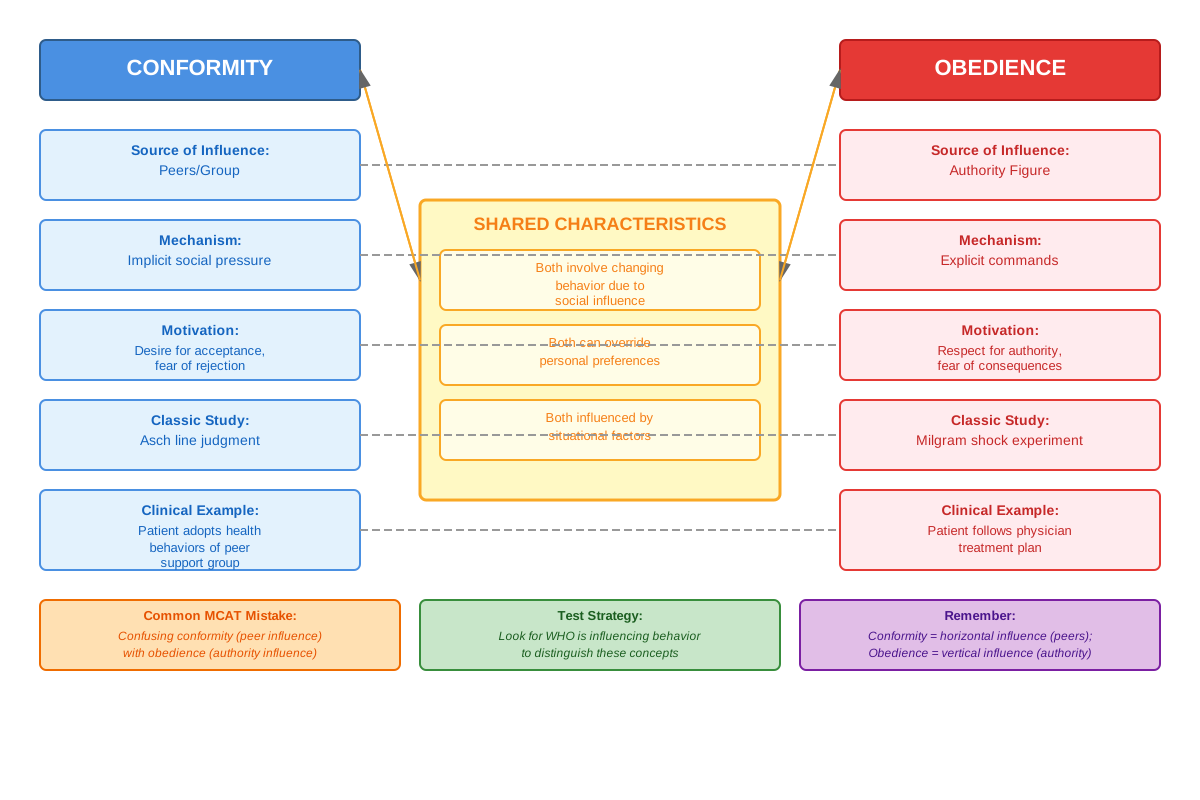
⭐ Conformity involves changing behavior to match group norms without direct commands, while obedience involves following direct orders from authority figures.
⭐ The bystander effect demonstrates that individuals are less likely to help in emergencies when more people are present due to diffusion of responsibility and pluralistic ignorance.
⭐ Groupthink occurs in cohesive groups that prioritize consensus over critical thinking, leading to poor decision-making and suppression of dissenting views.
⭐ Social facilitation improves performance on simple tasks in others' presence, while social inhibition impairs performance on complex tasks.
- Normative conformity is motivated by desire for acceptance, while informational conformity is motivated by belief that the group has better information.
- Deindividuation reduces self-awareness and self-restraint in group settings, often leading to impulsive or norm-violating behavior.
- Prosocial behavior includes any action benefiting others, while altruism specifically refers to selfless helping without expectation of reward.
- Social loafing describes reduced individual effort in group tasks when contributions are not individually identifiable.
- Group polarization causes group discussions to intensify initial attitudes, making group decisions more extreme than individual members' initial positions.
- Descriptive norms describe typical behavior, while injunctive norms prescribe what behavior should be, and these can sometimes conflict.
- Social roles are sets of expectations associated with social positions that powerfully shape behavior, as demonstrated in the Stanford Prison Experiment.
Common Misconceptions
Misconception: Social behavior only refers to positive, cooperative interactions between people.
Correction: Social behavior encompasses all behaviors influenced by social contexts, including aggression, competition, conformity, and antisocial actions. The term is descriptive, not evaluative.
Misconception: Conformity and obedience are the same phenomenon.
Correction: Conformity involves changing behavior to match group norms without explicit commands, while obedience involves following direct orders from authority figures. Conformity is often implicit and peer-driven; obedience is explicit and authority-driven.
Misconception: The bystander effect means people in groups are inherently uncaring or immoral.
Correction: The bystander effect results from situational factors (diffusion of responsibility, pluralistic ignorance) rather than character flaws. The same individuals who fail to help in group settings often help readily when alone, demonstrating that social context, not personality, drives the effect.
Misconception: Altruism and prosocial behavior are interchangeable terms.
Correction: Altruism is a specific type of prosocial behavior characterized by selfless motivation without expectation of reward. Prosocial behavior is broader, including helpful actions that may have selfish motives (reputation enhancement, reciprocity expectations).
Misconception: Social facilitation always improves performance when others are present.
Correction: Social facilitation only improves performance on simple or well-learned tasks. For complex or novel tasks, others' presence causes social inhibition, impairing performance due to increased arousal interfering with concentration.
Misconception: Groupthink only occurs in obviously dysfunctional or authoritarian groups.
Correction: Groupthink can occur in any cohesive group that values harmony, including well-intentioned medical teams, policy committees, or friend groups. High cohesion combined with insulation from outside opinions creates risk regardless of the group's overall functionality.
Misconception: Social norms are always explicitly stated rules.
Correction: Most social norms are implicit, unwritten expectations learned through observation and socialization. Explicit rules (laws, regulations) represent only a small subset of the norms governing social behavior.
Worked Examples
Example 1: Analyzing a Bystander Effect Study
Scenario: Researchers conduct an experiment where participants complete questionnaires in a waiting room. Smoke begins entering through a vent. In one condition, participants wait alone; in another, they wait with two confederates who ignore the smoke. The dependent variable is whether participants report the smoke within 6 minutes.
Question: Which concept best explains why participants with confederates are less likely to report the smoke?
Step 1 - Identify the social context: Participants are in a group setting (with confederates) versus alone, making this a question about how others' presence affects behavior.
Step 2 - Recognize the behavioral pattern: Participants are less likely to take action (report smoke) when others are present, particularly when those others are inactive.
Step 3 - Consider relevant concepts: This could involve bystander effect, conformity, or social influence. The key is that participants are failing to act in an emergency when others are present.
Step 4 - Apply specific mechanisms: The confederates' inaction creates pluralistic ignorance—participants interpret others' calm behavior as indicating no emergency exists. This is a component of the bystander effect. Additionally, participants may experience diffusion of responsibility, assuming confederates will report if it's truly dangerous.
Step 5 - Eliminate alternatives: This isn't simple conformity (no norm is being established about questionnaire completion) or obedience (no authority figure gives commands). It's specifically about failure to help in an emergency due to others' presence.
Answer: The bystander effect, specifically through pluralistic ignorance (misinterpreting others' inaction as indicating no emergency) and diffusion of responsibility (assuming others will act if necessary).
Connection to learning objectives: This example demonstrates applying social behavior concepts to experimental scenarios, a common MCAT question format. It requires distinguishing between related concepts (bystander effect versus general conformity) and identifying specific mechanisms.
Example 2: Distinguishing Social Influence Types
Scenario: A medical student observes that attending physicians in her hospital rarely wash hands between examining patients in the same room, despite knowing proper infection control protocols. She begins skipping handwashing in similar situations, though she washes hands when working alone or with different attending physicians.
Question: What type of social influence best explains the medical student's behavior change?
Step 1 - Identify the behavior change: The student changes from following proper protocol to violating it, but only in specific social contexts (when with certain attending physicians).
Step 2 - Determine if explicit commands are involved: No authority figure directly orders the student to skip handwashing. The influence is implicit, based on observation of others' behavior.
Step 3 - Distinguish conformity types: The student isn't changing because she believes the attending physicians have better information about infection control (she knows the protocols are correct). Instead, she's matching their behavior to fit in and avoid standing out.
Step 4 - Consider role dynamics: The student occupies a subordinate role in the medical hierarchy. Deviating from attending physicians' practices might be perceived as criticism or insubordination.
Step 5 - Apply the correct concept: This represents normative conformity—changing behavior to match group norms to gain acceptance and avoid disapproval, despite privately disagreeing. The student conforms to the descriptive norm (what attending physicians actually do) rather than the injunctive norm (what should be done).
Answer: Normative conformity driven by desire for acceptance within the medical team hierarchy, where the student matches observed behavior despite knowing it violates proper protocols.
Connection to learning objectives: This example illustrates how social behavior concepts apply to healthcare settings, demonstrates distinguishing between conformity types (normative versus informational), and shows how social roles and hierarchies influence behavior—all high-yield for MCAT passages about medical professionalism and team dynamics.
Exam Strategy
When approaching Social behavior questions on the MCAT, first determine whether the question asks for a sociological (group-level) or psychological (individual-level) explanation. Trigger words like "social context," "group dynamics," "norms," and "collective" indicate sociological frameworks, while "personality," "individual differences," and "cognitive processes" suggest psychological approaches.
For conformity versus obedience questions, identify whether explicit commands from authority figures are present (obedience) or whether individuals are responding to implicit group pressure (conformity). Watch for subtle distinctions: "the experimenter instructed participants" signals obedience, while "participants observed others" signals conformity.
When analyzing helping behavior scenarios, systematically consider bystander effect factors: How many people are present? Is responsibility diffused? Can participants see others' reactions (pluralistic ignorance)? Is the situation ambiguous? Questions often hinge on identifying which specific mechanism prevents helping.
For group dynamics questions, distinguish between related concepts using these triggers:
- Groupthink: cohesive group, pressure for consensus, suppression of dissent, illusion of unanimity
- Group polarization: discussion intensifies initial attitudes, group becomes more extreme
- Social loafing: reduced individual effort, lack of individual accountability
- Deindividuation: anonymity, loss of self-awareness, impulsive behavior
Process-of-elimination strategy: When answers include both psychological and sociological explanations, favor sociological explanations for questions explicitly about "social behavior" or "social influence." Eliminate answers that confuse related concepts (e.g., choosing "obedience" when no authority figure is mentioned, or "altruism" when behavior has clear selfish motives).
Time allocation: Social behavior questions often appear in passage-based formats requiring careful reading of experimental designs. Allocate 1.5-2 minutes for passage-based questions to identify independent/dependent variables, control conditions, and which social behavior concept the study examines. Discrete questions typically require 30-45 seconds once concepts are mastered.
Memory Techniques
Conformity vs. Obedience mnemonic: C-O-N = Conformity has O explicit commands, No authority required (implicit group pressure). O-B-E-Y = Obedience requires Being told Explicitly, Yielding to authority.
Bystander Effect factors: D-P-E = Diffusion of responsibility, Pluralistic ignorance, Evaluation apprehension. Visualize three people standing around an emergency, each thinking "Don't worry, someone else will help," "Probably not serious since no one's reacting," "Embarrassed if I help wrong."
Groupthink symptoms: I-C-S-P = Illusion of invulnerability, Collective rationalization, Stereotyping out-groups, Pressure on dissenters. Visualize a group in a closed room, isolated from outside perspectives, reinforcing each other's views.
Types of conformity: N-I = Normative (want to be Nice/accepted), Informational (assume group has better Info). Normative is emotional (fitting in), informational is cognitive (being correct).
Social facilitation/inhibition: S-I-C = Simple tasks Improved, Complex tasks impaired. Visualize an athlete performing better with a crowd (simple, practiced skill) versus a student struggling on a difficult test with others watching.
Prosocial behavior hierarchy: Visualize a pyramid with broad "prosocial behavior" at the base (includes all helping), narrowing to "altruism" at the peak (only selfless helping). This reminds you that all altruism is prosocial, but not all prosocial behavior is altruistic.
Summary
Social behavior encompasses all behaviors influenced by or directed toward others, representing a core concept in Sociology and a high-yield topic for the MCAT. Understanding social behavior requires distinguishing between conformity (implicit group pressure) and obedience (explicit authority commands), recognizing how social contexts paradoxically inhibit helping through the bystander effect, and analyzing how group dynamics produce phenomena like groupthink, group polarization, and social loafing. Social norms, roles, and situational factors powerfully shape behavior, often overriding individual personality or moral inclinations. The MCAT tests social behavior through experimental scenarios requiring identification of independent/dependent variables, interpretation of results through sociological frameworks, and application of concepts to healthcare contexts. Mastery requires not just memorizing definitions but understanding mechanisms (why does the bystander effect occur?), distinguishing related concepts (prosocial behavior versus altruism), and recognizing how social behavior connects to broader themes of social interaction, identity formation, and societal organization. Success on MCAT social behavior questions depends on systematic analysis of social contexts, careful attention to whether authority or peer influence drives behavior, and recognition that situational factors often matter more than individual characteristics in determining social behavior patterns.
Key Takeaways
- Social behavior is defined as any behavior influenced by or directed toward others, encompassing prosocial actions, aggression, conformity, obedience, and group dynamics
- Conformity (implicit group pressure) and obedience (explicit authority commands) are distinct mechanisms of social influence, frequently tested through classic experiments like Asch and Milgram studies
- The bystander effect demonstrates that helping behavior decreases as the number of bystanders increases, due to diffusion of responsibility, pluralistic ignorance, and evaluation apprehension
- Group dynamics including groupthink, group polarization, social loafing, and deindividuation show how collective contexts alter individual behavior in predictable ways
- Social norms (descriptive and injunctive) and social roles powerfully shape behavior, often overriding individual preferences or moral beliefs
- Understanding social behavior requires analyzing situational and contextual factors rather than focusing solely on individual personality or character traits
- MCAT questions on social behavior typically present experimental scenarios or healthcare contexts requiring application of sociological concepts to interpret behavior patterns
Related Topics
- Social Identity Theory: Examines how group membership shapes self-concept and behavior, building on social behavior foundations to explain in-group favoritism and out-group discrimination
- Socialization: Explores how individuals learn social norms and roles through various agents (family, peers, media), providing the developmental context for social behavior patterns
- Deviance and Social Control: Analyzes violations of social norms and societal responses, extending social behavior concepts to understand rule-breaking and enforcement mechanisms
- Collective Behavior and Social Movements: Examines large-scale coordinated action, applying group dynamics principles to crowds, riots, and organized social change efforts
- Attribution Theory: Bridges social psychology and sociology by examining how people explain others' behavior, connecting to social behavior through understanding of situational versus dispositional attributions
- Social Stratification and Inequality: Shows how social structures create contexts for different behavior patterns across social classes, races, and genders
Practice CTA
Now that you've mastered the core concepts of social behavior, it's time to solidify your understanding through active practice. Challenge yourself with MCAT-style practice questions that require applying these concepts to experimental scenarios and clinical vignettes. Use flashcards to drill the distinctions between related concepts like conformity versus obedience, prosocial behavior versus altruism, and normative versus informational conformity. Focus particularly on questions involving research design, as the MCAT frequently tests social behavior through interpretation of experimental studies. Remember that understanding social behavior isn't just about memorizing definitions—it's about recognizing patterns in how social contexts shape human action, a skill that will serve you throughout medical school and clinical practice. You've built a strong foundation; now demonstrate your mastery through deliberate practice!
Sign up free to keep reading
Create a free AnvayaPrep account to finish this MCAT guide on Social behavior — plus flashcards and practice questions.