Overview
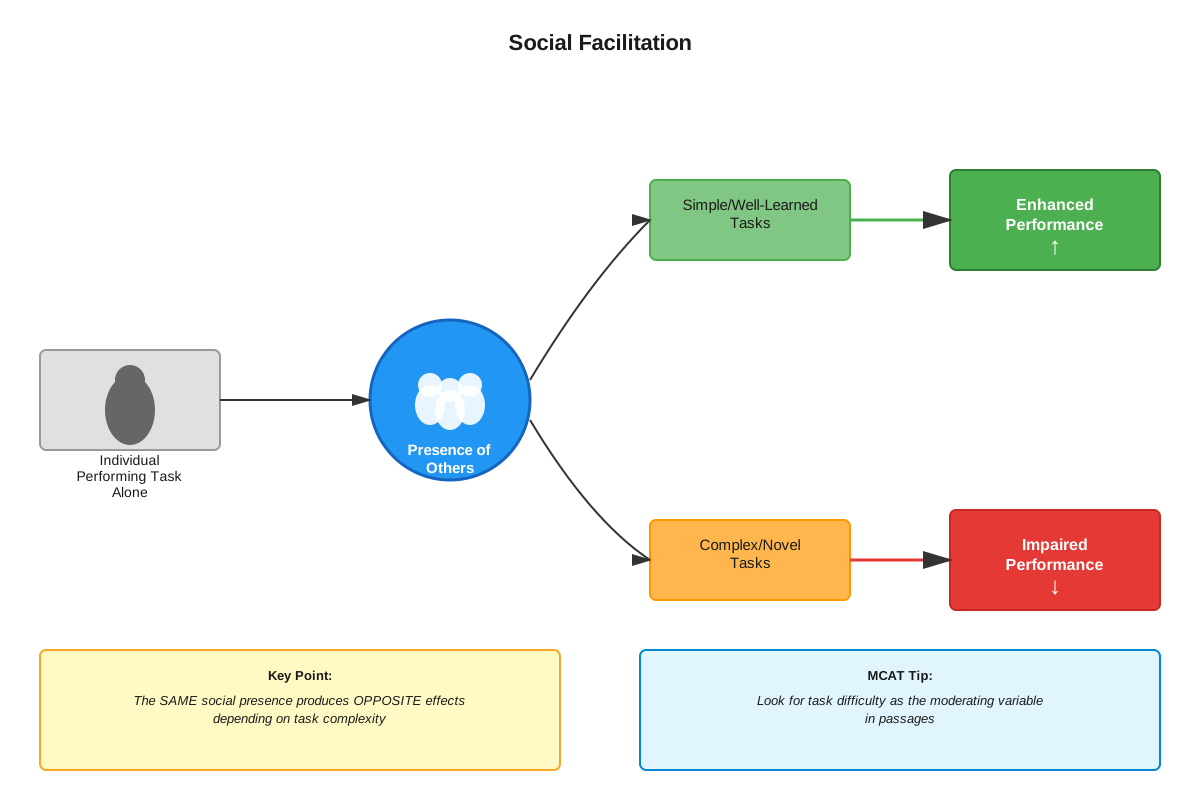
Social facilitation is a foundational concept in Sociology that describes how the mere presence of others influences an individual's performance on tasks. This phenomenon, first systematically studied by Norman Triplett in 1898, reveals that people tend to perform differently when observed or accompanied by others compared to when they work alone. The effect is bidirectional: the presence of others can either enhance performance on simple or well-learned tasks or impair performance on complex or novel tasks. Understanding this concept is crucial for the MCAT because it bridges individual psychology with social context, demonstrating how Social Interaction and Identity shape behavior in measurable ways.
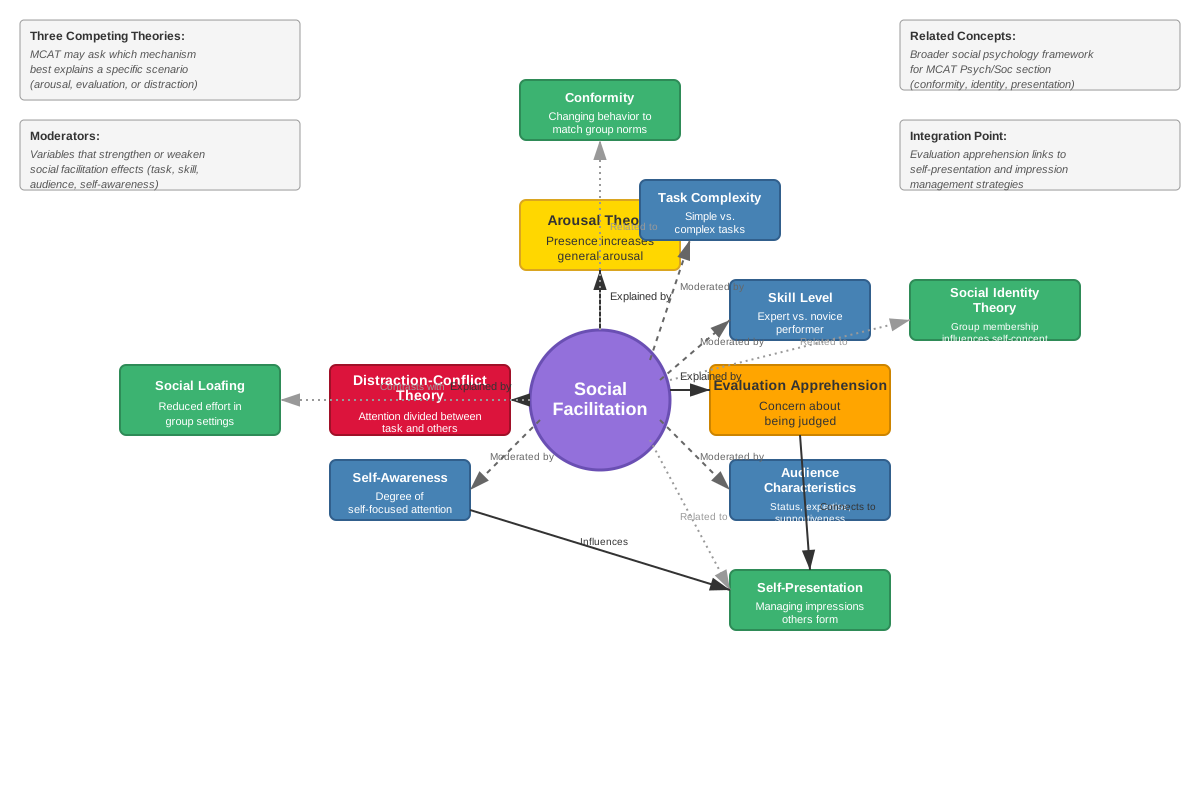
For Social facilitation MCAT questions, students must recognize that this concept extends beyond simple observation effects. It encompasses audience effects (passive spectators), coaction effects (others performing the same task simultaneously), and the underlying mechanisms that drive these changes in performance. The concept connects directly to arousal theory, evaluation apprehension, and distraction-conflict theory, all of which explain why social presence produces these performance changes. MCAT passages frequently embed social facilitation scenarios within research studies, workplace settings, athletic contexts, or educational environments, requiring students to identify the phenomenon and predict outcomes based on task complexity.
The significance of Social facilitation Sociology extends throughout the broader domain of social psychology and behavioral science. It connects to concepts of conformity, group dynamics, social loafing, deindividuation, and self-presentation. Understanding social facilitation provides insight into how social contexts modulate individual behavior, a theme that permeates MCAT Psychological, Social, and Biological Foundations of Behavior questions. This topic frequently appears in passages analyzing experimental designs, requiring students to interpret data about performance variations under different social conditions.
Learning Objectives
- [ ] Define Social facilitation using accurate Sociology terminology
- [ ] Explain why Social facilitation matters for the MCAT
- [ ] Apply Social facilitation to exam-style questions
- [ ] Identify common mistakes related to Social facilitation
- [ ] Connect Social facilitation to related Sociology concepts
- [ ] Distinguish between audience effects and coaction effects in social facilitation scenarios
- [ ] Analyze how task complexity moderates social facilitation outcomes
- [ ] Evaluate competing theoretical explanations for social facilitation (arousal theory, evaluation apprehension, distraction-conflict)
Prerequisites
- Basic understanding of arousal and performance: Social facilitation relies on the relationship between physiological/psychological arousal and task performance, particularly the Yerkes-Dodson law
- Familiarity with experimental design: Students must recognize independent and dependent variables in social facilitation studies to interpret MCAT passages
- Knowledge of dominant vs. non-dominant responses: Understanding that well-learned behaviors differ from novel behaviors is essential for predicting social facilitation effects
- Awareness of social psychology fundamentals: Basic concepts of how social context influences individual behavior provide the foundation for understanding social facilitation
Why This Topic Matters
Social facilitation represents one of the most empirically validated phenomena in social psychology, making it a high-yield topic for MCAT preparation. The concept appears regularly in Psychological, Social, and Biological Foundations of Behavior sections, particularly in passages describing research studies or real-world applications. Understanding social facilitation enables students to predict behavioral outcomes in various social contexts, a skill directly tested on the exam.
From a clinical and real-world perspective, social facilitation explains performance variations in numerous settings: athletes performing differently in front of crowds versus during practice, students experiencing test anxiety in examination rooms, musicians performing in concerts versus rehearsals, and workers' productivity changes in open-plan offices versus private spaces. Healthcare professionals encounter social facilitation effects when patients behave differently during observed medical procedures, when medical students perform procedures under supervision, or when group therapy dynamics influence individual participation.
Exam Frequency: Social facilitation appears in approximately 3-5% of MCAT Sociology questions, often embedded within experimental passages requiring interpretation of performance data across different social conditions.
MCAT questions on this topic typically present scenarios involving:
- Research studies comparing individual versus group performance
- Athletic or competitive contexts with varying audience sizes
- Educational settings examining study habits and test performance
- Workplace productivity under different supervision conditions
- Experimental designs manipulating social presence as an independent variable
The topic frequently appears in discrete questions asking students to predict outcomes or in passage-based questions requiring interpretation of experimental results. Questions may ask students to identify which theory best explains observed results or to predict how changing task complexity would alter outcomes.
Core Concepts
Definition and Basic Mechanism
Social facilitation refers to the tendency for people to perform differently when in the presence of others compared to when alone. Specifically, the presence of others enhances performance on simple or well-practiced tasks while impairing performance on complex or novel tasks. This definition captures the bidirectional nature of the effect and emphasizes that task characteristics determine whether facilitation or impairment occurs.
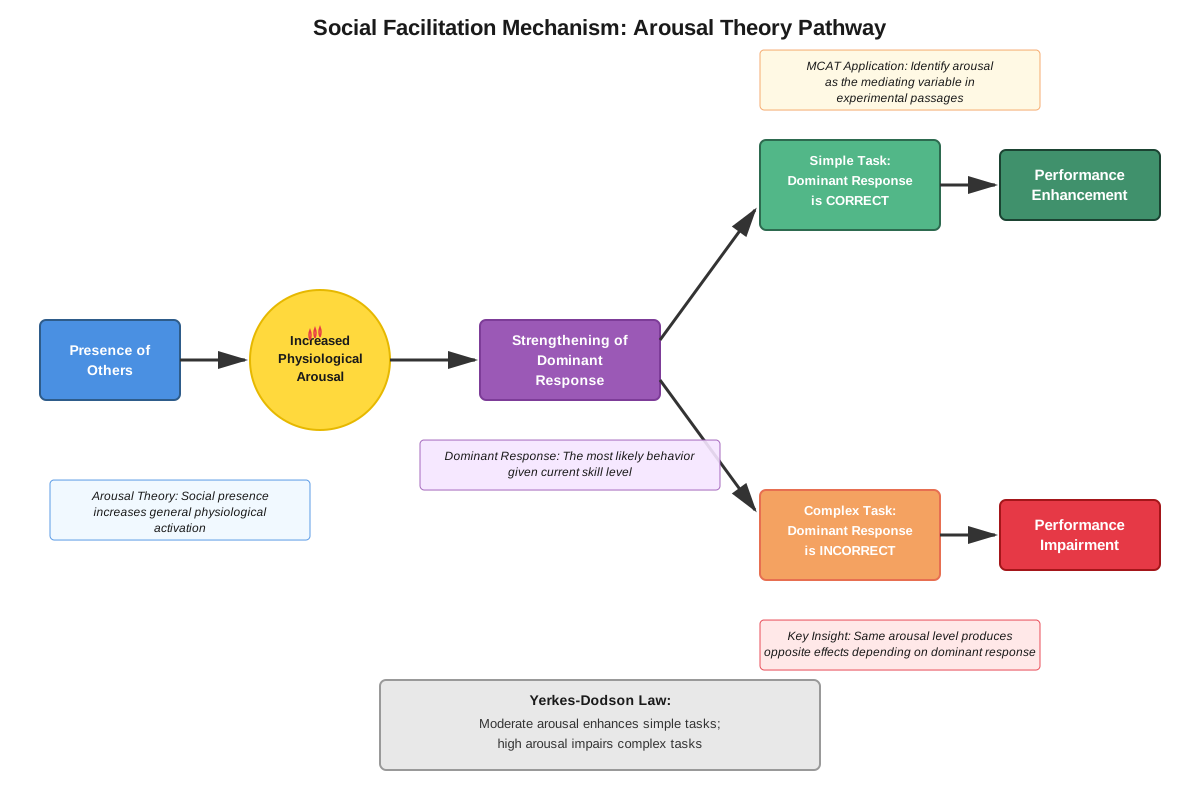
The phenomenon operates through several key mechanisms. When others are present, individuals experience increased arousal—a state of heightened physiological and psychological activation. This arousal strengthens the dominant response, which is the most likely behavioral response in a given situation. For well-learned tasks, the dominant response is correct, so increased arousal improves performance. For novel or difficult tasks, the dominant response is often incorrect or incomplete, so increased arousal impairs performance by strengthening these inadequate responses.
Types of Social Presence Effects
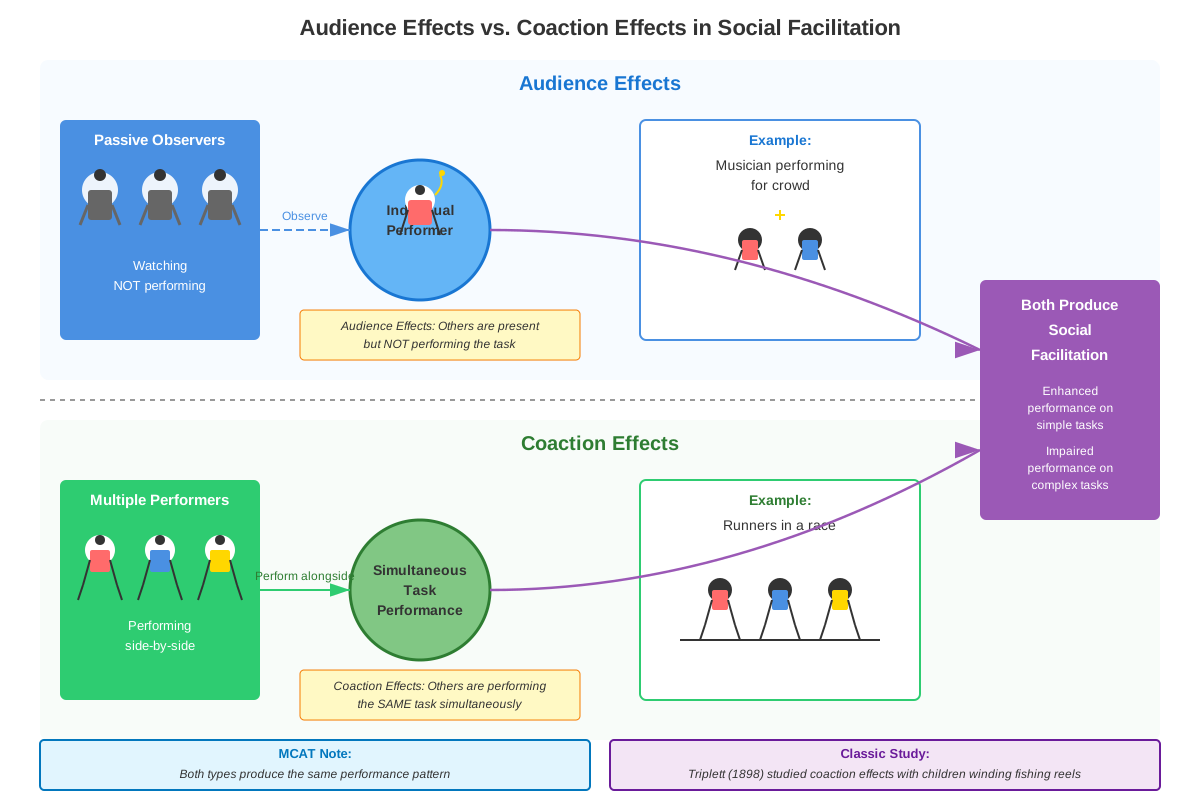
Social facilitation encompasses two distinct types of social presence:
Audience effects occur when passive observers watch an individual perform a task without performing the task themselves. The mere presence of spectators, even if they provide no feedback or interaction, influences performance. Research demonstrates that audience effects emerge even with minimal social presence—a single observer can trigger the phenomenon.
Coaction effects occur when multiple individuals perform the same task simultaneously in each other's presence. Unlike audience effects, coaction involves active participants rather than passive observers. Classic examples include cyclists racing alongside competitors, students taking exams in the same room, or workers completing tasks in shared workspaces.
Both types produce similar performance patterns, though coaction effects may be stronger due to implicit comparison and competition between performers.
Task Complexity as a Moderator
The critical moderating variable in social facilitation is task complexity. This dimension determines whether social presence helps or hinders performance:
| Task Type | Dominant Response | Effect of Social Presence | Example |
|---|---|---|---|
| Simple/Well-learned | Correct | Performance enhancement | Experienced runner completing familiar route |
| Complex/Novel | Incorrect or incomplete | Performance impairment | Beginner learning new dance steps |
| Moderately difficult | Mixed | Variable effects | Intermediate student solving challenging problems |
Simple tasks involve straightforward actions, minimal cognitive load, or highly practiced skills. Complex tasks require substantial cognitive processing, coordination of multiple steps, or learning new information. The distinction is not absolute but exists on a continuum, with social facilitation effects strongest at the extremes.
Theoretical Explanations
Three major theories explain why social presence produces these effects:
Arousal Theory (Zajonc)
Robert Zajonc's arousal theory proposes that the mere presence of others creates a non-specific state of increased arousal or drive. This arousal is an automatic, innate response that does not require conscious awareness or evaluation. The increased arousal energizes the dominant response, leading to facilitation on simple tasks and impairment on complex tasks. This theory emphasizes the biological and automatic nature of the response, suggesting that even non-evaluative presence (such as passive observers who cannot judge performance) triggers the effect.
Evaluation Apprehension Theory (Cottrell)
Nicholas Cottrell's evaluation apprehension theory argues that social presence effects occur not from mere presence but from concern about being evaluated by others. According to this perspective, individuals experience arousal because they worry about how others will judge their performance. This theory predicts that social facilitation should be stronger when:
- Observers are perceived as experts or authority figures
- The task has clear performance standards
- The individual cares about others' opinions
- Observers are paying attention and capable of evaluation
Evaluation apprehension theory explains why blindfolded audiences or observers who cannot see the performer produce weaker or absent social facilitation effects.
Distraction-Conflict Theory (Baron)
Robert Baron's distraction-conflict theory proposes that the presence of others creates attentional conflict. Individuals experience competing demands: focusing on the task versus monitoring the social environment. This conflict produces cognitive overload and arousal. The theory predicts that any distracting stimulus (not just social presence) could produce similar effects. For simple tasks, performers can manage the distraction without significant impairment, and the arousal may even help. For complex tasks requiring full attention, the distraction disrupts performance.
Individual and Situational Factors
Several factors modulate social facilitation effects:
Individual differences include personality traits (extroverts may show stronger facilitation effects), self-esteem (individuals with higher self-esteem may experience less evaluation apprehension), and expertise level (experts experience facilitation across a broader range of tasks).
Situational factors include audience size (larger audiences typically produce stronger effects, though effects plateau beyond a certain size), audience characteristics (familiar versus unfamiliar observers, supportive versus critical audiences), and physical proximity (closer observers produce stronger effects).
Cultural context also matters. Individualistic cultures may show stronger evaluation apprehension effects, while collectivistic cultures may show different patterns based on in-group versus out-group observers.
Concept Relationships
Social facilitation connects to numerous concepts within Social Interaction and Identity and broader sociology. The phenomenon directly relates to arousal and performance, demonstrating how physiological states mediate social influences on behavior. The Yerkes-Dodson law, which describes the inverted-U relationship between arousal and performance, provides the mechanistic foundation for understanding why increased arousal helps simple tasks but hinders complex ones.
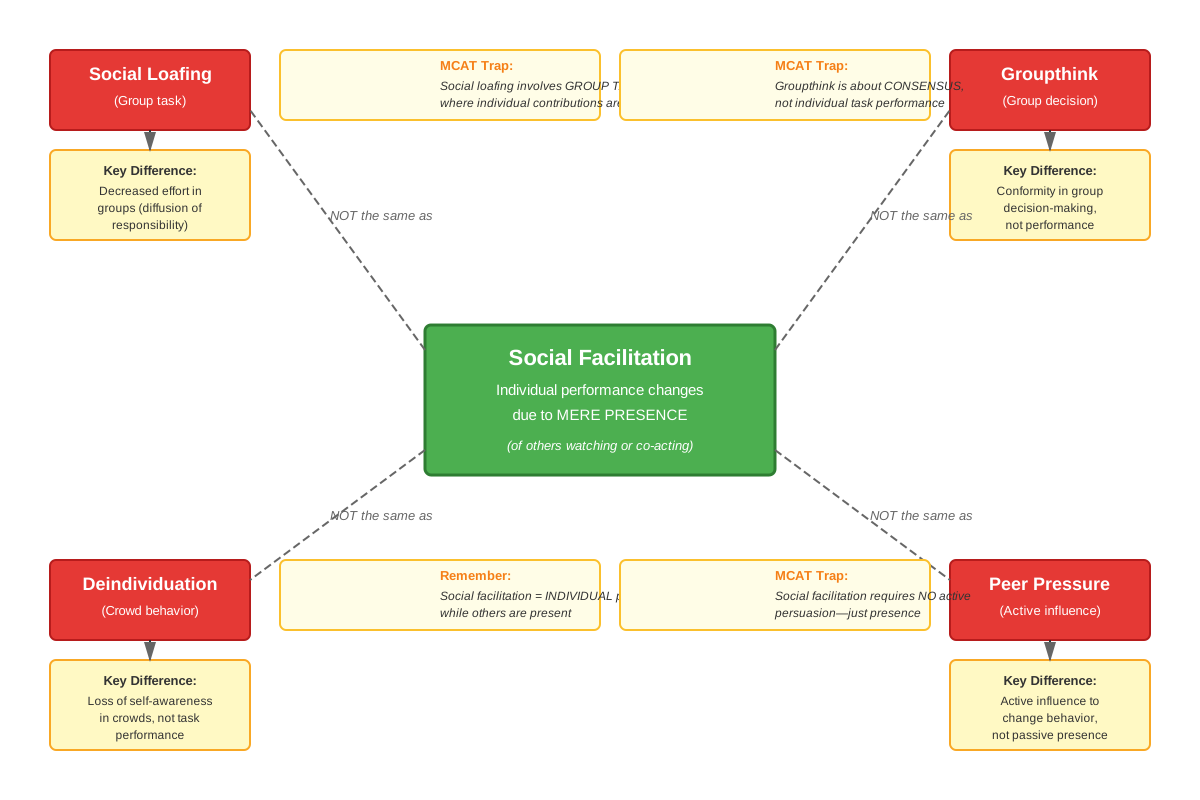
Social facilitation contrasts with social loafing, where individuals exert less effort when working collectively compared to working alone. While social facilitation involves performance changes due to social presence, social loafing involves motivation changes in group work contexts. The key distinction is that social facilitation occurs when individual performance is identifiable, whereas social loafing occurs when individual contributions are anonymous or diffused within a group.
The concept connects to conformity and normative social influence through evaluation apprehension. When individuals worry about others' judgments, they experience pressure to meet social standards, linking social facilitation to broader conformity processes. Similarly, self-presentation and impression management theories explain why evaluation apprehension produces arousal—individuals are motivated to present themselves favorably to others.
Deindividuation, the loss of self-awareness in group settings, represents an opposite phenomenon. While social facilitation involves heightened self-awareness and evaluation concern, deindividuation involves reduced self-awareness and decreased concern about evaluation.
The relationship map flows as follows:
Social Presence → Arousal/Evaluation Apprehension/Distraction → Strengthened Dominant Response → Performance Enhancement (simple tasks) OR Performance Impairment (complex tasks) → Observable Behavioral Outcomes
High-Yield Facts
⭐ Social facilitation enhances performance on simple or well-learned tasks while impairing performance on complex or novel tasks
⭐ The presence of others increases arousal, which strengthens the dominant (most likely) response
⭐ Task complexity is the critical moderating variable determining whether facilitation or impairment occurs
⭐ Three major theories explain social facilitation: arousal theory (Zajonc), evaluation apprehension (Cottrell), and distraction-conflict (Baron)
⭐ Social facilitation occurs with both audience effects (passive observers) and coaction effects (simultaneous performers)
- Social facilitation represents one of the oldest and most replicated findings in social psychology, first studied systematically by Norman Triplett in 1898
- The phenomenon occurs across species, having been demonstrated in humans, primates, birds, insects, and fish
- Evaluation apprehension theory predicts stronger effects when observers are experts or when performance is easily judged
- Social facilitation effects are strongest when individual performance is identifiable and attributable
- The mere presence of others can trigger social facilitation even without explicit evaluation or interaction
- Larger audiences produce stronger effects up to a point, after which effects plateau
- Social facilitation differs from social loafing: facilitation involves identifiable individual performance, while loafing involves diffused group responsibility
Quick check — test yourself on Social facilitation so far.
Try Flashcards →Common Misconceptions
Misconception: Social facilitation always improves performance when others are present → Correction: Social facilitation is bidirectional—it enhances performance on simple tasks but impairs performance on complex tasks. The effect depends entirely on task complexity and the performer's skill level.
Misconception: Social facilitation and social loafing are the same phenomenon → Correction: These are distinct and often opposite effects. Social facilitation occurs when individual performance is identifiable and involves performance changes (enhancement or impairment). Social loafing occurs when individual contributions are anonymous within a group and involves decreased effort.
Misconception: Social facilitation only occurs when people are actively watching and evaluating → Correction: While evaluation apprehension theory emphasizes this factor, arousal theory demonstrates that mere presence alone (even without evaluation) can trigger social facilitation effects. Different theories emphasize different mechanisms.
Misconception: Experts always experience performance enhancement in social situations → Correction: Even experts can experience impairment when learning new skills or performing novel variations of their expertise. The key is whether the specific task being performed is well-learned, not whether the person is generally skilled.
Misconception: Social facilitation effects are purely psychological with no biological basis → Correction: Social facilitation involves measurable physiological changes including increased heart rate, cortisol levels, and neural activation in arousal-related brain regions. The phenomenon has both psychological and biological components.
Misconception: Larger audiences always produce stronger social facilitation effects → Correction: While audience size generally correlates with effect strength, the relationship is not linear. Effects plateau beyond a certain audience size, and audience characteristics (expertise, familiarity, supportiveness) matter more than sheer numbers.
Worked Examples
Example 1: Athletic Performance Scenario
Vignette: A researcher studies basketball players' free-throw accuracy under three conditions: (A) practicing alone in an empty gym, (B) practicing with teammates present but not watching, and (C) performing during a game with a large audience. Players are categorized as either novices (less than 1 year experience) or experts (more than 5 years experience). The researcher measures free-throw percentage in each condition.
Question: Based on social facilitation theory, what pattern of results would you predict?
Analysis:
Step 1: Identify the key variables. The independent variables are social presence condition and expertise level. The dependent variable is free-throw accuracy.
Step 2: Determine task complexity for each group. For expert players, free throws are well-learned, simple tasks. For novice players, free throws are still being learned and represent complex tasks.
Step 3: Apply social facilitation principles. Social presence (conditions B and C) should increase arousal compared to practicing alone (condition A).
Step 4: Predict outcomes based on task complexity:
- Experts: Increased arousal strengthens the dominant (correct) response. Prediction: Experts show highest accuracy in condition C (game with audience), intermediate in condition B (teammates present), and lowest in condition A (alone).
- Novices: Increased arousal strengthens the dominant (often incorrect) response. Prediction: Novices show highest accuracy in condition A (alone), intermediate in condition B (teammates present), and lowest in condition C (game with audience).
Step 5: Consider theoretical mechanisms. Evaluation apprehension theory would predict stronger effects in condition C (game) than condition B (teammates) because game audiences represent higher evaluation pressure. Arousal theory would predict effects in both B and C compared to A.
Answer: Experts should demonstrate performance enhancement with social presence (C > B > A), while novices should demonstrate performance impairment with social presence (A > B > C). This interaction between expertise and social presence is the hallmark of social facilitation.
Example 2: Research Design Interpretation
Vignette: A study examines students learning a new computer programming language. Participants are randomly assigned to learn either in private cubicles or in an open computer lab where others can see their screens. After the learning period, all students complete a programming test in private. Results show that students who learned in private cubicles scored significantly higher on the test than those who learned in the open lab.
Question: Which theory of social facilitation best explains these results, and what alternative explanations should be considered?
Analysis:
Step 1: Identify the phenomenon. Students learning a novel, complex task (new programming language) performed worse when others could observe them during learning.
Step 2: Apply social facilitation framework. Learning a new programming language is a complex task where the dominant response is likely incorrect or incomplete. Social presence during learning should impair performance by strengthening these inadequate responses.
Step 3: Evaluate theoretical explanations:
Arousal theory: The mere presence of others in the open lab increased arousal, which strengthened incorrect or incomplete programming responses during learning. This impaired skill acquisition, leading to lower test scores.
Evaluation apprehension theory: Students in the open lab worried about others judging their mistakes or slow progress. This evaluation concern created arousal and anxiety, disrupting the learning process. This theory best explains the results because learning contexts typically involve high evaluation concern.
Distraction-conflict theory: Students in the open lab experienced attentional conflict between focusing on learning and monitoring their social environment. This distraction disrupted the cognitive processing necessary for learning complex material.
Step 4: Consider alternative explanations and confounds:
- The open lab might have had more ambient noise or other distractions beyond social presence
- Students in cubicles might have felt more comfortable asking for help or making mistakes
- The effect might reflect test anxiety rather than learning impairment if students associated the testing environment with the learning environment
Step 5: Determine best explanation. Evaluation apprehension theory best explains these results because learning contexts inherently involve concern about demonstrating competence. The fact that the test was administered privately (eliminating social presence during testing) yet still showed performance differences indicates that social presence during learning impaired skill acquisition, not just performance expression.
Answer: Evaluation apprehension theory best explains these results. Students learning in the open lab experienced concern about others judging their mistakes, creating arousal that impaired learning of complex material. The private testing condition rules out performance anxiety as the sole explanation, indicating that social presence during learning genuinely disrupted skill acquisition.
Exam Strategy
When approaching Social facilitation MCAT questions, follow this systematic strategy:
Step 1: Identify social presence. Look for keywords indicating that others are present, watching, or performing alongside the individual. Phrases like "in front of an audience," "with others present," "during competition," or "while being observed" signal potential social facilitation scenarios.
Step 2: Assess task complexity. Determine whether the task is simple/well-learned or complex/novel for the performer. Watch for indicators like "experienced," "expert," "practiced," "familiar" (suggesting simple tasks) versus "learning," "new," "difficult," "unfamiliar" (suggesting complex tasks).
Step 3: Predict the direction of effect. Simple tasks → performance enhancement. Complex tasks → performance impairment. If the question asks about performance changes, this prediction is your answer.
Step 4: Distinguish from related concepts. Eliminate answer choices involving:
- Social loafing: Requires group work with diffused responsibility, not identifiable individual performance
- Conformity: Involves changing behavior to match group norms, not performance changes due to presence
- Deindividuation: Involves loss of self-awareness in groups, opposite of social facilitation's heightened awareness
Step 5: Match theoretical explanations to scenario details:
- If the passage emphasizes "mere presence" or automatic responses → arousal theory
- If the passage emphasizes concern about judgment or evaluation → evaluation apprehension
- If the passage emphasizes divided attention or cognitive load → distraction-conflict theory
Trigger Words for Social Facilitation: "presence of others," "audience," "spectators," "observed," "watched," "alongside others," "in competition," "well-practiced," "novel task," "learning," "performance changes"
Process of Elimination Tips:
- Eliminate choices suggesting social facilitation always improves performance (it's bidirectional)
- Eliminate choices confusing social facilitation with social loafing (opposite conditions)
- Eliminate choices ignoring task complexity (it's the critical moderator)
- Eliminate choices suggesting effects require verbal feedback or explicit evaluation (mere presence suffices)
Time Allocation: Social facilitation questions typically require 60-90 seconds. Spend 20 seconds identifying the phenomenon and task complexity, 30 seconds predicting outcomes or matching theory, and 20 seconds eliminating wrong answers and confirming your choice.
Memory Techniques
Mnemonic for Social Facilitation Direction: "SIMPLE SOARS, COMPLEX CRASHES"
- SIMPLE tasks with social presence → performance SOARS (improves)
- COMPLEX tasks with social presence → performance CRASHES (impairs)
Mnemonic for Three Theories: "AED" (like the emergency device)
- Arousal theory (Zajonc) - mere presence creates arousal
- Evaluation apprehension (Cottrell) - concern about judgment
- Distraction-conflict (Baron) - divided attention
Visualization Strategy: Picture a spotlight shining on a performer. For simple tasks (like a professional musician playing scales), the spotlight energizes and improves performance. For complex tasks (like a student learning calculus), the spotlight creates pressure and impairs performance. The spotlight represents social presence—same stimulus, opposite effects depending on task complexity.
Acronym for Key Factors: "PACED"
- Presence of others (the trigger)
- Arousal increases (the mechanism)
- Complexity of task (the moderator)
- Enhancement or impairment (the bidirectional outcome)
- Dominant response strengthened (the process)
Contrast Memory Aid: Create a mental comparison table:
| Social Facilitation | Social Loafing |
|---|---|
| Individual performance identifiable | Individual contribution anonymous |
| Presence increases effort (simple tasks) | Group context decreases effort |
| Heightened self-awareness | Reduced self-awareness |
| Works alone or alongside others | Works collectively in group |
Summary
Social facilitation represents a fundamental principle of how social context influences individual behavior. The phenomenon describes the bidirectional effect of social presence on performance: enhancement for simple or well-learned tasks and impairment for complex or novel tasks. This effect occurs through increased arousal that strengthens the dominant response—the most likely behavioral output in a given situation. Three major theories explain the mechanism: arousal theory emphasizes automatic responses to mere presence, evaluation apprehension theory highlights concern about judgment, and distraction-conflict theory focuses on divided attention. Task complexity serves as the critical moderating variable, determining whether social presence helps or hinders performance. For MCAT success, students must recognize social facilitation scenarios, distinguish the phenomenon from related concepts like social loafing, predict outcomes based on task complexity, and match theoretical explanations to experimental designs. Understanding social facilitation provides insight into performance variations across athletic, educational, workplace, and clinical contexts, making it essential knowledge for both exam success and real-world application.
Key Takeaways
- Social facilitation is bidirectional: social presence enhances performance on simple tasks but impairs performance on complex tasks
- The mechanism involves increased arousal strengthening the dominant (most likely) response, which is correct for simple tasks but incorrect for complex tasks
- Task complexity is the critical moderating variable—always assess whether the task is well-learned or novel for the performer
- Three theories explain social facilitation: arousal theory (mere presence), evaluation apprehension (concern about judgment), and distraction-conflict (divided attention)
- Social facilitation differs fundamentally from social loafing: facilitation involves identifiable individual performance, while loafing involves anonymous group contributions
- The phenomenon occurs with both audience effects (passive observers) and coaction effects (simultaneous performers)
- MCAT questions test the ability to predict performance outcomes, distinguish social facilitation from related concepts, and match theories to experimental scenarios
Related Topics
Social Loafing: The tendency for individuals to exert less effort when working collectively compared to individually. Understanding the contrast between social facilitation (identifiable performance) and social loafing (diffused responsibility) is essential for distinguishing these frequently confused concepts.
Conformity and Normative Social Influence: The process of changing behavior to match group norms. Mastering social facilitation provides foundation for understanding how evaluation concerns drive conformity, as both involve concern about others' judgments.
Deindividuation: The loss of self-awareness and evaluation apprehension in group settings. This represents the opposite psychological state from social facilitation, where self-awareness is heightened.
Yerkes-Dodson Law: The inverted-U relationship between arousal and performance. This principle provides the mechanistic foundation for understanding why increased arousal helps simple tasks but hinders complex tasks.
Group Dynamics and Group Polarization: How group contexts influence individual attitudes and behaviors. Social facilitation represents one specific type of group influence, providing foundation for understanding broader group processes.
Practice CTA
Now that you've mastered the core concepts of social facilitation, it's time to solidify your understanding through active practice. Challenge yourself with MCAT-style practice questions that test your ability to identify social facilitation scenarios, predict performance outcomes based on task complexity, and distinguish this phenomenon from related concepts. Use flashcards to reinforce the three theoretical explanations and their key differences. Remember: understanding social facilitation isn't just about memorizing definitions—it's about developing the analytical skills to apply these principles to novel scenarios, exactly as the MCAT demands. Your ability to quickly assess task complexity and predict performance changes will serve you well not only on exam day but throughout your medical career as you observe how social contexts influence patient behavior, medical team performance, and your own clinical skills development. You've got this!
Sign up free to keep reading
Create a free AnvayaPrep account to finish this MCAT guide on Social facilitation — plus flashcards and practice questions.