Overview
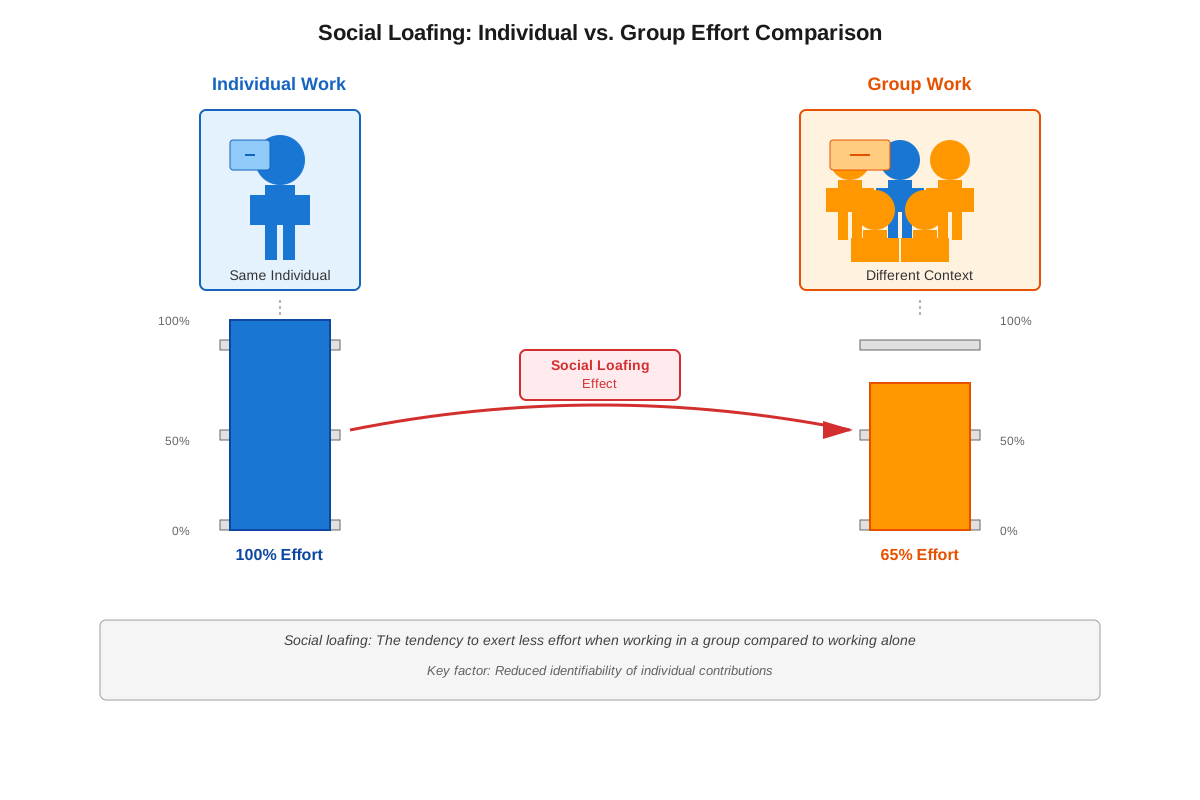
Social loafing is a fundamental phenomenon in Sociology that describes the tendency for individuals to exert less effort when working in a group compared to when working alone. This concept is central to understanding group dynamics and collective behavior, making it a high-yield topic for the MCAT. First identified by French agricultural engineer Max Ringelmann in the late 19th century through his rope-pulling experiments, social loafing reveals how the presence of others can paradoxically decrease individual motivation and performance. The phenomenon occurs because individuals perceive their contributions as less identifiable, less essential, or less evaluated when part of a collective effort.
Understanding Social loafing is essential for the MCAT because it frequently appears in passages and discrete questions within the Psychological, Social, and Biological Foundations of Behavior section. The exam tests not only the definition but also the ability to identify social loafing in experimental scenarios, distinguish it from related group phenomena, and predict when it will or will not occur. Questions often present research studies or real-world situations requiring students to analyze group performance patterns and explain discrepancies between individual and collective output.
Within the broader framework of Social Interaction and Identity, social loafing connects to numerous related concepts including group polarization, groupthink, deindividuation, and social facilitation. It illustrates how group contexts fundamentally alter individual behavior and performance, a theme central to understanding human social behavior. Mastering social loafing provides insight into organizational behavior, team dynamics, and the conditions under which groups either enhance or diminish individual contributions—knowledge applicable to both medical teamwork scenarios and standardized test questions.
Learning Objectives
- [ ] Define Social loafing using accurate Sociology terminology
- [ ] Explain why Social loafing matters for the MCAT
- [ ] Apply Social loafing to exam-style questions
- [ ] Identify common mistakes related to Social loafing
- [ ] Connect Social loafing to related Sociology concepts
- [ ] Distinguish social loafing from social facilitation and other group performance phenomena
- [ ] Predict conditions that increase or decrease social loafing based on situational factors
- [ ] Analyze experimental designs that measure social loafing effects
Prerequisites
- Group dynamics fundamentals: Understanding basic concepts of how individuals behave differently in groups versus alone is essential for contextualizing social loafing within broader group processes
- Social facilitation: Knowledge of how the presence of others can enhance performance on simple tasks provides a contrasting framework to social loafing
- Attribution theory: Familiarity with how people explain behavior helps understand why individuals reduce effort when contributions are less identifiable
- Research methodology basics: Understanding experimental design, independent/dependent variables, and control groups enables analysis of social loafing studies
Why This Topic Matters
Social loafing has significant real-world implications for medical practice and healthcare delivery. In clinical settings, understanding social loafing helps explain why some team members may contribute less during group rounds, committee work, or collaborative patient care. Recognizing this phenomenon enables future physicians to structure teams effectively, ensure accountability, and maximize collective performance. Medical errors sometimes occur when team members assume others are monitoring critical details—a manifestation of diffused responsibility related to social loafing.
For the MCAT, social loafing appears with moderate to high frequency in the Psychological, Social, and Biological Foundations of Behavior section. Approximately 2-4% of sociology questions directly or indirectly test this concept. Questions typically appear in three formats: (1) discrete questions asking for definitions or predictions about group behavior, (2) passage-based questions analyzing research studies on group performance, and (3) scenario-based questions requiring application to real-world situations. The MCAT particularly favors questions that require distinguishing social loafing from related phenomena or identifying factors that moderate its occurrence.
Common exam presentations include research passages describing experiments where individual versus group performance is measured, workplace or academic scenarios where team productivity is analyzed, and questions about factors affecting group cohesion and performance. The exam frequently tests whether students can identify when social loafing will increase (larger groups, low task importance) versus decrease (high identifiability, meaningful tasks). Understanding the mechanisms underlying social loafing—diffusion of responsibility, reduced evaluation apprehension, and decreased perceived self-efficacy—is crucial for answering higher-order application questions.
Core Concepts
Definition and Basic Mechanism
Social loafing refers to the phenomenon where individuals exert less effort toward achieving a goal when working collectively in a group compared to when working individually. This reduction in individual effort occurs specifically in additive tasks where group members' contributions are combined to produce a single group output. The term "loafing" captures the essence of reduced motivation and effort expenditure that characterizes this behavior.
The fundamental mechanism underlying social loafing involves three interconnected psychological processes. First, diffusion of responsibility occurs when individuals feel less personally accountable for outcomes because responsibility is distributed across multiple group members. Second, evaluation apprehension decreases because individual contributions become less identifiable and distinguishable within the collective output. Third, individuals may experience reduced perceived self-efficacy regarding their ability to meaningfully impact group outcomes, leading to motivational losses.
Historical Foundation: The Ringelmann Effect
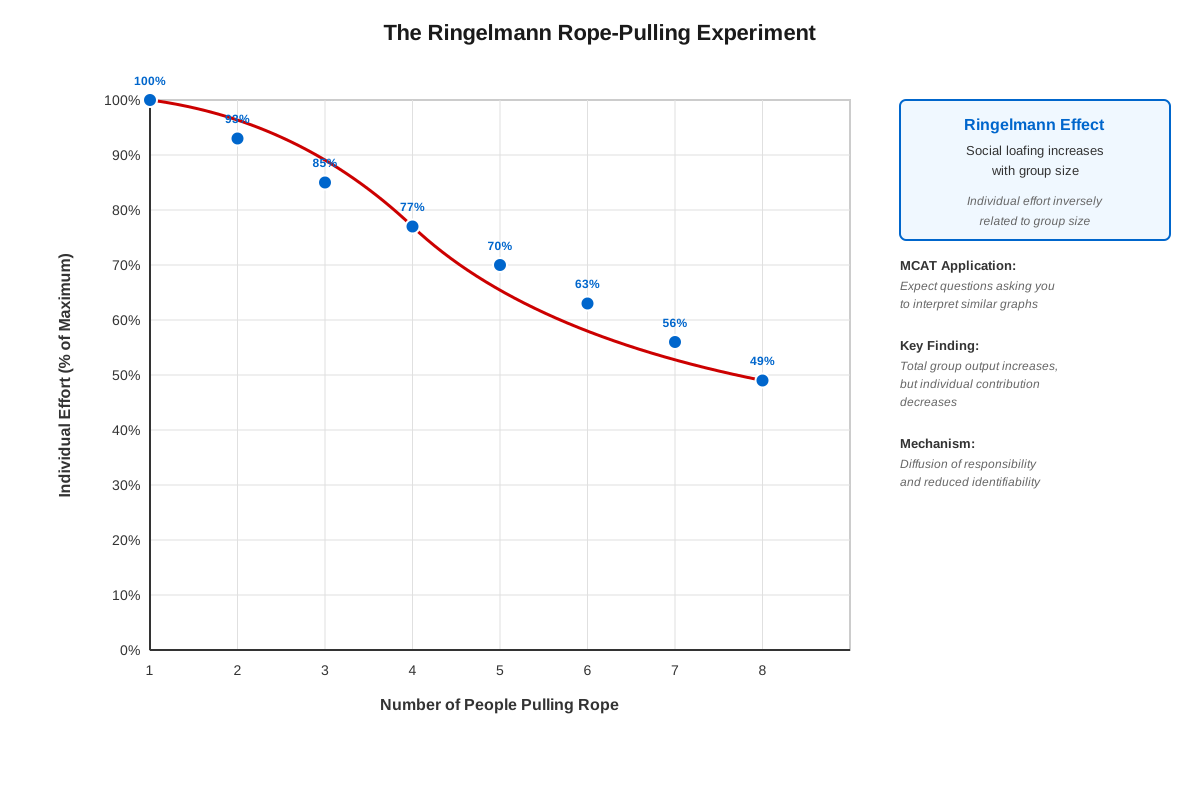
The scientific study of social loafing began with Max Ringelmann's rope-pulling experiments in the 1880s. Ringelmann observed that when individuals pulled on a rope alone, they exerted maximum effort, but when pulling as part of a group, total group output was less than the sum of individual efforts. Specifically, groups of eight people pulled at only about 50% of their combined individual capacity. This phenomenon, initially called the Ringelmann effect, demonstrated that group performance suffers not just from coordination losses but from actual motivational decreases.
Later research by Latané, Williams, and Harkins in the 1970s refined understanding by distinguishing between coordination losses (people getting in each other's way) and true motivational losses (people trying less hard). Their experiments using tasks like clapping and shouting—where coordination problems were minimal—confirmed that genuine motivational reduction occurs in group settings, establishing social loafing as a distinct psychological phenomenon.
Conditions That Increase Social Loafing
Several situational and task characteristics amplify social loafing effects:
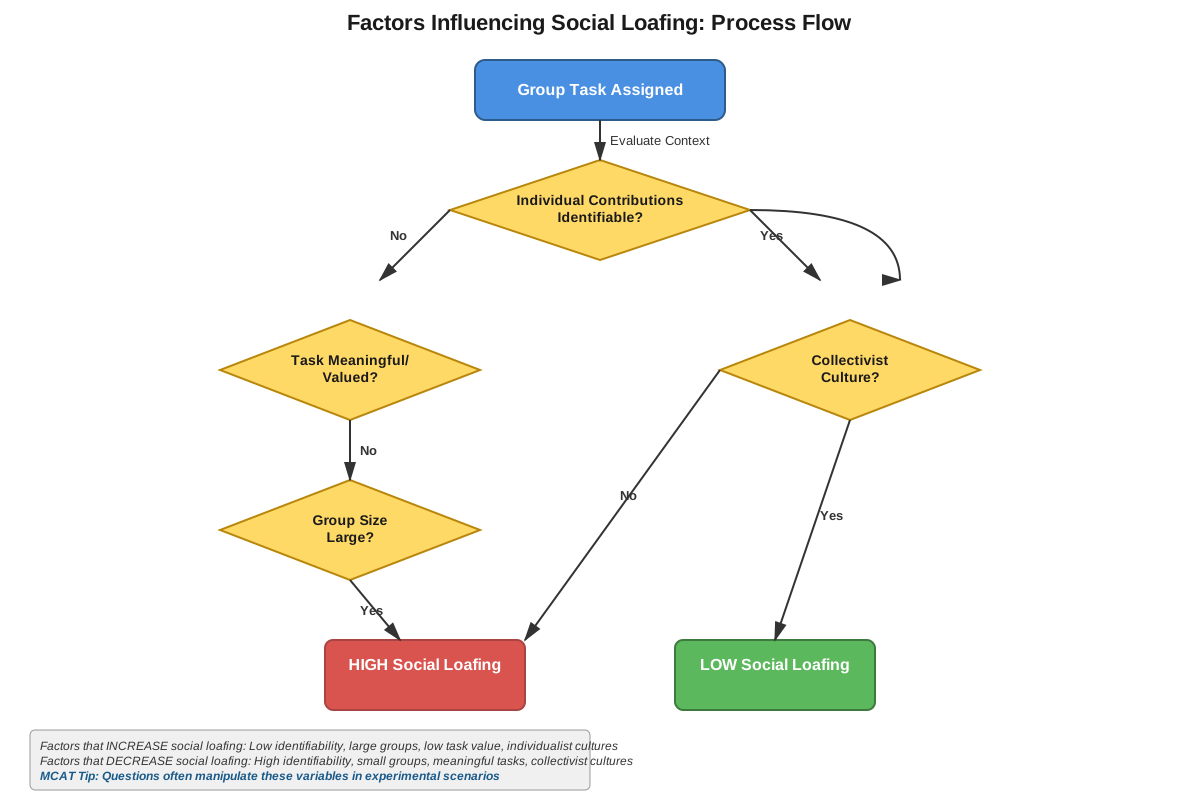
Group size: As groups become larger, individual contributions become less identifiable and each person's impact on the outcome decreases, leading to greater social loafing. The relationship is not linear; loafing increases most dramatically when moving from individual work to small groups, with diminishing additional effects as groups grow larger.
Task meaningfulness: When tasks are perceived as trivial, unimportant, or lacking personal relevance, individuals are more likely to reduce effort. Conversely, meaningful tasks that align with personal values or have significant consequences reduce social loafing.
Anonymity and identifiability: When individual contributions cannot be identified, evaluated, or attributed to specific people, social loafing increases substantially. Anonymous contributions eliminate evaluation apprehension and personal accountability.
Perceived dispensability: If individuals believe their contributions are redundant, unnecessary, or that others can compensate for their reduced effort, they are more likely to loaf. This relates to the concept of free riding, where individuals benefit from group membership without contributing proportionally.
Conditions That Decrease Social Loafing
Understanding factors that reduce or eliminate social loafing is equally important for exam questions:
Individual identifiability: When individual contributions can be monitored, measured, and attributed to specific people, social loafing decreases dramatically. Public evaluation of individual performance within group contexts maintains accountability.
Task importance and involvement: Personally meaningful tasks, challenging assignments, and work that engages intrinsic motivation reduce loafing. When individuals care about outcomes or find tasks inherently interesting, group context has less impact on effort.
Group cohesion: In highly cohesive groups where members value their relationships and group membership, social loafing decreases. Strong interpersonal bonds create social pressure to contribute and avoid letting teammates down.
Small group size: Smaller groups (2-4 members) show less social loafing than larger groups because individual contributions remain more visible and impactful.
Cultural factors: Research demonstrates that social loafing is more pronounced in individualistic cultures (Western societies) compared to collectivistic cultures (East Asian societies) where group harmony and collective success are more highly valued.
Comparison with Related Phenomena
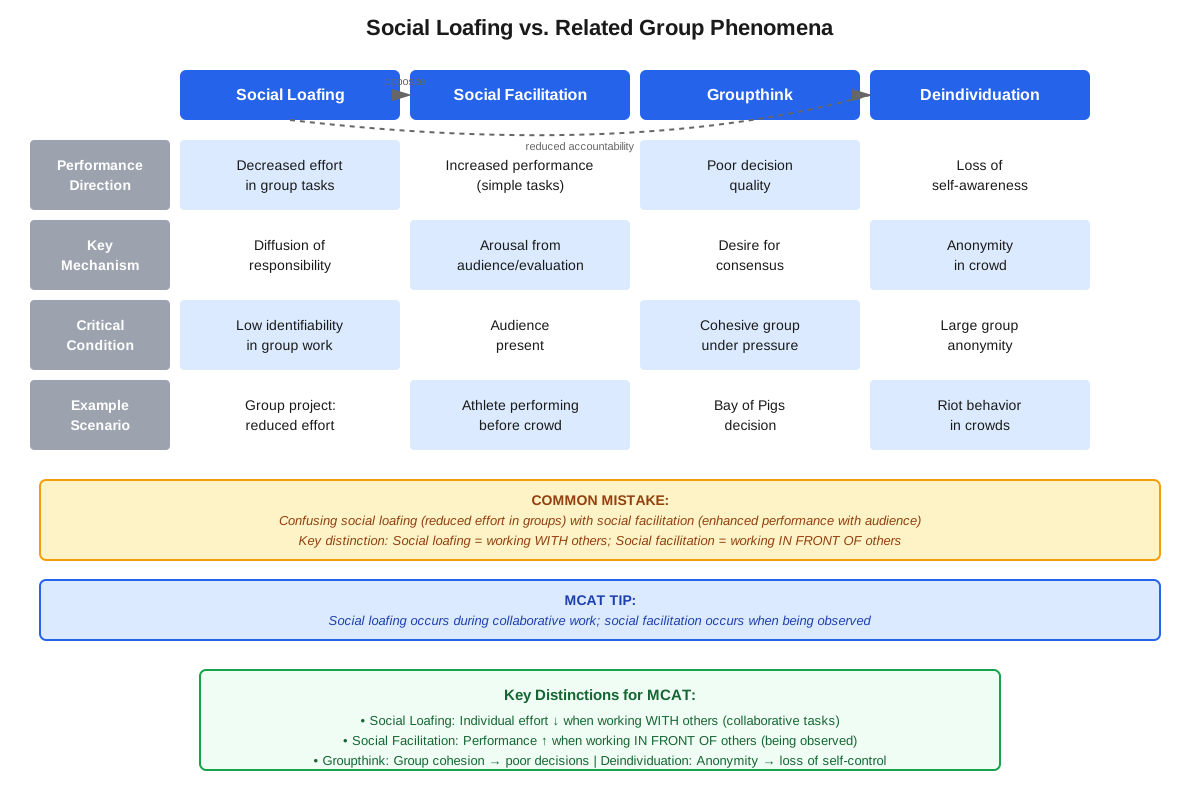
| Phenomenon | Definition | Effect on Performance | Key Difference from Social Loafing |
|---|---|---|---|
| Social facilitation | Improved performance on simple tasks when others are present | Increases performance | Occurs with individual tasks in presence of others; social loafing occurs in collective tasks |
| Social inhibition | Decreased performance on complex tasks when others are present | Decreases performance | Due to evaluation anxiety on difficult tasks; not specific to group work |
| Deindividuation | Loss of self-awareness and individual identity in groups | Variable effects | Focuses on identity loss and disinhibition; social loafing focuses on effort reduction |
| Groupthink | Desire for harmony leads to poor decision-making | Decreases decision quality | About consensus-seeking and conformity; not about effort reduction |
| Free riding | Benefiting from group without contributing | Decreases contribution | Intentional exploitation; social loafing may be unconscious |
Theoretical Explanations
Multiple theoretical frameworks explain why social loafing occurs:
Social impact theory (Latané) proposes that as the number of people increases, the impact of social forces (pressure, support, evaluation) is divided among group members, reducing the influence on any single individual. This diffusion of social impact leads to decreased motivation.
Equity theory suggests that individuals adjust their effort to match perceived group norms. If they observe or believe others are not contributing fully, they reduce their own effort to maintain equity and avoid being exploited.
Expectancy-value theory explains social loafing through reduced expectancy that effort will lead to valued outcomes. In groups, individuals perceive weaker connections between their personal effort and group success, reducing motivation.
Practical Implications and Interventions
Understanding social loafing enables prediction and prevention in real-world settings. Effective interventions include:
- Establishing individual accountability: Making contributions identifiable through individual evaluations, peer assessments, or tracking systems
- Reducing group size: Keeping teams small enough that each member's contribution remains visible and meaningful
- Increasing task meaningfulness: Connecting work to important outcomes, personal values, or intrinsic interests
- Building group cohesion: Fostering relationships, shared identity, and commitment to collective goals
- Setting clear standards: Establishing explicit performance expectations and monitoring progress
Concept Relationships
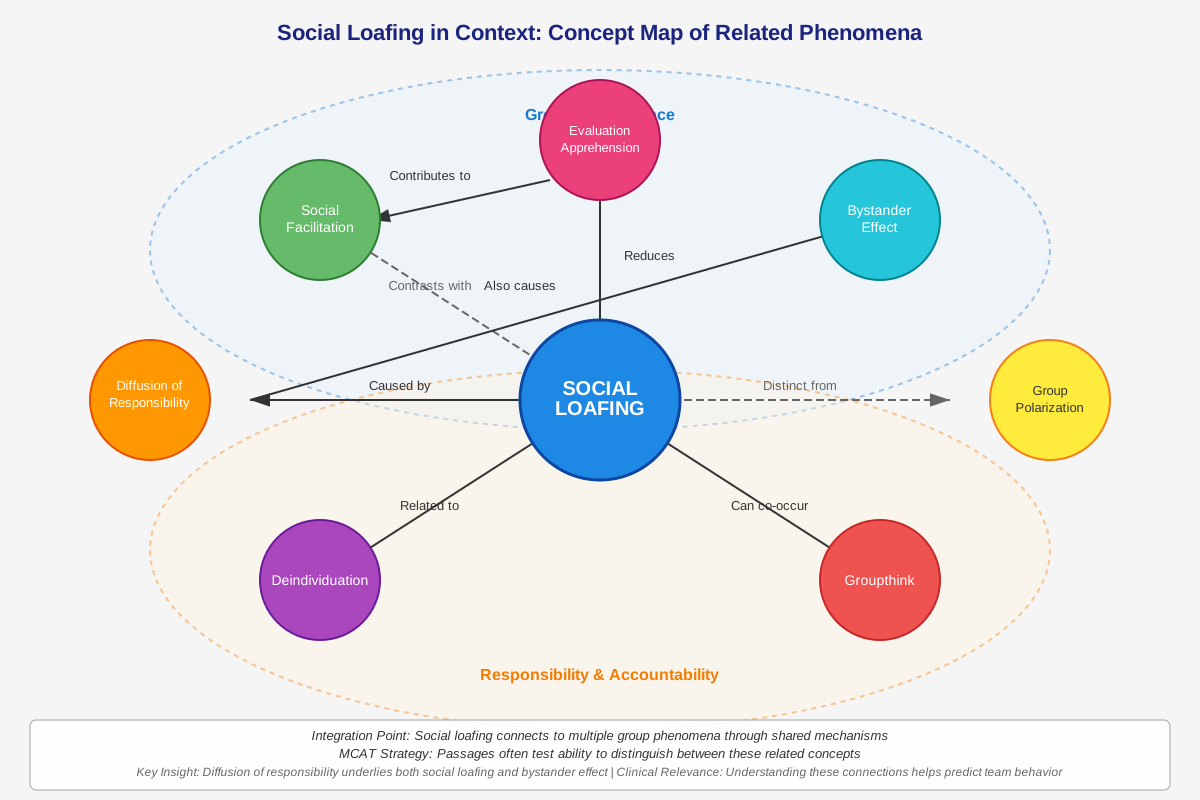
Social loafing exists within a network of interconnected group behavior concepts. The phenomenon directly contrasts with social facilitation, where the mere presence of others enhances performance on simple, well-learned tasks. While social facilitation involves individual task performance with an audience, social loafing specifically occurs during collective tasks where contributions are combined. Both phenomena demonstrate that social context fundamentally alters individual behavior, but in opposite directions depending on task structure and evaluation potential.
The relationship between social loafing and deindividuation involves shared mechanisms of reduced individual identifiability, but distinct outcomes. Deindividuation emphasizes loss of self-awareness and behavioral disinhibition (often leading to norm violations), while social loafing focuses specifically on motivational and effort reductions. Both increase in larger groups and anonymous contexts, but deindividuation affects behavior regulation broadly while social loafing specifically impacts task effort.
Diffusion of responsibility, a core mechanism in social loafing, also explains bystander effects in helping behavior. In both cases, the presence of others dilutes individual accountability, but social loafing applies to task performance while bystander effects apply to prosocial intervention. Understanding this shared mechanism helps predict when individuals will reduce contributions across different social contexts.
Social loafing connects to group polarization and groupthink through the broader theme of how groups alter individual psychology. While group polarization and groupthink affect decision-making and attitude formation, social loafing affects effort and motivation. All three demonstrate that group contexts can produce suboptimal outcomes, but through different mechanisms—conformity and consensus-seeking versus motivational losses.
The concept also relates to social identity theory: when group membership is central to self-concept, individuals are less likely to loaf because poor group performance threatens personal identity. This connection explains cultural differences in social loafing, as collectivistic cultures emphasize group identity more strongly than individualistic cultures.
Relationship map: Individual identifiability → reduces → Diffusion of responsibility → decreases → Social loafing → results in → Reduced group performance → can be prevented by → Accountability mechanisms → which increase → Individual identifiability (completing the cycle).
High-Yield Facts
⭐ Social loafing is the tendency for individuals to exert less effort when working collectively in a group compared to working alone on the same task.
⭐ Social loafing increases as group size increases because individual contributions become less identifiable and each person's impact on outcomes decreases.
⭐ The three primary mechanisms underlying social loafing are diffusion of responsibility, reduced evaluation apprehension, and decreased perceived self-efficacy.
⭐ Making individual contributions identifiable is the most effective intervention for reducing social loafing.
⭐ Social loafing is more pronounced in individualistic cultures (Western societies) than in collectivistic cultures (East Asian societies).
- The Ringelmann effect demonstrated that groups of eight people pulling a rope exerted only about 50% of their combined individual capacity.
- Social loafing occurs specifically in additive tasks where individual contributions are combined, not in tasks requiring coordination or unique contributions.
- Task meaningfulness and personal involvement significantly reduce social loafing; people loaf less on tasks they find important or interesting.
- Social loafing contrasts with social facilitation: facilitation improves performance on simple tasks with an audience, while loafing reduces effort in collective work.
- Group cohesion reduces social loafing because members feel greater commitment to teammates and group success.
- Free riding is related to but distinct from social loafing: free riding involves intentional exploitation of group membership, while social loafing may occur unconsciously.
- Smaller groups (2-4 members) experience significantly less social loafing than larger groups (8+ members).
Quick check — test yourself on Social loafing so far.
Try Flashcards →Common Misconceptions
Misconception: Social loafing and social facilitation are the same phenomenon because both involve the presence of others affecting performance.
Correction: These are opposite phenomena. Social facilitation occurs when the presence of others improves performance on simple tasks (individual work with an audience), while social loafing occurs when working collectively on group tasks reduces individual effort. The key distinction is whether the task is individual (facilitation) or collective (loafing).
Misconception: Social loafing always occurs whenever people work in groups.
Correction: Social loafing is not inevitable. It decreases or disappears when individual contributions are identifiable, tasks are meaningful, groups are small and cohesive, or cultural values emphasize collective responsibility. Many conditions can prevent or eliminate social loafing.
Misconception: Social loafing is the same as free riding, and both terms can be used interchangeably.
Correction: While related, these concepts differ in intentionality. Free riding involves deliberately minimizing contribution while benefiting from others' work—a conscious, strategic choice. Social loafing may occur unconsciously as a natural psychological response to reduced identifiability and diffused responsibility, without deliberate intent to exploit others.
Misconception: Social loafing only affects physical tasks like rope-pulling or clapping.
Correction: Social loafing occurs across diverse task types including cognitive tasks (brainstorming, problem-solving), creative tasks (generating ideas), and evaluative tasks (making judgments). Any additive task where individual contributions are combined can produce social loafing effects.
Misconception: Larger groups always perform worse than smaller groups because of social loafing.
Correction: While social loafing increases with group size, larger groups may still outperform smaller groups or individuals in absolute terms, especially on tasks requiring diverse skills or substantial effort. Social loafing means individuals contribute less per person, not that total group output is necessarily lower. Additionally, some tasks benefit from larger groups despite loafing effects.
Misconception: Social loafing is simply laziness or poor work ethic.
Correction: Social loafing is a situational phenomenon driven by psychological mechanisms (diffusion of responsibility, reduced identifiability) rather than stable personality traits. The same individual who loafs in one context will work hard in another context with different structural features. It reflects how situations shape behavior, not inherent laziness.
Worked Examples
Example 1: Research Study Analysis
Scenario: Researchers conduct an experiment where participants are asked to generate creative uses for a brick. In Condition A, participants work alone and their individual responses are recorded. In Condition B, participants work in groups of six, and the group collectively generates a list of uses. In Condition C, participants work in groups of six, but each person's contributions are identified with colored markers. Results show that Condition A produces an average of 12 uses per person, Condition B produces an average of 7 uses per person, and Condition C produces an average of 11 uses per person.
Question: Which condition demonstrates social loafing, and what explains the pattern of results?
Analysis:
Step 1: Identify the baseline individual performance. Condition A (working alone) shows 12 uses per person, establishing individual capability.
Step 2: Compare collective performance. Condition B (group work with anonymous contributions) shows only 7 uses per person—a 42% reduction from individual performance. This demonstrates social loafing because individuals exerted less effort in the collective task.
Step 3: Analyze the intervention condition. Condition C (group work with identified contributions) shows 11 uses per person—nearly returning to individual performance levels. This demonstrates that making contributions identifiable largely eliminates social loafing.
Step 4: Explain mechanisms. In Condition B, social loafing occurred due to reduced identifiability (contributions weren't attributed to individuals), diffusion of responsibility (each person felt less accountable), and decreased evaluation apprehension (no individual assessment). Condition C eliminated these factors by making contributions identifiable, restoring individual accountability and evaluation potential.
Answer: Condition B demonstrates social loafing. The pattern shows that anonymous group work reduces individual effort compared to working alone, but making individual contributions identifiable (Condition C) prevents social loafing by maintaining accountability and evaluation potential.
Connection to learning objectives: This example demonstrates how to apply social loafing concepts to experimental scenarios, identify when the phenomenon occurs, and recognize effective interventions—all common MCAT question types.
Example 2: Real-World Application
Scenario: A medical school assigns a group project where five students must create a presentation on cardiovascular physiology. The project is worth 10% of the final grade, and all group members receive the same grade. After the project, the professor notices that while the presentation was adequate, it lacked the depth and quality typically seen in individual assignments from these same students. Three students report doing most of the work, while two contributed minimally.
Question: Explain this outcome using social loafing theory and suggest three specific interventions to improve future group project performance.
Analysis:
Step 1: Identify social loafing indicators. The reduced quality compared to individual work and unequal contributions suggest social loafing occurred. Some students reduced effort in the collective task.
Step 2: Explain mechanisms. Multiple factors promoted social loafing: (1) identical grades for all members eliminated individual identifiability of contributions, (2) the moderate grade weight (10%) reduced task importance, (3) the five-person group size allowed contributions to become less visible, and (4) diffusion of responsibility meant no single person felt fully accountable for quality.
Step 3: Design interventions based on social loafing research:
Intervention 1—Individual accountability: Implement peer evaluations where each student rates teammates' contributions, with individual grades adjusted based on peer feedback. This makes contributions identifiable and maintains evaluation apprehension.
Intervention 2—Increase task meaningfulness: Increase the project's grade weight to 20% and have groups present to actual cardiology residents who provide feedback. This increases perceived importance and personal investment.
Intervention 3—Reduce group size: Limit groups to 2-3 students instead of five. Smaller groups make each person's contribution more visible and impactful, reducing diffusion of responsibility.
Answer: Social loafing occurred because the project structure reduced individual identifiability, accountability, and perceived importance. The three interventions target the core mechanisms of social loafing: establishing individual accountability through peer evaluation, increasing task meaningfulness through higher stakes and authentic audience, and reducing group size to maintain visibility of contributions.
Connection to learning objectives: This example demonstrates application to realistic scenarios, identification of social loafing in context, connection to underlying mechanisms, and generation of theory-based interventions—all valuable for MCAT passages involving group behavior in academic or professional settings.
Exam Strategy
When approaching MCAT questions on social loafing, employ these strategic approaches:
Trigger word recognition: Watch for phrases indicating collective work ("group project," "team effort," "working together"), reduced individual identifiability ("anonymous contributions," "combined output," "group grade"), or performance comparisons ("individual versus group performance," "effort in groups"). These signal potential social loafing questions.
Distinguish from related concepts: The MCAT frequently tests whether students can differentiate social loafing from similar phenomena. Use this decision tree:
- Is performance on an individual task with others watching? → Consider social facilitation/inhibition
- Is it about decision-making quality and consensus? → Consider groupthink
- Is it about loss of self-awareness and norm violations? → Consider deindividuation
- Is it about reduced effort in collective tasks? → Social loafing
Identify the mechanism: Higher-order questions require explaining why social loafing occurs. Always consider the three core mechanisms: diffusion of responsibility, reduced evaluation apprehension, and decreased perceived self-efficacy. Questions asking "why" or "what explains" typically want mechanism-level answers.
Predict conditions: Many questions present scenarios and ask whether social loafing will increase or decrease. Systematically evaluate: group size (larger = more loafing), identifiability (anonymous = more loafing), task importance (trivial = more loafing), and group cohesion (low = more loafing).
Process of elimination: When uncertain, eliminate answers that:
- Confuse social loafing with social facilitation (opposite effects)
- Suggest social loafing improves performance (it reduces individual effort)
- Claim social loafing is inevitable in all groups (it's situationally dependent)
- Attribute social loafing to stable personality traits rather than situational factors
Time allocation: Social loafing questions are typically straightforward once you recognize the concept. Spend 60-70 seconds on discrete questions, 90-120 seconds on passage-based questions. Don't overthink—if a scenario describes reduced effort in group work, social loafing is likely the answer.
Exam Tip: If a question describes an experiment comparing individual versus group performance and shows decreased per-person output in groups, social loafing is almost certainly the correct answer. The MCAT loves this classic experimental design.
Common question formats:
- Definition/identification: "Which of the following best describes social loafing?"
- Application: "Based on the passage, which condition would most likely reduce social loafing?"
- Mechanism: "What explains the decreased performance observed in the group condition?"
- Prediction: "In which scenario would social loafing be most pronounced?"
Memory Techniques
Mnemonic for conditions that INCREASE social loafing—"LATTE":
- Large groups (more people = more loafing)
- Anonymous contributions (can't identify who did what)
- Trivial tasks (unimportant work)
- Team gets same grade (no individual accountability)
- Effort seems dispensable (others can compensate)
Mnemonic for mechanisms—"DRE" (like "dread," which you might feel about group projects):
- Diffusion of responsibility
- Reduced evaluation apprehension
- Efficacy (perceived self-efficacy decreases)
Visualization strategy: Picture a tug-of-war rope (Ringelmann's original experiment). Imagine each person pulling with full strength when alone (bright, glowing rope), but when in a group, some people barely hold the rope (dim, faded sections). The larger the group, the more faded sections appear. This visual captures both the historical foundation and the core concept.
Contrast memory aid: Create a mental comparison chart:
- Social FACILITATION = Faster on simple tasks (alone with audience)
- Social LOAFING = Less effort in groups (collective work)
The first letters (F and L) remind you of the direction of effect (Faster vs. Less), and the context differs (alone vs. collective).
Acronym for interventions—"SIMS":
- Smaller groups
- Identifiable contributions
- Meaningful tasks
- Strong cohesion
Summary
Social loafing represents a fundamental principle of group behavior where individuals reduce effort when working collectively compared to working alone. This phenomenon, first documented through Ringelmann's rope-pulling experiments, occurs through three interconnected mechanisms: diffusion of responsibility across group members, reduced evaluation apprehension due to decreased identifiability, and diminished perceived self-efficacy regarding individual impact on outcomes. Social loafing increases with larger group sizes, anonymous contributions, trivial tasks, and low group cohesion, while decreasing when individual contributions are identifiable, tasks are meaningful, groups are small, and cohesion is high. The phenomenon contrasts with social facilitation (where others' presence enhances performance on individual tasks) and relates to broader concepts of group dynamics including deindividuation and diffusion of responsibility. For the MCAT, students must recognize social loafing in experimental and real-world scenarios, distinguish it from related phenomena, identify underlying mechanisms, and predict conditions that increase or decrease its occurrence. Effective interventions include establishing individual accountability, reducing group size, increasing task meaningfulness, and building group cohesion—all of which restore the connection between individual effort and outcomes.
Key Takeaways
- Social loafing is the reduction in individual effort when working collectively in groups compared to working alone, caused by diffusion of responsibility, reduced evaluation apprehension, and decreased perceived self-efficacy
- Social loafing increases with larger groups, anonymous contributions, trivial tasks, and low cohesion; it decreases with identifiable contributions, meaningful tasks, smaller groups, and high cohesion
- The phenomenon contrasts with social facilitation (improved performance on simple individual tasks with an audience) and must be distinguished from related concepts like free riding, groupthink, and deindividuation
- Making individual contributions identifiable is the most effective intervention for preventing social loafing by maintaining accountability and evaluation potential
- Social loafing is more pronounced in individualistic cultures than collectivistic cultures, demonstrating how cultural values moderate group behavior phenomena
- MCAT questions typically present experimental comparisons of individual versus group performance or real-world scenarios requiring prediction of when social loafing will occur
- Understanding the three core mechanisms (diffusion of responsibility, reduced evaluation apprehension, decreased perceived self-efficacy) enables explanation of why social loafing occurs and how to prevent it
Related Topics
Social facilitation and social inhibition: These complementary phenomena describe how the presence of others affects individual task performance—facilitation improves performance on simple tasks while inhibition impairs performance on complex tasks. Mastering social loafing provides foundation for understanding these contrasting effects of social presence.
Groupthink: This decision-making phenomenon shares with social loafing the theme of suboptimal group outcomes, but focuses on conformity pressure and consensus-seeking rather than effort reduction. Understanding both concepts provides comprehensive knowledge of how groups can underperform.
Deindividuation: This concept shares with social loafing the mechanism of reduced individual identifiability but focuses on loss of self-awareness and behavioral disinhibition. Comparing these phenomena deepens understanding of how anonymity affects behavior.
Bystander effect and diffusion of responsibility: These helping behavior concepts share the diffusion of responsibility mechanism with social loafing but apply to prosocial intervention rather than task performance. Understanding this shared mechanism across contexts strengthens conceptual mastery.
Group polarization: This phenomenon describes how group discussion intensifies initial attitudes, representing another way groups alter individual psychology. Together with social loafing and groupthink, it provides comprehensive understanding of group dynamics.
Organizational behavior and team dynamics: Social loafing connects to broader topics in organizational psychology, including team effectiveness, motivation theories, and workplace productivity—all relevant for understanding medical team functioning.
Practice CTA
Now that you've mastered the core concepts of social loafing, it's time to solidify your understanding through active practice. Challenge yourself with MCAT-style practice questions that test your ability to identify social loafing in experimental scenarios, distinguish it from related phenomena, and apply interventions to real-world situations. Use flashcards to reinforce the three core mechanisms, conditions that increase versus decrease loafing, and key distinctions from social facilitation. Remember: understanding social loafing isn't just about memorizing a definition—it's about recognizing patterns in group behavior and predicting outcomes based on situational factors. Your ability to analyze group dynamics will serve you both on test day and throughout your medical career. Keep pushing forward—you're building the foundation for excellence!
Sign up free to keep reading
Create a free AnvayaPrep account to finish this MCAT guide on Social loafing — plus flashcards and practice questions.