Overview
Nonmaterial culture represents one of the foundational concepts in Sociology that appears frequently on the MCAT, particularly within questions addressing Social Structure and Institutions. Unlike material culture, which encompasses the physical objects and artifacts that societies create, nonmaterial culture consists of the intangible aspects of society—the beliefs, values, norms, language, symbols, and knowledge systems that shape how people think, behave, and interact. Understanding this distinction is critical for MCAT success, as test questions often require students to differentiate between tangible and intangible cultural elements or to analyze how nonmaterial culture influences health behaviors, medical decision-making, and patient-provider interactions.
The MCAT Psychological, Social, and Biological Foundations of Behavior section regularly tests students' ability to recognize how nonmaterial cultural elements affect health outcomes, shape medical practices, and influence social institutions. Questions may present clinical vignettes where cultural beliefs impact treatment adherence, or passages discussing how societal values shape healthcare policy. The ability to quickly identify nonmaterial cultural components and understand their sociological implications can mean the difference between selecting a correct answer and falling for a distractor that confuses material and nonmaterial elements.
Mastering nonmaterial culture provides the conceptual foundation for understanding more complex sociological topics including socialization, social institutions, cultural change, and the relationship between culture and social structure. This topic connects directly to concepts such as cultural relativism, ethnocentrism, cultural transmission, and the mechanisms through which societies maintain social order. For medical professionals, recognizing nonmaterial cultural factors is essential for providing culturally competent care and understanding how patients' belief systems influence their health-seeking behaviors and treatment preferences.
Learning Objectives
- [ ] Define Nonmaterial culture using accurate Sociology terminology
- [ ] Explain why Nonmaterial culture matters for the MCAT
- [ ] Apply Nonmaterial culture to exam-style questions
- [ ] Identify common mistakes related to Nonmaterial culture
- [ ] Connect Nonmaterial culture to related Sociology concepts
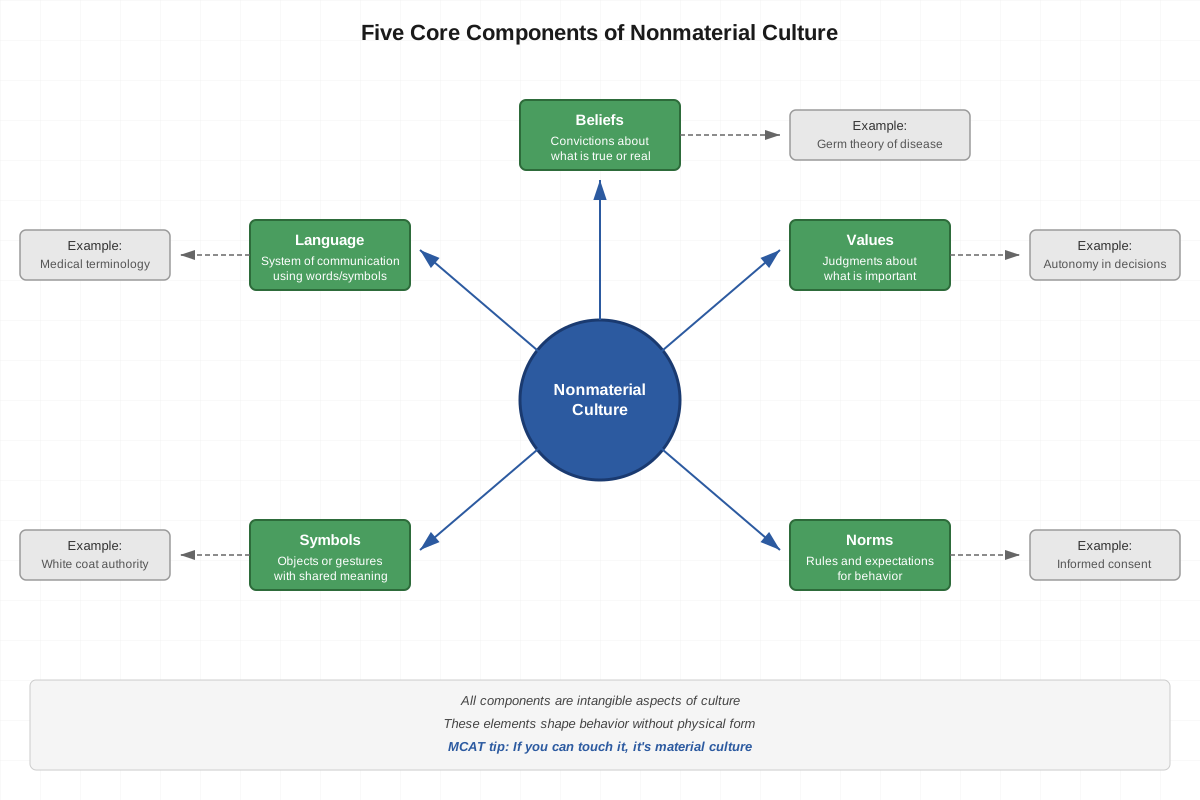
- [ ] Distinguish between the five major components of nonmaterial culture (beliefs, values, norms, symbols, and language)
- [ ] Analyze how nonmaterial culture influences health behaviors and medical decision-making in clinical scenarios
- [ ] Evaluate the relationship between nonmaterial culture and social institutions, particularly healthcare systems
Prerequisites
- Basic understanding of culture: Familiarity with culture as the shared way of life of a group of people is necessary to distinguish its material and nonmaterial components
- Social structure fundamentals: Knowledge of how societies organize themselves provides context for understanding how nonmaterial culture maintains social order
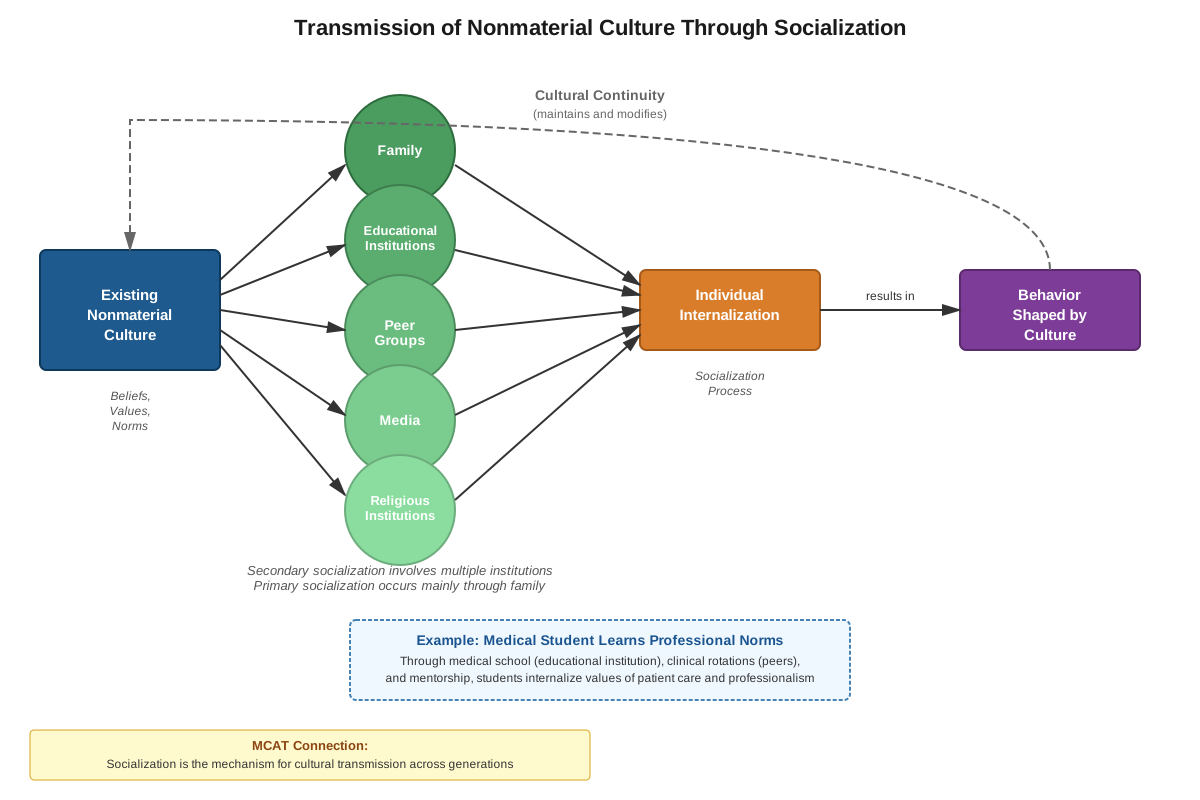
- Socialization concepts: Understanding how individuals learn cultural elements helps explain the transmission of nonmaterial culture across generations
- Basic symbolic interaction theory: Awareness that humans create and interpret symbols is foundational to understanding language and symbolic aspects of nonmaterial culture
Why This Topic Matters
Clinical and Real-World Significance
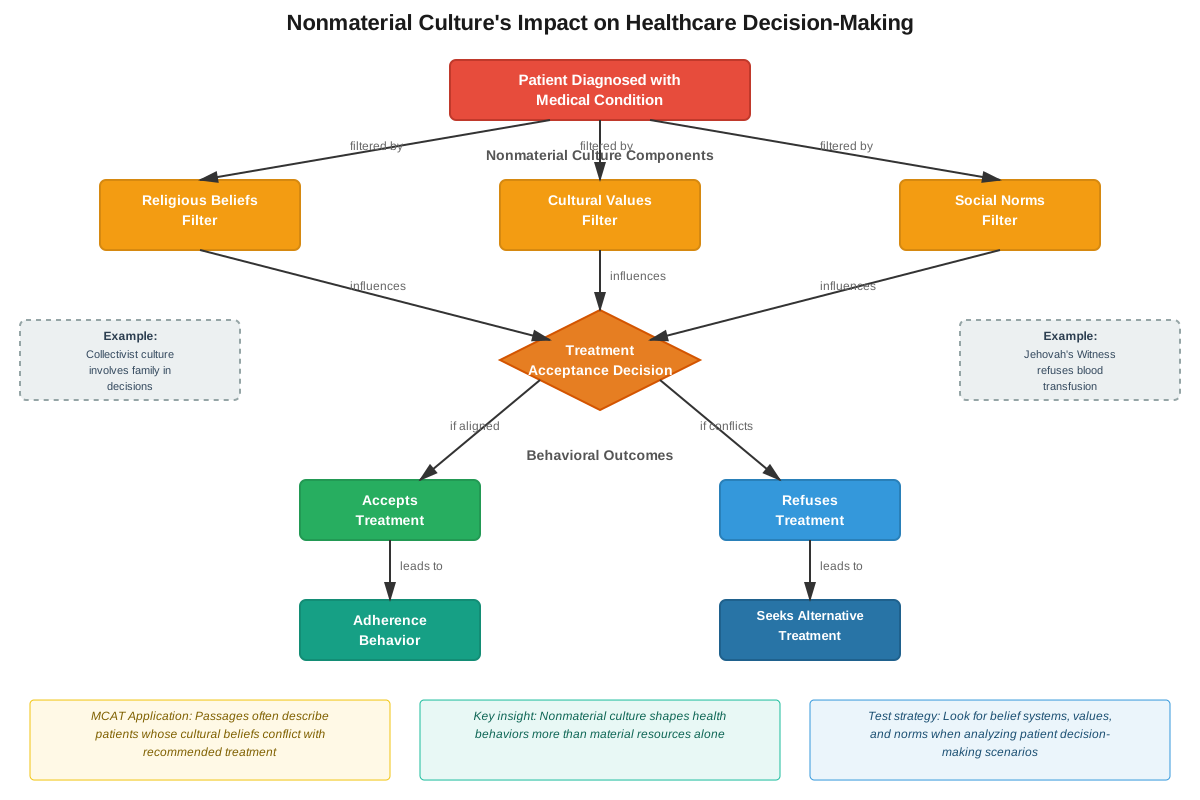
Nonmaterial culture directly impacts healthcare delivery and patient outcomes in numerous ways. A patient's religious beliefs (nonmaterial culture) may prohibit certain medical treatments, such as blood transfusions for Jehovah's Witnesses or organ transplantation in some religious traditions. Cultural values regarding family structure influence who participates in medical decision-making—some cultures prioritize family consensus over individual autonomy. Healthcare providers who fail to recognize these nonmaterial cultural factors risk poor patient compliance, miscommunication, and compromised therapeutic relationships. Understanding nonmaterial culture enables physicians to practice culturally competent medicine, which improves patient satisfaction, treatment adherence, and health outcomes across diverse populations.
MCAT Exam Statistics and Question Types
Nonmaterial culture appears in approximately 15-20% of Sociology questions on the MCAT, making it a high-yield topic. Questions typically fall into three categories: (1) definition and identification questions that require distinguishing nonmaterial from material culture, (2) application questions presenting clinical scenarios where students must identify how beliefs, values, or norms influence behavior, and (3) analysis questions that ask students to evaluate how changes in nonmaterial culture affect social institutions or health outcomes. The topic frequently appears in passage-based questions where students must analyze research studies examining cultural factors in health disparities or medical anthropology.
Common Exam Passage Contexts
MCAT passages featuring nonmaterial culture often present: research on health belief models and their influence on preventive care utilization; studies examining how cultural values affect end-of-life care preferences; analyses of how language barriers impact patient-provider communication; investigations of how social norms influence health behaviors like vaccination rates or mental health treatment-seeking; and discussions of how symbolic meanings attached to illness affect stigma and social support. Discrete questions may ask students to categorize cultural elements or predict how changes in values might affect healthcare institutions.
Core Concepts
Definition and Components of Nonmaterial Culture
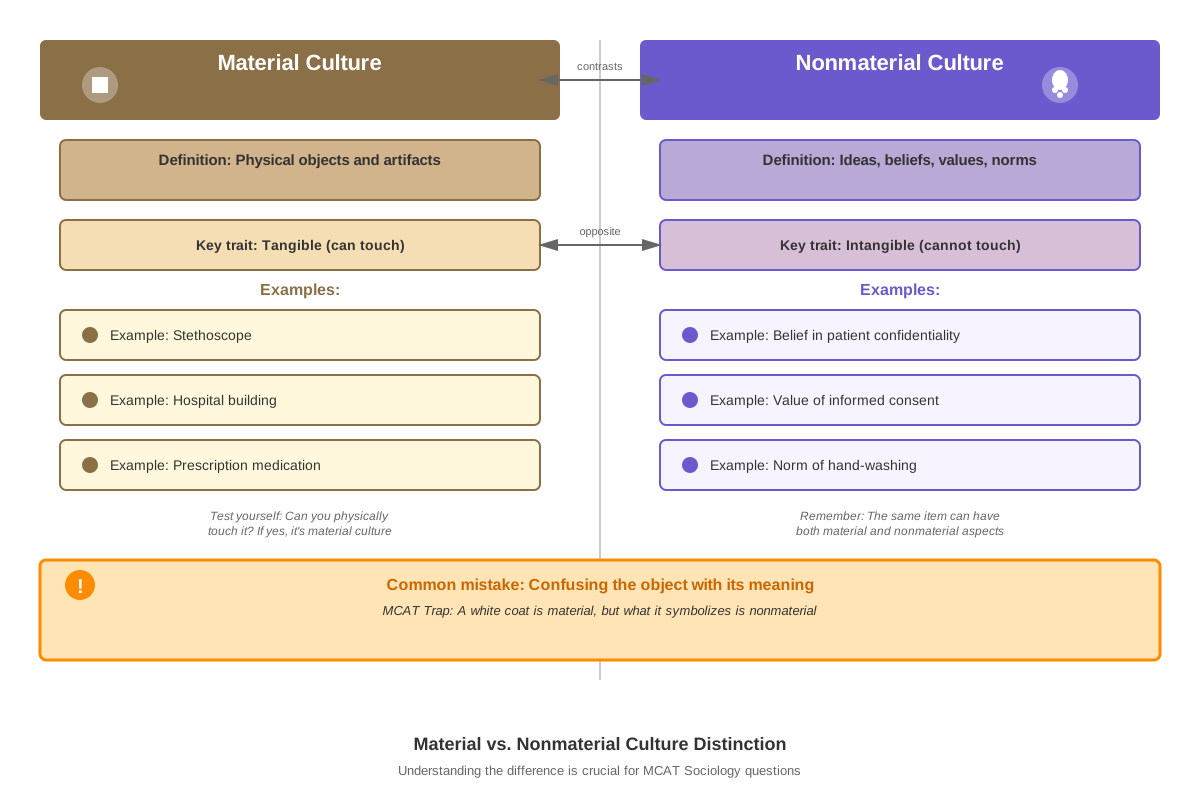
Nonmaterial culture refers to the intangible aspects of culture—the ideas, beliefs, values, norms, language, and symbols that exist in the minds of members of a society and guide their behavior. Unlike material culture (physical objects like medical equipment, buildings, or technology), nonmaterial culture cannot be touched or directly observed; it must be inferred from people's actions, communications, and social patterns. This distinction is fundamental for the MCAT, as questions often test whether students can correctly categorize cultural elements.
The five primary components of nonmaterial culture form an interconnected system:
1. Beliefs: Convictions or acceptances that certain things are true or real, whether or not they can be empirically verified. Medical beliefs might include ideas about disease causation (e.g., germ theory versus supernatural explanations), the efficacy of traditional versus Western medicine, or assumptions about the mind-body connection.
2. Values: Culturally defined standards about what is good, desirable, or important in a society. Healthcare-relevant values include individualism versus collectivism, the importance of life extension versus quality of life, privacy and confidentiality, and the value placed on scientific evidence versus traditional wisdom.
3. Norms: Rules and expectations that guide behavior in specific situations. Norms subdivide into folkways (informal norms with mild sanctions, like waiting room etiquette), mores (norms with strong moral significance and serious sanctions, like informed consent requirements), and laws (formalized norms enforced by government, like HIPAA regulations).
4. Language: A system of symbols (words, gestures, sounds) that allows people to communicate abstract ideas and transmit culture across generations. Medical terminology, patient-provider communication styles, and health literacy all involve language as nonmaterial culture.
5. Symbols: Anything that carries particular meaning recognized by members of a culture. In healthcare, symbols include the caduceus representing medicine, the color white representing cleanliness and sterility, or cultural symbols that patients may wear or display that have health-related meanings.
Nonmaterial Culture Versus Material Culture
Understanding the distinction between nonmaterial and material culture is essential for MCAT success:
| Aspect | Nonmaterial Culture | Material Culture |
|---|---|---|
| Nature | Intangible, abstract, exists in minds | Tangible, physical, can be touched |
| Examples | Beliefs, values, norms, language, symbols | Medical equipment, hospital buildings, medications |
| Transmission | Through socialization, communication, observation | Through physical creation and distribution |
| Change Rate | Can change rapidly or persist for centuries | Often changes with technology |
| Observation | Inferred from behavior and communication | Directly observable |
| Healthcare Examples | Belief in patient autonomy, value of informed consent | Stethoscopes, MRI machines, prescription pads |
MCAT Exam Tip: When a question asks about culture, first determine whether the element described is tangible (material) or intangible (nonmaterial). The physical manifestation of a belief is material culture, but the belief itself is nonmaterial.
The Relationship Between Beliefs, Values, and Norms
These three components of nonmaterial culture exist in a hierarchical relationship. Values are the broadest, most abstract cultural standards (e.g., "health is important"). Beliefs are specific convictions about how the world works that support values (e.g., "preventive care maintains health"). Norms are the specific behavioral expectations that operationalize beliefs and values (e.g., "people should get annual check-ups"). This hierarchy explains why changing norms is often easier than changing deeply held values, and why cultural conflicts often arise when norms based on different value systems come into contact.
In medical contexts, this hierarchy manifests clearly: A culture that values collectivism (value) may hold beliefs that family welfare supersedes individual preferences (belief), leading to norms where families make medical decisions collectively rather than deferring to patient autonomy (norm). Understanding this progression helps predict how cultural groups might respond to medical situations.
Functions of Nonmaterial Culture
Nonmaterial culture serves several critical sociological functions that MCAT questions may address:
- Social cohesion: Shared beliefs, values, and norms create solidarity and group identity, helping societies function cohesively
- Behavioral guidance: Norms provide clear expectations for appropriate behavior in various situations, reducing uncertainty
- Meaning-making: Symbols and language allow people to interpret experiences and create shared understanding
- Social control: Norms and values, enforced through sanctions, maintain social order without constant use of formal authority
- Cultural transmission: Language and symbols enable the passing of knowledge, traditions, and practices across generations
- Adaptation: Nonmaterial culture allows societies to develop solutions to environmental and social challenges
Cultural Lag and Nonmaterial Culture
Cultural lag occurs when material culture changes more rapidly than nonmaterial culture, creating social problems and tensions. This concept, developed by sociologist William Ogburn, is particularly relevant in healthcare. For example, reproductive technologies (material culture) have advanced rapidly, but societal values and norms (nonmaterial culture) regarding issues like surrogacy, genetic selection, and embryo disposition have not kept pace, creating ethical dilemmas and legal uncertainties. MCAT questions may present scenarios where technological advances outpace cultural adaptation, asking students to identify the resulting social tensions.
Nonmaterial Culture and Social Institutions
Social institutions—organized patterns of beliefs and behaviors centered on basic social needs—are fundamentally shaped by nonmaterial culture. The healthcare institution reflects cultural values (e.g., whether healthcare is viewed as a right or commodity), operates according to cultural norms (e.g., professional standards of care), and uses specialized language and symbols (e.g., medical terminology, professional credentials). Changes in nonmaterial culture can transform institutions: shifting values regarding mental health have reduced stigma and expanded mental healthcare services, while changing norms around informed consent have restructured patient-provider relationships.
Concept Relationships
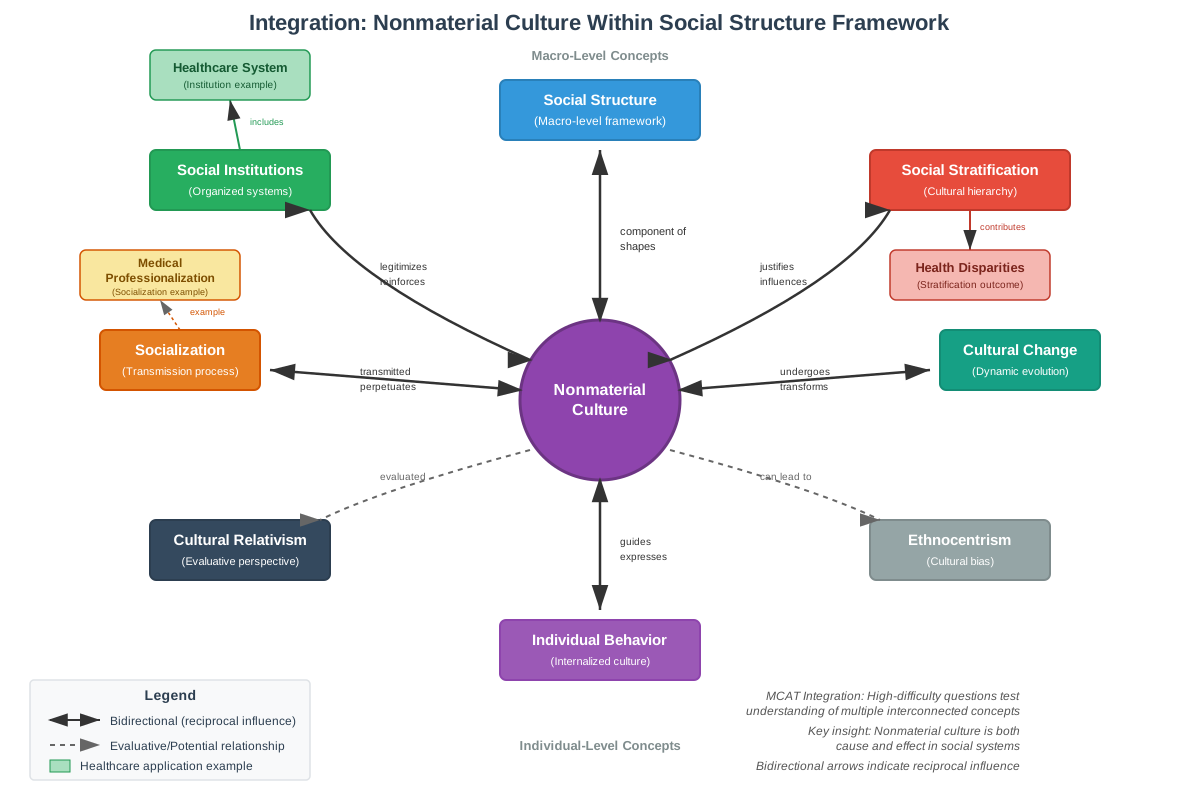
Nonmaterial culture forms the conceptual foundation for understanding how societies function and maintain order. The five components of nonmaterial culture (beliefs, values, norms, language, and symbols) are interconnected: values generate beliefs about how the world works, which in turn produce norms that guide behavior. Language and symbols enable the communication and transmission of values, beliefs, and norms across individuals and generations.
This topic connects directly to socialization, the process through which individuals learn their culture's nonmaterial elements. Through socialization agents (family, education, peers, media), people internalize values, learn norms, acquire language, and understand symbols. The relationship flows: nonmaterial culture → socialization → internalized cultural knowledge → culturally appropriate behavior.
Nonmaterial culture also connects to social structure, as cultural norms and values shape how societies organize themselves into hierarchies, institutions, and groups. The relationship is bidirectional: social structure ← → nonmaterial culture. Social structures both reflect and reinforce cultural values, while changes in nonmaterial culture can transform social structures.
The concept links to cultural relativism (understanding cultures on their own terms) and ethnocentrism (judging other cultures by one's own standards), as these perspectives determine how people evaluate different nonmaterial cultural systems. Understanding nonmaterial culture is prerequisite to analyzing cultural change, subcultures, countercultures, and multiculturalism.
In healthcare contexts, the relationship map looks like: Cultural values → Health beliefs → Health behaviors → Health outcomes. Simultaneously, Cultural norms → Healthcare institutions → Medical practices → Patient experiences. These pathways explain health disparities and guide culturally competent care.
High-Yield Facts
⭐ Nonmaterial culture consists of five main components: beliefs, values, norms, language, and symbols—all intangible elements that guide behavior and create shared meaning.
⭐ Norms are subdivided into three categories: folkways (informal, mild sanctions), mores (strong moral significance, serious sanctions), and laws (formalized, government-enforced).
⭐ Material culture refers to physical objects, while nonmaterial culture refers to intangible ideas, beliefs, and values—this distinction is frequently tested on the MCAT.
⭐ Cultural lag occurs when material culture changes faster than nonmaterial culture, creating social tensions particularly evident in medical ethics and healthcare technology.
⭐ Values are broader and more abstract than beliefs, which are more specific convictions; norms are the behavioral expectations that operationalize beliefs and values.
- Language is a component of nonmaterial culture that enables abstract thought, cultural transmission, and the creation of shared meaning within societies.
- Symbols carry culturally specific meanings that may not be understood by outsiders, making them important markers of cultural identity and group membership.
- Nonmaterial culture is transmitted through socialization and can persist across many generations, even when material conditions change dramatically.
- Healthcare institutions reflect the nonmaterial culture of their societies, including values about life, death, autonomy, and the role of medicine.
- Changes in nonmaterial culture (such as shifting values regarding mental health) can transform social institutions and reduce health-related stigma.
- Cultural competence in medicine requires understanding patients' nonmaterial culture, including their health beliefs, values, and norms regarding medical care.
- Sanctions (rewards and punishments) enforce norms and can be formal (legal penalties) or informal (social disapproval), maintaining social order.
Quick check — test yourself on Nonmaterial culture so far.
Try Flashcards →Common Misconceptions
Misconception: Nonmaterial culture only includes beliefs and values, not language or symbols.
Correction: Nonmaterial culture encompasses five major components: beliefs, values, norms, language, and symbols. Language and symbols are crucial intangible elements that enable communication and meaning-making within cultures.
Misconception: A hospital building is nonmaterial culture because it's part of the healthcare institution.
Correction: The physical hospital building is material culture (tangible object). The nonmaterial culture includes the values, beliefs, norms, and practices that govern how the hospital operates and how healthcare is delivered within it.
Misconception: Nonmaterial culture is less important than material culture because it's intangible.
Correction: Nonmaterial culture is arguably more fundamental than material culture because it shapes how people think, behave, and create material objects. Values and beliefs determine what material culture is created and how it's used.
Misconception: All norms have the same level of importance and consequences for violation.
Correction: Norms exist on a continuum from folkways (informal, minor consequences) to mores (serious moral significance, major consequences) to laws (formalized, legal penalties). Violating a folkway might result in mild social disapproval, while violating a more or law results in serious sanctions.
Misconception: Nonmaterial culture is static and unchanging within a society.
Correction: Nonmaterial culture is dynamic and can change over time, though often more slowly than material culture. Values, beliefs, and norms evolve in response to social movements, technological changes, contact with other cultures, and generational shifts.
Misconception: The written form of language (books, documents) is nonmaterial culture.
Correction: The physical books and documents are material culture, while the language system itself—the grammar, vocabulary, and meanings—is nonmaterial culture. The distinction is between the physical medium and the intangible system of communication.
Misconception: Cultural lag always resolves quickly as nonmaterial culture catches up to material culture.
Correction: Cultural lag can persist for extended periods, sometimes decades or longer, as societies struggle to develop appropriate values, norms, and institutions to address new technologies. Some cultural lags may never fully resolve if material culture continues advancing rapidly.
Worked Examples
Example 1: Distinguishing Material from Nonmaterial Culture in Healthcare
Question: A medical anthropologist studies how different cultures approach end-of-life care. She observes that in Culture A, families gather at the bedside, pray together, and make collective decisions about withdrawing life support, believing that death is a communal experience. In Culture B, individuals typically complete advance directives specifying their wishes, and medical decisions rest with the patient or their designated proxy, reflecting a belief in individual autonomy. The anthropologist also notes differences in hospital room designs, with Culture A having larger rooms to accommodate family gatherings and Culture B having smaller, more private rooms.
Identify which elements represent nonmaterial culture and which represent material culture.
Solution:
Step 1: Identify all cultural elements mentioned in the scenario.
- Families gathering at bedside
- Prayer practices
- Collective decision-making
- Belief that death is communal
- Advance directives (as documents)
- Individual decision-making
- Belief in individual autonomy
- Hospital room designs and sizes
Step 2: Apply the definition of nonmaterial culture (intangible ideas, beliefs, values, norms) versus material culture (tangible physical objects).
Nonmaterial culture elements:
- Belief that death is a communal experience (Culture A) - This is an intangible belief about the nature of death
- Belief in individual autonomy (Culture B) - This is an intangible value about personal rights
- Collective decision-making norm (Culture A) - This is a behavioral expectation (norm) about who participates in decisions
- Individual decision-making norm (Culture B) - This is a norm about decision-making authority
- Prayer practices - While prayer involves physical actions, the practice itself represents religious beliefs and values (nonmaterial)
Material culture elements:
- Hospital room designs and sizes - These are physical structures (tangible)
- Advance directive documents - The physical papers are material culture (though the concept of advance directives and the values they represent are nonmaterial)
Step 3: Connect to learning objectives.
This example demonstrates how nonmaterial culture (beliefs about death, values regarding autonomy versus collectivism, norms about decision-making) directly influences health behaviors and medical practices. It also shows how material culture (hospital design) often reflects and accommodates nonmaterial cultural values. For MCAT questions, the key is distinguishing the intangible ideas from their physical manifestations.
Example 2: Analyzing Cultural Lag in Medical Technology
Question: A passage describes how in vitro fertilization (IVF) and preimplantation genetic diagnosis (PGD) now allow parents to screen embryos for genetic diseases before implantation. However, there is significant societal disagreement about whether it's ethical to select embryos based on non-disease traits like sex or physical characteristics. Some argue this represents "designer babies" and violates natural processes, while others contend it's a legitimate extension of parental choice. Legal regulations vary widely between countries, with some banning trait selection and others allowing it. The passage asks: What sociological concept best explains the tension between technological capability and societal uncertainty about its appropriate use?
Solution:
Step 1: Identify the key elements in the scenario.
- Advanced reproductive technology (IVF, PGD) exists and is functional
- Society lacks consensus on ethical use of this technology
- Values conflict exists (natural processes vs. parental choice)
- Legal/normative frameworks are inconsistent and still developing
Step 2: Recognize the pattern of material versus nonmaterial culture change.
- Material culture (reproductive technology) has advanced rapidly and now provides capabilities that didn't exist previously
- Nonmaterial culture (values about appropriate use, ethical norms, legal regulations) has not kept pace with technological advancement
- This creates a gap between what is technologically possible and what is socially acceptable or normatively regulated
Step 3: Apply the concept of cultural lag.
This scenario exemplifies cultural lag—the phenomenon where material culture changes more rapidly than nonmaterial culture, creating social tensions and normative uncertainty. The technology (material culture) has outpaced society's ability to develop shared values, ethical norms, and legal frameworks (nonmaterial culture) to govern its use.
Step 4: Explain the sociological implications.
Cultural lag in medical technology creates several problems:
- Ethical uncertainty: Without clear normative guidance, individuals and practitioners face difficult decisions without societal consensus
- Legal inconsistency: Different jurisdictions develop conflicting regulations, creating inequality and "medical tourism"
- Social conflict: Groups with different values clash over appropriate technology use
- Institutional strain: Healthcare institutions must develop policies without clear cultural guidelines
Step 5: Connect to MCAT relevance.
MCAT questions on cultural lag typically present scenarios where technology has advanced but social norms haven't adapted, then ask students to identify the sociological concept or predict social consequences. Key trigger phrases include "technological advancement," "ethical uncertainty," "lack of consensus," and "varying regulations." The correct answer will identify cultural lag and recognize that nonmaterial culture (values, norms, laws) changes more slowly than material culture (technology).
Exam Strategy
Approaching MCAT Questions on Nonmaterial Culture
Step 1: Identify whether the question asks about material or nonmaterial culture. Read carefully to determine if the question focuses on tangible objects (material) or intangible ideas, beliefs, values, or norms (nonmaterial). Many distractor answers will confuse these categories.
Step 2: When analyzing scenarios, separate behaviors from the underlying cultural elements. Behaviors are observable manifestations of nonmaterial culture. The MCAT often asks you to identify the nonmaterial cultural element (belief, value, norm) that explains an observed behavior.
Step 3: Use the hierarchy: values → beliefs → norms. If a question asks about the relationship between cultural elements, remember that values are most abstract and fundamental, beliefs are specific convictions that support values, and norms are behavioral expectations that operationalize beliefs.
Trigger Words and Phrases
Watch for these terms that signal nonmaterial culture questions:
- "Cultural beliefs about..." or "cultural values regarding..."
- "Social norms governing..." or "behavioral expectations"
- "Symbolic meaning" or "cultural significance"
- "Language barriers" or "communication systems"
- "Intangible aspects of culture"
- "Shared understanding" or "collective meaning"
- "Cultural transmission" or "socialization into..."
Phrases suggesting cultural lag:
- "Technological advancement has outpaced..."
- "Society has not yet developed norms for..."
- "Ethical uncertainty surrounding new..."
- "Lack of consensus about appropriate use..."
Process-of-Elimination Tips
Eliminate answers that confuse material and nonmaterial culture: If the question asks about nonmaterial culture, eliminate any answer choice that describes physical objects, even if those objects have cultural significance.
Eliminate answers that confuse the hierarchy: If a question asks about values, eliminate answers that describe specific norms or behaviors rather than broad cultural standards.
Eliminate answers that ignore cultural context: Nonmaterial culture is always specific to particular societies or groups. Eliminate answers that suggest universal, biological, or instinctive explanations when the question asks about cultural factors.
Watch for answers that oversimplify: Nonmaterial culture is complex and multifaceted. Eliminate answers that suggest single-cause explanations when multiple cultural factors likely interact.
Time Allocation Advice
Nonmaterial culture questions typically require 60-90 seconds. Spend:
- 20-30 seconds carefully reading the question and identifying whether it asks about material or nonmaterial culture
- 20-30 seconds analyzing the scenario to identify relevant cultural elements (beliefs, values, norms, symbols, language)
- 20-30 seconds evaluating answer choices and eliminating distractors
For passage-based questions, invest time understanding the cultural context presented in the passage, as multiple questions may test your understanding of the same cultural elements from different angles.
Memory Techniques
Mnemonic for Components of Nonmaterial Culture
"Big Values Need Language and Symbols"
- Beliefs
- Values
- Norms
- Language
- Symbols
Mnemonic for Types of Norms
"FML" (from least to most serious consequences)
- Folkways (informal, mild sanctions)
- Mores (moral significance, serious sanctions)
- Laws (formalized, legal penalties)
Visualization Strategy for Material vs. Nonmaterial
The "Touch Test": Visualize yourself reaching out to touch the cultural element in question. If you can physically touch it (a stethoscope, a hospital, a medication), it's material culture. If you cannot touch it because it exists only as an idea (a belief about health, a value of autonomy, a norm about confidentiality), it's nonmaterial culture.
Hierarchy Visualization
Picture a pyramid with three levels:
- Top (smallest, most abstract): VALUES - broad cultural standards
- Middle: BELIEFS - specific convictions supporting values
- Bottom (largest, most concrete): NORMS - specific behavioral expectations
This visual helps remember that values are foundational and abstract, while norms are numerous and specific.
Cultural Lag Visualization
Imagine two runners on a track:
- Material Culture Runner: Fast, athletic, constantly pulling ahead
- Nonmaterial Culture Runner: Slower, struggling to keep up, creating an increasing gap
The gap between them represents cultural lag—the social tension created when technology advances faster than values and norms can adapt.
Summary
Nonmaterial culture encompasses the intangible aspects of society—beliefs, values, norms, language, and symbols—that shape how people think, behave, and interact. Unlike material culture (physical objects), nonmaterial culture exists in the minds of society members and must be inferred from behavior and communication. The five components exist in relationship: values (broad cultural standards) generate beliefs (specific convictions), which produce norms (behavioral expectations), all communicated through language and symbols. Norms range from informal folkways to serious mores to formalized laws. Cultural lag occurs when material culture (especially technology) advances faster than nonmaterial culture, creating ethical uncertainty and social tension particularly evident in medical contexts. For the MCAT, students must distinguish material from nonmaterial culture, understand how nonmaterial cultural elements influence health behaviors and medical decision-making, recognize cultural lag in healthcare scenarios, and apply these concepts to analyze patient-provider interactions and health disparities. Mastering nonmaterial culture provides the foundation for understanding socialization, social institutions, cultural competence in medicine, and the relationship between culture and social structure.
Key Takeaways
- Nonmaterial culture consists of five intangible components: beliefs, values, norms, language, and symbols that guide behavior and create shared meaning within societies
- The material/nonmaterial distinction is frequently tested: material culture includes physical objects you can touch; nonmaterial culture includes intangible ideas, beliefs, and values
- Norms exist on a continuum of seriousness: folkways (informal) → mores (moral significance) → laws (formalized), with increasingly serious sanctions for violations
- Cultural lag creates healthcare ethics dilemmas: when medical technology (material culture) advances faster than societal values and norms (nonmaterial culture) can adapt
- Nonmaterial culture directly impacts health outcomes: patients' beliefs, values, and norms influence treatment adherence, health-seeking behaviors, and medical decision-making
- Values → beliefs → norms hierarchy: values are most abstract and fundamental, beliefs are specific convictions, norms are concrete behavioral expectations
- Cultural competence requires understanding nonmaterial culture: effective healthcare providers recognize how patients' intangible cultural elements shape their medical experiences and preferences
Related Topics
Socialization: The process through which individuals learn and internalize their culture's nonmaterial elements, including values, beliefs, norms, language, and symbols. Mastering nonmaterial culture enables deeper understanding of how socialization agents transmit culture.
Social Institutions: Organized patterns of beliefs and behaviors centered on basic social needs (healthcare, education, family, religion, economy). Understanding nonmaterial culture is essential for analyzing how institutions reflect and reinforce cultural values and norms.
Cultural Relativism and Ethnocentrism: Perspectives on evaluating cultures—either on their own terms (relativism) or through the lens of one's own culture (ethnocentrism). These concepts build directly on understanding nonmaterial culture.
Symbolic Interactionism: A theoretical perspective emphasizing how people create and interpret symbols to construct social reality. This theory explains how nonmaterial culture (especially symbols and language) shapes human interaction.
Cultural Change and Diffusion: Processes through which nonmaterial culture evolves over time and spreads between societies. Understanding nonmaterial culture's components is prerequisite to analyzing how and why cultures change.
Health Belief Model: A framework explaining how beliefs, values, and perceived barriers influence health behaviors. This applied model directly incorporates nonmaterial cultural elements to predict and modify health-related actions.
Practice CTA
Now that you've mastered the core concepts of nonmaterial culture, it's time to reinforce your learning through active practice. Challenge yourself with MCAT-style practice questions that test your ability to distinguish material from nonmaterial culture, identify cultural lag in medical scenarios, and analyze how beliefs, values, and norms influence health behaviors. Use flashcards to memorize the five components of nonmaterial culture and the three types of norms. The more you practice applying these concepts to clinical vignettes and research scenarios, the more automatic your recognition will become on test day. Remember: understanding nonmaterial culture isn't just about memorizing definitions—it's about developing the analytical skills to recognize how intangible cultural elements shape human behavior in healthcare contexts. You've built a strong foundation; now solidify it through deliberate practice!
Sign up free to keep reading
Create a free AnvayaPrep account to finish this MCAT guide on Nonmaterial culture — plus flashcards and practice questions.