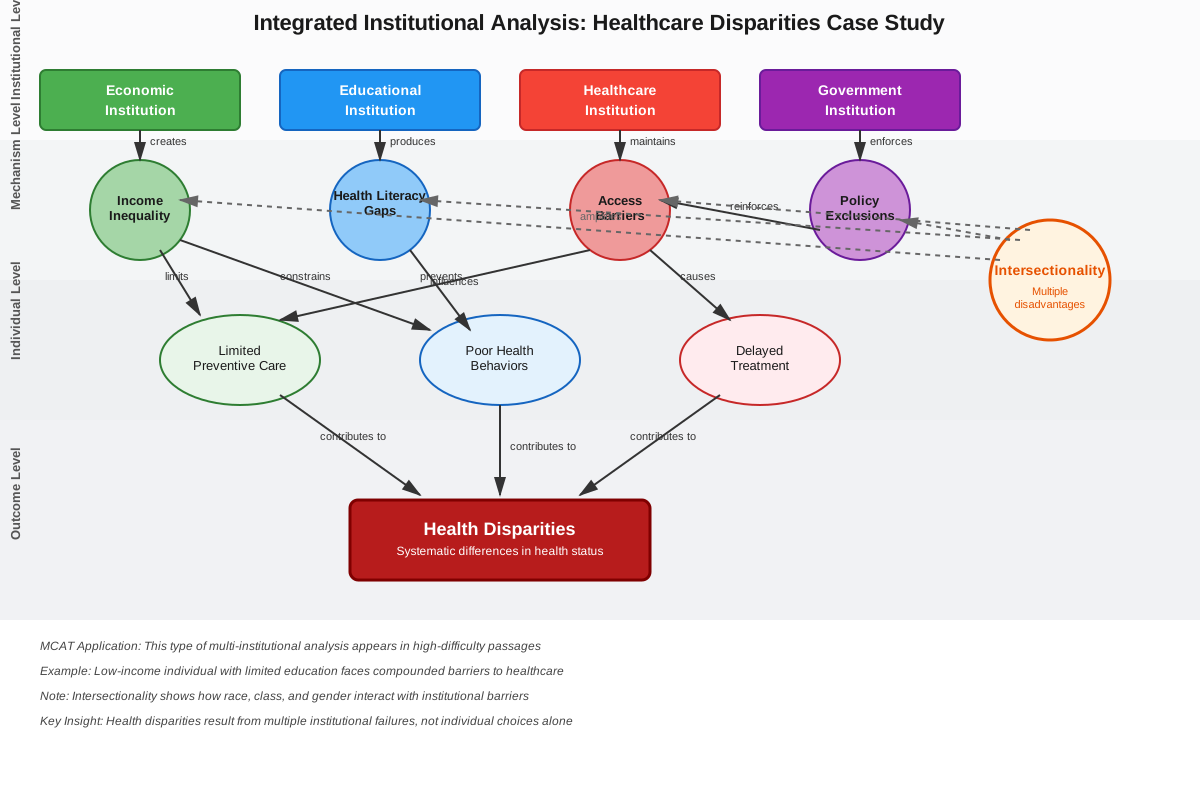
Overview
Institutions are fundamental building blocks of society that organize and structure human behavior across generations. In Sociology, institutions represent established patterns of behavior, norms, values, and social structures that fulfill essential societal needs. These complex systems—including family, education, religion, government, economy, healthcare, and media—shape individual experiences and collective outcomes in profound ways. Understanding institutions is critical for the MCAT because they directly influence health behaviors, access to healthcare, disease patterns, and health disparities that appear frequently in Psychological, Social, and Biological Foundations of Behavior passages.
For MCAT preparation, institutions serve as a lens through which to analyze how society organizes itself to meet fundamental needs such as reproduction, socialization, resource distribution, social order, and meaning-making. The exam frequently tests how institutional structures create inequalities, perpetuate or challenge social stratification, and impact individual health outcomes. Questions may present scenarios involving educational disparities affecting health literacy, religious beliefs influencing medical decisions, or economic institutions creating barriers to healthcare access.
The concept of institutions connects intimately with broader themes in Social Structure and Institutions, including social inequality, social mobility, demographic shifts, and organizational behavior. Institutions both reflect and reinforce existing power structures while simultaneously serving as sites of social change. Mastering this topic enables students to analyze complex societal phenomena, understand how macro-level structures influence micro-level interactions, and recognize the institutional determinants of health—all essential skills for MCAT success and future medical practice.
Learning Objectives
- [ ] Define Institutions using accurate Sociology terminology
- [ ] Explain why Institutions matters for the MCAT
- [ ] Apply Institutions to exam-style questions
- [ ] Identify common mistakes related to Institutions
- [ ] Connect Institutions to related Sociology concepts
- [ ] Distinguish between the five major social institutions and their primary functions
- [ ] Analyze how institutions perpetuate social inequality and stratification
- [ ] Evaluate the relationship between institutional change and social change
- [ ] Apply institutional analysis to healthcare disparities and health outcomes
Prerequisites
- Basic sociological terminology: Understanding terms like norms, values, roles, and status provides the foundation for comprehending how institutions organize these elements into coherent systems
- Social structure concepts: Familiarity with how society organizes relationships and positions enables recognition of institutions as macro-level structural components
- Socialization processes: Knowledge of how individuals learn societal expectations helps explain how institutions transmit culture across generations
- Functionalist perspective basics: Understanding that social phenomena serve purposes in maintaining society provides context for analyzing institutional functions
Why This Topic Matters
Institutions represent one of the highest-yield topics in MCAT Sociology because they appear across multiple question types and integrate with numerous other concepts. Medical schools recognize that physicians must understand how institutional forces shape patient experiences, health behaviors, and healthcare outcomes. Questions about institutions appear in approximately 15-20% of sociology passages on the MCAT, making this topic essential for competitive scoring.
In clinical contexts, institutional analysis helps future physicians recognize that individual health behaviors occur within larger structural contexts. For example, understanding educational institutions explains why patients with limited formal education may struggle with medication adherence or health literacy. Recognizing how economic institutions create employment patterns illuminates why shift workers face particular health challenges. Appreciating religious institutions' influence helps physicians provide culturally competent care that respects patients' belief systems.
The MCAT frequently presents passages describing health disparities, healthcare access barriers, or population health patterns that require institutional analysis. Questions may ask students to identify which institution most directly influences a described outcome, explain how institutional change might address a health problem, or recognize how multiple institutions interact to produce observed patterns. Discrete questions often test knowledge of specific institutional functions, the relationship between institutions and social stratification, or how institutions maintain social order while enabling social change.
Core Concepts
Definition and Characteristics of Institutions
Institutions are complex, integrated sets of social norms, roles, values, and structures organized around the satisfaction of important social needs. Unlike organizations (which are concrete groups with specific memberships), institutions represent abstract patterns of behavior and belief that transcend individual organizations. For example, "education" as an institution encompasses not just schools but the entire system of values, norms, and practices surrounding knowledge transmission—including homeschooling, apprenticeships, online learning, and informal mentorship.
Key characteristics distinguish institutions from other social phenomena:
- Persistence over time: Institutions endure across generations, though their specific forms evolve
- Legitimacy: Society recognizes institutions as appropriate and necessary ways to meet needs
- Internalization: Individuals incorporate institutional norms and values into their identities
- Interconnection: Institutions influence and depend upon one another in complex ways
- Resistance to change: Institutional structures tend toward stability and resist rapid transformation
Institutions operate at the macro level of sociological analysis, meaning they represent large-scale social patterns that shape individual experiences. This distinguishes them from micro-level interactions (face-to-face encounters) and meso-level organizations (specific groups and associations).
The Five Major Social Institutions
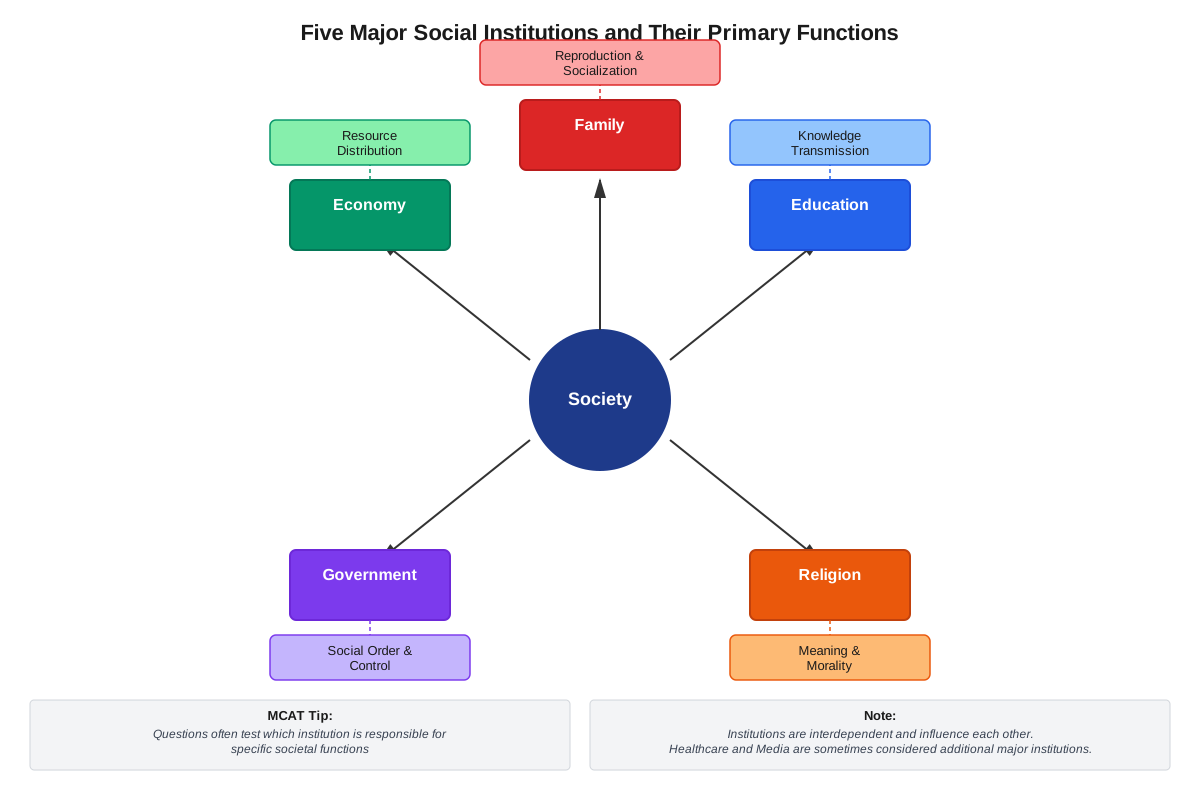
Sociologists identify five primary institutions that fulfill fundamental societal needs:
| Institution | Primary Functions | Key Organizations | MCAT Relevance |
|---|---|---|---|
| Family | Reproduction, socialization, emotional support, economic cooperation | Nuclear families, extended families, kinship networks | Childhood development, health behaviors, caregiving, social support |
| Education | Knowledge transmission, socialization, social placement, cultural innovation | Schools, universities, training programs | Health literacy, socioeconomic mobility, professional socialization |
| Religion | Meaning-making, moral guidance, social cohesion, emotional comfort | Churches, temples, mosques, spiritual communities | End-of-life decisions, health beliefs, coping mechanisms, community support |
| Government/Political | Social order, resource distribution, conflict resolution, collective decision-making | Legislative bodies, courts, regulatory agencies | Healthcare policy, public health, medical regulation, health insurance |
| Economy | Production and distribution of goods and services, resource allocation | Corporations, markets, labor unions | Healthcare access, occupational health, health insurance, pharmaceutical industry |
Some sociologists identify additional institutions including healthcare (increasingly recognized as distinct from other institutions), media (information dissemination and cultural production), and military (defense and organized violence). For MCAT purposes, focus on the five primary institutions while recognizing that healthcare itself functions as an institution with its own norms, values, and structures.
Institutional Functions: Manifest and Latent
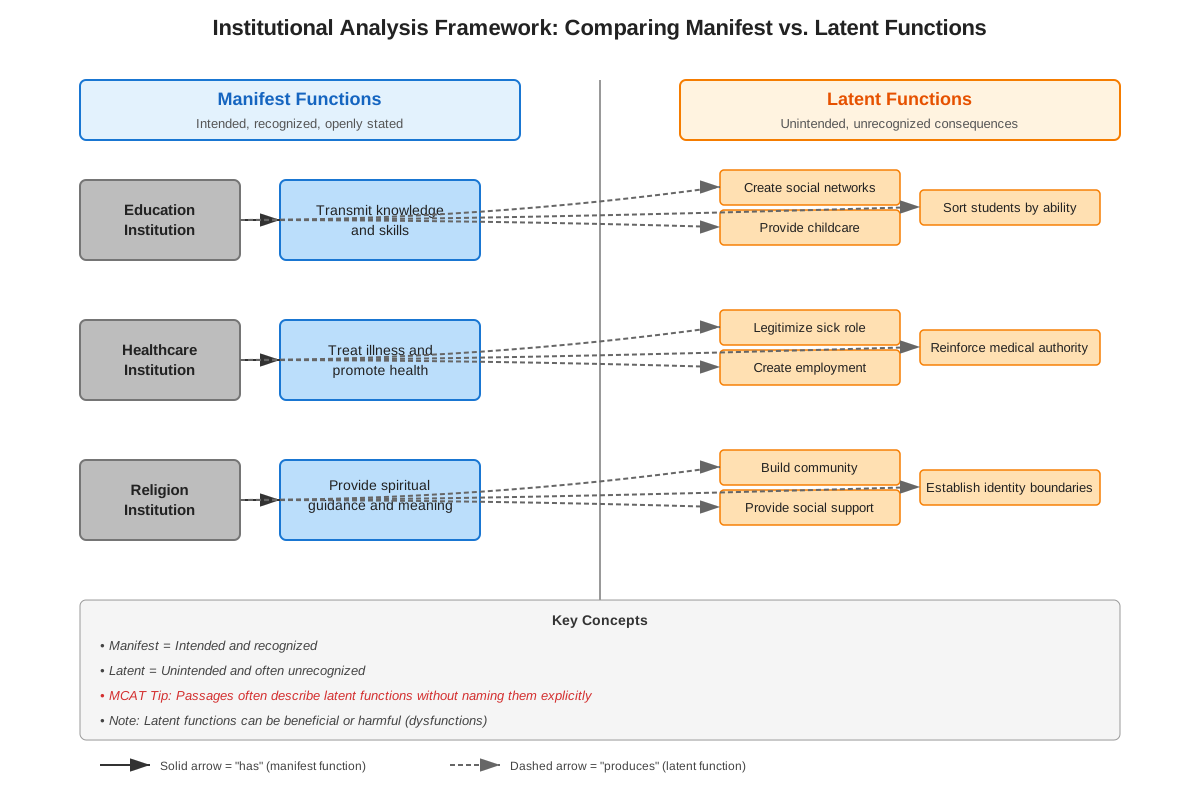
Institutions serve both manifest functions (intended, recognized purposes) and latent functions (unintended, often unrecognized consequences). This distinction, developed by sociologist Robert Merton, helps explain why institutions persist even when they appear inefficient or problematic.
Manifest functions represent the explicit, stated purposes of institutions:
- Education's manifest function includes teaching academic skills and knowledge
- Healthcare's manifest function involves treating illness and promoting health
- Government's manifest function encompasses maintaining order and providing public services
Latent functions represent hidden or secondary consequences:
- Education provides childcare, enabling parental employment (latent function)
- Healthcare institutions serve as major employers, supporting local economies (latent function)
- Government agencies create social networks and professional identities for employees (latent function)
Understanding this distinction helps explain institutional resistance to change—even dysfunctional institutions may serve important latent functions that stakeholders wish to preserve. MCAT questions may present scenarios where institutional reform faces opposition due to latent functions that benefit certain groups.
Institutions and Social Stratification
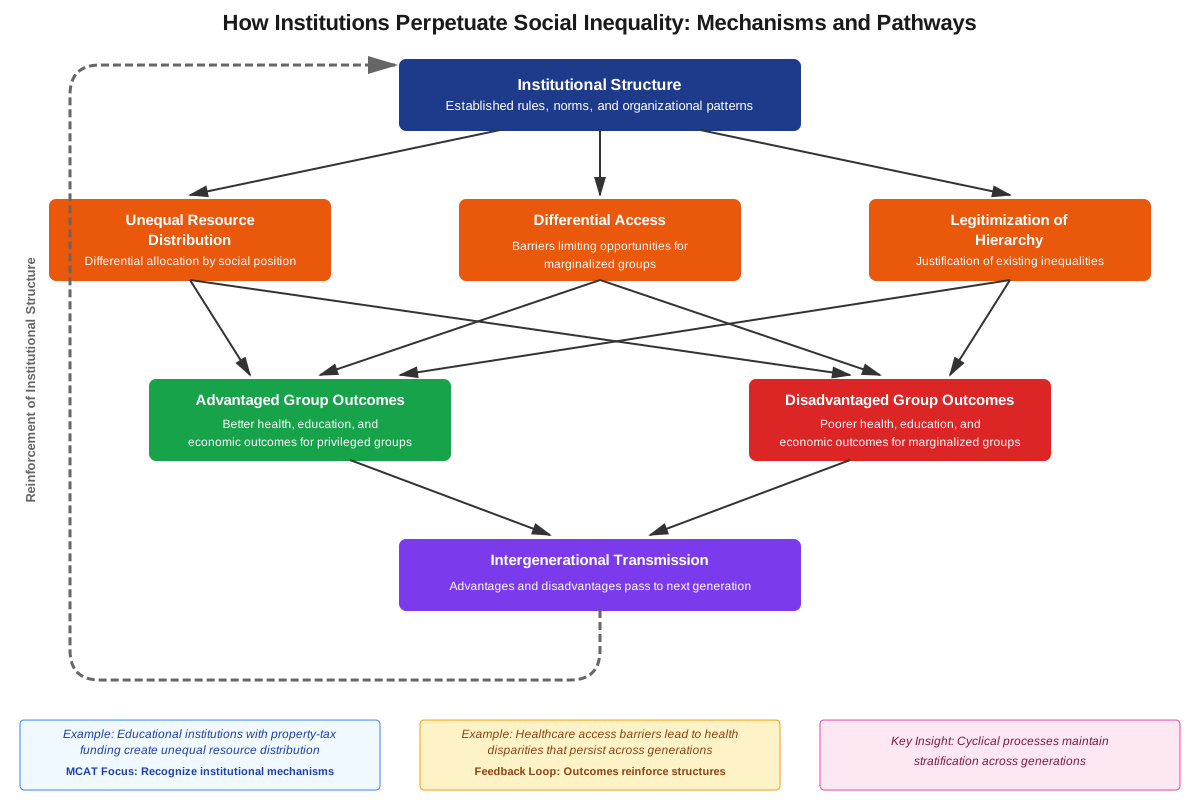
Institutions play crucial roles in creating, maintaining, and sometimes challenging social stratification—the hierarchical arrangement of individuals into social classes, status groups, and power structures. This relationship between institutions and inequality represents a high-yield MCAT topic.
Educational institutions stratify society through several mechanisms:
- Credentialing systems that grant differential access to occupational opportunities
- Tracking practices that sort students into different educational pathways
- Funding disparities between schools in wealthy versus poor communities
- Cultural capital requirements that advantage students from educated families
Economic institutions create stratification through:
- Wage structures that compensate different occupations unequally
- Wealth accumulation mechanisms that enable intergenerational advantage
- Employment discrimination based on race, gender, age, or other characteristics
- Globalization patterns that benefit some workers while displacing others
Healthcare institutions both reflect and reinforce stratification:
- Unequal access to quality care based on insurance status or geographic location
- Differential treatment based on patient race, ethnicity, or socioeconomic status
- Health disparities that follow lines of social stratification
- Medical education systems that preferentially recruit from privileged backgrounds
The conflict theory perspective emphasizes how dominant groups use institutions to maintain their advantages, while functionalist theory argues that institutional stratification serves necessary social purposes by motivating achievement and ensuring qualified individuals fill important positions. MCAT questions often require recognizing which theoretical perspective best explains a described institutional pattern.
Institutional Change and Social Change
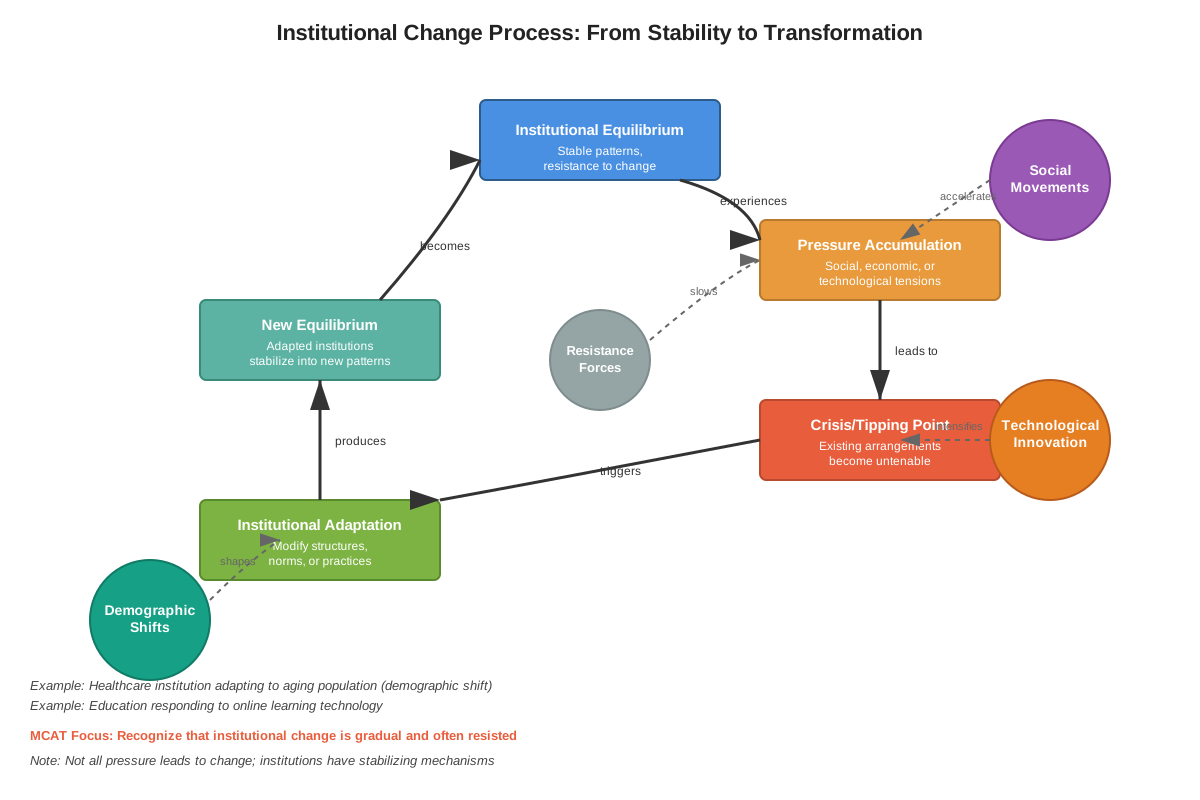
Institutions exhibit remarkable stability, yet they do change over time through various mechanisms. Understanding institutional change helps explain historical shifts in health practices, medical ethics, and healthcare delivery.
Sources of institutional change include:
- Technological innovation: New technologies disrupt existing institutional arrangements (telemedicine transforming healthcare delivery)
- Demographic shifts: Population changes create new institutional needs (aging populations requiring expanded eldercare institutions)
- Social movements: Collective action challenges institutional norms (civil rights movement transforming educational and political institutions)
- Cultural diffusion: Ideas and practices spread between societies (Western medical practices spreading globally)
- Internal contradictions: Institutions contain tensions that eventually force adaptation (healthcare cost inflation forcing system reforms)
Institutional lag occurs when institutions change more slowly than other aspects of society, creating social problems. For example, healthcare institutions may lag behind technological capabilities, leaving patients unable to access beneficial treatments due to outdated regulations or payment structures.
The relationship between institutional change and social change is reciprocal: institutions shape society, but social forces also reshape institutions. MCAT passages may describe historical changes in medical practice, public health approaches, or healthcare organization, requiring students to identify the social forces driving institutional transformation.
Institutional Interactions and Healthcare
Institutions do not operate in isolation but interact in complex ways that profoundly affect health outcomes. These institutional interactions represent sophisticated MCAT content that appears in challenging passages.
Education-Healthcare interactions:
- Educational attainment strongly predicts health outcomes across the lifespan
- Health literacy depends on educational background
- Schools serve as sites for public health interventions (vaccination programs, nutrition education)
- Medical education institutions socialize future physicians into professional norms
Economy-Healthcare interactions:
- Employment provides health insurance for many Americans
- Economic recessions increase stress-related health problems
- Pharmaceutical and medical device industries influence treatment options
- Healthcare costs affect household economic security
Family-Healthcare interactions:
- Families provide informal caregiving for ill members
- Family structure influences children's health and development
- Genetic health risks concentrate in family lines
- Family beliefs shape healthcare decision-making
Religion-Healthcare interactions:
- Religious beliefs influence medical decisions (blood transfusions, end-of-life care)
- Religious communities provide social support affecting health
- Religious practices may promote or harm health (dietary restrictions, meditation)
- Religious institutions may support or oppose public health measures
Government-Healthcare interactions:
- Government regulations shape medical practice and healthcare delivery
- Public health agencies address population-level health threats
- Healthcare policy determines insurance coverage and access
- Government funding supports medical research and training
MCAT questions frequently present scenarios involving multiple institutions and ask students to identify which institution most directly influences the described outcome or how institutional interactions produce observed patterns.
Concept Relationships
Institutions connect to numerous other sociology concepts tested on the MCAT. Understanding these relationships enables sophisticated analysis of complex passages.
Institutions → Social Structure: Institutions represent the macro-level components of social structure, providing the framework within which social positions, roles, and relationships exist. Social structure encompasses both institutional patterns and the stratification systems they create.
Institutions → Socialization: Institutions serve as primary agents of socialization, transmitting culture across generations. Family institutions provide primary socialization in early childhood, while educational, religious, and occupational institutions provide secondary socialization throughout life.
Institutions → Culture: Institutions both reflect and reinforce cultural values, norms, and beliefs. Cultural change often requires institutional change, while institutional structures preserve cultural patterns across time.
Institutions → Social Inequality: Institutions create and maintain systems of stratification based on class, race, gender, and other characteristics. Understanding how institutions perpetuate inequality is essential for analyzing health disparities.
Institutions → Social Change: Institutions resist change due to their stability and the vested interests they create, yet they also serve as targets for social movements seeking societal transformation. The relationship is dialectical—institutions constrain change while change reshapes institutions.
Institutions → Organizations: While institutions represent abstract patterns, organizations are concrete groups that embody institutional principles. Hospitals are organizations within the healthcare institution; schools are organizations within the educational institution.
Institutions → Social Capital: Institutions provide contexts for developing social capital—the networks, norms, and trust that facilitate cooperation. Educational institutions create professional networks; religious institutions build community bonds.
Quick check — test yourself on Institutions so far.
Try Flashcards →High-Yield Facts
⭐ Institutions are enduring, complex systems of social norms, roles, and structures organized around fundamental societal needs, operating at the macro level of analysis
⭐ The five major social institutions are family, education, religion, government, and economy—each fulfilling distinct but interconnected functions
⭐ Manifest functions are intended institutional purposes, while latent functions are unintended consequences that often explain institutional persistence
⭐ Institutions both create and maintain social stratification through mechanisms like credentialing, resource distribution, and differential access
⭐ Institutional change occurs through technological innovation, demographic shifts, social movements, cultural diffusion, and internal contradictions, but institutions resist rapid transformation
- Institutions differ from organizations: institutions are abstract patterns while organizations are concrete groups with specific memberships
- Healthcare increasingly functions as a distinct institution with its own norms, values, professional roles, and organizational structures
- Institutional interactions produce complex effects on health outcomes—educational attainment, economic resources, family support, religious beliefs, and government policies all influence health
- Institutional lag occurs when institutions change more slowly than other social aspects, creating social problems and health disparities
- Conflict theory emphasizes how institutions maintain dominant group advantages, while functionalism stresses how institutions serve necessary social purposes
- Religious institutions influence healthcare through beliefs about medical interventions, end-of-life care, reproduction, and the meaning of suffering
- Educational institutions affect health through multiple pathways: health literacy, socioeconomic mobility, social networks, and stress exposure
Common Misconceptions
Misconception: Institutions and organizations are the same thing → Correction: Institutions are abstract patterns of norms, values, and behaviors that persist across time and space, while organizations are concrete groups with specific memberships and structures. A hospital is an organization; healthcare is an institution. Schools are organizations; education is an institution.
Misconception: Institutions only serve positive functions for society → Correction: While functionalist theory emphasizes how institutions meet societal needs, institutions also perpetuate inequality, resist beneficial change, and may serve the interests of dominant groups at others' expense. Conflict theory highlights these problematic aspects of institutions.
Misconception: Institutional change happens quickly when problems are identified → Correction: Institutions exhibit remarkable stability and resistance to change due to their legitimacy, the vested interests they create, their interconnections with other institutions, and their latent functions. Significant institutional change typically requires sustained pressure from multiple sources over extended periods.
Misconception: Each institution operates independently without affecting others → Correction: Institutions are deeply interconnected, with changes in one institution rippling through others. Economic recessions affect family stability, educational funding, and healthcare access. Educational reforms influence economic productivity and political participation. These institutional interactions are crucial for understanding complex social phenomena.
Misconception: Modern societies are moving away from institutional influence toward individualism → Correction: While institutions evolve in form, they remain fundamental to social organization. Even as traditional institutions like religion decline in some societies, new institutional forms emerge (social media as a communication institution) and existing institutions adapt. Healthcare institutions have actually expanded their social influence in modern societies.
Misconception: Institutions affect everyone equally within a society → Correction: Institutional effects vary dramatically based on social position. Educational institutions provide vastly different experiences and opportunities depending on family socioeconomic status, race, and geographic location. Healthcare institutions deliver different quality care based on insurance status, race, and other factors. Recognizing this differential impact is essential for understanding health disparities.
Worked Examples
Example 1: Analyzing Institutional Influences on Health Outcomes
Passage Summary: A study examines health outcomes among adults aged 45-65 across different socioeconomic groups. Researchers find that individuals with college degrees live an average of 7 years longer than those without high school diplomas, even after controlling for income. College-educated individuals show lower rates of smoking, better medication adherence, and more frequent preventive care visits. The study notes that educational attainment in childhood predicts adult health outcomes decades later.
Question: Which of the following best explains the relationship between education and health outcomes described in the passage?
A) Educational institutions directly provide healthcare services that improve health
B) Educational institutions transmit health knowledge and shape health behaviors through socialization
C) Genetic factors that influence educational success also determine health outcomes
D) Healthcare institutions preferentially serve educated patients
Analysis:
Step 1: Identify the institutional focus. The passage describes how educational institutions (not just individual education) influence health across the lifespan.
Step 2: Recognize the mechanism. The passage emphasizes that education affects health behaviors (smoking, medication adherence, preventive care) and that childhood educational experiences predict adult outcomes—suggesting a socialization process.
Step 3: Evaluate each option:
- Option A is incorrect because educational institutions don't directly provide healthcare
- Option B correctly identifies that educational institutions socialize individuals into health-promoting behaviors and provide knowledge that shapes lifelong health practices
- Option C introduces genetic factors not supported by the passage and ignores the institutional mechanism
- Option D describes healthcare discrimination but doesn't explain the educational effect
Step 4: Connect to learning objectives. This question requires understanding how institutions (education) influence individual outcomes through socialization and how institutional effects persist across time.
Answer: B
Key Takeaway: Educational institutions affect health not just through knowledge transmission but through socialization into behaviors, values, and practices that influence health across the lifespan. This represents an institutional-level explanation rather than an individual-level one.
Example 2: Institutional Interactions and Healthcare Access
Passage Summary: A community health center in a rural area struggles to provide adequate care despite having qualified physicians. Many patients work in agriculture or service industries that don't provide health insurance. The nearest hospital is 45 miles away, and public transportation is limited. Local churches have organized volunteer driver programs to help patients reach appointments. A recent factory closure increased unemployment, leading more families to delay seeking care due to cost concerns.
Question: This scenario best illustrates the interaction of which institutions in shaping healthcare access?
A) Healthcare and education only
B) Economy, government, and religion only
C) Economy, family, government, religion, and healthcare
D) Healthcare and economy only
Analysis:
Step 1: Systematically identify each institution mentioned:
- Economy: Employment patterns determine insurance access; factory closure affects healthcare utilization
- Healthcare: Community health center and hospital represent healthcare institutional structures
- Religion: Churches organize transportation, demonstrating religious institutions' role in healthcare access
- Government: Lack of public transportation suggests limited government infrastructure
- Family: Families make collective decisions about seeking care
Step 2: Recognize that the question asks about institutional interactions—multiple institutions working together to shape outcomes.
Step 3: Evaluate options:
- Option A misses most institutions involved
- Option B omits family and healthcare institutions
- Option C comprehensively identifies all institutions shaping the described healthcare access patterns
- Option D oversimplifies by including only two institutions
Step 4: Apply the concept that health outcomes result from complex institutional interactions, not single institutional effects.
Answer: C
Key Takeaway: Healthcare access results from interactions among multiple institutions. Economic institutions determine employment and insurance; government institutions provide (or fail to provide) infrastructure; religious institutions offer community support; family institutions make healthcare decisions; and healthcare institutions deliver services. MCAT questions often require recognizing these complex institutional interactions rather than single-institution explanations.
Exam Strategy
Approaching Institution Questions:
- Identify the level of analysis: Institution questions operate at the macro level. If an answer choice focuses on individual psychology or micro-level interactions, it's likely incorrect unless the question specifically asks how institutions affect individuals.
- Distinguish institutions from organizations: Watch for answer choices that confuse these concepts. If a question asks about "educational institutions," an answer about "a specific school's policy" is too narrow—think about education as a societal system.
- Look for structural explanations: Institution questions typically require structural rather than individual explanations. If a passage describes a health disparity, institutional analysis focuses on how systems create differential outcomes, not on individual choices.
Trigger Words and Phrases:
- "Societal level," "macro level," "structural factors" → Think institutions
- "System of," "organized around," "social patterns" → Institutional language
- "Across generations," "enduring," "persistent" → Institutional stability
- "Stratification," "inequality," "differential access" → Institutional effects on social hierarchy
- "Interconnected," "multiple factors," "complex interactions" → Institutional interactions
Process of Elimination Tips:
- Eliminate answers that focus solely on individual agency when the question asks about structural factors
- Eliminate answers that confuse institutions with organizations unless the question specifically asks about organizations
- Eliminate answers that attribute to one institution what clearly involves multiple institutions
- Eliminate answers that ignore the temporal dimension when questions address institutional change or persistence
Time Allocation:
Institution questions often appear in longer passages describing complex social phenomena. Budget 1.5-2 minutes per question for these passages, as they require careful analysis of how multiple factors interact. Don't rush—institutional analysis questions reward systematic thinking about how societal structures shape outcomes.
Common Question Stems:
- "Which institution most directly influences...?" → Identify the primary institutional mechanism
- "This scenario best illustrates...?" → Recognize institutional patterns or interactions
- "From a conflict/functionalist perspective...?" → Apply theoretical frameworks to institutional analysis
- "How do institutions contribute to...?" → Explain institutional mechanisms producing outcomes
Memory Techniques
FREGE Mnemonic for Five Major Institutions:
- Family (reproduction, socialization, support)
- Religion (meaning, morality, cohesion)
- Economy (production, distribution, resources)
- Government (order, policy, collective decisions)
- Education (knowledge, socialization, placement)
"Manifest = Meant" Memory Aid:
Manifest functions are what institutions meant to do—the intended purposes. Latent functions are later discovered or hidden consequences.
Institutional Characteristics - "PILIR" Acronym:
- Persistence over time
- Internalization by individuals
- Legitimacy in society
- Interconnection with other institutions
- Resistance to rapid change
Visualization for Institutional Interactions:
Picture institutions as overlapping circles (like a Venn diagram) with healthcare outcomes in the center where all circles intersect. This visual reminds you that health results from multiple institutional influences, not single causes.
"Macro-Meso-Micro" Hierarchy:
- Macro = Institutions (society-wide patterns)
- Meso = Organizations (specific groups)
- Micro = Interactions (individual encounters)
Remember: Move from large (institutions) to medium (organizations) to small (interactions)
Summary
Institutions represent enduring, complex systems of social norms, roles, values, and structures organized around fundamental societal needs. The five major institutions—family, education, religion, government, and economy—fulfill distinct but interconnected functions that shape individual experiences and collective outcomes. For MCAT success, students must understand that institutions operate at the macro level of sociological analysis, distinguishing them from organizations (concrete groups) and micro-level interactions. Institutions serve both manifest functions (intended purposes) and latent functions (unintended consequences), with the latter often explaining institutional persistence despite apparent inefficiencies. Critically, institutions create and maintain social stratification through mechanisms like differential access to resources, credentialing systems, and discriminatory practices. While institutions exhibit remarkable stability and resistance to change, they do evolve through technological innovation, demographic shifts, social movements, and internal contradictions. Healthcare outcomes result from complex institutional interactions—educational attainment, economic resources, family support, religious beliefs, and government policies all influence health in interconnected ways. Understanding institutions enables analysis of health disparities, healthcare access barriers, and the social determinants of health that appear frequently in MCAT passages.
Key Takeaways
- Institutions are macro-level, enduring systems of norms, roles, and structures that organize society around fundamental needs—distinct from organizations and micro-level interactions
- The five major institutions (family, religion, economy, government, education) each serve specific functions while interacting in complex ways to shape health outcomes
- Institutions perpetuate social stratification through differential access to resources, opportunities, and quality services—a key mechanism underlying health disparities
- Manifest functions represent intended institutional purposes, while latent functions are unintended consequences that often explain why problematic institutions persist
- Institutional change occurs slowly through multiple mechanisms (technology, demographics, social movements) and faces resistance due to legitimacy, vested interests, and interconnections
- Healthcare outcomes result from institutional interactions—education, economy, family, religion, and government all influence health through multiple pathways
- MCAT questions on institutions require structural, macro-level analysis rather than individual-level explanations, focusing on how societal systems shape patterns of behavior and outcomes
Related Topics
Social Stratification and Inequality: Understanding how institutions create and maintain hierarchical social arrangements deepens comprehension of health disparities and differential healthcare access. Mastering institutions provides the foundation for analyzing class, race, and gender stratification.
Socialization and Identity Formation: Institutions serve as primary agents of socialization throughout the lifespan. Exploring socialization processes reveals how institutions transmit culture and shape individual identities, health beliefs, and behaviors.
Social Movements and Collective Behavior: Social movements target institutions for change, making institutional analysis essential for understanding how societies transform. This connection illuminates healthcare reform efforts and public health advocacy.
Demography and Population Health: Demographic patterns both shape and are shaped by institutions. Understanding this reciprocal relationship explains how population aging, migration, and fertility changes affect healthcare institutions and health outcomes.
Healthcare Systems and Policy: Healthcare itself functions as an institution with distinct organizational forms across societies. Institutional analysis provides tools for comparing healthcare systems and understanding policy debates about access, quality, and cost.
Practice CTA
Now that you've mastered the foundational concepts of institutions in sociology, it's time to test your understanding and reinforce your learning. Challenge yourself with practice questions that mirror actual MCAT passages, requiring you to apply institutional analysis to complex healthcare scenarios. Work through flashcards covering key definitions, institutional functions, and common misconceptions to ensure rapid recall on test day. Remember: understanding institutions isn't just about memorizing definitions—it's about developing the analytical skills to recognize how societal structures shape health outcomes, a competency that will serve you throughout medical school and your career as a physician. You've built a strong foundation; now solidify it through active practice and application!
Sign up free to keep reading
Create a free AnvayaPrep account to finish this MCAT guide on Institutions — plus flashcards and practice questions.