Overview
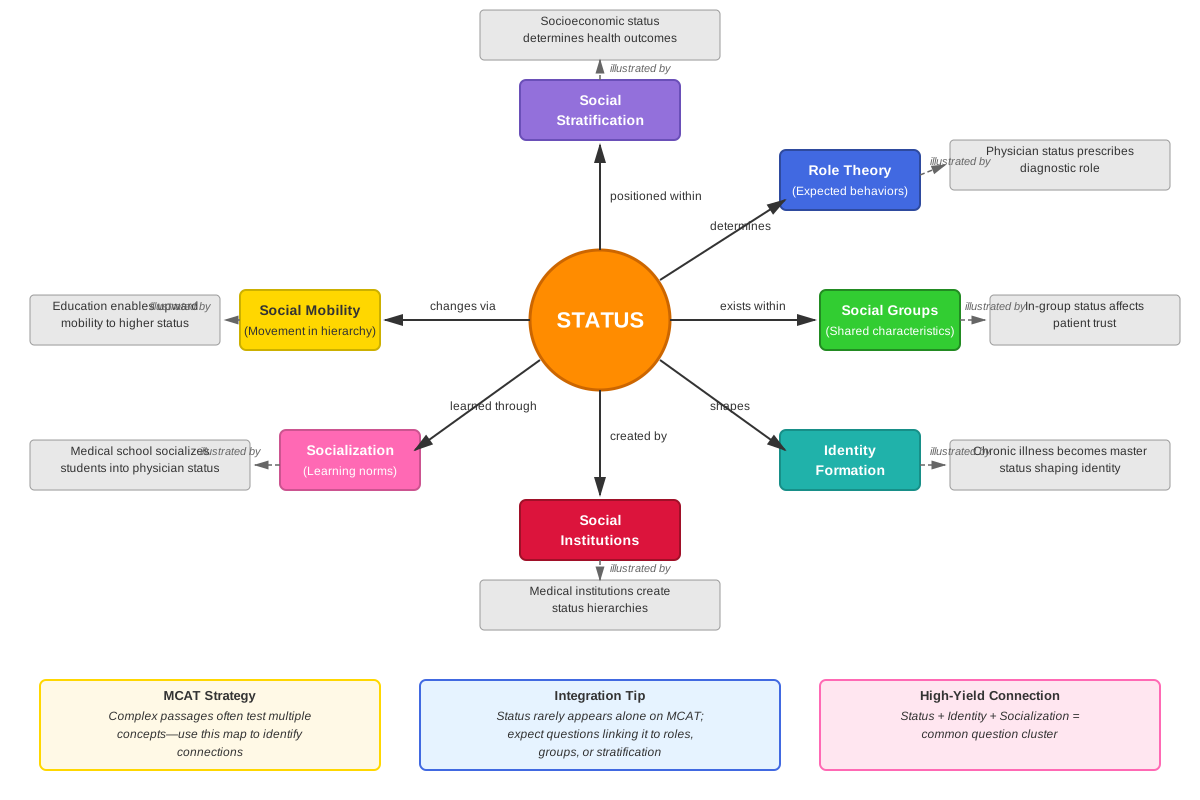
Status is a foundational concept in Sociology that refers to the position an individual occupies within a social hierarchy or group. Understanding status is essential for the MCAT because it forms the backbone of how societies organize themselves and how individuals navigate Social Structure and Institutions. Status determines access to resources, influences social interactions, and shapes identity formation—all critical themes tested in the Psychological, Social, and Biological Foundations of Behavior section of the MCAT.
The concept of status extends far beyond simple social ranking. It encompasses both positions that individuals are born into (ascribed status) and those they achieve through their own efforts (achieved status). Status also includes the roles and expectations attached to social positions, creating a complex web of social relationships that influence health outcomes, healthcare access, and patient-physician interactions. For medical students, understanding status provides insight into health disparities, patient compliance, social determinants of health, and the dynamics of medical hierarchies.
Status MCAT questions frequently appear in passage-based scenarios involving healthcare settings, community health initiatives, or social psychology experiments. These questions test the ability to identify different types of status, understand status inconsistency, recognize how status influences behavior, and analyze the relationship between status and other sociological concepts like role, social stratification, and group dynamics. Mastering status enables students to approach complex sociological passages with confidence and connect abstract sociological theory to concrete medical scenarios.
Learning Objectives
- [ ] Define Status using accurate Sociology terminology
- [ ] Explain why Status matters for the MCAT
- [ ] Apply Status to exam-style questions
- [ ] Identify common mistakes related to Status
- [ ] Connect Status to related Sociology concepts
- [ ] Distinguish between ascribed status, achieved status, and master status with clinical examples
- [ ] Analyze status inconsistency and its psychological and social consequences
- [ ] Evaluate how status hierarchies influence healthcare delivery and patient outcomes
Prerequisites
- Basic understanding of social groups: Status exists within the context of social groups and organizations, making group dynamics foundational to understanding status hierarchies
- Familiarity with socialization: The process by which individuals learn and internalize status expectations occurs through socialization mechanisms
- Awareness of social inequality: Status is inherently linked to differential access to resources, power, and prestige in society
- Understanding of identity formation: Status contributes significantly to how individuals develop their sense of self and social identity
Why This Topic Matters
Clinical and Real-World Significance
Status profoundly impacts health outcomes and healthcare delivery. Patients with higher socioeconomic status typically have better access to healthcare, higher health literacy, and more favorable health outcomes. Physicians must recognize how status differences between themselves and patients can create communication barriers, affect treatment compliance, and influence diagnostic accuracy. Understanding status helps future physicians navigate medical hierarchies (attending physicians, residents, medical students), collaborate effectively in interdisciplinary teams, and address health disparities rooted in social stratification.
Exam Statistics and Question Types
Status appears in approximately 15-20% of Sociology questions on the MCAT Psychological, Social, and Biological Foundations section. Questions typically present in three formats: (1) passage-based questions requiring identification of status types in research scenarios or clinical vignettes, (2) discrete questions testing definitions and distinctions between status concepts, and (3) application questions asking students to predict behavioral outcomes based on status relationships. Status is particularly high-yield because it connects to numerous other testable concepts including role conflict, social stratification, stigma, and group dynamics.
Common Exam Appearances
MCAT passages frequently embed status concepts within: healthcare access studies comparing different socioeconomic groups; workplace dynamics in medical settings; research on stereotype threat and academic performance; community health interventions targeting specific populations; and social psychology experiments examining conformity, obedience, or group behavior. Questions often require students to identify which type of status is being described, predict consequences of status inconsistency, or explain how status influences social interactions and health outcomes.
Core Concepts
Definition of Status
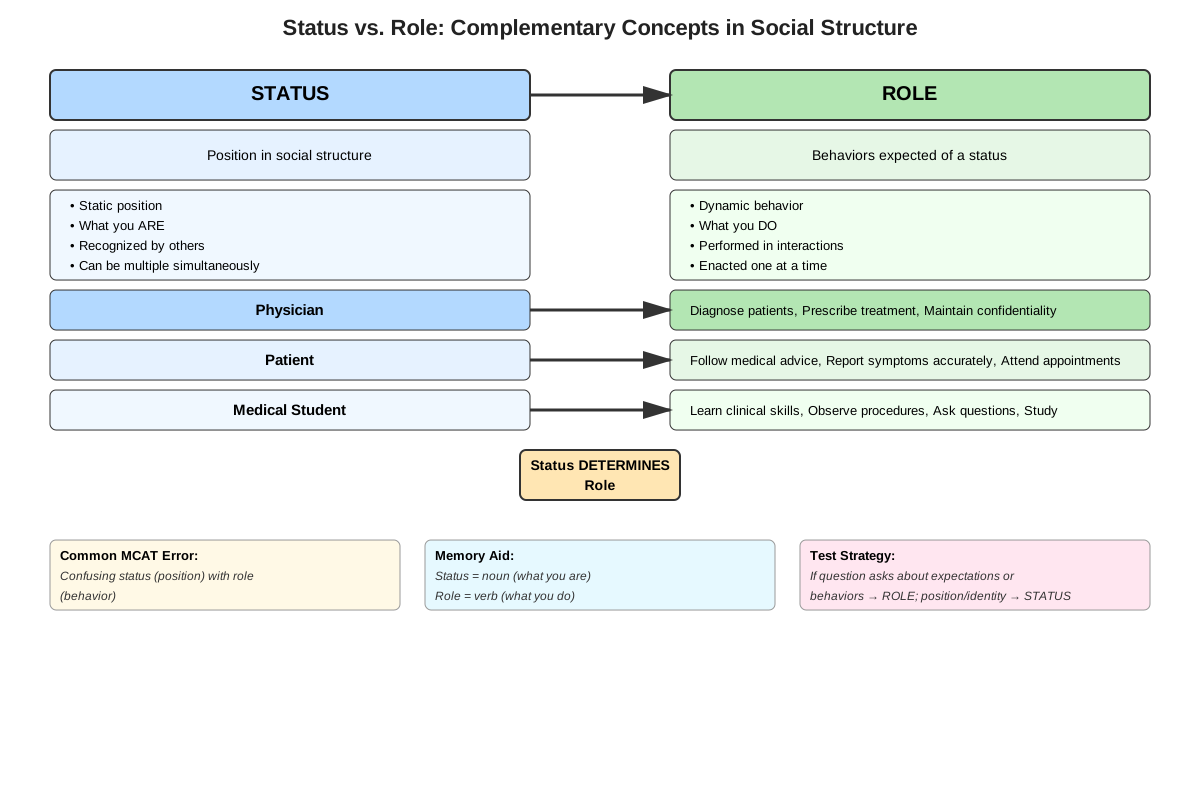
Status is the social position that an individual occupies within a social hierarchy, group, or society. Each status comes with a set of expected behaviors, rights, obligations, and relationships with other statuses. Status is fundamentally relational—it only has meaning in comparison to other positions within the same social structure. For example, "physician" as a status only makes sense in relation to other healthcare statuses like "patient," "nurse," or "medical student."
Status should be distinguished from role, though the two concepts are intimately connected. While status refers to the position itself, role refers to the behaviors and expectations associated with that position. An individual simultaneously occupies multiple statuses (student, daughter, employee, volunteer), creating a status set—the complete collection of statuses held by an individual at any given time.
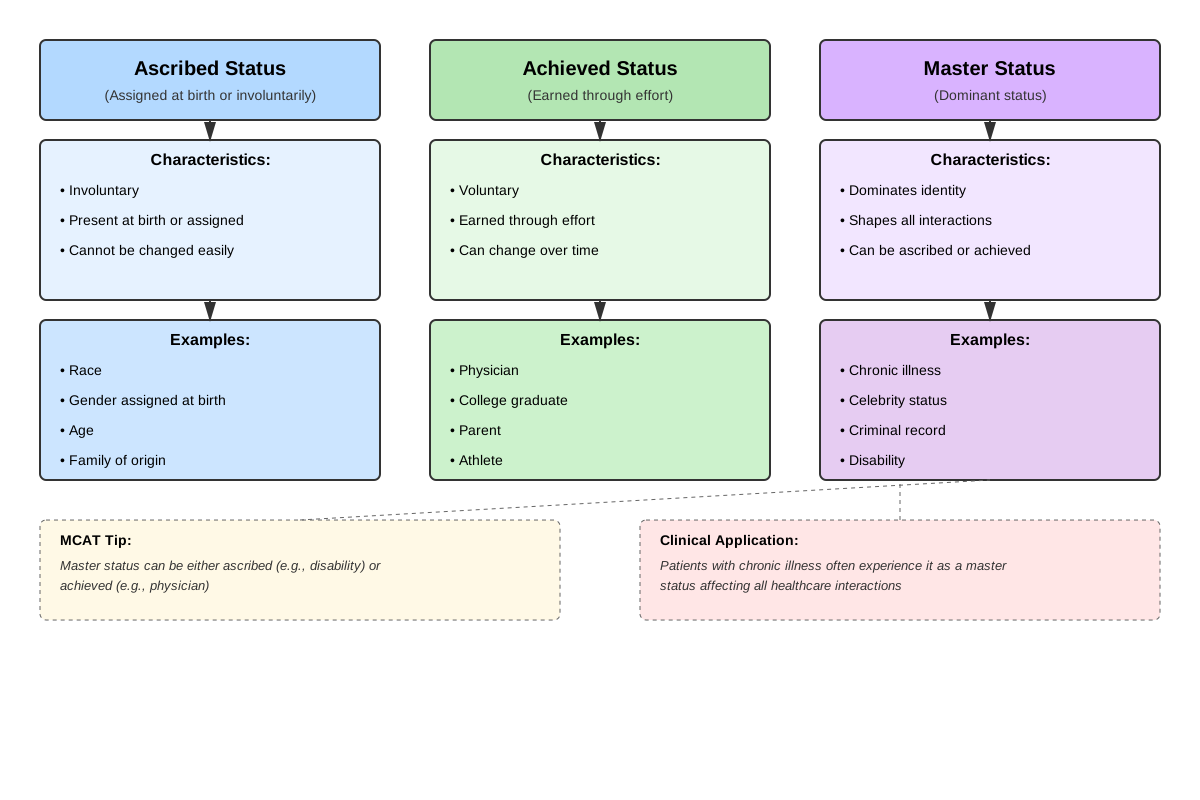
Ascribed Status
Ascribed status is a social position assigned to an individual at birth or involuntarily assumed later in life, regardless of personal effort or merit. These statuses are typically based on characteristics over which individuals have little or no control. Common examples include:
- Race and ethnicity
- Biological sex
- Age
- Family lineage or social class of origin
- Birth order within a family
- Nationality or place of birth
Ascribed statuses significantly influence life opportunities, access to resources, and social interactions. In healthcare contexts, ascribed statuses like race and age can unfortunately lead to implicit bias, differential treatment, and health disparities. For the MCAT, understanding ascribed status is crucial for analyzing questions about health equity, social determinants of health, and structural barriers to healthcare access.
Achieved Status
Achieved status is a social position that an individual attains through personal effort, choice, merit, or accomplishment. Unlike ascribed status, achieved status reflects individual agency and action. Examples include:
- Educational attainment (high school graduate, college degree, medical degree)
- Occupational position (physician, teacher, engineer)
- Marital status (married, divorced, single)
- Athletic achievements (varsity athlete, Olympic medalist)
- Professional certifications or licenses
The distinction between ascribed and achieved status varies across cultures and historical periods. In meritocratic societies, achieved statuses theoretically carry more weight, though ascribed statuses often influence which achieved statuses are accessible. For instance, while "physician" is an achieved status, individuals from higher socioeconomic backgrounds (an ascribed element) have greater access to the educational opportunities necessary to achieve this status.
Master Status
Master status is a status that dominates or overrides all other statuses an individual holds, becoming the primary lens through which others perceive and interact with that person. Master status can be either ascribed or achieved and often carries significant social stigma or prestige. Examples include:
- Chronic illness or disability (e.g., "cancer patient," "wheelchair user")
- Criminal record (e.g., "ex-convict," "sex offender")
- Celebrity or fame
- Prestigious occupation (e.g., "Nobel laureate," "Supreme Court Justice")
- Stigmatized identity (e.g., "homeless person," "drug addict")
Master status is particularly relevant in medical contexts. When illness becomes a master status, patients may feel their entire identity is reduced to their diagnosis, leading to depersonalization and reduced quality of care. Healthcare providers must consciously recognize when they are allowing a single status to dominate their perception of a patient, potentially overlooking other important aspects of the patient's identity and social context.
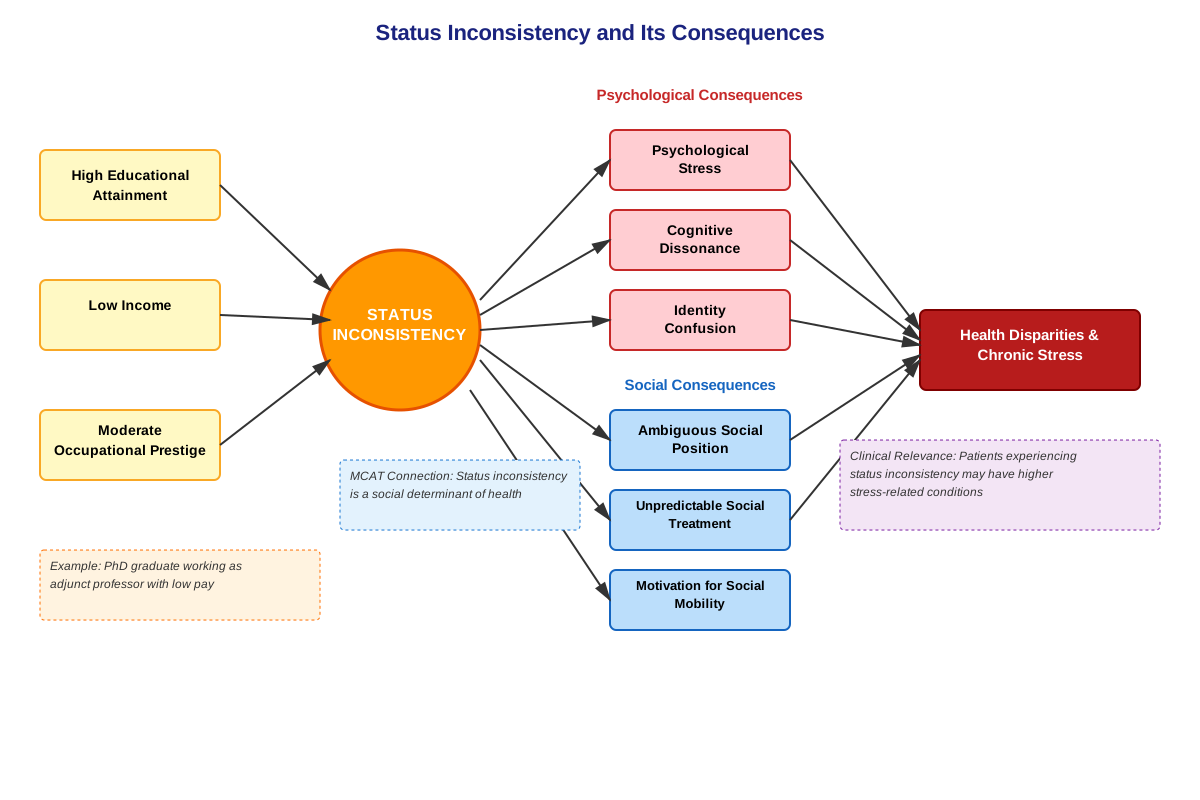
Status Inconsistency
Status inconsistency (also called status incongruence) occurs when an individual occupies statuses that are ranked differently or appear contradictory within a social hierarchy. This creates tension because society expects certain statuses to align. For example:
- A highly educated individual (high status) working a minimum-wage job (low status)
- A wealthy individual (high status) with a criminal record (low status)
- A young person (typically lower status) in a position of authority over older individuals (typically higher status)
Status inconsistency produces psychological stress, social discomfort, and unpredictable social interactions. Research shows that individuals experiencing status inconsistency have higher rates of stress-related health problems, including cardiovascular disease and mental health issues. On the MCAT, questions about status inconsistency often appear in passages examining social stress, role strain, or unexpected social dynamics.
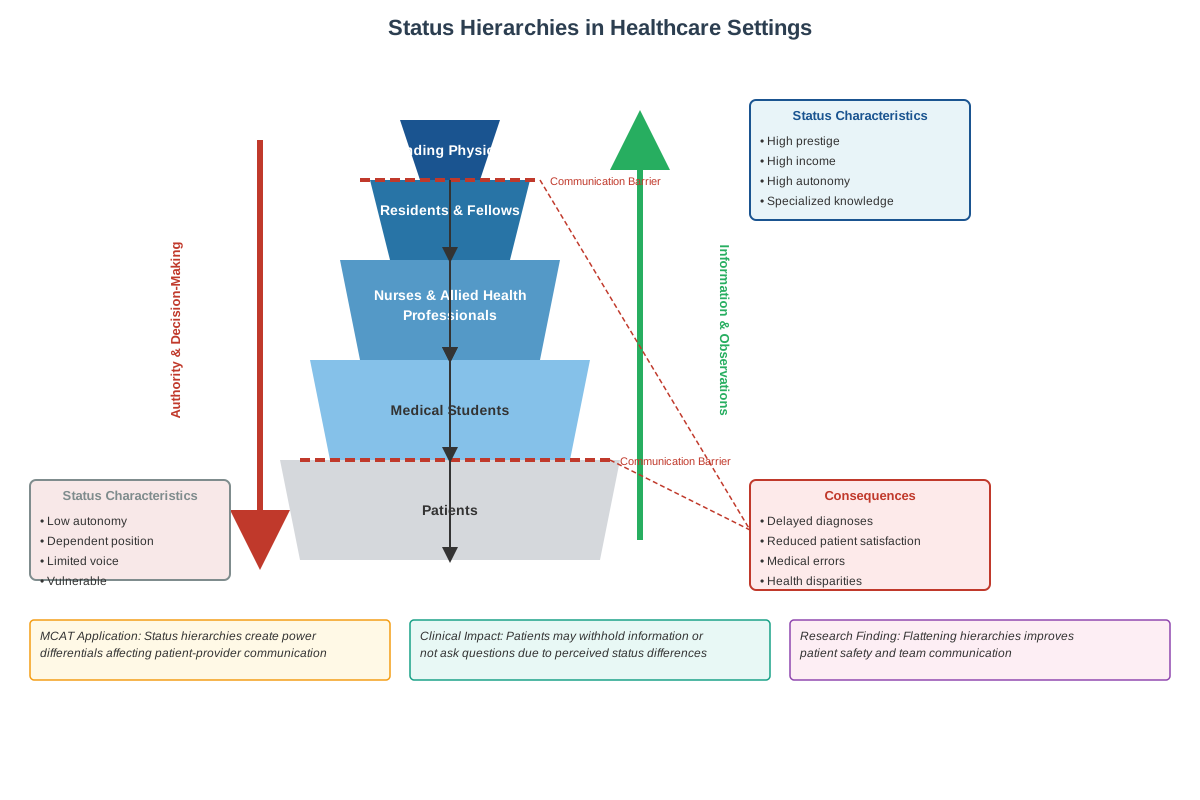
Status Hierarchy and Social Stratification
Statuses exist within status hierarchies—ranked orderings of social positions based on prestige, power, and access to resources. These hierarchies form the basis of social stratification, the systematic ranking of entire groups of people within society. Status hierarchies can be:
- Formal: Explicitly defined with clear criteria (military ranks, academic positions, corporate organizational charts)
- Informal: Implicitly understood through social norms and cultural values (popularity hierarchies in schools, prestige rankings of professions)
| Characteristic | Formal Hierarchy | Informal Hierarchy |
|---|---|---|
| Definition | Explicitly codified | Implicitly understood |
| Mobility | Clear advancement paths | Ambiguous pathways |
| Recognition | Official titles/credentials | Social consensus |
| Examples | Military ranks, job titles | Popularity, coolness, respect |
Understanding status hierarchies is essential for analyzing questions about power dynamics in healthcare settings, physician-patient relationships, and interdisciplinary team functioning.
Status Symbols
Status symbols are material or behavioral markers that communicate an individual's status to others. These symbols serve as shorthand for social position and include:
- Material possessions (luxury cars, designer clothing, expensive homes)
- Credentials and titles (MD, PhD, Esq.)
- Behavioral patterns (speech patterns, manners, leisure activities)
- Physical markers (uniforms, white coats, stethoscopes)
In medical settings, status symbols like white coats, stethoscopes, and name badges communicate professional status and expertise. However, these symbols can also create barriers between healthcare providers and patients, potentially inhibiting open communication. MCAT questions may ask students to identify status symbols in passages or analyze how status symbols influence social interactions.
Concept Relationships
Status serves as a central organizing concept that connects to numerous other sociological principles. Status → determines → Role (the behaviors expected of that position) → can lead to → Role conflict (when expectations of different roles clash) or Role strain (when a single role has competing demands).
Ascribed status → influences → Social stratification → creates → Social inequality → affects → Health disparities and Healthcare access. This chain is particularly important for MCAT passages examining social determinants of health.
Master status → can lead to → Stigma (when the master status is devalued) → results in → Discrimination and Prejudice → impacts → Mental health and Physical health outcomes.
Status inconsistency → produces → Psychological stress → activates → Stress response systems → contributes to → Chronic disease and Mental health disorders.
Status hierarchies → establish → Power dynamics → influence → Group behavior, Conformity, and Obedience → shape → Organizational culture in healthcare settings.
Understanding these relationships enables students to approach complex MCAT passages that integrate multiple sociological concepts, recognizing how status serves as a foundational element connecting various social phenomena.
High-Yield Facts
⭐ Status is a social position within a hierarchy, while role is the set of behaviors expected of that position—status is what you are, role is what you do.
⭐ Ascribed status is assigned at birth or involuntarily (race, sex, age), while achieved status is earned through effort (education, occupation, marital status).
⭐ Master status dominates all other statuses and becomes the primary lens through which others perceive an individual, often related to stigmatized conditions or highly prestigious positions.
⭐ Status inconsistency occurs when an individual holds statuses ranked differently in the social hierarchy, leading to psychological stress and increased health risks.
⭐ Status symbols are markers (material or behavioral) that communicate social position, such as white coats in medical settings or luxury goods in consumer culture.
- An individual's status set includes all statuses they simultaneously hold (student, daughter, employee, athlete, volunteer).
- Status hierarchies can be formal (explicitly defined with clear criteria) or informal (implicitly understood through social norms).
- In healthcare, physician status creates power differentials that can affect patient communication, treatment compliance, and health outcomes.
- Status influences access to resources, social networks, and opportunities, making it a key social determinant of health.
- The distinction between ascribed and achieved status varies across cultures—some societies emphasize meritocracy while others prioritize inherited position.
- Status transitions (changes in social position) can be stressful life events requiring adaptation and resocialization.
- Multiple statuses can create role conflict when expectations of different positions clash, or role strain when a single status has competing demands.
Quick check — test yourself on Status so far.
Try Flashcards →Common Misconceptions
Misconception: Status and role are the same thing and can be used interchangeably.
Correction: Status refers to the social position itself (what you are), while role refers to the behaviors and expectations associated with that position (what you do). A person holds a status and performs a role. For example, "physician" is a status, while diagnosing patients and prescribing treatment are roles associated with that status.
Misconception: Achieved status is always more important than ascribed status in modern societies.
Correction: While meritocratic ideologies emphasize achieved status, ascribed statuses like race, sex, and social class of origin continue to profoundly influence opportunities and outcomes. Ascribed statuses often determine access to the resources necessary to achieve certain statuses, creating persistent social inequalities.
Misconception: Master status is always negative or stigmatizing.
Correction: Master status can be either positive or negative. While chronic illness or criminal history can become negative master statuses, highly prestigious positions like Nobel laureate or Olympic champion can become positive master statuses that dominate how others perceive the individual.
Misconception: Status inconsistency only affects the individual experiencing it, not others around them.
Correction: Status inconsistency creates social discomfort and unpredictable interactions for everyone involved. When statuses don't align as expected, others may not know how to behave appropriately, leading to awkward social situations and communication breakdowns that affect all parties.
Misconception: An individual can only have one status at a time.
Correction: Every individual simultaneously holds multiple statuses, forming a status set. At any given moment, a person might be a student, daughter, employee, athlete, and volunteer. Different statuses become salient in different contexts, but all are held concurrently.
Misconception: Status symbols always accurately reflect actual status.
Correction: Status symbols can be manipulated, misrepresented, or misinterpreted. Individuals may display status symbols they haven't earned (credential fraud), or symbols may lose their meaning over time. Additionally, what serves as a status symbol varies across cultures and contexts.
Worked Examples
Example 1: Identifying Status Types in a Clinical Vignette
Vignette: Dr. Martinez is a 28-year-old emergency medicine resident who recently immigrated from Mexico. She is the first person in her family to attend college. While treating a 65-year-old white male patient with chest pain, the patient repeatedly asks to speak with "a real doctor" and questions her medical knowledge. Dr. Martinez feels frustrated because she has worked extremely hard to reach her current position, yet the patient seems to focus only on her age, accent, and appearance.
Question: Which of the following best describes the status dynamics in this scenario?
Analysis:
Let's identify the relevant statuses:
- Dr. Martinez's statuses:
- Physician (achieved status—earned through education and training)
- 28 years old (ascribed status—age)
- Female (ascribed status—sex)
- Mexican immigrant (ascribed status—ethnicity/nationality)
- First-generation college student (achieved status, but influenced by ascribed family background)
- Patient's statuses:
- 65 years old (ascribed status—age)
- White (ascribed status—race)
- Male (ascribed status—sex)
- Patient (achieved status in this context—he sought medical care)
Key observations:
- Dr. Martinez's achieved status as a physician should grant her authority and respect in the medical setting
- The patient is allowing Dr. Martinez's ascribed statuses (age, ethnicity, possibly sex) to override her achieved professional status
- The patient's ascribed statuses (older age, white, male) may give him perceived social advantages in broader society
- This represents status inconsistency from the patient's perspective—he expects physicians to be older and possibly white/male, so Dr. Martinez's combination of statuses doesn't match his schema
Answer: The patient is allowing Dr. Martinez's ascribed statuses to overshadow her achieved professional status, demonstrating how ascribed characteristics can undermine achieved positions, particularly when they don't align with stereotypical expectations. This scenario illustrates implicit bias and how status hierarchies in broader society can intrude into professional settings where different status hierarchies should dominate.
Connection to learning objectives: This example demonstrates how to identify different types of status (ascribed vs. achieved), recognize status inconsistency, and understand how status influences social interactions in healthcare settings—all critical skills for MCAT passages.
Example 2: Analyzing Master Status and Its Consequences
Vignette: A research study examines how medical students interact with standardized patients (actors trained to portray patients). In one condition, the standardized patient is introduced as "Mr. Johnson, a 45-year-old accountant with diabetes." In another condition, the same actor is introduced as "Mr. Johnson, a 45-year-old homeless man with diabetes." Researchers find that medical students spend significantly less time with the "homeless" patient, ask fewer questions about his life circumstances, and are less likely to provide detailed discharge instructions.
Question: This study best illustrates which sociological concept?
Analysis:
Let's examine what's happening:
- The only difference between conditions is one status: "accountant" vs. "homeless person"
- This single status dramatically changes how medical students interact with the patient
- The "homeless" status appears to dominate all other information about the patient
- Medical students make assumptions and alter their behavior based primarily on this one status
Identification: This is a clear example of master status. The status of "homeless person" becomes the dominant lens through which medical students perceive and interact with the patient, overshadowing other statuses (45 years old, male, person with diabetes) and even the primary professional relationship (patient-provider).
Consequences illustrated:
- Depersonalization: The individual is reduced to a single characteristic
- Stereotyping: Medical students likely activated stereotypes about homeless individuals
- Discrimination: Different treatment based on a single status
- Reduced quality of care: Less time, fewer questions, less detailed instructions
Broader implications:
- Master status can lead to health disparities when stigmatized statuses (homeless, drug user, ex-convict) cause healthcare providers to deliver lower-quality care
- Healthcare providers must consciously resist allowing any single status to dominate their perception of patients
- The study demonstrates how easily master status influences behavior, even among trained medical professionals
Connection to learning objectives: This example shows how to identify master status in research scenarios, understand its consequences, and connect status concepts to healthcare outcomes—all high-yield skills for MCAT passages examining health disparities and social determinants of health.
Exam Strategy
Approaching MCAT Questions on Status
When encountering status-related questions, follow this systematic approach:
- Identify all statuses mentioned: List every social position described for each individual in the passage or question stem
- Classify each status: Determine whether each status is ascribed (assigned at birth/involuntary) or achieved (earned through effort)
- Look for hierarchy clues: Identify which statuses carry more prestige, power, or resources in the given context
- Check for inconsistency: Determine if any individual holds statuses that are ranked differently or seem contradictory
- Identify master status: Look for a single status that appears to dominate how others perceive or interact with an individual
Trigger Words and Phrases
Watch for these key phrases that signal status concepts:
- Ascribed status triggers: "born into," "inherited," "assigned at birth," "involuntary," "based on age/race/sex"
- Achieved status triggers: "earned," "accomplished," "worked toward," "attained through effort," "educational/occupational"
- Master status triggers: "primarily seen as," "reduced to," "defined by," "overshadows other characteristics," "dominates perception"
- Status inconsistency triggers: "unexpected combination," "contradictory positions," "doesn't fit the typical pattern," "creates tension"
- Status hierarchy triggers: "ranked," "prestige," "power differential," "authority," "subordinate/superior"
Process-of-Elimination Tips
When choosing between answer options:
- Eliminate options that confuse status with role: If an answer describes behaviors rather than positions, it's likely incorrect
- Eliminate options that misclassify ascribed/achieved: Age, race, and sex are always ascribed; education and occupation are always achieved
- Look for the most comprehensive answer: Status questions often require recognizing multiple concepts simultaneously (e.g., both master status AND status inconsistency)
- Prioritize answers that connect to health outcomes: MCAT passages favor options that link sociological concepts to health disparities, healthcare access, or patient outcomes
Time Allocation Advice
Status questions typically require 60-90 seconds:
- 30 seconds: Read and identify all statuses in the passage/question
- 20 seconds: Classify statuses and identify relevant concepts
- 20 seconds: Evaluate answer options and eliminate incorrect choices
- 10 seconds: Confirm your answer addresses what the question is actually asking
Exam Tip: If a passage describes individuals in a healthcare setting, immediately identify the status hierarchy (attending physician > resident > medical student > nurse > patient) as this often becomes relevant for answering questions about power dynamics, communication barriers, or role conflict.
Memory Techniques
Mnemonic for Status Types: "AAM"
Ascribed - Assigned at birth (Age, Ancestry, Appearance)
Achieved - Attained through action (Accomplishments, Academics, Achievements)
Master - Most important, overshadows all others
Visualization for Status Inconsistency
Picture a person wearing mismatched clothing—a tuxedo jacket with sweatpants and flip-flops. Just as this outfit creates visual discomfort because the pieces don't "match," status inconsistency creates social discomfort because the statuses don't align as expected. This image helps remember that status inconsistency produces tension and stress.
Acronym for Master Status Effects: "DROPS"
Dominates perception
Reduces complexity of identity
Overshadows other statuses
Primary lens for interaction
Stigma often attached
Memory Palace for Status Hierarchy
Imagine walking up a staircase in a hospital:
- Ground floor: Patients (lowest status in medical hierarchy)
- Second floor: Medical students (learning, limited authority)
- Third floor: Residents (more responsibility, still supervised)
- Fourth floor: Attending physicians (highest medical authority)
- Penthouse: Hospital administrators (organizational authority)
This spatial visualization helps remember status hierarchies in medical settings, a common MCAT scenario.
Rhyme for Status vs. Role
"Status is your place, role is what you do in that space."
This simple rhyme reinforces the fundamental distinction between status (position) and role (behavior), preventing the most common confusion on MCAT questions.
Summary
Status is a foundational sociological concept referring to the social position an individual occupies within a hierarchy or group. Understanding status requires distinguishing between ascribed status (assigned at birth or involuntarily), achieved status (earned through effort), and master status (dominates all other statuses). Status differs from role—status is the position itself, while role encompasses the behaviors expected of that position. Status inconsistency occurs when an individual holds statuses ranked differently in the social hierarchy, producing psychological stress and social discomfort. Status hierarchies organize social positions based on prestige, power, and resources, forming the basis of social stratification. For the MCAT, status is essential for analyzing health disparities, understanding physician-patient dynamics, recognizing how social determinants affect health outcomes, and interpreting research on social behavior. Status connects to numerous other sociological concepts including role conflict, stigma, discrimination, and group dynamics, making it a high-yield topic that appears frequently in passage-based questions examining healthcare settings, social psychology experiments, and community health initiatives.
Key Takeaways
- Status is a social position within a hierarchy, distinct from role which refers to the behaviors expected of that position
- Ascribed status is assigned at birth or involuntarily (race, age, sex), while achieved status is earned through personal effort (education, occupation)
- Master status dominates all other statuses and becomes the primary lens through which others perceive an individual, often leading to stereotyping and discrimination
- Status inconsistency creates psychological stress and social discomfort when an individual holds statuses ranked differently in the social hierarchy
- Status hierarchies in healthcare settings (physician > resident > medical student > patient) influence communication, power dynamics, and quality of care
- Status serves as a social determinant of health, affecting access to resources, healthcare quality, and health outcomes
- Understanding status is essential for analyzing MCAT passages on health disparities, social stratification, and physician-patient relationships
Related Topics
Role and Role Conflict: Building on status, this topic explores the behaviors expected of social positions and what happens when expectations clash. Mastering status provides the foundation for understanding role dynamics.
Social Stratification: Status hierarchies aggregate into larger systems of social stratification, including class, caste, and meritocracy. Understanding individual status enables analysis of societal-level inequality.
Stigma and Discrimination: Master status often leads to stigmatization when the dominant status is devalued. This connection is crucial for understanding health disparities and barriers to healthcare access.
Social Identity and Self-Concept: The statuses individuals hold significantly shape their sense of self and social identity. Status provides the sociological framework for understanding identity formation.
Group Dynamics and Social Hierarchies: Status hierarchies within groups influence conformity, obedience, and leadership. Understanding status enables deeper analysis of group behavior.
Social Determinants of Health: Status, particularly socioeconomic status, is a primary social determinant affecting health outcomes, healthcare access, and health behaviors—a critical connection for medical students.
Practice CTA
Now that you've mastered the core concepts of status, it's time to reinforce your learning through active practice. Attempt the practice questions and flashcards to test your ability to identify status types, recognize status inconsistency, and apply these concepts to MCAT-style passages. Remember, understanding status isn't just about memorizing definitions—it's about recognizing how social positions shape health outcomes, influence medical interactions, and create the social structures you'll navigate as a physician. Each practice question you complete strengthens your ability to quickly identify status concepts in complex passages and select the correct answer under time pressure. You've built a strong foundation—now solidify it through deliberate practice!
Sign up free to keep reading
Create a free AnvayaPrep account to finish this MCAT guide on Status — plus flashcards and practice questions.