Overview
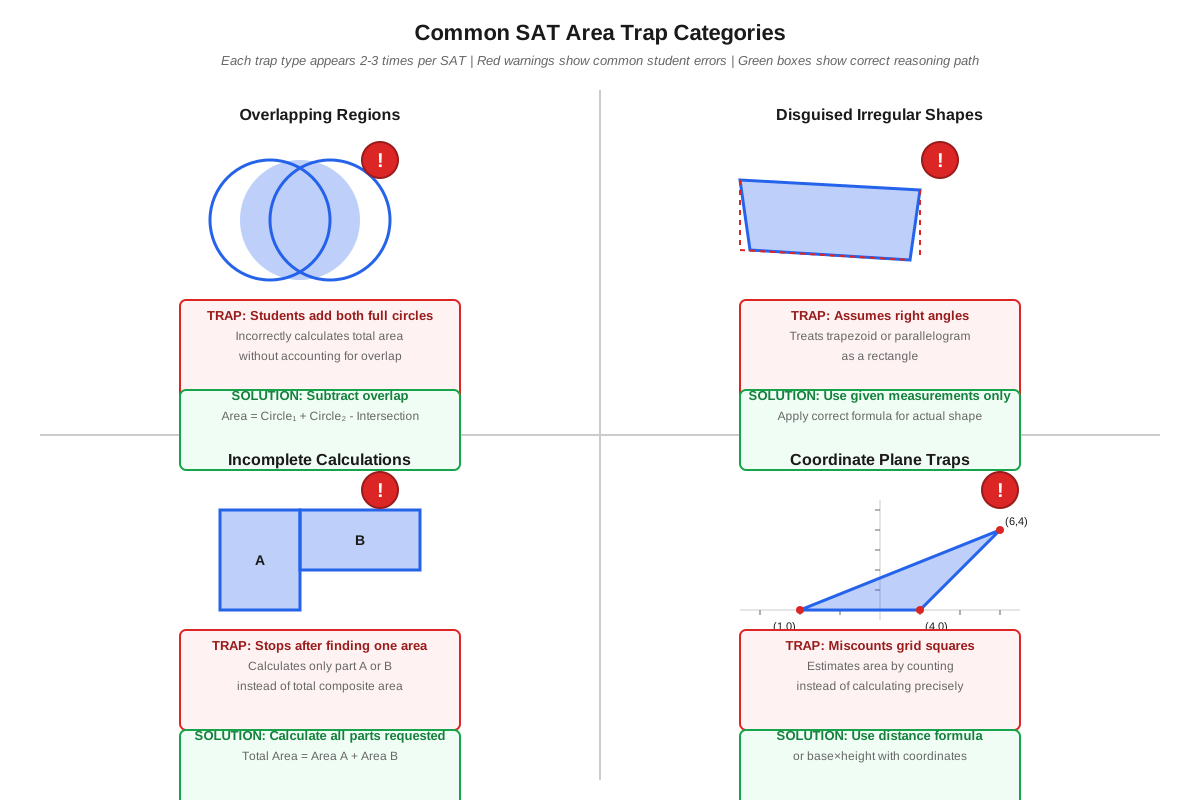
SAT area traps represent one of the most frequently tested categories of deceptive geometry problems on the SAT Math section. These questions are specifically designed to catch students who rush through calculations or make common assumptions about geometric figures. The College Board strategically places these problems throughout the exam to differentiate between students who truly understand geometric principles and those who rely on visual estimation or incomplete reasoning. Area traps typically involve figures that appear straightforward but contain hidden complexities—such as overlapping regions, irregular shapes disguised as regular ones, or problems requiring multi-step reasoning where students often stop after the first calculation.
Understanding sat area traps is essential for achieving a competitive score on the math section because these questions appear in both the calculator and no-calculator portions, often as medium-to-hard difficulty problems worth the same points as easier questions. Students who fall for these traps lose valuable points not due to lack of knowledge, but due to insufficient attention to detail or failure to verify what the question actually asks. These problems test not just computational ability but also careful reading, spatial reasoning, and the discipline to check whether an answer makes logical sense.
The relationship between area traps and broader SAT geometry concepts is fundamental. Area calculations connect to coordinate geometry (finding areas using coordinates), triangle properties (special right triangles, similar triangles), circle geometry (sectors, segments), and algebraic reasoning (setting up equations from geometric constraints). Mastering area traps strengthens overall geometric intuition and develops the critical thinking skills necessary for tackling complex multi-step problems across all SAT math domains.
Learning Objectives
- [ ] Identify key features of SAT area traps
- [ ] Explain how SAT area traps appears on the SAT
- [ ] Apply SAT area traps to answer SAT-style questions
- [ ] Distinguish between what a figure appears to show versus what information is actually given
- [ ] Recognize when additional calculations or geometric principles are needed beyond the obvious first step
- [ ] Verify that calculated areas match the specific quantity requested in the question stem
Prerequisites
- Basic area formulas: Students must know formulas for rectangles, triangles, circles, and trapezoids, as area traps build upon correct formula application
- Coordinate plane fundamentals: Understanding how to plot points and calculate distances is essential for coordinate-based area problems
- Algebraic manipulation: Many area traps require setting up and solving equations, making algebraic fluency necessary
- Properties of geometric shapes: Familiarity with angle relationships, parallel lines, and special triangles helps identify when figures have hidden properties
Why This Topic Matters
In real-world applications, calculating areas accurately is crucial for fields ranging from architecture and construction to data visualization and computer graphics. Professionals must avoid the same types of errors that SAT area traps test—making unwarranted assumptions, miscounting regions, or stopping calculations prematurely. The critical thinking skills developed by mastering area traps transfer directly to problem-solving in engineering, design, and any field requiring spatial reasoning.
On the SAT specifically, area problems appear in approximately 10-15% of all math questions, with area traps comprising a significant portion of medium and hard difficulty questions. According to College Board data, these questions have among the highest incorrect response rates, making them prime opportunities for prepared students to gain competitive advantage. Area traps most commonly appear as:
- Multiple-choice questions where the obvious wrong answer is deliberately included as a distractor
- Grid-in questions where partial calculations lead to incorrect numerical answers
- Word problems embedded in real-world contexts (gardens, floors, paintings) where students must extract geometric information
- Coordinate geometry problems requiring area calculations from plotted points
- Composite figure problems where total area requires adding or subtracting multiple regions
The strategic placement of these questions means that students who recognize and avoid area traps can significantly improve their percentile ranking, as these problems effectively separate score ranges in the 600-750 range.
Core Concepts
Understanding What Makes an Area Problem a "Trap"
An sat area traps question contains deliberate features designed to elicit incorrect responses from students who work too quickly or make common assumptions. The fundamental characteristic of these traps is the gap between what appears obvious and what is actually true. The College Board constructs these problems by exploiting predictable student behaviors: visual estimation instead of calculation, stopping after finding one value when the question asks for another, or assuming figures are drawn to scale when they explicitly state otherwise.
The most important principle for avoiding area traps is recognizing that SAT figures are not drawn to scale unless explicitly stated. This warning appears frequently but is often ignored. A triangle that looks equilateral might be scalene; a quadrilateral that appears to be a square might be an irregular trapezoid. Students must rely exclusively on given information—marked angles, stated side lengths, and labeled measurements—rather than visual appearance.
Types of SAT Area Traps
The "Part vs. Whole" Trap
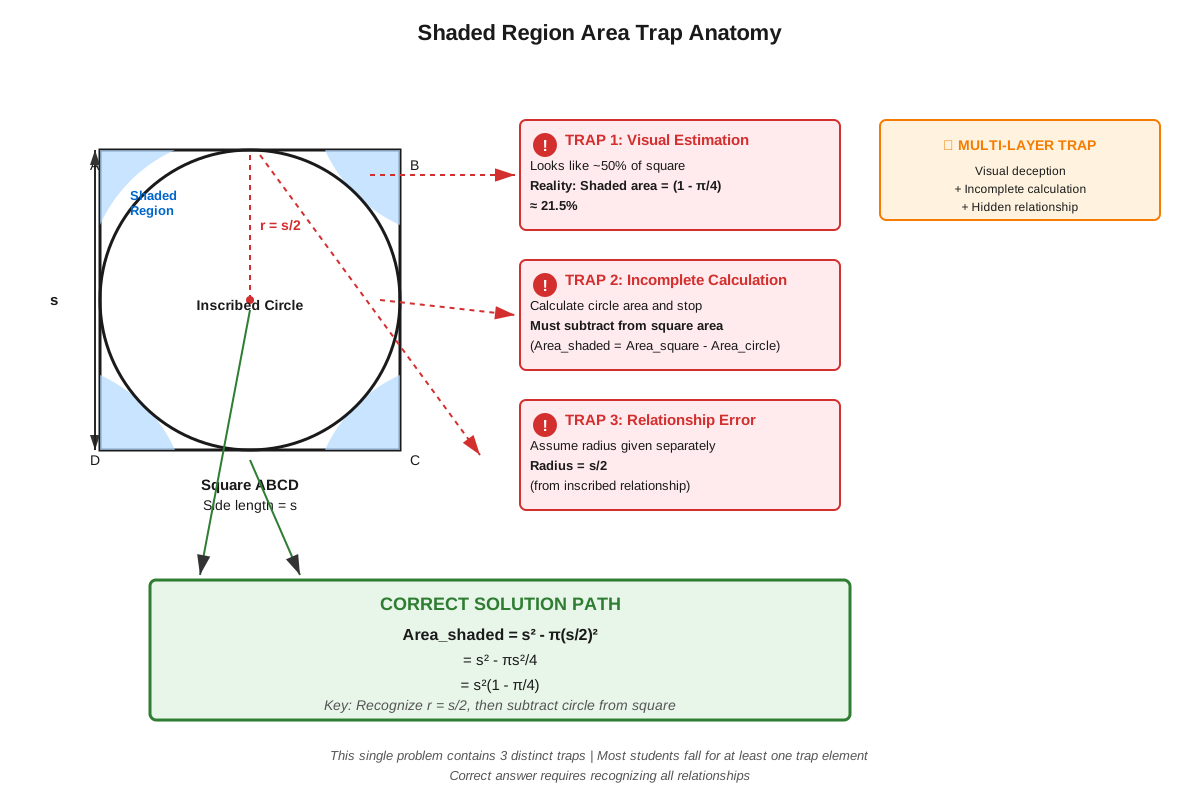
This trap occurs when students calculate the area of one component but the question asks for a different quantity. For example, a problem might show a rectangle with a triangle inside and ask for the area of the shaded region (the rectangle minus the triangle), but students calculate only the rectangle's area. The trap answer—the rectangle's area alone—will always appear among the multiple-choice options.
Key identification features:
- Questions using words like "shaded region," "remaining area," or "unshaded portion"
- Composite figures with multiple distinct regions
- Problems requiring subtraction of areas
The "Hidden Information" Trap
These problems provide geometric information indirectly, requiring students to use properties of shapes to find missing measurements. A classic example involves giving the perimeter of a rectangle and one dimension, expecting students to find the other dimension before calculating area. Students who guess or estimate the missing dimension fall into the trap.
Key identification features:
- Not all dimensions are directly labeled
- Presence of special triangles (30-60-90, 45-45-90) where ratios determine unlabeled sides
- Parallel lines or similar figures where proportional relationships reveal missing measurements
The "Unit Confusion" Trap
This sophisticated trap involves mixing units within a single problem. A figure might show dimensions in feet but ask for area in square inches, or provide a scale (1 cm = 5 meters) requiring conversion before calculation. Students who calculate correctly but forget to convert units select trap answers that represent the unconverted result.
Key identification features:
- Multiple units mentioned in the problem (feet and inches, centimeters and meters)
- Scale drawings or maps
- Word problems describing real-world scenarios with mixed measurement systems
The "Coordinate Geometry" Trap
When area problems appear on the coordinate plane, traps often involve miscounting grid squares, incorrectly applying the distance formula, or forgetting that coordinates can be negative. A common version shows a triangle with vertices at given coordinates, and students must use the formula: Area = ½|x₁(y₂ - y₃) + x₂(y₃ - y₁) + x₃(y₁ - y₂)|. Trap answers result from sign errors or using the distance formula when area is requested.
Key identification features:
- Figures plotted on coordinate grids
- Vertices given as ordered pairs
- Questions asking for area when coordinates are provided
The "Overlapping Regions" Trap
These problems show two or more shapes that overlap, and students must carefully determine which areas to add or subtract. The classic version shows two circles that intersect, asking for the total area covered by at least one circle. Students who simply add both circle areas double-count the overlapping region, selecting a trap answer.
Key identification features:
- Venn diagram-style arrangements
- Phrases like "at least one," "exactly one," or "both"
- Shaded regions that span multiple shapes
Essential Formulas and When Traps Exploit Them
| Shape | Formula | Common Trap |
|---|---|---|
| Rectangle | A = length × width | Giving perimeter instead, expecting students to find dimensions first |
| Triangle | A = ½ × base × height | Height not being a side length; students use wrong measurement |
| Circle | A = πr² | Giving diameter instead of radius; students forget to divide by 2 |
| Trapezoid | A = ½(b₁ + b₂) × h | Students add all four sides instead of just the parallel bases |
| Parallelogram | A = base × height | Height not being the slanted side; students use wrong measurement |
The "What Are They Actually Asking?" Principle
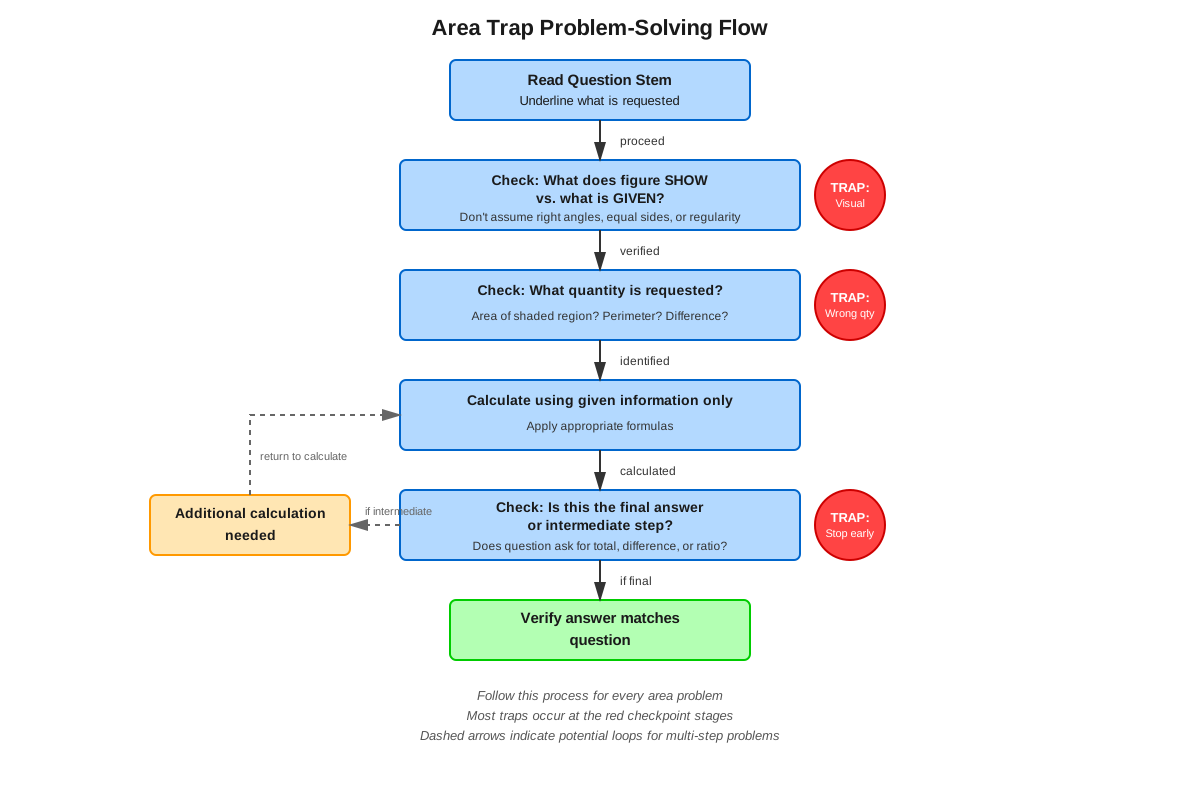
The most critical skill for avoiding area traps is carefully identifying what quantity the question requests. SAT area trap questions often involve multiple calculations where intermediate values appear as trap answers. The solution process might be:
- Find a missing dimension using given information
- Calculate the area of one shape
- Calculate the area of another shape
- Subtract or add to find the requested region
- Convert units if necessary
Trap answers correspond to stopping after steps 1, 2, or 3. The correct answer requires completing all steps. Students must underline or highlight exactly what the question asks for before beginning calculations.
Concept Relationships
The concepts within SAT area traps form a hierarchical relationship where recognition precedes solution. First, students must identify trap features (visual deception, missing information, unit mixing) → which enables them to determine what additional information is needed (using geometric properties, theorems, or conversions) → which allows them to execute the complete solution path (all necessary calculations in correct order) → finally verifying the answer matches what was requested (not an intermediate value).
Area traps connect to prerequisite knowledge in specific ways. Basic area formulas provide the computational foundation, but traps test whether students know when and how to apply them. Coordinate geometry becomes the setting for area traps when figures are plotted on grids, requiring integration of distance calculations with area formulas. Algebraic reasoning enables students to set up equations when dimensions are given indirectly (e.g., "the length is 3 more than twice the width").
The relationship to broader SAT geometry topics is extensive. Triangle properties frequently appear in area traps involving special right triangles where students must use side ratios to find unlabeled dimensions. Circle geometry connects through problems involving sectors (fractional areas) or circles inscribed in or circumscribed around polygons. Similar figures create traps where students must recognize that area scales with the square of the linear scale factor, not the scale factor itself.
Understanding area traps also strengthens test-taking strategy across all SAT math domains. The discipline of reading carefully, identifying what's actually asked, and checking whether an answer is reasonable applies equally to algebra, data analysis, and advanced math questions.
Quick check — test yourself on SAT area traps so far.
Try Flashcards →High-Yield Facts
⭐ SAT figures are NOT drawn to scale unless explicitly stated; never estimate measurements visually
⭐ The most common trap answer is the result of stopping one step early in multi-step area problems
⭐ When a problem involves shaded regions, the answer almost never equals the area of the largest shape alone
⭐ If dimensions are given in different units, unit conversion is required before or after area calculation
⭐ The height of a triangle or parallelogram is always perpendicular to the base, not necessarily a side length
- Area problems involving coordinates typically require the coordinate area formula or counting grid squares carefully, not the distance formula
- When two shapes overlap, adding their individual areas double-counts the overlapping region
- Trap answers are deliberately calculated and included in multiple-choice options; if your answer appears as option A or B, verify your work
- Problems giving perimeter or circumference expect you to find dimensions before calculating area
- For circles, always verify whether the problem provides radius or diameter; using diameter as radius quadruples the area incorrectly
- Composite figures require breaking the shape into recognizable components (rectangles, triangles, semicircles) before calculating
- The phrase "in terms of" in the question means the answer will contain variables, not a numerical value
- Scale factor problems: if linear dimensions scale by factor k, area scales by k²
- Sector area equals (central angle/360°) × πr² for circles; students often forget the fractional multiplier
- Grid-in questions have no answer choices to guide you; double-checking is essential
Common Misconceptions
Misconception: All quadrilaterals that look like rectangles are rectangles with perpendicular sides and equal opposite sides.
Correction: Unless right angles are marked or the figure is stated to be a rectangle, it could be any quadrilateral. Use only the given information to determine properties.
Misconception: The area of a triangle can be found by multiplying any two given side lengths and dividing by 2.
Correction: The area formula A = ½bh requires the base and the height perpendicular to that base. If two sides are given without the included angle or perpendicular height, additional information or the Heron's formula is needed.
Misconception: When a problem shows a circle with a given diameter, that value can be used directly as r in the formula A = πr².
Correction: The radius is half the diameter. Using diameter as radius produces an area four times too large, which is always included as a trap answer.
Misconception: If a figure is divided into regions and one region's area is requested, calculating the total area is sufficient.
Correction: Questions asking for "the shaded region," "the area of triangle ABC," or similar specific portions require isolating that exact region, often through subtraction.
Misconception: On coordinate geometry problems, the distance between two points equals the area of a figure with those points as vertices.
Correction: Distance and area are different quantities. Distance uses √[(x₂-x₁)² + (y₂-y₁)²], while area requires different formulas depending on the shape.
Misconception: When a problem provides a scale (e.g., "1 inch represents 10 feet"), areas scale by the same factor as lengths.
Correction: Areas scale by the square of the linear scale factor. If lengths scale by 10, areas scale by 100.
Misconception: The first calculation performed in a multi-step problem is likely the answer.
Correction: SAT area traps specifically target this assumption. Intermediate values are deliberately included as wrong answer choices.
Worked Examples
Example 1: The Shaded Region Trap
Problem: Rectangle ABCD has length 12 and width 8. Triangle EFG is drawn inside the rectangle with base EF = 12 (along the length of the rectangle) and height 5. What is the area of the shaded region (the rectangle minus the triangle)?
Solution Process:
Step 1: Identify what's being asked
The question asks for the shaded region, which is the rectangle's area minus the triangle's area. This is a "part vs. whole" trap.
Step 2: Calculate the rectangle's area
A_rectangle = length × width = 12 × 8 = 96
Trap Alert: 96 will appear as a wrong answer choice, catching students who stop here.
Step 3: Calculate the triangle's area
A_triangle = ½ × base × height = ½ × 12 × 5 = 30
Trap Alert: 30 might also appear as a wrong answer choice.
Step 4: Find the shaded region
A_shaded = A_rectangle - A_triangle = 96 - 30 = 66
Answer: 66
Connection to Learning Objectives: This example demonstrates identifying the key feature (shaded region requiring subtraction), explaining how the trap appears (intermediate values as wrong answers), and applying the complete solution process.
Example 2: Coordinate Geometry Area Trap
Problem: Triangle ABC has vertices at A(2, 3), B(8, 3), and C(5, 9). What is the area of triangle ABC?
Solution Process:
Step 1: Visualize or sketch the triangle
Points A and B have the same y-coordinate (3), so AB is horizontal and can serve as the base.
Step 2: Calculate the base length
Base AB = |8 - 2| = 6
Trap Alert: Students might use the distance formula unnecessarily here, or might calculate 6 and think this is the answer.
Step 3: Calculate the height
The height is the perpendicular distance from C to line AB. Since AB is at y = 3 and C is at y = 9:
Height = |9 - 3| = 6
Step 4: Apply the triangle area formula
A = ½ × base × height = ½ × 6 × 6 = 18
Alternative Method (using coordinate formula):
A = ½|x₁(y₂ - y₃) + x₂(y₃ - y₁) + x₃(y₁ - y₂)|
A = ½|2(3 - 9) + 8(9 - 3) + 5(3 - 3)|
A = ½|2(-6) + 8(6) + 5(0)|
A = ½|-12 + 48 + 0|
A = ½|36| = 18
Answer: 18
Connection to Learning Objectives: This example shows how to apply area concepts to coordinate geometry, avoid the trap of using distance when area is requested, and verify the answer using an alternative method.
Exam Strategy
Approaching SAT Area Trap Questions
Step 1: Read the entire question twice before looking at the figure. Underline or circle exactly what quantity is being requested (total area, shaded region, difference between areas, etc.).
Step 2: List all given information separately from what you need to find. Mark given measurements directly on the figure. If the figure is not drawn to scale, write "NTS" prominently.
Step 3: Identify potential traps by asking:
- Is this a composite figure requiring multiple calculations?
- Are all necessary dimensions provided, or must I find some using geometric properties?
- Are units consistent throughout?
- Does "shaded region" or similar language indicate subtraction?
Step 4: Plan the complete solution path before calculating. Write out the steps: "First find x using..., then calculate area of..., then subtract..."
Step 5: Execute calculations carefully, showing all work. Don't skip steps mentally.
Step 6: Verify your answer by checking:
- Does this answer the actual question asked?
- Is the magnitude reasonable given the figure's dimensions?
- Did I use the correct formula for each shape?
- If my answer appears as choice A or B, did I fall for a trap?
Trigger Words and Phrases
Watch for these high-alert phrases that signal potential traps:
- "Shaded region" → requires subtraction or careful region identification
- "Not drawn to scale" → ignore visual appearance completely
- "In terms of" → answer contains variables, not numbers
- "Remaining area" → total minus some part
- "At least one" → overlapping region problems
- "Perimeter is" → must find dimensions before calculating area
- "Scale of 1:n" → unit conversion required; area scales by n²
Process of Elimination Tips
For multiple-choice area trap questions:
- Eliminate answers with wrong units (if the problem asks for square feet, eliminate answers in feet)
- Eliminate the "obvious" answer if it equals the first calculation in a multi-step problem
- Eliminate answers that are impossibly large or small based on given dimensions (e.g., if a rectangle is 5 by 7, the area cannot exceed 35)
- Check if your answer appears as choice A or B; these positions often contain trap answers for medium/hard questions
Time Allocation
- Easy area problems (direct formula application): 30-45 seconds
- Medium area traps (one hidden step): 60-90 seconds
- Hard area traps (multiple steps, coordinate geometry): 90-120 seconds
If a problem is taking longer than 2 minutes, mark it for review and move on. Return with fresh perspective after completing other questions.
Memory Techniques
The "TRAP" Acronym for Area Problems
Type of region: What exactly is being asked for?
Read all given info: Mark everything on the figure
Assumptions: Make none; use only stated facts
Plan before calculating: Write out all steps needed
The "Height is Perpendicular" Visualization
For triangles and parallelograms, visualize a raindrop falling straight down from the highest point to the base. That vertical path is the height, not the slanted side. Mentally draw this perpendicular line on every figure.
The "Diameter Doubles, Area Quadruples" Rule
Remember: Diameter → Divide by 2 to get radius. If you forget and use diameter as radius, the area becomes 4× too large (since (2r)² = 4r²).
The "Scale Squared" Mnemonic
Linear scale → Area scale²
If a map scale is 1:100, areas scale 1:10,000 (100²)
Think: "Scale Squared for Surface area"
The "Subtract for Shade" Reminder
When you see shading, think: "Shade = Subtract"
Shaded regions almost always require finding a difference between areas.
Summary
SAT area traps represent carefully constructed geometry problems designed to catch common student errors through visual deception, incomplete calculations, and misleading answer choices. Mastering these problems requires moving beyond simple formula memorization to develop critical analytical skills: reading questions precisely to identify what's actually requested, recognizing when figures are not drawn to scale, determining when additional geometric principles must be applied to find missing information, and executing complete multi-step solution paths without stopping at intermediate values. The most common traps involve shaded regions requiring subtraction, hidden dimensions that must be calculated using properties of special triangles or other geometric relationships, unit conversions that students forget to perform, and coordinate geometry problems where distance and area formulas are confused. Success on these problems comes from systematic approaches—marking all given information on figures, planning the complete solution before calculating, and verifying that the final answer matches what the question requested rather than an intermediate calculation. Students who develop the discipline to avoid these traps gain significant competitive advantage, as area problems appear frequently on the SAT and trap versions effectively differentiate score ranges in the 600-750 band where college admissions become increasingly competitive.
Key Takeaways
- SAT area traps exploit predictable errors: visual estimation, stopping calculations early, and making unwarranted assumptions about figures
- "Not drawn to scale" means exactly that: rely exclusively on marked measurements and stated properties, never visual appearance
- Shaded regions almost always require subtraction: calculate the total area and subtract unwanted portions
- The height of triangles and parallelograms is perpendicular to the base, not necessarily a side length shown in the figure
- Trap answers are deliberately included in multiple-choice options: if your answer appears as choice A or B on a medium/hard question, verify your work
- Multi-step problems require complete execution: intermediate values appear as wrong answers to catch students who stop early
- Unit consistency is essential: convert all measurements to the same unit before calculating, and remember that area scales by the square of linear scale factors
Related Topics
Triangle Properties and Special Right Triangles: Understanding 30-60-90 and 45-45-90 triangles enables solving area traps where dimensions must be found using side ratios before calculating area. Mastering area traps provides foundation for these more complex geometric relationships.
Circle Geometry (Sectors, Segments, and Inscribed Figures): Area traps involving circles often require calculating fractional areas (sectors) or finding areas of regions between circles and polygons. Success with basic area traps prepares students for these advanced circle problems.
Coordinate Geometry and Distance Formula: Many area traps appear on coordinate planes, requiring integration of coordinate concepts with area calculations. Distinguishing between when to use distance formulas versus area formulas is crucial.
Similar Figures and Scale Factors: Understanding how area scales with the square of linear dimensions prevents traps involving scale drawings, maps, and proportional figures. This topic builds directly on area trap concepts.
Volume and Three-Dimensional Geometry: The same trap principles (hidden dimensions, unit conversion, part vs. whole) extend to volume problems. Mastering area traps provides the analytical framework for avoiding volume traps.
Practice CTA
Now that you understand the key features of SAT area traps and the strategies to avoid them, it's time to put your knowledge into practice. Work through the practice questions to encounter these traps in realistic SAT contexts, and use the flashcards to reinforce the critical formulas and identification techniques. Remember: every area trap you learn to recognize now is a question you'll answer correctly on test day, potentially adding valuable points to your score. The difference between a good score and a great score often comes down to avoiding these predictable traps—and you now have the tools to do exactly that. Start practicing with confidence!
Sign up free to keep reading
Create a free AnvayaPrep account to finish this SAT guide on SAT area traps — plus flashcards and practice questions.