Overview
The volume of cones is a fundamental geometric concept that appears regularly on the SAT math section, testing students' ability to work with three-dimensional shapes and apply spatial reasoning skills. A cone is a three-dimensional solid with a circular base that tapers smoothly to a single point called the apex or vertex. Understanding how to calculate the volume of cones requires mastery of the relationship between the cone's dimensions—its radius and height—and the space it occupies. This topic bridges algebraic manipulation with geometric visualization, making it an essential skill for success on standardized tests.
On the SAT, questions involving sat volume of cones typically appear in both the calculator and no-calculator sections, often integrated with other mathematical concepts such as ratios, proportions, and problem-solving in real-world contexts. Students may encounter straightforward calculation problems, but more commonly, the SAT presents multi-step questions that require identifying relevant dimensions from word problems, working with composite shapes, or applying the volume formula in reverse to find missing measurements. The ability to recognize when a cone volume problem is being presented—even when disguised within a complex scenario—is crucial for efficient test-taking.
This topic connects directly to broader geometric principles including area calculations, coordinate geometry, and the relationships between two-dimensional and three-dimensional figures. Mastery of cone volume also reinforces understanding of circular measurements, the constant π (pi), and proportional reasoning. Since volume problems often appear alongside cylinders, spheres, and pyramids on the SAT, developing fluency with cone calculations strengthens overall spatial reasoning abilities and prepares students for the diverse geometry questions they will encounter on test day.
Learning Objectives
- [ ] Identify key features of Volume of cones, including radius, height, and the apex
- [ ] Explain how Volume of cones appears on the SAT in various question formats
- [ ] Apply Volume of cones to answer SAT-style questions accurately and efficiently
- [ ] Derive and manipulate the cone volume formula to solve for different variables
- [ ] Recognize and solve problems involving composite shapes that include cones
- [ ] Convert between different units of measurement when calculating cone volumes
- [ ] Analyze the relationship between cone dimensions and volume changes when dimensions are scaled
Prerequisites
- Basic algebra skills: Ability to manipulate equations and solve for variables is essential when working with the volume formula
- Understanding of circles: Knowledge of radius, diameter, and the constant π is necessary since cones have circular bases
- Exponent rules: Squaring the radius (r²) appears in the volume formula and requires comfort with basic exponent operations
- Fraction operations: The volume formula includes the fraction 1/3, requiring multiplication and division with fractions
- Unit conversion: Problems may require converting between inches, feet, centimeters, or other measurement units
Why This Topic Matters
Understanding cone volume has practical applications across numerous real-world fields. Engineers use cone calculations when designing funnels, traffic cones, and conical storage containers. Architects incorporate conical elements in building designs, from roof structures to decorative features. Food service professionals work with cone-shaped containers for ice cream and beverages, requiring volume calculations for inventory and pricing. Manufacturing industries rely on cone volume formulas when producing conical parts or determining material requirements.
On the SAT, volume questions appear with moderate to high frequency, typically comprising 1-3 questions per test administration. These questions most commonly appear in the calculator-permitted section but can also surface in the no-calculator portion when the numbers are designed for mental math. The College Board includes volume problems because they assess multiple mathematical competencies simultaneously: spatial reasoning, formula application, algebraic manipulation, and problem-solving in context. Questions may present cones explicitly or embed them within word problems involving real-world scenarios like water tanks, party hats, or architectural structures.
The SAT presents cone volume in several distinct formats: direct calculation problems where all dimensions are provided; reverse problems requiring students to find radius or height given the volume; comparison questions asking students to determine how volume changes when dimensions are scaled; and composite figure problems where cones are combined with cylinders, hemispheres, or other shapes. Additionally, the test may present problems involving rates, such as liquid filling or draining from a conical container, requiring integration of volume concepts with time-based calculations.
Core Concepts
The Cone Volume Formula
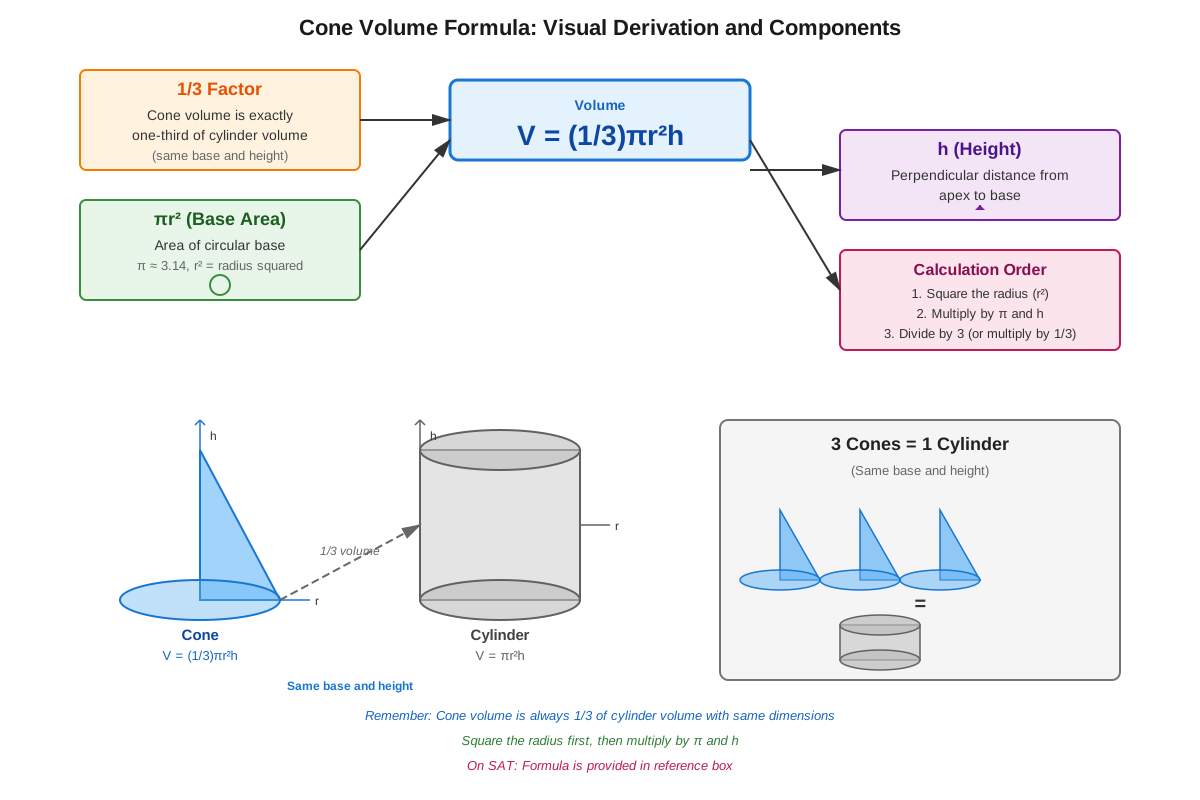
The fundamental formula for calculating the volume of cones is:
V = (1/3)πr²hWhere:
- V represents the volume (measured in cubic units)
- π (pi) is the mathematical constant approximately equal to 3.14159 (or 22/7 for estimation)
- r represents the radius of the circular base
- h represents the perpendicular height from the base to the apex
This formula reveals that a cone's volume is exactly one-third the volume of a cylinder with the same base radius and height. Understanding this relationship helps students remember the formula and provides insight into the geometric relationship between these shapes. The factor of 1/3 accounts for the cone's tapering shape—as you move from the base toward the apex, the cross-sectional area decreases linearly until reaching zero at the point.
Key Components of a Cone
A cone has several defining features that students must identify correctly:
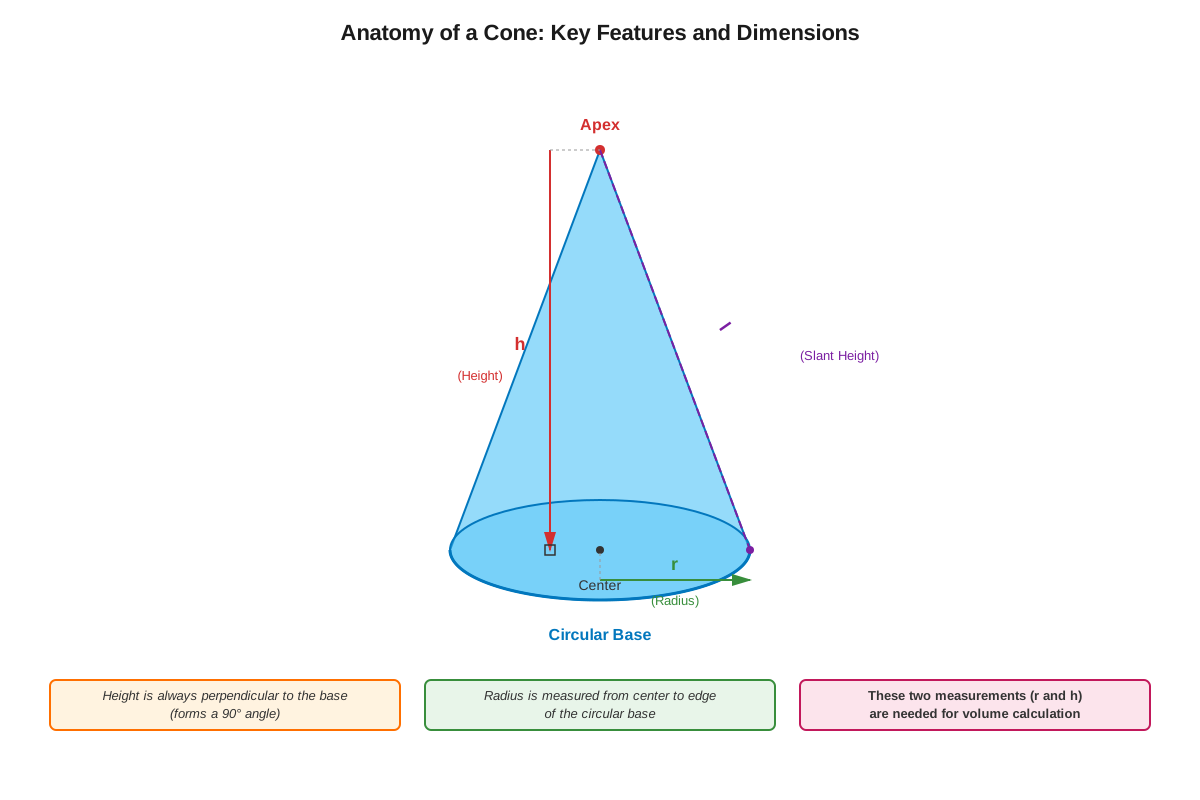
The Base: A circular region that forms the bottom of the cone. The base's radius (r) is the distance from the center of the circle to any point on its edge. Some problems provide the diameter instead, requiring division by 2 to find the radius.
The Height (h): The perpendicular distance from the base's center to the apex. This is crucial—the height must be measured perpendicular to the base, not along the slanted side. Many SAT problems test whether students can distinguish between height and slant height.
The Apex (or Vertex): The single point at the top of the cone where all the slanted edges meet.
The Slant Height (ℓ): The distance from any point on the base's edge to the apex, measured along the cone's surface. While slant height is important for surface area calculations, it is NOT used directly in the volume formula. However, SAT problems may provide slant height and require students to use the Pythagorean theorem to find the perpendicular height.
Relationship Between Slant Height and Perpendicular Height
When a problem provides the slant height (ℓ) instead of the perpendicular height (h), students must apply the Pythagorean theorem. Visualizing a right triangle formed by the radius, perpendicular height, and slant height:
ℓ² = r² + h²This can be rearranged to solve for height:
h = √(ℓ² - r²)This relationship frequently appears on the SAT as an additional step before applying the volume formula, testing whether students can integrate multiple geometric concepts.
Scaling and Proportional Changes
Understanding how volume changes when dimensions are scaled is a high-yield SAT concept. When all linear dimensions of a cone are multiplied by a scale factor k:
- The radius becomes kr
- The height becomes kh
- The volume becomes k³V
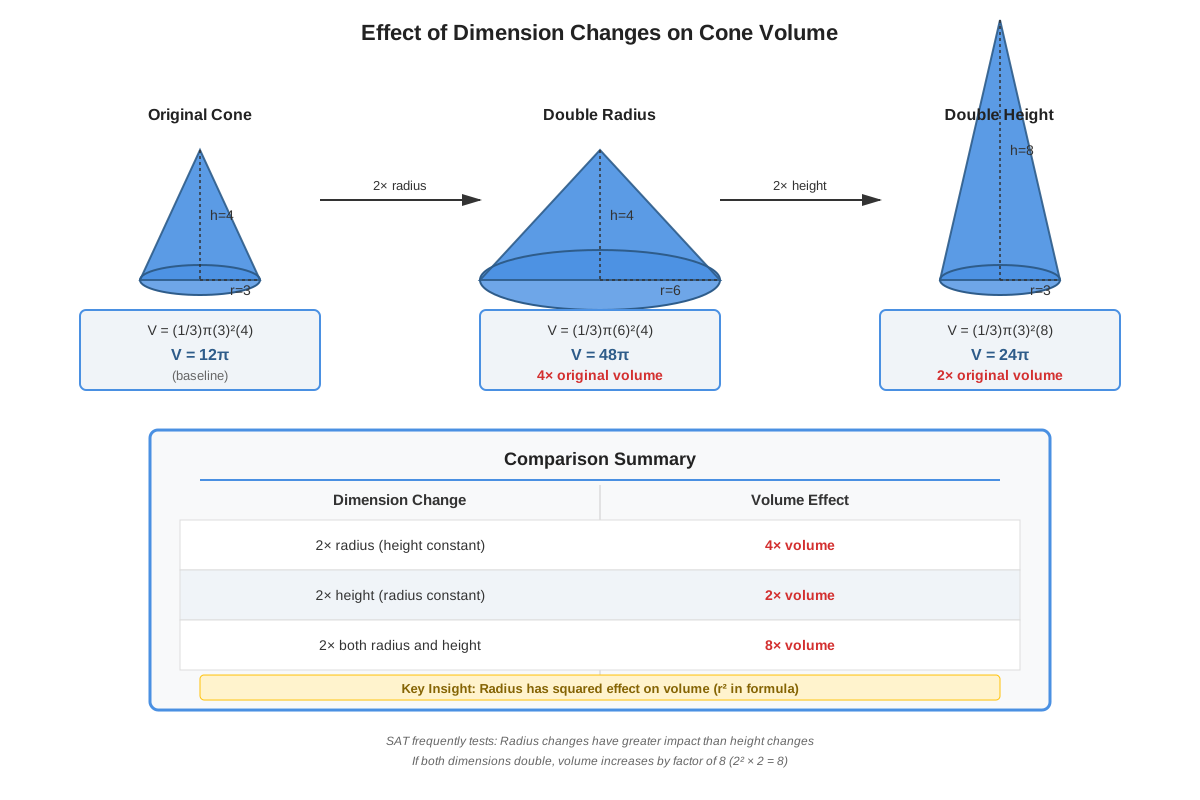
This cubic relationship means that doubling all dimensions (k = 2) results in a volume that is 8 times larger (2³ = 8), not merely twice as large. The SAT frequently tests this concept through comparison questions or problems involving similar cones.
| Scale Factor (k) | Radius Change | Height Change | Volume Change |
|---|---|---|---|
| 2 | 2r | 2h | 8V |
| 3 | 3r | 3h | 27V |
| 1/2 | r/2 | h/2 | V/8 |
| 0.5 | 0.5r | 0.5h | 0.125V |
Working with Different Units
SAT problems may present dimensions in different units, requiring conversion before calculation. Common conversions include:
- 1 foot = 12 inches
- 1 meter = 100 centimeters
- 1 yard = 3 feet
When calculating volume, all linear dimensions must be in the same unit. The resulting volume will be in cubic units of whatever unit was used. For example, if radius and height are both in centimeters, the volume will be in cubic centimeters (cm³).
Composite Figures Involving Cones
The SAT often combines cones with other three-dimensional shapes:
Cone + Cylinder: A common combination where a cone sits atop a cylinder (like a silo with a conical roof). Total volume equals the sum of both shapes' volumes.
Cone + Hemisphere: Sometimes a cone is topped with a hemisphere (half-sphere), requiring knowledge of both volume formulas.
Truncated Cone (Frustum): Occasionally, problems involve a cone with its top cut off parallel to the base. This requires calculating the volume of the large cone and subtracting the volume of the removed smaller cone.
Solving for Unknown Dimensions
SAT problems frequently provide the volume and one dimension, requiring students to solve for the missing measurement. This requires algebraic manipulation of the volume formula:
To find radius when volume and height are known:
r = √(3V / πh)To find height when volume and radius are known:
h = 3V / πr²These rearrangements test algebraic fluency and the ability to work backward from a formula.
Concept Relationships
The volume of cones concept builds directly upon foundational knowledge of circles, since the base of every cone is circular. The formula V = (1/3)πr²h incorporates the area of a circle (πr²) multiplied by height and the factor 1/3, demonstrating how two-dimensional area concepts extend into three-dimensional volume calculations.
The relationship between cones and cylinders is particularly important: Cone Volume → is exactly 1/3 of → Cylinder Volume (with identical base and height). This connection helps students remember the formula and provides a checking mechanism—if a calculated cone volume exceeds a cylinder with the same dimensions, an error has occurred.
The Pythagorean theorem connects to cone problems through the relationship between slant height, perpendicular height, and radius: Slant Height Problem → requires → Pythagorean Theorem → leads to → Height Calculation → enables → Volume Calculation. This chain of reasoning appears frequently on the SAT.
Scaling concepts link cone volume to proportional reasoning: Linear Dimension Change → produces → Cubic Volume Change. This relationship extends to all three-dimensional figures and represents a fundamental principle of geometric similarity.
Unit conversion skills integrate with volume calculations: Mixed Units → require → Conversion → before → Formula Application. This connection emphasizes the importance of dimensional analysis in mathematical problem-solving.
Quick check — test yourself on Volume of cones so far.
Try Flashcards →High-Yield Facts
⭐ The volume formula for a cone is V = (1/3)πr²h, where r is the base radius and h is the perpendicular height
⭐ A cone's volume is exactly one-third the volume of a cylinder with the same base radius and height
⭐ The height in the volume formula must be perpendicular to the base, not the slant height along the surface
⭐ When all dimensions of a cone are multiplied by k, the volume is multiplied by k³
⭐ The radius must be squared in the formula (r²), making it the most sensitive dimension for volume changes
- The slant height (ℓ), perpendicular height (h), and radius (r) form a right triangle where ℓ² = r² + h²
- If a problem provides diameter instead of radius, divide by 2 before using the formula
- Volume is always expressed in cubic units (cm³, in³, ft³, etc.)
- On the SAT, π is typically left as π in the answer choices rather than approximated as 3.14
- Doubling the radius while keeping height constant increases volume by a factor of 4 (since 2² = 4)
- Doubling the height while keeping radius constant only doubles the volume
- When comparing two cones, the one with the larger radius typically has greater volume, even if its height is smaller
- Composite figures require adding or subtracting individual volumes calculated separately
- The apex of a cone must be directly above the center of the circular base for the standard volume formula to apply
- Converting all measurements to the same unit before calculation prevents common errors
Common Misconceptions
Misconception: The slant height can be used directly in the volume formula as the height value.
Correction: Only the perpendicular height (the vertical distance from the base center to the apex) should be used in V = (1/3)πr²h. If given slant height, use the Pythagorean theorem to find perpendicular height first.
Misconception: Doubling all dimensions of a cone doubles its volume.
Correction: When all linear dimensions are doubled, the volume increases by a factor of 8 (2³), not 2. Volume scales with the cube of the linear scale factor because it is a three-dimensional measurement.
Misconception: The formula is V = πr²h (forgetting the 1/3 factor).
Correction: The cone volume formula must include the factor of 1/3, making it V = (1/3)πr²h. Without this factor, you're calculating the volume of a cylinder instead.
Misconception: Radius and diameter are interchangeable in the formula.
Correction: The formula specifically requires radius (r), which is half the diameter. If a problem provides diameter (d), you must divide by 2 to get r = d/2 before substituting into the formula.
Misconception: When radius doubles and height halves, volume stays the same.
Correction: Since radius is squared in the formula, doubling radius increases volume by a factor of 4, while halving height decreases it by a factor of 2. The net effect is that volume doubles (4 × 1/2 = 2).
Misconception: π should always be approximated as 3.14 in calculations.
Correction: On the SAT, answer choices typically include π as a symbol. Unless specifically instructed to approximate, leave π in your answer for greater accuracy and to match the provided answer choices.
Misconception: All cones have the same proportions between radius and height.
Correction: Cones can have any ratio of radius to height. A "tall, narrow" cone has large h relative to r, while a "short, wide" cone has large r relative to h. The volume formula works for all proportions.
Worked Examples
Example 1: Direct Volume Calculation
Problem: A cone-shaped paper cup has a radius of 3 inches and a height of 8 inches. What is the volume of the cup in cubic inches?
Solution:
Step 1: Identify the given information
- Radius (r) = 3 inches
- Height (h) = 8 inches
- We need to find volume (V)
Step 2: Write the volume formula
V = (1/3)πr²h
Step 3: Substitute the known values
V = (1/3)π(3)²(8)
Step 4: Calculate step by step
- First, square the radius: 3² = 9
- V = (1/3)π(9)(8)
- Multiply 9 × 8 = 72
- V = (1/3)π(72)
- Multiply 72 × (1/3) = 24
- V = 24π cubic inches
Step 5: Check if approximation is needed
Since the answer choices would likely include π, the final answer is 24π cubic inches (or approximately 75.4 cubic inches if numerical approximation is required).
Connection to Learning Objectives: This example demonstrates direct application of the cone volume formula, addressing the objective to apply volume of cones to answer SAT-style questions.
Example 2: Finding Height from Volume
Problem: A conical water tank has a volume of 150π cubic feet and a radius of 5 feet. What is the height of the tank?
Solution:
Step 1: Identify what we know and what we need to find
- Volume (V) = 150π cubic feet
- Radius (r) = 5 feet
- Height (h) = unknown
Step 2: Write the volume formula
V = (1/3)πr²h
Step 3: Substitute known values
150π = (1/3)π(5)²h
Step 4: Solve for h algebraically
- 150π = (1/3)π(25)h
- Divide both sides by π: 150 = (1/3)(25)h
- Simplify: 150 = (25/3)h
- Multiply both sides by 3: 450 = 25h
- Divide both sides by 25: h = 450/25
- h = 18 feet
Step 5: Verify the answer
Check: V = (1/3)π(5)²(18) = (1/3)π(25)(18) = (1/3)π(450) = 150π ✓
Connection to Learning Objectives: This example demonstrates manipulating the cone volume formula to solve for different variables, showing how the formula can be applied in reverse—a common SAT question type.
Example 3: Composite Figure with Scaling
Problem: A decorative piece consists of a cylinder with a cone on top. The cylinder has radius 6 cm and height 10 cm. The cone has the same radius as the cylinder and a height of 8 cm. If a similar decorative piece is made with all dimensions doubled, how many times greater is the volume of the larger piece compared to the original?
Solution:
Step 1: Calculate the original total volume
- Cylinder volume: V_cyl = πr²h = π(6)²(10) = 360π cm³
- Cone volume: V_cone = (1/3)πr²h = (1/3)π(6)²(8) = (1/3)π(36)(8) = 96π cm³
- Total original volume: V_original = 360π + 96π = 456π cm³
Step 2: Apply scaling principle
When all linear dimensions are doubled (scale factor k = 2), volume is multiplied by k³ = 2³ = 8
Step 3: Calculate the ratio
The larger piece has volume = 8 × 456π = 3,648π cm³
Ratio = 3,648π / 456π = 8
Answer: The larger piece has a volume 8 times greater than the original.
Alternative approach: Recognize immediately that doubling all dimensions means volume increases by 2³ = 8, without calculating actual volumes.
Connection to Learning Objectives: This example integrates composite shapes with scaling concepts, demonstrating how cone volume connects to broader geometric reasoning required on the SAT.
Exam Strategy
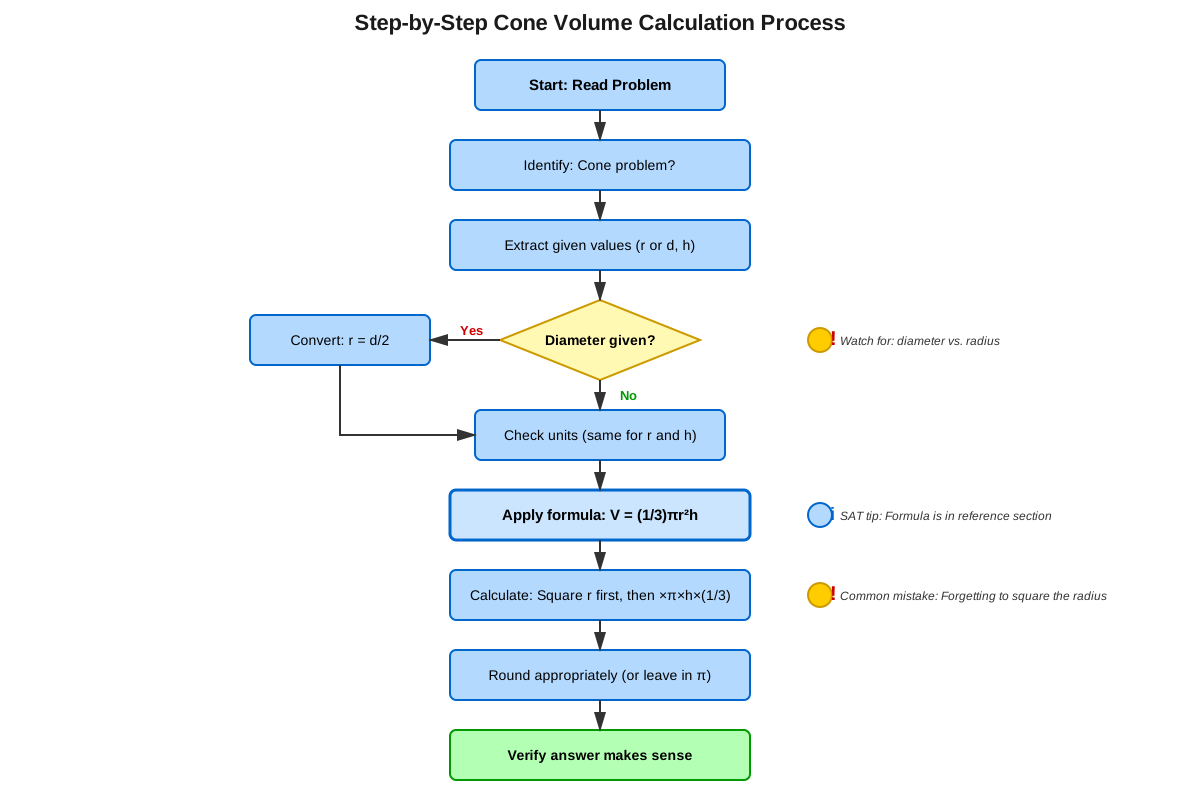
When approaching sat volume of cones questions, begin by carefully reading the problem to identify what information is provided and what is being asked. Draw a quick sketch of the cone, labeling the radius, height, and any other given measurements. This visualization helps prevent confusion between slant height and perpendicular height.
Trigger words and phrases to watch for include:
- "Cone-shaped," "conical," or "tapers to a point" → indicates a cone problem
- "Diameter" → remember to divide by 2 to get radius
- "Slant height" → signals you'll need the Pythagorean theorem before using the volume formula
- "Similar cones" or "scaled by a factor" → think about cubic relationships in volume
- "Combined with a cylinder" → indicates a composite figure requiring addition of volumes
- "How much greater" or "ratio of volumes" → suggests comparison or scaling concepts
Process-of-elimination strategies specific to cone volume:
- Eliminate any answer choice that doesn't include π unless the problem specifically asks for a numerical approximation
- If you've correctly identified radius and height, eliminate answers that would result from forgetting the 1/3 factor (these will be exactly 3 times too large)
- For scaling problems, eliminate answers that show linear relationships when cubic relationships are required
- Check units in answer choices—if your calculation yields cubic inches but answers are in cubic feet, you've likely made a conversion error
Time allocation advice: Straightforward cone volume calculations should take 30-60 seconds once you've identified the given information. Problems requiring the Pythagorean theorem or involving composite figures may take 90-120 seconds. If a problem requires multiple steps and you're running short on time, consider marking it for review and moving to simpler questions first. However, don't skip these problems entirely—they're often worth the same points as easier questions and become manageable with practice.
Calculator usage: For the calculator-permitted section, use your calculator for squaring the radius and multiplying, but be careful when entering the formula. Use parentheses appropriately: (1/3) × π × r² × h. Many students make errors by entering 1/3 × π × r² × h without parentheses, causing order-of-operations mistakes.
Memory Techniques
Formula Mnemonic: Remember "Very Cool Pie Really Helps" for V = C(one factor) × P(i) × R(adius squared) × H(eight), where C represents 1/3.
Visual Memory Aid: Picture a cone as a "pointed cylinder" that holds exactly one-third as much as a cylinder with the same base and height. Visualize pouring water from a cone into a cylinder three times to fill it completely.
The "One-Third Rule": Create a mental association: "A cone is one-third as pointy as it gets—one-third of a cylinder." This helps remember the 1/3 factor that distinguishes cone volume from cylinder volume.
Radius vs. Diameter: Use the phrase "Radius is Really half" to remember that radius is half the diameter, preventing the common error of using diameter directly in the formula.
Scaling Memory Device: "Linear Changes Cube" → When Linear dimensions change, volume changes by the Cube of that factor. Alternatively, remember "3D means power of 3" since three-dimensional volume scales with the third power.
Pythagorean Connection: When you see "slant height," think "Slant means Solve with Squares" (Pythagorean theorem uses squares: a² + b² = c²).
Summary
The volume of cones is a critical SAT math topic that combines geometric visualization with algebraic manipulation. The fundamental formula V = (1/3)πr²h requires students to identify the radius of the circular base and the perpendicular height from base to apex, then apply the formula correctly including the essential 1/3 factor. Success on SAT cone problems demands distinguishing between perpendicular height and slant height, understanding that slant height problems require the Pythagorean theorem as an intermediate step. Students must also master scaling relationships, recognizing that when linear dimensions change by a factor k, volume changes by k³. Common SAT question types include direct volume calculations, solving for unknown dimensions given the volume, comparing volumes of similar cones, and working with composite figures that combine cones with cylinders or other shapes. The key to mastering this topic lies in careful problem analysis, accurate formula application, and awareness of common pitfalls such as confusing radius with diameter or forgetting the 1/3 factor. With systematic practice, students can efficiently handle any cone volume question the SAT presents.
Key Takeaways
- The cone volume formula V = (1/3)πr²h must include the 1/3 factor and uses perpendicular height, not slant height
- A cone's volume is exactly one-third that of a cylinder with identical base radius and height
- When all dimensions of a cone are scaled by factor k, the volume scales by k³ (cubic relationship)
- Slant height problems require using the Pythagorean theorem (ℓ² = r² + h²) to find perpendicular height first
- The radius is squared in the formula, making it the most influential dimension for volume changes
- Always convert diameter to radius (r = d/2) and ensure all measurements use the same units before calculating
- SAT answer choices typically leave π as a symbol rather than approximating it numerically
Related Topics
Volume of Cylinders: Understanding cylinder volume (V = πr²h) reinforces the relationship with cone volume and helps with composite figure problems where both shapes appear together.
Volume of Spheres and Hemispheres: These formulas (V = (4/3)πr³ for spheres) often appear alongside cone problems in comprehensive geometry questions, and mastering cone volume builds confidence with similar three-dimensional calculations.
Surface Area of Cones: While volume measures space inside, surface area measures the outside covering. This related topic uses slant height directly and connects to the same geometric features.
Pythagorean Theorem Applications: Since many cone problems involve finding perpendicular height from slant height, strengthening Pythagorean theorem skills directly improves cone problem-solving efficiency.
Geometric Similarity and Scaling: The principles learned about how cone volume scales with dimension changes apply to all three-dimensional figures and represent fundamental concepts in proportional reasoning.
Practice CTA
Now that you've mastered the core concepts of cone volume, it's time to solidify your understanding through active practice. Attempt the practice questions designed specifically for this topic, focusing on applying the strategies and formulas you've learned. Use the flashcards to reinforce the key formulas, relationships, and common pitfalls. Remember, the SAT rewards both accuracy and efficiency—practice will help you recognize cone problems quickly and solve them confidently. Each problem you work through strengthens your geometric intuition and brings you closer to your target score. You've built a strong foundation; now apply it!
Sign up free to keep reading
Create a free AnvayaPrep account to finish this SAT guide on Volume of cones — plus flashcards and practice questions.