Overview
The volume of spheres is a fundamental geometric concept that appears regularly on the SAT Math section, testing students' ability to work with three-dimensional shapes and apply spatial reasoning. A sphere is a perfectly round three-dimensional object where every point on its surface is equidistant from its center. Understanding how to calculate the volume of a sphere—the amount of three-dimensional space it occupies—is essential for success on multiple SAT questions each test administration.
This topic holds particular importance on the SAT because it frequently appears in both calculator and no-calculator sections, often integrated with other mathematical concepts such as ratios, proportions, and real-world application problems. The SAT volume of spheres questions typically require students to not only recall the formula but also manipulate it algebraically, work backwards from given information, or apply it in complex multi-step problems. Mastery of this concept demonstrates mathematical maturity and problem-solving ability that the College Board values highly.
Within the broader landscape of math concepts tested on the SAT, sphere volume connects directly to other geometric principles including surface area, radius and diameter relationships, and coordinate geometry. It also reinforces algebraic manipulation skills, particularly working with exponents and the constant π (pi). Students who thoroughly understand sphere volume are better equipped to tackle composite figure problems, optimization questions, and real-world modeling scenarios that appear throughout the exam.
Learning Objectives
- [ ] Identify key features of Volume of spheres
- [ ] Explain how Volume of spheres appears on the SAT
- [ ] Apply Volume of spheres to answer SAT-style questions
- [ ] Derive and manipulate the sphere volume formula to solve for different variables (radius, diameter, or volume)
- [ ] Compare and contrast sphere volume with volumes of other three-dimensional shapes
- [ ] Solve multi-step problems involving sphere volume combined with other geometric or algebraic concepts
- [ ] Interpret real-world contexts that require sphere volume calculations
Prerequisites
- Basic algebra skills: Ability to solve equations, isolate variables, and work with exponents is essential for manipulating the sphere volume formula
- Understanding of π (pi): Familiarity with this mathematical constant and when to use its approximate value versus leaving it in symbolic form
- Exponent rules: Knowledge of how to work with cubic powers (x³) and cube roots, as the volume formula involves r³
- Circle geometry: Understanding radius, diameter, and their relationship (d = 2r) provides the foundation for three-dimensional sphere concepts
- Unit conversion: Ability to work with different measurement units (cubic inches, cubic centimeters, etc.) and convert between them when necessary
Why This Topic Matters
Real-World Applications: Sphere volume calculations appear throughout science, engineering, and everyday life. Architects and engineers use these calculations when designing spherical structures like domes and water towers. Medical professionals calculate dosages based on spherical droplet volumes. Manufacturers determine material requirements for producing spherical products ranging from ball bearings to sports equipment. Understanding sphere volume enables students to model and solve practical problems involving any round three-dimensional object.
SAT Exam Statistics: Volume of spheres appears on approximately 60-70% of SAT administrations, typically in 1-2 questions per test. These questions can appear in either the calculator or no-calculator sections and are worth the same point value as any other question, making them high-yield study material. The College Board considers this a medium-difficulty topic, meaning it separates average scorers from high scorers. Questions involving sphere volume often appear in the latter half of each math section, where more challenging problems are concentrated.
Common Exam Formats: On the SAT, sphere volume appears in several distinct question types. Direct calculation problems provide a radius or diameter and ask for the volume. Reverse problems give the volume and require finding the radius or diameter. Comparison questions ask students to relate the volumes of two or more spheres with different dimensions. Application problems embed sphere volume within real-world scenarios like filling containers, comparing capacities, or calculating material requirements. Multi-step problems combine sphere volume with ratios, percentages, or other geometric shapes, testing integrated mathematical reasoning.
Core Concepts
The Sphere Volume Formula
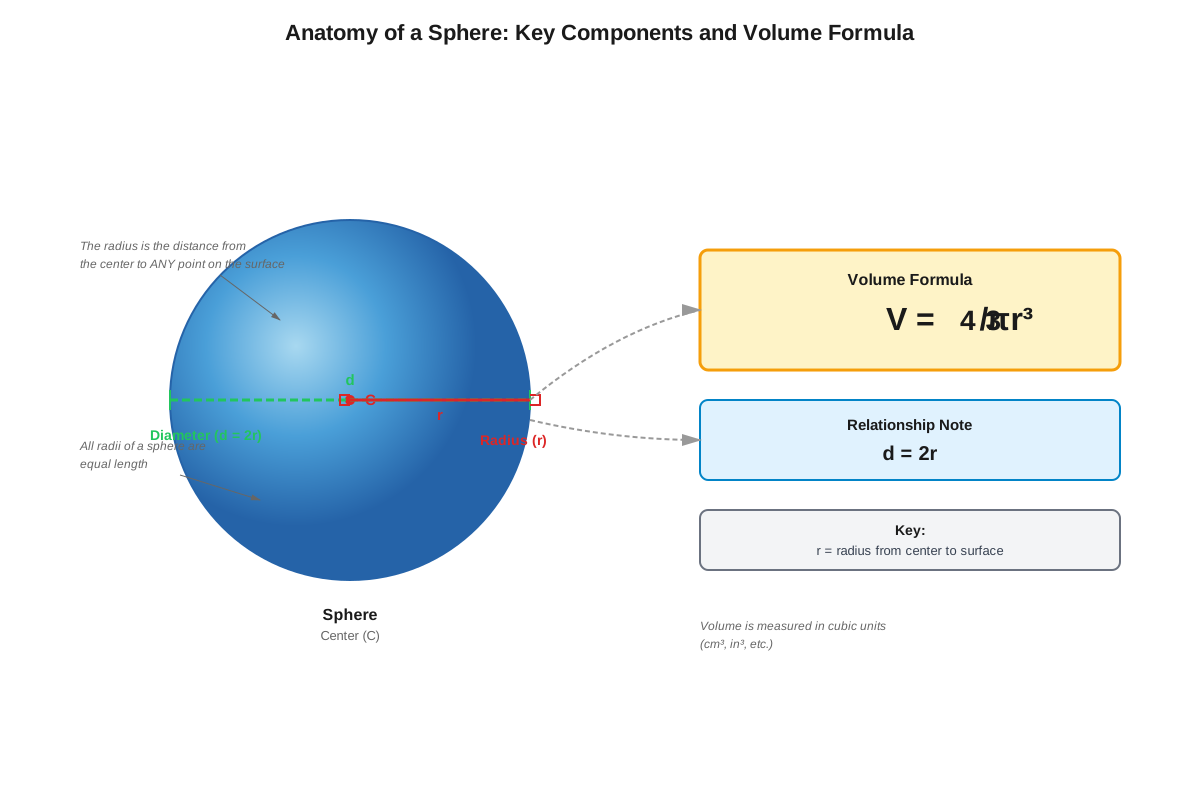
The volume of spheres is calculated using the formula:
V = (4/3)πr³Where:
- V represents the volume
- π (pi) is approximately 3.14159 or 22/7
- r represents the radius (the distance from the center to any point on the surface)
This formula tells us that sphere volume depends on the cube of the radius, meaning that small changes in radius create large changes in volume. The coefficient 4/3 (approximately 1.333) is a constant that emerges from calculus-based derivation, though SAT students need only memorize and apply the formula, not derive it.
Understanding Radius and Diameter Relationships
The radius is half the diameter, expressed as r = d/2, or conversely, d = 2r. Many SAT questions deliberately provide the diameter instead of the radius to test whether students remember to convert before applying the formula. This is one of the most common error points on sphere volume questions.
When given a diameter of 6 units, students must first calculate r = 6/2 = 3 units before substituting into the volume formula. Failing to make this conversion leads to a volume calculation that is eight times too large (since (2r)³ = 8r³).
Working with the Cubic Relationship
The r³ term in the volume formula creates a cubic relationship between radius and volume. This means:
- Doubling the radius multiplies the volume by 8 (2³ = 8)
- Tripling the radius multiplies the volume by 27 (3³ = 27)
- Halving the radius divides the volume by 8
Understanding this relationship allows students to solve comparison problems quickly without calculating exact volumes. If Sphere A has twice the radius of Sphere B, then Sphere A has 8 times the volume of Sphere B.
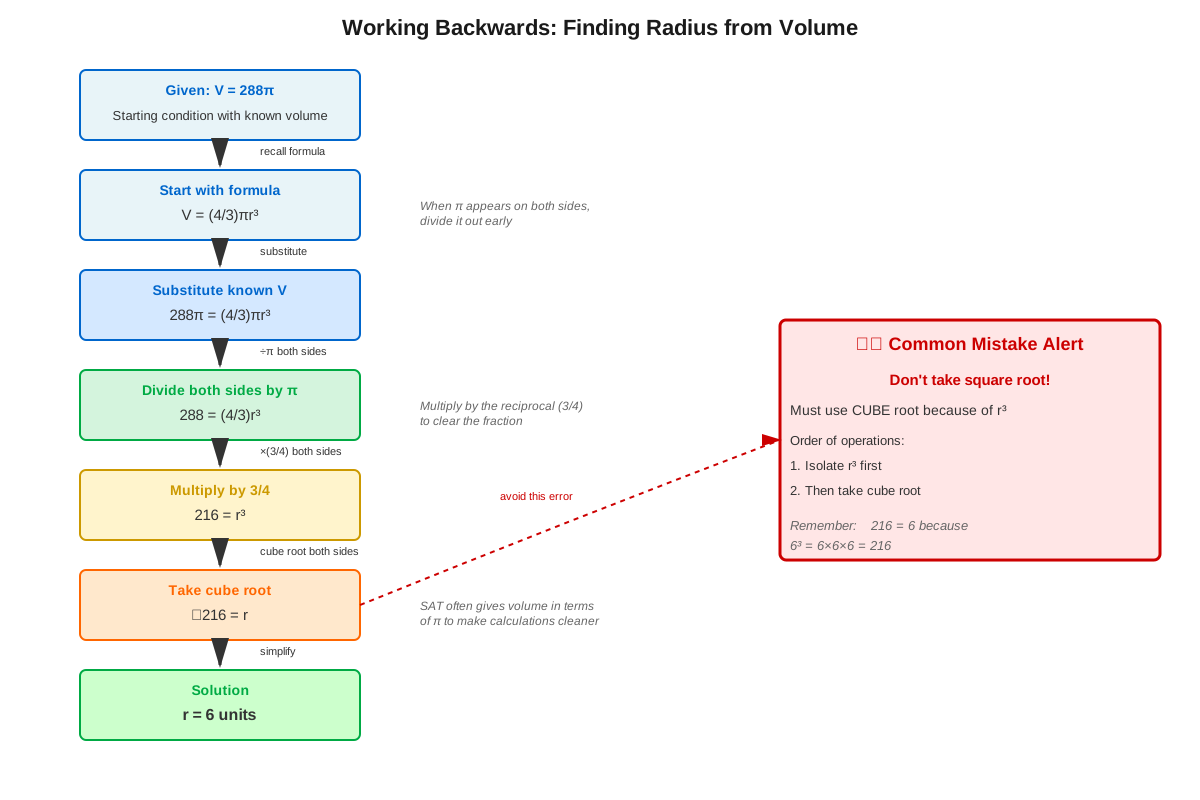
Solving for Radius from Volume
Many SAT questions reverse the typical problem structure by providing the volume and asking for the radius or diameter. This requires algebraic manipulation:
Starting with V = (4/3)πr³, solve for r:
- Multiply both sides by 3/4: (3V)/(4π) = r³
- Take the cube root of both sides: r = ∛[(3V)/(4π)]
This reverse calculation appears frequently enough that students should practice it until comfortable with the algebraic steps.
Units and Dimensional Analysis
Volume is always measured in cubic units (units³). If the radius is given in centimeters, the volume will be in cubic centimeters (cm³). If the radius is in feet, the volume is in cubic feet (ft³). The SAT occasionally tests whether students recognize that volume must be expressed in cubic units, not square units or linear units.
When converting between unit systems, remember that the conversion factor must be cubed. If converting from inches to feet where 12 inches = 1 foot, then 1,728 cubic inches (12³) = 1 cubic foot.
Comparing Spheres to Other Shapes
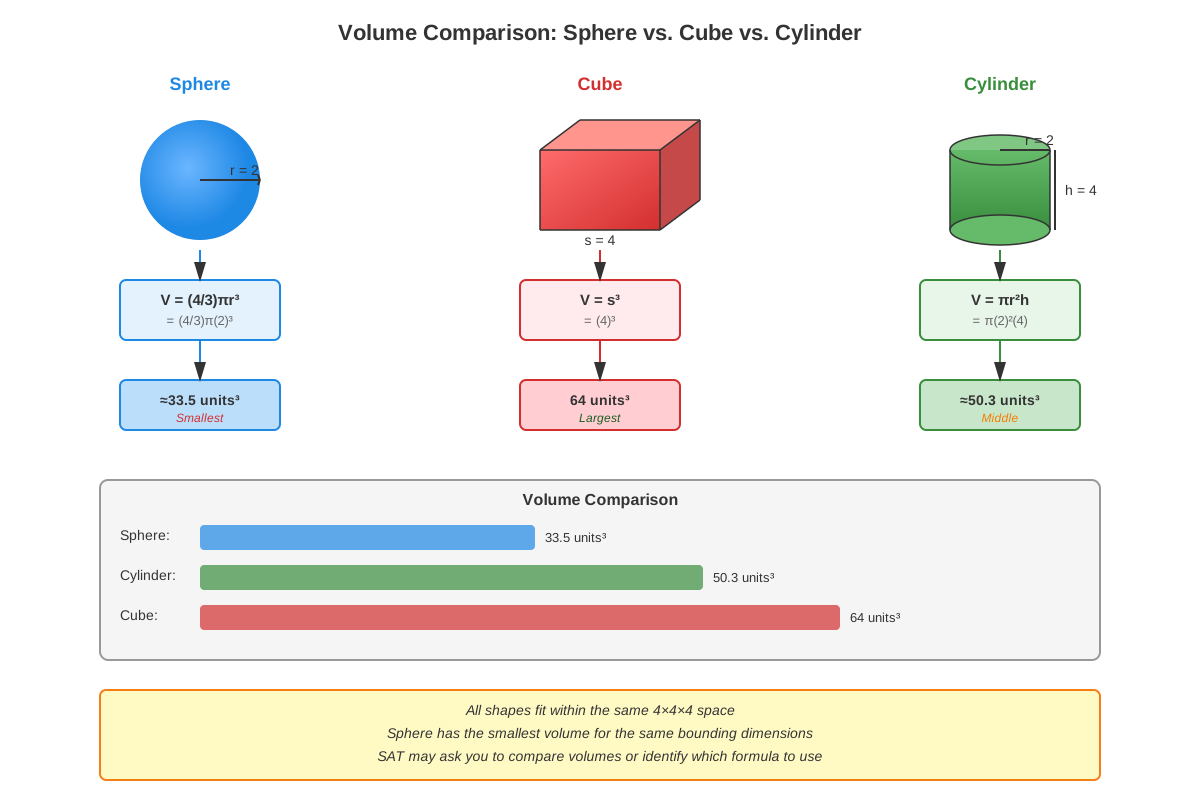
| Shape | Volume Formula | Relationship to Sphere |
|---|---|---|
| Sphere | (4/3)πr³ | Base shape |
| Cylinder | πr²h | Sphere volume = (2/3) × cylinder volume when h = 2r |
| Cone | (1/3)πr²h | Sphere volume = 2 × cone volume when h = 2r |
| Cube | s³ | No direct relationship; depends on how sphere fits |
Understanding these relationships helps on comparison questions where multiple shapes appear in the same problem.
Hemisphere Volume
A hemisphere is exactly half a sphere, so its volume is:
V_hemisphere = (2/3)πr³This formula appears occasionally on the SAT, particularly in composite figure problems where a hemisphere is attached to a cylinder or other shape.
Concept Relationships
The volume of spheres concept connects to multiple mathematical domains, creating a web of interrelated knowledge. At the foundation, circle geometry (radius, diameter, circumference) provides the two-dimensional basis that extends into three dimensions for spheres. The relationship r = d/2 transfers directly from circles to spheres.
Algebraic manipulation skills enable students to rearrange the volume formula, solving for radius when volume is given or finding diameter from radius. This connects to the broader SAT algebra domain, particularly solving equations with exponents and working with rational expressions.
The cubic relationship between radius and volume connects to exponential growth concepts and proportional reasoning. Understanding that doubling the radius increases volume by a factor of 8 demonstrates mastery of exponent rules (specifically that (2r)³ = 8r³).
Surface area of spheres (4πr²) provides a parallel concept where both formulas share the same radius variable but produce different measurements—one two-dimensional (area) and one three-dimensional (volume). Comparing these formulas reinforces understanding of dimensions and units.
Composite figures represent the most complex application, where sphere volume combines with cylinders, cones, cubes, or other shapes. These problems require: identifying individual shapes → calculating each volume separately → combining volumes through addition or subtraction → arriving at a final answer.
Real-world modeling connects sphere volume to practical applications, requiring students to translate word problems into mathematical expressions, reinforcing the relationship between abstract formulas and concrete situations.
The progression flows: Basic circle concepts → Sphere properties → Volume formula application → Algebraic manipulation → Multi-step problem solving → Real-world applications.
High-Yield Facts
⭐ The sphere volume formula is V = (4/3)πr³, where r is the radius
⭐ Radius is half the diameter: r = d/2; always convert diameter to radius before using the volume formula
⭐ Doubling the radius multiplies the volume by 8 (since 2³ = 8)
⭐ Volume is always measured in cubic units (cm³, in³, ft³, etc.)
⭐ To solve for radius from volume: r = ∛[(3V)/(4π)]
- A hemisphere has volume (2/3)πr³, exactly half of a full sphere
- Tripling the radius multiplies the volume by 27 (3³ = 27)
- The coefficient 4/3 in the formula is approximately 1.333
- When π appears in both the question and answer choices, it often cancels out or remains in the final answer
- The volume of a sphere with radius r equals the volume of a cylinder with radius r and height (4/3)r
- If two spheres have radii in the ratio a:b, their volumes are in the ratio a³:b³
- The SAT provides the sphere volume formula in the reference information at the beginning of each math section
- Converting units requires cubing the conversion factor (e.g., 12 inches = 1 foot means 1,728 in³ = 1 ft³)
Quick check — test yourself on Volume of spheres so far.
Try Flashcards →Common Misconceptions
Misconception: Using diameter directly in the formula without converting to radius
Correction: The formula requires radius, not diameter. Always divide the diameter by 2 before substituting into V = (4/3)πr³. Using diameter instead of radius produces a volume that is 8 times too large.
Misconception: Confusing the volume formula (4/3)πr³ with the surface area formula (4πr²)
Correction: Volume involves r³ (cubic) and measures three-dimensional space in cubic units. Surface area involves r² (squared) and measures two-dimensional area in square units. The presence or absence of the 3 exponent is the key distinguishing feature.
Misconception: Believing that doubling the radius doubles the volume
Correction: Because of the cubic relationship (r³), doubling the radius multiplies the volume by 8, not 2. The volume increases by the cube of the scaling factor: if radius increases by factor k, volume increases by factor k³.
Misconception: Expressing volume in square units (like cm²) instead of cubic units (like cm³)
Correction: Volume always requires cubic units because it measures three-dimensional space. Square units measure area (two dimensions), while cubic units measure volume (three dimensions). The exponent in the units must match the dimensionality.
Misconception: Forgetting to cube the entire radius value, especially when the radius is a fraction or decimal
Correction: When r = 1/2, then r³ = (1/2)³ = 1/8, not 1/2. When r = 0.5, then r³ = 0.125. The cubing operation applies to the entire numerical value, and students must carefully calculate this, especially without a calculator.
Misconception: Thinking the 4/3 coefficient can be ignored or approximated as 1
Correction: The 4/3 coefficient is essential to the formula and significantly affects the result. Omitting it produces a volume that is only 75% of the correct answer. While approximations are sometimes useful for estimation, the exact coefficient must be used for precise calculations.
Worked Examples
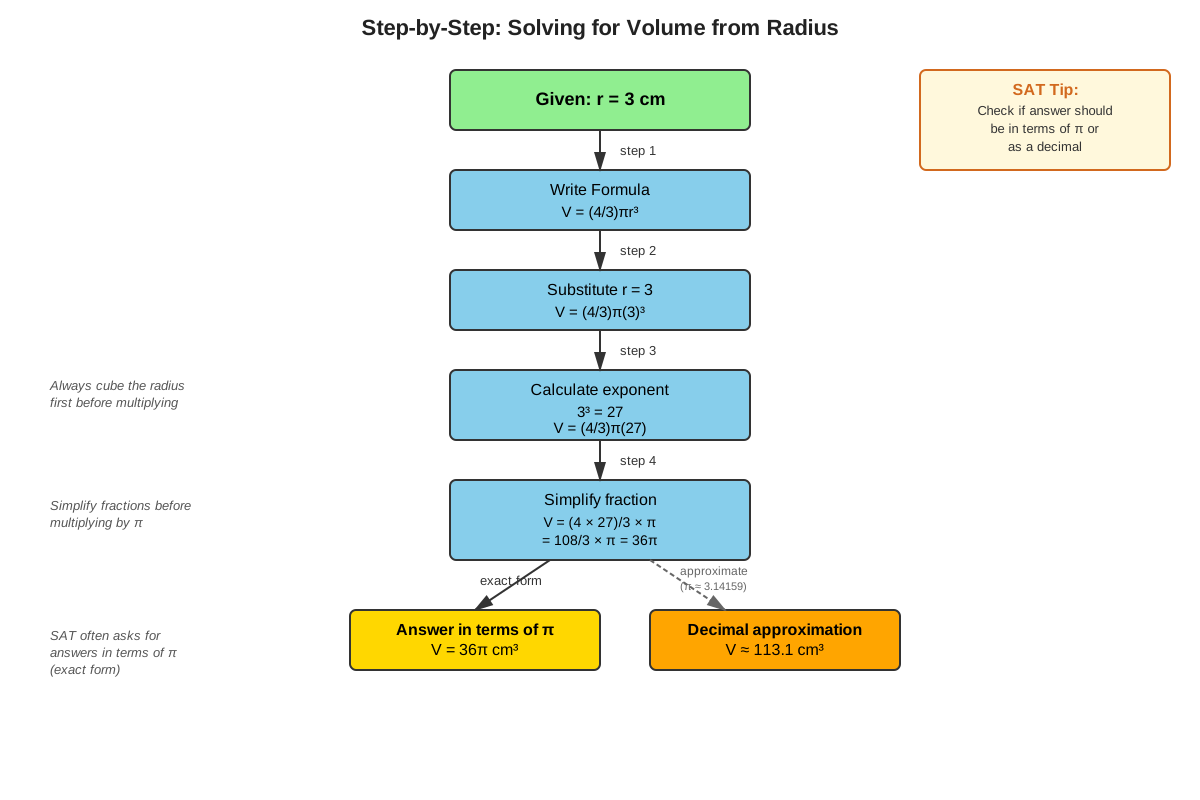
Example 1: Direct Volume Calculation
Problem: A spherical water tank has a radius of 6 feet. What is the volume of the tank in cubic feet?
Solution:
Step 1: Identify the given information
- Radius r = 6 feet
- Need to find volume V
Step 2: Write the sphere volume formula
V = (4/3)πr³
Step 3: Substitute the radius value
V = (4/3)π(6)³
Step 4: Calculate 6³
6³ = 6 × 6 × 6 = 216
Step 5: Substitute and simplify
V = (4/3)π(216)
V = (4 × 216)/3 × π
V = 864/3 × π
V = 288π cubic feet
Step 6: If a numerical approximation is needed
V ≈ 288 × 3.14159 ≈ 904.78 cubic feet
Answer: 288π ft³ (exact) or approximately 905 ft³ (rounded)
Connection to Learning Objectives: This example demonstrates direct application of the volume formula, identifying the key feature (radius) and applying it to calculate volume—core skills for SAT questions.
Example 2: Reverse Calculation with Diameter
Problem: A sphere has a volume of 36π cubic inches. What is the diameter of the sphere?
Solution:
Step 1: Identify given information
- Volume V = 36π in³
- Need to find diameter d
Step 2: Write the volume formula and substitute
(4/3)πr³ = 36π
Step 3: Divide both sides by π
(4/3)r³ = 36
Step 4: Multiply both sides by 3/4
r³ = 36 × (3/4)
r³ = 108/4
r³ = 27
Step 5: Take the cube root of both sides
r = ∛27
r = 3 inches
Step 6: Convert radius to diameter
d = 2r
d = 2(3)
d = 6 inches
Answer: 6 inches
Connection to Learning Objectives: This example demonstrates reverse problem-solving (working from volume to find dimensions), algebraic manipulation of the formula, and the critical radius-to-diameter conversion—all high-yield SAT skills.
Example 3: Comparison Problem
Problem: Sphere A has a radius of 3 cm. Sphere B has a radius of 6 cm. How many times greater is the volume of Sphere B than the volume of Sphere A?
Solution:
Step 1: Recognize the relationship
Sphere B's radius is 2 times Sphere A's radius (6/3 = 2)
Step 2: Apply the cubic relationship
When radius is multiplied by k, volume is multiplied by k³
Here, k = 2, so volume multiplies by 2³ = 8
Alternative approach (calculating both volumes):
Volume of Sphere A: V_A = (4/3)π(3)³ = (4/3)π(27) = 36π cm³
Volume of Sphere B: V_B = (4/3)π(6)³ = (4/3)π(216) = 288π cm³
Ratio: V_B/V_A = 288π/36π = 288/36 = 8
Answer: Sphere B has 8 times the volume of Sphere A
Connection to Learning Objectives: This demonstrates understanding of the cubic relationship between radius and volume, a concept that enables quick problem-solving on comparison questions without lengthy calculations.
Exam Strategy
Approach Strategy: When encountering sphere volume questions on the SAT, follow this systematic approach:
- Identify what's given and what's needed: Circle the radius, diameter, or volume in the problem. Underline what the question asks for.
- Check for diameter vs. radius: If diameter is given, immediately convert to radius by dividing by 2. Mark this conversion clearly in your work.
- Write the formula: Even though it's in the reference section, writing V = (4/3)πr³ helps organize your thinking and prevents errors.
- Decide on π handling: If answer choices contain π, leave it in symbolic form throughout your calculation. If answers are numerical, use the calculator's π button for accuracy.
- Show algebraic steps: For reverse problems, write each manipulation step to avoid errors and enable checking your work.
Trigger Words and Phrases:
- "spherical," "sphere," "ball," "globe" → signals sphere volume formula
- "diameter" → convert to radius immediately
- "radius is doubled/tripled/halved" → think about cubic relationship (8×, 27×, 1/8×)
- "how many times greater" → set up a ratio or use scaling relationships
- "hemisphere" → use (2/3)πr³ instead of (4/3)πr³
- "tank," "container," "holds" → volume calculation in context
Process of Elimination Tips:
When answer choices include both numerical values and expressions with π, the correct answer typically matches the form of the given information. If the problem gives values with π, the answer likely contains π.
Eliminate answers with wrong units: volume must be cubic units (in³, cm³, ft³), never square units or linear units.
For comparison questions, eliminate answers that don't reflect the cubic relationship. If radius doubles, any answer suggesting volume doubles is incorrect.
Check magnitude: A sphere with radius 10 cm has volume approximately 4,000 cm³. Eliminate answers that are wildly different from reasonable estimates.
Time Allocation: Sphere volume questions typically require 60-90 seconds. Direct calculation problems should take closer to 60 seconds, while multi-step or reverse problems may need the full 90 seconds. If a problem requires more than 2 minutes, mark it and return later—you may be overcomplicating the approach.
Memory Techniques
Formula Mnemonic: "Four Thirds Pie Radius Cubed" → (4/3)πr³
Think: "Four Tasty Pies Require Careful Cutting" to remember the sequence.
Diameter-Radius Reminder: "Diameter Divided" → Always divide diameter by 2 to get radius. The double-D reminds you to divide.
Cubic Relationship Visualization: Picture a small sphere fitting inside a larger sphere. If the larger sphere has twice the radius, imagine that 8 of the small spheres could fit inside (2³ = 8). This visual reinforces the cubic scaling relationship.
Units Check Acronym: "Volume Calls Cubes" → Volume requires Cubic units (V-C-C). This prevents the common error of using square units.
Hemisphere Memory: A hemisphere is "half" a sphere, and the formula (2/3)πr³ is "half" of (4/3)πr³. The word "half" appears in both the name and the relationship.
Formula Component Memory: Remember "4/3" by thinking "one more third than a whole" (1 + 1/3 = 4/3). This helps distinguish it from other formulas and makes the coefficient memorable.
Summary
The volume of spheres is a high-yield SAT Math topic that requires students to master the formula V = (4/3)πr³ and apply it flexibly across various problem types. Success depends on recognizing that radius must be used (not diameter), understanding the cubic relationship between radius and volume (doubling radius multiplies volume by 8), and maintaining proper cubic units throughout calculations. SAT questions test this concept through direct calculations, reverse problems requiring algebraic manipulation, comparison questions leveraging scaling relationships, and real-world applications embedded in context. The formula appears in the reference section, but efficient problem-solving requires memorization and practiced application. Students must be alert to common traps including diameter-radius confusion, incorrect unit dimensions, and misunderstanding of scaling relationships. Mastery of sphere volume connects to broader geometric reasoning, algebraic manipulation skills, and spatial visualization abilities that support success across multiple SAT Math domains.
Key Takeaways
- The sphere volume formula V = (4/3)πr³ uses radius, not diameter; always convert d to r by dividing by 2
- Volume scales with the cube of the radius: doubling radius multiplies volume by 8, tripling multiplies by 27
- Volume must always be expressed in cubic units (cm³, in³, ft³), never square or linear units
- For reverse problems, isolate r³ first, then take the cube root: r = ∛[(3V)/(4π)]
- The SAT tests sphere volume through direct calculation, reverse problems, comparisons, and real-world applications
- Understanding the cubic relationship enables quick problem-solving on comparison questions without full calculations
- Hemisphere volume is exactly half sphere volume: (2/3)πr³
Related Topics
Surface Area of Spheres: After mastering volume, students should explore surface area (4πr²), which measures the two-dimensional area covering the sphere's exterior. This reinforces understanding of dimensional differences and provides comparison opportunities between area and volume formulas.
Volume of Cylinders and Cones: These related three-dimensional shapes share π and radius components with spheres, and SAT questions frequently combine multiple shapes in composite figure problems. Understanding all three formulas enables solving complex multi-shape problems.
Coordinate Geometry in Three Dimensions: Spheres can be represented algebraically as (x-h)² + (y-k)² + (z-l)² = r², connecting geometric and algebraic representations. This advanced topic builds on sphere fundamentals.
Ratios and Proportions: Since sphere volume involves cubic relationships, mastering proportional reasoning with cubed values enhances problem-solving efficiency, particularly for comparison questions.
Optimization Problems: Advanced applications involve finding maximum or minimum volumes given constraints, connecting sphere volume to algebraic problem-solving and real-world modeling.
Practice CTA
Now that you've mastered the core concepts of sphere volume, it's time to solidify your understanding through active practice. Attempt the practice questions to apply these concepts in SAT-style problems, testing your ability to recognize problem types, execute calculations accurately, and avoid common traps. Use the flashcards to reinforce formula memorization and key relationships until they become automatic. Remember: understanding the concepts is the first step, but achieving SAT success requires practiced application under timed conditions. Each practice problem you complete builds the confidence and speed you'll need on test day. You've got this—now prove it through practice!
Sign up free to keep reading
Create a free AnvayaPrep account to finish this SAT guide on Volume of spheres — plus flashcards and practice questions.