Overview
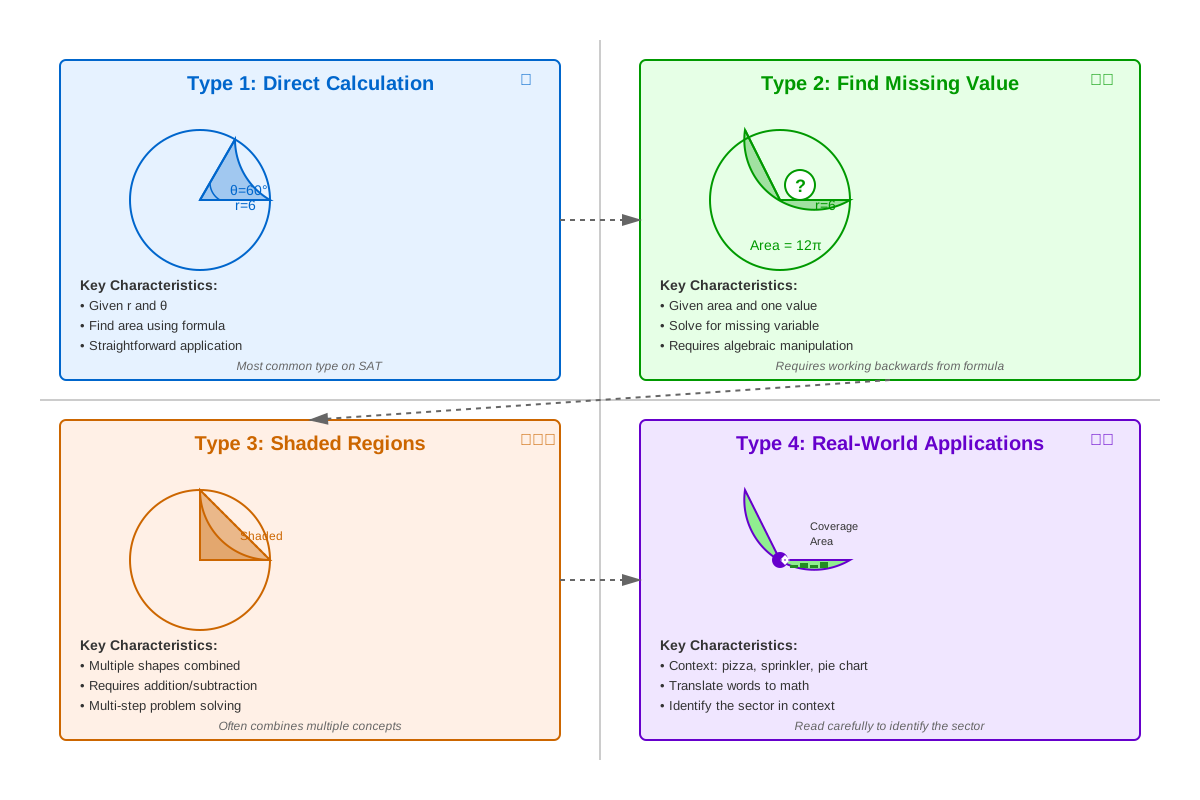
The sector area is a fundamental concept in circle geometry that appears regularly on the SAT math section. A sector is essentially a "slice" of a circle, bounded by two radii and the arc between them—imagine a piece of pie cut from a circular pie. Understanding how to calculate the area of these circular segments is crucial for success on the SAT, as questions involving sectors often combine multiple geometric concepts and require proportional reasoning.
On the SAT, sat sector area problems test a student's ability to work with fractions of circles, understand the relationship between central angles and arc lengths, and apply proportional thinking to geometric situations. These questions frequently appear in both the calculator and no-calculator sections, and they often serve as components of more complex multi-step problems. Mastering sector area calculations provides a foundation for understanding more advanced circle properties and demonstrates proficiency in applying formulas flexibly.
The concept of sector area connects directly to broader mathematical principles including proportional relationships, angle measurement in both degrees and radians, and the fundamental properties of circles. Students who understand sector area can more easily tackle problems involving arc length, circle circumference, and composite geometric figures. This topic also reinforces the critical SAT skill of recognizing when a problem requires finding a fractional part of a whole—a reasoning pattern that appears across many mathematical contexts on the exam.
Learning Objectives
- [ ] Identify key features of sector area, including the central angle, radius, and arc
- [ ] Explain how sector area appears on the SAT in various question formats
- [ ] Apply sector area formulas to answer SAT-style questions accurately and efficiently
- [ ] Calculate sector area using both degree and radian measures of central angles
- [ ] Solve multi-step problems that combine sector area with other circle properties
- [ ] Determine the central angle or radius when given the sector area and other information
Prerequisites
- Circle area formula (A = πr²): Essential because sector area is calculated as a fraction of the total circle area
- Basic angle measurement: Understanding degrees and the fact that a full circle contains 360° is necessary for determining what fraction of the circle a sector represents
- Proportional reasoning: Required to understand that sector area relates to total circle area in the same proportion as the central angle relates to 360°
- Basic algebraic manipulation: Needed to solve for unknown variables when sector area, radius, or angle is missing
Why This Topic Matters
In real-world applications, sector area calculations appear in fields ranging from engineering and architecture to agriculture and urban planning. Designers use sector area when creating circular gardens with segmented planting areas, engineers calculate it when determining the coverage area of rotating sensors or sprinkler systems, and architects apply it when designing circular buildings with wedge-shaped rooms. The mathematical reasoning behind sector area—understanding parts of a whole through proportional relationships—is fundamental to data analysis, probability, and resource allocation.
On the SAT, sector area questions appear with moderate to high frequency, typically showing up 1-2 times per exam. These problems account for approximately 3-5% of the total math section questions. The SAT tests sector area through direct calculation problems, word problems involving real-world scenarios, and complex multi-step questions that require students to find missing information before calculating the sector area. Questions may present sectors in coordinate geometry contexts, ask students to compare multiple sectors, or require finding the area of shaded regions that involve sectors.
Common question formats include: providing a central angle and radius and asking for sector area; giving sector area and asking for the central angle or radius; presenting diagrams with multiple sectors and requesting comparisons; and incorporating sectors into larger geometric figures where students must identify the relevant sector before calculating. The SAT particularly favors questions that test whether students understand the proportional relationship between the central angle and the sector area, often embedding this concept within more complex problem scenarios.
Core Concepts
Definition and Components of a Sector
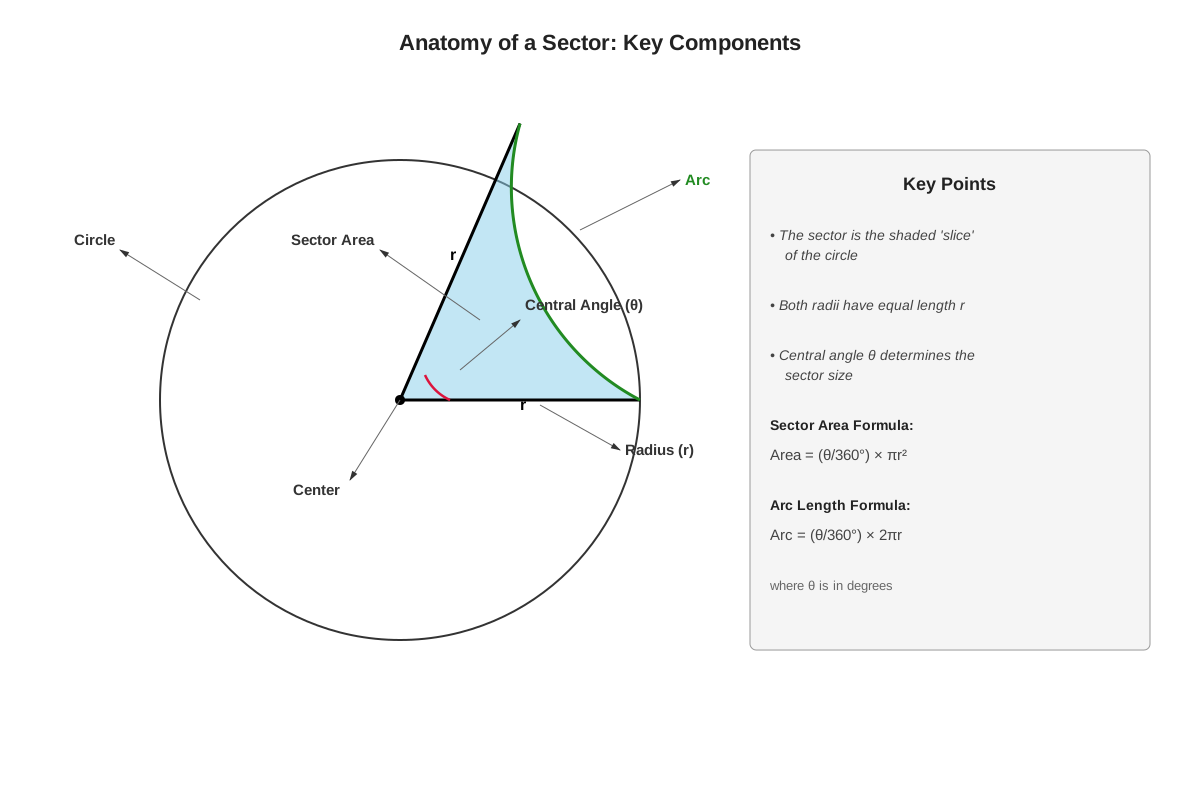
A sector is a region of a circle bounded by two radii and the arc connecting their endpoints. Think of it as a wedge-shaped piece of the circle. Every sector has three essential components: the radius (r), which is the distance from the center to the edge of the circle; the central angle (θ), which is the angle formed by the two radii at the center of the circle; and the arc, which is the curved boundary of the sector along the circle's circumference.
The sector area represents the amount of space enclosed within this wedge-shaped region. Understanding that a sector is simply a fractional part of the complete circle is the key conceptual foundation for all sector area calculations.
The Fundamental Sector Area Formula
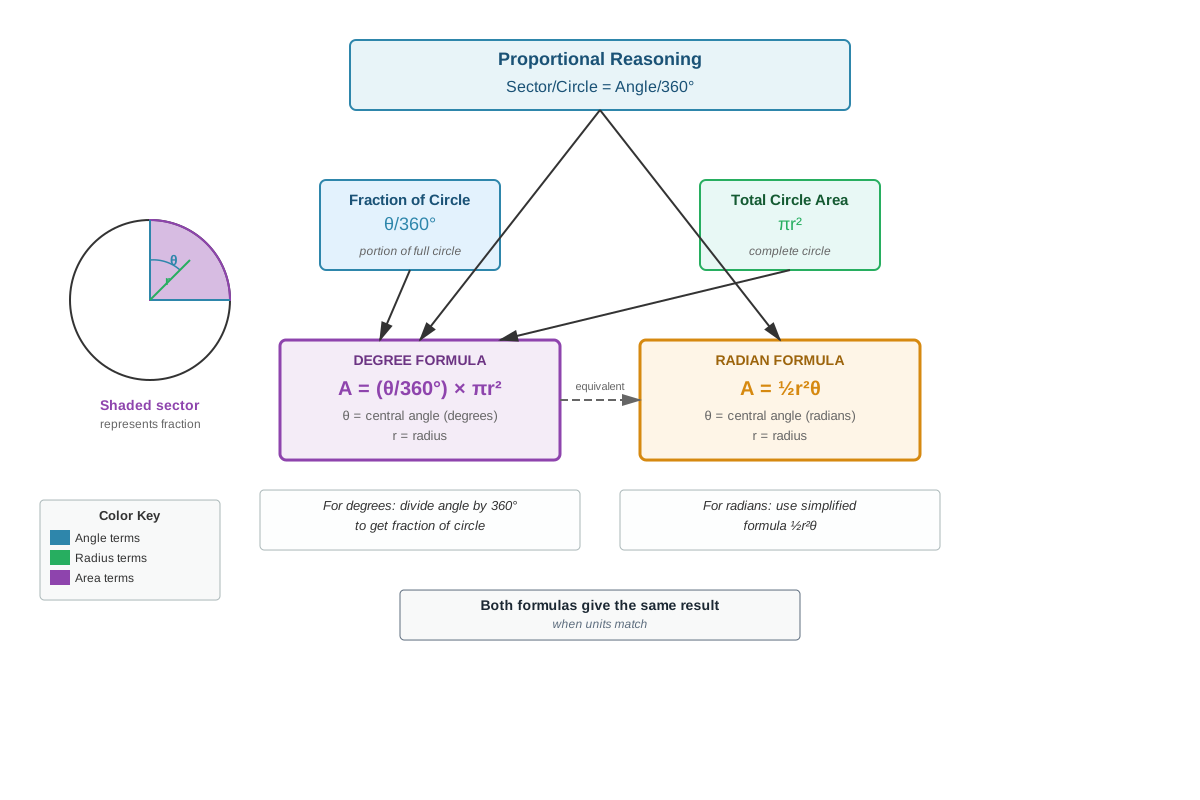
The sector area formula is derived from the principle that the sector's area is proportional to its central angle. Since a complete circle has a central angle of 360° and an area of πr², a sector with central angle θ (in degrees) has an area equal to the fraction θ/360 of the total circle area.
Sector Area = (θ/360°) × πr²Where:
- θ = central angle in degrees
- r = radius of the circle
- π ≈ 3.14159 (or use the π button on your calculator)
This formula can be understood as: (fraction of the circle) × (total circle area). The fraction θ/360° tells us what portion of the complete circle the sector represents.
Alternative Formula Using Radians
While the SAT primarily uses degrees, understanding the radian-based formula provides deeper insight and occasionally appears in more advanced questions. When the central angle is measured in radians, the formula simplifies to:
Sector Area = (1/2) × r² × θWhere θ is now in radians. This formula is more elegant because it doesn't require the 360° conversion factor. Remember that 2π radians = 360°, so π radians = 180°.
Step-by-Step Calculation Process
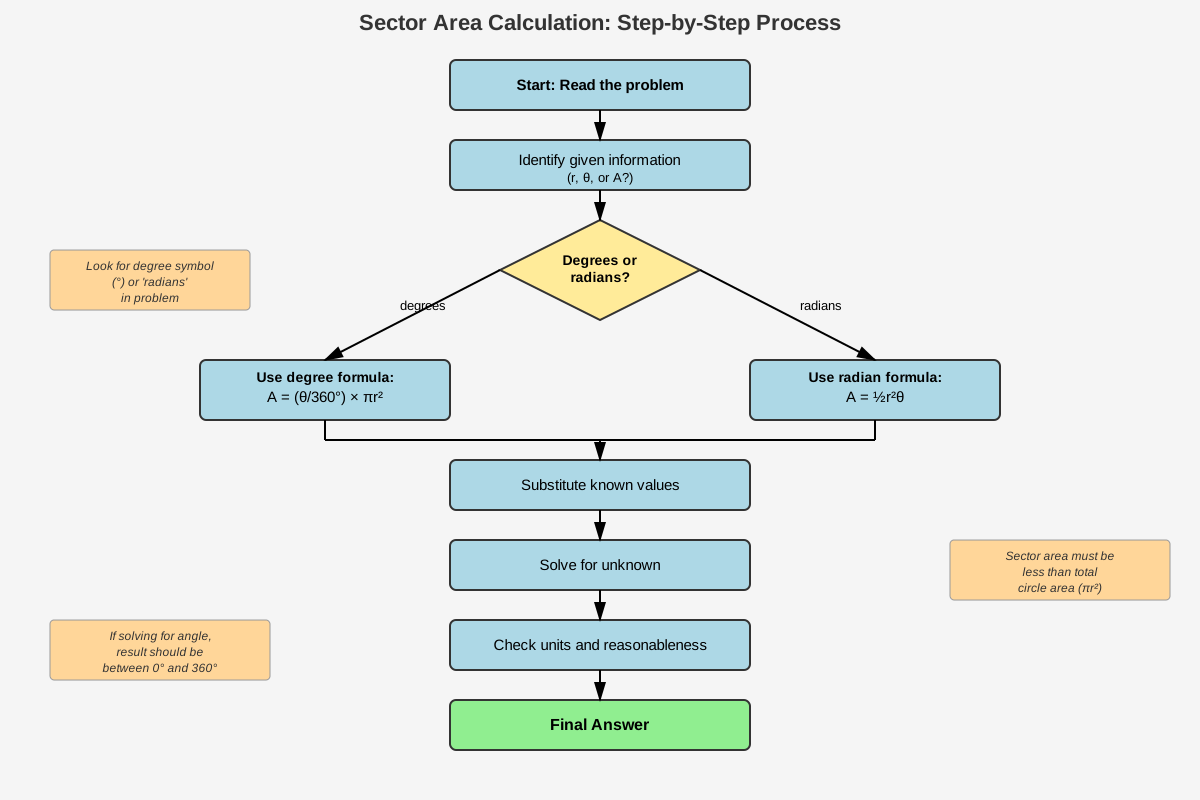
To calculate sector area systematically:
- Identify the radius (r) from the problem statement or diagram
- Determine the central angle (θ) in degrees
- Calculate the fraction of the circle: θ/360°
- Find the total circle area: πr²
- Multiply the fraction by the total area: (θ/360°) × πr²
- Simplify and round as appropriate for the answer format
Working Backwards: Finding Missing Information
SAT questions frequently provide the sector area and ask students to find either the radius or the central angle. This requires algebraic manipulation of the sector area formula:
To find the central angle when sector area and radius are known:
θ = (Sector Area × 360°)/(πr²)To find the radius when sector area and central angle are known:
r² = (Sector Area × 360°)/(θ × π)
r = √[(Sector Area × 360°)/(θ × π)]
Comparing Sectors
The SAT often asks students to compare sectors from the same circle or different circles. Key comparison principles:
| Comparison Type | Relationship |
|---|---|
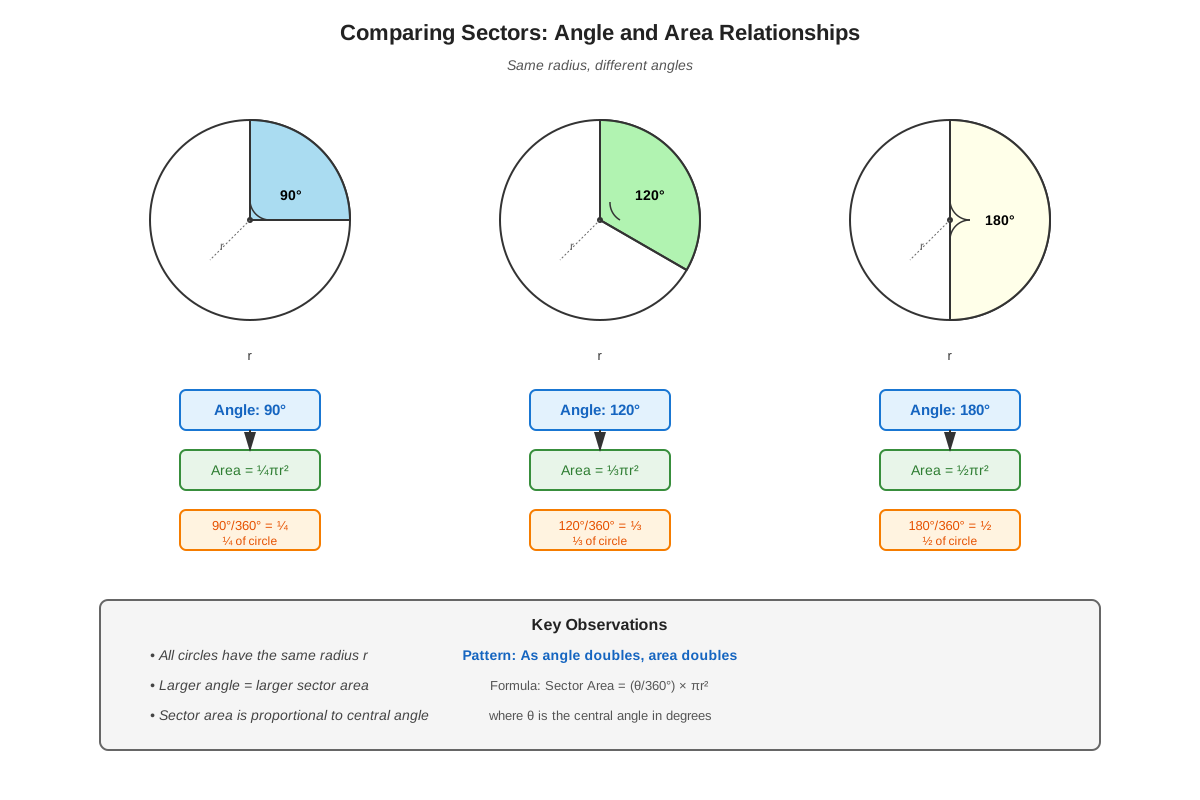
| Same radius, different angles | Sector area is directly proportional to central angle |
| Same angle, different radii | Sector area is proportional to r² (quadratic relationship) |
| Different radius and angle | Must calculate both areas to compare |
Special Cases and Common Angle Values
Certain central angles appear frequently on the SAT because they create convenient fractions:
- 90° sector: Represents 1/4 of the circle (quarter circle)
- 180° sector: Represents 1/2 of the circle (semicircle)
- 60° sector: Represents 1/6 of the circle
- 120° sector: Represents 1/3 of the circle
- 45° sector: Represents 1/8 of the circle
Recognizing these common angles allows for faster mental calculations and helps verify that answers are reasonable.
Concept Relationships
The sector area concept builds directly on the foundational circle area formula (A = πr²), serving as an application of proportional reasoning to circular geometry. The relationship flows as: Circle properties → Proportional reasoning → Sector area calculation.
Within the topic itself, the concepts connect as follows: Sector definition → Central angle identification → Fraction determination → Area calculation. Each step depends on the previous one, creating a linear progression of understanding.
Sector area connects intimately with arc length, as both represent fractional parts of a circle using the same proportional relationship. While sector area uses the fraction θ/360° applied to the circle's area (πr²), arc length uses the same fraction applied to the circle's circumference (2πr). This parallel structure means: Sector area : Circle area = Arc length : Circumference.
The concept also relates to angle measurement systems, bridging degrees and radians. Understanding this connection enables students to work flexibly with different angle representations: Degrees ↔ Radians → Different sector area formulas.
Furthermore, sector area problems often incorporate algebraic equation solving, particularly when working backwards from a given sector area to find missing dimensions. This demonstrates the relationship: Geometric understanding → Algebraic representation → Problem solving.
High-Yield Facts
⭐ The sector area formula is (θ/360°) × πr², where θ is the central angle in degrees and r is the radius
⭐ A sector's area is always a fraction of the total circle area, determined by the ratio of the central angle to 360°
⭐ A 90° sector (quarter circle) has an area of (1/4)πr²
⭐ When the radius doubles, the sector area quadruples (area scales with r²)
⭐ The central angle can be found by: θ = (Sector Area × 360°)/(πr²)
- A semicircular sector (180°) has exactly half the area of the full circle
- Sector area problems on the SAT often require identifying the central angle from a diagram or word problem description
- The sector area formula works for any angle from 0° to 360°, including angles greater than 180°
- When comparing sectors, if the central angle doubles while radius stays constant, the sector area also doubles
- The units of sector area are always square units (square inches, square centimeters, etc.)
- Converting between degrees and radians: multiply degrees by π/180° to get radians
- A 60° sector represents exactly 1/6 of a circle, making calculations particularly straightforward
Quick check — test yourself on Sector area so far.
Try Flashcards →Common Misconceptions
Misconception: The sector area formula is θ × πr² (forgetting to divide by 360°)
Correction: The sector area must include the fraction θ/360° because the sector is only a portion of the complete circle. Without dividing by 360°, you're multiplying the angle value directly by the area, which doesn't represent a meaningful geometric relationship.
Misconception: Doubling the radius doubles the sector area
Correction: Since area depends on r², doubling the radius actually quadruples the sector area. If r becomes 2r, then r² becomes 4r², making the area four times larger. This is a quadratic, not linear, relationship.
Misconception: A sector with a 180° angle has the same area as the circle
Correction: A 180° sector is a semicircle with exactly half the area of the full circle, since 180°/360° = 1/2. The full circle requires a 360° "sector," which encompasses the entire circle.
Misconception: The arc length and sector area are the same thing
Correction: Arc length measures the distance along the curved edge of the sector (a one-dimensional measurement in linear units), while sector area measures the two-dimensional space enclosed by the sector (in square units). They use similar proportional reasoning but measure different quantities.
Misconception: You can add central angles from different circles to find a combined sector area
Correction: Sector area depends on both the central angle AND the radius. You cannot simply add angles from sectors of different circles; each sector area must be calculated separately using its own radius, then the areas can be added if needed.
Misconception: The sector area formula only works for angles less than 180°
Correction: The formula (θ/360°) × πr² works for any central angle from 0° to 360°. A sector with a 270° angle, for example, represents 3/4 of the circle and has an area of (3/4)πr².
Worked Examples
Example 1: Direct Sector Area Calculation
Problem: A circle has a radius of 6 cm. Find the area of a sector with a central angle of 120°.
Solution:
Step 1: Identify the given information
- Radius (r) = 6 cm
- Central angle (θ) = 120°
Step 2: Determine what fraction of the circle this sector represents
- Fraction = θ/360° = 120°/360° = 1/3
Step 3: Calculate the total circle area
- Circle area = πr² = π(6)² = 36π cm²
Step 4: Calculate the sector area
- Sector area = (1/3) × 36π = 12π cm²
Step 5: Express the final answer
- Sector area = 12π cm² ≈ 37.7 cm²
Connection to Learning Objectives: This example demonstrates the direct application of the sector area formula and shows how to identify key features (radius and central angle) to solve a standard SAT-style problem.
Example 2: Finding the Central Angle from Sector Area
Problem: A sector of a circle with radius 8 inches has an area of 32π square inches. What is the measure of the central angle in degrees?
Solution:
Step 1: Identify the given information
- Radius (r) = 8 inches
- Sector area = 32π square inches
- Unknown: central angle (θ)
Step 2: Write the sector area formula
- Sector area = (θ/360°) × πr²
Step 3: Substitute the known values
- 32π = (θ/360°) × π(8)²
- 32π = (θ/360°) × 64π
Step 4: Solve for θ
- 32π = (θ × 64π)/360°
- Divide both sides by π: 32 = (θ × 64)/360°
- Multiply both sides by 360°: 32 × 360° = θ × 64
- 11,520° = θ × 64
- θ = 11,520°/64 = 180°
Step 5: Verify the answer makes sense
- A 180° sector is a semicircle
- Semicircle area = (1/2)πr² = (1/2)π(8)² = 32π ✓
Answer: The central angle is 180°
Connection to Learning Objectives: This example shows how to work backwards from sector area to find a missing angle, demonstrating algebraic manipulation of the sector area formula—a common SAT question type that tests deeper understanding.
Exam Strategy
When approaching sat sector area questions on the SAT, begin by carefully reading the problem to identify what information is given and what is being asked. Draw a diagram if one isn't provided, labeling the radius and central angle clearly. This visual representation helps prevent errors and often reveals relationships that aren't immediately obvious from the text alone.
Trigger words and phrases to watch for include: "sector," "wedge," "slice of a circle," "central angle," "portion of a circle," and "shaded region." When you see these terms, immediately think about the proportional relationship between the central angle and 360°. Questions asking for "the area of the shaded region" often involve sectors, especially when the diagram shows a circle with radii drawn.
For process-of-elimination on multiple-choice questions, use these strategies:
- Check if answer choices are in terms of π or decimal approximations; this tells you which form to work in
- Eliminate answers that are larger than the total circle area (πr²)
- For a 90° sector, the answer should be exactly 1/4 of πr²; use this to eliminate unreasonable options
- If the central angle is less than 180°, the sector area must be less than half the circle area
- When comparing answer choices, verify that the relationship between angle and area is proportional (doubling the angle should double the area if radius is constant)
Time allocation: Straightforward sector area calculations should take 30-60 seconds once you've identified the given information. Multi-step problems that require finding a missing value first may take 90-120 seconds. If a problem requires more than two minutes, mark it and return later—you may be overcomplicating the approach.
Exam Tip: Always check whether the problem provides the diameter or radius. A common trap is giving the diameter when the formula requires radius. If you see diameter, immediately divide by 2 before proceeding.
When working with the calculator, use the π button rather than 3.14 for greater accuracy. However, if answer choices are in terms of π (like 12π), leave your answer in that form rather than converting to a decimal—this saves time and prevents rounding errors.
Memory Techniques
Mnemonic for the sector area formula: "Theta Over Three-sixty Times Area Large" (TOTAL)
- Theta (θ) / 360° × πr² (the Total circle Area Large)
Visualization strategy: Picture a pizza cut into slices. The sector is one slice, and you're finding how much pizza (area) is in that slice. The bigger the angle at the center (where the slices meet), the bigger the slice. If someone takes a 90° slice, they get 1/4 of the pizza; a 180° slice is half the pizza.
Acronym for problem-solving steps: RIFC (Riff-See)
- Radius: Identify the radius
- Identify: Find the central angle
- Fraction: Calculate θ/360°
- Compute: Multiply fraction by πr²
Memory aid for common angles: "Quarter, Third, Half" (QTH)
- Quarter circle = 90° = 1/4 of area
- Third circle = 120° = 1/3 of area
- Half circle = 180° = 1/2 of area
Relationship reminder: "Sector is to circle as angle is to 360" — this proportion helps you remember that the sector area formula is based on the ratio of the central angle to the full rotation.
Summary
Sector area is a fundamental circle geometry concept that tests proportional reasoning and formula application on the SAT. A sector represents a wedge-shaped portion of a circle, and its area is calculated using the formula (θ/360°) × πr², where θ is the central angle in degrees and r is the radius. This formula derives from the principle that a sector's area is proportional to its central angle—the sector occupies the same fraction of the circle's area as its central angle represents of 360°. Students must be able to calculate sector area directly, work backwards to find missing angles or radii, and recognize common angle values like 90° (quarter circle) and 180° (semicircle). The concept connects to broader mathematical principles including proportional relationships, the fundamental circle area formula, and algebraic manipulation. Success on SAT sector area questions requires identifying given information accurately, applying the formula correctly, and understanding that area scales with the square of the radius while maintaining a linear relationship with the central angle.
Key Takeaways
- The sector area formula (θ/360°) × πr² represents the fraction of the circle's total area determined by the central angle
- Sector area is always proportional to the central angle: doubling the angle doubles the area (when radius is constant)
- Common angles create convenient fractions: 90° = 1/4, 120° = 1/3, 180° = 1/2 of the circle
- When radius doubles, sector area quadruples because area depends on r² (quadratic relationship)
- SAT questions often require working backwards from sector area to find the central angle or radius using algebraic manipulation
- Always verify whether the problem provides radius or diameter—use radius in the formula
- Sector area problems frequently combine with other circle properties, requiring multi-step solutions
Related Topics
Arc Length: The distance along the curved edge of a sector, calculated using the same proportional relationship (θ/360°) applied to circumference instead of area. Mastering sector area makes arc length calculations intuitive.
Circle Circumference and Area: The foundational formulas (C = 2πr and A = πr²) that sector calculations build upon. Strong understanding of complete circle properties is essential for sector work.
Radians and Angle Conversion: Alternative angle measurement system that simplifies sector area calculations to (1/2)r²θ. Understanding both degree and radian approaches provides flexibility for advanced problems.
Composite Geometric Figures: Problems involving sectors combined with triangles, rectangles, or other shapes. Sector area mastery enables solving complex shaded region problems.
Proportional Relationships: The mathematical reasoning underlying sector calculations applies broadly across SAT math, including similar figures, scale factors, and probability.
Practice CTA
Now that you've mastered the core concepts of sector area, it's time to solidify your understanding through practice! Work through the practice questions to apply these formulas in various SAT-style contexts, and use the flashcards to reinforce the key formulas and relationships. Remember, sector area questions are high-yield on the SAT—investing time to master this topic now will pay dividends on test day. Each practice problem you solve strengthens your pattern recognition and builds the confidence you need to tackle any sector area question quickly and accurately. You've got this!
Sign up free to keep reading
Create a free AnvayaPrep account to finish this SAT guide on Sector area — plus flashcards and practice questions.