Overview
The area of circle is one of the most fundamental geometric concepts tested on the SAT, appearing in multiple questions across both the calculator and no-calculator sections. Understanding how to calculate and apply circle area formulas is essential not only for direct computation problems but also for complex multi-step questions involving composite figures, optimization, and real-world applications. The SAT frequently tests this concept by embedding it within word problems, requiring students to extract relevant information, identify when a circle area calculation is needed, and combine it with other geometric principles.
Mastery of circle area calculations extends beyond simple formula application. The SAT expects students to recognize circles in various contexts—from pizza sizes and circular gardens to satellite coverage areas and rotating objects. Questions may require finding the area when given the radius, diameter, or circumference, or working backward from area to find other circle measurements. Additionally, the concept frequently appears in questions involving sectors (portions of circles), annuli (regions between concentric circles), and inscribed or circumscribed figures.
The area of circle concept connects deeply to other math topics tested on the SAT, including coordinate geometry (circles on the xy-plane), algebraic manipulation (solving for variables within area formulas), ratios and proportions (comparing areas of different circles), and even trigonometry (relating arc length and sector area). This interconnectedness makes circle area a high-yield topic that, when thoroughly understood, provides a foundation for tackling numerous question types across the entire mathematics section.
Learning Objectives
- [ ] Identify key features of Area of circle
- [ ] Explain how Area of circle appears on the SAT
- [ ] Apply Area of circle to answer SAT-style questions
- [ ] Calculate the area of a circle given radius, diameter, or circumference
- [ ] Solve for radius or diameter when given the area of a circle
- [ ] Determine the area of sectors, annuli, and composite figures involving circles
- [ ] Apply circle area concepts to real-world SAT word problems
- [ ] Convert between different circle measurements using area relationships
Prerequisites
- Basic algebra: Ability to solve equations for a variable, essential for working backward from area to radius
- Exponents and square roots: Understanding of squaring numbers and taking square roots, required since area formulas involve r²
- Pi (π) as a constant: Familiarity with π ≈ 3.14159 and when to use exact vs. approximate values
- Basic geometry vocabulary: Knowledge of terms like radius, diameter, and circumference to interpret problem statements correctly
- Unit conversions: Ability to work with different measurement units (inches, feet, centimeters) since area involves squared units
Why This Topic Matters
Circle area problems appear in approximately 3-5 questions per SAT exam, making this a high-frequency topic that directly impacts scores. These questions typically fall into the "Problem Solving and Data Analysis" and "Additional Topics in Math" categories, with point values ranging from easy single-step calculations to challenging multi-concept problems worth significant points. The College Board consistently includes circle area in both multiple-choice and grid-in formats, with recent exams showing an increased emphasis on application problems rather than straightforward computational questions.
In real-world contexts, circle area calculations are ubiquitous: architects use them to design circular structures, engineers apply them to calculate material requirements for cylindrical components, urban planners employ them to determine coverage zones, and scientists utilize them in fields from astronomy to microbiology. The SAT leverages these practical applications by presenting problems involving circular gardens, pizza comparisons, satellite coverage, water sprinkler ranges, and circular tracks. Understanding circle area also builds spatial reasoning skills that transfer to three-dimensional thinking, as circles form the basis of cylinders, cones, and spheres.
Common SAT question formats include: direct area calculations given a radius or diameter; reverse calculations finding radius from area; comparing areas of multiple circles; finding areas of shaded regions involving circles; determining how area changes when radius is scaled; and word problems requiring students to set up and solve area equations. The topic frequently appears in questions testing proportional reasoning, as doubling the radius quadruples the area—a relationship that confuses many test-takers but provides quick elimination opportunities for prepared students.
Core Concepts
The Fundamental Area Formula
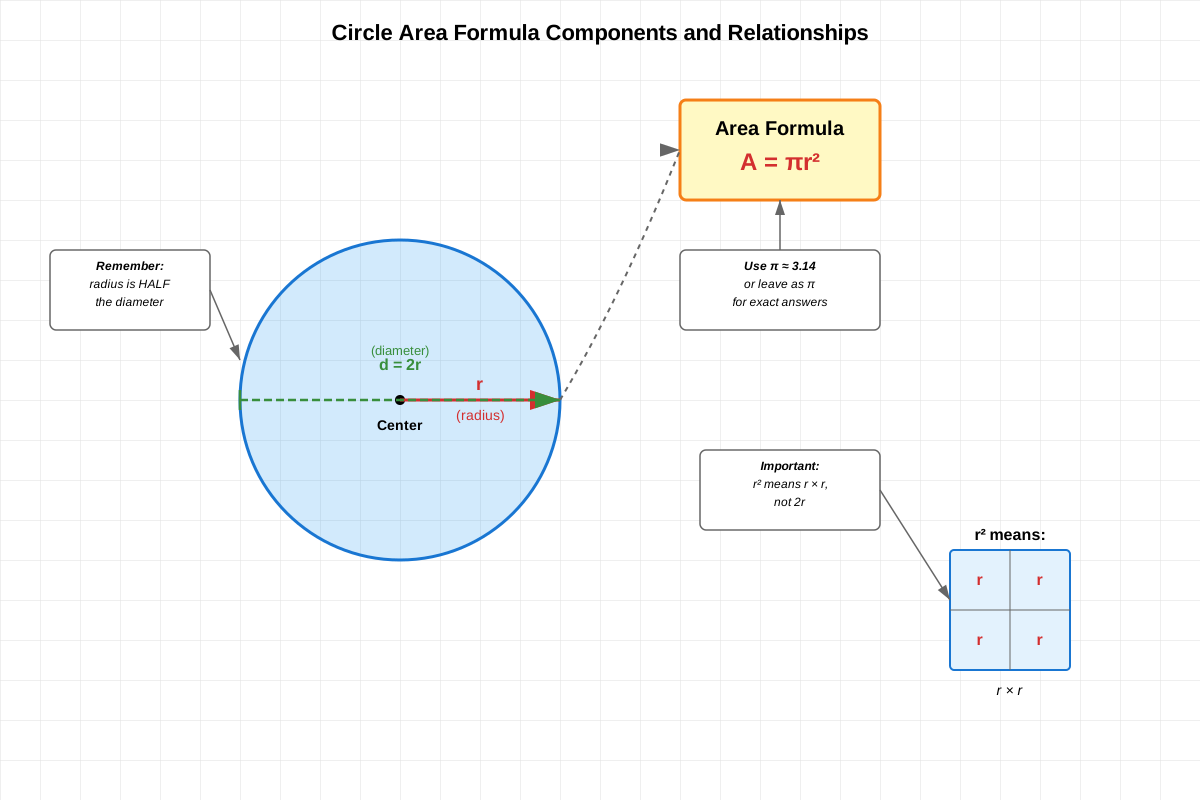
The area of circle is calculated using the formula A = πr², where A represents the area, π (pi) is the mathematical constant approximately equal to 3.14159, and r is the radius of the circle. The radius is the distance from the center of the circle to any point on its edge. This formula is provided in the SAT reference box at the beginning of each math section, but understanding its derivation and application is crucial for efficient problem-solving.
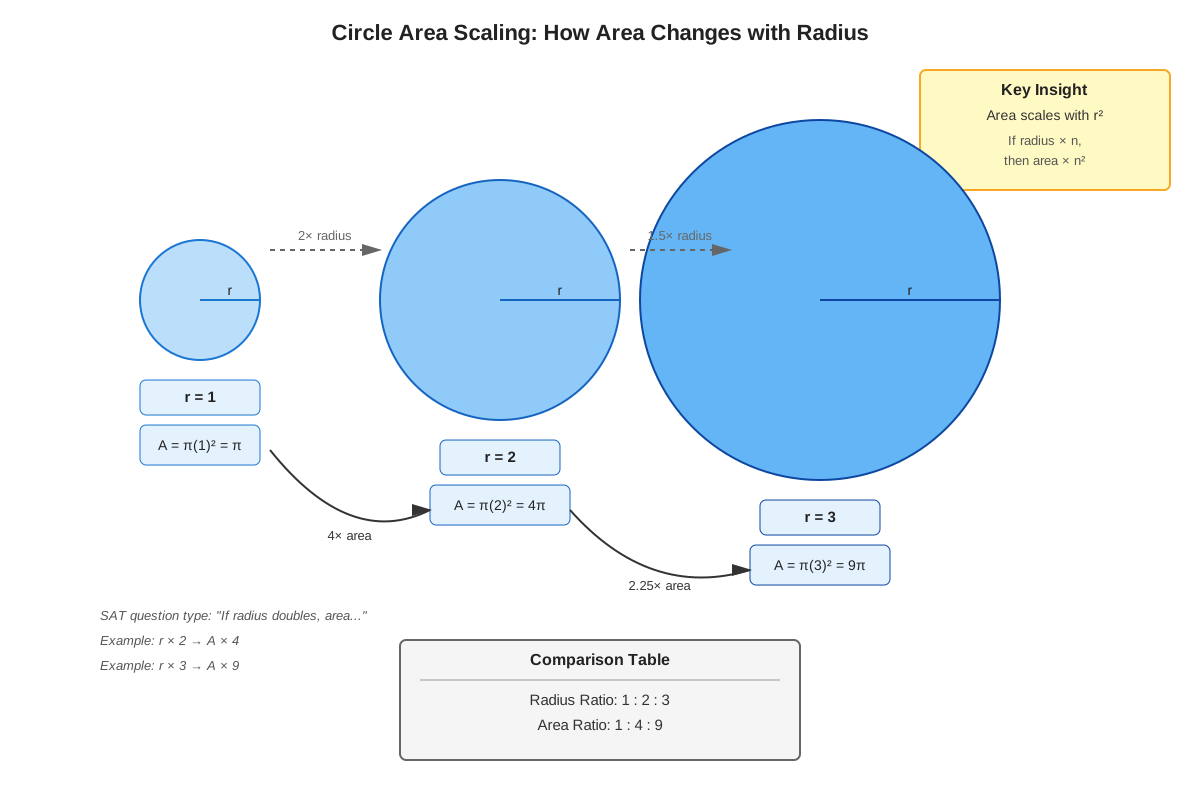
The formula's structure reveals important relationships: area is proportional to the square of the radius, meaning that if you double the radius, the area increases by a factor of four (2² = 4). This quadratic relationship is frequently tested on the SAT through scaling problems. For example, if a circle has radius 3 and area 9π, a circle with radius 6 will have area 36π, not 18π.
A = πr²When working with the area formula, students must pay careful attention to whether they're given the radius or diameter. The diameter is twice the radius (d = 2r), so if given the diameter, you must divide by 2 before applying the area formula. A common error is using the diameter directly in the formula, which produces an area four times too large.
Working with Different Given Information
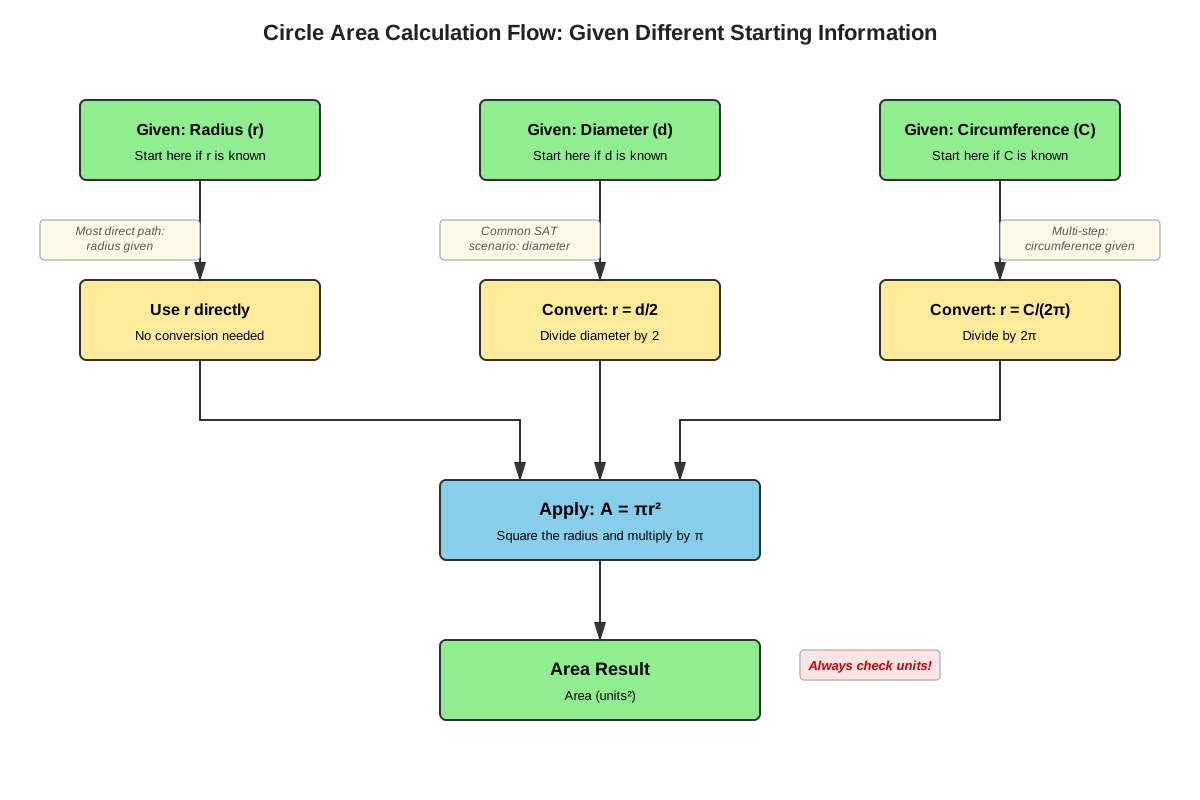
SAT questions rarely simply provide the radius and ask for area. Instead, they test your ability to extract or calculate the radius from various types of information:
Given the diameter: If d = 10, then r = 5, and A = π(5)² = 25π
Given the circumference: Since C = 2πr, you can solve for r = C/(2π), then calculate area. For example, if C = 12π, then r = 6, and A = 36π
Given a relationship: Problems might state "the radius is 3 more than x" or "the diameter is twice the width of a rectangle," requiring algebraic setup before calculation
Exact vs. Approximate Answers
The SAT tests both exact answers (in terms of π) and approximate decimal answers. Understanding when to use each is critical:
Exact answers leave π in the expression (e.g., 25π square units). These are preferred when:
- The answer choices include π
- The question asks for an exact value
- You're setting up an equation to solve for another variable
Approximate answers use π ≈ 3.14 or the calculator's π button. These are necessary when:
- Answer choices are decimals
- The question explicitly asks for an approximation
- You're using a grid-in answer format that requires a decimal
Exam Tip: If answer choices contain π, never convert to decimals—you'll waste time and risk rounding errors. If choices are decimals, use your calculator's π button for maximum accuracy.
Sectors and Partial Circles
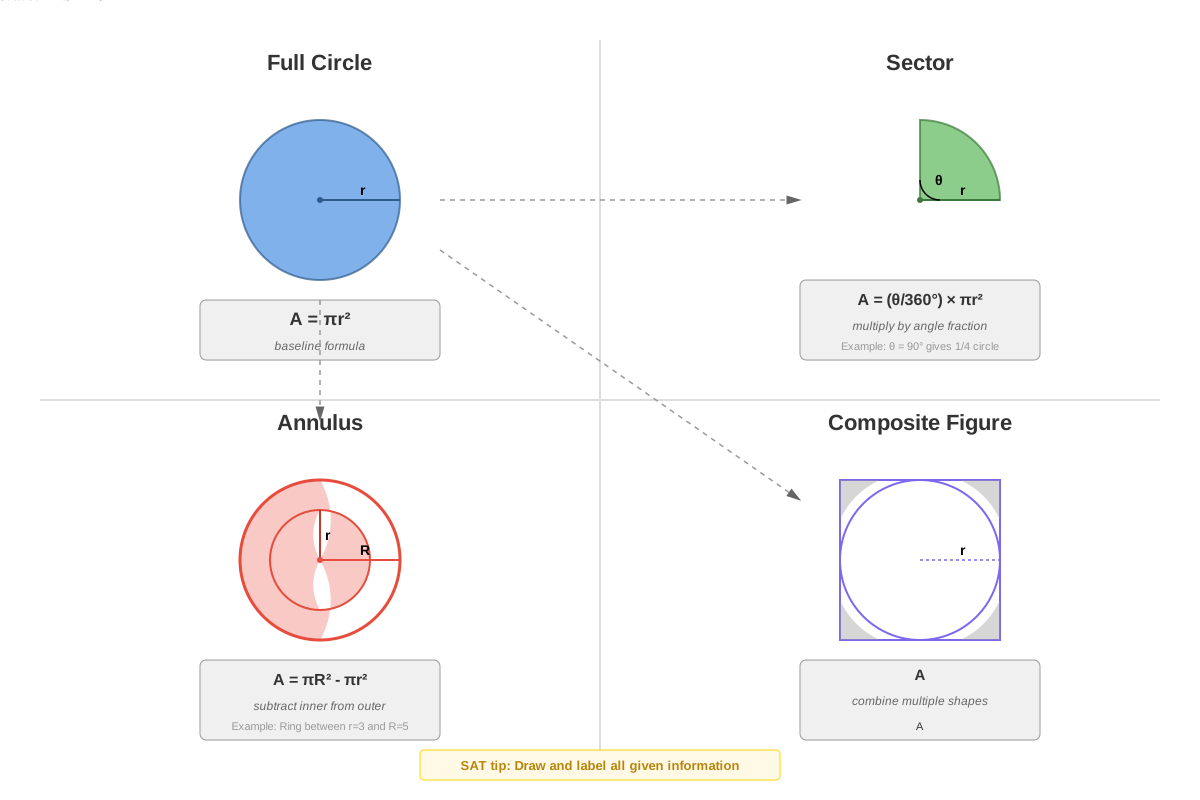
A sector is a "slice" of a circle, like a piece of pie. The area of a sector is proportional to the central angle that defines it. If the central angle is θ degrees, the sector area is:
A_sector = (θ/360°) × πr²For example, a 90° sector (quarter circle) has area (90/360) × πr² = (1/4)πr². A semicircle (180° sector) has area (1/2)πr².
The SAT frequently tests sectors in shaded region problems, where you must subtract a sector from a square or find the area between a sector and a triangle. Recognizing that sector area is simply a fraction of the full circle area allows for quick mental calculations.
Annuli and Composite Figures
An annulus (plural: annuli) is the region between two concentric circles (circles sharing the same center). To find the area of an annulus:
A_annulus = πR² - πr²where R is the outer radius and r is the inner radius. This can be factored as π(R² - r²) or π(R + r)(R - r).
Composite figures combine circles with other shapes. Common SAT scenarios include:
- A circle inscribed in a square (touching all four sides)
- A circle circumscribed around a square (passing through all four corners)
- Semicircles attached to rectangles or triangles
- Overlapping circles creating shaded regions
For these problems, identify each component shape, calculate individual areas, and add or subtract as needed based on what the question asks for.
Scaling and Proportional Relationships
Understanding how area changes with radius is crucial for ratio and proportion questions. Key relationships:
| Radius Change | Area Change | Example |
|---|---|---|
| Multiply by 2 | Multiply by 4 | r = 3 → 9π; r = 6 → 36π |
| Multiply by 3 | Multiply by 9 | r = 2 → 4π; r = 6 → 36π |
| Multiply by k | Multiply by k² | r → kr means A → k²A |
| Divide by 2 | Divide by 4 | r = 8 → 64π; r = 4 → 16π |
This quadratic scaling relationship allows for quick mental calculations. If Circle A has twice the radius of Circle B, Circle A has four times the area. If you need a circle with three times the area, you must multiply the radius by √3, not by 3.
Concept Relationships
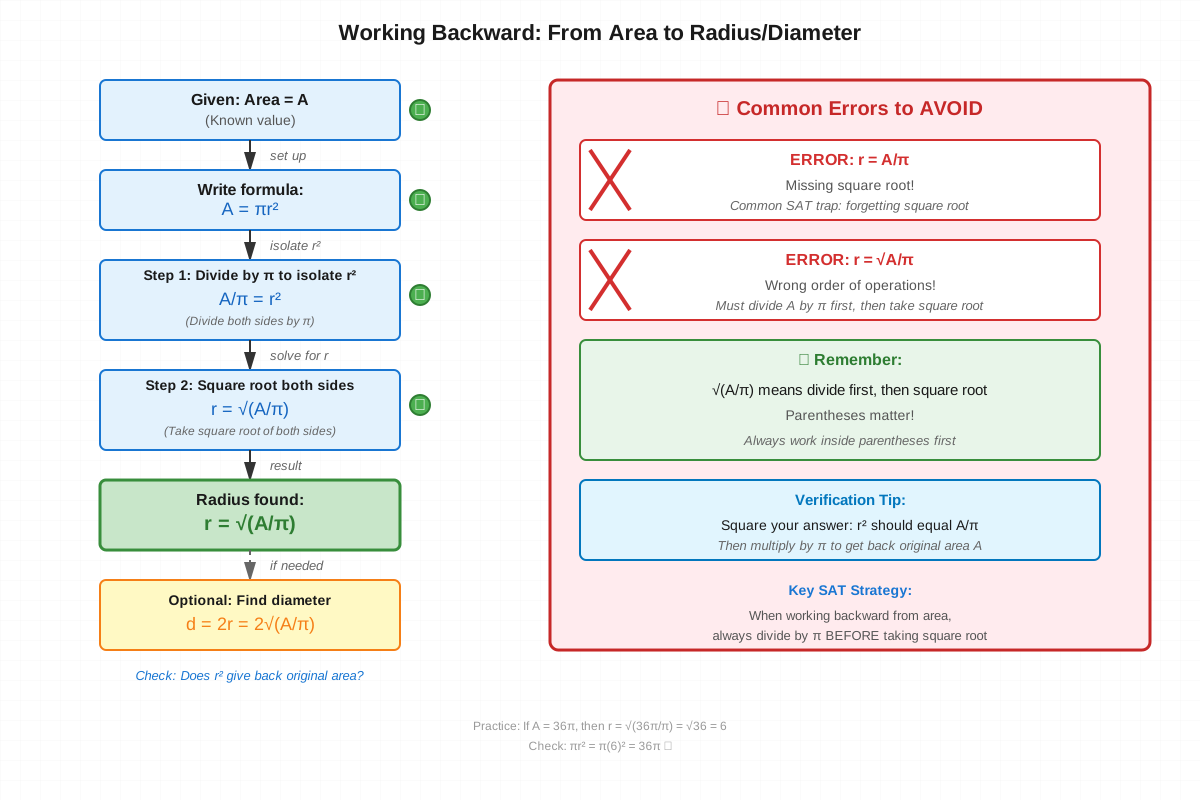
The area of circle formula serves as a central hub connecting multiple mathematical concepts. The formula A = πr² directly relates to exponents and powers, as students must square the radius value. This connection extends to square roots, since finding radius from area requires taking the square root: r = √(A/π).
The relationship between area and circumference (C = 2πr) creates a pathway for solving problems where circumference is given but area is needed. By solving C = 2πr for r, then substituting into A = πr², students can derive the relationship A = C²/(4π), though this is rarely necessary if the step-by-step approach is understood.
Circle area connects to coordinate geometry when circles are graphed on the xy-plane. The standard form equation (x - h)² + (y - k)² = r² contains the radius, which can be extracted to calculate area. This bridges pure geometry with algebraic representations.
Proportional reasoning emerges from the quadratic relationship between radius and area. When comparing two circles, the ratio of their areas equals the square of the ratio of their radii: A₁/A₂ = (r₁/r₂)². This concept extends to similarity in geometry, where similar figures have areas proportional to the square of corresponding linear dimensions.
The concept flow follows this pattern:
Given Information → Extract/Calculate Radius → Apply A = πr² → Interpret Result
For composite figures: Identify Components → Calculate Individual Areas → Combine Using Addition/Subtraction → Final Answer
Quick check — test yourself on Area of circle so far.
Try Flashcards →High-Yield Facts
⭐ The area formula A = πr² is provided in the SAT reference box, but you must know when and how to apply it
⭐ Doubling the radius quadruples the area; tripling the radius multiplies area by nine
⭐ Diameter is twice the radius; using diameter instead of radius in the formula gives an area four times too large
⭐ When given circumference C, find radius using r = C/(2π) before calculating area
⭐ A semicircle has area (1/2)πr²; a quarter circle has area (1/4)πr²
- The area of a circle is always expressed in square units (cm², in², ft²)
- If two circles have radii in ratio a:b, their areas are in ratio a²:b²
- A circle inscribed in a square with side s has radius s/2 and area πs²/4
- A circle circumscribed around a square with side s has radius s√2/2 and area πs²/2
- The area between two concentric circles is π(R² - r²), which factors to π(R + r)(R - r)
- Sector area equals (central angle/360°) × πr² when angle is in degrees
- When comparing pizza sizes, a 16-inch pizza has four times the area of an 8-inch pizza, not twice
- If area is given as a multiple of π (like 49π), the radius is the square root of the coefficient (r = 7)
- Shaded region problems typically require subtracting one area from another
- On grid-in questions, if your answer contains π, you must convert to a decimal approximation
Common Misconceptions
Misconception: The area formula is A = πd² where d is diameter.
Correction: The correct formula uses radius: A = πr². Since d = 2r, using diameter gives A = π(d/2)² = πd²/4. Using d² directly produces an area four times too large.
Misconception: Doubling the radius doubles the area.
Correction: Because area depends on r², doubling the radius multiplies the area by 2² = 4. This quadratic relationship means area grows much faster than radius. A circle with radius 6 has four times the area of a circle with radius 3, not twice.
Misconception: π equals exactly 3.14 or 22/7.
Correction: π is an irrational number approximately equal to 3.14159. While 3.14 and 22/7 are useful approximations, the SAT calculator has a π button that provides greater accuracy. Use exact values (leaving π in the answer) when possible, and only approximate when answer choices require it.
Misconception: The units for area are the same as the units for radius.
Correction: Area is always measured in square units. If radius is in inches, area is in square inches (in²). If radius is in feet, area is in square feet (ft²). Forgetting to square the units is a common error that the SAT exploits in wrong answer choices.
Misconception: A semicircle has half the perimeter of a full circle.
Correction: While a semicircle has half the area of a full circle, its perimeter includes the diameter plus half the circumference: P = πr + 2r. Students often forget to add the straight edge when calculating perimeter, though this is less commonly tested than area.
Misconception: When a circle is inscribed in a square, the circle's diameter equals the square's diagonal.
Correction: When a circle is inscribed in (fits inside) a square, the circle's diameter equals the square's side length, not its diagonal. When a circle is circumscribed around (passes through the corners of) a square, then the circle's diameter equals the square's diagonal.
Worked Examples
Example 1: Multi-Step Area Calculation
Problem: A circular garden has a circumference of 20π feet. The owner wants to plant grass in the garden, and grass seed covers 50 square feet per bag. How many bags of grass seed are needed?
Solution:
Step 1: Find the radius from the circumference.
- Given: C = 20π feet
- Formula: C = 2πr
- Solve: 20π = 2πr
- Divide both sides by 2π: r = 10 feet
Step 2: Calculate the area of the circular garden.
- Formula: A = πr²
- Substitute: A = π(10)²
- Calculate: A = 100π square feet
- Approximate: A ≈ 314.16 square feet
Step 3: Determine the number of bags needed.
- Each bag covers 50 square feet
- Number of bags = 314.16 ÷ 50 = 6.28 bags
- Since you can't buy a partial bag, round up to 7 bags
Answer: 7 bags
Connection to Learning Objectives: This problem demonstrates applying circle area to SAT-style questions by requiring multiple steps: extracting radius from circumference, calculating area, and interpreting the result in a real-world context. It also shows when to use approximate values (for the final calculation) rather than exact values.
Example 2: Shaded Region with Composite Figures
Problem: A square with side length 12 inches has a circle inscribed inside it (the circle touches all four sides of the square). What is the area of the shaded region between the square and the circle? Express your answer in terms of π.
Solution:
Step 1: Understand the geometric relationship.
- When a circle is inscribed in a square, the circle's diameter equals the square's side length
- Square side = 12 inches, so circle diameter = 12 inches
- Therefore, circle radius = 6 inches
Step 2: Calculate the area of the square.
- Formula: A_square = s²
- Calculate: A_square = 12² = 144 square inches
Step 3: Calculate the area of the circle.
- Formula: A_circle = πr²
- Substitute: A_circle = π(6)²
- Calculate: A_circle = 36π square inches
Step 4: Find the shaded region area.
- The shaded region is the square minus the circle
- A_shaded = A_square - A_circle
- A_shaded = 144 - 36π square inches
Answer: (144 - 36π) square inches or 36(4 - π) square inches
Connection to Learning Objectives: This problem requires identifying key features (inscribed circle relationship), applying the area formula, and working with composite figures. It also demonstrates when to leave answers in exact form with π rather than converting to decimals.
Exam Strategy
When approaching SAT area of circle questions, follow this systematic process:
Step 1: Identify what's given and what's needed
- Read carefully to determine if you have radius, diameter, circumference, or area
- Note whether the answer should be exact (with π) or approximate (decimal)
- Look for keywords: "inscribed," "circumscribed," "sector," "shaded region"
Step 2: Draw a diagram if none is provided
- Visual representation prevents errors and reveals relationships
- Label all known measurements
- Mark the center and radius clearly
Step 3: Extract or calculate the radius
- If given diameter, divide by 2
- If given circumference, use r = C/(2π)
- If given area, use r = √(A/π)
- If given a relationship, set up an equation
Step 4: Apply the appropriate formula
- Full circle: A = πr²
- Semicircle: A = (1/2)πr²
- Sector: A = (θ/360°) × πr²
- Annulus: A = π(R² - r²)
Trigger Words to Watch For: - "Inscribed" → circle fits inside another shape, touching edges - "Circumscribed" → circle passes through vertices of another shape - "Concentric" → circles share the same center - "Shaded region" → requires subtraction or addition of areas - "Diameter" → must divide by 2 to get radius
Process of Elimination Tips:
- Eliminate answers with wrong units (linear instead of square)
- If you doubled the radius, eliminate answers that only doubled
- Check if answers are reasonable (area should be larger than radius for r > 1)
- If the question involves π, eliminate decimal-only answers unless specifically requested
Time Allocation:
- Simple direct calculation: 30-45 seconds
- Multi-step problems: 1-2 minutes
- Complex composite figures: 2-3 minutes
- If stuck after 1 minute, mark for review and move on
Memory Techniques
"Area = Pi R Squared" Mnemonic: Remember the phrase "Pies are round, cornbread are square" to avoid confusing area with perimeter formulas. The "R squared" emphasizes that radius must be squared.
"Double Trouble" Rule: When radius doubles, area quadruples. Visualize this: if you double the radius, you can fit four of the original circles into the new one. This prevents the common error of thinking doubled radius means doubled area.
"D-I-V-I-D-E" for Diameter: When given diameter, Don't Immediately Vault Into Doing Equations—divide by 2 first to get radius. This acronym reminds you to convert diameter to radius before using the area formula.
Sector Fraction Visualization: Picture a pizza cut into slices. A 90° slice is 1/4 of the pizza (90/360 = 1/4), so its area is 1/4 of the full circle's area. This mental image makes sector calculations intuitive.
"Inside-Outside" for Inscribed/Circumscribed:
- Inscribed = Inside (circle inside the shape, diameter = side)
- Circumscribed = Circumference around (circle around the shape, diameter = diagonal)
Square Root Reversal: To find radius from area, think "square root reverses the square." If A = πr², then r = √(A/π). Visualize "undoing" the squaring operation.
Summary
The area of circle is a foundational geometric concept that appears frequently on the SAT in various forms, from straightforward calculations to complex multi-step problems involving composite figures. The essential formula A = πr² must be applied correctly, with careful attention to whether radius or diameter is provided. Success requires understanding the quadratic relationship between radius and area—doubling the radius quadruples the area—which is tested through scaling and comparison questions. Students must be proficient in working backward from area to find radius, extracting radius from circumference, and calculating areas of sectors and annuli. The SAT emphasizes application over memorization, presenting circle area problems in real-world contexts that require interpretation, setup, and multi-step reasoning. Mastery involves recognizing when to use exact answers (with π) versus approximations, understanding inscribed and circumscribed relationships, and efficiently solving shaded region problems by combining areas of multiple shapes. With systematic problem-solving strategies and awareness of common misconceptions, students can confidently tackle any circle area question on the exam.
Key Takeaways
- The area formula A = πr² requires the radius, not diameter; always divide diameter by 2 before calculating
- Area scales with the square of radius: doubling radius multiplies area by 4, tripling radius multiplies area by 9
- Extract radius from circumference using r = C/(2π) before applying the area formula
- Sector area is a fraction of the full circle: (central angle/360°) × πr²
- Leave answers in terms of π when answer choices contain π; only approximate when choices are decimals
- Shaded region problems require identifying component shapes and using addition or subtraction
- An inscribed circle's diameter equals the square's side; a circumscribed circle's diameter equals the square's diagonal
Related Topics
Circumference of Circles: Understanding the relationship between circumference C = 2πr and area allows for solving problems where one measurement leads to another, essential for comprehensive circle mastery.
Volume of Cylinders and Cones: These three-dimensional shapes have circular bases, so calculating their volumes requires first finding the area of the circular cross-section using A = πr².
Coordinate Geometry of Circles: The equation (x - h)² + (y - k)² = r² represents circles on the coordinate plane, where extracting r allows for area calculations in algebraic contexts.
Arc Length and Radians: Advanced circle problems involve arc length (s = rθ) and radian measure, which connect to sector area through the relationship A = (1/2)r²θ when θ is in radians.
Trigonometry in Circles: The unit circle and trigonometric functions build on circle concepts, with area calculations appearing in problems involving inscribed triangles and polygons.
Practice CTA
Now that you've mastered the core concepts of circle area, it's time to solidify your understanding through practice! Work through the practice questions to apply these formulas in various SAT-style scenarios, from straightforward calculations to challenging multi-step problems. Use the flashcards to reinforce key formulas, relationships, and common pitfalls. Remember, the difference between knowing the formula and scoring points lies in repeated application—each practice problem builds the pattern recognition and problem-solving speed essential for test day success. You've got this!
Sign up free to keep reading
Create a free AnvayaPrep account to finish this SAT guide on Area of circle — plus flashcards and practice questions.