Overview
Inscribed angles represent one of the most elegant and frequently tested concepts in circle geometry on the SAT math section. An inscribed angle is formed when two chords of a circle share a common endpoint on the circle's circumference, with the angle's vertex positioned on the circle itself. This seemingly simple geometric configuration unlocks a powerful theorem: an inscribed angle is always half the measure of the central angle that subtends the same arc. This relationship forms the foundation for solving numerous SAT problems involving circles, arcs, and polygons inscribed within circles.
Understanding inscribed angles is essential for SAT success because these problems appear regularly in both the calculator and no-calculator sections, often integrated with other geometric concepts like arc length, sector area, and properties of special triangles. The College Board frequently tests students' ability to recognize inscribed angle relationships quickly and apply the inscribed angle theorem to find missing angle measures, arc lengths, or to prove geometric properties. Questions may present circles with multiple chords, inscribed polygons, or scenarios requiring students to work backward from angle measures to determine arc measures.
The concept of inscribed angles connects directly to broader circle geometry principles, including central angles, arc measures, and the properties of cyclic quadrilaterals. Mastering inscribed angles provides the foundation for understanding why certain quadrilaterals can be inscribed in circles, how to calculate angles in inscribed triangles, and how circle geometry relates to coordinate geometry when circles are graphed on the coordinate plane. This topic bridges pure geometric reasoning with algebraic problem-solving, making it a high-yield area for SAT preparation.
Learning Objectives
- [ ] Identify key features of inscribed angles, including the vertex location and the relationship between the angle and its intercepted arc
- [ ] Explain how inscribed angles appears on the SAT, including common question formats and integration with other geometric concepts
- [ ] Apply inscribed angles to answer SAT-style questions involving angle measures, arc measures, and inscribed polygons
- [ ] Calculate the measure of an inscribed angle given the measure of its intercepted arc
- [ ] Determine arc measures when given inscribed angle measurements
- [ ] Recognize and apply the theorem that inscribed angles subtending the same arc are congruent
- [ ] Solve problems involving inscribed right triangles and semicircles
Prerequisites
- Basic angle relationships: Understanding complementary, supplementary, and vertical angles is necessary for solving multi-step inscribed angle problems
- Circle terminology: Familiarity with radius, diameter, chord, arc, and central angle enables proper identification of inscribed angle components
- Arc measure concepts: Knowing that arc measure equals the central angle measure provides the foundation for the inscribed angle theorem
- Triangle angle sum: The principle that triangle angles sum to 180° is frequently combined with inscribed angle problems
- Properties of isosceles triangles: Many inscribed angle problems involve radii forming isosceles triangles, requiring knowledge of base angle relationships
Why This Topic Matters
Inscribed angles appear in real-world applications ranging from architecture and engineering to navigation and astronomy. Architects use inscribed angle principles when designing circular structures with specific viewing angles, while engineers apply these concepts in gear design and mechanical systems involving circular motion. Surveyors and navigators use inscribed angle relationships to determine positions and distances when working with circular reference systems.
On the SAT, inscribed angle questions appear with notable frequency—typically 1-2 questions per test, representing approximately 2-4% of the math section. These questions often carry medium to high difficulty ratings and can serve as differentiators between good and excellent scores. The College Board presents inscribed angles in various formats: straightforward angle calculation problems, multi-step problems combining inscribed angles with other geometric concepts, and complex scenarios involving inscribed polygons or multiple intersecting chords.
SAT inscribed angles questions commonly appear as: direct applications of the inscribed angle theorem requiring students to find a single angle measure; problems involving inscribed triangles where students must use both the inscribed angle theorem and triangle properties; scenarios with inscribed quadrilaterals testing knowledge that opposite angles in cyclic quadrilaterals are supplementary; and coordinate geometry problems where circles are graphed and students must apply inscribed angle concepts to points on the circle. The topic frequently integrates with arc length calculations, sector area problems, and proofs requiring logical reasoning about geometric relationships.
Core Concepts
The Inscribed Angle Theorem
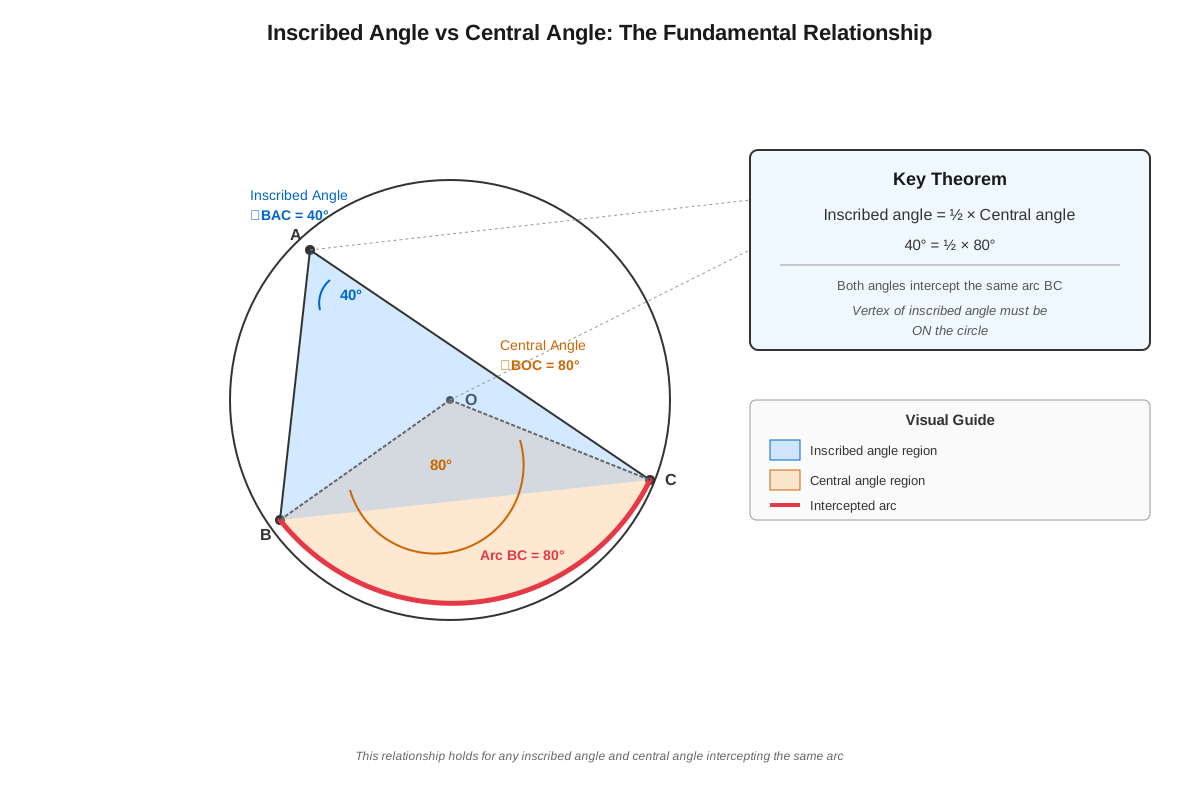
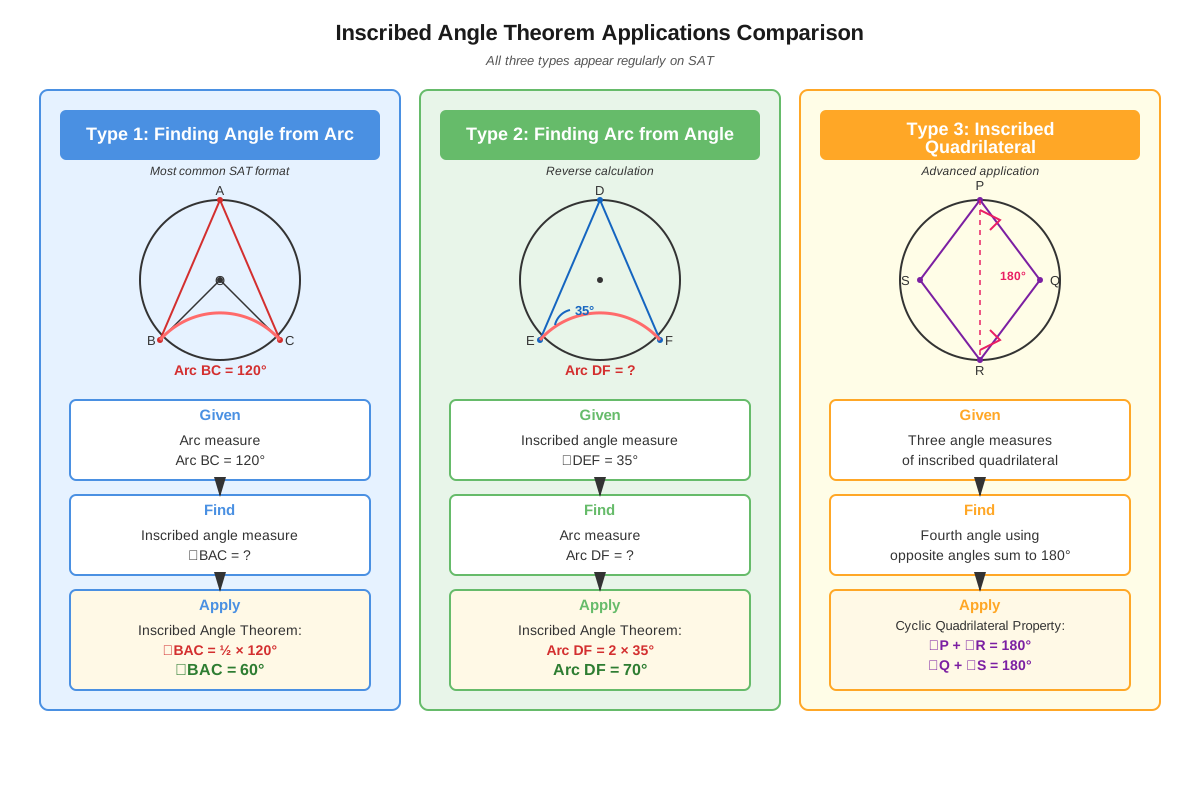
The inscribed angle theorem states that an inscribed angle measures exactly half the central angle that subtends (intercepts) the same arc. Mathematically, if an inscribed angle intercepts an arc measuring x°, the inscribed angle measures x°/2. Conversely, if an inscribed angle measures y°, the intercepted arc measures 2y°.
An inscribed angle has three defining characteristics:
- The vertex lies on the circle's circumference
- Both sides of the angle are chords of the circle
- The angle "opens up" to intercept an arc of the circle
The central angle, by contrast, has its vertex at the circle's center and intercepts the same arc. This fundamental 2:1 ratio between arc measure (or central angle) and inscribed angle forms the basis for solving most inscribed angle problems on the SAT.
Inscribed Angles Subtending the Same Arc
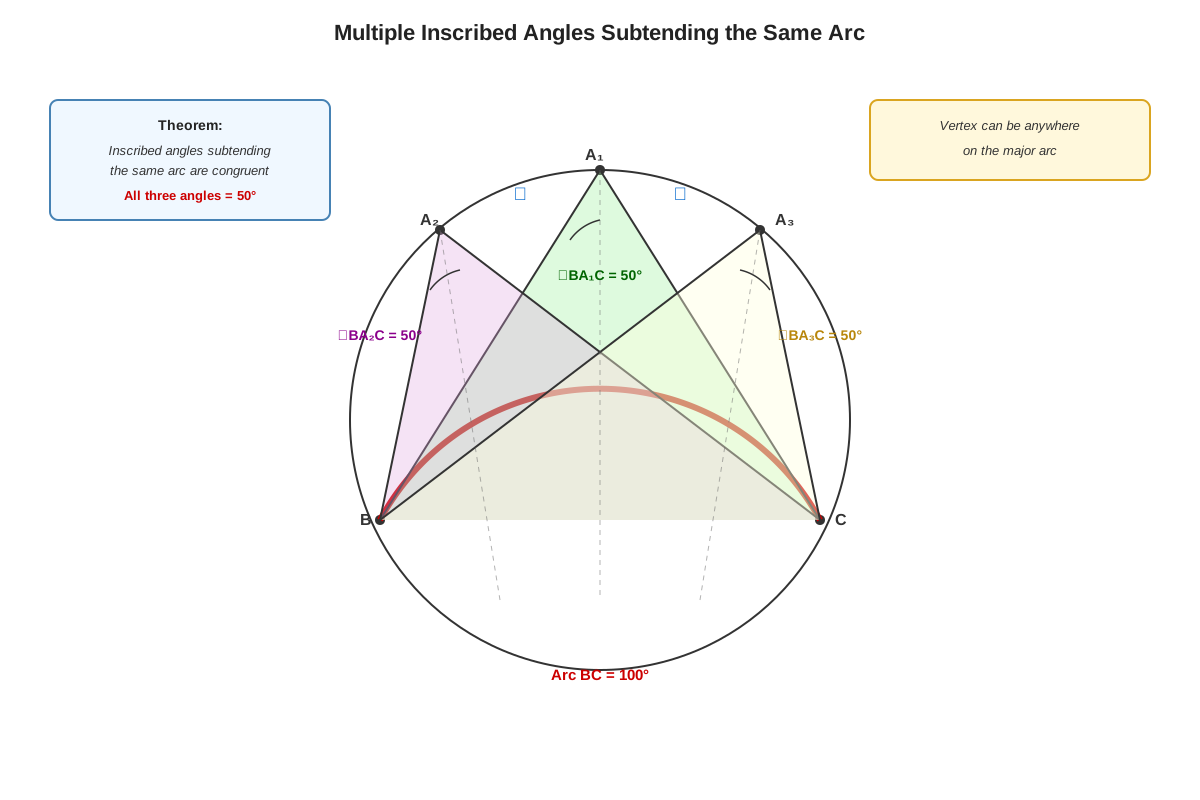
A powerful corollary to the inscribed angle theorem states that all inscribed angles subtending the same arc are congruent. If multiple points on a circle's circumference serve as vertices for angles that intercept the same arc, all those angles have equal measure. This property appears frequently on the SAT when diagrams show multiple inscribed angles, and students must recognize which angles are equal without explicit calculation.
This concept proves particularly useful when working with inscribed polygons. For example, if a quadrilateral is inscribed in a circle, angles that subtend the same arc must be equal, providing relationships that help solve for unknown angle measures.
The Semicircle Theorem
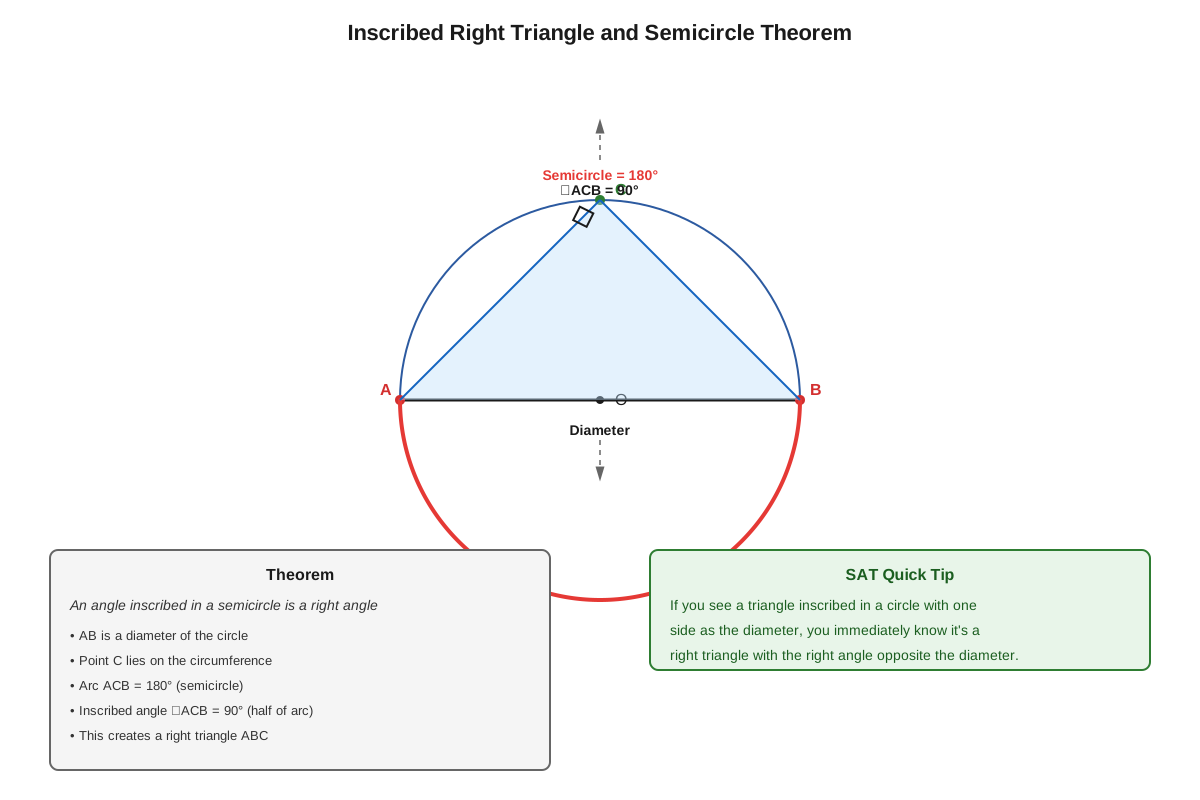
One of the most tested applications of inscribed angles involves semicircles. The semicircle theorem states that any angle inscribed in a semicircle (an angle whose sides pass through the endpoints of a diameter) is a right angle measuring 90°. This occurs because the diameter creates an arc of 180°, and the inscribed angle theorem gives us 180°/2 = 90°.
This theorem has immediate practical applications: if a problem states that a triangle is inscribed in a circle with one side being a diameter, you immediately know the angle opposite that diameter is 90°. This transforms the problem into a right triangle problem, allowing use of the Pythagorean theorem, special right triangle ratios, and trigonometric relationships.
Inscribed Quadrilaterals and Cyclic Quadrilaterals
A quadrilateral inscribed in a circle is called a cyclic quadrilateral. These figures have a special property: opposite angles are supplementary (they sum to 180°). This occurs because opposite angles in a cyclic quadrilateral subtend arcs that together form the complete circle (360°). Since each inscribed angle measures half its intercepted arc, the two opposite angles measure (arc₁)/2 + (arc₂)/2 = (arc₁ + arc₂)/2 = 360°/2 = 180°.
The SAT tests this property by providing three angle measures in an inscribed quadrilateral and asking students to find the fourth, or by presenting algebraic expressions for angles and requiring students to set up equations based on the supplementary relationship.
Relationship Between Inscribed and Central Angles
| Angle Type | Vertex Location | Relationship to Arc | Measure Formula |
|---|---|---|---|
| Central Angle | Center of circle | Equals arc measure | θ = arc measure |
| Inscribed Angle | On circle circumference | Half the arc measure | θ = (arc measure)/2 |
| Arc | N/A (portion of circle) | Equals central angle | arc = central angle |
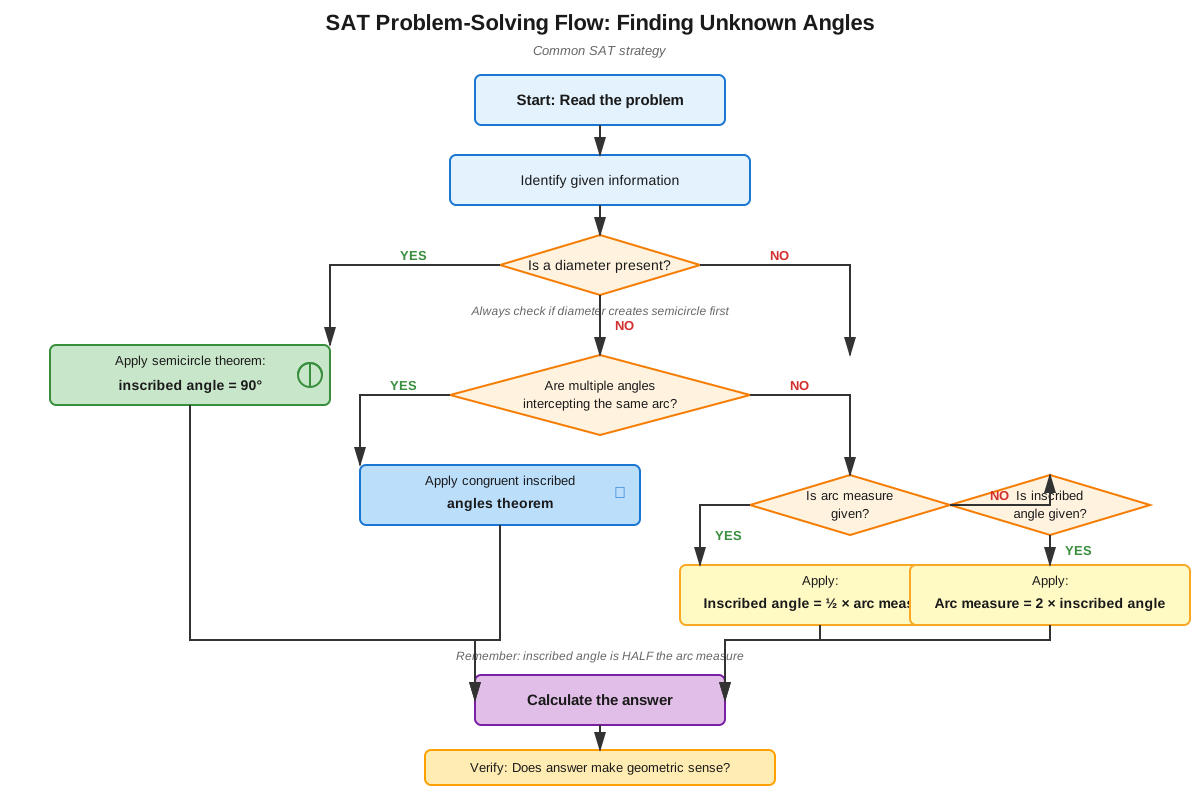
Understanding this table helps students quickly identify which formula to apply. When a problem provides an arc measure and asks for an inscribed angle, divide by 2. When given an inscribed angle and asked for the arc or central angle, multiply by 2.
Multiple Chords and Complex Configurations
SAT problems often present circles with multiple chords creating several inscribed angles simultaneously. The key strategy involves:
- Identifying each inscribed angle and its intercepted arc
- Applying the inscribed angle theorem to each angle-arc pair
- Using the fact that all arcs around a circle sum to 360°
- Setting up equations when variables are present
- Solving systematically, often finding one angle measure that unlocks others
These multi-step problems test both conceptual understanding and algebraic manipulation skills, making them higher-difficulty questions that separate top scorers from average performers.
Concept Relationships
The inscribed angle theorem serves as the central hub connecting multiple geometric concepts. Inscribed angles → directly apply to → arc measures, creating a bidirectional relationship where knowing one immediately determines the other through the 2:1 ratio. This relationship → extends to → central angles, since central angles equal their intercepted arcs, creating a transitive relationship: inscribed angle = (1/2) × central angle.
The semicircle theorem → represents a special case of → the inscribed angle theorem, where the intercepted arc equals 180°, producing the right angle. This connection → bridges to → right triangle geometry, allowing problems to incorporate Pythagorean theorem, special right triangles (30-60-90 and 45-45-90), and trigonometric ratios.
Inscribed angles → combine with → triangle angle sum (180°) in problems featuring inscribed triangles, where students must use both principles simultaneously. Similarly, inscribed angles → integrate with → properties of cyclic quadrilaterals, where the supplementary opposite angles property derives from inscribed angle relationships.
The concept → connects to → coordinate geometry when circles are graphed on coordinate planes, requiring students to identify points on the circle, calculate distances to verify chord lengths, and apply inscribed angle theorems to geometric figures in coordinate systems. Finally, inscribed angles → relate to → arc length and sector area calculations, as determining these measurements often requires first finding arc measures through inscribed angle relationships.
Quick check — test yourself on Inscribed angles so far.
Try Flashcards →High-Yield Facts
⭐ An inscribed angle measures exactly half the central angle that subtends the same arc
⭐ Any angle inscribed in a semicircle (subtending a diameter) is a right angle (90°)
⭐ All inscribed angles subtending the same arc are congruent
⭐ In a cyclic quadrilateral, opposite angles are supplementary (sum to 180°)
⭐ The measure of an inscribed angle equals half the measure of its intercepted arc
- If an inscribed angle measures 40°, its intercepted arc measures 80°
- If an arc measures 120°, any inscribed angle subtending that arc measures 60°
- The sum of all arcs around a circle equals 360°
- A central angle and its intercepted arc have equal measures
- Two inscribed angles are congruent if and only if they subtend congruent arcs
- An inscribed angle and a central angle subtending the same arc have a 1:2 ratio
- If a triangle is inscribed in a circle with one side as a diameter, the triangle is a right triangle
Common Misconceptions
Misconception: An inscribed angle equals its intercepted arc measure → Correction: An inscribed angle measures half the intercepted arc. Students must remember to divide the arc measure by 2 when finding the inscribed angle, or multiply the inscribed angle by 2 when finding the arc.
Misconception: Any angle inside a circle is an inscribed angle → Correction: An inscribed angle must have its vertex on the circle's circumference, not inside or outside. If the vertex is at the center, it's a central angle; if inside but not at center, different theorems apply.
Misconception: The inscribed angle theorem only works for acute angles → Correction: The inscribed angle theorem applies to all inscribed angles regardless of whether they're acute, right, or obtuse. An inscribed angle can measure up to 180° (when it subtends an arc of 360°, though this creates a degenerate case).
Misconception: All angles in an inscribed polygon are equal → Correction: Only inscribed angles subtending the same arc are equal. Different inscribed angles in a polygon typically subtend different arcs and therefore have different measures. The exception is regular polygons inscribed in circles.
Misconception: In a cyclic quadrilateral, all angles are supplementary to each other → Correction: Only opposite angles in a cyclic quadrilateral are supplementary. Adjacent angles are not necessarily supplementary and depend on the specific quadrilateral's shape.
Misconception: The semicircle theorem means any triangle in a circle is a right triangle → Correction: Only triangles where one side is a diameter are guaranteed to be right triangles. Triangles inscribed in circles with all three vertices on the circumference but no side being a diameter are not necessarily right triangles.
Worked Examples
Example 1: Basic Inscribed Angle Application
Problem: Circle O has points A, B, and C on its circumference. The arc from A to C (not passing through B) measures 140°. What is the measure of inscribed angle ABC?
Solution:
Step 1: Identify the components. Angle ABC is an inscribed angle with vertex at point B on the circle's circumference. The angle intercepts arc AC.
Step 2: Recall the inscribed angle theorem. An inscribed angle measures half its intercepted arc.
Step 3: Apply the formula:
Inscribed angle = (Intercepted arc) / 2
Angle ABC = 140° / 2 = 70°
Step 4: Verify the answer makes sense. Since the arc is less than 180° (not a semicircle), the inscribed angle should be less than 90°, which 70° satisfies.
Answer: Angle ABC measures 70°
This problem directly tests Learning Objective 1 (identifying key features) and Learning Objective 3 (applying inscribed angles to SAT-style questions).
Example 2: Inscribed Triangle with Diameter
Problem: Triangle PQR is inscribed in circle O, with PQ being a diameter of length 10. If angle QPR measures 35°, what is the measure of angle PRQ?
Solution:
Step 1: Apply the semicircle theorem. Since PQ is a diameter and R is a point on the circle, angle PRQ (the angle inscribed in the semicircle) must be 90°.
Step 2: Verify using the triangle angle sum. The three angles of triangle PQR must sum to 180°:
Angle QPR + Angle PRQ + Angle RQP = 180°
35° + 90° + Angle RQP = 180°
Angle RQP = 55°
Step 3: Confirm the semicircle theorem application. We identified that angle PRQ is opposite the diameter PQ, making it the angle inscribed in the semicircle.
Answer: Angle PRQ measures 90°
This problem combines the semicircle theorem with triangle properties, demonstrating how inscribed angles integrate with other geometric concepts (Learning Objective 2). The problem also shows a common SAT pattern where the diameter information is the key insight needed to solve the problem quickly.
Exam Strategy
When approaching SAT inscribed angles questions, begin by identifying whether angles have vertices on the circle (inscribed), at the center (central), or elsewhere. Circle all inscribed angles and their intercepted arcs in different colors if time permits, creating a visual map of relationships.
Trigger words and phrases to watch for include: "inscribed in a circle," "points on the circumference," "diameter," "semicircle," "cyclic quadrilateral," "subtends an arc," and "intercepted arc." When you see "diameter" combined with "inscribed triangle," immediately think "right angle" and look for the angle opposite the diameter.
For process of elimination, eliminate answer choices that violate basic principles:
- If an arc measures 100°, eliminate any answer suggesting the inscribed angle is 100° (it should be 50°)
- If a problem involves a semicircle, eliminate answers that don't include a 90° angle
- For cyclic quadrilaterals, eliminate answers where opposite angles don't sum to 180°
- If multiple inscribed angles subtend the same arc, eliminate answers where these angles differ
Time allocation: Straightforward inscribed angle problems (applying the theorem once) should take 30-45 seconds. Multi-step problems involving inscribed polygons or multiple angle relationships may require 90-120 seconds. If a problem requires more than 2 minutes, mark it and return later—you may be missing a key insight that would simplify the solution.
Strategic approach sequence:
- Identify all inscribed angles and mark their vertices
- Identify all intercepted arcs
- Look for special cases (semicircles, same arc subtended by multiple angles)
- Apply the inscribed angle theorem systematically
- Use supplementary/complementary relationships as needed
- Check that your answer is reasonable given the diagram
Memory Techniques
"HALF the arc" - Remember that inscribed angles are always HALF their intercepted arc. Visualize cutting the arc measure in half with scissors to get the inscribed angle.
"Diameter = Right" - Any time you see a diameter with an inscribed angle, think "right angle." The mnemonic "D-R" (Diameter-Right) reinforces this connection.
"Same Arc = Same Angle" - When multiple inscribed angles subtend the same arc, they're congruent. Visualize multiple people standing at different points on a circular track, all looking at the same two points—they all see the same angle.
"Opposite = 180" - For cyclic quadrilaterals, opposite angles sum to 180°. Visualize the quadrilateral as a bow tie where opposite angles "balance" to create supplementary pairs.
The 2:1 Ratio Rule - Create a mental image of a central angle as a "full-strength" angle and an inscribed angle as "half-strength" when they subtend the same arc. This reinforces that inscribed = central ÷ 2.
Visual anchor: Picture a pizza slice (central angle) and someone standing on the crust looking at the same arc (inscribed angle). The person on the crust sees half the angle that the center "sees."
Summary
Inscribed angles form when two chords share an endpoint on a circle's circumference, creating an angle that intercepts an arc. The fundamental inscribed angle theorem establishes that any inscribed angle measures exactly half its intercepted arc, creating a 2:1 ratio between arc measure and inscribed angle measure. This relationship extends to multiple powerful corollaries: all inscribed angles subtending the same arc are congruent; any angle inscribed in a semicircle is a right angle; and opposite angles in cyclic quadrilaterals are supplementary. SAT problems test these concepts through direct applications of the theorem, multi-step problems combining inscribed angles with triangle or quadrilateral properties, and complex scenarios involving multiple chords and angles. Success requires quickly identifying inscribed angles, recognizing special cases like semicircles and cyclic quadrilaterals, and systematically applying the 2:1 ratio to find unknown measures. Mastery of inscribed angles provides essential tools for solving a significant portion of SAT circle geometry questions.
Key Takeaways
- The inscribed angle theorem states that an inscribed angle equals half the measure of its intercepted arc (or half the central angle subtending the same arc)
- Any angle inscribed in a semicircle (subtending a diameter) is always a right angle measuring 90°
- All inscribed angles that subtend the same arc are congruent, regardless of where their vertices are located on the circle
- In cyclic quadrilaterals (quadrilaterals inscribed in circles), opposite angles are supplementary and sum to 180°
- To solve inscribed angle problems, identify the vertex location (must be on the circle), determine the intercepted arc, and apply the 2:1 ratio
- Inscribed angle problems frequently combine with other geometric concepts including triangle angle sum, properties of special triangles, and coordinate geometry
- Watch for trigger words like "diameter," "semicircle," and "inscribed" that signal which theorems to apply
Related Topics
Central Angles and Arc Length: Understanding how central angles relate to arc length calculations builds directly on inscribed angle knowledge, as both concepts use arc measures. Mastering inscribed angles makes arc length problems more intuitive.
Sector Area: Calculating the area of sectors requires finding central angles, which often involves working backward from inscribed angles using the relationships learned in this topic.
Tangent Lines to Circles: Tangent lines create special angle relationships with radii and chords, extending the angle-relationship concepts introduced with inscribed angles.
Coordinate Geometry with Circles: Applying inscribed angle theorems to circles graphed on coordinate planes combines algebraic and geometric reasoning, representing a higher-level application of these concepts.
Trigonometry in Circles: Inscribed angles in circles provide a geometric foundation for understanding unit circle concepts and trigonometric functions in more advanced mathematics.
Practice CTA
Now that you've mastered the core concepts of inscribed angles, it's time to solidify your understanding through practice. Work through the practice questions to test your ability to identify inscribed angles, apply the inscribed angle theorem, and solve multi-step problems combining these concepts with other geometric principles. The flashcards will help you memorize key theorems and relationships for quick recall during the exam. Remember, inscribed angles appear regularly on the SAT, and confident mastery of this topic can earn you valuable points. Each practice problem you solve strengthens your pattern recognition and problem-solving speed—skills that directly translate to test-day success!
Sign up free to keep reading
Create a free AnvayaPrep account to finish this SAT guide on Inscribed angles — plus flashcards and practice questions.