Overview
Circle basics form one of the most frequently tested geometry topics on the SAT, appearing in approximately 2-4 questions per test. Understanding circles is essential not only for direct circle problems but also for coordinate geometry, trigonometry, and complex problem-solving scenarios that integrate multiple math concepts. The SAT tests circle fundamentals through questions involving equations, radius and diameter relationships, arc lengths, sector areas, and the relationship between circles and other geometric figures.
Mastering sat circle basics provides students with a powerful toolkit for tackling a significant portion of the geometry questions on both the calculator and no-calculator sections. These concepts build directly upon foundational algebra and coordinate geometry skills, requiring students to manipulate equations, visualize spatial relationships, and apply formulas efficiently under time pressure. Circle problems often serve as vehicles for testing algebraic manipulation, equation solving, and the ability to translate between geometric and algebraic representations.
The beauty of circle geometry lies in its predictability and pattern recognition potential. Unlike some SAT topics that require extensive memorization, circle problems reward students who understand core relationships and can apply a limited set of formulas flexibly. Success with circles creates a foundation for more advanced topics including conic sections, polar coordinates, and calculus concepts that students will encounter in college-level mathematics courses.
Learning Objectives
- [ ] Identify key features of Circle basics including radius, diameter, circumference, and area
- [ ] Explain how Circle basics appears on the SAT in various question formats and difficulty levels
- [ ] Apply Circle basics to answer SAT-style questions involving calculations and problem-solving
- [ ] Derive and manipulate the standard form equation of a circle in the coordinate plane
- [ ] Calculate arc lengths and sector areas given central angles in both degrees and radians
- [ ] Solve multi-step problems involving circles inscribed in or circumscribed about other polygons
- [ ] Interpret circle graphs and diagrams to extract relevant information for problem-solving
Prerequisites
- Basic algebraic manipulation: Essential for rearranging circle equations and solving for unknown variables in circle problems
- Coordinate plane understanding: Required for working with circle equations and identifying center coordinates and radius values
- Pythagorean theorem: Frequently used to calculate distances that represent radii or to find points on circles
- Basic angle measurement: Necessary for understanding central angles, arc measures, and sector calculations
- Exponent rules and square roots: Critical for working with the squared terms in circle equations and calculating radius from area
Why This Topic Matters
Circle problems appear consistently across both SAT Math sections, making them high-yield content for test preparation. Statistical analysis of recent SAT administrations shows that circles account for approximately 5-8% of all math questions, with difficulty ranging from straightforward formula application to complex multi-step reasoning problems. Students who master circle basics can reliably secure these points, significantly improving their overall math scores.
In real-world applications, circles model countless phenomena: planetary orbits, wheel mechanics, signal propagation, architectural design, and engineering specifications. Understanding circle properties enables professionals in fields ranging from urban planning to computer graphics to solve practical problems involving circular motion, coverage areas, and optimal design configurations.
On the SAT, circle questions typically appear in several formats: direct calculation problems requiring circumference or area formulas, coordinate geometry questions involving circle equations, word problems requiring translation from verbal descriptions to mathematical representations, and complex scenarios combining circles with triangles, squares, or other polygons. The College Board particularly favors questions that test whether students can move fluidly between geometric and algebraic representations of circles, making conceptual understanding more valuable than mere formula memorization.
Core Concepts
Fundamental Circle Components
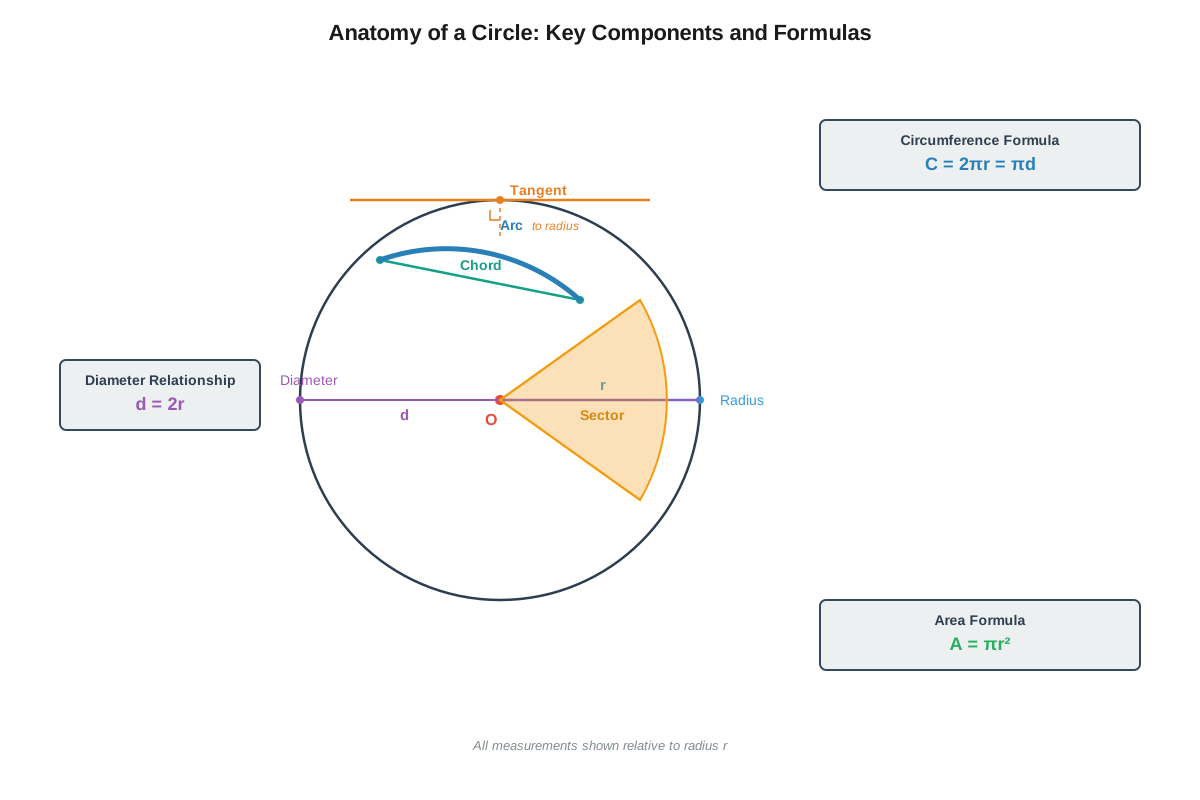
A circle is defined as the set of all points in a plane that are equidistant from a fixed center point. This distance is called the radius (r), which represents the most fundamental measurement of any circle. The diameter (d) is the distance across the circle through its center, always exactly twice the radius: d = 2r. Understanding this relationship is crucial because SAT questions frequently provide one measurement and require the other.
The center of a circle serves as the reference point for all measurements and appears as the coordinates (h, k) in the circle's equation. Every radius drawn from the center to any point on the circle has identical length, a property that generates many useful geometric relationships. The circumference represents the distance around the circle—essentially the perimeter of this curved figure.
Essential Circle Formulas
Four formulas form the foundation of SAT circle problems:
Circumference Formula:
C = 2πr = πdArea Formula:
A = πr²Standard Form Circle Equation:
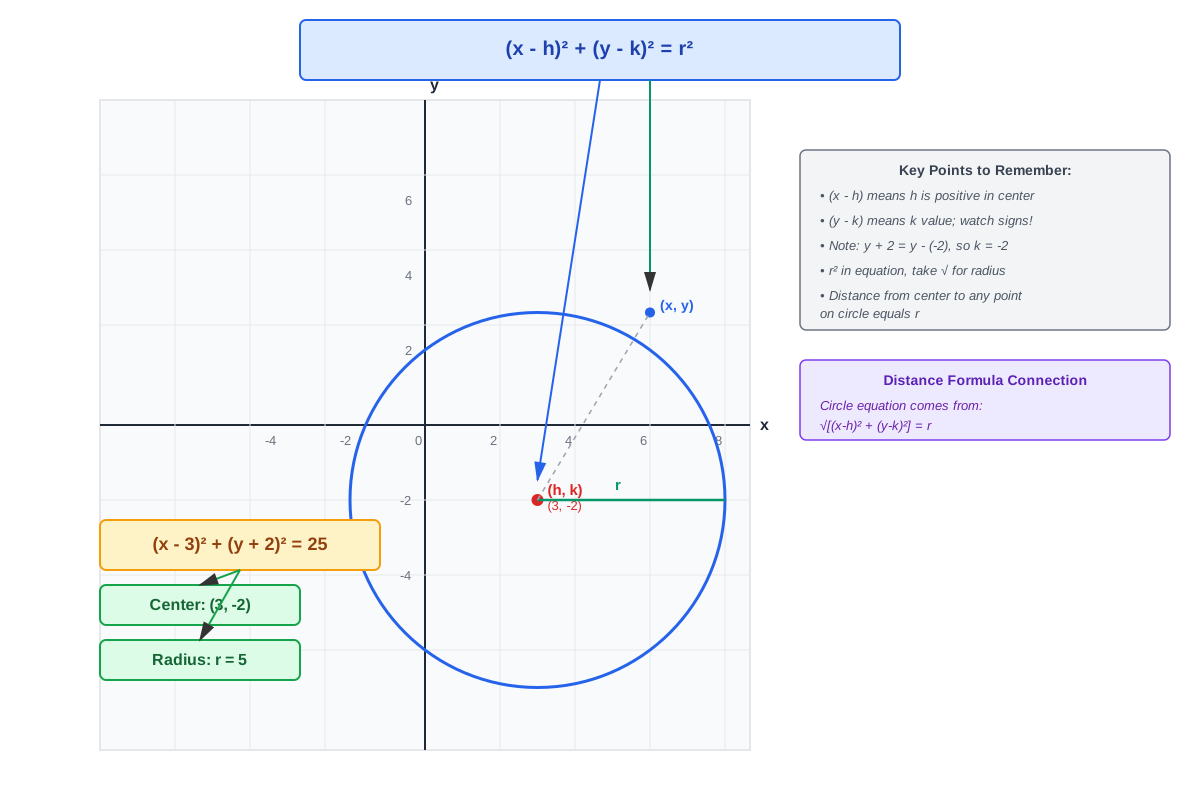
(x - h)² + (y - k)² = r²where (h, k) represents the center coordinates and r represents the radius.
General Form Circle Equation:
x² + y² + Dx + Ey + F = 0The SAT expects students to recognize both forms and convert between them through completing the square. The standard form immediately reveals the center and radius, while the general form requires algebraic manipulation to extract these values.
Circumference and Area Relationships
The relationship between circumference and area creates powerful problem-solving opportunities. Given either measurement, students can determine the radius and subsequently calculate any other circle property. For example, if a circle has circumference 12π, the radius must be 6 (since C = 2πr means 12π = 2πr, so r = 6). This radius then yields an area of 36π.
| Given Information | Find Radius | Then Calculate Other Values |
|---|---|---|
| Circumference C | r = C/(2π) | Area = πr² |
| Area A | r = √(A/π) | Circumference = 2πr |
| Diameter d | r = d/2 | Area = πr², Circumference = πd |
Circle Equations in Coordinate Geometry
The standard form equation (x - h)² + (y - k)² = r² derives directly from the distance formula. Any point (x, y) on the circle must be exactly r units from the center (h, k). The SAT frequently tests whether students can identify the center and radius from an equation or write an equation given geometric information.
Converting from general form to standard form requires completing the square for both x and y terms:
- Group x terms and y terms separately
- Move the constant to the right side
- Complete the square for x by adding (D/2)² to both sides
- Complete the square for y by adding (E/2)² to both sides
- Factor the perfect square trinomials
- Identify center as (-D/2, -E/2) and radius as √(right side)
Arcs and Central Angles
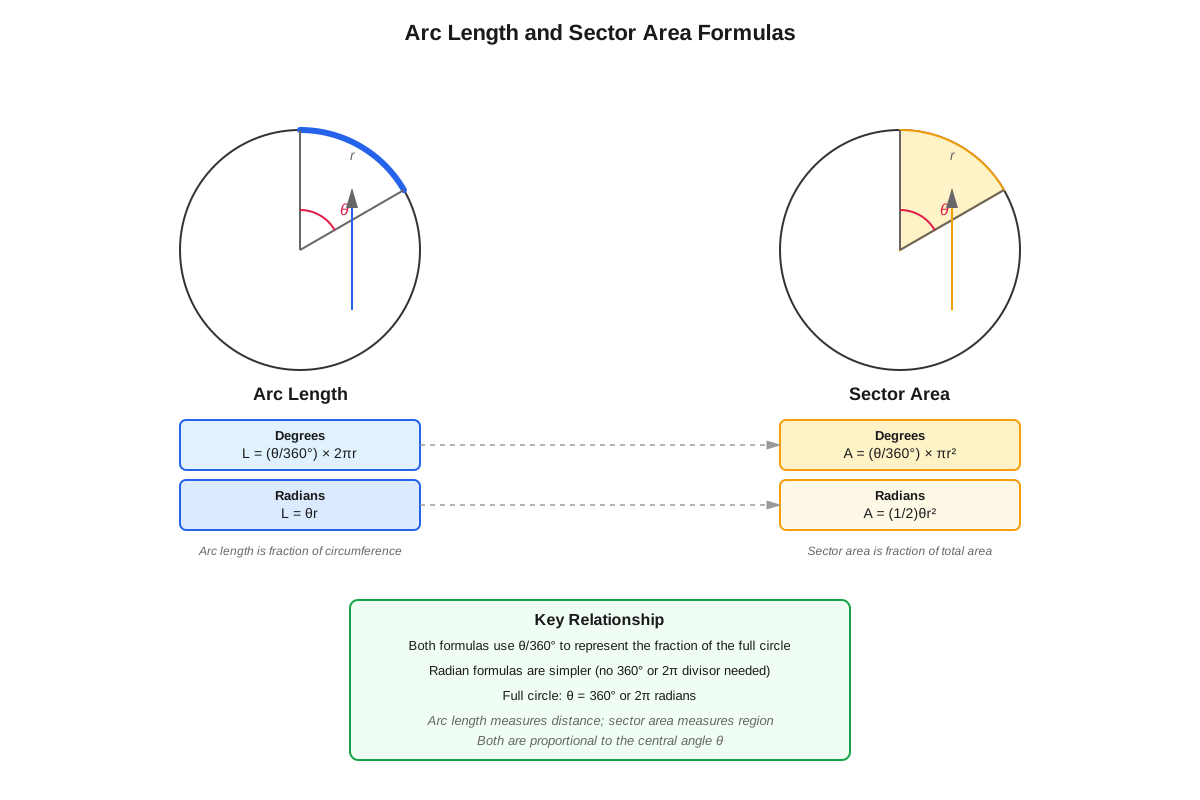
An arc is a portion of the circle's circumference, measured by its central angle—the angle formed at the center with endpoints on the circle. The arc length is proportional to the central angle: if the angle represents a fraction of 360°, the arc length represents the same fraction of the total circumference.
Arc Length Formula:
Arc Length = (θ/360°) × 2πr = (θ/360°) × CFor angles measured in radians:
Arc Length = θrSectors and Segment Areas
A sector is a "pie slice" of the circle, bounded by two radii and an arc. Its area relates to the central angle exactly as arc length does to circumference:
Sector Area Formula:
Sector Area = (θ/360°) × πr² = (θ/360°) × AA segment is the region between a chord and the arc it cuts off. Calculating segment area requires finding the sector area and subtracting the triangle area formed by the two radii and the chord.
Inscribed and Circumscribed Figures
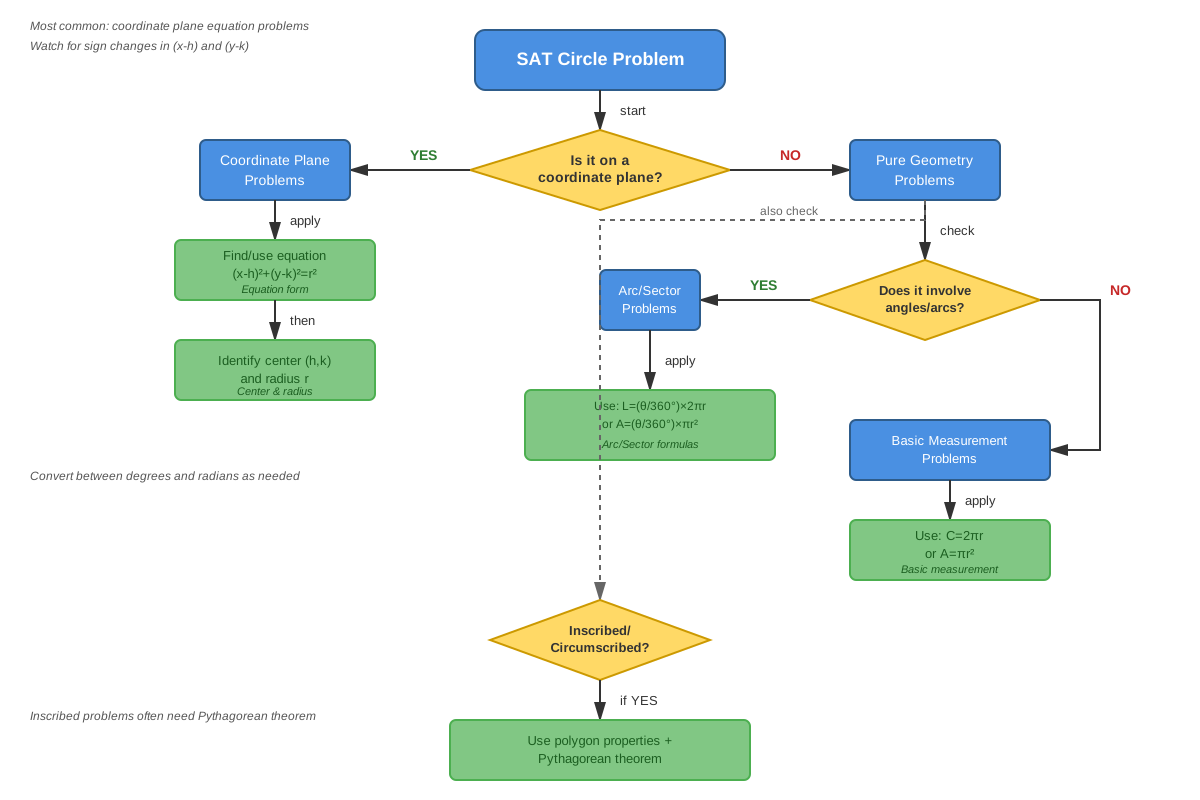
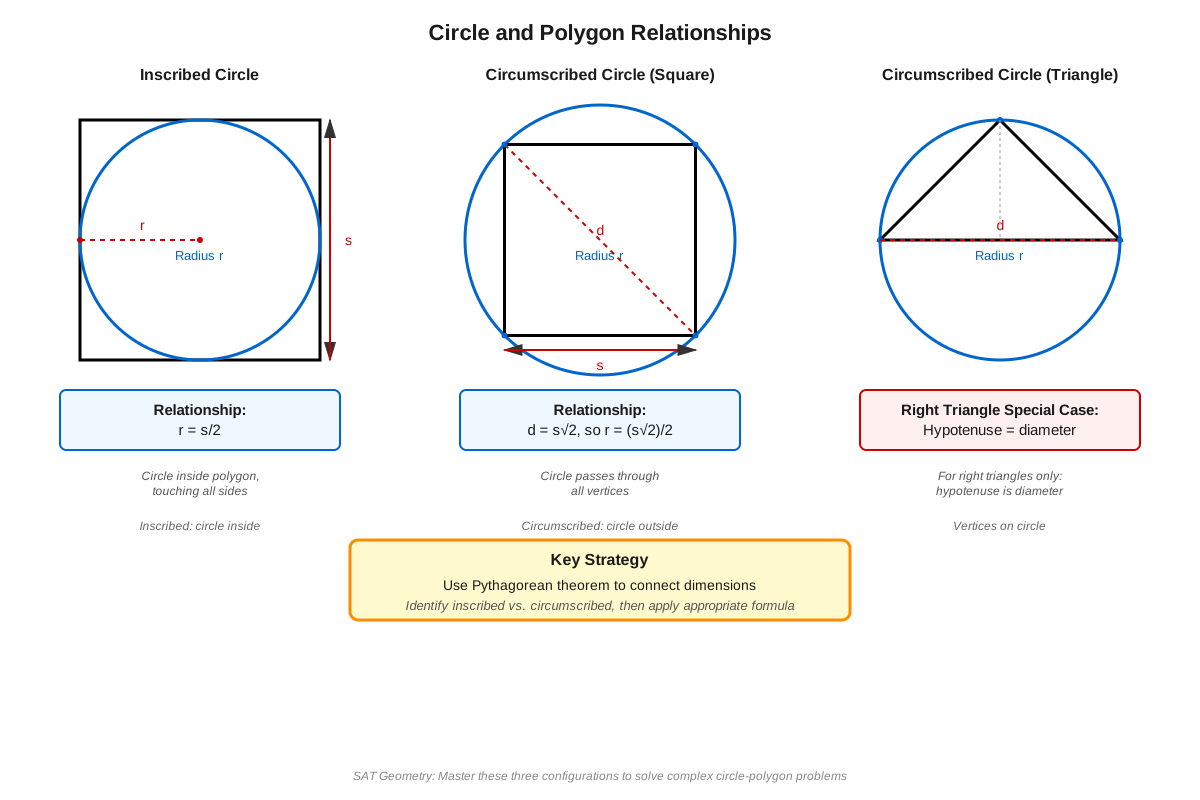
Circles frequently interact with polygons in two ways. An inscribed polygon has all vertices touching the circle (the circle is circumscribed about the polygon). A circumscribed polygon has all sides tangent to the circle (the circle is inscribed in the polygon). These relationships create right angles and special triangles that enable radius calculations.
For a circle inscribed in a square with side length s, the diameter equals s. For a circle circumscribed about a square with side length s, the diameter equals s√2 (the diagonal of the square). These relationships appear frequently on the SAT.
Concept Relationships
The fundamental circle measurements form a hierarchical relationship: radius → serves as the basis for → diameter (2r), circumference (2πr), and area (πr²). Any one of these measurements allows calculation of all others through algebraic manipulation.
Circle equations connect to coordinate geometry through the distance formula, which generates the standard form equation. The center coordinates (h, k) determine the circle's position, while the radius r determines its size. This algebraic representation enables integration of circles with linear equations, systems of equations, and function concepts.
Arc length and sector area both derive from the same proportional relationship with central angles, creating parallel calculation methods. Both concepts extend the basic circumference and area formulas by applying a fractional multiplier based on the angle measure.
The relationship map flows as follows:
Distance Formula → Standard Form Equation → Center and Radius Identification → Circumference and Area Calculations → Arc Length and Sector Area → Complex Problem Solving with Multiple Figures
High-Yield Facts
⭐ The radius is exactly half the diameter: r = d/2, a relationship tested in nearly every circle problem
⭐ Circumference formula: C = 2πr = πd, essential for perimeter calculations and arc length problems
⭐ Area formula: A = πr², the most frequently tested circle formula on the SAT
⭐ Standard form circle equation: (x - h)² + (y - k)² = r², where (h, k) is the center and r is the radius
⭐ Arc length is proportional to central angle: Arc = (θ/360°) × 2πr for angles in degrees
- The diameter is the longest chord in any circle, passing through the center
- All radii in the same circle have equal length, creating isosceles triangles when two radii are drawn
- A circle inscribed in a square with side s has diameter s; circumscribed about a square has diameter s√2
- Sector area uses the same angle proportion as arc length: Sector Area = (θ/360°) × πr²
- Converting from general form to standard form requires completing the square for both variables
- The center of a circle in standard form (x - h)² + (y - k)² = r² is at point (h, k), not (-h, -k)
- When π appears in an answer choice, leave it in the expression rather than using 3.14 unless specifically instructed
Quick check — test yourself on Circle basics so far.
Try Flashcards →Common Misconceptions
Misconception: The center of the circle (x - 3)² + (y + 4)² = 25 is at (3, 4).
Correction: The center is at (3, -4). The standard form is (x - h)² + (y - k)² = r², so signs are opposite of what appears in the equation. The equation (x - 3)² means x - 3, so h = 3, while (y + 4)² means y - (-4), so k = -4.
Misconception: The radius of (x - 2)² + (y - 1)² = 16 is 16.
Correction: The radius is 4, not 16. The equation format is (x - h)² + (y - k)² = r², where r² = 16, so r = √16 = 4. Students must remember to take the square root of the right side to find the radius.
Misconception: Circumference and area formulas are interchangeable or can be confused.
Correction: Circumference (C = 2πr) measures the distance around the circle in linear units, while area (A = πr²) measures the space inside the circle in square units. The formulas are fundamentally different: circumference is linear in r, area is quadratic in r.
Misconception: Doubling the radius doubles the area.
Correction: Doubling the radius quadruples the area because area depends on r². If r becomes 2r, then A = π(2r)² = 4πr², which is four times the original area πr². This relationship frequently appears in SAT ratio and proportion problems.
Misconception: Arc length can be calculated without knowing the radius.
Correction: Arc length requires both the central angle and the radius (or circumference). The formula Arc = (θ/360°) × 2πr shows that both angle and radius are necessary. Knowing only the angle provides the fraction of the circle but not the actual length.
Misconception: All circle equations must be in standard form to identify the center and radius.
Correction: While standard form makes identification immediate, the general form x² + y² + Dx + Ey + F = 0 also contains this information. Completing the square converts general form to standard form, revealing the center at (-D/2, -E/2) and radius √[(D/2)² + (E/2)² - F].
Worked Examples
Example 1: Multi-Step Circle Equation Problem
Problem: A circle in the xy-plane has equation x² + y² - 6x + 8y = 24. What is the radius of the circle?
Solution:
Step 1: Recognize this is general form and requires completing the square.
Step 2: Group x terms and y terms:
(x² - 6x) + (y² + 8y) = 24
Step 3: Complete the square for x terms. Take half of -6, square it: (-6/2)² = 9
Add 9 inside the parentheses and to the right side:
(x² - 6x + 9) + (y² + 8y) = 24 + 9
Step 4: Complete the square for y terms. Take half of 8, square it: (8/2)² = 16
Add 16 inside the parentheses and to the right side:
(x² - 6x + 9) + (y² + 8y + 16) = 24 + 9 + 16
Step 5: Factor the perfect square trinomials:
(x - 3)² + (y + 4)² = 49
Step 6: Identify r² = 49, so r = 7
Answer: The radius is 7.
Connection to Learning Objectives: This problem requires identifying key features (center and radius) from an equation and applying algebraic manipulation skills essential for SAT circle problems.
Example 2: Arc Length and Sector Area
Problem: A circle has radius 9. A sector of this circle has a central angle of 40°. What is the area of this sector?
Solution:
Step 1: Identify given information: r = 9, θ = 40°
Step 2: Recall the sector area formula: Sector Area = (θ/360°) × πr²
Step 3: Calculate the total area of the circle:
A = πr² = π(9)² = 81π
Step 4: Find what fraction of the circle the sector represents:
40°/360° = 1/9
Step 5: Calculate sector area:
Sector Area = (1/9) × 81π = 9π
Answer: The sector area is 9π square units.
Alternative approach: Directly substitute into the formula:
Sector Area = (40/360) × π(9)² = (1/9) × 81π = 9π
Connection to Learning Objectives: This demonstrates applying circle basics formulas to calculate sector areas, a common SAT question type that combines angle relationships with area calculations.
Example 3: Inscribed Circle Problem
Problem: A circle is inscribed in a square with side length 10. What is the area of the circle?
Solution:
Step 1: Visualize the relationship. An inscribed circle touches all four sides of the square at their midpoints.
Step 2: Recognize that the diameter of the inscribed circle equals the side length of the square.
Therefore, d = 10
Step 3: Calculate the radius:
r = d/2 = 10/2 = 5
Step 4: Apply the area formula:
A = πr² = π(5)² = 25π
Answer: The area is 25π square units.
Connection to Learning Objectives: This problem tests the ability to identify relationships between circles and polygons, a high-yield SAT topic that combines geometric visualization with formula application.
Exam Strategy
When approaching SAT circle questions, begin by identifying what information is given and what is being asked. Circle problems typically provide one or two measurements and require calculating others. Draw a diagram if one isn't provided—visualizing the circle with labeled radius, center, or relevant angles dramatically reduces errors.
Trigger words to watch for include: "circumference" (use C = 2πr), "area" (use A = πr²), "diameter" (remember d = 2r), "equation of a circle" (think standard form), "arc" (need angle and radius), "sector" (need angle and area), "inscribed" (figure inside circle), and "circumscribed" (figure outside circle). Each term signals specific formulas and relationships.
For equation problems, immediately identify whether the equation is in standard form or requires completing the square. If you see (x - h)² + (y - k)² = r², extract the center and radius directly. If you see x² + y² with additional linear terms, plan to complete the square. The SAT rewards students who can execute this process quickly and accurately.
Process of elimination works effectively on circle problems because wrong answers often result from common errors: using diameter instead of radius, forgetting to square the radius in area calculations, or misidentifying the center coordinates. If your calculated answer doesn't appear, check these common mistakes before recalculating from scratch.
Time allocation: Straightforward formula application problems should take 30-60 seconds. Multi-step problems involving completing the square or combining multiple concepts may require 90-120 seconds. If a circle problem seems to require more than two minutes, you may be missing a key insight—consider marking it and returning after completing easier questions.
For problems involving π, leave it in symbolic form unless the question specifically asks for a decimal approximation. Answer choices typically include π, making exact answers both faster and more accurate than decimal calculations.
Memory Techniques
"C-A-R" for Circle Formulas:
- Circumference = 2πr (or πd)
- Area = πr²
- Radius is half the diameter
"Standard Form Sign Switch": In (x - h)² + (y - k)² = r², the center coordinates have opposite signs from what appears in the equation. Remember: "Switch the signs to find the center."
"Square Root for Radius": When you see r² in the equation, remember to take the square root to find r. Visualize: "r² → √ → r"
"Angle Fraction = Length/Area Fraction": For arcs and sectors, the fraction of 360° equals the fraction of circumference or area. Visualize a pie: if you take 1/4 of the angle (90°), you get 1/4 of the pie.
"Inscribed = Inside, Circumscribed = Outside": The prefix "in-" means inside (inscribed figure is inside the circle), while "circum-" means around (circumscribed figure goes around the circle).
"Complete the Square: Half, Square, Add": For completing the square, remember the three-word sequence: take half the coefficient, square it, add it to both sides.
Summary
Circle basics represent essential SAT content that combines geometric visualization with algebraic manipulation. Mastery requires understanding the fundamental relationships between radius, diameter, circumference, and area, along with the ability to work fluently with circle equations in both standard and general forms. The core formulas—C = 2πr, A = πr², and (x - h)² + (y - k)² = r²—serve as the foundation for all circle problems, from straightforward calculations to complex multi-step scenarios. Success on SAT circle questions depends on recognizing which formula or relationship applies, executing algebraic procedures accurately (especially completing the square), and understanding how circles interact with other geometric figures. Students who can quickly identify centers and radii from equations, calculate arc lengths and sector areas using angle proportions, and visualize inscribed and circumscribed relationships will confidently handle the 2-4 circle questions appearing on each SAT administration, securing valuable points toward their target math scores.
Key Takeaways
- The radius is the fundamental circle measurement from which all other properties (diameter, circumference, area) can be calculated using the formulas d = 2r, C = 2πr, and A = πr²
- The standard form circle equation (x - h)² + (y - k)² = r² immediately reveals the center (h, k) and radius r, but remember that signs in the equation are opposite the actual center coordinates
- Converting from general form to standard form requires completing the square for both x and y variables, a high-yield skill for SAT coordinate geometry questions
- Arc length and sector area both use the same proportional relationship with central angles: multiply the full circumference or area by the fraction θ/360°
- Circles inscribed in or circumscribed about polygons create predictable relationships, particularly with squares where inscribed circles have diameter equal to the side length
- Always leave π in symbolic form in answers unless specifically instructed otherwise, and remember to take the square root of r² to find the actual radius
- Drawing diagrams and labeling known information dramatically improves accuracy and speed on circle problems, especially those involving multiple geometric figures
Related Topics
Coordinate Geometry and Distance Formula: Understanding how the distance formula generates the circle equation enables deeper comprehension of why the standard form appears as it does, and prepares students for more advanced conic sections.
Trigonometry and Unit Circle: Circle basics provide the foundation for understanding the unit circle, where radius equals 1 and coordinates represent trigonometric function values—essential for advanced SAT problems and pre-calculus.
Geometric Transformations: Circles can be translated, reflected, and dilated in the coordinate plane, with transformations affecting the center coordinates and radius in predictable ways.
Three-Dimensional Geometry: Extending circle concepts to spheres, cylinders, and cones requires understanding how circular cross-sections relate to volume and surface area formulas.
Tangent Lines and Circles: Advanced circle problems involve lines tangent to circles, where the radius to the point of tangency is perpendicular to the tangent line, creating right triangle relationships.
Practice CTA
Now that you've mastered the core concepts of circle basics, it's time to cement your understanding through active practice. Work through the practice questions to apply these formulas and relationships in SAT-style scenarios, testing your ability to identify what's given, select the appropriate approach, and execute calculations accurately. Use the flashcards to reinforce the essential formulas and relationships until they become automatic—speed and accuracy on circle problems come from pattern recognition and formula fluency. Remember, every circle problem you solve correctly represents valuable points toward your target score. You've built the foundation; now practice transforming that knowledge into test-day success!
Sign up free to keep reading
Create a free AnvayaPrep account to finish this SAT guide on Circle basics — plus flashcards and practice questions.