Overview
The radius is one of the most fundamental elements of circle geometry and appears frequently throughout the SAT Math section. Understanding the radius goes far beyond simply knowing it as "the distance from the center to the edge"—it serves as the key to unlocking virtually every other circle property, from circumference and area calculations to more complex problems involving sectors, arcs, and coordinate geometry. On the SAT, radius problems can appear in multiple forms: straightforward calculation questions, word problems requiring translation of real-world scenarios into mathematical expressions, and multi-step problems that combine circle properties with algebra, coordinate geometry, or trigonometry.
Mastering the radius concept is essential for SAT success because circle-related questions consistently appear on every test administration, typically accounting for 2-4 questions per exam. These questions often serve as medium-difficulty problems that separate average scorers from high achievers. The radius connects directly to formulas for circumference (C = 2πr), area (A = πr²), and serves as the foundation for understanding how circles interact with other geometric figures such as triangles, squares, and coordinate planes.
The radius concept integrates seamlessly with broader mathematical principles tested on the SAT. It connects to the Pythagorean theorem when circles are inscribed in or circumscribed around polygons, relates to distance formula applications in coordinate geometry, and appears in real-world modeling problems involving circular motion, design, and optimization. Students who develop fluency with radius-based calculations gain a significant advantage in tackling the diverse array of geometry problems that constitute approximately 15% of all SAT Math questions.
Learning Objectives
- [ ] Identify key features of Radius
- [ ] Explain how Radius appears on the SAT
- [ ] Apply Radius to answer SAT-style questions
- [ ] Calculate radius when given circumference, area, diameter, or coordinate information
- [ ] Solve multi-step problems involving radius in combination with other geometric concepts
- [ ] Recognize and apply the relationship between radius and other circle components (diameter, chord, arc, sector)
Prerequisites
- Basic algebraic manipulation: Essential for isolating radius in formulas and solving equations involving π
- Understanding of π (pi): Necessary since all circle formulas incorporate this constant (approximately 3.14 or 22/7)
- Coordinate plane fundamentals: Required for problems involving circles graphed on x-y axes
- Square roots and exponents: Critical for working with area formulas and the Pythagorean theorem
- Basic geometry vocabulary: Terms like center, diameter, and circumference must be familiar
Why This Topic Matters
In real-world applications, the radius concept appears everywhere from engineering and architecture to technology and natural sciences. Architects use radius calculations to design circular structures like domes and arches. Engineers apply radius principles when designing wheels, gears, and rotating machinery. GPS technology relies on circular radius calculations to determine location accuracy. Even in everyday life, understanding radius helps with tasks like determining how much fencing is needed for a circular garden or calculating the coverage area of a wireless router.
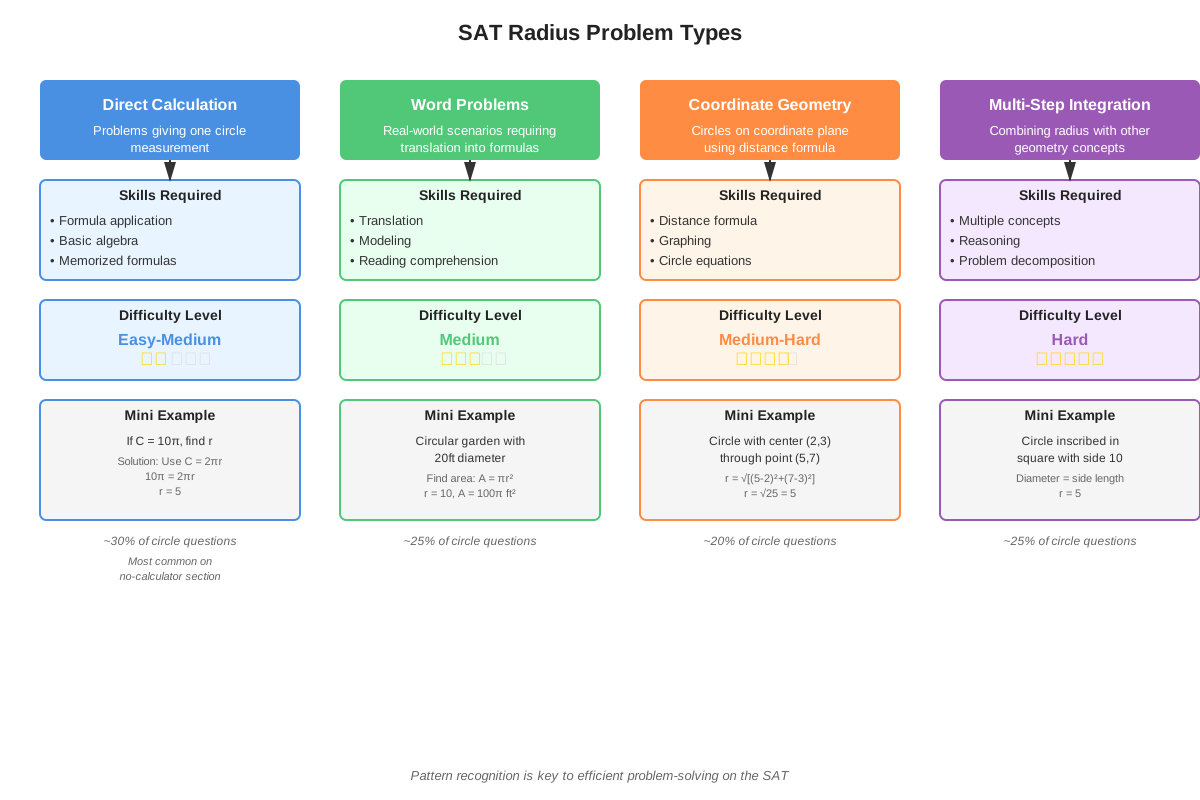
On the SAT specifically, radius-related questions appear with remarkable consistency. Test analysis shows that approximately 10-15% of geometry questions directly involve circles, and nearly all of these require understanding the radius. These questions typically appear in both the calculator and no-calculator sections, with difficulty levels ranging from straightforward formula application to complex multi-step reasoning problems. The College Board frequently tests radius concepts through:
- Direct calculation problems asking students to find radius given area or circumference
- Word problems requiring students to model real-world circular scenarios
- Coordinate geometry questions involving the equation of a circle: (x - h)² + (y - k)² = r²
- Combined geometry problems where circles interact with triangles, rectangles, or other polygons
- Arc length and sector area problems that require radius as an intermediate step
The SAT particularly favors questions that test whether students can work backward from given information (like area) to find the radius, then use that radius to calculate another property. This multi-step reasoning approach appears frequently and rewards students who have developed true conceptual understanding rather than mere formula memorization.
Core Concepts
Definition and Basic Properties
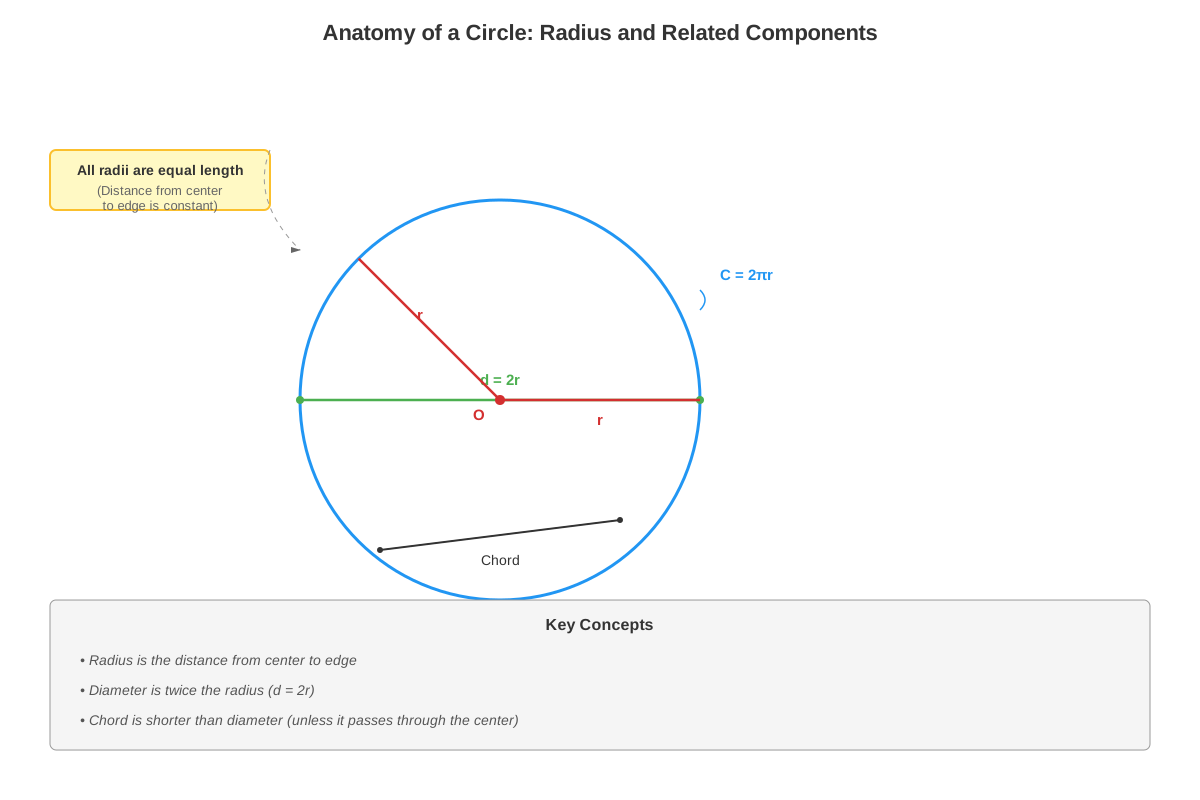
The radius of a circle is defined as the distance from the center point to any point on the circle's edge (circumference). This distance remains constant regardless of which point on the circle is selected, which is precisely what makes a circle a circle—all points are equidistant from the center. The radius is typically denoted by the lowercase letter "r" in mathematical formulas and diagrams.
Several key properties define the radius:
- Every circle has infinitely many radii, but all have the same length
- The radius is exactly half the length of the diameter (r = d/2)
- Two radii placed end-to-end form a diameter
- The radius is always perpendicular to the tangent line at the point where it meets the circle
- In coordinate geometry, the radius represents the constant distance in the circle equation
Relationship to Diameter
The diameter is the longest chord of a circle and passes through the center point. The fundamental relationship between radius and diameter is:
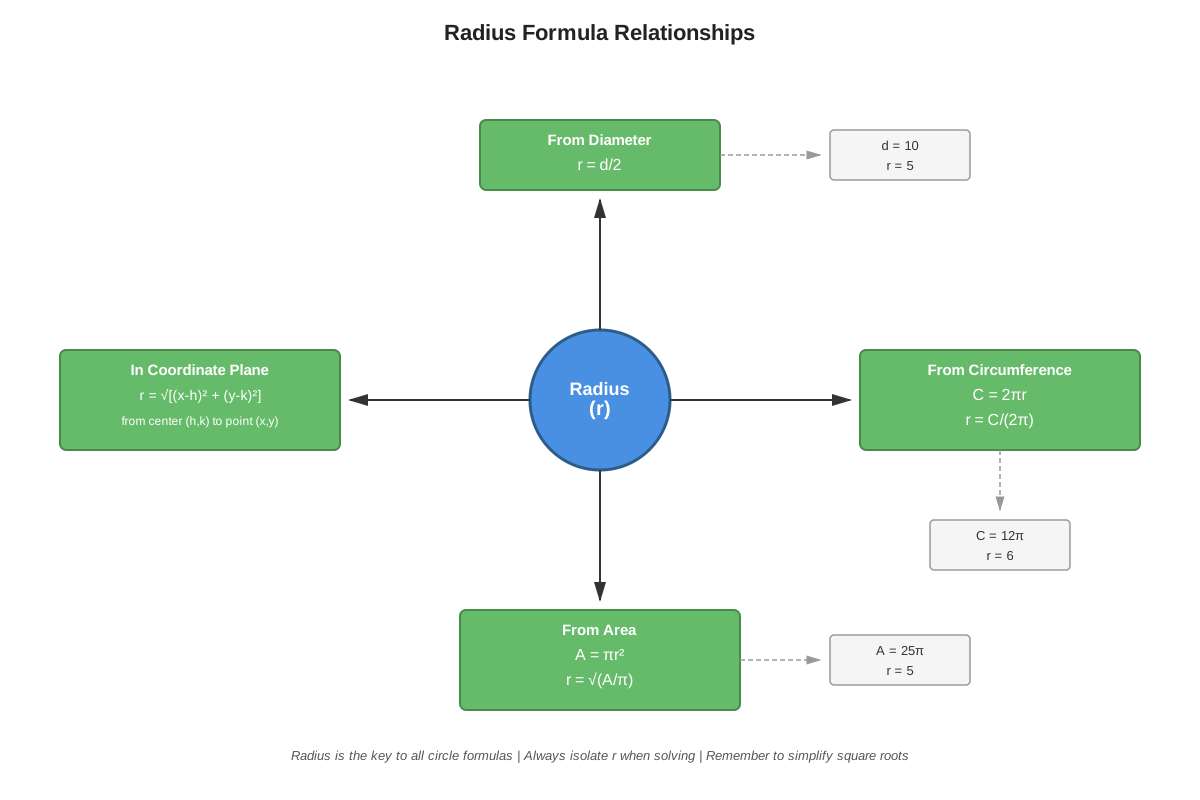
d = 2r or r = d/2This relationship appears frequently on the SAT, often in problems where students must convert between diameter and radius. Many students make errors by confusing these two measurements, so recognizing which measurement a problem provides is crucial. When a problem states "a circle with diameter 10," the radius is 5, not 10.
Radius in Circle Formulas
The radius serves as the key variable in the two most important circle formulas tested on the SAT:
Circumference Formula:
C = 2πrThis formula calculates the distance around the circle. Since the diameter d = 2r, this can also be written as C = πd. On the SAT, students must be comfortable rearranging this formula to solve for radius:
r = C/(2π)Area Formula:
A = πr²This formula calculates the space enclosed within the circle. Solving for radius requires taking a square root:
r = √(A/π)| Given Information | Formula to Find Radius | Example |
|---|---|---|
| Diameter = 12 | r = d/2 | r = 12/2 = 6 |
| Circumference = 20π | r = C/(2π) | r = 20π/(2π) = 10 |
| Area = 49π | r = √(A/π) | r = √(49π/π) = 7 |
Radius in Coordinate Geometry
When circles appear on the coordinate plane, the standard equation of a circle incorporates the radius:
(x - h)² + (y - k)² = r²In this equation:
- (h, k) represents the center coordinates
- r represents the radius
- r² appears on the right side of the equation
To find the radius from this equation, take the square root of the right side. For example, if the equation is (x - 3)² + (y + 2)² = 25, then r² = 25, so r = 5.
The radius can also be calculated using the distance formula when given the center point and any point on the circle:
r = √[(x₂ - x₁)² + (y₂ - y₁)²]Radius in Sectors and Arcs
A sector is a "slice" of a circle, like a piece of pie, bounded by two radii and an arc. The radius is essential for calculating both arc length and sector area:
Arc Length:
Arc Length = (θ/360°) × 2πr or (θ/2π) × 2πr (when θ is in radians)Sector Area:
Sector Area = (θ/360°) × πr²where θ represents the central angle in degrees.
Inscribed and Circumscribed Circles
The radius plays a crucial role when circles interact with polygons:
- Inscribed circle: A circle drawn inside a polygon, touching all sides. The radius connects the center to the point of tangency.
- Circumscribed circle: A circle drawn around a polygon, passing through all vertices. The radius connects the center to each vertex.
For a circle inscribed in a square with side length s, the radius equals s/2. For a circle circumscribed around a square with side length s, the radius equals s√2/2 (derived from the Pythagorean theorem applied to half the diagonal).
Concept Relationships
The radius serves as the central hub connecting all circle properties. Understanding these relationships creates a conceptual map that helps solve complex problems:
Radius → Diameter: The radius directly determines the diameter through the relationship d = 2r. This is the most fundamental connection and often serves as the first step in multi-step problems.
Radius → Circumference: The radius determines the distance around the circle through C = 2πr. This relationship works bidirectionally—knowing either the radius or circumference allows calculation of the other.
Radius → Area: The radius determines the enclosed space through A = πr². Because area involves r², small changes in radius create larger changes in area (quadratic relationship).
Radius → Chord relationships: Any chord (line segment connecting two points on a circle) relates to the radius through the perpendicular from the center. The radius, half the chord length, and this perpendicular distance form a right triangle, connecting radius to the Pythagorean theorem.
Radius → Coordinate geometry: In the equation (x - h)² + (y - k)² = r², the radius connects algebraic representation to geometric visualization, bridging coordinate geometry and circle properties.
Radius → Trigonometry: In unit circle applications (less common on SAT but occasionally appearing), the radius of 1 creates the foundation for sine and cosine definitions.
These interconnections mean that SAT problems rarely test radius in isolation. Instead, they require students to navigate through multiple relationships, using radius as the connecting thread. For example, a problem might provide area, require finding radius, then use that radius to calculate arc length—demonstrating the chain: Area → Radius → Arc Length.
Quick check — test yourself on Radius so far.
Try Flashcards →High-Yield Facts
⭐ The radius is exactly half the diameter: r = d/2, and this relationship is tested frequently in conversion problems
⭐ Area formula uses radius squared: A = πr², meaning doubling the radius quadruples the area
⭐ Circumference formula uses radius once: C = 2πr, meaning doubling the radius doubles the circumference
⭐ In the circle equation (x - h)² + (y - k)² = r², the right side equals r², not r
⭐ The radius is perpendicular to any tangent line at the point of tangency, creating right angles useful for problem-solving
- All radii in the same circle have equal length, making them useful for creating isosceles triangles
- The radius of a circle inscribed in a square equals half the square's side length
- When a circle is circumscribed around a square, the radius equals the square's diagonal divided by 2
- Arc length and sector area formulas both require the radius as a key component
- The distance formula calculates radius when given center coordinates and a point on the circle
- In problems involving circles and triangles, the radius often serves as a side length in right triangles
- The radius connects to the Pythagorean theorem in numerous SAT geometry problems
Common Misconceptions
Misconception: The radius and diameter are interchangeable terms.
Correction: The radius is exactly half the diameter. Using diameter when radius is needed (or vice versa) leads to answers that are off by a factor of 2 or 4 (in area calculations). Always identify which measurement the problem provides and convert if necessary.
Misconception: In the circle equation (x - h)² + (y - k)² = r², the number on the right side is the radius.
Correction: The right side equals r², not r. To find the actual radius, take the square root. For example, if the equation is (x - 2)² + (y + 1)² = 36, the radius is 6, not 36.
Misconception: Doubling the radius doubles the area.
Correction: Because area equals πr², doubling the radius actually quadruples the area. If r = 2, then A = 4π. If r = 4, then A = 16π (four times larger, not two times). This quadratic relationship is frequently tested.
Misconception: The radius must always be a whole number.
Correction: The radius can be any positive real number, including fractions, decimals, and irrational numbers. Many SAT problems result in radii like 5√2 or 3.5, and these are perfectly valid answers.
Misconception: All circles in a problem have the same radius.
Correction: Unless explicitly stated, different circles in a problem can have different radii. Always track which radius belongs to which circle, especially in problems involving multiple circles or concentric circles.
Misconception: The radius is the longest line segment in a circle.
Correction: The diameter is the longest line segment in a circle. The radius is half this length. This confusion often leads to errors in problems asking for maximum distances.
Worked Examples
Example 1: Multi-Step Area and Circumference Problem
Problem: A circular garden has an area of 144π square feet. A fence will be built around the garden's perimeter. How many feet of fencing are needed?
Solution:
Step 1: Identify what's given and what's needed.
- Given: Area = 144π square feet
- Need: Circumference (perimeter)
Step 2: Find the radius using the area formula.
A = πr²
144π = πr²
Step 3: Divide both sides by π.
144 = r²Step 4: Take the square root of both sides.
r = 12 feetStep 5: Use the radius to find circumference.
C = 2πr
C = 2π(12)
C = 24π feetAnswer: 24π feet (or approximately 75.4 feet if a decimal answer is required)
Connection to Learning Objectives: This problem demonstrates applying radius to answer SAT-style questions by requiring students to work backward from area to radius, then forward to circumference—a common SAT problem structure.
Example 2: Coordinate Geometry with Circles
Problem: A circle in the xy-plane has the equation (x + 3)² + (y - 5)² = 49. Point P lies on this circle, and the x-coordinate of P is -3. What are the possible y-coordinates of point P?
Solution:
Step 1: Identify the radius from the equation.
(x + 3)² + (y - 5)² = 49Since the right side equals r², we have r² = 49, so r = 7.
Step 2: Identify the center coordinates.
The equation form is (x - h)² + (y - k)² = r², so:
- h = -3 (note the sign change)
- k = 5
- Center: (-3, 5)
Step 3: Substitute the given x-coordinate into the equation.
(-3 + 3)² + (y - 5)² = 49
0 + (y - 5)² = 49
(y - 5)² = 49
Step 4: Solve for y.
y - 5 = ±7
y = 5 + 7 = 12 or y = 5 - 7 = -2Answer: The possible y-coordinates are 12 and -2.
Connection to Learning Objectives: This problem shows how radius appears in coordinate geometry on the SAT and requires identifying key features of radius within the circle equation, then applying that knowledge to find specific points.
Exam Strategy
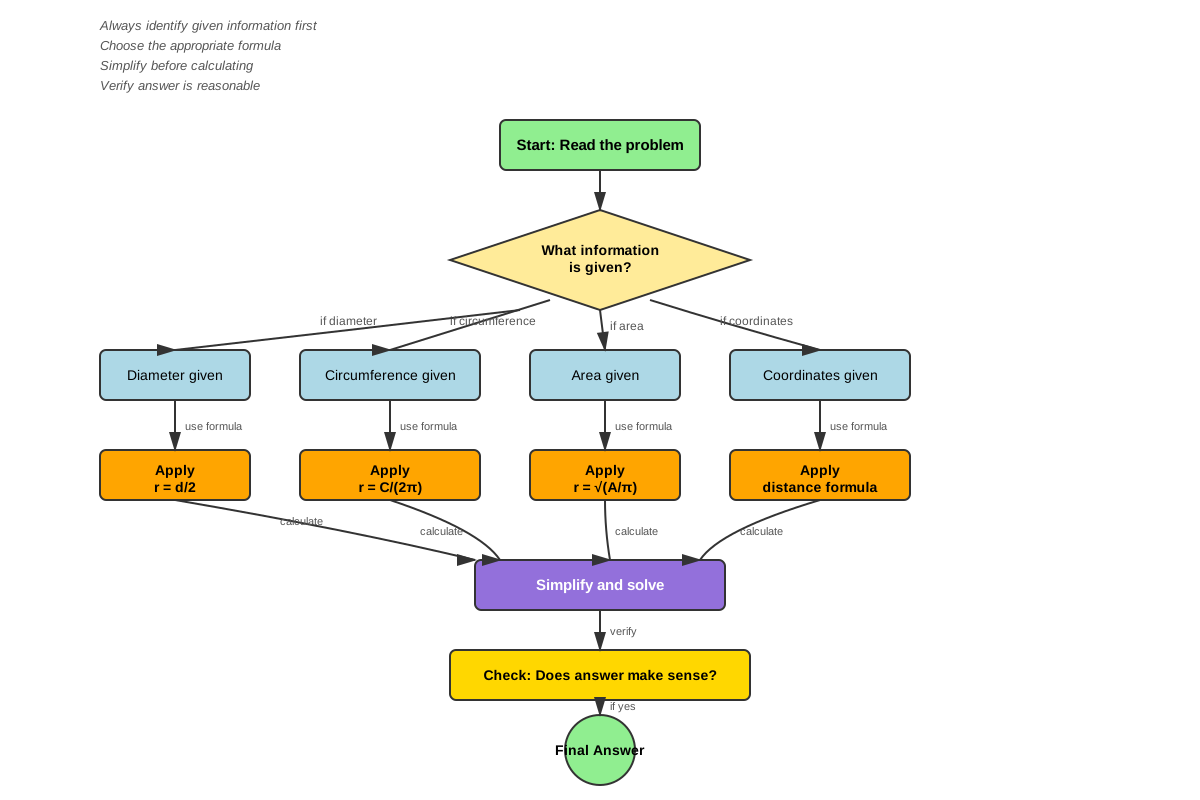
When approaching radius problems on the SAT, follow this systematic process:
Step 1: Identify what information is provided
- Is the problem giving you diameter, circumference, area, or coordinates?
- Are there multiple circles involved?
- Is the radius explicitly stated or must it be calculated?
Step 2: Determine what the question asks for
- Does it want the radius itself, or another property that requires radius as an intermediate step?
- Are units specified, and do they need conversion?
Step 3: Select the appropriate formula
- Area problems: A = πr²
- Circumference problems: C = 2πr
- Coordinate problems: (x - h)² + (y - k)² = r²
- Distance problems: r = √[(x₂ - x₁)² + (y₂ - y₁)²]
Exam Tip: Write down the formula before substituting numbers. This prevents errors and helps you track your work if you need to check your answer.
Trigger words and phrases to watch for:
- "Distance from the center" → directly refers to radius
- "Diameter" → convert to radius immediately (divide by 2)
- "Around the circle" or "perimeter" → circumference problem
- "Inside the circle" or "enclosed" → area problem
- "Equation of the circle" → coordinate geometry, look for r²
Process-of-elimination strategies:
- If answer choices differ by factors of 2, check whether you confused radius and diameter
- If answer choices differ by factors of π, verify whether the question asks for an exact answer or approximation
- If answer choices include both positive and negative values, consider whether the problem involves coordinates (where both might be valid)
- Eliminate answers that would make the radius negative or zero (unless the problem explicitly involves a degenerate case)
Time allocation advice:
- Simple radius calculation problems: 30-45 seconds
- Multi-step problems involving radius: 1-2 minutes
- Complex coordinate geometry with circles: 2-3 minutes
Exam Tip: If a problem seems to require extensive calculation, look for a shortcut. SAT problems often have elegant solutions that avoid messy arithmetic.
Memory Techniques
Mnemonic for circle formulas: "Circumference is 2 Cute Pies Rolling" → C = 2πr (where "pies" reminds you of π)
Mnemonic for area formula: "A Pie is Really Round" → A = πr² (emphasizing the r²)
Visualization strategy for radius vs. diameter: Picture a pizza. The radius is from the center to the edge (where you'd hold a slice). The diameter is the full width across (if you cut straight through the middle). You can't eat a diameter—you eat along the radius!
Acronym for circle equation components: CHR = Center (h, k), Radius squared
- In (x - h)² + (y - k)² = r², remember CHR to recall what each part represents
Memory technique for area vs. circumference growth:
- Circumference is linear (one r) → grows proportionally
- Area is squared (r²) → grows exponentially
- Think: "Line around = Linear, Space inside = Squared"
Visualization for inscribed circles: Picture a circle inside a square like a wheel in a box—it touches all four sides at the middle of each side. The radius goes from the center to these touch points, making it half the square's side.
Summary
The radius is the foundational measurement of any circle, defined as the constant distance from the center to any point on the circumference. Mastery of radius concepts is essential for SAT success because it connects to virtually every circle-related problem, from basic circumference and area calculations to complex coordinate geometry and multi-step reasoning questions. The key relationships to remember are: radius equals half the diameter (r = d/2), circumference equals 2πr, and area equals πr². In coordinate geometry, the radius appears as r² in the standard circle equation (x - h)² + (y - k)² = r². Understanding that area grows with the square of the radius while circumference grows linearly is crucial for avoiding common errors. SAT problems frequently require working backward from given information to find the radius, then using that radius to calculate another property, making flexibility with formula manipulation essential. The radius also connects circles to other geometric figures through inscribed and circumscribed relationships, and it creates right triangles when combined with chords and tangent lines, linking circle geometry to the Pythagorean theorem.
Key Takeaways
- The radius is half the diameter and serves as the key variable in all major circle formulas
- Area formula (A = πr²) involves radius squared, meaning doubling radius quadruples area
- Circumference formula (C = 2πr) involves radius once, meaning doubling radius doubles circumference
- In the circle equation (x - h)² + (y - k)² = r², the right side is r², not r—always take the square root to find actual radius
- SAT problems frequently require finding radius as an intermediate step before calculating the final answer
- The radius creates right angles with tangent lines and forms the basis for connecting circles with polygons
- Converting between diameter and radius is one of the most common operations in SAT circle problems
Related Topics
Diameter and Chords: Understanding how the radius relates to other line segments within circles, including the longest chord (diameter) and perpendicular relationships with other chords. Mastering radius provides the foundation for these more complex chord relationships.
Circle Area and Circumference: Deep exploration of the formulas A = πr² and C = 2πr, including applications to real-world problems and combined geometry scenarios. Radius mastery is prerequisite to these calculations.
Sectors and Arc Length: Calculating portions of circles using central angles, where both arc length and sector area formulas require the radius. This topic extends radius knowledge to partial circles.
Coordinate Geometry of Circles: Advanced work with the equation (x - h)² + (y - k)² = r², including completing the square to convert general form to standard form. Radius understanding enables success with these algebraic manipulations.
Inscribed and Circumscribed Figures: Exploring relationships between circles and polygons, including inscribed angles and the properties of tangent lines. The radius serves as the connecting measurement in these complex geometric relationships.
Practice CTA
Now that you've mastered the fundamental concepts of radius and its applications on the SAT, it's time to solidify your understanding through active practice. Work through the practice questions to test your ability to identify, calculate, and apply radius in various contexts. Use the flashcards to reinforce key formulas and relationships until they become automatic. Remember, the difference between knowing these concepts and scoring points on test day lies in repeated, focused practice. Each problem you solve strengthens your pattern recognition and builds the confidence you need to tackle any radius question the SAT presents. You've built the foundation—now construct your success through deliberate practice!
Sign up free to keep reading
Create a free AnvayaPrep account to finish this SAT guide on Radius — plus flashcards and practice questions.