Overview
The diameter is one of the most fundamental and frequently tested concepts in circle geometry on the SAT. As the longest chord that passes through the center of a circle, the diameter serves as a critical measurement that connects to virtually every other circle property tested on the exam. Understanding diameter relationships is essential not only for direct calculation questions but also for solving complex problems involving area, circumference, inscribed angles, and coordinate geometry.
On the SAT math section, diameter questions appear in multiple contexts: pure geometry problems, word problems involving circular objects, coordinate plane scenarios where circles are graphed, and multi-step problems that require connecting diameter to radius, area, or arc length. The College Board consistently includes 2-4 questions per test that either directly ask about diameter or require diameter knowledge as an intermediate step. These questions typically appear in both the calculator and no-calculator sections, with difficulty ranging from straightforward identification to complex application problems worth critical points.
Mastering diameter concepts provides the foundation for understanding all circle-related topics on the SAT. The diameter's relationship to radius (d = 2r) serves as the gateway to formulas for circumference (C = πd) and area (A = πr²). Additionally, diameter creates special angle relationships—most notably, any angle inscribed in a semicircle equals 90 degrees—that frequently appear in high-value geometry questions. Students who thoroughly understand diameter properties gain significant advantages in both speed and accuracy across the entire circles unit.
Learning Objectives
- [ ] Identify key features of diameter including its definition, properties, and relationship to other circle components
- [ ] Explain how diameter appears on the SAT in various question formats and contexts
- [ ] Apply diameter to answer SAT-style questions involving calculations, coordinate geometry, and word problems
- [ ] Calculate diameter when given radius, circumference, or area, and vice versa
- [ ] Recognize and apply the inscribed angle theorem related to diameter (semicircle angles)
- [ ] Solve multi-step problems that require diameter as an intermediate calculation
- [ ] Identify diameter in coordinate plane representations of circles
Prerequisites
- Basic circle vocabulary (center, radius, chord): Understanding these terms is essential because diameter is defined in relation to them—it is a chord that passes through the center and equals twice the radius
- Algebraic manipulation skills: Solving for diameter often requires rearranging formulas like C = πd or working with equations involving multiple variables
- Coordinate plane fundamentals: Many SAT diameter questions involve circles graphed on coordinate planes, requiring distance formula knowledge
- Basic properties of right triangles: Diameter-related problems frequently create right triangles, especially when applying the inscribed angle theorem
Why This Topic Matters
In real-world applications, diameter measurements are ubiquitous in engineering, architecture, manufacturing, and everyday problem-solving. When purchasing circular items like pizzas, pipes, or wheels, diameter is the standard measurement used. Engineers use diameter specifications for designing everything from water mains to telescope lenses. Urban planners calculate diameters when designing roundabouts and circular parks. Understanding diameter relationships enables practical calculations involving any circular object, from determining how much fencing surrounds a circular garden to calculating the size of a circular table that fits a room.
On the SAT, diameter-related questions appear with remarkable consistency. Statistical analysis of released SAT exams shows that approximately 15-20% of geometry questions involve circles, and roughly half of these directly test diameter knowledge or require diameter as a calculation step. These questions typically appear as:
- Direct calculation problems: "If a circle has a circumference of 18π, what is its diameter?"
- Word problems: "A circular track has a diameter of 200 meters. How far does a runner travel completing one lap?"
- Coordinate geometry: "What is the diameter of a circle with center (3, 4) that passes through point (7, 7)?"
- Multi-step problems: Questions requiring students to find diameter first, then use it to calculate area or other properties
- Inscribed angle problems: Scenarios involving triangles inscribed in circles where diameter creates right angles
The topic appears across difficulty levels, making it essential for students targeting any score range. Basic diameter questions may simply test formula knowledge, while advanced questions combine diameter with other geometric concepts, algebraic reasoning, or require recognizing subtle relationships.
Core Concepts
Definition and Basic Properties
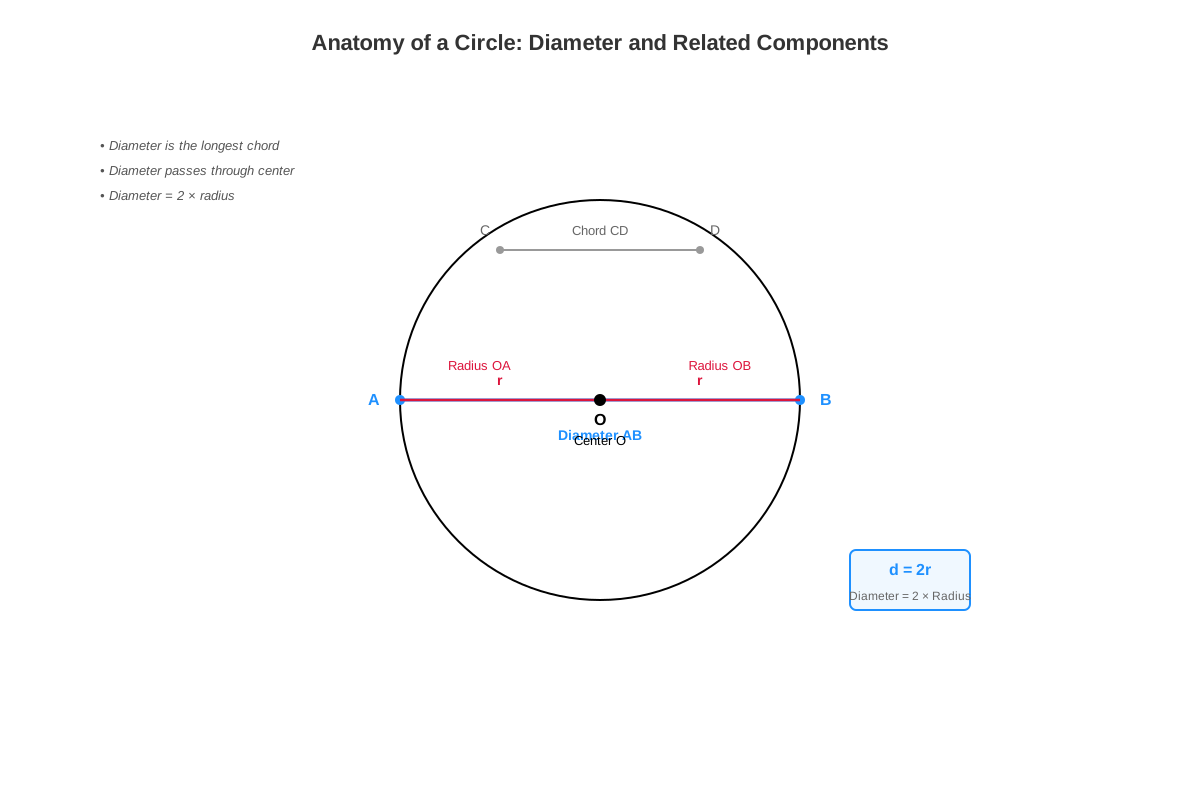
The diameter of a circle is defined as any line segment that passes through the center of the circle and has both endpoints on the circle itself. More specifically, it is the longest possible chord (a line segment connecting two points on a circle) and represents the maximum distance between any two points on the circle.
Key properties of diameter include:
- Every diameter divides the circle into two equal semicircles
- All diameters of the same circle have equal length
- The diameter is exactly twice the length of the radius: d = 2r
- The diameter passes through the center point of the circle
- A circle has infinitely many diameters, all intersecting at the center
Relationship to Radius
The most fundamental relationship in circle geometry connects diameter and radius. Since the radius extends from the center to any point on the circle, and the diameter extends from one side of the circle through the center to the opposite side, the diameter equals two radii placed end-to-end.
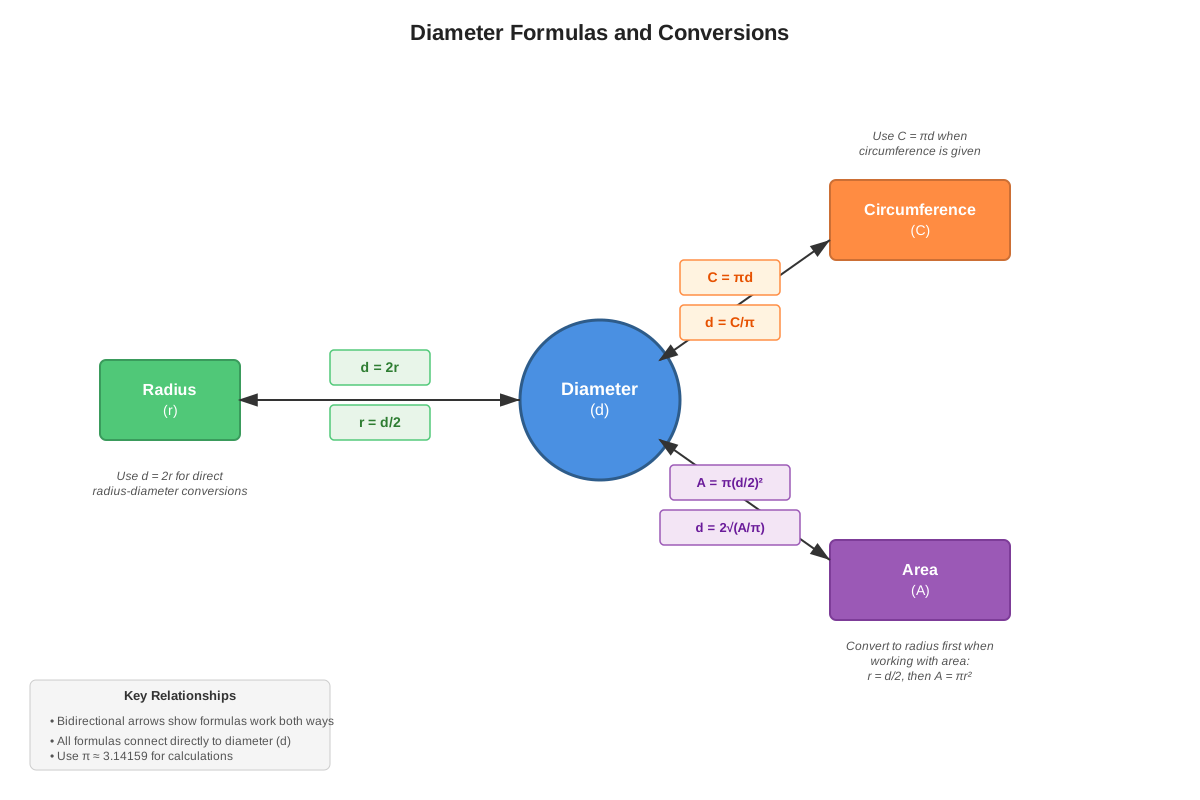
Formula: d = 2r or equivalently r = d/2
This relationship appears constantly on the SAT because many formulas are expressed in terms of radius (like area), while problems often provide diameter information. Students must fluidly convert between these measurements.
Diameter and Circumference
The circumference (perimeter) of a circle relates directly to diameter through one of geometry's most elegant formulas:
C = πd
This can also be written as C = 2πr, but the diameter form is often more direct when diameter is given. This relationship means:
- If you know the diameter, multiply by π to find circumference
- If you know the circumference, divide by π to find diameter
- The ratio of circumference to diameter is always π (approximately 3.14159...)
On the SAT, circumference problems frequently require working backward from circumference to diameter, then using diameter to find other properties.
Diameter and Area
While area formulas are typically expressed using radius (A = πr²), diameter plays a crucial role since radius must often be calculated from diameter first:
A = πr² = π(d/2)² = πd²/4
The SAT frequently tests whether students can:
- Convert diameter to radius
- Apply the area formula correctly
- Work backward from area to find diameter
Diameter in Coordinate Geometry
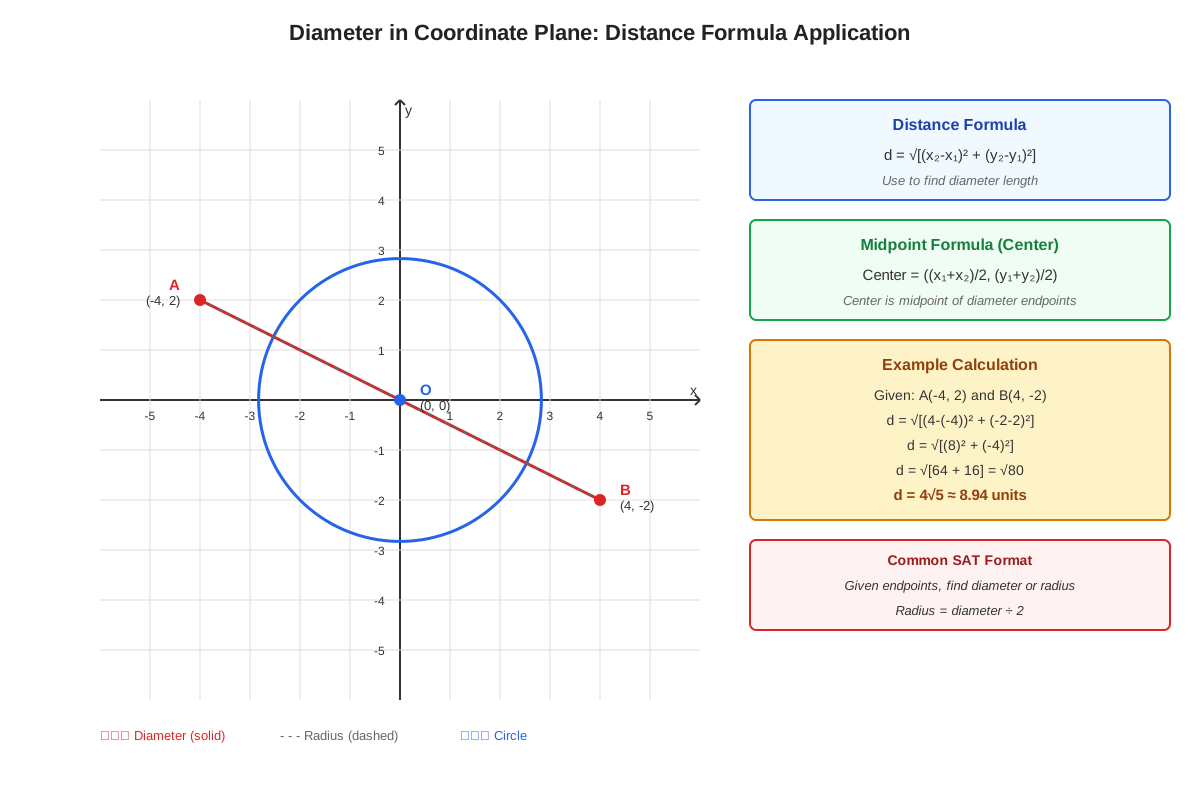
When circles appear on the coordinate plane, the diameter can be calculated using the distance formula. If a circle has center (h, k) and a point (x, y) on the circle, the radius equals the distance from center to that point, and diameter equals twice that distance.
For a circle with endpoints of a diameter at (x₁, y₁) and (x₂, y₂):
d = √[(x₂ - x₁)² + (y₂ - y₁)²]
The center of the circle lies at the midpoint of any diameter: ((x₁ + x₂)/2, (y₁ + y₂)/2)
The Inscribed Angle Theorem (Thales' Theorem)
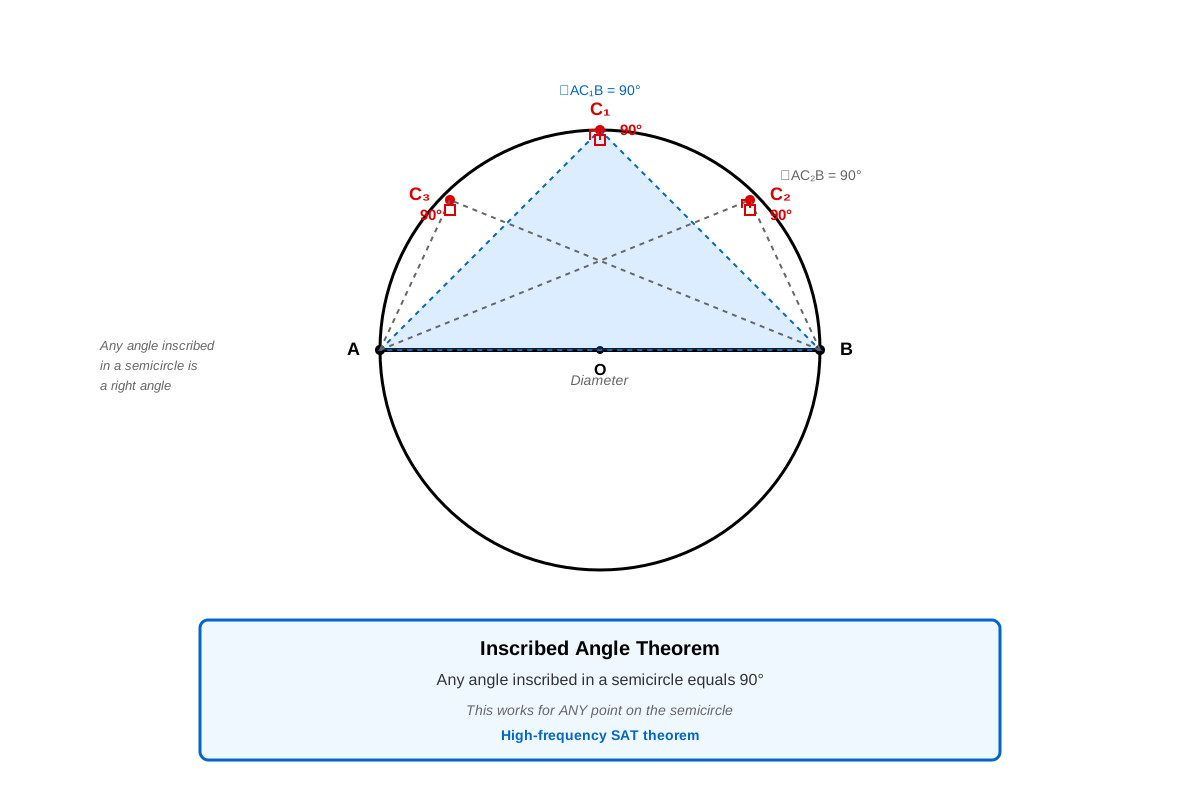
One of the most powerful and frequently tested properties involving diameter is the inscribed angle theorem: Any angle inscribed in a semicircle (with the diameter as one side) is a right angle (90°).
This means if you draw a diameter and then connect its endpoints to any other point on the circle, you create a right triangle. This property appears in numerous SAT problems, often disguised within more complex scenarios. Recognizing this relationship can immediately unlock solutions to problems that otherwise seem intractable.
Diameter as the Longest Chord
Among all possible chords in a circle, the diameter is unique as the longest. Any chord that doesn't pass through the center will be shorter than the diameter. This property occasionally appears in optimization problems or in questions asking students to compare lengths.
Concept Relationships
The diameter serves as the central hub connecting virtually all circle concepts. Understanding these relationships is crucial for SAT success:
Diameter → Radius: The most direct relationship (d = 2r) serves as the foundation for all other calculations. Nearly every circle problem requires converting between these measurements.
Diameter → Circumference: Through the formula C = πd, diameter directly determines the perimeter of the circle. This relationship works bidirectionally—knowing either measurement allows immediate calculation of the other.
Diameter → Area: While area formulas use radius, diameter connects through the relationship A = π(d/2)². Many SAT problems provide diameter information but require area calculations, making this conversion essential.
Diameter → Inscribed Angles: The inscribed angle theorem creates a bridge between diameter and triangle geometry. When diameter appears in a problem with triangles, checking for right angles often reveals the solution path.
Diameter → Coordinate Geometry: In the coordinate plane, diameter connects to the distance formula and midpoint formula, linking circle geometry to algebraic concepts.
Diameter → Chords and Arcs: Understanding that diameter is the longest chord and that it creates two semicircular arcs helps solve comparison and optimization problems.
The progression of problem-solving typically follows: Given Information → Diameter Calculation → Radius Determination → Application of Area/Circumference Formulas → Final Answer. Recognizing this pattern accelerates problem-solving significantly.
High-Yield Facts
⭐ The diameter equals exactly twice the radius: d = 2r (this is the single most-used relationship in circle problems)
⭐ Circumference equals π times diameter: C = πd (memorize this formula in both directions)
⭐ Any angle inscribed in a semicircle equals 90°: This is Thales' theorem and appears frequently in complex geometry problems
⭐ The diameter is the longest possible chord in a circle: No other line segment connecting two points on the circle can be longer
⭐ All diameters of the same circle have equal length: This seems obvious but is crucial for solving problems with multiple diameters
- The diameter passes through the center point of the circle by definition
- The center of a circle is the midpoint of any diameter
- A diameter divides a circle into two congruent semicircles
- In coordinate geometry, if you know the endpoints of a diameter, you can find the center using the midpoint formula
- The area formula can be rewritten using diameter: A = πd²/4
- When a circle is inscribed in a square, the diameter equals the side length of the square
- When a circle is circumscribed around a square, the diameter equals the diagonal of the square
- The diameter is perpendicular to a tangent line at the point where the diameter intersects the circle
- If two circles have diameters in ratio a:b, their areas are in ratio a²:b²
- On the SAT, diameter problems often require multiple steps: finding diameter, then using it to calculate another property
Quick check — test yourself on Diameter so far.
Try Flashcards →Common Misconceptions
Misconception: The diameter is the same as the radius.
Correction: The diameter is exactly twice the radius. This confusion stems from mixing up the definitions. Remember: radius goes from center to edge (one "arm"), while diameter goes from edge through center to opposite edge (two "arms").
Misconception: The formula for circumference is C = 2πd.
Correction: The correct formula is C = πd (or equivalently C = 2πr). The factor of 2 appears when using radius, not diameter. Mixing these formulas is one of the most common errors on SAT circle problems.
Misconception: Any chord that looks long is a diameter.
Correction: A diameter must pass through the center of the circle. A chord can be very long but still not be a diameter if it doesn't pass through the center. On the SAT, diagrams aren't always to scale, so don't rely on visual estimation.
Misconception: The inscribed angle theorem applies to any angle in a circle.
Correction: The 90° inscribed angle property specifically applies only when the angle is inscribed in a semicircle (meaning the two rays forming the angle connect to the endpoints of a diameter). Other inscribed angles follow different rules.
Misconception: When given area, you can directly calculate diameter using A = πd.
Correction: The area formula uses radius: A = πr². To find diameter from area, you must first solve for radius (r = √(A/π)), then double it to get diameter (d = 2r). Skipping the radius step leads to incorrect answers.
Misconception: In coordinate geometry, the diameter equals the x-coordinate difference or y-coordinate difference between two points.
Correction: The diameter equals the actual distance between two points on opposite sides of the circle, calculated using the distance formula: d = √[(x₂-x₁)² + (y₂-y₁)²]. You must account for both horizontal and vertical distances.
Misconception: A circle's diameter changes depending on which diameter you measure.
Correction: All diameters of the same circle have identical length. While there are infinitely many diameters (you can draw one through the center at any angle), they all measure the same distance.
Worked Examples
Example 1: Multi-Step Circumference to Area Problem
Problem: A circular garden has a circumference of 36π feet. What is the area of the garden in square feet?
Solution:
Step 1: Identify what's given and what's needed.
- Given: Circumference C = 36π feet
- Need: Area A = ?
Step 2: Find the diameter using the circumference formula.
- Formula: C = πd
- Substitute: 36π = πd
- Divide both sides by π: 36 = d
- The diameter is 36 feet
Step 3: Convert diameter to radius.
- Formula: r = d/2
- Substitute: r = 36/2 = 18 feet
Step 4: Calculate area using the radius.
- Formula: A = πr²
- Substitute: A = π(18)²
- Calculate: A = π(324) = 324π square feet
Answer: 324π square feet (or approximately 1,017.88 square feet)
Connection to Learning Objectives: This problem demonstrates the essential skill of using diameter as an intermediate step. The SAT frequently requires this type of multi-step reasoning where diameter serves as the bridge between circumference and area.
Example 2: Coordinate Geometry with Inscribed Angle
Problem: In the coordinate plane, a circle has a diameter with endpoints at A(2, 3) and B(10, 9). Point C lies on the circle at coordinates (10, 3). What is the measure of angle ACB?
Solution:
Step 1: Recognize the geometric setup.
- Points A and B are endpoints of a diameter
- Point C is on the circle
- We need to find the angle at C formed by connecting to both diameter endpoints
Step 2: Apply the inscribed angle theorem.
- Any angle inscribed in a semicircle (with vertices at the diameter endpoints and any other point on the circle) equals 90°
- Since AB is a diameter and C is on the circle, angle ACB must be 90°
Step 3: Verify if needed (optional but good practice).
- We could verify by calculating distances:
- AC = √[(10-2)² + (3-3)²] = √[64 + 0] = 8
- BC = √[(10-10)² + (9-3)²] = √[0 + 36] = 6
- AB = √[(10-2)² + (9-3)²] = √[64 + 36] = √100 = 10
- Check Pythagorean theorem: 8² + 6² = 64 + 36 = 100 = 10² ✓
- This confirms a right triangle, so angle ACB = 90°
Answer: 90°
Connection to Learning Objectives: This problem illustrates how diameter knowledge intersects with coordinate geometry and the inscribed angle theorem. Recognizing that a diameter creates right angles at any other point on the circle is a high-yield SAT skill that can save significant time.
Exam Strategy
When approaching SAT diameter questions, follow this systematic strategy:
1. Identify what's given and what's needed: Circle problems often provide information in one form (like circumference) but ask for another (like area). Diameter frequently serves as the connecting link.
2. Watch for trigger words and phrases:
- "Distance across" or "width" of a circle → diameter
- "From the center to the edge" → radius (convert to diameter if needed)
- "Around the circle" or "perimeter" → circumference (use to find diameter)
- "Inscribed in a semicircle" → expect a 90° angle
- "Passes through the center" → diameter by definition
3. Draw and label diagrams: Even when the SAT provides a figure, redraw it with all given information labeled. Mark the center, label the diameter, and note any calculated values. This visual reference prevents errors.
4. Use the d = 2r relationship immediately: As soon as you identify either diameter or radius, immediately calculate the other and write both values on your diagram. This preparation often reveals the solution path.
5. Check units carefully: SAT problems sometimes give diameter in one unit (like inches) but ask for area in another (like square feet). Convert before calculating.
6. Process of elimination tips:
- If answer choices differ by factors of 2, you likely confused radius and diameter
- If choices differ by factors of π, check whether you included or omitted π correctly
- If choices differ by factors of 4, you may have confused area formulas (πr² vs πd²/4)
7. Time allocation: Basic diameter problems should take 30-60 seconds. Multi-step problems involving diameter may require 90-120 seconds. If you're spending more than 2 minutes, mark the question and return to it later.
8. Look for the inscribed angle shortcut: In problems with triangles and circles, always check if a diameter is present. If so, look for the 90° angle—this often eliminates the need for complex calculations.
Memory Techniques
"Diameter = Double": Both words start with 'D' and diameter equals double the radius. This simple alliteration helps prevent the most common error.
"C-D-R Chain": Remember the formula chain: Circumference = π × Diameter = 2π × Radius. Visualize these three concepts linked together, with diameter in the middle connecting the other two.
"Thales' Right Angle": Create a mental image of a semicircle with a triangle inside it. The triangle's base is the diameter, and the opposite vertex touches the circle, forming a right angle. Visualize this as a "tent" pitched on the diameter—the tent pole is always perpendicular (90°).
"DRAC" for problem-solving: Diameter → Radius → Area → Circumference. This acronym reminds you of the typical calculation sequence in multi-step problems.
Finger trick for formulas: Hold up your index finger (one finger) for diameter formulas (C = πd, one variable). Hold up two fingers for radius formulas (C = 2πr, A = πr², two variables or squared). This physical reminder helps distinguish which formula to use.
"Center-Cut": Remember that diameter "cuts" through the center. Any chord that doesn't cut through the center isn't a diameter, no matter how long it looks.
Summary
The diameter represents the fundamental measurement of a circle, defined as any line segment passing through the center with endpoints on the circle. Mastering diameter requires understanding its relationship to radius (d = 2r), its role in circumference calculations (C = πd), and its connection to area through the radius conversion. On the SAT, diameter appears in direct calculation problems, multi-step word problems, coordinate geometry scenarios, and inscribed angle questions. The inscribed angle theorem—stating that any angle inscribed in a semicircle equals 90°—is particularly high-yield and frequently tested. Success with diameter problems requires fluid conversion between diameter and radius, recognition of when diameter serves as an intermediate calculation step, and awareness of the special properties diameter creates in geometric figures. Students must memorize core formulas, practice identifying diameter in various contexts, and develop the ability to work both forward (from diameter to other properties) and backward (from circumference or area to diameter). The diameter concept connects to virtually every other circle topic, making it essential foundational knowledge for the entire circles unit on the SAT.
Key Takeaways
- The diameter equals exactly twice the radius (d = 2r), and this relationship is used in nearly every circle problem on the SAT
- Circumference relates directly to diameter through C = πd, making diameter the bridge between given information and required calculations
- Any angle inscribed in a semicircle (with the angle's rays connecting to diameter endpoints) equals 90°—this is one of the most powerful and frequently tested properties
- Diameter is the longest possible chord in a circle and always passes through the center point
- Multi-step SAT problems often require finding diameter first, then using it to calculate radius, area, or other properties
- In coordinate geometry, diameter can be calculated using the distance formula between two points on opposite sides of the circle
- Watch for problems that give information in terms of circumference or area but require diameter as an intermediate calculation step
Related Topics
Radius and Circle Equations: Understanding diameter provides the foundation for working with the standard form of circle equations (x-h)² + (y-k)² = r², where diameter equals 2r. Mastering diameter enables quick transitions to more complex circle equation problems.
Arc Length and Sectors: Diameter knowledge extends naturally to arc length calculations and sector areas, which use similar formulas but apply them to portions of circles rather than complete circles.
Inscribed and Central Angles: The inscribed angle theorem involving diameter is just one case of broader angle relationships in circles. Understanding diameter-based angles prepares students for more complex inscribed and central angle problems.
Tangent Lines: Diameter properties connect to tangent line problems, particularly the principle that a radius (half a diameter) drawn to a point of tangency is perpendicular to the tangent line.
Three-Dimensional Geometry: Diameter concepts extend to spheres, cylinders, and cones, where understanding circular cross-sections and their diameters becomes essential for volume and surface area calculations.
Practice CTA
Now that you've mastered the core concepts of diameter, it's time to solidify your understanding through active practice. Complete the practice questions to test your ability to identify diameter properties, convert between diameter and other measurements, and apply the inscribed angle theorem. Use the flashcards to reinforce the key formulas and relationships until they become automatic. Remember: diameter questions are among the most predictable on the SAT—consistent practice with these concepts translates directly into points on test day. Every problem you solve strengthens your pattern recognition and builds the confidence you need to tackle even the most complex circle questions efficiently. Start practicing now to transform this knowledge into test-day success!
Sign up free to keep reading
Create a free AnvayaPrep account to finish this SAT guide on Diameter — plus flashcards and practice questions.