Overview
Random sampling is a fundamental statistical concept that appears regularly on the SAT math section, particularly within questions involving data analysis, surveys, and experimental design. Understanding random sampling is crucial for interpreting study results, evaluating the validity of conclusions drawn from data, and recognizing when generalizations about populations are appropriate. On the SAT, questions about random sampling typically assess whether students can identify proper sampling methods, recognize bias in data collection, and determine when sample results can be extended to larger populations.
The concept of random sampling bridges multiple mathematical domains tested on the SAT, including probability, statistics, and logical reasoning. Students must understand not only the mechanical definition of random sampling but also its practical implications for data validity and statistical inference. Questions may present scenarios involving surveys, experiments, or observational studies, requiring students to evaluate whether the sampling method used allows for valid conclusions about the population of interest.
Mastery of random sampling connects directly to broader SAT math topics such as data interpretation, experimental design, and statistical reasoning. This topic frequently appears in Problem Solving and Data Analysis questions, which constitute approximately 15% of the SAT math section. Students who thoroughly understand random sampling principles gain a significant advantage in answering questions about margin of error, confidence in results, and the appropriateness of generalizing findings from samples to populations.
Learning Objectives
- [ ] Identify key features of random sampling and distinguish it from other sampling methods
- [ ] Explain how random sampling appears on the SAT in various question formats
- [ ] Apply random sampling concepts to answer SAT-style questions accurately
- [ ] Evaluate whether a given sampling method produces a representative sample
- [ ] Determine when conclusions from a sample can be generalized to a population
- [ ] Recognize sources of bias in sampling procedures and their effects on validity
- [ ] Analyze the relationship between sample size, randomness, and reliability of results
Prerequisites
- Basic probability concepts: Understanding that random selection means each member has an equal chance of being chosen is foundational to grasping random sampling principles
- Population vs. sample distinction: Recognizing the difference between an entire group (population) and a subset (sample) is essential for understanding why sampling methods matter
- Percentages and proportions: Converting between different representations of data helps interpret sampling results and make predictions about populations
- Basic statistical terminology: Familiarity with terms like mean, median, and data distribution aids in understanding how samples represent populations
Why This Topic Matters
Random sampling serves as the cornerstone of valid statistical inference in virtually every field that relies on data collection. In medicine, researchers use random sampling to test drug effectiveness; in politics, pollsters employ it to predict election outcomes; in business, companies utilize it to understand consumer preferences. The ability to distinguish between properly randomized samples and biased samples is a critical thinking skill that extends far beyond standardized testing into informed citizenship and professional decision-making.
On the SAT, random sampling appears in approximately 2-4 questions per test, making it a high-yield topic for focused study. These questions typically appear in the Problem Solving and Data Analysis domain and may be presented as multiple-choice or student-produced response questions. The College Board emphasizes random sampling because it assesses students' ability to think critically about data validity—a skill increasingly important in our data-driven world.
Common SAT question formats include: (1) identifying whether a sampling method is random, (2) determining whether conclusions can be generalized from a sample to a population, (3) recognizing sources of bias in sampling procedures, (4) comparing different sampling methods for appropriateness, and (5) evaluating claims made based on sample data. Questions often present real-world scenarios involving surveys, experiments, or observational studies, requiring students to apply conceptual understanding rather than merely recall definitions.
Core Concepts
Definition of Random Sampling
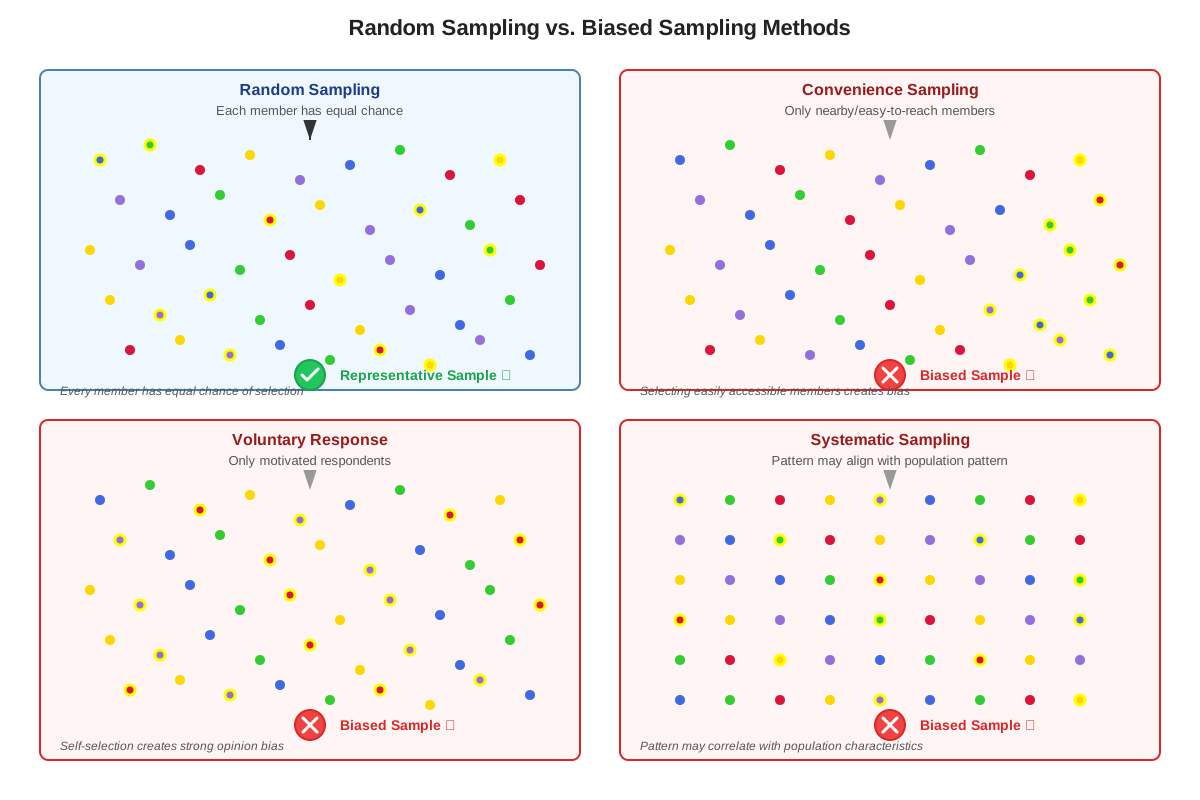
Random sampling is a data collection method in which every member of a population has an equal and independent chance of being selected for the sample. This equality of selection probability is what distinguishes truly random samples from convenience samples, voluntary response samples, or other non-random methods. The independence requirement means that selecting one individual does not affect the probability of selecting any other individual.
A simple random sample represents the most basic form of random sampling, where each possible sample of size n from a population of size N has an equal probability of being selected. For example, if a researcher wants to survey 50 students from a school of 500, a simple random sample would give every possible group of 50 students the same chance of being chosen.
Key Characteristics of Random Sampling
Random sampling possesses several critical features that make it the gold standard for statistical inference:
- Equal probability: Every member of the population has the same likelihood of selection
- Independence: Selection of one member doesn't influence selection of others
- Representativeness: Random samples tend to reflect population characteristics proportionally
- Unbiased: No systematic favoritism toward particular population subgroups
- Generalizable: Results from random samples can be extended to the entire population with known confidence levels
Methods of Achieving Random Sampling
Several practical techniques ensure randomness in sample selection:
- Random number generators: Assigning each population member a number and using computer-generated random numbers to select the sample
- Lottery method: Placing all population members' names in a container and drawing without looking
- Systematic random sampling: Selecting every kth member after a random start (e.g., every 10th person on a list)
- Stratified random sampling: Dividing the population into subgroups (strata) and randomly sampling from each stratum proportionally
Non-Random Sampling Methods (What to Avoid)
Understanding what random sampling is NOT helps identify it correctly on the SAT:
| Sampling Method | Description | Why It's Problematic |
|---|---|---|
| Convenience sampling | Selecting easily accessible individuals | Systematically excludes less accessible population members |
| Voluntary response | Allowing individuals to self-select into the sample | Attracts people with strong opinions, creating bias |
| Systematic bias | Using a selection method that favors certain groups | Produces unrepresentative samples |
| Quota sampling | Filling predetermined quotas for subgroups | Selection within quotas may not be random |
Population vs. Sample Generalization
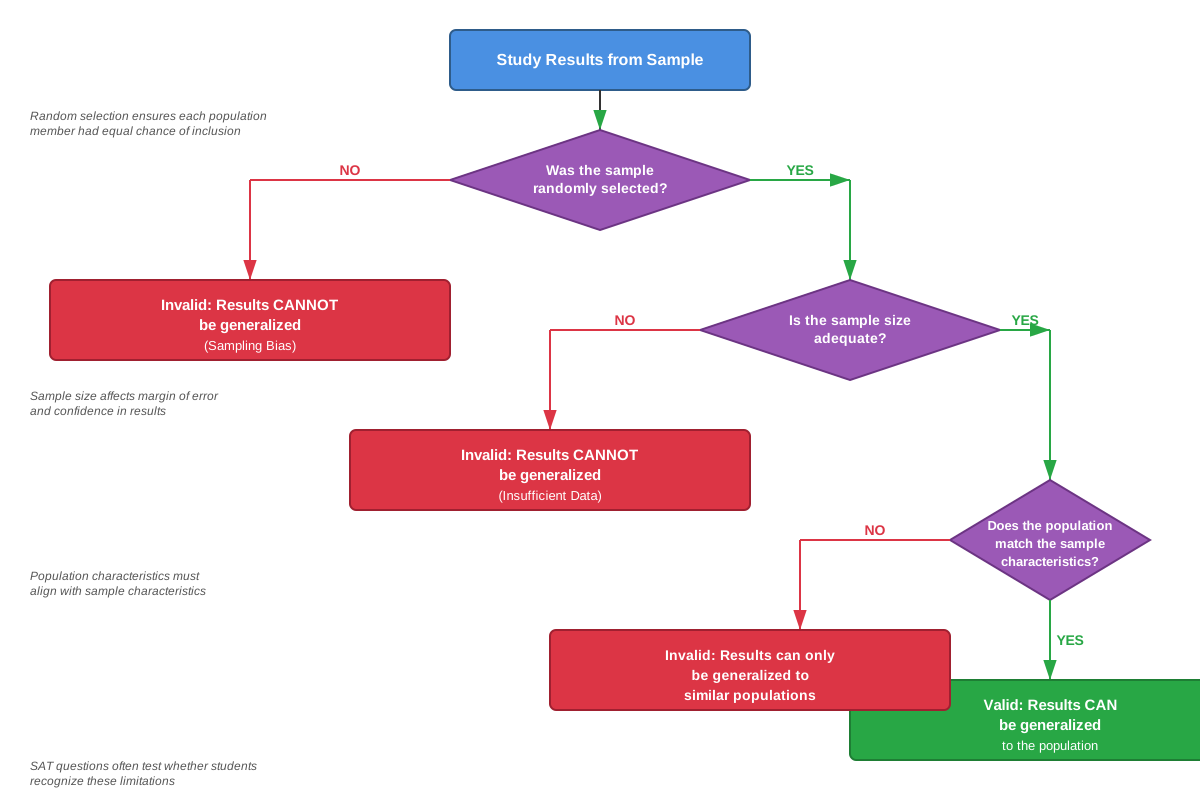
A fundamental principle tested on the SAT is understanding when sample results can be generalized to populations. Valid generalization requires:
- Random selection: The sample must be randomly selected from the target population
- Adequate sample size: Larger samples generally provide more reliable estimates
- Population match: The population from which the sample is drawn must match the population about which conclusions are made
For example, if researchers randomly sample 200 students from Central High School and find that 65% prefer online learning, they can generalize this finding to all students at Central High School. However, they CANNOT generalize to all high school students nationwide because the sample was only drawn from one school.
Sample Size and Reliability
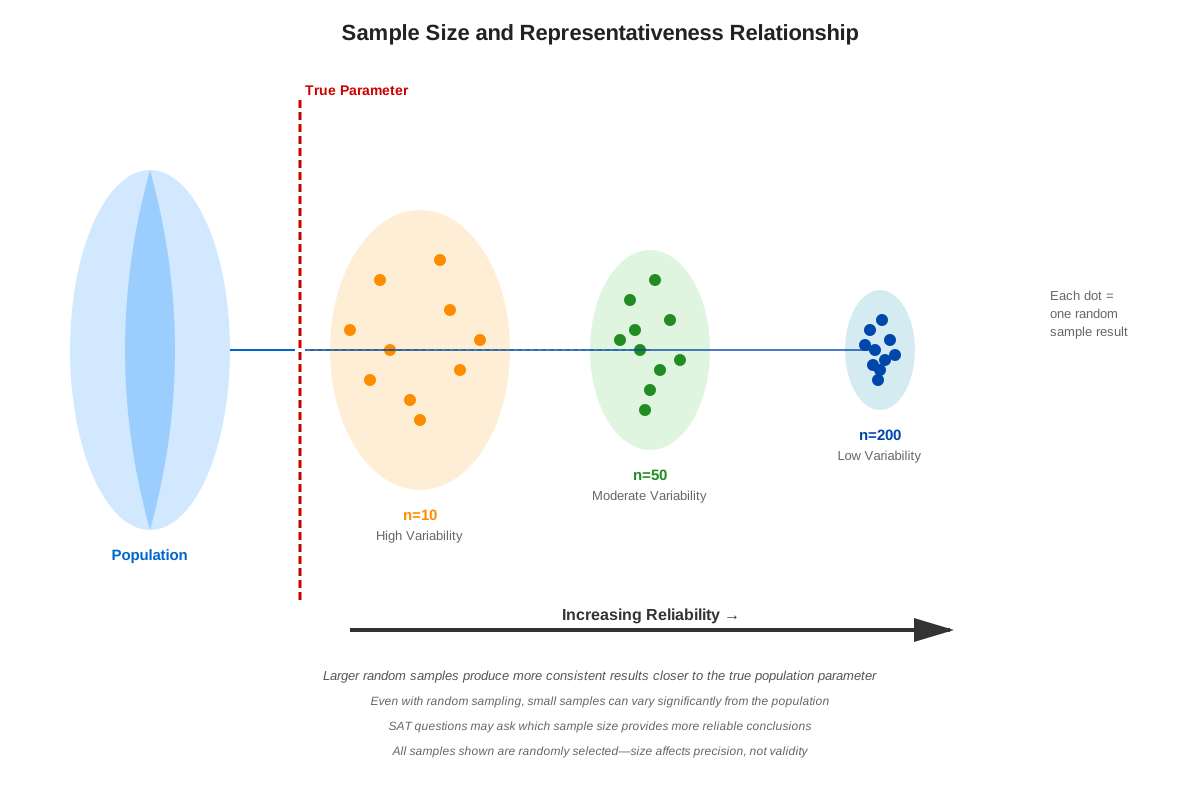
While randomness is crucial, sample size also affects the reliability of results. Larger random samples typically provide:
- More precise estimates of population parameters
- Smaller margins of error
- Greater confidence in conclusions
- Better representation of population diversity
However, a large non-random sample is still inferior to a smaller random sample for making valid inferences. The SAT may present scenarios where students must recognize that randomness matters more than sheer size.
Bias in Sampling
Bias occurs when a sampling method systematically favors certain outcomes or population subgroups. Common sources of bias include:
- Selection bias: The sampling method excludes or underrepresents certain groups
- Response bias: The way questions are asked influences responses
- Non-response bias: Certain groups are less likely to participate
- Undercoverage: The sampling frame doesn't include all population members
Recognizing bias is a high-yield SAT skill, as questions frequently ask students to identify why a particular sampling method might produce biased results.
Concept Relationships
Random sampling serves as the foundation for valid statistical inference, connecting directly to concepts of probability (equal chance of selection), data analysis (interpreting sample results), and logical reasoning (determining when generalizations are valid). The relationship flows as follows:
Population definition → Random sampling method → Representative sample → Data collection → Statistical analysis → Valid generalization to population
When any link in this chain breaks—particularly the random sampling step—the entire inference process becomes questionable. This concept connects to prerequisite knowledge of probability (understanding "equal chance") and proportional reasoning (recognizing that sample proportions estimate population proportions).
Random sampling also relates to experimental design concepts tested on the SAT. While random sampling involves randomly selecting subjects from a population, random assignment (a related but distinct concept) involves randomly assigning selected subjects to treatment groups in experiments. Both randomization types serve different purposes: random sampling enables generalization to populations, while random assignment enables causal conclusions about treatments.
The concept hierarchy can be visualized as: Basic probability → Random selection principles → Random sampling methods → Sample representativeness → Statistical inference → Population generalizations. Each level builds upon the previous, with random sampling serving as the critical bridge between data collection and valid conclusions.
High-Yield Facts
⭐ Random sampling means every member of the population has an equal chance of being selected for the sample
⭐ Results from a random sample can be generalized to the population from which the sample was drawn
⭐ Convenience sampling (selecting easily accessible individuals) is NOT random and produces biased results
⭐ Voluntary response samples (self-selection) systematically overrepresent people with strong opinions
⭐ A random sample from one population cannot be used to make conclusions about a different population
- Larger random samples generally provide more precise estimates than smaller random samples
- Random sampling eliminates systematic bias but doesn't guarantee perfect representation in any single sample
- Stratified random sampling can improve representativeness by ensuring proportional selection from subgroups
- The randomness of selection matters more than sample size for valid inference
- Non-response in surveys can introduce bias even when initial selection was random
- Random assignment (for experiments) and random sampling (for surveys) serve different purposes
- A census (surveying the entire population) eliminates sampling error but is often impractical
Quick check — test yourself on Random sampling so far.
Try Flashcards →Common Misconceptions
Misconception: Random sampling means haphazard or careless selection without any method.
Correction: Random sampling requires a deliberate, systematic process that ensures equal probability of selection for all population members. True randomness requires careful planning and execution, often using random number generators or other formal randomization techniques.
Misconception: A large sample size automatically makes results generalizable, regardless of how the sample was selected.
Correction: Sample size affects precision, but only random sampling enables valid generalization to populations. A survey of 10,000 volunteers is less valid for population inference than a random sample of 100 people because voluntary response introduces systematic bias.
Misconception: If a sample "looks diverse" or includes different types of people, it must be representative.
Correction: Visual diversity doesn't guarantee representativeness. Only random selection from the target population ensures that the sample is likely to represent population characteristics proportionally. Deliberately selecting diverse individuals actually introduces bias.
Misconception: Random sampling and random assignment are the same thing.
Correction: Random sampling involves randomly selecting subjects from a population (enabling generalization), while random assignment involves randomly assigning already-selected subjects to treatment groups in experiments (enabling causal conclusions). They serve different purposes in research design.
Misconception: Results from a random sample of one population can be applied to any similar population.
Correction: Generalization is only valid to the specific population from which the sample was randomly drawn. A random sample of college students in California cannot be used to make conclusions about all college students nationwide without additional justification.
Misconception: Random sampling guarantees that the sample will perfectly match the population.
Correction: Random sampling makes it likely that the sample will be representative, but any single random sample may differ from the population due to chance variation. This is why larger samples and repeated sampling provide more reliable results.
Misconception: Asking every 10th person entering a building constitutes random sampling.
Correction: This systematic sampling method is only random if the order in which people enter is itself random. If certain types of people tend to arrive at certain times, this method introduces bias. True random sampling would require randomly selecting from all people who enter during the entire time period.
Worked Examples
Example 1: Identifying Valid Random Sampling
Question: A researcher wants to determine the average amount of time students at Lincoln High School spend on homework each night. Which of the following methods would produce a random sample?
A) Surveying all students in the researcher's first-period class
B) Posting an online survey and analyzing responses from students who choose to participate
C) Assigning each student a number and using a random number generator to select 100 students to survey
D) Surveying the first 100 students who arrive at school on Monday morning
Solution:
Let's evaluate each option against the criteria for random sampling:
Option A: Surveying one class is convenience sampling. Students in first-period classes may differ systematically from students in other periods (perhaps early classes attract more organized students). This is NOT random sampling.
Option B: An online survey with voluntary participation is a voluntary response sample. Students who choose to participate likely have stronger opinions about homework than those who don't respond. This systematically biases results and is NOT random sampling.
Option C: Assigning numbers to all students and using a random number generator ensures that every student has an equal chance of selection. The selection of one student doesn't affect the probability of selecting others. This IS random sampling. ✓
Option D: Surveying early arrivals is convenience sampling with systematic bias. Students who arrive early may be more conscientious or live closer to school, making them unrepresentative of all students. This is NOT random sampling.
Answer: C
Connection to learning objectives: This example demonstrates how to identify key features of random sampling (equal probability, independence) and distinguish valid random sampling from biased methods.
Example 2: Determining Valid Generalization
Question: A polling organization randomly selects 500 registered voters in Ohio and finds that 52% support Candidate A. The organization concludes that Candidate A will win the national election. Which of the following best describes this conclusion?
A) Valid, because the sample was randomly selected
B) Valid, because 500 is a large sample size
C) Invalid, because the sample was only drawn from Ohio voters, not all national voters
D) Invalid, because 52% is too close to 50% to draw any conclusion
Solution:
To evaluate this conclusion, we must determine whether the sample population matches the target population for the conclusion.
Sample population: Registered voters in Ohio (randomly selected)
Target population for conclusion: All national voters
Even though the sampling method was random and the sample size was adequate, the fundamental principle of generalization is violated: results can only be generalized to the population from which the sample was drawn.
The random sample of Ohio voters allows valid conclusions about Ohio voters' preferences, but Ohio voters may have different preferences than voters in other states. Regional differences in political preferences are well-documented, making it inappropriate to extend Ohio results to the entire nation.
Option A is incorrect because randomness alone doesn't justify generalizing beyond the sampled population.
Option B is incorrect because sample size doesn't overcome the population mismatch problem.
Option C is correct because it identifies the fundamental flaw: the sample population (Ohio) doesn't match the target population (national). ✓
Option D is incorrect because the margin of victory isn't the issue; the population mismatch is the problem.
Answer: C
Connection to learning objectives: This example illustrates how to apply random sampling principles to evaluate the validity of conclusions and recognize when generalization is inappropriate despite proper sampling technique.
Exam Strategy
When approaching SAT random sampling questions, follow this systematic process:
Step 1: Identify the population and sample
- Determine what group the question is asking about (population)
- Identify what group was actually studied (sample)
- Check whether these match
Step 2: Evaluate the sampling method
- Look for keywords indicating randomness: "randomly selected," "random sample," "random number generator"
- Watch for red flags: "volunteer," "convenience," "first," "available," "chose to participate"
- Determine if every population member had equal selection probability
Step 3: Assess the conclusion
- Identify what claim is being made
- Verify that the claim only extends to the population from which the sample was drawn
- Check that the sampling method was truly random
Trigger words and phrases to watch for:
Positive indicators (suggest valid random sampling):
- "randomly selected"
- "random sample"
- "random number generator"
- "lottery method"
- "each had an equal chance"
Warning signs (suggest bias or non-random sampling):
- "volunteer"
- "chose to participate"
- "convenience"
- "available"
- "first [number] people"
- "easiest to reach"
- "self-selected"
Process-of-elimination tips:
- Immediately eliminate any answer choice that suggests voluntary response is random
- Eliminate choices that claim convenience sampling produces generalizable results
- Eliminate conclusions that extend beyond the sampled population
- Be suspicious of any method that doesn't explicitly describe a randomization process
Time allocation advice:
Random sampling questions typically require 60-90 seconds. Spend 20-30 seconds identifying the population and sample, 20-30 seconds evaluating the sampling method, and 20-30 seconds checking the conclusion's validity. Don't overthink these questions—they test straightforward application of principles rather than complex calculations.
Memory Techniques
RANDOM Acronym for Valid Sampling:
- Representative of the population
- All members have equal chance
- No systematic bias
- Drawn from target population
- Objective selection process
- Method uses formal randomization
Visualization Strategy:
Picture a large jar containing colored marbles representing a population. Random sampling is like blindfolding yourself, shaking the jar thoroughly, and drawing marbles without looking. Any method that's like looking into the jar and picking marbles you can reach easily (convenience), or letting marbles jump out on their own (voluntary response), is NOT random.
The "Equal Chance" Test:
When evaluating any sampling method, ask: "Does my grandmother in a wheelchair have the same chance of being selected as an athletic teenager?" If the answer is no, the sampling isn't random.
Generalization Rule Mnemonic:
"Sample from SAME, conclude about SAME" - You can only generalize to the SAME population from which you SAMpled.
Bias Detection Phrase:
"Volunteers are Vocal" - Remember that voluntary response samples overrepresent people with strong opinions (who are more vocal).
Summary
Random sampling is a fundamental statistical concept that ensures every member of a population has an equal and independent chance of being selected for a sample. This equality of selection probability is what enables researchers to generalize sample results to entire populations with known confidence levels. On the SAT, students must distinguish truly random sampling from biased methods like convenience sampling and voluntary response, recognize when conclusions can validly be extended from samples to populations, and identify sources of bias in data collection procedures. The key principle is that results can only be generalized to the population from which the sample was randomly drawn—not to different or broader populations. Understanding that randomness in selection matters more than sample size for valid inference, and that even large samples cannot overcome systematic bias, is essential for SAT success. Questions typically present real-world scenarios requiring students to evaluate sampling methods and conclusions rather than perform calculations.
Key Takeaways
- Random sampling requires that every population member has an equal and independent chance of selection, enabling valid generalization from sample to population
- Convenience sampling, voluntary response, and other non-random methods introduce systematic bias that invalidates population inferences
- Results from a random sample can only be generalized to the specific population from which the sample was drawn, not to different or broader populations
- Sample size affects precision, but randomness of selection is more critical for valid inference than sheer sample size
- SAT questions test conceptual understanding of when sampling methods are appropriate and when conclusions are valid, not complex statistical calculations
- Recognizing trigger words like "volunteer," "convenience," and "randomly selected" helps quickly identify sampling method validity
- The fundamental chain for valid inference is: random sampling → representative sample → valid generalization to source population
Related Topics
Experimental Design and Random Assignment: While random sampling involves selecting subjects from populations, random assignment involves assigning selected subjects to treatment groups. Understanding both concepts enables comprehensive analysis of research validity.
Margin of Error and Confidence Intervals: Random sampling provides the foundation for calculating margins of error and confidence intervals, which quantify the uncertainty in sample-based estimates of population parameters.
Observational Studies vs. Experiments: Random sampling is crucial in observational studies for generalizability, while experiments also require random assignment for causal conclusions. Distinguishing these research types builds on sampling knowledge.
Bias and Confounding Variables: Understanding sampling bias connects to broader concepts of confounding variables and how they affect the validity of statistical conclusions in various research contexts.
Statistical Inference: Mastering random sampling enables progression to more advanced topics in statistical inference, including hypothesis testing and population parameter estimation.
Practice CTA
Now that you've mastered the core concepts of random sampling, it's time to solidify your understanding through active practice. Attempt the practice questions to test your ability to identify valid sampling methods, recognize bias, and evaluate the appropriateness of generalizations. Use the flashcards to reinforce key definitions and principles until they become automatic. Remember, random sampling questions on the SAT reward careful reading and systematic application of principles—skills that improve dramatically with focused practice. Each practice question you complete strengthens your ability to quickly recognize sampling validity and avoid common traps on test day. You've got this!
Sign up free to keep reading
Create a free AnvayaPrep account to finish this SAT guide on Random sampling — plus flashcards and practice questions.