Overview
Exponent word problems represent a critical category of questions on the SAT Math section that test students' ability to apply exponential concepts to real-world scenarios. These problems go beyond simple computational exercises by embedding exponential relationships within contextual situations such as population growth, compound interest, radioactive decay, and bacterial reproduction. Success with these questions requires not only understanding the mathematical properties of exponents but also the ability to translate verbal descriptions into algebraic expressions and equations.
On the SAT, exponent word problems frequently appear in both the calculator and no-calculator sections, accounting for approximately 3-5 questions per test. These problems assess multiple competencies simultaneously: reading comprehension, mathematical modeling, algebraic manipulation, and quantitative reasoning. The College Board specifically designs these questions to evaluate whether students can recognize exponential patterns in real-world contexts and apply appropriate mathematical tools to solve them. Mastering this topic is essential because it bridges abstract mathematical concepts with practical applications, a skill highly valued in college-level coursework and STEM fields.
Understanding sat exponent word problems connects directly to broader mathematical concepts including functions, sequences, and logarithms. These problems often serve as the foundation for more advanced topics in precalculus and calculus, making them not only important for SAT success but also for future academic preparation. The ability to work with exponential models is fundamental to understanding growth and decay processes across multiple disciplines, from biology and chemistry to economics and computer science.
Learning Objectives
- [ ] Identify key features of exponent word problems, including growth/decay rates, initial values, and time intervals
- [ ] Explain how exponent word problems appears on the SAT, including common contexts and question formats
- [ ] Apply exponent word problems to answer SAT-style questions with accuracy and efficiency
- [ ] Translate verbal descriptions of exponential situations into algebraic expressions and equations
- [ ] Distinguish between exponential growth and exponential decay scenarios based on problem context
- [ ] Evaluate exponential expressions for specific values and interpret results within the problem context
- [ ] Construct exponential models from given data points or verbal descriptions
Prerequisites
- Basic exponent rules: Understanding properties like x^a · x^b = x^(a+b) and (x^a)^b = x^(ab) is essential for simplifying expressions within word problems
- Order of operations: Correctly evaluating expressions with exponents requires proper sequencing of mathematical operations
- Algebraic equation solving: Word problems often require setting up and solving equations, including isolating variables
- Percentage calculations: Many exponential contexts involve percent increase or decrease, requiring conversion between percentages and decimals
- Function notation: Understanding f(x) notation helps interpret exponential functions presented in word problems
Why This Topic Matters
Exponential relationships govern countless real-world phenomena, making this topic one of the most practically applicable areas of math tested on the SAT. From calculating investment returns and loan payments to modeling population dynamics and understanding viral spread, exponential functions describe situations where quantities change by a constant factor over equal time intervals. This fundamental pattern appears across scientific disciplines, making it essential knowledge for college-bound students regardless of their intended major.
On the SAT, exponent word problems appear with high frequency, typically comprising 2-4 questions per test administration. These questions most commonly appear in the following formats: multiple-choice questions requiring calculation of a specific value, questions asking students to identify the correct exponential model from several options, and questions requiring interpretation of parameters within an exponential function. The College Board reports that approximately 15-20% of the Heart of Algebra and Problem Solving and Data Analysis domains involve exponential relationships, making this a high-yield topic for focused study.
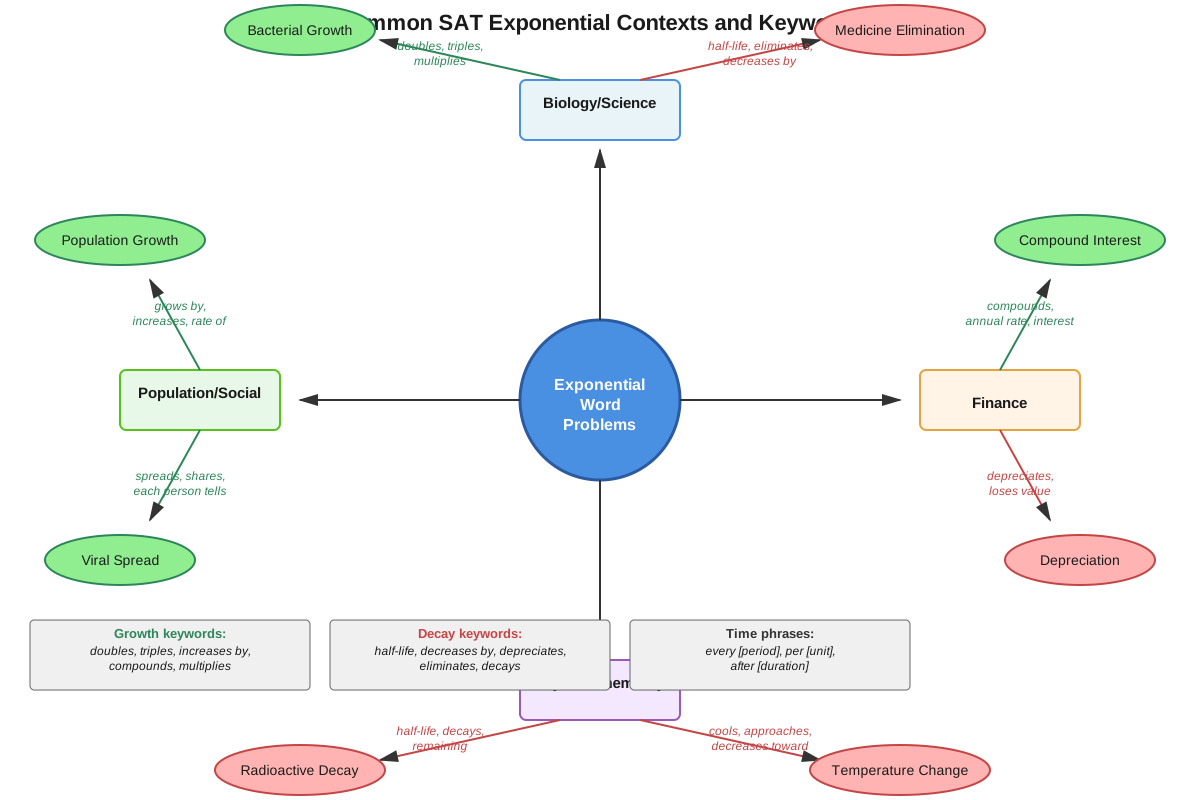
Common SAT contexts for exponent word problems include: compound interest calculations where money grows exponentially over time; population growth or decline scenarios for bacteria, animals, or human populations; radioactive decay problems involving half-lives; temperature change following Newton's Law of Cooling; and depreciation of assets like vehicles or equipment. Recognizing these standard scenarios allows students to quickly identify the appropriate mathematical approach and avoid common pitfalls.
Core Concepts
The Standard Exponential Model
The foundation of all exponent word problems is the standard exponential function formula:
y = a · b^xWhere:
- y represents the final amount or value
- a represents the initial amount (the value when x = 0)
- b represents the base or growth/decay factor
- x represents the independent variable (often time)
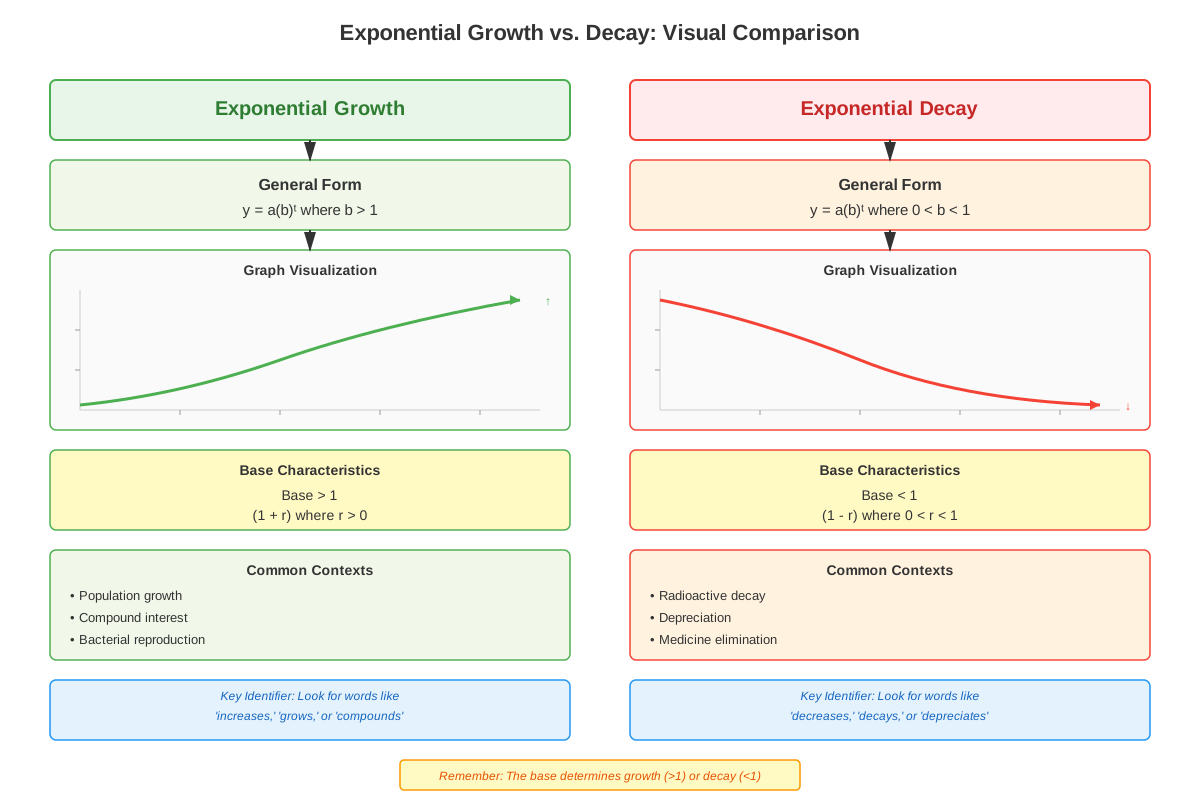
Understanding each parameter's role is crucial for SAT success. The initial value a is the starting quantity before any growth or decay occurs. The base b determines whether the function represents growth (b > 1) or decay (0 < b < 1). The exponent x typically represents time elapsed, though it can represent other quantities like the number of iterations or cycles.
Growth vs. Decay Identification
Distinguishing between exponential growth and decay is a fundamental skill tested on the SAT:
| Characteristic | Exponential Growth | Exponential Decay |
|---|---|---|
| Base value (b) | b > 1 | 0 < b < 1 |
| Verbal cues | "increases by," "grows," "appreciates," "compounds" | "decreases by," "decays," "depreciates," "half-life" |
| Graph behavior | Rises from left to right | Falls from left to right |
| Real-world examples | Population growth, compound interest, bacterial reproduction | Radioactive decay, depreciation, cooling |
Converting Percent Change to Exponential Base
A critical skill for SAT exponent word problems involves converting percentage increases or decreases into the appropriate base value:
For growth (increase):
If something increases by r% per time period, the base b = 1 + (r/100)
Example: A 15% annual increase means b = 1 + 0.15 = 1.15
For decay (decrease):
If something decreases by r% per time period, the base b = 1 - (r/100)
Example: A 20% annual decrease means b = 1 - 0.20 = 0.80
This conversion is essential because word problems describe changes in percentage terms, but the mathematical model requires the multiplicative factor.
Time Period Adjustments
Many SAT problems require careful attention to time period alignment. The exponent must match the time period of the growth/decay rate:
- Identify the rate period: Determine whether the given rate is per year, per month, per day, etc.
- Identify the question period: Determine what time unit the problem asks about
- Convert if necessary: Adjust the exponent to match the rate period
For example, if a population grows at 5% per year and the question asks about growth over 6 months, the exponent would be 0.5 (representing half a year), not 6.
Compound Interest Formula
A specialized but frequently tested exponential application is compound interest:
A = P(1 + r/n)^(nt)Where:
- A = final amount
- P = principal (initial investment)
- r = annual interest rate (as a decimal)
- n = number of times interest compounds per year
- t = time in years
This formula appears regularly on the SAT, particularly in questions about savings accounts, investments, or loans. Understanding that more frequent compounding (higher n) results in greater returns is important for conceptual questions.
Half-Life and Doubling Time
Two special exponential scenarios appear frequently:
Half-life: The time required for a quantity to reduce to half its initial value. After one half-life, 50% remains; after two half-lives, 25% remains; after three half-lives, 12.5% remains, following the pattern:
Amount remaining = Initial amount × (1/2)^(t/h)where t is elapsed time and h is the half-life period.
Doubling time: The time required for a quantity to double. The relationship follows:
Final amount = Initial amount × 2^(t/d)where t is elapsed time and d is the doubling time period.
Setting Up Equations from Word Problems
The systematic approach to translating word problems into exponential equations involves:
- Identify the initial value: Look for phrases like "starts with," "initially," "at the beginning"
- Determine the rate and direction: Find percentage changes and whether they represent growth or decay
- Identify the time variable: Determine what represents the independent variable
- Construct the model: Combine components into the standard form y = a · b^x
- Verify units: Ensure time periods align between rate and exponent
Concept Relationships
The concepts within exponent word problems form an interconnected framework. The standard exponential model serves as the foundation, from which all other concepts derive. Growth vs. decay identification determines whether the base exceeds or falls below 1, directly connecting to percent change conversion, which transforms verbal descriptions into the mathematical base value. Time period adjustments modify the exponent to ensure consistency between the rate period and the question's timeframe.
Compound interest represents a specialized application of the standard model with additional complexity through the compounding frequency parameter. Half-life and doubling time problems are specific cases where the base is predetermined (1/2 or 2, respectively), simplifying the model but requiring careful attention to time ratios. All these concepts ultimately support the overarching skill of setting up equations from word problems, which synthesizes reading comprehension with mathematical modeling.
The relationship to prerequisite topics is direct: basic exponent rules enable simplification of complex exponential expressions that arise during problem-solving; algebraic equation solving allows students to find unknown values once the exponential model is established; percentage calculations bridge the gap between verbal descriptions and mathematical representations. These prerequisites → enable model construction → which leads to problem solution.
Quick check — test yourself on Exponent word problems so far.
Try Flashcards →High-Yield Facts
⭐ The standard exponential model is y = a · b^x, where a is the initial value, b is the growth/decay factor, and x is typically time
⭐ For growth by r%, the base b = 1 + (r/100); for decay by r%, the base b = 1 - (r/100)
⭐ Exponential growth occurs when b > 1; exponential decay occurs when 0 < b < 1
⭐ In compound interest problems, more frequent compounding (higher n) produces greater returns
⭐ After n half-lives, the remaining amount is (1/2)^n times the original amount
- The exponent's time unit must match the rate's time period (e.g., annual rate requires time in years)
- Doubling time and half-life problems use bases of 2 and 1/2, respectively
- The initial value (a) is the y-intercept of the exponential function
- When comparing exponential functions, the one with the larger base grows faster (for b > 1)
- Exponential functions never reach zero in decay scenarios; they approach zero asymptotically
- The compound interest formula A = P(1 + r/n)^(nt) reduces to A = Pe^(rt) for continuous compounding
- Word problems often provide the initial value and one other data point, requiring students to solve for the base
Common Misconceptions
Misconception: The exponent represents the growth rate percentage → Correction: The exponent represents time (or number of periods), while the base represents the growth factor. A 5% growth rate means b = 1.05, not an exponent of 5.
Misconception: Exponential decay means the quantity eventually reaches zero → Correction: Exponential decay functions approach zero asymptotically but never actually reach zero mathematically, though practical contexts may round to zero.
Misconception: Doubling the time period doubles the final amount in exponential growth → Correction: Exponential growth is multiplicative, not additive. Doubling the time period squares the growth factor, not doubles it. If something grows to 150 in 5 years, it doesn't grow to 300 in 10 years.
Misconception: A 50% decrease followed by a 50% increase returns to the original value → Correction: These operations are not inverse. Starting with 100, a 50% decrease yields 50, then a 50% increase yields 75, not 100. The order and magnitude of percentage changes matter.
Misconception: The base in compound interest is simply (1 + r) → Correction: The base is (1 + r/n) where n is the compounding frequency. Forgetting to divide the rate by the number of compounding periods per year is a common error.
Misconception: Half-life problems always use the formula with (1/2) as the base → Correction: While (1/2)^(t/h) is correct, some problems may present the decay rate differently, requiring conversion to the half-life format or using an alternative base.
Misconception: Exponential growth always outpaces linear growth → Correction: For small time values, linear growth may exceed exponential growth. Exponential growth eventually surpasses linear growth, but not necessarily immediately.
Worked Examples
Example 1: Bacterial Growth
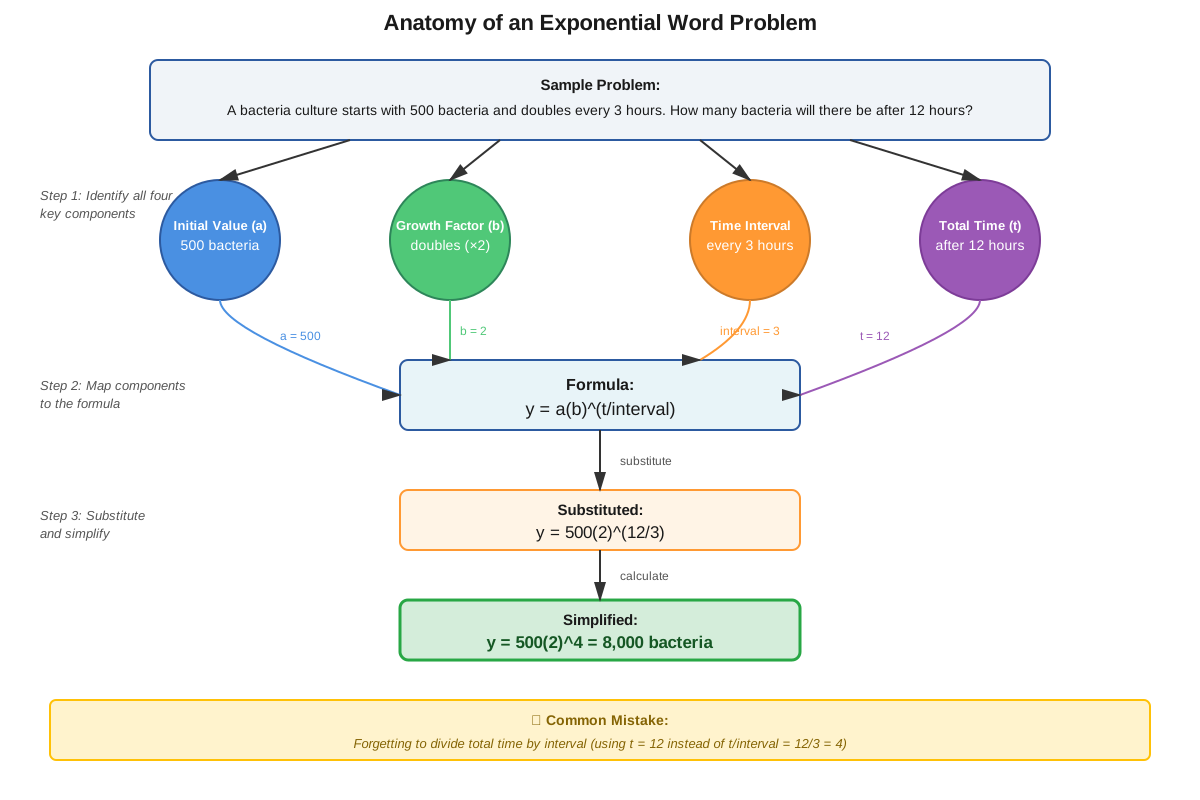
Problem: A bacterial culture initially contains 500 bacteria. The population doubles every 3 hours. How many bacteria will be present after 15 hours?
Solution:
Step 1: Identify the components
- Initial value (a) = 500 bacteria
- This is a doubling problem, so the base involves powers of 2
- Time period: doubles every 3 hours
- Question asks about 15 hours
Step 2: Determine the number of doubling periods
- Number of 3-hour periods in 15 hours = 15 ÷ 3 = 5 periods
Step 3: Set up the exponential model
Since the population doubles, we use:
Population = Initial × 2^(number of doubling periods)
P = 500 × 2^5
Step 4: Calculate
P = 500 × 32 = 16,000 bacteriaConnection to learning objectives: This problem demonstrates identifying key features (initial value, doubling time), translating verbal description into mathematical form, and applying the exponential model to find a specific value.
Example 2: Depreciation with Percentage Decay
Problem: A car purchased for $28,000 depreciates at a rate of 15% per year. What will be the approximate value of the car after 4 years?
Solution:
Step 1: Identify the components
- Initial value (a) = $28,000
- Decay rate = 15% per year
- Time (x) = 4 years
- This is exponential decay (depreciation)
Step 2: Convert percentage to decay factor
- Decreases by 15% means the car retains 85% of its value each year
- Base (b) = 1 - 0.15 = 0.85
Step 3: Set up the exponential model
Value = 28,000 × (0.85)^4Step 4: Calculate
(0.85)^4 = 0.52200625
Value = 28,000 × 0.52200625 ≈ $14,616
Step 5: Interpret
After 4 years, the car will be worth approximately $14,616.
Connection to learning objectives: This example shows how to distinguish decay from growth, convert percentage decrease to the appropriate base, and apply the standard exponential model to a real-world depreciation scenario commonly tested on the SAT.
Example 3: Compound Interest Comparison
Problem: Sarah invests $5,000 in an account that pays 6% annual interest compounded quarterly. How much will she have after 3 years?
Solution:
Step 1: Identify the components
- Principal (P) = $5,000
- Annual rate (r) = 6% = 0.06
- Compounding frequency (n) = 4 (quarterly means 4 times per year)
- Time (t) = 3 years
Step 2: Apply the compound interest formula
A = P(1 + r/n)^(nt)
A = 5,000(1 + 0.06/4)^(4×3)
Step 3: Simplify inside the parentheses
A = 5,000(1 + 0.015)^12
A = 5,000(1.015)^12
Step 4: Calculate
(1.015)^12 ≈ 1.19562
A = 5,000 × 1.19562 ≈ $5,978.10
Connection to learning objectives: This problem requires applying the specialized compound interest formula, demonstrating understanding of how compounding frequency affects growth, and accurately calculating with multiple parameters.
Exam Strategy
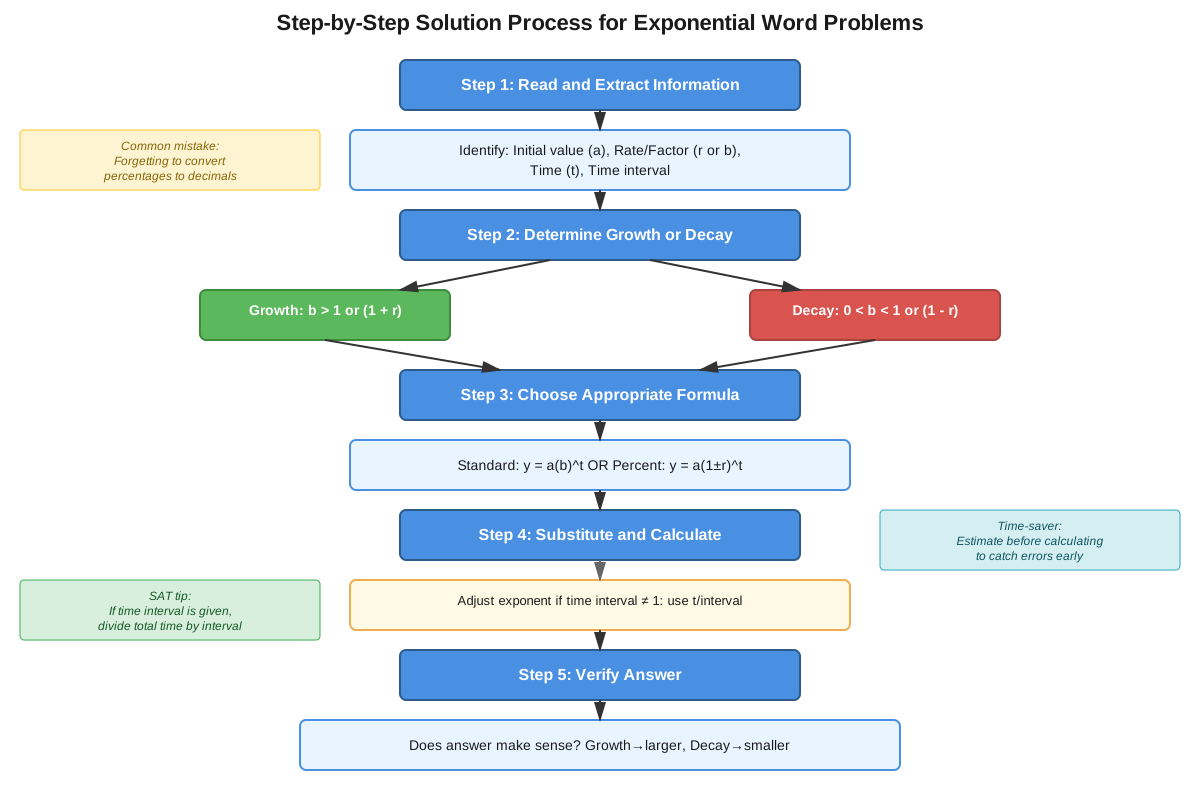
When approaching sat exponent word problems, follow this systematic process:
Step 1: Read carefully and identify the scenario type
Look for trigger words that indicate the problem type: "doubles," "half-life," "depreciates," "compounds," "grows by," "decreases by." These words immediately signal which exponential model to use.
Step 2: Extract numerical information systematically
Create a mental or written list:
- What is the initial value?
- What is the rate of change (and its time period)?
- What time period does the question ask about?
- What specific value or relationship is being requested?
Step 3: Watch for time period mismatches
The SAT frequently tests whether students notice when the rate period differs from the question period. If interest compounds monthly but the question asks about years, ensure the exponent reflects months (multiply years by 12).
Step 4: Set up before calculating
Write the complete exponential expression before performing calculations. This prevents errors and allows you to verify your setup matches the problem.
Step 5: Use process of elimination strategically
- Eliminate answers that show growth when the problem describes decay (or vice versa)
- Eliminate answers that don't match the initial value when x = 0
- For "which equation represents..." questions, test x = 0 to verify the initial value
- Check whether the answer is reasonable given the context (a population can't be negative, money values should be positive)
Time allocation: Spend 30-45 seconds reading and identifying the problem type, 45-60 seconds setting up the equation, and 30-45 seconds calculating and verifying. Total time per problem should be approximately 2-2.5 minutes.
Exam Tip: If a problem provides two data points (e.g., "initially 100, after 5 years is 200"), you can solve for the base by setting up the equation 200 = 100 × b^5, then solving for b.
Memory Techniques
GRID Mnemonic for Exponential Model Components:
- Growth factor (the base b)
- Rate conversion (percentage to decimal)
- Initial value (coefficient a)
- Duration (exponent x)
"BIGGER BASE, BIGGER GROWTH" Rule:
When b > 1, larger bases mean faster growth. When comparing exponential functions, the one with the larger base will eventually exceed all others (assuming equal initial values).
Percentage Conversion Visualization:
Imagine a percentage as a piece of a whole pie:
- Growth: You're adding that piece to the whole pie (1 + percentage)
- Decay: You're removing that piece from the whole pie (1 - percentage)
Half-Life Halving Pattern:
Remember the sequence: 1 → 1/2 → 1/4 → 1/8 → 1/16
Each arrow represents one half-life period. Visualize this as repeatedly cutting something in half.
Compound Interest "PRINT" Acronym:
- Principal (initial amount)
- Rate (annual percentage as decimal)
- Interest (what you're calculating)
- Number of compounds per year
- Time in years
Summary
Exponent word problems on the SAT require students to translate real-world scenarios into exponential models and solve for specific values or relationships. The foundation is the standard exponential function y = a · b^x, where the initial value, growth/decay factor, and time variable must be correctly identified from verbal descriptions. Success depends on distinguishing growth (b > 1) from decay (0 < b < 1), accurately converting percentage changes to multiplicative factors, and ensuring time period consistency between rates and exponents. Common contexts include compound interest, population dynamics, radioactive decay, and depreciation. Students must recognize trigger words, systematically extract information, set up equations before calculating, and verify answers for reasonableness. Mastery of these problems requires both computational accuracy and conceptual understanding of how exponential relationships model real-world phenomena where quantities change by constant factors over equal intervals.
Key Takeaways
- The standard exponential model y = a · b^x is the foundation for all exponent word problems, with a as initial value, b as growth/decay factor, and x as time
- Convert percentage changes to bases using b = 1 + (r/100) for growth and b = 1 - (r/100) for decay
- Always verify that the exponent's time unit matches the rate's time period; adjust by converting time units when necessary
- Exponential growth (b > 1) and decay (0 < b < 1) have distinct characteristics and verbal cues that help identify the problem type
- Compound interest, half-life, and doubling time are specialized exponential applications with specific formulas and patterns
- Read problems carefully to extract initial values, rates, time periods, and what the question asks for before setting up equations
- Use process of elimination by checking initial values, growth/decay direction, and answer reasonableness
Related Topics
Logarithms and Exponential Equations: After mastering basic exponential word problems, students progress to solving for exponents using logarithms, which is essential when the unknown variable appears in the exponent position.
Exponential vs. Linear Growth Comparison: Understanding how exponential functions differ from linear functions helps students recognize which model applies to different real-world situations and appears in SAT data analysis questions.
Sequences and Series: Exponential functions relate closely to geometric sequences, where each term is found by multiplying the previous term by a constant ratio, connecting discrete and continuous growth models.
Function Transformations: Studying how changes to parameters in y = a · b^x affect the graph builds deeper understanding of exponential behavior and prepares students for function analysis questions.
Scientific Notation and Powers of Ten: Exponential notation with base 10 appears frequently in science contexts and connects to the broader understanding of exponential expressions.
Practice CTA
Now that you've mastered the core concepts of exponent word problems, it's time to solidify your understanding through active practice. Work through the practice questions to apply these strategies to SAT-style problems, and use the flashcards to reinforce key formulas and concepts. Remember, consistent practice with these high-yield problems will build both speed and accuracy—two essential components for SAT success. Each problem you solve strengthens your pattern recognition and problem-solving intuition, bringing you closer to your target score!
Sign up free to keep reading
Create a free AnvayaPrep account to finish this SAT guide on Exponent word problems — plus flashcards and practice questions.