Overview
Exponential expressions form a cornerstone of algebra and appear frequently throughout the SAT math section. These expressions involve variables or numbers raised to powers, and understanding how to manipulate them is essential for solving a wide range of problems efficiently. On the SAT, exponential expressions appear in multiple contexts: simplifying algebraic expressions, solving equations, modeling growth and decay scenarios, and working with scientific notation. Mastery of the laws of exponents enables students to transform complex-looking expressions into simpler forms, identify equivalent expressions, and solve problems that would otherwise require extensive calculation.
The importance of exponential expressions extends beyond isolated algebra questions. They connect directly to functions, particularly exponential and polynomial functions, and provide the foundation for understanding radical expressions (since roots are fractional exponents). Students who develop fluency with exponent rules can approach SAT questions with confidence, recognizing patterns and applying systematic methods rather than relying on trial and error. The College Board consistently includes 3-5 questions per test that directly test exponent manipulation, and many additional questions require exponent knowledge as a component of multi-step problem solving.
Understanding exponential expressions also builds mathematical maturity essential for higher-level mathematics. The ability to recognize when expressions are equivalent, to simplify complex terms, and to work with both positive and negative exponents demonstrates algebraic reasoning that the SAT values highly. This topic bridges arithmetic and advanced algebra, making it a high-yield area for focused study that yields immediate score improvements.
Learning Objectives
- [ ] Identify key features of exponential expressions
- [ ] Explain how exponential expressions appears on the SAT
- [ ] Apply exponential expressions to answer SAT-style questions
- [ ] Simplify exponential expressions using all laws of exponents
- [ ] Evaluate expressions with negative and zero exponents accurately
- [ ] Recognize equivalent exponential forms and select correct answer choices
- [ ] Solve exponential equations by equating bases or exponents
Prerequisites
- Basic arithmetic operations: Multiplication, division, and understanding of repeated multiplication form the foundation of exponents
- Order of operations (PEMDAS): Exponents must be evaluated in the correct sequence relative to other operations
- Integer properties: Understanding positive, negative, and zero values is essential for working with various exponent types
- Algebraic notation: Familiarity with variables and coefficients allows manipulation of exponential expressions
- Fraction operations: Many exponent rules produce fractional results or require fraction manipulation
Why This Topic Matters
Exponential expressions represent one of the most practical mathematical concepts students encounter. In real-world applications, exponential relationships model population growth, compound interest, radioactive decay, bacterial reproduction, and technological advancement (Moore's Law). Scientists use exponential notation to express extremely large numbers (distances in astronomy) and extremely small numbers (atomic measurements). Financial planners rely on exponential functions to calculate investment returns and loan payments. Understanding how quantities change exponentially versus linearly is fundamental to interpreting data in fields ranging from epidemiology to economics.
On the SAT, exponential expressions appear with remarkable consistency. Approximately 8-12% of math questions involve exponents directly, translating to 4-6 questions per test. These questions span both the calculator and no-calculator sections, appearing in multiple-choice and grid-in formats. The College Board tests exponential expressions through several question types: simplification problems requiring application of exponent laws, equation-solving questions where students must isolate variables in exponents, word problems involving exponential growth or decay, and questions asking students to identify equivalent expressions among answer choices.
Common SAT question formats include: simplifying expressions like (x³y²)⁴/(x²y)³, solving equations such as 2^(x+1) = 32, working with scientific notation in context problems, and identifying which expression is equivalent to a given exponential form. The test also integrates exponential expressions into function questions, asking students to evaluate f(x) = 2^x at specific values or to determine properties of exponential functions. Questions may present exponential expressions in word problems about compound interest, population models, or depreciation, requiring students to set up and manipulate exponential equations.
Core Concepts
Definition and Structure of Exponential Expressions
An exponential expression consists of a base raised to a power (exponent). In the expression b^n, b represents the base and n represents the exponent or power. The expression means "multiply b by itself n times." For example, 5³ = 5 × 5 × 5 = 125. When working with variables, x⁴ means x · x · x · x. The base can be any real number (positive, negative, or zero), and the exponent can be positive, negative, zero, or even a fraction (though fractional exponents connect to radical expressions).
Sat exponential expressions often involve multiple bases and exponents within a single expression, such as 3x²y³ or (2a³b)⁴. Understanding the structure helps identify which operations to apply. The coefficient (3 in the first example) is separate from the exponential terms and follows different rules during manipulation.
The Laws of Exponents
The power of working with exponential expressions comes from systematic rules that govern their manipulation. These laws allow transformation of complex expressions into simpler equivalent forms.
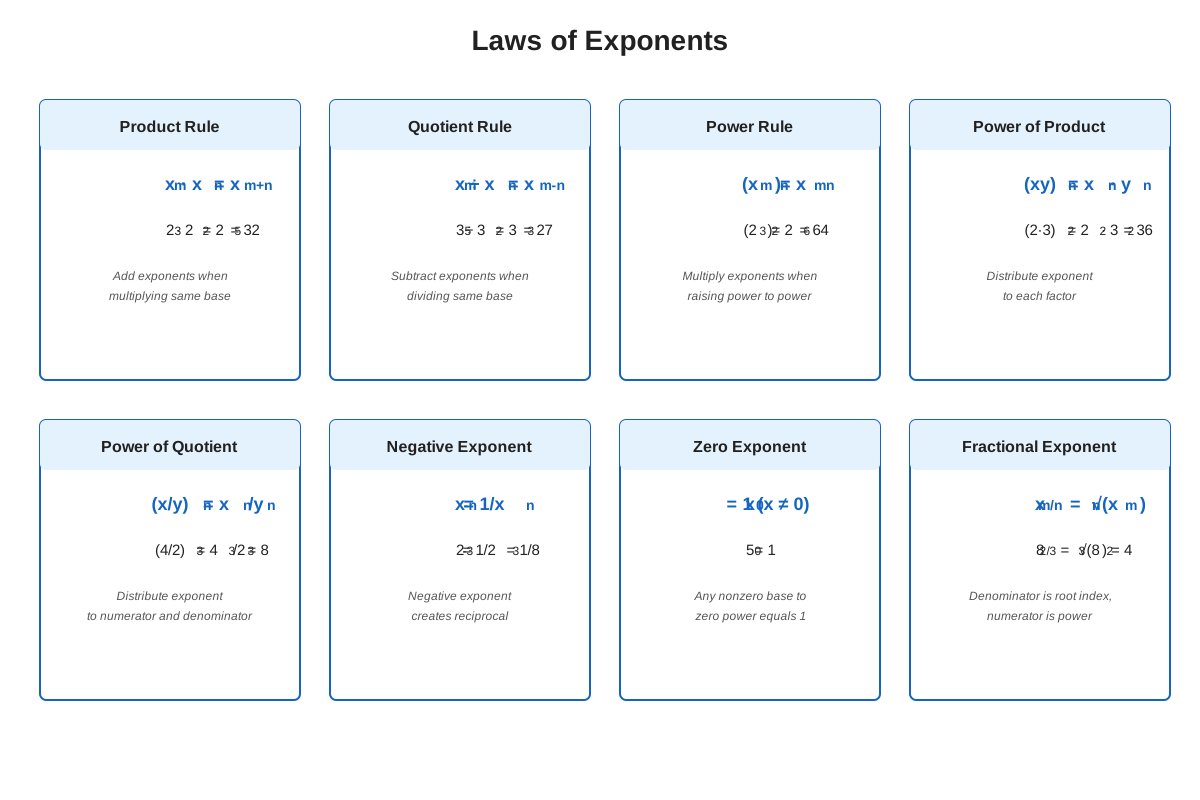
Product Rule: When multiplying expressions with the same base, add the exponents.
b^m · b^n = b^(m+n)Example: x³ · x⁵ = x^(3+5) = x⁸
Quotient Rule: When dividing expressions with the same base, subtract the exponents.
b^m / b^n = b^(m-n)Example: y⁷ / y² = y^(7-2) = y⁵
Power Rule: When raising a power to another power, multiply the exponents.
(b^m)^n = b^(m·n)Example: (z²)⁴ = z^(2·4) = z⁸
Power of a Product Rule: When raising a product to a power, distribute the exponent to each factor.
(ab)^n = a^n · b^nExample: (3x)⁴ = 3⁴ · x⁴ = 81x⁴
Power of a Quotient Rule: When raising a quotient to a power, distribute the exponent to both numerator and denominator.
(a/b)^n = a^n / b^nExample: (x/2)³ = x³/2³ = x³/8
Special Exponent Cases
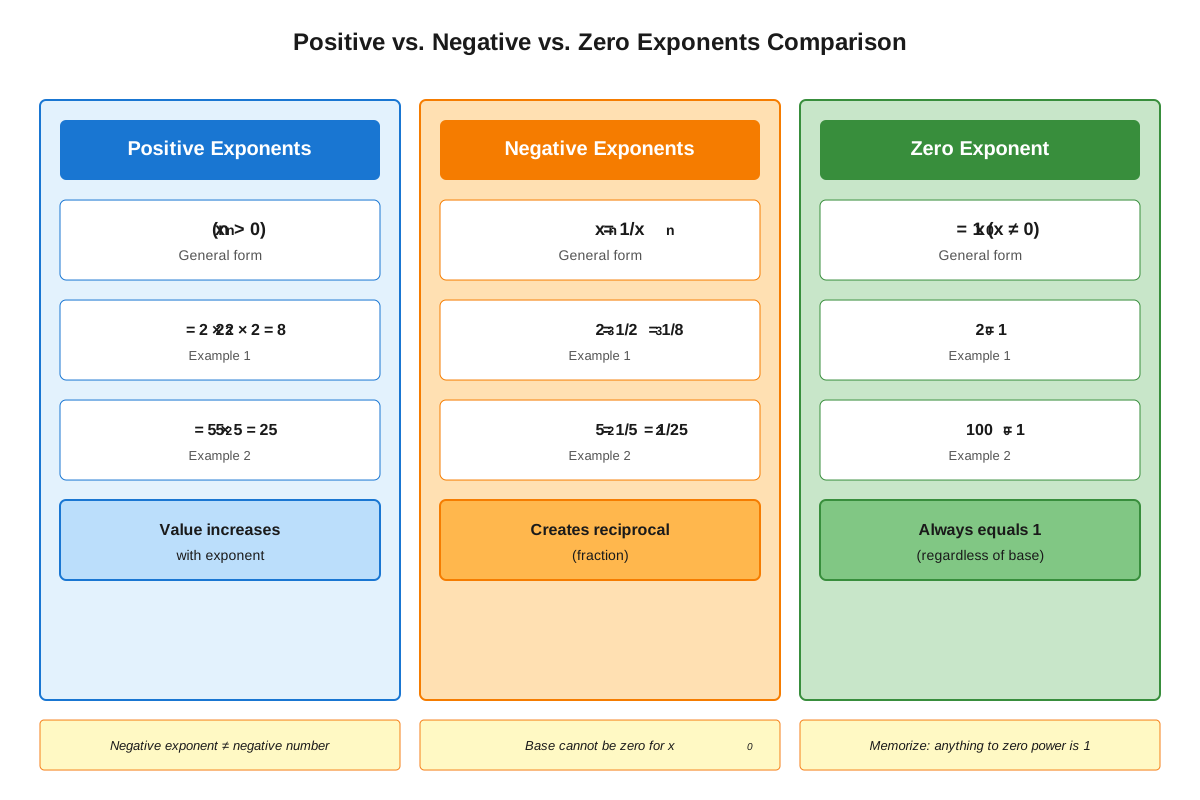
Zero Exponent: Any non-zero base raised to the power of zero equals 1.
b^0 = 1 (where b ≠ 0)Example: 5⁰ = 1, (3x²y)⁰ = 1, (-7)⁰ = 1
This rule often appears in SAT questions designed to test whether students remember this special case.
Negative Exponents: A negative exponent indicates the reciprocal of the base raised to the positive exponent.
b^(-n) = 1/b^nExample: 2^(-3) = 1/2³ = 1/8, x^(-2) = 1/x²
Negative exponents frequently appear in SAT answer choices, and students must recognize that they don't make the entire expression negative—they indicate reciprocals.
One as an Exponent: Any base raised to the first power equals itself.
b^1 = bWorking with Coefficients and Multiple Variables
When exponential expressions include coefficients and multiple variables, apply exponent rules carefully to each component. Consider the expression (2x³y²)⁴:
- Apply the power to the coefficient: 2⁴ = 16
- Apply the power to x: (x³)⁴ = x^(3·4) = x¹²
- Apply the power to y: (y²)⁴ = y^(2·4) = y⁸
- Combine: 16x¹²y⁸
For division problems like (12x⁵y³)/(3x²y), simplify coefficients and variables separately:
- Coefficients: 12/3 = 4
- x terms: x⁵/x² = x^(5-2) = x³
- y terms: y³/y¹ = y^(3-1) = y²
- Result: 4x³y²
Exponential Equations
Exponential equations contain variables in the exponent position. The SAT tests two primary solution strategies:
Strategy 1: Equal Bases Method
If both sides can be expressed with the same base, set the exponents equal.
Example: Solve 2^(x+3) = 32
- Rewrite 32 as a power of 2: 32 = 2⁵
- Equation becomes: 2^(x+3) = 2⁵
- Set exponents equal: x + 3 = 5
- Solve: x = 2
Strategy 2: Taking Roots or Logarithms
For equations where bases cannot easily be made equal, other methods apply (though logarithms are rarely required on the SAT).
Comparison Table of Exponent Operations
| Operation | Same Base Required? | Rule | Example |
|---|---|---|---|
| Multiplication | Yes | Add exponents | x³ · x⁴ = x⁷ |
| Division | Yes | Subtract exponents | x⁵ / x² = x³ |
| Power of power | N/A | Multiply exponents | (x²)³ = x⁶ |
| Power of product | N/A | Distribute exponent | (xy)³ = x³y³ |
| Negative exponent | N/A | Take reciprocal | x^(-2) = 1/x² |
| Zero exponent | N/A | Result is 1 | x⁰ = 1 |
Concept Relationships
The laws of exponents form an interconnected system where each rule relates to fundamental properties of multiplication. The product rule (adding exponents when multiplying) derives directly from the definition of exponents as repeated multiplication: x³ · x² = (x·x·x) · (x·x) = x⁵. This foundational understanding leads to the quotient rule (subtracting exponents when dividing), which represents canceling common factors.
The power rule extends the product rule to situations where the repeated multiplication happens in layers: (x²)³ means x² · x² · x², which by the product rule equals x^(2+2+2) = x⁶. The power of a product rule and power of a quotient rule both stem from the distributive nature of exponentiation over multiplication and division.
Negative exponents connect to the quotient rule: when subtracting a larger exponent from a smaller one (x² / x⁵ = x^(2-5) = x^(-3)), the result must equal the algebraic simplification (x·x)/(x·x·x·x·x) = 1/x³, establishing that x^(-3) = 1/x³. The zero exponent rule emerges from the quotient rule when identical expressions divide: x³/x³ = x^(3-3) = x⁰, and since any number divided by itself equals 1, x⁰ = 1.
These exponential concepts connect to prerequisite knowledge of integer operations (exponents represent repeated multiplication) and fraction operations (negative exponents create fractions). They lead forward to radical expressions (roots are fractional exponents: √x = x^(1/2)), polynomial operations (combining like terms with exponents), and exponential functions (f(x) = b^x). The relationship map flows: Basic Multiplication → Repeated Multiplication (Exponents) → Exponent Laws → Exponential Equations → Exponential Functions → Growth/Decay Models.
Quick check — test yourself on Exponential expressions so far.
Try Flashcards →High-Yield Facts
⭐ When multiplying with the same base, add exponents: x^a · x^b = x^(a+b)
⭐ When dividing with the same base, subtract exponents: x^a / x^b = x^(a-b)
⭐ When raising a power to a power, multiply exponents: (x^a)^b = x^(ab)
⭐ Any non-zero number raised to the zero power equals 1: x⁰ = 1 (x ≠ 0)
⭐ A negative exponent means reciprocal: x^(-a) = 1/x^a
- When raising a product to a power, distribute the exponent to all factors: (xy)^a = x^a · y^a
- When raising a quotient to a power, distribute the exponent to numerator and denominator: (x/y)^a = x^a/y^a
- Exponents apply only to their immediate base unless parentheses indicate otherwise: -3² = -9, but (-3)² = 9
- In exponential equations with equal bases, equal exponents: if b^x = b^y, then x = y
- Coefficients and exponents follow different rules: in 3x², the 3 is not affected by exponent operations on x
- The order of operations requires evaluating exponents before multiplication or division: 2 · 3² = 2 · 9 = 18, not 6² = 36
- Fractional exponents represent roots: x^(1/2) = √x, x^(1/3) = ∛x
- Adding or subtracting exponential expressions requires like terms: x² + x³ cannot be simplified further
- Scientific notation uses powers of 10: 3.5 × 10⁴ = 35,000
- The base 1 raised to any power equals 1: 1^n = 1 for all n
Common Misconceptions
Misconception: When multiplying exponential expressions, multiply the exponents.
Correction: When multiplying with the same base, add the exponents, not multiply them. x² · x³ = x⁵, not x⁶. Multiplying exponents only occurs when raising a power to a power: (x²)³ = x⁶.
Misconception: A negative exponent makes the entire expression negative.
Correction: A negative exponent indicates a reciprocal, not a negative value. 2^(-3) = 1/8 (positive), not -8. The negative sign in the exponent moves the base to the denominator but doesn't change the sign of the result.
Misconception: The zero exponent rule means the expression equals zero.
Correction: Any non-zero base raised to the zero power equals 1, not 0. x⁰ = 1, (5y³)⁰ = 1. This is one of the most commonly tested misconceptions on the SAT.
Misconception: Exponent rules apply when adding or subtracting exponential terms.
Correction: Exponent rules only apply to multiplication, division, and raising to powers. x² + x³ cannot be simplified using exponent rules; these are not like terms. Only x² + x² = 2x² (combining like terms, not using exponent rules).
Misconception: The exponent applies to everything in the expression without parentheses.
Correction: Exponents apply only to their immediate base. In 2x³, only x is cubed, giving 2·x·x·x. To cube both 2 and x, parentheses are required: (2x)³ = 8x³. Similarly, -x² means -(x²) = -x·x, while (-x)² = (-x)(-x) = x².
Misconception: When dividing exponential expressions, divide the exponents.
Correction: When dividing with the same base, subtract the exponents. x⁶/x² = x^(6-2) = x⁴, not x^(6/2) = x³.
Misconception: Different bases can be combined using exponent rules.
Correction: Exponent rules for multiplication and division require the same base. x² · y³ cannot be simplified further because the bases differ. However, (xy)² = x²y² uses the power of a product rule.
Worked Examples
Example 1: Simplifying Complex Exponential Expressions
Problem: Simplify the expression (3x²y³)² · (2x³y)³ / (6xy²)²
Solution:
Step 1: Apply the power of a product rule to each term.
For (3x²y³)²:
- 3² = 9
- (x²)² = x⁴
- (y³)² = y⁶
- Result: 9x⁴y⁶
For (2x³y)³:
- 2³ = 8
- (x³)³ = x⁹
- y³ = y³
- Result: 8x⁹y³
For (6xy²)²:
- 6² = 36
- x² = x²
- (y²)² = y⁴
- Result: 36x²y⁴
Step 2: Rewrite the expression with simplified terms.
(9x⁴y⁶) · (8x⁹y³) / (36x²y⁴)
Step 3: Multiply the numerator terms.
- Coefficients: 9 · 8 = 72
- x terms: x⁴ · x⁹ = x^(4+9) = x¹³
- y terms: y⁶ · y³ = y^(6+3) = y⁹
- Numerator: 72x¹³y⁹
Step 4: Divide by the denominator.
72x¹³y⁹ / 36x²y⁴
- Coefficients: 72/36 = 2
- x terms: x¹³/x² = x^(13-2) = x¹¹
- y terms: y⁹/y⁴ = y^(9-4) = y⁵
Final Answer: 2x¹¹y⁵
This problem demonstrates the systematic application of multiple exponent rules and connects to the learning objective of simplifying exponential expressions using all laws of exponents.
Example 2: Solving an Exponential Equation
Problem: If 4^(x+2) = 8^(2x-1), what is the value of x?
Solution:
Step 1: Express both sides using the same base. Since 4 = 2² and 8 = 2³, use base 2.
Left side: 4^(x+2) = (2²)^(x+2) = 2^(2(x+2)) = 2^(2x+4)
Right side: 8^(2x-1) = (2³)^(2x-1) = 2^(3(2x-1)) = 2^(6x-3)
Step 2: Rewrite the equation with equal bases.
2^(2x+4) = 2^(6x-3)
Step 3: Since the bases are equal, set the exponents equal.
2x + 4 = 6x - 3
Step 4: Solve for x.
4 + 3 = 6x - 2x
7 = 4x
x = 7/4 or 1.75
Step 5: Verify (optional but recommended).
Left side: 4^(7/4 + 2) = 4^(15/4) = 2^(15/2)
Right side: 8^(2·7/4 - 1) = 8^(7/2 - 1) = 8^(5/2) = (2³)^(5/2) = 2^(15/2) ✓
Final Answer: x = 7/4 or 1.75
This problem illustrates the equal bases method for solving exponential equations and connects to the learning objective of applying exponential expressions to answer SAT-style questions.
Exam Strategy
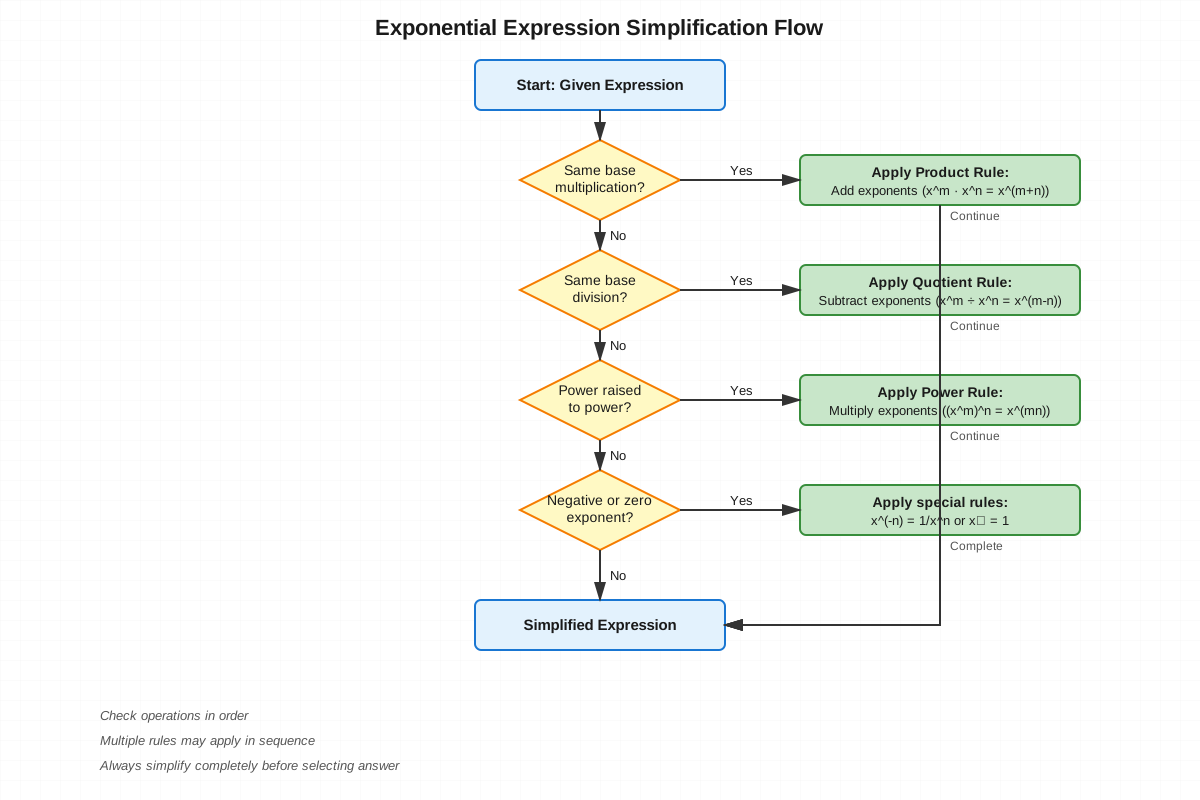
When approaching SAT questions involving exponential expressions, begin by identifying what the question asks: simplification, solving for a variable, or identifying equivalent expressions. Read carefully to determine whether the question requires numerical calculation or algebraic manipulation.
Trigger words and phrases that signal exponential expression questions include: "simplify," "equivalent to," "which expression equals," "solve for x," "if a^x = b," and "in terms of." Questions about scientific notation, growth rates, or compound interest also involve exponential expressions. Watch for phrases like "raised to the power" or "squared/cubed."
Process-of-elimination strategies work particularly well for exponential questions. When answer choices contain exponential expressions:
- Check exponent signs (positive vs. negative) first—this often eliminates 2-3 choices immediately
- Verify coefficients separately from variable terms
- Test with simple values (like x = 2) if algebraic manipulation seems complex
- Look for the zero exponent rule—if any term has a zero exponent, it equals 1
- Eliminate choices with different variables than the original expression
Time allocation: Most exponential expression questions should take 45-90 seconds. If a problem requires more than 2 minutes, consider whether you're missing a simpler approach. Questions asking for simplification typically take less time than those requiring equation solving. Don't spend excessive time on complex calculations—the SAT rewards efficient pattern recognition over lengthy computation.
Strategic approaches:
- For simplification: Apply one rule at a time, working systematically through the expression
- For equations: Always try the equal bases method first before considering other approaches
- For multiple-choice: Substitute answer choices back into the original equation when solving seems difficult
- For grid-in: Double-check that your answer makes sense (positive when expected, reasonable magnitude)
Common traps to avoid: The SAT frequently includes answer choices that result from common errors—multiplying instead of adding exponents, forgetting the zero exponent rule, or mishandling negative exponents. When you arrive at an answer quickly, verify it's not the result of a common mistake.
Memory Techniques
MADSPM - Mnemonic for remembering when to add, subtract, or multiply exponents:
- Multiply same base → Add exponents
- Divide same base → Subtract exponents
- Power to power → Multiply exponents
"Negative means flip" - For negative exponents, visualize flipping the fraction: x^(-3) flips to 1/x³. The negative sign tells you to flip the base to the opposite part of the fraction (numerator to denominator or vice versa).
"Zero makes one" - Any base (except zero itself) raised to zero power equals one. Visualize the exponent zero as a magic wand that transforms any expression into 1.
"Same base, same rules" - Exponent rules for multiplication and division only work when bases match. Visualize bases as team uniforms—only players on the same team (same base) can use the special rules.
Power distribution visualization: When raising a product or quotient to a power, imagine the exponent as rain falling equally on everything inside the parentheses. (xy)³ → the 3 "rains down" on both x and y → x³y³.
The reciprocal flip: For expressions like (a/b)^(-n), remember "negative flips twice"—first flip for the negative exponent, then flip the fraction: (a/b)^(-n) = (b/a)^n.
Summary
Exponential expressions represent a high-yield SAT math topic that combines pattern recognition with systematic rule application. Mastery requires understanding the five fundamental laws of exponents: adding exponents when multiplying like bases, subtracting when dividing, multiplying exponents when raising powers to powers, and distributing exponents across products and quotients. Special cases—zero exponents equaling one and negative exponents indicating reciprocals—appear frequently in SAT questions designed to test conceptual understanding rather than mere calculation. Success with exponential expressions depends on recognizing which rule applies to each situation, working systematically through multi-step simplifications, and avoiding common errors like multiplying exponents when adding is correct or treating negative exponents as negative values. Students who develop fluency with these concepts can quickly simplify complex expressions, solve exponential equations by equating bases, and identify equivalent forms among answer choices, skills that directly translate to correct answers on test day.
Key Takeaways
- The five core exponent rules govern all exponential expression manipulation: product rule (add exponents), quotient rule (subtract exponents), power rule (multiply exponents), power of a product (distribute exponents), and power of a quotient (distribute exponents)
- Any non-zero base raised to the zero power equals 1, not zero—this is one of the most frequently tested special cases on the SAT
- Negative exponents indicate reciprocals, not negative values: x^(-n) = 1/x^n, and the result is positive when the base is positive
- Exponent rules only apply to multiplication, division, and raising to powers—not to addition or subtraction of exponential terms
- When solving exponential equations, express both sides with the same base, then set exponents equal to find the solution
- Coefficients and exponents follow different rules and must be handled separately when simplifying expressions
- Systematic application of one rule at a time prevents errors and leads to correct simplification of complex expressions
Related Topics
Radical Expressions and Rational Exponents: Exponential expressions with fractional exponents connect directly to radicals (x^(1/2) = √x). Mastering exponential expressions provides the foundation for understanding how roots and powers relate, enabling simplification of radical expressions and conversion between radical and exponential forms.
Polynomial Operations: Adding, subtracting, and multiplying polynomials requires understanding how to combine terms with exponents. The exponent rules learned here apply when multiplying polynomial terms and simplifying polynomial expressions.
Exponential Functions: The expressions studied here form the basis of exponential functions f(x) = b^x, which model growth and decay. Understanding how to manipulate exponential expressions enables analysis of exponential function behavior, transformations, and applications.
Logarithms: Logarithms are the inverse operations of exponential expressions. While logarithms appear less frequently on the SAT, understanding exponential expressions provides the foundation for logarithmic concepts when they do appear.
Scientific Notation: This practical application of exponential expressions uses powers of 10 to express very large or very small numbers, appearing in SAT science-context problems and data interpretation questions.
Practice CTA
Now that you've mastered the core concepts of exponential expressions, it's time to solidify your understanding through practice. Attempt the practice questions to apply these rules in SAT-style contexts, and use the flashcards to reinforce the key facts and formulas. Remember, fluency with exponential expressions comes from repeated application—each practice problem strengthens your pattern recognition and speeds up your problem-solving. The investment you make in practicing this high-yield topic will pay dividends across multiple questions on test day. You've got this!
Sign up free to keep reading
Create a free AnvayaPrep account to finish this SAT guide on Exponential expressions — plus flashcards and practice questions.