Overview
Exponential graphs represent one of the most powerful and frequently tested concepts in SAT math. These graphs model situations where quantities grow or decay at rates proportional to their current value—a pattern that appears everywhere from population growth to radioactive decay, from compound interest to viral spread. On the SAT, exponential functions typically appear in 2-4 questions per test, making them a high-yield topic that rewards thorough preparation.
Understanding exponential graphs requires recognizing their distinctive curved shape, identifying key features like y-intercepts and asymptotes, and interpreting how changes to the function's equation affect the graph's appearance. Unlike linear functions that change at constant rates, exponential functions change at rates that themselves change—creating the characteristic "J-curve" that accelerates rapidly. This fundamental difference makes exponential graphs both visually distinctive and conceptually important for modeling real-world phenomena.
Mastery of exponential graphs connects directly to broader mathematical literacy on the SAT. These functions bridge algebra (manipulating exponential expressions), coordinate geometry (analyzing graphs), and applied problem-solving (interpreting real-world scenarios). Students who understand exponential graphs gain tools for tackling questions about growth and decay, comparing different mathematical models, and translating between equations, tables, and visual representations—all essential skills for achieving top scores on the SAT Math section.
Learning Objectives
- [ ] Identify key features of exponential graphs including y-intercepts, asymptotes, domain, and range
- [ ] Explain how exponential graphs appears on the SAT in both abstract and applied contexts
- [ ] Apply exponential graphs to answer SAT-style questions involving growth and decay
- [ ] Distinguish between exponential growth and exponential decay based on graph characteristics
- [ ] Determine the effect of parameter changes on exponential graph transformations
- [ ] Interpret exponential graphs in real-world contexts such as population growth and compound interest
- [ ] Compare exponential and linear functions to identify which model best fits given data
Prerequisites
- Basic function notation: Understanding f(x) notation is essential for reading and interpreting exponential function equations
- Coordinate plane familiarity: Plotting points and reading graphs enables visualization of exponential behavior
- Exponent rules: Knowledge of how exponents work (positive, negative, fractional) underlies understanding of exponential function behavior
- Linear functions: Comparing exponential to linear growth helps highlight the distinctive accelerating nature of exponential change
- Basic algebraic manipulation: Solving simple equations and substituting values allows for working with exponential expressions
Why This Topic Matters
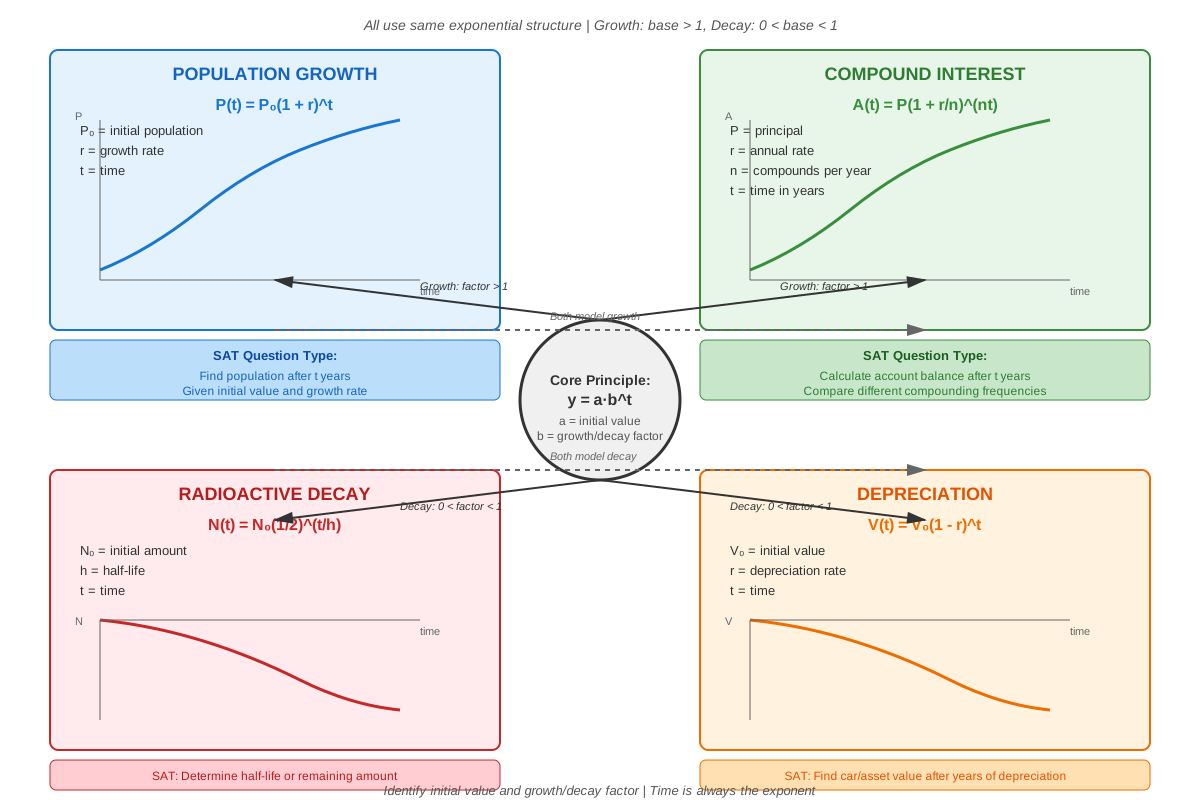
Exponential functions model some of the most important phenomena in science, finance, and everyday life. Population growth follows exponential patterns when resources are abundant. Money grows exponentially through compound interest. Radioactive materials decay exponentially over time. Viral content spreads exponentially across social networks. Understanding exponential graphs provides the mathematical foundation for analyzing these critical real-world situations.
On the SAT, exponential graphs appear with remarkable consistency. Test-takers can expect 2-4 questions per exam involving exponential functions, representing approximately 5-10% of the Math section. These questions appear in multiple formats: identifying graphs from equations, determining equations from graphs, interpreting real-world scenarios, and comparing exponential to other function types. The College Board particularly favors questions that combine exponential graphs with applied contexts—asking students to interpret what specific features mean in practical situations.
SAT exponential graphs questions typically appear in three main forms: (1) pure graph identification where students match equations to visual representations, (2) parameter interpretation where students explain how changing values in the equation affects the graph, and (3) applied problems where exponential models represent real situations like bacterial growth, investment returns, or depreciation. The most challenging questions often combine multiple skills, requiring students to both manipulate exponential expressions algebraically and interpret their graphical representations.
Core Concepts
The General Form of Exponential Functions
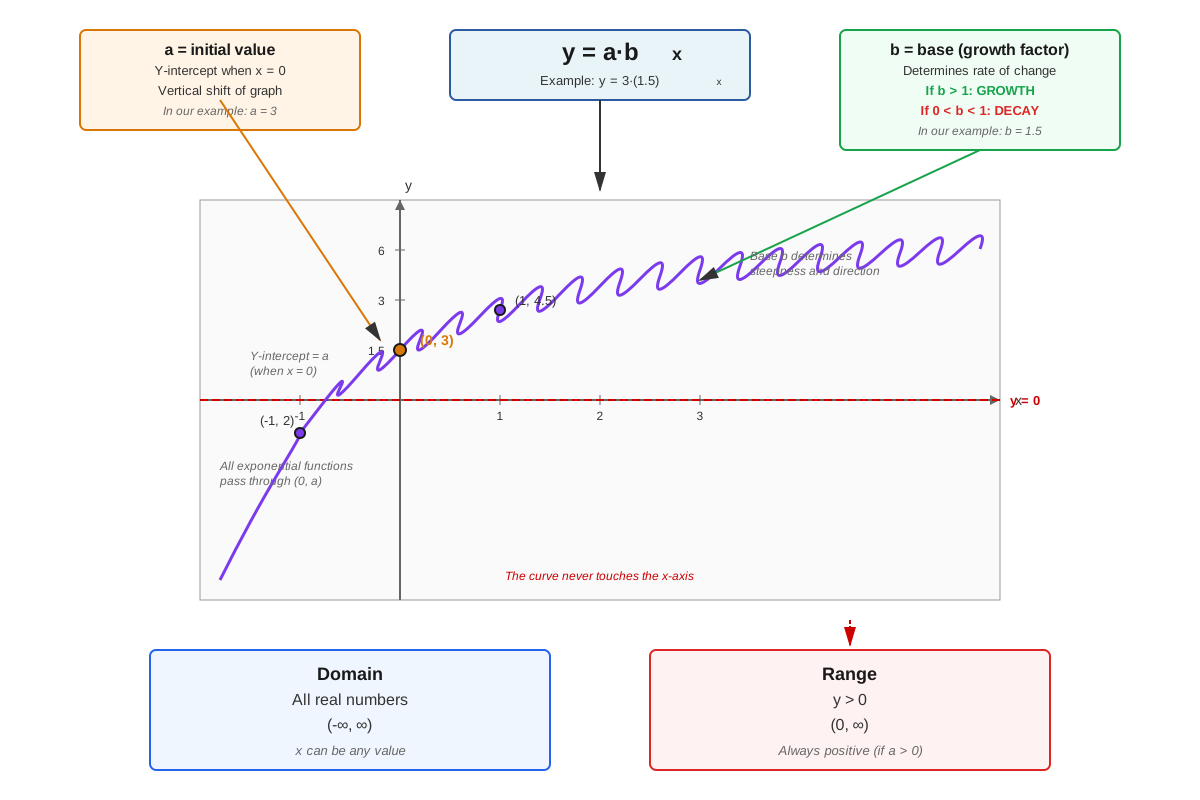
An exponential function follows the general form:
f(x) = a · b^xWhere:
- a represents the initial value (y-intercept when x = 0)
- b represents the base (growth/decay factor)
- x represents the independent variable (often time)
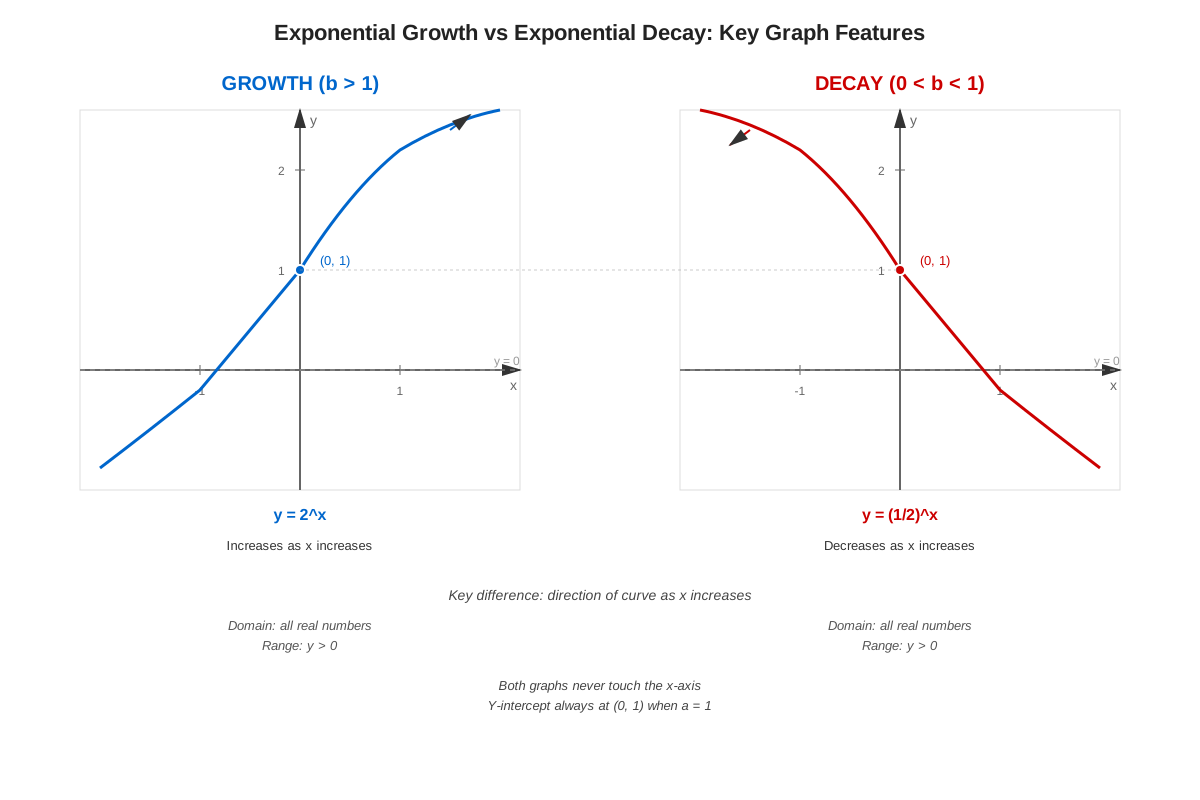
The base b determines the fundamental behavior of the function. When b > 1, the function exhibits exponential growth—values increase as x increases. When 0 < b < 1, the function exhibits exponential decay—values decrease as x increases. The SAT frequently tests whether students can identify growth versus decay from either the equation or the graph.
Key Features of Exponential Graphs
Every exponential graph possesses several distinctive characteristics that make them recognizable and analyzable:
Y-intercept: The point where the graph crosses the y-axis always occurs at (0, a). This represents the initial value before any growth or decay occurs. On the SAT, questions often ask students to identify what this value represents in context—such as the starting population or initial investment.
Horizontal asymptote: Exponential graphs approach but never touch the x-axis (y = 0) as x approaches negative infinity (for growth functions) or positive infinity (for decay functions). This asymptotic behavior reflects that exponential quantities approach zero but never become negative. Some SAT questions feature transformed exponential functions with asymptotes at y = k rather than y = 0.
Domain and range: The domain of basic exponential functions includes all real numbers (−∞, ∞), while the range includes only positive real numbers (0, ∞) for standard forms. Understanding these constraints helps eliminate incorrect answer choices on multiple-choice questions.
Increasing vs. decreasing behavior: Growth functions (b > 1) are always increasing—moving upward from left to right. Decay functions (0 < b < 1) are always decreasing—moving downward from left to right. This monotonic behavior distinguishes exponential functions from polynomials that may change direction.
Exponential Growth Graphs
Exponential growth functions create the characteristic "J-curve" shape that starts slowly and accelerates rapidly. Consider f(x) = 2^x:
| x | f(x) |
|---|---|
| -2 | 0.25 |
| -1 | 0.5 |
| 0 | 1 |
| 1 | 2 |
| 2 | 4 |
| 3 | 8 |
Notice how the function values double with each unit increase in x. This constant multiplicative rate of change (rather than additive) creates the accelerating curve. As x increases, the graph rises more and more steeply, eventually appearing almost vertical. As x decreases (moving left), the graph approaches the x-axis asymptotically, getting closer and closer to zero without ever touching.
The steepness of exponential growth depends on the base value. Larger bases (like f(x) = 3^x) grow more rapidly than smaller bases (like f(x) = 1.5^x). The SAT often presents multiple exponential graphs and asks students to match them with their equations based on relative steepness.
Exponential Decay Graphs
Exponential decay functions create a mirror-image pattern, starting high and decreasing toward zero. Consider f(x) = (1/2)^x or equivalently f(x) = 2^(-x):
| x | f(x) |
|---|---|
| -2 | 4 |
| -1 | 2 |
| 0 | 1 |
| 1 | 0.5 |
| 2 | 0.25 |
| 3 | 0.125 |
The function values halve with each unit increase in x. The graph descends from left to right, starting steep and gradually flattening as it approaches the horizontal asymptote. Real-world decay processes like radioactive half-life, drug concentration in the bloodstream, and vehicle depreciation all follow this pattern.
Transformations of Exponential Graphs
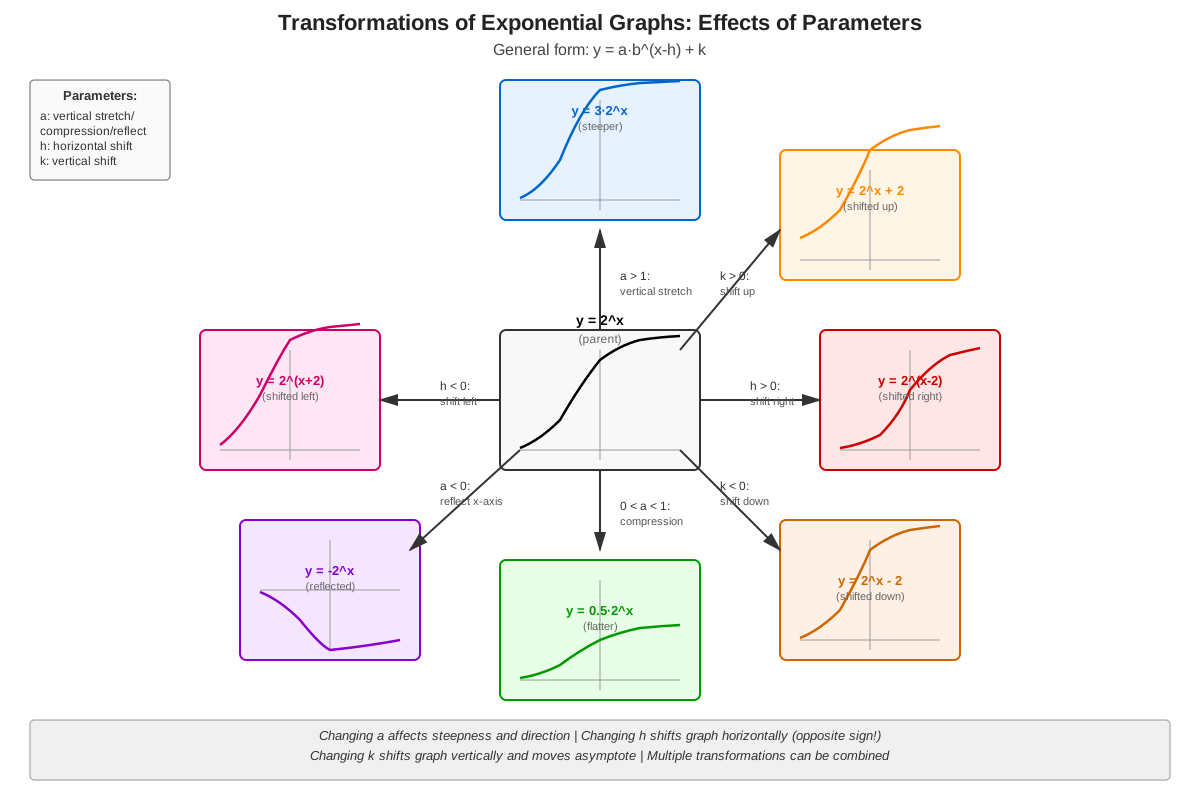
The SAT frequently tests understanding of how modifications to the basic exponential equation affect the graph:
Vertical stretch/compression: In f(x) = a · b^x, changing the value of a stretches (|a| > 1) or compresses (0 < |a| < 1) the graph vertically. This changes the y-intercept and affects how quickly the function reaches large values, but doesn't change the fundamental growth/decay rate.
Horizontal shifts: The function f(x) = b^(x-h) shifts the graph h units horizontally. Positive h shifts right; negative h shifts left. These shifts don't change the y-intercept but do affect where the graph reaches specific values.
Vertical shifts: The function f(x) = b^x + k shifts the graph k units vertically, moving the horizontal asymptote from y = 0 to y = k. This transformation is particularly important for modeling situations with a baseline value that doesn't decay to zero.
Reflections: Negative values of a create reflections across the x-axis, while negative exponents (or bases between 0 and 1) create the decay pattern that mirrors growth functions.
Comparing Exponential and Linear Growth
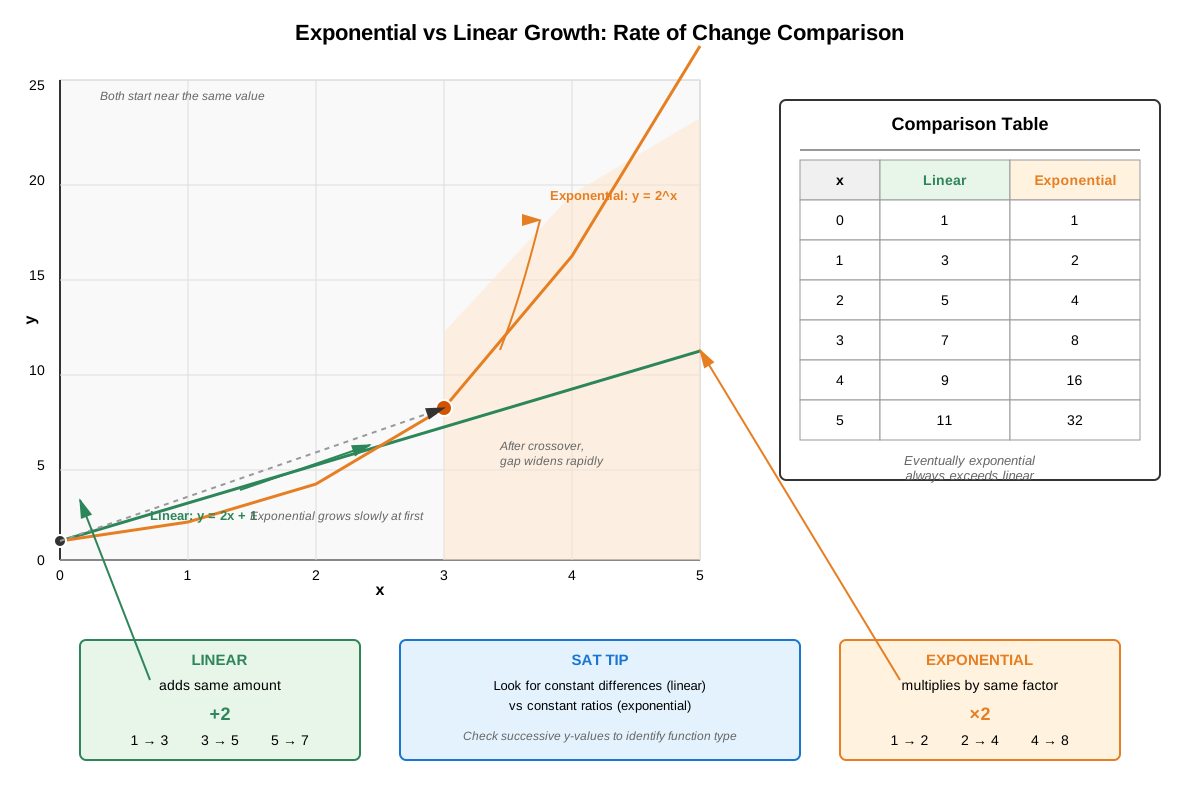
A critical SAT skill involves distinguishing exponential from linear patterns. Linear functions have constant additive change (same difference between consecutive values), while exponential functions have constant multiplicative change (same ratio between consecutive values).
| x | Linear: f(x) = 2x + 1 | Exponential: g(x) = 2^x |
|---|---|---|
| 0 | 1 | 1 |
| 1 | 3 (+2) | 2 (×2) |
| 2 | 5 (+2) | 4 (×2) |
| 3 | 7 (+2) | 8 (×2) |
| 4 | 9 (+2) | 16 (×2) |
Initially, linear growth may outpace exponential growth, but exponential functions eventually overtake and far exceed linear functions. The SAT often presents data tables or graphs and asks students to determine which function type best models the relationship.
Concept Relationships
The concepts within exponential graphs form an interconnected web of understanding. The general form equation (f(x) = a·b^x) → determines → key features (y-intercept, asymptote, domain, range) → which manifest visually in → graph shape and behavior. The base value b → controls → growth versus decay → which determines → increasing or decreasing behavior. Understanding transformations → requires → recognizing how parameter changes → affect → graph position and shape.
Exponential graphs connect backward to prerequisite knowledge of exponent rules—understanding that b^(-x) = (1/b)^x explains why negative exponents create decay. They connect forward to logarithmic functions (the inverse of exponential functions) and to more advanced modeling in calculus. Within the SAT Math curriculum, exponential graphs relate to systems of equations (finding intersections), function interpretation (reading graphs in context), and data analysis (determining best-fit models).
The relationship between algebraic and graphical representations forms the core of SAT testing: equation form ↔ visual representation ↔ real-world interpretation. Students must fluidly translate between these three representations, recognizing that each provides different insights into the same mathematical relationship.
Quick check — test yourself on Exponential graphs so far.
Try Flashcards →High-Yield Facts
⭐ The y-intercept of f(x) = a·b^x always equals a, found by evaluating f(0) = a·b^0 = a·1 = a
⭐ Exponential growth occurs when the base b > 1; exponential decay occurs when 0 < b < 1
⭐ All basic exponential graphs have a horizontal asymptote at y = 0 (the x-axis)
⭐ The domain of exponential functions is all real numbers; the range is all positive real numbers (y > 0)
⭐ Exponential functions never touch or cross their horizontal asymptote
- Exponential graphs are always smooth curves with no breaks, corners, or straight segments
- The rate of change in exponential functions is proportional to the current value (not constant)
- Multiplying the base by a constant factor shifts the graph vertically, not horizontally
- A negative coefficient (−a) reflects the exponential graph across the x-axis
- Exponential decay can be written as f(x) = a·b^x where 0 < b < 1 or as f(x) = a·b^(-x) where b > 1
- The steeper an exponential growth curve, the larger its base value
- In real-world contexts, the base often represents "1 plus the growth rate" (e.g., 1.05 for 5% growth)
Common Misconceptions
Misconception: Exponential graphs eventually become straight lines at steep angles.
Correction: Exponential graphs continuously curve, becoming steeper and steeper without ever becoming truly straight. The rate of increase itself increases, creating ever-increasing curvature.
Misconception: The y-intercept of an exponential function can be zero.
Correction: For functions of the form f(x) = a·b^x where a ≠ 0, the y-intercept equals a and cannot be zero. If a = 0, the function becomes f(x) = 0 for all x (not truly exponential).
Misconception: Exponential decay graphs eventually reach zero and become flat along the x-axis.
Correction: Exponential decay approaches zero asymptotically but never reaches it. The graph continues decreasing forever, getting infinitesimally close to but never touching y = 0.
Misconception: Changing the base from 2 to 3 in f(x) = 2^x shifts the graph horizontally.
Correction: Changing the base affects the steepness (rate of growth) but doesn't shift the graph left or right. Both f(x) = 2^x and f(x) = 3^x pass through (0, 1), but f(x) = 3^x grows more rapidly.
Misconception: Exponential functions can have negative outputs.
Correction: Standard exponential functions f(x) = a·b^x with positive a and b always produce positive outputs. Negative outputs only occur with transformations like f(x) = −a·b^x (reflection) or f(x) = b^x − k where k is large enough.
Misconception: The equation f(x) = x^2 represents exponential growth because it grows rapidly.
Correction: Exponential functions have the variable in the exponent (f(x) = 2^x), not as the base. The function f(x) = x^2 is quadratic (polynomial), not exponential, despite also showing accelerating growth.
Misconception: All exponential graphs look essentially the same.
Correction: While sharing common features, exponential graphs vary significantly in steepness (based on the base value), starting height (based on the coefficient a), and position (based on transformations). Recognizing these differences is crucial for matching equations to graphs.
Worked Examples
Example 1: Identifying Graph Features from an Equation
Problem: The function f(x) = 3(2)^x models the population of bacteria in a culture, where x represents time in hours and f(x) represents the number of bacteria in thousands. Identify the initial population, determine whether the population is growing or decaying, and find the population after 4 hours.
Solution:
Step 1: Identify the initial population by finding the y-intercept.
The y-intercept occurs when x = 0:
f(0) = 3(2)^0 = 3(1) = 3
Since f(x) is measured in thousands, the initial population is 3,000 bacteria.
Step 2: Determine growth or decay by examining the base.
The base is b = 2, and since 2 > 1, this represents exponential growth. The population is increasing over time.
Step 3: Calculate the population after 4 hours.
f(4) = 3(2)^4 = 3(16) = 48
After 4 hours, the population is 48,000 bacteria.
Connection to learning objectives: This problem demonstrates identifying key features (y-intercept, growth vs. decay) and applying exponential graphs to answer SAT-style questions in a real-world context.
Example 2: Matching Equations to Graphs
Problem: Four exponential functions are given:
- Function A: f(x) = 2^x
- Function B: g(x) = 3^x
- Function C: h(x) = (1/2)^x
- Function D: j(x) = 2^x + 1
Which function has the steepest growth? Which function represents decay? Which function does not pass through the point (0, 1)?
Solution:
Step 1: Determine which function has the steepest growth.
Growth functions have bases greater than 1. Both A and B show growth, but B has the larger base (3 > 2). Larger bases create steeper growth curves, so Function B: g(x) = 3^x has the steepest growth.
Step 2: Identify the decay function.
Decay occurs when 0 < b < 1. Function C: h(x) = (1/2)^x has a base of 1/2, which falls in this range. Function C represents exponential decay.
Step 3: Find which function doesn't pass through (0, 1).
For basic exponential functions f(x) = b^x, the y-intercept is always (0, 1) because b^0 = 1.
- Function A: f(0) = 2^0 = 1 ✓
- Function B: g(0) = 3^0 = 1 ✓
- Function C: h(0) = (1/2)^0 = 1 ✓
- Function D: j(0) = 2^0 + 1 = 1 + 1 = 2 ✗
Function D: j(x) = 2^x + 1 passes through (0, 2) instead of (0, 1) due to the vertical shift.
Connection to learning objectives: This problem requires identifying key features of exponential graphs, distinguishing growth from decay, and understanding how transformations affect graph characteristics—all essential SAT skills.
Exam Strategy
When approaching SAT exponential graphs questions, begin by identifying what the question asks: matching equations to graphs, interpreting features in context, or determining parameter values. Read carefully to distinguish between growth and decay scenarios.
Trigger words and phrases to watch for include:
- "Initial value" or "starting amount" → indicates the y-intercept (coefficient a)
- "Growth rate" or "decay rate" → relates to the base b
- "Doubles every" or "halves every" → indicates the base (2 for doubling, 1/2 for halving)
- "Approaches but never reaches" → refers to the horizontal asymptote
- "Increases/decreases rapidly" → suggests exponential rather than linear behavior
For graph-matching questions, use process of elimination effectively:
- First, determine growth vs. decay by checking if the graph rises or falls from left to right
- Eliminate all equations with the wrong type (growth bases > 1, decay bases < 1)
- Check the y-intercept to eliminate equations with incorrect a values
- Compare relative steepness if multiple options remain (larger bases = steeper curves)
For applied problems, translate the context into mathematical features:
- Identify what x and f(x) represent (often time and quantity)
- Determine the initial value from the problem setup
- Calculate the growth/decay factor from percentage changes (5% growth → multiply by 1.05)
- Verify your answer makes sense in context (populations shouldn't be negative, etc.)
Time allocation: Most exponential graph questions should take 60-90 seconds. If a question requires extensive calculation, check whether estimation or elimination strategies might be faster. The SAT rewards efficient problem-solving, not just correct answers.
Memory Techniques
BASE mnemonic for identifying growth vs. decay:
- Bigger than 1 = Ascending (growth)
- Smaller than 1 = Expanding downward (decay)
Y-INTERCEPT memory aid: "When x is zero, b to the zero equals one, so y equals a—the coefficient alone!"
Asymptote visualization: Picture the exponential curve as a rocket launch (growth) or airplane landing (decay). The rocket never returns to ground level (asymptote at y = 0), and the plane approaches the runway but takes time to actually touch down.
GROWTH acronym for exponential increase:
- Gets steeper over time
- Rises continuously
- Outpaces linear functions eventually
- Without bound (no maximum)
- Times itself by constant factor
- Has base greater than one
Transformation memory: "Coefficient changes HEIGHT (vertical stretch), exponent changes SHIFT (horizontal movement), added constant changes ASYMPTOTE (vertical shift)."
Summary
Exponential graphs represent functions where the independent variable appears as an exponent, creating distinctive curved patterns that model growth and decay in countless real-world situations. The general form f(x) = a·b^x contains all essential information: a determines the y-intercept and initial value, while b determines whether the function grows (b > 1) or decays (0 < b < 1). These graphs feature horizontal asymptotes at y = 0, domains including all real numbers, and ranges limited to positive values. On the SAT, exponential graphs appear in 2-4 questions per test, testing students' ability to identify features from equations, match graphs to equations, interpret transformations, and apply exponential models to real-world contexts. Success requires recognizing the characteristic J-curve shape, understanding how parameter changes affect graph appearance, and distinguishing exponential from linear patterns. Mastery of exponential graphs provides essential tools for modeling population growth, compound interest, radioactive decay, and other phenomena where rates of change depend on current values.
Key Takeaways
- Exponential functions have the form f(x) = a·b^x where a is the y-intercept and b determines growth (b > 1) or decay (0 < b < 1)
- All exponential graphs have a horizontal asymptote (typically y = 0), approach but never touch this asymptote, and curve continuously without straight segments
- The y-intercept always equals the coefficient a, found by evaluating f(0) = a·b^0 = a
- Exponential growth accelerates over time (gets steeper), while exponential decay decelerates (flattens out), creating mirror-image patterns
- Transformations affect graphs predictably: changing a stretches vertically, changing b affects steepness, adding constants shifts position
- SAT questions frequently test graph-equation matching, real-world interpretation, and distinguishing exponential from linear patterns
- Process of elimination works effectively by checking growth/decay type, y-intercept values, and relative steepness
Related Topics
Logarithmic Functions: The inverse of exponential functions, logarithms "undo" exponentiation and create graphs that are reflections of exponential graphs across the line y = x. Mastering exponential graphs provides the foundation for understanding logarithmic relationships.
Exponential Equations: Solving equations where the variable appears in an exponent requires techniques like taking logarithms or using common bases. Understanding exponential graphs helps visualize solutions and verify answers.
Compound Interest and Growth Models: Real-world applications of exponential functions include financial calculations, population dynamics, and scientific phenomena. Graph interpretation skills enable analysis of these practical situations.
Function Transformations: The systematic study of how modifications to function equations affect their graphs applies across all function types. Exponential graphs provide clear examples of transformation principles.
Systems of Equations with Exponentials: Finding where exponential and linear (or other) functions intersect requires both algebraic and graphical reasoning, combining multiple SAT math skills.
Practice CTA
Now that you've mastered the core concepts of exponential graphs, it's time to cement your understanding through active practice. Work through the practice questions to test your ability to identify graph features, match equations to visual representations, and solve applied problems. Use the flashcards to reinforce key definitions and high-yield facts until they become automatic. Remember: exponential graphs appear on every SAT, and the skills you've learned here will directly translate to points on test day. The more you practice recognizing these distinctive curves and their characteristics, the faster and more confident you'll become. You've got this!
Sign up free to keep reading
Create a free AnvayaPrep account to finish this SAT guide on Exponential graphs — plus flashcards and practice questions.