Overview
Negative exponents represent one of the most frequently tested algebraic concepts on the SAT exam, appearing in approximately 10-15% of all math questions across both calculator and no-calculator sections. Understanding negative exponents is fundamental to simplifying expressions, solving equations, and working with scientific notation—all critical skills for achieving a competitive score. Despite their intimidating appearance, negative exponents follow straightforward rules that, once mastered, become powerful tools for manipulating algebraic expressions efficiently.
The concept of negative exponents extends the basic rules of exponents into the realm of reciprocals and fractions. When students encounter an expression like x⁻³, they must recognize this as equivalent to 1/x³, transforming what appears to be a complex notation into a manageable fraction. This transformation skill is essential because SAT questions frequently require students to convert between exponential forms, simplify complex fractions, and recognize equivalent expressions—all within strict time constraints.
Negative exponents connect directly to multiple other mathematical domains tested on the SAT, including rational expressions, polynomial operations, scientific notation, and exponential functions. Mastery of this topic creates a foundation for understanding inverse relationships, growth and decay problems, and the behavior of functions as variables approach zero or infinity. Students who develop fluency with negative exponents gain significant advantages in both the Heart of Algebra and Passport to Advanced Math content domains, making this a high-yield topic worthy of focused study and practice.
Learning Objectives
- [ ] Identify key features of negative exponents and recognize them in various algebraic expressions
- [ ] Explain how negative exponents appears on the SAT across different question formats and difficulty levels
- [ ] Apply negative exponents to answer SAT-style questions efficiently and accurately
- [ ] Convert expressions with negative exponents to equivalent forms using positive exponents and fractions
- [ ] Simplify complex expressions containing multiple terms with negative exponents
- [ ] Evaluate numerical expressions with negative exponents without a calculator
- [ ] Recognize and avoid common errors when manipulating negative exponents in algebraic operations
Prerequisites
- Positive integer exponents: Understanding that x³ means x·x·x is essential because negative exponents build directly on this foundation by introducing reciprocals
- Fraction operations: Proficiency with multiplying, dividing, and simplifying fractions enables students to work confidently with the fractional forms that result from negative exponents
- Basic algebraic manipulation: Comfort with variables, coefficients, and combining like terms allows students to simplify complex expressions containing negative exponents
- Order of operations: Knowing when to apply exponent rules relative to other operations prevents calculation errors in multi-step problems
Why This Topic Matters
Negative exponents appear throughout real-world applications in science, engineering, and finance. Scientists use negative exponents to express extremely small quantities like atomic radii (10⁻¹⁰ meters) or electrical charges. Engineers employ them in formulas for electrical resistance, wave frequencies, and decay rates. Financial analysts use negative exponents when calculating present value and compound interest over time periods. Understanding negative exponents enables students to interpret data presented in scientific notation and to work with formulas that model inverse relationships.
On the SAT, negative exponents appear in approximately 3-5 questions per test, distributed across both the calculator and no-calculator sections. These questions typically fall into several categories: direct simplification problems requiring students to rewrite expressions with positive exponents, equation-solving questions where isolating variables involves manipulating negative exponents, and word problems involving exponential decay or inverse variation. The College Board frequently embeds negative exponents within more complex algebraic expressions to test whether students can apply multiple exponent rules simultaneously.
Questions involving negative exponents commonly appear as multiple-choice problems asking students to identify equivalent expressions, grid-in questions requiring numerical evaluation, and multi-step problems where negative exponents are one component of a larger algebraic challenge. The SAT particularly favors questions that combine negative exponents with other operations like multiplication, division, and raising powers to powers, testing students' ability to apply the correct sequence of exponent rules under time pressure.
Core Concepts
Definition of Negative Exponents
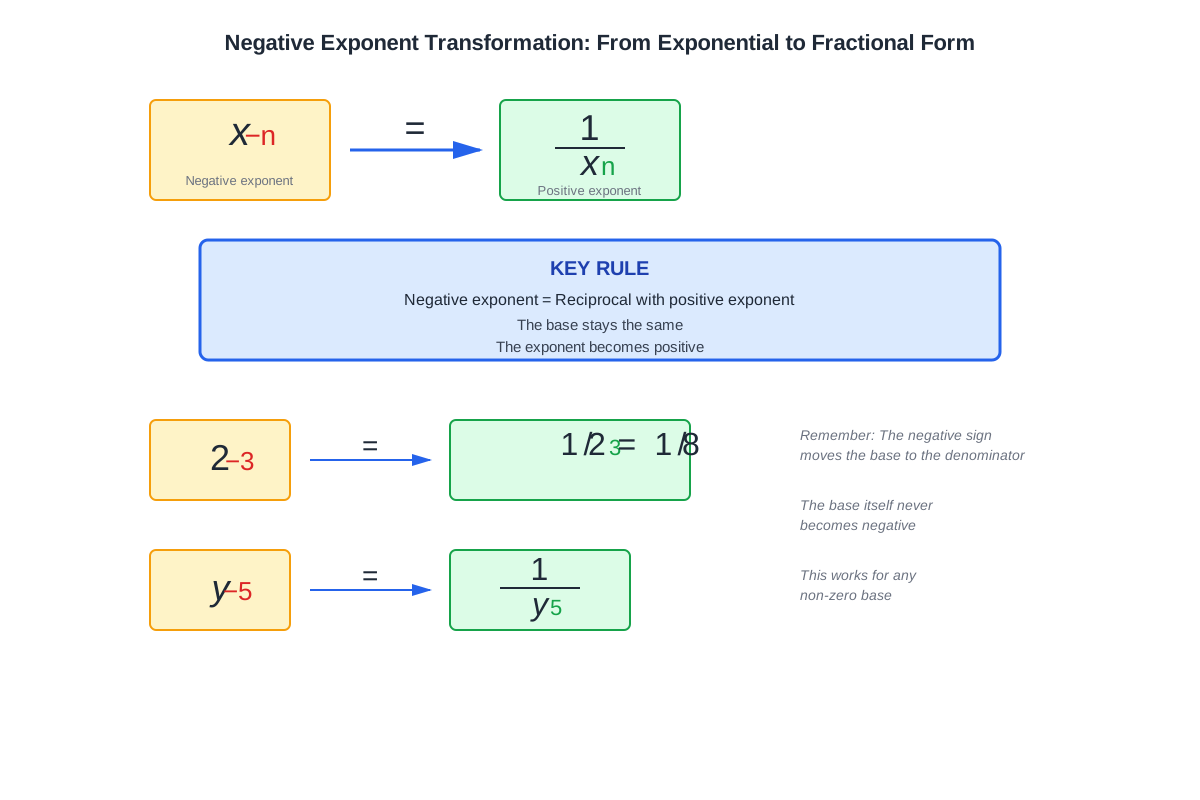
A negative exponent indicates the reciprocal of the base raised to the corresponding positive exponent. The fundamental rule states that for any nonzero number a and positive integer n:
a⁻ⁿ = 1/aⁿThis definition means that x⁻⁵ equals 1/x⁵, and 2⁻³ equals 1/2³ = 1/8. The negative sign in the exponent does not make the result negative; rather, it signals a reciprocal operation. This is a critical distinction that prevents one of the most common student errors.
The rule applies equally to variables and numerical bases. For example, (3x)⁻² = 1/(3x)² = 1/(9x²), demonstrating how the negative exponent affects the entire base expression. When the base itself is a fraction, the negative exponent flips the fraction: (2/5)⁻³ = (5/2)³ = 125/8.
Converting Between Forms
Converting expressions with negative exponents to positive exponents (and vice versa) is an essential skill for simplification and comparison. The conversion process follows these steps:
- Identify the base and the negative exponent
- Write the reciprocal of the base (1 divided by the base)
- Change the exponent to positive
- Simplify if necessary
For example, converting 4x⁻³y² to positive exponents:
- The term x⁻³ has a negative exponent
- Write as 4 · (1/x³) · y²
- Result: 4y²/x³
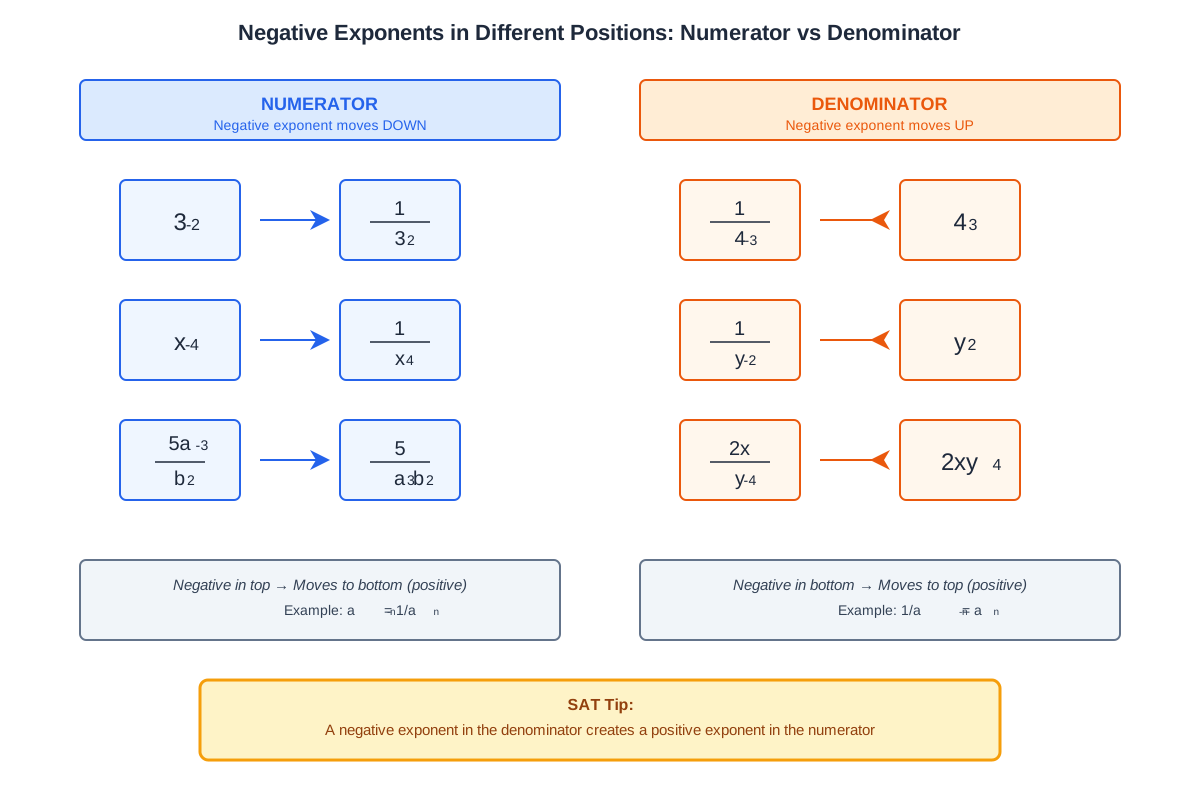
When negative exponents appear in denominators, they move to the numerator with positive exponents: 1/x⁻⁴ = x⁴. This "flip" property is particularly useful for simplifying complex fractions.
Exponent Rules with Negative Exponents
All standard exponent rules apply to negative exponents. Understanding how to apply these rules correctly is crucial for SAT success.
| Rule Name | Formula | Example with Negative Exponents |
|---|---|---|
| Product Rule | aᵐ · aⁿ = aᵐ⁺ⁿ | x⁻³ · x⁻⁵ = x⁻⁸ = 1/x⁸ |
| Quotient Rule | aᵐ / aⁿ = aᵐ⁻ⁿ | x⁻² / x⁻⁷ = x⁵ |
| Power Rule | (aᵐ)ⁿ = aᵐⁿ | (x⁻³)⁴ = x⁻¹² = 1/x¹² |
| Power of Product | (ab)ⁿ = aⁿbⁿ | (2x)⁻³ = 2⁻³x⁻³ = 1/(8x³) |
| Power of Quotient | (a/b)ⁿ = aⁿ/bⁿ | (x/3)⁻² = x⁻²/3⁻² = 9/x² |
The product rule with negative exponents requires careful attention to signs when adding exponents. For instance, x³ · x⁻⁵ = x³⁺⁽⁻⁵⁾ = x⁻² = 1/x². Students must remember that adding a negative number is equivalent to subtraction.
The quotient rule often produces positive exponents from negative ones. When dividing x⁻² by x⁻⁵, subtract the exponents: -2 - (-5) = -2 + 5 = 3, yielding x³. This demonstrates how division can eliminate negative exponents entirely.
Zero Exponent Connection
The zero exponent rule (a⁰ = 1 for any nonzero a) connects directly to negative exponents through the quotient rule. Consider x³/x³ = 1 (any number divided by itself equals 1). Using the quotient rule: x³/x³ = x³⁻³ = x⁰. Therefore, x⁰ must equal 1. This same logic extends to negative exponents: x²/x⁵ = x²⁻⁵ = x⁻³, which must equal 1/x³ to maintain consistency with fraction division.
Simplifying Complex Expressions
SAT questions frequently present expressions with multiple terms containing various positive and negative exponents. Simplification requires systematic application of exponent rules:
For expressions like (2x⁻³y²)⁻⁴:
- Apply the power rule to each factor: 2⁻⁴ · x¹² · y⁻⁸
- Evaluate numerical bases: (1/16) · x¹² · y⁻⁸
- Convert to positive exponents: x¹²/(16y⁸)
When combining like terms with negative exponents, factor out the term with the smallest (most negative) exponent: x⁻⁵ + x⁻³ = x⁻⁵(1 + x²) = (1 + x²)/x⁵.
Numerical Evaluation
Evaluating expressions with negative exponents numerically is a common SAT task, especially in the no-calculator section. The key is converting to fractions before calculating:
- 2⁻⁴ = 1/2⁴ = 1/16
- 5⁻² = 1/5² = 1/25
- (1/3)⁻² = 3² = 9
For more complex expressions like 2⁻³ + 3⁻², convert each term separately: 1/8 + 1/9 = 9/72 + 8/72 = 17/72.
Concept Relationships
Negative exponents serve as a bridge between several fundamental mathematical concepts. The definition of negative exponents directly connects to reciprocals and fractions, as every negative exponent can be rewritten as a fraction with a positive exponent in the denominator. This relationship flows into rational expressions, where negative exponents frequently appear in both simplified and unsimplified forms.
The connection between negative exponents and the quotient rule is particularly strong: when dividing powers with the same base, subtracting exponents naturally produces negative results when the denominator's exponent exceeds the numerator's. This leads to understanding inverse relationships, where quantities with negative exponents decrease as the base increases.
Negative exponents → reciprocals → fractions → rational expressions → equation solving
The power rule with negative exponents connects to polynomial operations, as expressions like (x⁻²)³ require understanding both exponent multiplication and sign rules. This relationship extends to function transformations, where negative exponents in function notation indicate inverse or reciprocal relationships.
Scientific notation relies heavily on negative exponents to represent small numbers (3.2 × 10⁻⁶), connecting this algebraic concept to real-world applications in science and measurement. This practical application reinforces why mastering negative exponents matters beyond pure mathematics.
Quick check — test yourself on Negative exponents so far.
Try Flashcards →High-Yield Facts
⭐ Any nonzero base raised to a negative exponent equals the reciprocal of that base raised to the positive exponent: a⁻ⁿ = 1/aⁿ
⭐ Negative exponents in the denominator move to the numerator with positive exponents: 1/x⁻³ = x³
⭐ When multiplying powers with the same base, add the exponents even when they're negative: x⁻² · x⁻⁵ = x⁻⁷
⭐ When dividing powers with the same base, subtract the exponents: x⁻³/x⁻⁷ = x⁴
⭐ A negative exponent does NOT make the result negative; it creates a reciprocal
- When raising a power to a power, multiply the exponents: (x⁻³)⁴ = x⁻¹²
- The expression x⁻¹ always equals 1/x (the multiplicative inverse)
- Negative exponents apply to the entire base: (2x)⁻³ = 1/(2x)³ = 1/(8x³)
- Zero raised to any negative exponent is undefined because division by zero is undefined
- Fractional bases with negative exponents flip the fraction: (a/b)⁻ⁿ = (b/a)ⁿ
- When simplifying, convert all negative exponents to positive exponents in the final answer unless otherwise specified
- The product of a term and its negative exponent version equals the base to the zero power: x³ · x⁻³ = x⁰ = 1
Common Misconceptions
Misconception: A negative exponent makes the entire expression negative.
Correction: Negative exponents create reciprocals, not negative numbers. The expression 2⁻³ equals 1/8 (positive), not -8. The negative sign affects the position (numerator vs. denominator), not the sign of the result.
Misconception: When converting x⁻⁴ to positive exponents, the result is -x⁴.
Correction: The correct conversion is 1/x⁴. The negative exponent indicates reciprocal, not negation. The variable x remains positive (or takes whatever sign it has), and the expression becomes a fraction.
Misconception: The expression 3x⁻² equals 3/x².
Correction: This is actually correct, but students often mistakenly write 1/(3x²). The negative exponent applies only to x, not to the coefficient 3. Only the factor with the negative exponent moves to the denominator.
Misconception: When adding exponents with negative signs, the result is always negative.
Correction: Adding exponents follows standard integer addition rules. For example, x⁻² · x⁵ = x⁻²⁺⁵ = x³ (positive exponent). The sum of a negative and positive number can be positive, negative, or zero depending on their magnitudes.
Misconception: The expression (x⁻²)⁻³ equals x⁻⁵.
Correction: When raising a power to a power, multiply the exponents: (x⁻²)⁻³ = x⁽⁻²⁾⁽⁻³⁾ = x⁶. Multiplying two negative numbers yields a positive result, so the final exponent is positive.
Misconception: Negative exponents can be ignored or treated as positive when simplifying quickly.
Correction: Negative exponents fundamentally change the structure of an expression by creating reciprocals. Ignoring them leads to answers that are off by factors of x², x³, or more, resulting in completely incorrect solutions.
Misconception: The expression 1/x⁻³ simplifies to 1/x³.
Correction: When a negative exponent appears in the denominator, it moves to the numerator with a positive exponent: 1/x⁻³ = x³. The double reciprocal (reciprocal of a reciprocal) returns to the original form.
Worked Examples
Example 1: Simplifying a Complex Expression
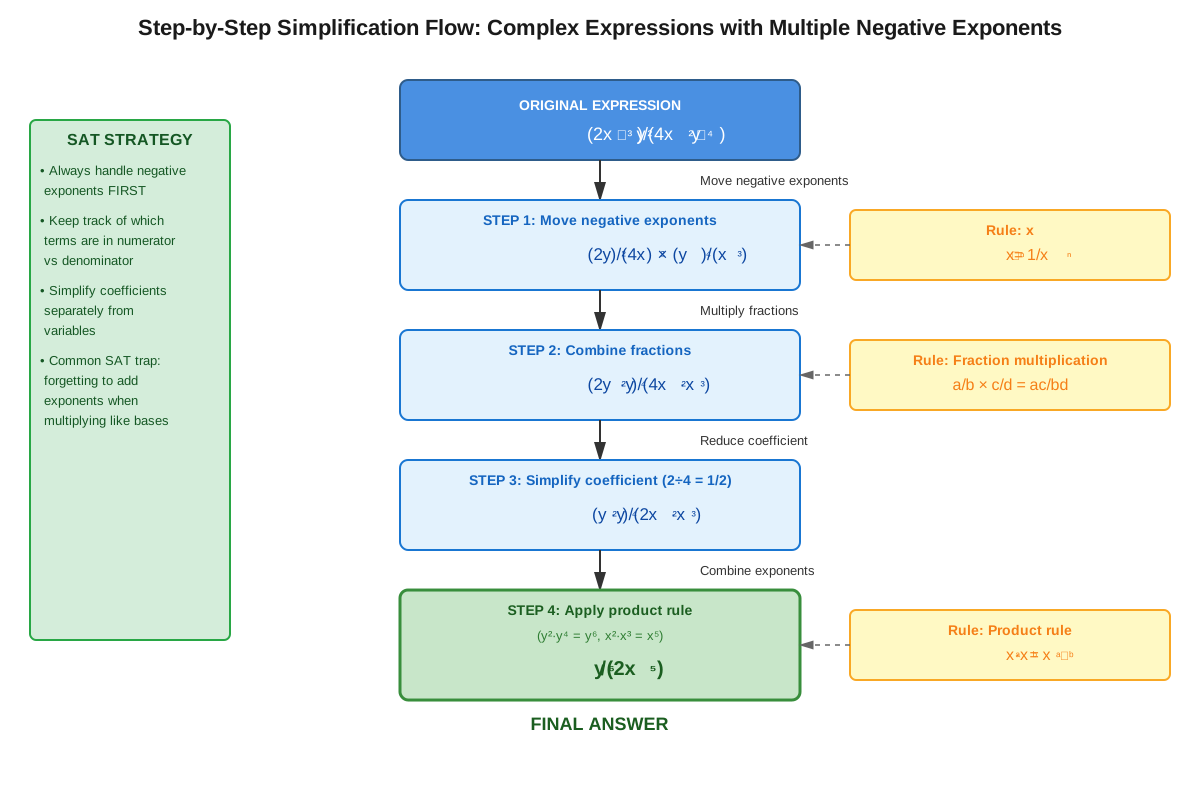
Problem: Simplify the expression (2x⁻³y²)⁻² / (4x²y⁻⁴) and write with positive exponents only.
Solution:
Step 1: Apply the power rule to the numerator.
- (2x⁻³y²)⁻² = 2⁻² · (x⁻³)⁻² · (y²)⁻²
- = 2⁻² · x⁶ · y⁻⁴
- = (1/4) · x⁶ · y⁻⁴
Step 2: Rewrite the entire expression.
- [(1/4) · x⁶ · y⁻⁴] / [4x²y⁻⁴]
Step 3: Separate into numerical and variable components.
- (1/4 ÷ 4) · (x⁶ ÷ x²) · (y⁻⁴ ÷ y⁻⁴)
Step 4: Simplify each component.
- Numerical: 1/4 ÷ 4 = 1/16
- x terms: x⁶⁻² = x⁴
- y terms: y⁻⁴⁻⁽⁻⁴⁾ = y⁰ = 1
Step 5: Combine results.
- (1/16) · x⁴ · 1 = x⁴/16
Answer: x⁴/16
This problem demonstrates the importance of systematically applying the power rule, quotient rule, and careful attention to negative signs when subtracting exponents. The y terms completely cancel because they have identical exponents, illustrating how negative exponents can simplify to the zero exponent.
Example 2: Evaluating a Numerical Expression
Problem: Without a calculator, evaluate: 3⁻² + 2⁻³ - (1/2)⁻²
Solution:
Step 1: Convert each term with negative exponents to fractions.
- 3⁻² = 1/3² = 1/9
- 2⁻³ = 1/2³ = 1/8
- (1/2)⁻² = (2/1)² = 4 (flipping the fraction and making exponent positive)
Step 2: Rewrite the expression.
- 1/9 + 1/8 - 4
Step 3: Find a common denominator for the fractions (LCD = 72).
- 1/9 = 8/72
- 1/8 = 9/72
Step 4: Combine the fractions.
- 8/72 + 9/72 = 17/72
Step 5: Subtract the whole number.
- 17/72 - 4 = 17/72 - 288/72 = -271/72
Answer: -271/72 (or approximately -3.76)
This example illustrates several key concepts: converting negative exponents to fractions, handling fractional bases with negative exponents (which flip the fraction), and combining terms with different forms. The final answer is negative not because of the negative exponents, but because of the subtraction operation with a larger positive number.
Exam Strategy
When approaching SAT questions involving negative exponents, begin by identifying all terms with negative exponents and mentally noting whether they're in the numerator or denominator. This initial scan prevents errors from overlooking negative exponents buried within complex expressions. Questions that ask for "equivalent expressions" often test whether students can correctly convert between negative and positive exponent forms.
Trigger words and phrases to watch for include: "simplify," "write with positive exponents," "equivalent to," "which expression equals," and "evaluate without a calculator." When a question asks to "simplify," the SAT typically expects all negative exponents converted to positive form with the expression written as a single fraction if necessary. The phrase "equivalent to" signals that multiple answer choices may look different but one matches the given expression exactly when simplified.
For process of elimination, immediately eliminate answer choices that have negative signs in front of expressions when the original has only negative exponents (remember: negative exponents don't make results negative). Also eliminate choices where the base appears in the wrong location (numerator vs. denominator). If the question involves numerical evaluation, estimate the magnitude: 2⁻⁵ is a small positive number (1/32), so eliminate any answer choices that are negative or greater than 1.
Time allocation for negative exponent questions should be approximately 45-60 seconds for straightforward simplification problems and 90-120 seconds for multi-step problems combining negative exponents with other operations. If a problem requires more than two minutes, mark it for review and move on—these questions test efficiency as much as knowledge. Practice converting negative exponents to positive form quickly, as this skill saves valuable seconds on test day.
When stuck, try working backwards from answer choices by converting them all to the same form (all positive or all negative exponents) and comparing. This strategy is particularly effective for multiple-choice questions asking which expression is equivalent to a given expression.
Memory Techniques
"Negative Means Navigate": When you see a negative exponent, navigate (move) the base to the opposite location—numerator to denominator or denominator to numerator—and make the exponent positive. This mnemonic reinforces the reciprocal nature of negative exponents.
"Flip and Switch": For negative exponents, flip the base to the other side of the fraction bar and switch the sign of the exponent to positive. This two-step phrase helps students remember both actions required.
The "Opposite Day" Visualization: Imagine negative exponents as "opposite day" for the base's location. If it's on top, it wants to be on bottom (and vice versa). Once it moves to the opposite location, the exponent becomes positive because it's "happy" in its new home.
"Add When Multiply, Subtract When Divide": This acronym helps remember that multiplying powers means adding exponents (even negative ones), while dividing powers means subtracting exponents. The parallel structure makes both rules easier to recall under pressure.
Finger Counting for Signs: When multiplying exponents (power to a power), use fingers to track signs: one finger for each negative. Even number of fingers (two negatives) = positive result; odd number of fingers = negative result. This kinesthetic technique helps students avoid sign errors.
Summary
Negative exponents represent reciprocals of positive exponents, transforming expressions like x⁻³ into 1/x³. This fundamental concept appears frequently on the SAT across multiple question types, requiring students to convert between forms, simplify complex expressions, and evaluate numerical expressions. All standard exponent rules—product, quotient, power, and power of a product—apply to negative exponents with careful attention to sign rules when adding or subtracting exponents. The key to mastery lies in recognizing that negative exponents indicate position (numerator versus denominator) rather than negative values, and systematically applying conversion rules to achieve simplified forms with positive exponents. Success with negative exponents requires both conceptual understanding of reciprocals and procedural fluency with exponent rules, as SAT questions often embed negative exponents within multi-step problems testing multiple algebraic skills simultaneously. Students who develop automatic recognition of negative exponent patterns and practice converting between forms efficiently gain significant advantages in both accuracy and speed on test day.
Key Takeaways
- Negative exponents create reciprocals: a⁻ⁿ = 1/aⁿ for any nonzero base a
- Negative exponents do not make expressions negative; they indicate the reciprocal operation
- All standard exponent rules apply to negative exponents with careful attention to sign arithmetic
- Converting between negative and positive exponent forms is essential for simplification and comparison
- When multiplying or dividing powers with negative exponents, add or subtract exponents following integer rules
- Negative exponents in denominators move to numerators with positive exponents (and vice versa)
- SAT questions frequently test negative exponents combined with other algebraic operations, requiring systematic application of multiple rules
Related Topics
Rational Expressions and Equations: Mastering negative exponents provides the foundation for simplifying complex rational expressions where variables appear in denominators with various powers. This progression enables solving equations involving fractions and understanding domain restrictions.
Scientific Notation: Negative exponents are essential for expressing very small numbers in scientific notation (e.g., 3.2 × 10⁻⁶), connecting algebraic skills to real-world scientific applications and data interpretation questions on the SAT.
Exponential Functions and Growth/Decay: Understanding negative exponents leads naturally to studying exponential decay functions where the exponent is negative, modeling phenomena like radioactive decay, depreciation, and cooling processes.
Polynomial Operations: Combining negative exponents with polynomial addition, subtraction, and multiplication builds toward advanced algebraic manipulation skills tested in Passport to Advanced Math questions.
Logarithms: Negative exponents connect to logarithmic relationships, as log(a⁻ⁿ) = -n·log(a), providing a bridge to more advanced mathematical concepts in precalculus and calculus.
Practice CTA
Now that you've mastered the core concepts of negative exponents, it's time to solidify your understanding through active practice. Attempt the practice questions designed specifically to mirror SAT question formats and difficulty levels. Work through each problem systematically, applying the strategies and techniques covered in this guide. Use the flashcards to reinforce quick recognition of negative exponent patterns and conversion rules—speed and accuracy both matter on test day. Remember, confidence with negative exponents comes from repeated practice and learning from mistakes. Each problem you solve strengthens your mathematical intuition and brings you closer to your target score. You've got this!
Sign up free to keep reading
Create a free AnvayaPrep account to finish this SAT guide on Negative exponents — plus flashcards and practice questions.