Overview
Simplifying radicals is a foundational algebraic skill that appears frequently on the SAT Math section, testing students' ability to manipulate and reduce expressions containing square roots, cube roots, and higher-order roots. This topic requires understanding how to break down radical expressions into their simplest forms by identifying perfect square factors, applying radical properties, and rationalizing denominators. Mastery of this concept is essential because radical expressions appear not only as standalone simplification problems but also embedded within equations, functions, geometry problems, and word problems throughout the exam.
The SAT consistently includes 2-4 questions per test that directly or indirectly assess radical simplification skills. These questions may ask students to simplify radical expressions, combine like radicals, rationalize denominators, or recognize equivalent forms of radical expressions. Understanding sat simplifying radicals enables students to work efficiently with quadratic formulas, distance formulas, Pythagorean theorem applications, and various geometric relationships involving area and volume. The ability to recognize when radicals are in simplest form and to convert between radical and exponential notation provides a significant advantage in both calculator and no-calculator sections.
Within the broader math curriculum, simplifying radicals connects directly to exponent rules, factorization, and rational expressions. This topic serves as a bridge between basic arithmetic operations and more advanced algebraic manipulations, including solving radical equations and working with complex numbers. Students who master radical simplification develop stronger number sense and pattern recognition skills that transfer to multiple areas of the SAT Math section, making this a high-yield topic worthy of focused study and practice.
Learning Objectives
- [ ] Identify key features of simplifying radicals, including perfect square factors and irreducible forms
- [ ] Explain how simplifying radicals appears on the SAT across different question types and contexts
- [ ] Apply simplifying radicals to answer SAT-style questions efficiently and accurately
- [ ] Determine whether a radical expression is in simplest form by checking for perfect nth powers under the radical
- [ ] Rationalize denominators containing radicals using appropriate multiplication techniques
- [ ] Combine and simplify expressions containing multiple radical terms with like and unlike radicands
- [ ] Convert between radical notation and exponential notation to solve complex problems
Prerequisites
- Prime factorization: Essential for identifying perfect square factors within radicands and breaking down composite numbers systematically
- Exponent rules: Necessary for understanding the relationship between radicals and fractional exponents (√x = x^(1/2))
- Multiplication and division of fractions: Required for rationalizing denominators and simplifying complex radical expressions
- Perfect squares recognition: Students must quickly identify perfect squares (1, 4, 9, 16, 25, 36, 49, 64, 81, 100, 121, 144, etc.) to efficiently simplify radicals
- Distributive property: Needed for multiplying radical expressions and expanding binomials containing radicals
Why This Topic Matters
Simplifying radicals represents a critical skill set that extends far beyond the SAT into real-world applications in engineering, physics, computer graphics, and financial modeling. Engineers use radical expressions when calculating distances in three-dimensional space, determining structural loads, and analyzing wave frequencies. In physics, radical expressions appear in formulas for kinetic energy, pendulum periods, and electromagnetic field calculations. Computer programmers working with graphics and game development regularly manipulate radical expressions when calculating distances, rotations, and transformations in coordinate systems.
On the SAT specifically, radical simplification appears in approximately 10-15% of all Math questions, making it one of the most frequently tested algebraic skills. Questions involving radicals typically appear in multiple formats: direct simplification problems worth 1 point each, multi-step algebra problems where simplification is an intermediate step, geometry problems requiring the Pythagorean theorem or distance formula, and grid-in questions where the answer must be expressed in simplest radical form. The College Board consistently includes at least one question requiring rationalization of denominators and another requiring combination of like radical terms.
Common exam scenarios include: simplifying √(72) or similar expressions; solving equations like x² = 50 and expressing the answer in simplest radical form; finding the exact distance between two points and leaving the answer as a simplified radical; determining side lengths in 45-45-90 or 30-60-90 triangles; and identifying equivalent expressions among answer choices where one option contains a simplified radical. Students who can quickly recognize perfect square factors and apply simplification rules gain significant time advantages, often completing these problems in under 30 seconds compared to 90+ seconds for students who struggle with the concept.
Core Concepts
Understanding Radical Notation and Terminology
A radical is an expression that uses a root symbol (√) to indicate the inverse operation of raising to a power. The radicand is the number or expression under the radical symbol, while the index indicates which root to take (square root has an implied index of 2, cube root has index 3, etc.). For SAT purposes, square roots dominate, though occasional cube root problems appear. An expression like √50 asks "what number, when squared, equals 50?" The answer involves both a numerical coefficient and a remaining radical: 5√2.
The fundamental principle of radical simplification states that √(ab) = √a · √b, allowing us to separate factors under a radical. This property works in reverse as well: √a · √b = √(ab). Similarly, for division: √(a/b) = √a / √b. These properties form the foundation for all simplification techniques. A radical is considered in simplest form when: (1) no perfect square factors remain under the radical, (2) no fractions appear under the radical, (3) no radicals appear in denominators, and (4) the index is as small as possible.
Identifying Perfect Square Factors
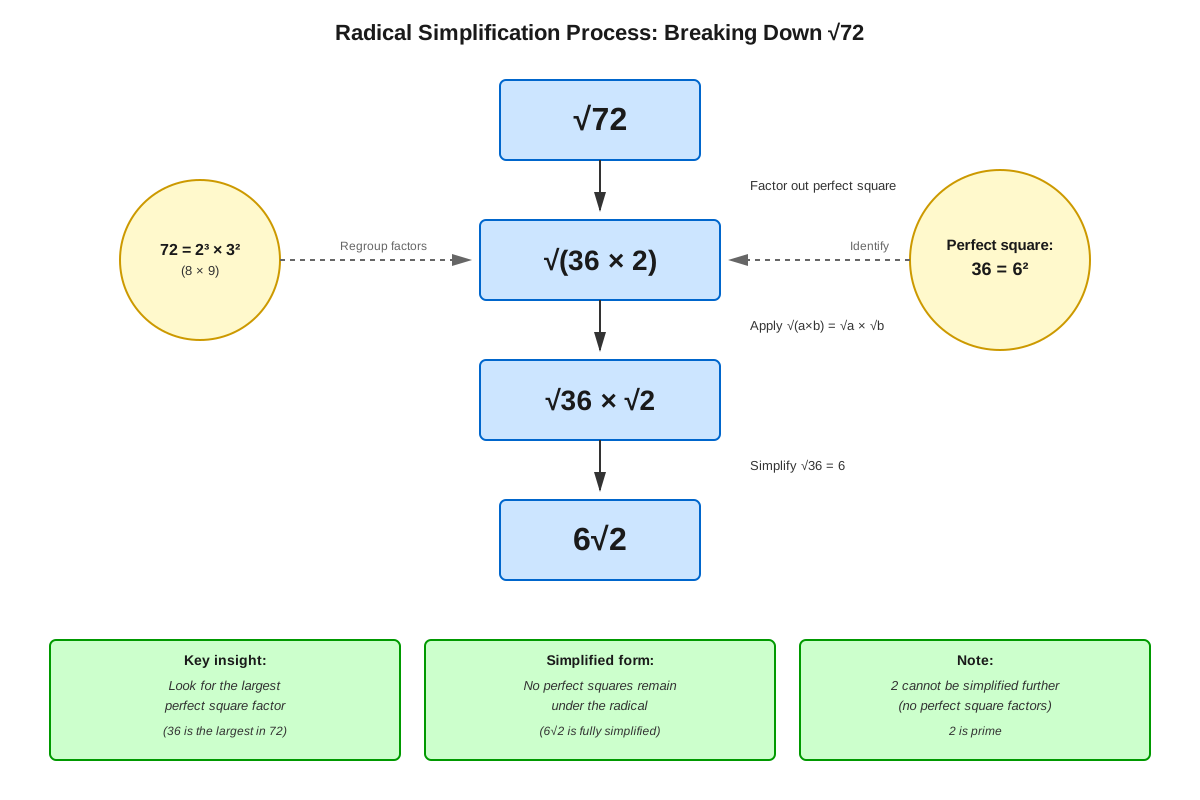
The key to efficient radical simplification lies in quickly recognizing perfect square factors within the radicand. Perfect squares are numbers that result from squaring integers: 1, 4, 9, 16, 25, 36, 49, 64, 81, 100, 121, 144, 169, 196, 225, etc. When simplifying √72, the goal is to identify the largest perfect square that divides 72. Using prime factorization: 72 = 2³ × 3² = 4 × 18 = 36 × 2. Since 36 is a perfect square (6²), we can write √72 = √(36 × 2) = √36 · √2 = 6√2.
For systematic simplification, prime factorization provides a foolproof method:
- Factor the radicand completely into prime factors
- Group pairs of identical factors (for square roots)
- Move one factor from each pair outside the radical
- Multiply factors outside the radical together
- Multiply remaining factors inside the radical together
Example: Simplify √180
- Prime factorization: 180 = 2² × 3² × 5
- Pairs: (2²) and (3²), with 5 remaining
- Result: 2 × 3 × √5 = 6√5
Simplifying Radical Expressions with Variables
When variables appear under radicals, apply the same principles while considering even and odd powers. For square roots, pairs of identical variables move outside: √(x²) = |x| (technically, though SAT typically assumes positive values), √(x⁴) = x², √(x⁶) = x³. When simplifying √(48x⁵y⁴), factor systematically:
√(48x⁵y⁴) = √(16 × 3 × x⁴ × x × y⁴) = √16 · √x⁴ · √y⁴ · √(3x) = 4x²y²√(3x)
The variable x⁵ splits into x⁴ (perfect square) and x (remainder). Always extract the highest even power possible for square roots. For cube roots, extract groups of three identical factors; for fourth roots, extract groups of four, and so on.
Rationalizing Denominators
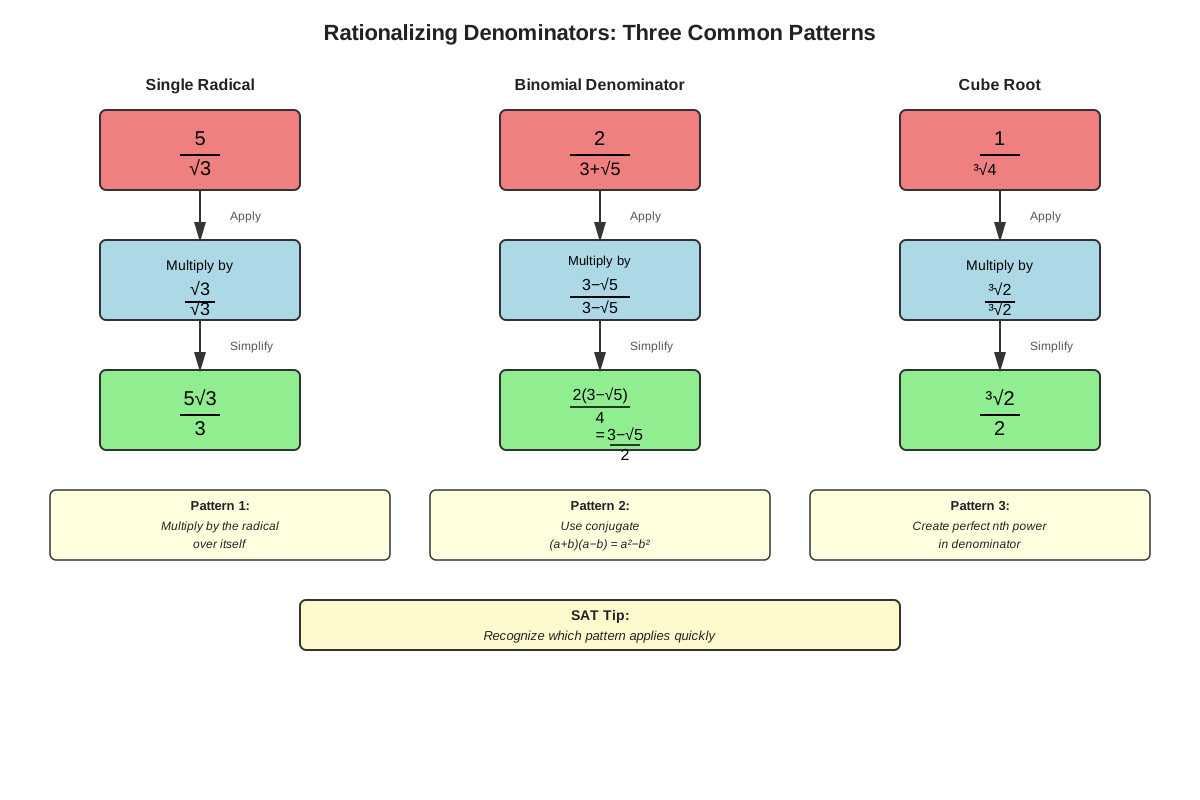
The SAT requires answers with rationalized denominators—no radicals in the denominator. For simple cases with a single radical in the denominator, multiply both numerator and denominator by that radical:
5/√3 = (5/√3) × (√3/√3) = 5√3/3For denominators containing a sum or difference with a radical (binomial denominators), use the conjugate—the same expression with the opposite sign between terms. The conjugate of (a + √b) is (a - √b). Multiplying conjugates eliminates the radical through the difference of squares pattern:
(a + √b)(a - √b) = a² - bExample: Rationalize 6/(2 + √5)
6/(2 + √5) × (2 - √5)/(2 - √5) = 6(2 - √5)/(4 - 5) = 6(2 - √5)/(-1) = -12 + 6√5 = 6√5 - 12Adding and Subtracting Radicals
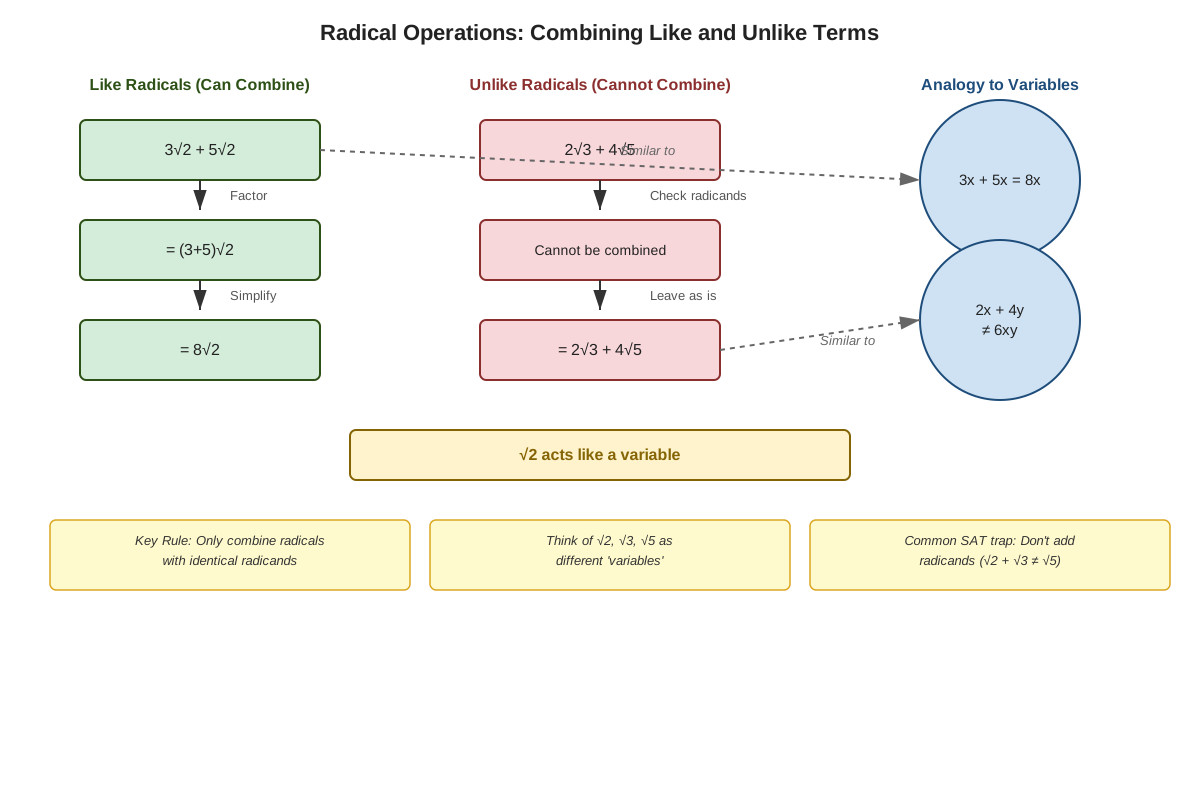
Radicals can only be combined through addition or subtraction when they have identical radicands—these are called like radicals. The process mirrors combining like terms in algebra: 3√5 + 7√5 = 10√5, just as 3x + 7x = 10x. The coefficient changes while the radical part remains constant.
Before concluding that radicals cannot be combined, always simplify each radical completely. Terms that initially appear unlike may become like radicals after simplification:
√12 + √27 = √(4×3) + √(9×3) = 2√3 + 3√3 = 5√3
Multiplying and Dividing Radicals
When multiplying radicals with the same index, multiply the coefficients together and the radicands together, then simplify:
(3√2)(5√6) = 15√12 = 15√(4×3) = 15(2√3) = 30√3
For binomial multiplication involving radicals, apply the distributive property (FOIL for binomials):
(√3 + 2)(√3 - 5) = √3·√3 - 5√3 + 2√3 - 10 = 3 - 3√3 - 10 = -7 - 3√3
Division follows similar principles, often requiring rationalization as a final step:
√50 / √2 = √(50/2) = √25 = 5
Radical-Exponent Equivalence
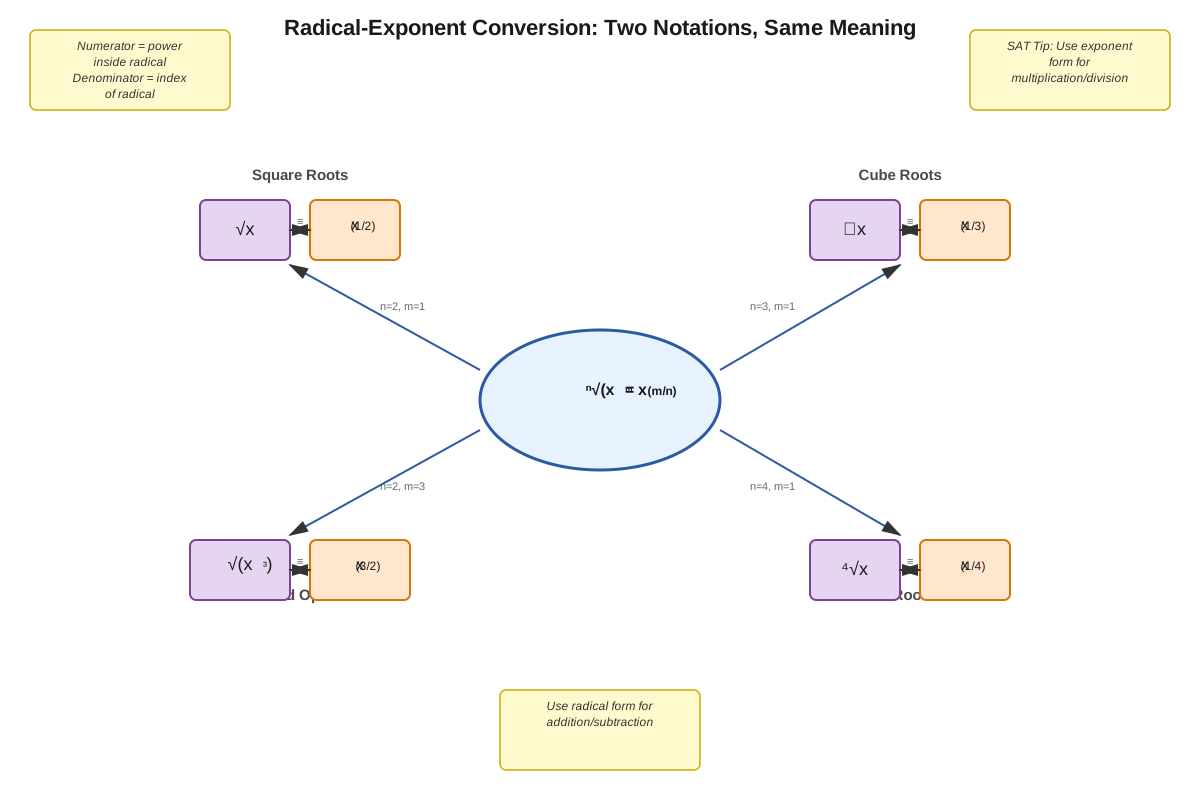
Understanding the connection between radicals and fractional exponents provides alternative solution pathways. The general relationship: ⁿ√(x^m) = x^(m/n). Specifically:
| Radical Form | Exponential Form |
|---|---|
| √x | x^(1/2) |
| ³√x | x^(1/3) |
| √(x³) | x^(3/2) |
| ⁴√(x⁵) | x^(5/4) |
This equivalence allows application of exponent rules to radical problems, particularly useful for complex expressions: √(x³) · √x = x^(3/2) · x^(1/2) = x^(3/2 + 1/2) = x² = x²
Concept Relationships
The concepts within radical simplification build upon each other in a logical progression. Identifying perfect square factors serves as the foundation → enabling systematic simplification of numerical radicals → which extends to simplifying radicals with variables by treating variable powers similarly to numerical factors. Once individual radicals are simplified, students can combine like radicals through addition and subtraction, recognizing that simplification often reveals previously hidden like terms.
Rationalizing denominators represents an application of multiplication principles, requiring both simplification skills and strategic use of conjugates. The process connects back to the fundamental property that √a · √a = a, eliminating radicals through multiplication. Multiplying and dividing radicals synthesizes all previous concepts, often requiring simplification both before and after the operation.
The radical-exponent equivalence provides an overarching framework connecting this topic to the broader unit on exponents. This relationship enables students to verify their radical simplification work using exponent rules and offers alternative solution methods for complex problems. Understanding this equivalence also prepares students for more advanced topics like solving radical equations and working with rational exponents.
Prerequisite knowledge of prime factorization directly enables the systematic approach to identifying perfect square factors. Exponent rules provide the theoretical foundation for why radical properties work (since radicals are fractional exponents). The distributive property from basic algebra transfers directly to multiplying binomials containing radicals. This interconnected web of concepts means that weakness in any area can impede progress, while mastery of the fundamentals accelerates learning of advanced applications.
Quick check — test yourself on Simplifying radicals so far.
Try Flashcards →High-Yield Facts
⭐ A radical is in simplest form when no perfect square factors remain under the radical, no fractions appear under the radical, and no radicals appear in denominators
⭐ The largest perfect squares to memorize for SAT efficiency are: 1, 4, 9, 16, 25, 36, 49, 64, 81, 100, 121, 144, 169, 196, 225
⭐ √(ab) = √a · √b and √(a/b) = √a / √b are the fundamental properties enabling all radical simplification
⭐ To rationalize a denominator with a binomial containing a radical, multiply by the conjugate (change the sign between terms)
⭐ Only like radicals (identical radicands) can be combined through addition or subtraction
- Prime factorization provides a systematic method for identifying all perfect square factors within any radicand
- When simplifying √(x^n), extract x^(n/2) if n is even; if n is odd, extract x^((n-1)/2) and leave x under the radical
- The conjugate of (a + b√c) is (a - b√c), and their product equals a² - b²c (no radicals)
- √2 ≈ 1.414, √3 ≈ 1.732, and √5 ≈ 2.236 are useful approximations for checking reasonableness of answers
- Multiplying a radical by itself eliminates the radical: √7 · √7 = 7
- The expression √(-n) where n > 0 is not a real number (involves imaginary numbers, rarely tested on SAT)
- When grid-in questions require radical answers, the SAT accepts both simplified and certain equivalent forms, but simplified form is safest
- √(x²) = |x| technically, but SAT problems typically involve contexts where x ≥ 0, so √(x²) = x
- Cube roots can be negative: ³√(-8) = -2, unlike square roots which require non-negative radicands for real results
- The index of a radical indicates which root: no visible index means square root (index 2), ³√ means cube root (index 3)
Common Misconceptions
Misconception: √(a + b) = √a + √b → Correction: Radicals do NOT distribute over addition or subtraction. √(9 + 16) = √25 = 5, but √9 + √16 = 3 + 4 = 7. The radical must be simplified as a single expression first, or terms must be combined before taking the root.
Misconception: √(x²) always equals x → Correction: Technically, √(x²) = |x| because the square root symbol represents the principal (non-negative) root. If x = -3, then x² = 9, and √9 = 3 = |x|, not -3. However, SAT problems typically specify or imply that variables represent positive values, so this distinction rarely affects answers.
Misconception: When rationalizing 1/√2, the answer is √2/2, which equals √1 = 1 → Correction: √2/2 does NOT equal √(2/2) = √1. The radical only applies to the numerator: √2/2 means (√2)/2, which is approximately 1.414/2 = 0.707, not 1. The radical and fraction are separate operations unless explicitly grouped.
Misconception: 2√3 + 4√5 = 6√8 → Correction: Unlike radicals cannot be combined by adding coefficients and radicands. This is like saying 2x + 4y = 6xy, which is false. The expression 2√3 + 4√5 is already in simplest form and cannot be simplified further.
Misconception: √12 simplified is 2√6 → Correction: This results from incorrectly factoring 12 as 2 × 6 and extracting √2. The correct factorization identifies the largest perfect square: 12 = 4 × 3, so √12 = √(4×3) = 2√3. Always seek the largest perfect square factor, not just any factorization.
Misconception: (√a)² = a only when a is positive → Correction: For any real number a ≥ 0 (the domain of square roots), (√a)² = a by definition. This is the fundamental inverse relationship between squaring and square roots. The restriction is on the input to the square root function, not on the squaring operation afterward.
Misconception: Rationalizing denominators is optional or just for aesthetics → Correction: On the SAT, rationalized form is often required for grid-in answers and is the expected form for multiple-choice answers. Additionally, rationalized form facilitates comparison of expressions and further algebraic manipulation. It's a mathematical convention with practical benefits.
Worked Examples
Example 1: Multi-Step Simplification with Addition
Problem: Simplify completely: √48 + √75 - √12
Solution:
Step 1: Simplify each radical individually by finding perfect square factors.
For √48:
- Factor: 48 = 16 × 3
- √48 = √(16×3) = √16 · √3 = 4√3
For √75:
- Factor: 75 = 25 × 3
- √75 = √(25×3) = √25 · √3 = 5√3
For √12:
- Factor: 12 = 4 × 3
- √12 = √(4×3) = √4 · √3 = 2√3
Step 2: Substitute simplified forms into the original expression.
√48 + √75 - √12 = 4√3 + 5√3 - 2√3
Step 3: Combine like radicals (all have radicand of 3).
4√3 + 5√3 - 2√3 = (4 + 5 - 2)√3 = 7√3
Answer: 7√3
Connection to Learning Objectives: This problem demonstrates identifying perfect square factors (16, 25, and 4), applying simplification systematically to each term, and combining like radicals—all essential SAT skills.
Example 2: Rationalizing a Complex Denominator
Problem: Rationalize and simplify: (8)/(3 - √5)
Solution:
Step 1: Identify that the denominator is a binomial containing a radical, requiring the conjugate method.
The conjugate of (3 - √5) is (3 + √5).
Step 2: Multiply both numerator and denominator by the conjugate.
8/(3 - √5) × (3 + √5)/(3 + √5) = 8(3 + √5)/[(3 - √5)(3 + √5)]Step 3: Simplify the numerator using the distributive property.
Numerator: 8(3 + √5) = 24 + 8√5
Step 4: Simplify the denominator using the difference of squares pattern: (a - b)(a + b) = a² - b².
Denominator: (3 - √5)(3 + √5) = 3² - (√5)² = 9 - 5 = 4
Step 5: Write the complete fraction and simplify if possible.
(24 + 8√5)/4 = 24/4 + 8√5/4 = 6 + 2√5
Answer: 6 + 2√5 (or equivalently, 2√5 + 6)
Connection to Learning Objectives: This problem applies the conjugate rationalization technique, demonstrates why conjugates eliminate radicals (difference of squares), and shows how to simplify the resulting expression—a high-frequency SAT question type.
Example 3: Simplifying Radicals with Variables
Problem: Simplify completely: √(72x⁷y⁴)
Solution:
Step 1: Factor the numerical coefficient to identify perfect squares.
72 = 36 × 2 = 6² × 2
Step 2: Separate variable powers into perfect squares and remainders.
x⁷ = x⁶ · x = (x³)² · x
y⁴ = (y²)²
Step 3: Rewrite the entire expression showing perfect square factors.
√(72x⁷y⁴) = √(36 · 2 · x⁶ · x · y⁴)
Step 4: Apply the property √(ab) = √a · √b to separate perfect squares.
= √36 · √x⁶ · √y⁴ · √(2x)
Step 5: Simplify each perfect square.
= 6 · x³ · y² · √(2x)
Step 6: Combine coefficients and variables outside the radical.
= 6x³y²√(2x)
Answer: 6x³y²√(2x)
Connection to Learning Objectives: This problem extends simplification to variable expressions, demonstrating how to handle odd powers of variables and combine numerical and variable factors—essential for SAT algebra and geometry problems.
Exam Strategy
When approaching SAT questions involving radicals, begin by quickly scanning the answer choices to determine the required form. If all choices are in simplified radical form, simplify immediately. If choices mix radical and decimal forms, consider whether estimation might eliminate options faster than exact simplification. For grid-in questions, always simplify completely before entering your answer, as the grid may not accommodate unsimplified forms.
Trigger words and phrases that signal radical simplification questions include: "simplify," "express in simplest form," "rationalize," "which expression is equivalent to," and "what is the exact value." The phrase "exact value" specifically indicates that a radical answer is expected rather than a decimal approximation. Questions asking for "the distance between points" or "the length of the hypotenuse" often require radical answers left in simplified form.
For process-of-elimination strategies, recognize that incorrect answer choices frequently contain these errors: (1) unsimplified radicals (√12 instead of 2√3), (2) unrationalized denominators (5/√3 instead of 5√3/3), (3) incorrectly combined unlike radicals (√2 + √3 ≠ √5), and (4) sign errors in rationalization. If you can quickly identify any of these errors, eliminate those choices immediately. When multiplying radicals, wrong answers often result from adding radicands instead of multiplying them, or vice versa.
Time allocation for radical problems should average 30-45 seconds for straightforward simplification, 60-90 seconds for problems requiring rationalization or multiple steps, and up to 2 minutes for complex problems embedded within geometry or algebra contexts. If a problem requires more than 2 minutes, mark it for review and move on—radical problems should never consume excessive time since they test mechanical skills rather than complex reasoning.
Develop a systematic approach: (1) Identify what the question asks (simplify, rationalize, combine, etc.), (2) Check if radicals are already simplified or need simplification first, (3) Apply the appropriate technique (factoring, conjugate multiplication, combining like terms), (4) Verify your answer is in the required form (simplified, rationalized), and (5) Check reasonableness if time permits (√50 should be slightly greater than 7, since 7² = 49).
Memory Techniques
Perfect Squares Mnemonic: Remember perfect squares in groups of five using the phrase "Four Nice Teachers Sell Thirty Fresh Salads Every Tuesday" for 4, 9, 16, 25, 36, 49, 64, 81, 100, 121 (First letters: F=4, N=9, T=16, S=25, T=36, F=49, S=64, E=81, T=100, and 121 is 11²). Alternatively, visualize a multiplication table and highlight the diagonal (1×1, 2×2, 3×3, etc.).
Simplification Steps Acronym - FGMS: Factor the radicand, Group perfect squares, Move them outside, Simplify what remains. This four-step process ensures systematic simplification without missing steps.
Rationalization Reminder - "No Roots in the Basement": Visualize a fraction as a building with the numerator as the roof and denominator as the basement. Radicals (roots) don't belong in the basement (denominator)—they should be moved to the roof (numerator) through rationalization.
Conjugate Visualization: Picture conjugates as mirror images with opposite signs. When you multiply them together, the radicals "cancel out" like reflections meeting, leaving only the squared terms. The pattern (a + √b)(a - √b) = a² - b always eliminates the radical.
Like Radicals Rule - "Same Root, Same Fruit": Only radicals with the same radicand (same "fruit" under the root) can be combined. Just as you can add 3 apples + 5 apples = 8 apples, you can add 3√2 + 5√2 = 8√2, but you cannot add apples and oranges (√2 + √3 stays separate).
Prime Factorization Shortcut: For numbers ending in 2, 4, 6, 8, or 0, immediately divide by 2 repeatedly. For numbers ending in 5 or 0, divide by 5. For other numbers, test divisibility by 3 (sum of digits divisible by 3). This systematic approach speeds up factorization significantly.
Summary
Simplifying radicals represents a critical SAT Math skill requiring systematic application of factorization, radical properties, and rationalization techniques. The core principle involves identifying perfect square factors within radicands, extracting them outside the radical, and ensuring the final expression meets three criteria: no perfect squares remain under the radical, no fractions appear under the radical, and no radicals appear in denominators. Students must recognize that radicals follow specific operational rules—they can be multiplied and divided freely, but addition and subtraction require like radicands. Rationalization of denominators, particularly those containing binomials with radicals, requires strategic use of conjugates to eliminate radicals through the difference of squares pattern. The connection between radicals and fractional exponents provides an alternative framework for understanding and verifying simplification work. Mastery requires memorizing perfect squares through 225, developing fluency with prime factorization, and practicing systematic simplification procedures until they become automatic. Success on SAT radical questions depends on recognizing the required form from answer choices, applying the appropriate technique efficiently, and avoiding common errors like attempting to distribute radicals over addition or combining unlike radicals.
Key Takeaways
- Simplifying radicals requires identifying and extracting perfect square factors, leaving no perfect squares under the radical in the final answer
- The fundamental properties √(ab) = √a · √b and √(a/b) = √a / √b enable all radical manipulations, but these properties do NOT apply to addition or subtraction
- Rationalization eliminates radicals from denominators using multiplication by the radical itself for simple cases, or by the conjugate for binomial denominators
- Only like radicals (identical radicands) can be combined through addition or subtraction, similar to combining like terms in algebra
- Prime factorization provides a systematic, foolproof method for identifying all perfect square factors and simplifying any radical expression
- Memorizing perfect squares through at least 144 (12²) is essential for SAT efficiency, enabling rapid recognition of simplification opportunities
- The SAT expects answers in simplified, rationalized form, making mastery of these techniques necessary for both multiple-choice and grid-in questions
Related Topics
Solving Radical Equations: After mastering simplification, students progress to solving equations containing radicals, which requires isolating the radical, squaring both sides, and checking for extraneous solutions. Simplification skills are essential prerequisites for this topic.
Rational Exponents: Understanding that radicals are equivalent to fractional exponents (√x = x^(1/2)) enables application of exponent rules to radical problems and provides alternative solution methods for complex expressions.
Complex Numbers: Simplifying radicals extends to expressions involving √(-1) = i, where students simplify expressions like √(-12) = 2i√3, building on the same factorization and simplification techniques.
Quadratic Formula Applications: The quadratic formula produces radical expressions in the form (-b ± √(b² - 4ac))/(2a), requiring simplification and rationalization skills to express solutions in simplest form.
Distance and Midpoint Formulas: Geometry problems frequently generate radical expressions when calculating distances between points, requiring simplification to express exact answers rather than decimal approximations.
Practice CTA
Now that you've mastered the core concepts of simplifying radicals, it's time to solidify your understanding through active practice. Complete the practice questions to test your ability to identify perfect square factors, rationalize denominators, and combine like radicals under timed conditions. Use the flashcards to drill perfect squares and key properties until recognition becomes automatic—this speed will give you a significant advantage on test day. Remember, radical simplification is a mechanical skill that improves dramatically with focused practice. Every problem you solve correctly builds the pattern recognition and procedural fluency that will make these questions feel effortless on the actual SAT. You've got this!
Sign up free to keep reading
Create a free AnvayaPrep account to finish this SAT guide on Simplifying radicals — plus flashcards and practice questions.