Overview
Interval notation is a mathematical shorthand used to represent ranges of numbers on the number line. Rather than writing lengthy inequality statements or drawing number lines repeatedly, interval notation provides a compact, standardized way to express solution sets. This notation uses brackets and parentheses to indicate whether endpoints are included or excluded from a set, making it an essential tool for communicating mathematical solutions efficiently.
For SAT interval notation questions, mastery of this topic is critical because it appears across multiple question types in the math section. Students encounter interval notation when solving linear inequalities, interpreting graphs, analyzing domain and range of functions, and working with absolute value problems. The College Board frequently tests whether students can translate between different representations of the same mathematical relationship—converting from inequality notation to interval notation, from graphs to intervals, or from word problems to mathematical notation. This translation skill is fundamental to demonstrating mathematical fluency.
Understanding interval notation connects directly to broader mathematical concepts including set theory, function analysis, and algebraic reasoning. It serves as a bridge between visual representations (number lines and graphs) and symbolic mathematics (inequalities and equations). Students who master interval notation gain a powerful tool for expressing solutions concisely and accurately, which becomes increasingly important in higher-level mathematics and on standardized tests where precision and efficiency matter.
Learning Objectives
- [ ] Identify key features of interval notation including brackets, parentheses, and infinity symbols
- [ ] Explain how interval notation appears on the SAT in various question formats
- [ ] Apply interval notation to answer SAT-style questions involving inequalities and solution sets
- [ ] Convert between inequality notation, interval notation, and graphical representations fluently
- [ ] Determine whether to use brackets or parentheses based on whether endpoints are included
- [ ] Recognize and correctly interpret union and intersection notation within interval contexts
- [ ] Analyze compound inequalities and express their solutions using appropriate interval notation
Prerequisites
- Basic inequality symbols (>, <, ≥, ≤): Understanding these symbols is essential because interval notation directly translates inequality relationships into bracket notation
- Number line concepts: Familiarity with plotting points and regions on a number line helps visualize what intervals represent spatially
- Real number system: Knowledge of integers, rational numbers, and the continuous nature of real numbers provides the foundation for understanding intervals as sets
- Set membership: Basic understanding that elements either belong to or don't belong to a set clarifies what interval notation includes and excludes
Why This Topic Matters
In real-world applications, interval notation appears whenever ranges or constraints need to be communicated efficiently. Engineers use intervals to specify tolerances in manufacturing (a part must measure between 2.45 and 2.55 inches). Scientists express confidence intervals in research findings. Financial analysts describe acceptable ranges for investment returns. Computer programmers define valid input ranges for functions. The ability to read and write interval notation is a fundamental literacy skill in technical fields.
On the SAT, interval notation appears in approximately 8-12% of math questions, making it a high-yield topic for test preparation. Questions involving interval notation typically appear in both the calculator and no-calculator sections, with difficulty levels ranging from medium to hard. The College Board tests this concept through multiple question formats: multiple-choice questions asking students to identify correct interval representations, grid-in questions requiring numerical answers about interval endpoints, and questions embedded within larger problems about functions, inequalities, or data analysis.
Common SAT question patterns include: providing a graph and asking for the interval notation of the solution set; giving an inequality and requesting the equivalent interval; presenting a word problem about constraints and asking for interval representation; showing interval notation and asking which inequality matches; and testing understanding of domain and range using interval notation. The topic frequently appears in questions worth 1-2 points each, and because these questions test fundamental understanding, they're often designed to separate students who truly understand mathematical notation from those who have only memorized procedures.
Core Concepts
Basic Interval Notation Structure
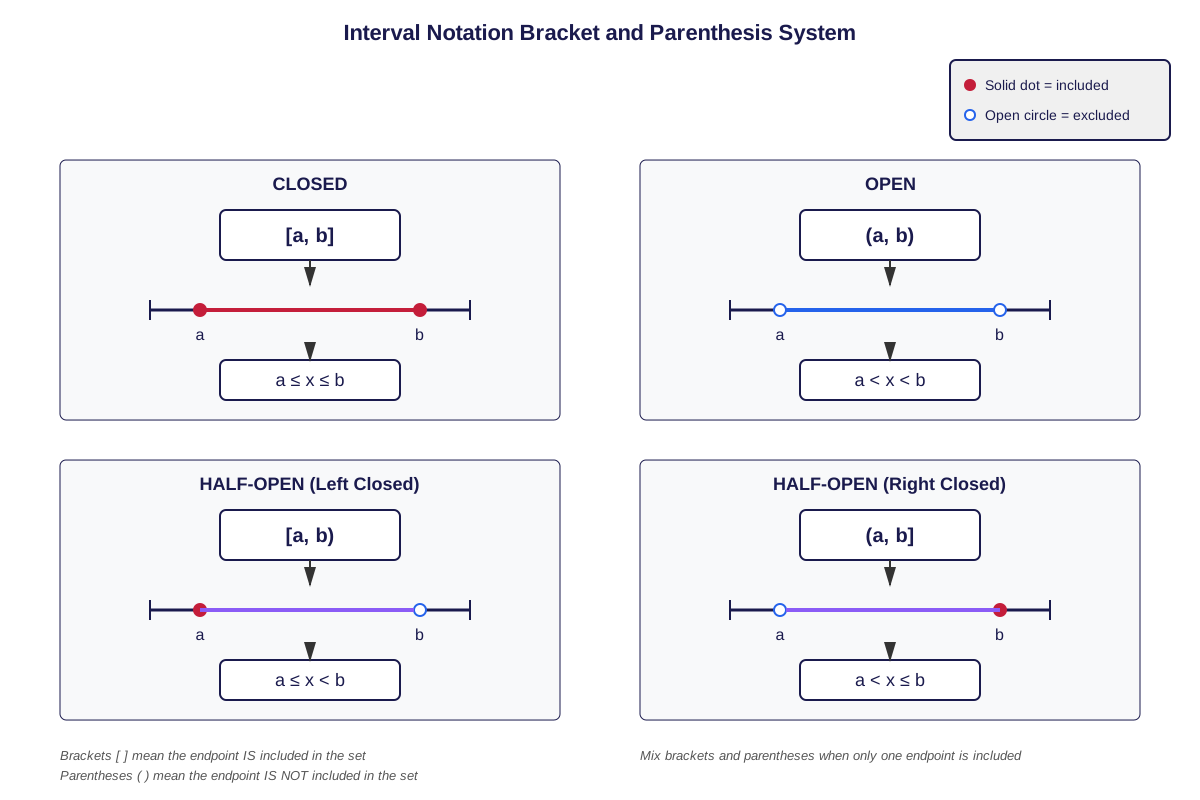
Interval notation uses brackets and parentheses to represent sets of numbers between two endpoints. The fundamental structure consists of two numbers separated by a comma, enclosed by either brackets [ ] or parentheses ( ). The first number represents the lower bound (left endpoint) and the second number represents the upper bound (right endpoint).
The notation [a, b] represents all real numbers x such that a ≤ x ≤ b. This is called a closed interval because both endpoints are included in the set. For example, [2, 5] includes 2, 5, and every number between them: 2.1, 3, 4.999, etc.
The notation (a, b) represents all real numbers x such that a < x < b. This is called an open interval because neither endpoint is included. For example, (2, 5) includes 3 and 4 but excludes both 2 and 5 themselves.
Bracket and Parenthesis Rules
The choice between brackets and parentheses depends on whether endpoints are included:
| Symbol | Meaning | Inequality Equivalent | Endpoint Status |
|---|---|---|---|
| [ | Greater than or equal to | ≥ | Included |
| ] | Less than or equal to | ≤ | Included |
| ( | Greater than | > | Excluded |
| ) | Less than | < | Excluded |
Mixed intervals combine brackets and parentheses when one endpoint is included and the other is not. The interval [2, 5) means 2 ≤ x < 5, including 2 but excluding 5. The interval (2, 5] means 2 < x ≤ 5, excluding 2 but including 5.
Infinity in Interval Notation
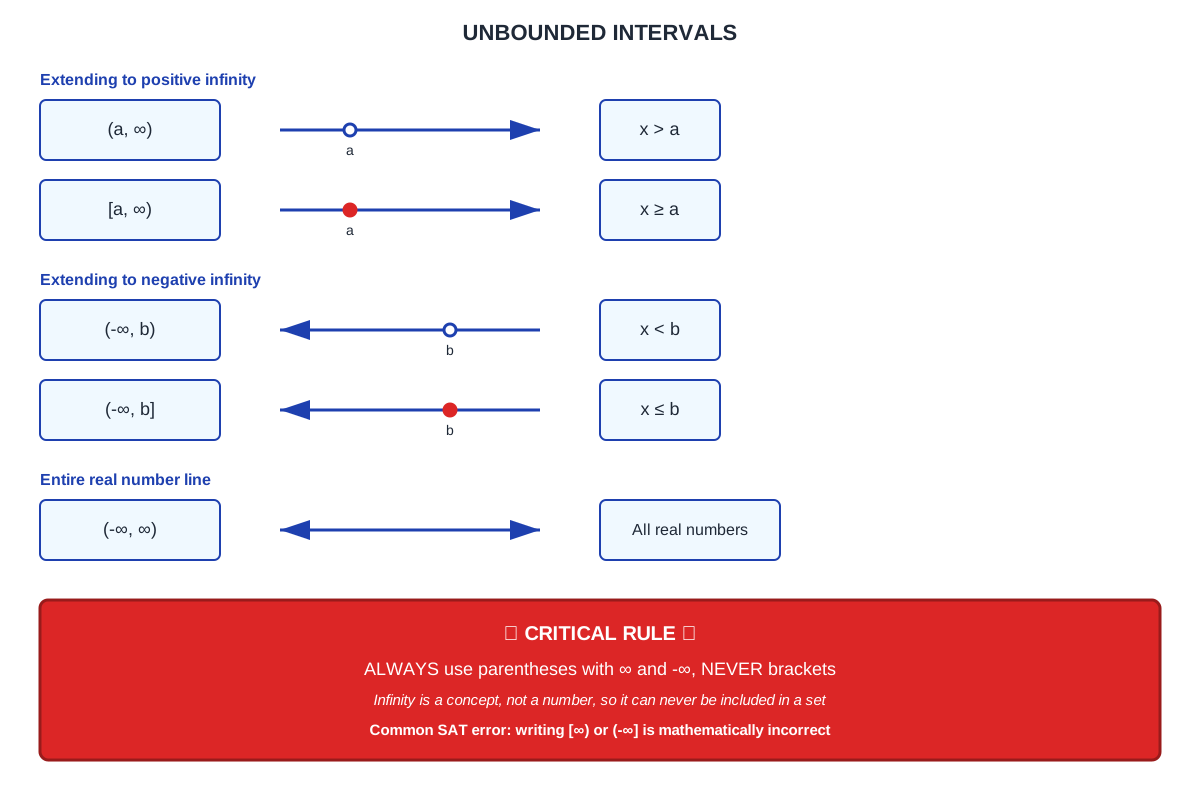
When an interval extends indefinitely in one or both directions, the infinity symbol (∞) is used. Infinity is not a number but rather a concept representing unboundedness, so it always uses parentheses, never brackets.
The interval [3, ∞) represents all numbers greater than or equal to 3, extending infinitely to the right. This translates to x ≥ 3. The interval (-∞, 7] represents all numbers less than or equal to 7, extending infinitely to the left, translating to x ≤ 7.
The interval (-∞, ∞) represents all real numbers, as it extends infinitely in both directions. This is equivalent to stating "x is any real number" or using the symbol ℝ.
Converting Between Notations
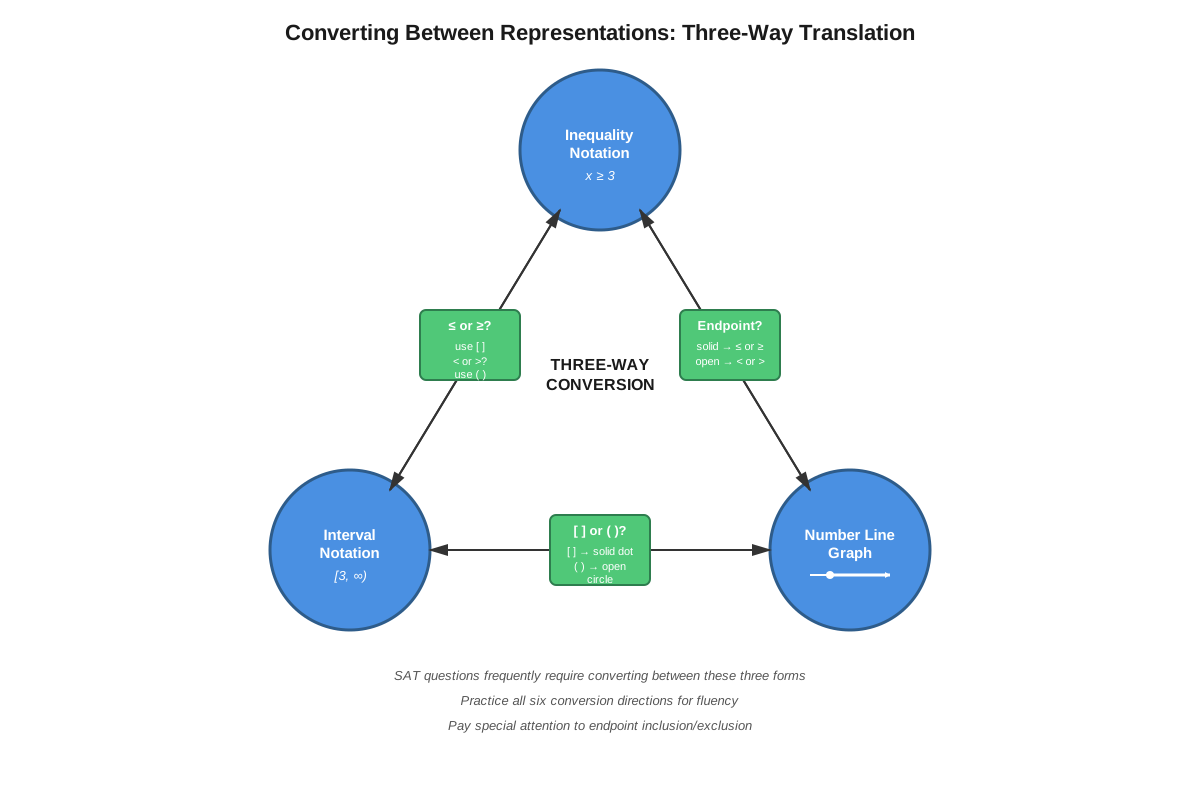
Converting from inequality notation to interval notation requires identifying the boundary values and determining whether they're included:
- Identify the variable and isolate it if necessary
- Determine the boundary value(s)
- Check whether the inequality uses ≤/≥ (bracket) or (parenthesis)
- Write the interval with the smaller value first, larger value second
- Use -∞ or ∞ if the interval extends indefinitely
For example, converting x > -2 to interval notation:
- Boundary value: -2
- Symbol: > means excluded, so use parenthesis
- Extends to positive infinity
- Result: (-2, ∞)
Converting from interval notation to inequality notation reverses this process. The interval [-4, 1) becomes -4 ≤ x < 1.
Compound Intervals and Union Notation
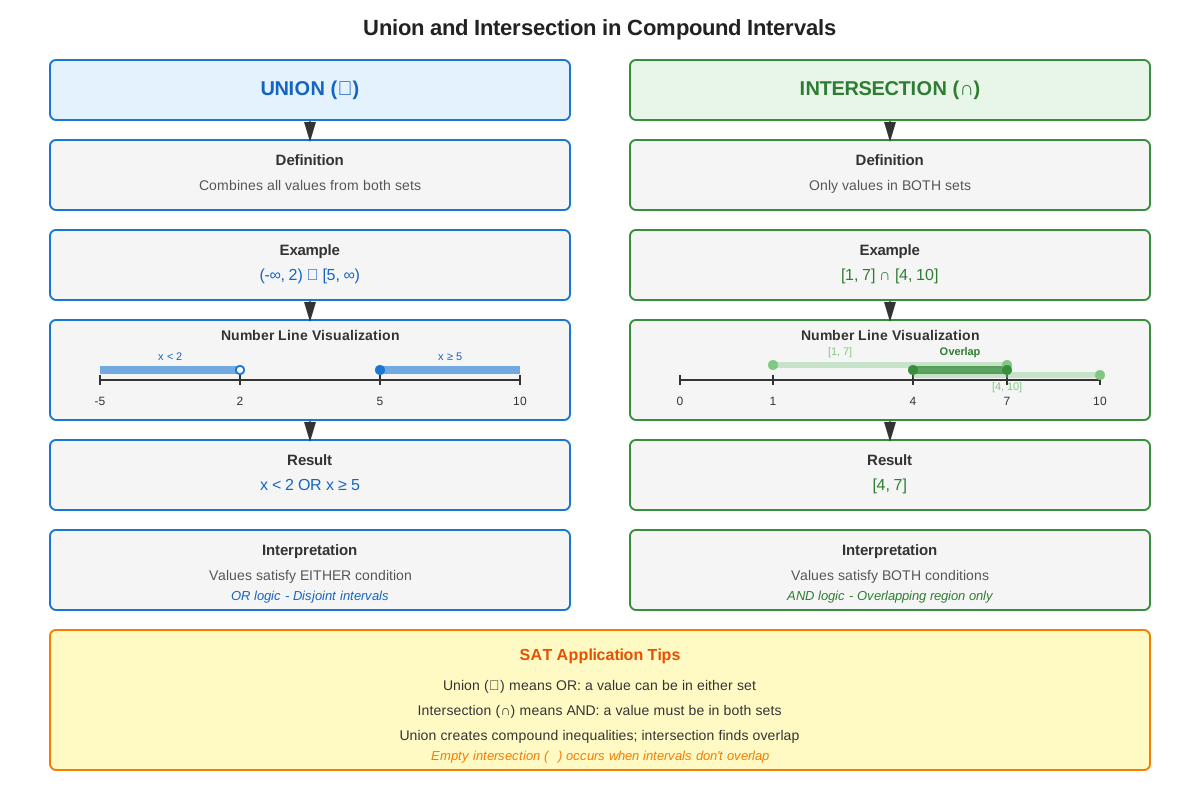
Some solution sets consist of multiple separate intervals. The union symbol (∪) combines these intervals. For example, (-∞, -1) ∪ (3, ∞) represents all numbers less than -1 OR greater than 3, but not the numbers between -1 and 3.
This notation commonly appears when solving absolute value inequalities or quadratic inequalities where the solution set has gaps. The key understanding is that union means "or"—a number belongs to the set if it's in either interval.
Special Cases and Edge Scenarios
A single point can be represented as [a, a], though this is rarely used in practice. More commonly, single values are simply stated as x = a.
An empty set (no solutions) is represented by ∅ or { }, not by interval notation. This occurs when an inequality has no solutions, such as x < 2 AND x > 5 simultaneously.
When working with discrete sets (like integers only), interval notation becomes less precise because it implies all real numbers in the range. In such cases, set-builder notation or roster notation may be more appropriate, though the SAT typically uses interval notation for continuous ranges.
Concept Relationships
Interval notation serves as the connecting notation between multiple mathematical representations. Inequality notation → translates to → interval notation → represents → graphical solutions on number lines. This three-way relationship means that mastering interval notation requires fluency in moving between all three forms.
Within the topic itself, understanding bracket versus parenthesis rules → determines → correct endpoint representation → which affects → whether boundary values satisfy the inequality. The concept of infinity → extends → basic bounded intervals → creating → unbounded solution sets that represent rays or the entire number line.
Interval notation connects to prerequisite knowledge through several pathways: number line visualization → supports → understanding interval extent, while inequality symbols → directly correspond to → bracket and parenthesis choices. The real number system → provides → the continuous set of values → that intervals represent.
Looking forward, interval notation enables work with domain and range of functions (expressing which x-values and y-values are valid), absolute value inequalities (which often produce union of intervals), and systems of inequalities (where intersection and union of intervals become important). The notation also appears in calculus concepts tested on advanced exams, making it a foundational skill with long-term value.
High-Yield Facts
⭐ Brackets [ ] mean the endpoint IS included; parentheses ( ) mean the endpoint is NOT included
⭐ Infinity (∞) and negative infinity (-∞) ALWAYS use parentheses, never brackets
⭐ The interval [a, b] translates to the inequality a ≤ x ≤ b
⭐ The union symbol ∪ means "or" and combines separate intervals
⭐ In interval notation, the smaller number always comes first (left endpoint before right endpoint)
- The interval (a, b) is called an open interval; [a, b] is called a closed interval
- An interval extending infinitely in one direction is called a ray or half-line
- The interval (-∞, ∞) represents all real numbers
- Mixed intervals like [a, b) or (a, b] are called half-open or half-closed intervals
- When graphing intervals on a number line, use a filled circle for brackets and an open circle for parentheses
- The intersection symbol ∩ means "and" and represents values in both intervals simultaneously
- Converting from interval to inequality notation: read the brackets/parentheses to determine ≤, ≥, <, or >
Quick check — test yourself on Interval notation so far.
Try Flashcards →Common Misconceptions
Misconception: Infinity can be included in an interval, so [3, ∞] is valid notation.
Correction: Infinity is not a number but a concept representing unboundedness. It cannot be "reached" or "included," so it always uses parentheses: [3, ∞) is correct, [3, ∞] is incorrect.
Misconception: The interval [2, 5] only includes the integers 2, 3, 4, and 5.
Correction: Interval notation represents all real numbers in the range unless otherwise specified. [2, 5] includes 2, 2.1, 2.001, π, 4.9999, 5, and infinitely many other values between 2 and 5.
Misconception: In the interval (3, 7), the parentheses mean the same thing as in coordinate pairs like (3, 7).
Correction: Context determines meaning. In interval notation, (3, 7) means all numbers between 3 and 7, excluding the endpoints. In coordinate notation, (3, 7) means a single point with x-coordinate 3 and y-coordinate 7. These are completely different concepts using the same symbols.
Misconception: The larger number should come first in interval notation, so x > 5 becomes (∞, 5).
Correction: Interval notation always lists the smaller value first (left endpoint) and larger value second (right endpoint). The inequality x > 5 correctly converts to (5, ∞), not (∞, 5).
Misconception: The union (-∞, 2) ∪ (2, ∞) is the same as (-∞, ∞).
Correction: These are almost the same but not identical. (-∞, 2) ∪ (2, ∞) excludes the single value x = 2, while (-∞, ∞) includes all real numbers including 2. The difference matters when the excluded point is significant to the problem.
Misconception: When converting [3, 8) to inequality notation, both endpoints use the same inequality symbol.
Correction: Mixed intervals require different symbols for each endpoint. [3, 8) correctly converts to 3 ≤ x < 8, using ≤ for the bracket and < for the parenthesis. Each endpoint must be evaluated independently.
Misconception: Empty sets can be written as (∅, ∅) or [∅, ∅].
Correction: Empty sets (no solutions) are represented by the symbol ∅ or { }, not by interval notation. Interval notation is only used when there is at least one value in the solution set.
Worked Examples
Example 1: Converting Inequality to Interval Notation
Problem: Express the solution to the inequality -3 ≤ x < 7 in interval notation.
Solution:
Step 1: Identify the boundary values.
The inequality has two boundaries: -3 and 7.
Step 2: Determine which endpoints are included.
The symbol ≤ at -3 means -3 IS included (use bracket).
The symbol < at 7 means 7 is NOT included (use parenthesis).
Step 3: Write the interval with smaller value first.
Since -3 < 7, write -3 first: [-3, 7)
Step 4: Verify by checking test values.
- Is x = -3 in the solution? Yes, because -3 ≤ -3 < 7 is true. ✓ (bracket correct)
- Is x = 0 in the solution? Yes, because -3 ≤ 0 < 7 is true. ✓
- Is x = 7 in the solution? No, because -3 ≤ 7 < 7 is false. ✓ (parenthesis correct)
Answer: [-3, 7)
Connection to Learning Objectives: This example demonstrates applying interval notation to represent inequality solutions and identifying key features (brackets vs. parentheses based on endpoint inclusion).
Example 2: Interpreting a Graph and Writing Interval Notation
Problem: A number line shows a solution set with an open circle at -2 and shading extending to the right indefinitely. Write this solution in both interval notation and inequality notation.
Solution:
Step 1: Interpret the open circle.
An open circle at -2 means -2 is NOT included in the solution set (use parenthesis).
Step 2: Interpret the shading direction.
Shading to the right means all values greater than -2 are included.
Step 3: Determine if there's an upper bound.
"Extending indefinitely" means no upper limit, so use ∞.
Step 4: Write the interval notation.
Start with the boundary value: -2
Use parenthesis because it's excluded: (-2
Extend to infinity: (-2, ∞)
Step 5: Write the equivalent inequality notation.
Since values are greater than (but not equal to) -2: x > -2
Step 6: Verify with test values.
- Is x = -2 in the solution? No (open circle). ✓
- Is x = 0 in the solution? Yes, 0 > -2. ✓
- Is x = 100 in the solution? Yes, 100 > -2. ✓
Answer: Interval notation: (-2, ∞); Inequality notation: x > -2
Connection to Learning Objectives: This example demonstrates converting between graphical representations and interval notation, a common SAT question format, while explaining how interval notation appears on the exam.
Example 3: Working with Compound Intervals
Problem: Solve the compound inequality x < -1 OR x ≥ 4 and express the solution in interval notation.
Solution:
Step 1: Analyze each part separately.
Part 1: x < -1 means all values less than -1
Part 2: x ≥ 4 means all values greater than or equal to 4
Step 2: Convert each part to interval notation.
Part 1: x < -1 → (-∞, -1) [extends left to negative infinity, excludes -1]
Part 2: x ≥ 4 → [4, ∞) [includes 4, extends right to positive infinity]
Step 3: Combine using union symbol.
Since the original statement uses OR, use the union symbol ∪.
Step 4: Write the complete solution.
(-∞, -1) ∪ [4, ∞)
Step 5: Verify the solution makes sense.
- Values between -1 and 4 should NOT be included: x = 0 satisfies neither x < -1 nor x ≥ 4. ✓
- x = -5 should be included: -5 < -1 is true. ✓
- x = 4 should be included: 4 ≥ 4 is true. ✓
- x = -1 should NOT be included: -1 < -1 is false, -1 ≥ 4 is false. ✓
Answer: (-∞, -1) ∪ [4, ∞)
Connection to Learning Objectives: This example applies interval notation to compound inequalities and demonstrates recognizing union notation, both high-yield skills for SAT questions.
Exam Strategy
When approaching SAT interval notation questions, first identify what form the information is presented in: inequality, graph, word problem, or interval notation itself. The question will typically ask for conversion to a different form. Immediately determine whether you're converting TO interval notation or FROM interval notation to another representation.
Trigger words and phrases to watch for include: "express in interval notation," "which interval represents," "solution set," "all values of x such that," "domain," "range," "between," "at least," "at most," "greater than," and "less than." When you see "at least" or "at most," remember these translate to ≥ and ≤ respectively, which means brackets in interval notation. "Between" requires careful attention—does the problem mean inclusive or exclusive?
For process-of-elimination on multiple-choice questions, check the endpoints first. If a problem states x > 3, immediately eliminate any answer choices using [3 instead of (3. If infinity appears with a bracket [∞ or ∞], eliminate that choice immediately—this is always incorrect. For compound intervals, verify that the union symbol ∪ appears when there are separate regions, and check that intervals are written with smaller values first.
Time allocation for interval notation questions should be approximately 30-60 seconds for straightforward conversion problems and up to 90 seconds for questions embedded in larger contexts (like finding domain of a function). These questions are designed to be quick wins if you know the notation, so don't overthink them. If you find yourself spending more than 90 seconds, mark the question and return to it later.
A powerful strategy is to sketch a quick number line in your test booklet when converting between forms. Plot the critical values, mark whether they're included (filled circle) or excluded (open circle), and shade the solution region. This visual check takes only seconds but prevents careless errors in bracket/parenthesis selection.
Exam Tip: When in doubt about whether an endpoint is included, substitute the boundary value into the original inequality or condition. If it makes the statement true, use a bracket; if false, use a parenthesis.
Memory Techniques
Bracket Mnemonic: "Brackets Bring the Boundary" — Brackets include the boundary value, bringing it into the solution set.
Parenthesis Mnemonic: "Parentheses Push away the Point" — Parentheses exclude the endpoint, pushing it away from the solution set.
Infinity Rule: "Infinity is Impossible to Include" — Since infinity isn't a real number, it's impossible to include it, so always use parentheses.
Visual Association: Picture brackets [ ] as arms reaching out to grab and hold the endpoint (included), while parentheses ( ) are curved and slippery, letting the endpoint slide away (excluded).
Union vs. Intersection: "Union = Unite separate pieces" (∪ combines intervals); "Intersection = In both" (∩ requires values in both intervals). For SAT purposes, union appears much more frequently.
Conversion Checklist Acronym - BIPS:
- Boundaries: Identify the endpoint values
- Inclusion: Determine if endpoints are included or excluded
- Position: Place smaller value first, larger value second
- Symbols: Choose brackets or parentheses appropriately
Number Line Visualization: Always imagine walking along a number line from left to right. If you can step ON the endpoint, use a bracket. If you must step OVER it, use a parenthesis.
Summary
Interval notation provides a standardized mathematical language for expressing ranges of numbers efficiently and precisely. The fundamental principle is that brackets [ ] indicate included endpoints (corresponding to ≤ or ≥), while parentheses ( ) indicate excluded endpoints (corresponding to < or >). Infinity always uses parentheses because it represents a concept rather than a reachable value. The basic structure places the smaller value first and larger value second, separated by a comma: [a, b], (a, b), [a, b), or (a, b). When solution sets consist of multiple separate regions, the union symbol ∪ combines intervals. Converting between interval notation, inequality notation, and graphical representations requires careful attention to endpoint inclusion and boundary values. On the SAT, interval notation appears frequently in questions about inequalities, domain and range, and solution sets, making it a high-yield topic that rewards precise understanding. Mastery requires recognizing the notation's features, understanding how it appears in various question formats, and applying it accurately to solve problems efficiently.
Key Takeaways
- Brackets [ ] include endpoints; parentheses ( ) exclude endpoints — this is the most fundamental rule of interval notation
- Infinity (∞ or -∞) always uses parentheses, never brackets, because infinity is not a reachable number
- Interval notation format is always [smaller value, larger value], maintaining left-to-right order on the number line
- The union symbol ∪ combines separate intervals and represents "or" in compound inequalities
- Converting between forms requires checking each endpoint independently for inclusion or exclusion
- Quick number line sketches prevent errors by providing visual confirmation of solution sets
- SAT questions test interval notation through multiple representations: graphs, inequalities, word problems, and direct notation questions
Related Topics
Domain and Range of Functions: Interval notation is the standard way to express which x-values (domain) and y-values (range) are valid for functions. Mastering interval notation enables efficient communication about function behavior and restrictions.
Absolute Value Inequalities: Solutions to absolute value inequalities often produce two separate intervals joined by union notation, making interval notation essential for expressing these solution sets concisely.
Systems of Inequalities: When solving systems involving multiple inequalities, interval notation helps express the intersection or union of solution sets, particularly when working with linear programming or constraint problems.
Quadratic Inequalities: Parabolas create solution sets that may be single intervals or unions of intervals, depending on whether solutions lie between or outside the roots. Interval notation efficiently captures these solutions.
Function Transformations: Understanding domain and range changes through transformations requires facility with interval notation to track how intervals shift, stretch, or reflect.
Practice CTA
Now that you've mastered the fundamentals of interval notation, it's time to solidify your understanding through practice! Attempt the practice questions to test your ability to convert between notations, interpret graphs, and solve SAT-style problems. Use the flashcards to drill the key rules and symbols until they become automatic. Remember, interval notation questions on the SAT are designed to be quick points for students who know the notation cold—make sure you're one of them. Every practice problem you complete builds the confidence and speed you'll need on test day. You've got this!
Sign up free to keep reading
Create a free AnvayaPrep account to finish this SAT guide on Interval notation — plus flashcards and practice questions.