Overview
Composite functions represent one of the most elegant and powerful concepts in algebra, where two or more functions combine to create a new function. On the SAT math section, composite functions test a student's ability to understand function notation, follow multi-step processes, and manipulate algebraic expressions with precision. Rather than simply evaluating a single function at a point, composite functions require students to use the output of one function as the input for another—a process that mirrors countless real-world scenarios from computer programming to engineering calculations.
Understanding sat composite functions is essential because they appear regularly on the exam in various forms: direct evaluation problems, equation-solving questions, and conceptual questions about function behavior. The SAT typically includes 1-3 questions directly testing composite functions, and the underlying principles appear in many other function-related problems. Mastery of this topic demonstrates mathematical maturity and the ability to work with abstract representations, skills that the College Board values highly.
Composite functions serve as a bridge between basic function evaluation and more advanced topics like function transformations, inverse functions, and piecewise functions. They require solid foundational skills in substitution, order of operations, and algebraic simplification while building toward more sophisticated mathematical reasoning. Students who master composite functions gain confidence in tackling complex multi-step problems and develop the systematic thinking patterns that lead to success across the entire SAT math section.
Learning Objectives
- [ ] Identify key features of composite functions
- [ ] Explain how composite functions appears on the SAT
- [ ] Apply composite functions to answer SAT-style questions
- [ ] Evaluate composite functions using proper notation and order of operations
- [ ] Determine the domain of composite functions by analyzing restrictions from both component functions
- [ ] Decompose complex functions into simpler component functions
- [ ] Solve equations involving composite functions algebraically
Prerequisites
- Function notation and evaluation: Understanding f(x) notation is essential because composite functions build directly on the ability to substitute values into functions
- Order of operations: Composite functions require careful attention to which function is applied first, making PEMDAS mastery critical
- Algebraic substitution: The core mechanism of composite functions involves replacing variables with entire expressions
- Domain and range concepts: Recognizing valid inputs and outputs helps identify restrictions in composite functions
- Basic function types: Familiarity with linear, quadratic, and other elementary functions provides the building blocks for composition
Why This Topic Matters
Composite functions model countless real-world processes where one transformation follows another. In economics, a manufacturer might apply a cost function to production levels, then apply a profit function to those costs. In physics, position might be a function of velocity, which itself is a function of time. Computer science relies heavily on function composition, where data passes through multiple processing stages. Understanding how functions combine prepares students for calculus, where the chain rule—a direct application of composite function thinking—becomes essential.
On the SAT, composite functions appear in approximately 3-5% of math questions, making them a high-yield topic relative to study time investment. The College Board tests composite functions through direct evaluation questions (finding f(g(3))), algebraic manipulation problems (simplifying f(g(x))), equation-solving scenarios (finding x when f(g(x)) = 5), and conceptual questions about domain restrictions. These questions typically appear in both the calculator and no-calculator sections, with difficulty ranging from medium to hard.
The SAT favors composite function questions because they efficiently test multiple skills simultaneously: function notation fluency, algebraic manipulation, attention to detail, and systematic problem-solving. Questions often combine composite functions with other topics like systems of equations, quadratic functions, or word problems, making them excellent discriminators between students at different skill levels. Students who can confidently navigate composite functions demonstrate the mathematical sophistication that colleges seek.
Core Concepts
Definition and Notation
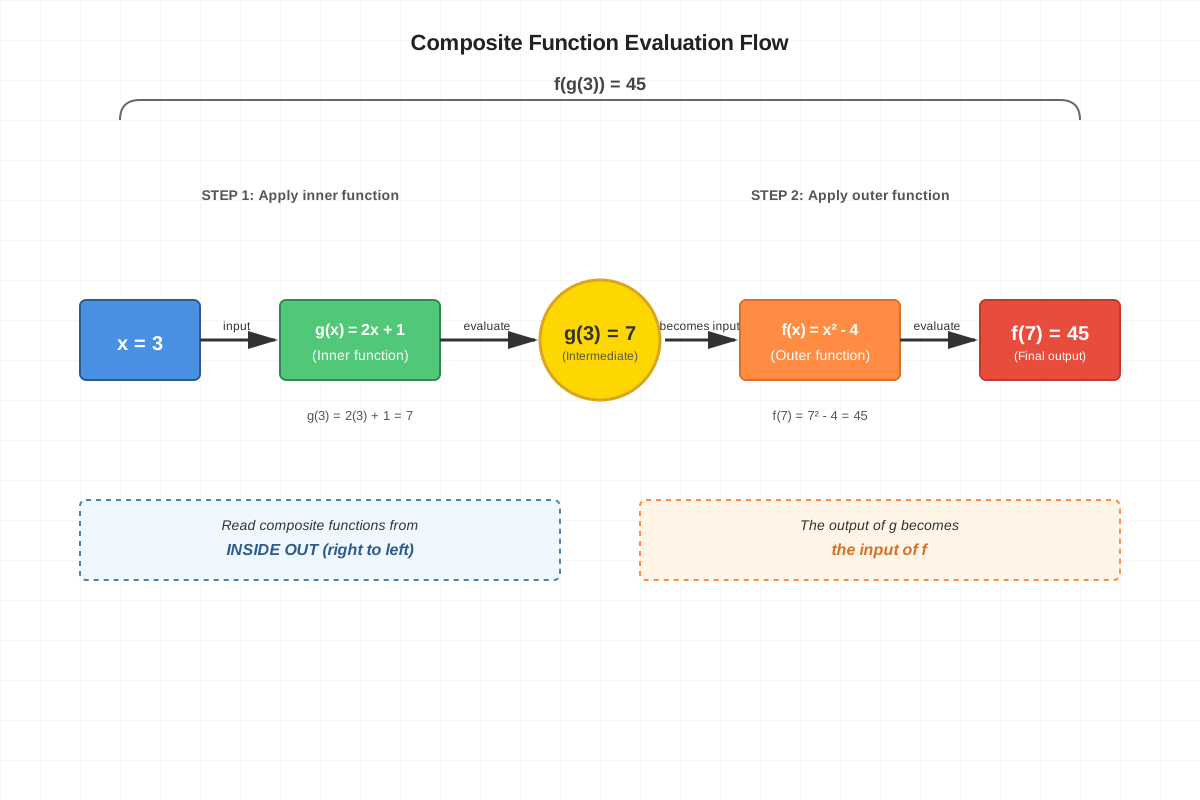
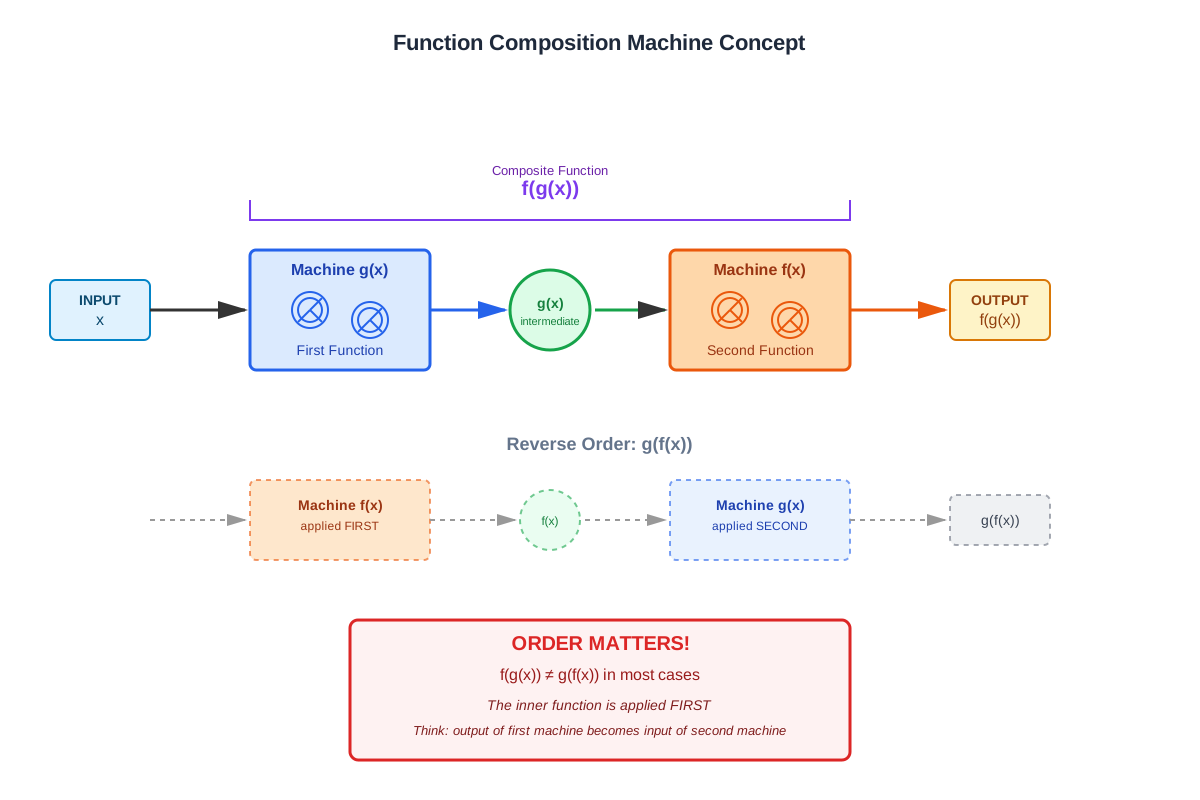
A composite function combines two functions by using the output of one function as the input for another. The notation (f ∘ g)(x) or f(g(x)) represents the composition of functions f and g, read as "f of g of x" or "f composed with g." The function g is applied first to the input x, then function f is applied to the result g(x).
The order matters critically: f(g(x)) generally does not equal g(f(x)). Think of composite functions as a two-stage process where data flows through g first, then through f. The notation f(g(x)) makes this order explicit—work from the inside out, just as with nested parentheses in arithmetic.
Evaluating Composite Functions with Numbers
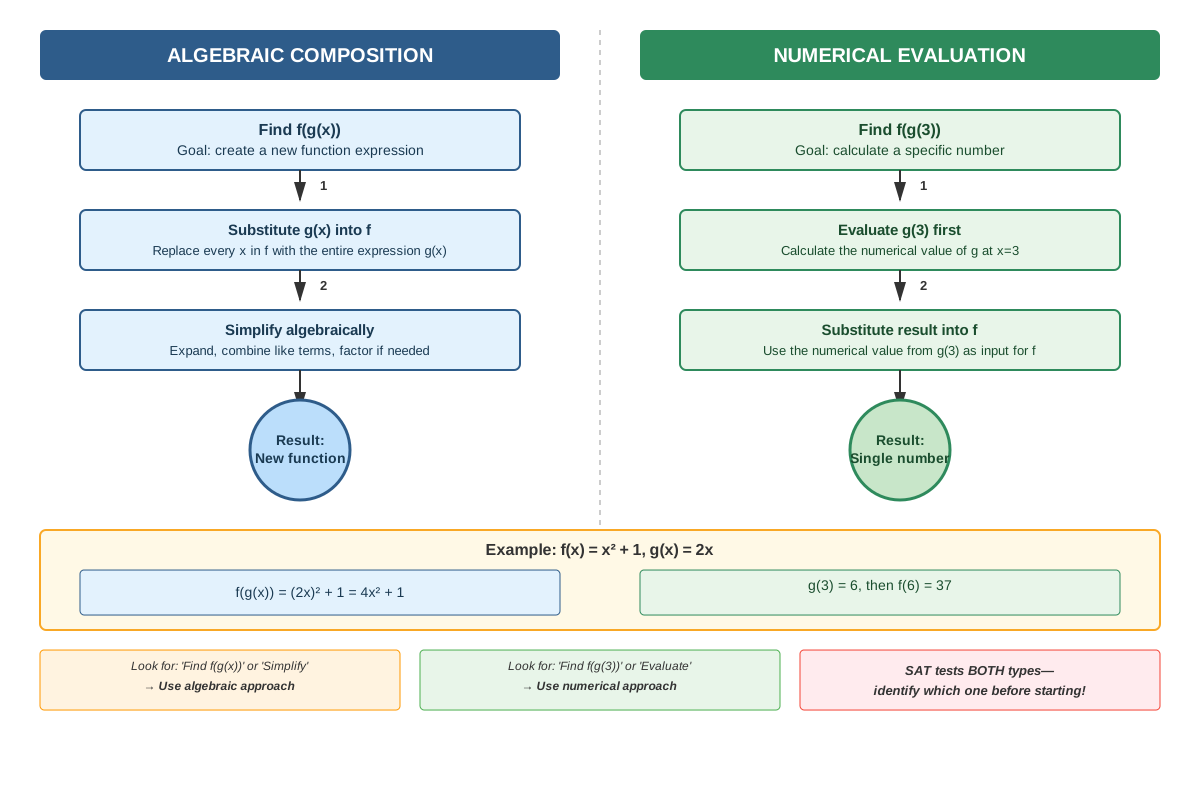
To evaluate a composite function at a specific numerical value, follow this systematic three-step process:
- Evaluate the inner function: Calculate g(x) using the given input value
- Use that result as input for the outer function: Take the output from step 1 and substitute it into f
- Simplify: Perform the arithmetic to reach the final answer
For example, if f(x) = 2x + 1 and g(x) = x², find f(g(3)):
- First, evaluate g(3) = 3² = 9
- Then, evaluate f(9) = 2(9) + 1 = 18 + 1 = 19
- Therefore, f(g(3)) = 19
This inside-out evaluation mirrors how nested operations work in any mathematical expression. The key is maintaining careful organization and not skipping steps, especially under test pressure.
Evaluating Composite Functions Algebraically
When finding f(g(x)) as an algebraic expression rather than a single number, substitute the entire expression for g(x) into every instance of the variable in f(x). This creates a new function that represents the composition.
For instance, if f(x) = 3x - 2 and g(x) = x² + 1, find f(g(x)):
- Identify that g(x) = x² + 1
- Substitute (x² + 1) for every x in f(x) = 3x - 2
- f(g(x)) = 3(x² + 1) - 2
- Simplify: f(g(x)) = 3x² + 3 - 2 = 3x² + 1
The resulting expression 3x² + 1 is itself a function that can be evaluated at any value. This algebraic form is particularly useful for solving equations or analyzing function behavior.
Order of Composition
The order in which functions are composed dramatically affects the result. Consider f(x) = x + 5 and g(x) = 2x:
Finding f(g(x)):
- g(x) = 2x
- f(g(x)) = f(2x) = (2x) + 5 = 2x + 5
Finding g(f(x)):
- f(x) = x + 5
- g(f(x)) = g(x + 5) = 2(x + 5) = 2x + 10
Notice that 2x + 5 ≠ 2x + 10, demonstrating that composition is not commutative. The SAT frequently tests whether students recognize this distinction by asking for both f(g(x)) and g(f(x)) or by presenting answer choices that reflect common order-reversal errors.
Domain Considerations
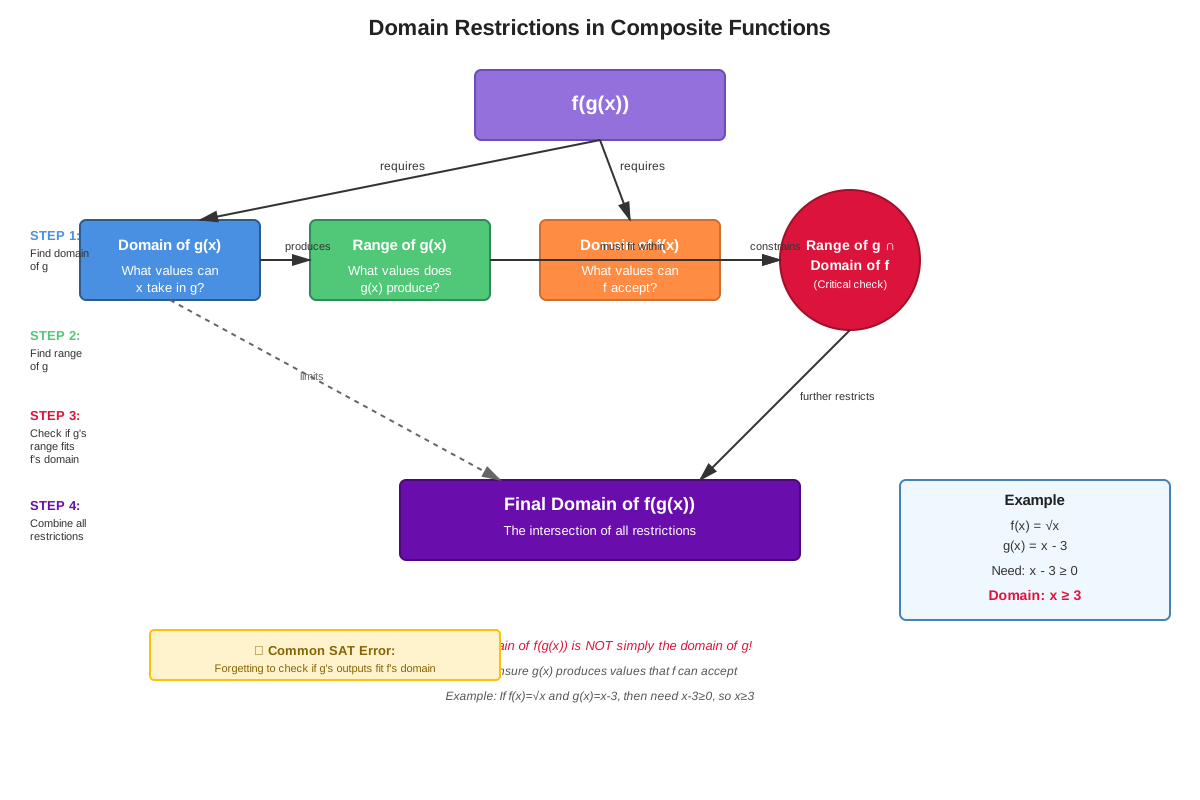
The domain of a composite function f(g(x)) requires careful analysis of restrictions from both functions. A value x is in the domain of f(g(x)) only if:
- x is in the domain of g (the inner function can accept x as input)
- g(x) is in the domain of f (the output of g must be a valid input for f)
For example, if f(x) = √x and g(x) = x - 3, find the domain of f(g(x)):
- g(x) = x - 3 has domain: all real numbers
- f requires non-negative inputs: g(x) ≥ 0
- Therefore: x - 3 ≥ 0, which means x ≥ 3
- Domain of f(g(x)): x ≥ 3
This two-stage checking process ensures that the composite function produces valid outputs. The SAT occasionally tests domain understanding by asking which values cannot be used in a composite function.
Decomposing Functions
Sometimes the SAT presents a complex function and asks students to identify which two simpler functions could be composed to create it. This decomposition skill requires recognizing the structure of nested operations.
For h(x) = (2x + 1)³, possible decompositions include:
- f(x) = x³ and g(x) = 2x + 1, where h(x) = f(g(x))
- The inner operation (2x + 1) becomes g, and the outer operation (cubing) becomes f
Decomposition questions test conceptual understanding of how composite functions work and require students to think flexibly about function structure.
Solving Equations with Composite Functions
When solving equations involving composite functions, the strategy depends on what information is given:
Type 1: Given f(g(x)) = k, find x
- Evaluate the composite function algebraically
- Set the result equal to k
- Solve the resulting equation
Type 2: Given f(g(a)) = k, find a
- Evaluate g(a) first
- Use that result in f
- Set equal to k and solve
Type 3: Given f(x) and f(g(x)), find g(x)
- Work backwards from the composite function
- Use algebraic reasoning to isolate g(x)
These equation-solving scenarios appear frequently on harder SAT questions and require strong algebraic manipulation skills combined with systematic thinking.
Concept Relationships
Composite functions build directly on basic function evaluation—instead of substituting a number for x, students substitute an entire function expression. This connection makes function notation fluency the foundation for all composite function work. The relationship flows: Function Notation → Function Evaluation → Composite Function Evaluation.
Within composite functions themselves, the concepts form a hierarchy: Basic Numerical Evaluation → Algebraic Composition → Domain Analysis → Equation Solving. Each level requires mastery of the previous one. Students must evaluate before they can analyze domains, and they must compose algebraically before they can solve equations involving compositions.
Composite functions connect forward to several advanced topics. They lead directly to inverse functions (where f(f⁻¹(x)) = x represents a special composition), function transformations (which can be viewed as compositions with basic transformation functions), and the chain rule in calculus (which provides the derivative of composite functions). Understanding composition also enhances work with piecewise functions, where different rules might apply at different stages of composition.
The relationship between composite functions and other SAT topics includes connections to systems of equations (solving f(g(x)) = h(x)), quadratic functions (when composition produces quadratic expressions), and word problems (where multi-stage processes naturally create compositions). This interconnectedness makes composite functions a central hub in the SAT math curriculum.
Quick check — test yourself on Composite functions so far.
Try Flashcards →High-Yield Facts
- ⭐ The notation f(g(x)) means apply g first, then apply f to the result—always work from the inside out
- ⭐ f(g(x)) and g(f(x)) are generally different functions; composition order matters critically
- ⭐ To evaluate f(g(3)), first find g(3), then substitute that result into f
- ⭐ When composing algebraically, substitute the entire expression for g(x) into every x in f(x)
- ⭐ The domain of f(g(x)) requires that x be in the domain of g AND g(x) be in the domain of f
- The notation (f ∘ g)(x) is equivalent to f(g(x)) and represents the same composition
- Composite functions can involve more than two functions: f(g(h(x))) means apply h, then g, then f
- If f(g(x)) = x for all x in the domain, then f and g are inverse functions
- Simplifying f(g(x)) algebraically before substituting specific values often saves time and reduces errors
- The range of g must overlap with the domain of f for the composition f(g(x)) to be defined
- Composite functions preserve certain properties: if both f and g are increasing, then f(g(x)) is increasing
- On the SAT, composite function questions often combine with other topics like quadratic equations or word problems
Common Misconceptions
Misconception: f(g(x)) means multiply f times g times x → Correction: The notation represents function composition, not multiplication. f(g(x)) means evaluate g at x, then evaluate f at that result. Multiplication would be written as f·g·x or f(x)·g(x).
Misconception: f(g(x)) and g(f(x)) are the same thing → Correction: Composition order matters. f(g(x)) applies g first, then f. g(f(x)) applies f first, then g. These produce different results except in special cases. Always respect the order indicated by the notation.
Misconception: To find f(g(3)), substitute 3 into f first → Correction: Work from the inside out. Evaluate g(3) first to get a number, then substitute that number into f. The innermost function is always evaluated first.
Misconception: When finding f(g(x)) algebraically, only substitute g(x) for the first x in f(x) → Correction: Substitute the expression for g(x) into every instance of the variable in f(x). If f(x) = x² + 2x and g(x) = 3x, then f(g(x)) = (3x)² + 2(3x), not (3x)² + 2x.
Misconception: The domain of f(g(x)) is just the domain of g → Correction: The domain requires two conditions: x must be in the domain of g, AND g(x) must be in the domain of f. Both restrictions must be satisfied simultaneously.
Misconception: Composite functions always produce more complicated expressions → Correction: Sometimes composition simplifies expressions. For example, if f(x) = √x and g(x) = x², then f(g(x)) = √(x²) = |x|, which is simpler in some ways than the original functions.
Worked Examples
Example 1: Multi-Step Numerical Evaluation
Problem: Given f(x) = x² - 3x + 1 and g(x) = 2x + 5, find the value of f(g(2)).
Solution:
Step 1: Evaluate the inner function g(2)
- g(2) = 2(2) + 5
- g(2) = 4 + 5 = 9
Step 2: Use this result as input for the outer function f
- We need f(9)
- f(9) = (9)² - 3(9) + 1
- f(9) = 81 - 27 + 1
- f(9) = 55
Step 3: State the final answer
- f(g(2)) = 55
Key Insight: This problem demonstrates the fundamental inside-out evaluation process. Notice how we completely finished evaluating g(2) before moving to f. This systematic approach prevents errors and aligns with the learning objective of applying composite functions to SAT-style questions.
Example 2: Algebraic Composition and Equation Solving
Problem: Let f(x) = 3x - 4 and g(x) = x² + 2. Find f(g(x)) in simplified form, then solve f(g(x)) = 23.
Solution:
Part A: Find f(g(x)) algebraically
Step 1: Identify g(x)
- g(x) = x² + 2
Step 2: Substitute g(x) into f(x) = 3x - 4
- Replace every x in f with (x² + 2)
- f(g(x)) = 3(x² + 2) - 4
Step 3: Simplify
- f(g(x)) = 3x² + 6 - 4
- f(g(x)) = 3x² + 2
Part B: Solve f(g(x)) = 23
Step 1: Set up the equation
- 3x² + 2 = 23
Step 2: Solve for x
- 3x² = 21
- x² = 7
- x = ±√7
Step 3: State both solutions
- x = √7 or x = -√7
Key Insight: This problem combines algebraic composition with equation solving, demonstrating how composite functions integrate with other SAT math skills. The algebraic form 3x² + 2 is much easier to work with than repeatedly evaluating the original functions. This addresses the learning objective of identifying key features of composite functions and applying them to solve problems efficiently.
Exam Strategy
When approaching SAT questions on composite functions, begin by identifying the order of operations clearly. Circle or underline the innermost function and work outward systematically. This visual organization prevents the most common error—applying functions in the wrong order.
Trigger words and phrases that signal composite function questions include: "f of g of x," "f(g(x))," "the composition of f and g," "apply function g then function f," and questions asking for values like "f(g(3))." Any time you see one function notation nested inside another, you're dealing with composition.
For process of elimination, watch for answer choices that reflect common errors:
- Choices that reverse the order (showing g(f(x)) instead of f(g(x)))
- Choices that multiply functions instead of composing them
- Choices that only substitute into one instance of the variable
- Choices that add or subtract functions instead of composing them
Time allocation for composite function questions should follow this pattern: spend 15-20 seconds identifying what's being asked and the order of operations, 30-45 seconds performing the calculation or algebraic manipulation, and 10-15 seconds checking your work by verifying the order and reviewing your arithmetic. Most composite function questions should take 60-90 seconds total.
A powerful strategy is to write intermediate steps even in the calculator section. Writing "g(3) = 9" before moving to the next step creates a checkpoint that prevents cascading errors. On no-calculator questions, this practice becomes even more critical for maintaining accuracy.
When questions involve both f(g(x)) and g(f(x)), calculate both carefully and don't assume they're equal. The SAT specifically tests whether students recognize that composition is not commutative. If a question seems too easy, double-check that you haven't accidentally reversed the order.
Memory Techniques
"Inside Out" Mnemonic: Remember that f(g(x)) works like putting on socks (g) then shoes (f)—you must do the inner operation first, and you can't reverse the order. Just as you can't put shoes on before socks, you can't apply f before g in f(g(x)).
"Nesting Dolls" Visualization: Picture Russian nesting dolls where g(x) is the innermost doll, and f wraps around it. To see what's inside, you must work from the outside in when reading, but when evaluating, you build from the inside out.
"FIFO" Acronym: First In, First Out—the first function written (f in f(g(x))) is the last one applied. This reversal is counterintuitive but crucial to remember.
"Substitute Everything" Rule: When composing algebraically, use the phrase "everywhere x appears" to remind yourself to substitute the inner function into every instance of the variable, not just the first one.
Domain Check Rhyme: "Inner must work, outer must take—both conditions for domain's sake." This reminds you that both functions impose restrictions on the domain of the composition.
Summary
Composite functions represent the combination of two or more functions where the output of one becomes the input of another, expressed as f(g(x)) or (f ∘ g)(x). Mastery requires understanding that evaluation proceeds from the inside out—always evaluate g(x) first, then apply f to that result. The order of composition matters critically; f(g(x)) and g(f(x)) are generally different functions. When working algebraically, substitute the entire expression for the inner function into every instance of the variable in the outer function, then simplify carefully. Domain analysis requires checking that inputs work for the inner function and that the inner function's outputs are valid inputs for the outer function. On the SAT, composite functions appear in direct evaluation problems, algebraic simplification questions, and equation-solving scenarios, often combined with other topics. Success requires systematic thinking, careful attention to order, and strong algebraic manipulation skills. Students who master composite functions demonstrate the mathematical sophistication and multi-step problem-solving ability that the SAT values highly.
Key Takeaways
- Composite functions combine two functions by using one's output as another's input, written as f(g(x))
- Always evaluate from the inside out: find g(x) first, then apply f to that result
- The order of composition matters—f(g(x)) ≠ g(f(x)) in most cases
- When composing algebraically, substitute the inner function's expression into every instance of the variable in the outer function
- The domain of f(g(x)) requires that x be valid for g AND that g(x) be valid for f
- SAT questions test numerical evaluation, algebraic composition, domain analysis, and equation solving with composite functions
- Systematic organization and writing intermediate steps prevent the most common errors on test day
Related Topics
Inverse Functions: Understanding that f(f⁻¹(x)) = x represents a special case of composition where functions "undo" each other builds directly on composite function skills and appears regularly on the SAT.
Function Transformations: Transformations like f(x) + k or f(x - h) can be viewed as compositions with basic functions, making composite function mastery essential for understanding how graphs shift and stretch.
Piecewise Functions: When composite functions involve piecewise-defined functions, students must determine which piece applies at each stage of composition, combining two important function concepts.
Rational Functions: Composing rational functions often creates complex expressions that require sophisticated algebraic simplification, extending composite function skills to more advanced contexts.
Chain Rule (Calculus Preview): The derivative of composite functions follows the chain rule, which is fundamentally based on understanding how functions compose—making this topic essential preparation for calculus.
Practice CTA
Now that you've mastered the core concepts of composite functions, it's time to solidify your understanding through practice. Work through the practice questions to test your ability to evaluate compositions numerically and algebraically, analyze domains, and solve equations involving composite functions. Use the flashcards to reinforce key definitions and procedures until they become automatic. Remember, composite functions appear on virtually every SAT, and the systematic thinking skills you develop here will serve you across the entire math section. Confidence with composite functions signals mathematical maturity—invest the practice time now to earn those points on test day!
Sign up free to keep reading
Create a free AnvayaPrep account to finish this SAT guide on Composite functions — plus flashcards and practice questions.