Overview
Inverse functions represent one of the most elegant and powerful concepts in algebra, describing the mathematical relationship that "undoes" another function. When a function takes an input and produces an output, its inverse reverses this process—taking the output back to the original input. This bidirectional relationship appears frequently on the SAT, where understanding inverse functions is crucial for solving problems involving function composition, graphical analysis, and algebraic manipulation.
On the SAT math section, inverse functions typically appear in 2-4 questions per test, making this a high-yield topic that can significantly impact your score. These questions test not only your ability to find inverse functions algebraically but also your understanding of their graphical properties, domain and range restrictions, and how they interact with function composition. The College Board frequently embeds inverse function concepts within more complex problems, requiring students to recognize when inverse relationships are at play even when not explicitly stated.
Mastering inverse functions strengthens your broader understanding of function behavior, symmetry, and transformations—all fundamental concepts in the Functions and Nonlinear Models unit. This topic serves as a bridge between basic function notation and more advanced concepts like exponential and logarithmic relationships, where inverse functions play a defining role. The skills developed here directly support success with function composition, domain and range analysis, and graphical interpretation throughout the SAT math section.
Learning Objectives
- [ ] Identify key features of inverse functions including domain, range, and graphical properties
- [ ] Explain how inverse functions appears on the SAT in various question formats
- [ ] Apply inverse functions to answer SAT-style questions involving algebraic and graphical representations
- [ ] Determine whether a function has an inverse by analyzing its one-to-one property
- [ ] Find the inverse of a function algebraically using systematic substitution methods
- [ ] Interpret the relationship between a function and its inverse on a coordinate plane
- [ ] Solve problems involving composition of inverse functions
Prerequisites
- Function notation and evaluation: Understanding f(x) notation is essential because inverse functions are expressed as f⁻¹(x) and require fluency with function input-output relationships
- Domain and range concepts: Inverse functions swap domain and range, so recognizing these sets is fundamental to working with inverses
- Solving equations for a variable: Finding an inverse algebraically requires isolating variables, making equation-solving skills critical
- Coordinate plane and graphing: Inverse functions have specific graphical properties related to reflection across y = x
- One-to-one functions: Only functions that pass the horizontal line test have inverses, requiring understanding of this property
Why This Topic Matters
Inverse functions appear throughout mathematics and real-world applications. In practical contexts, inverse functions model situations where you need to reverse a process: converting Celsius to Fahrenheit and back, encoding and decoding messages, or determining the original price before a discount was applied. In physics, inverse relationships describe phenomena like the relationship between distance and time when solving for one variable given the other. Financial calculations frequently involve inverse operations when working backward from a final amount to determine initial investments or interest rates.
On the SAT, inverse functions appear with notable frequency and variety. Approximately 3-5% of SAT math questions directly test inverse function concepts, with additional questions incorporating inverse relationships indirectly. The most common question types include: (1) finding the inverse function algebraically given f(x), (2) evaluating f⁻¹(a) for a specific value, (3) identifying properties of inverse functions from graphs, (4) solving equations involving function composition like f(f⁻¹(x)) or f⁻¹(f(x)), and (5) determining domain and range of inverse functions.
The College Board particularly favors questions that combine inverse functions with other concepts. You might encounter a problem asking you to find the inverse of a quadratic function with restricted domain, or to identify which graph represents an inverse relationship. These multi-step problems reward students who understand the underlying principles rather than just memorizing procedures. Questions involving inverse functions often appear in both the calculator and no-calculator sections, emphasizing conceptual understanding over computational complexity.
Core Concepts
Definition and Notation of Inverse Functions
An inverse function, denoted f⁻¹(x), is a function that reverses the action of the original function f(x). Formally, if f(a) = b, then f⁻¹(b) = a. The notation f⁻¹ does NOT mean 1/f(x); rather, it represents the inverse operation. This relationship creates a perfect symmetry: the inverse function takes outputs back to inputs.
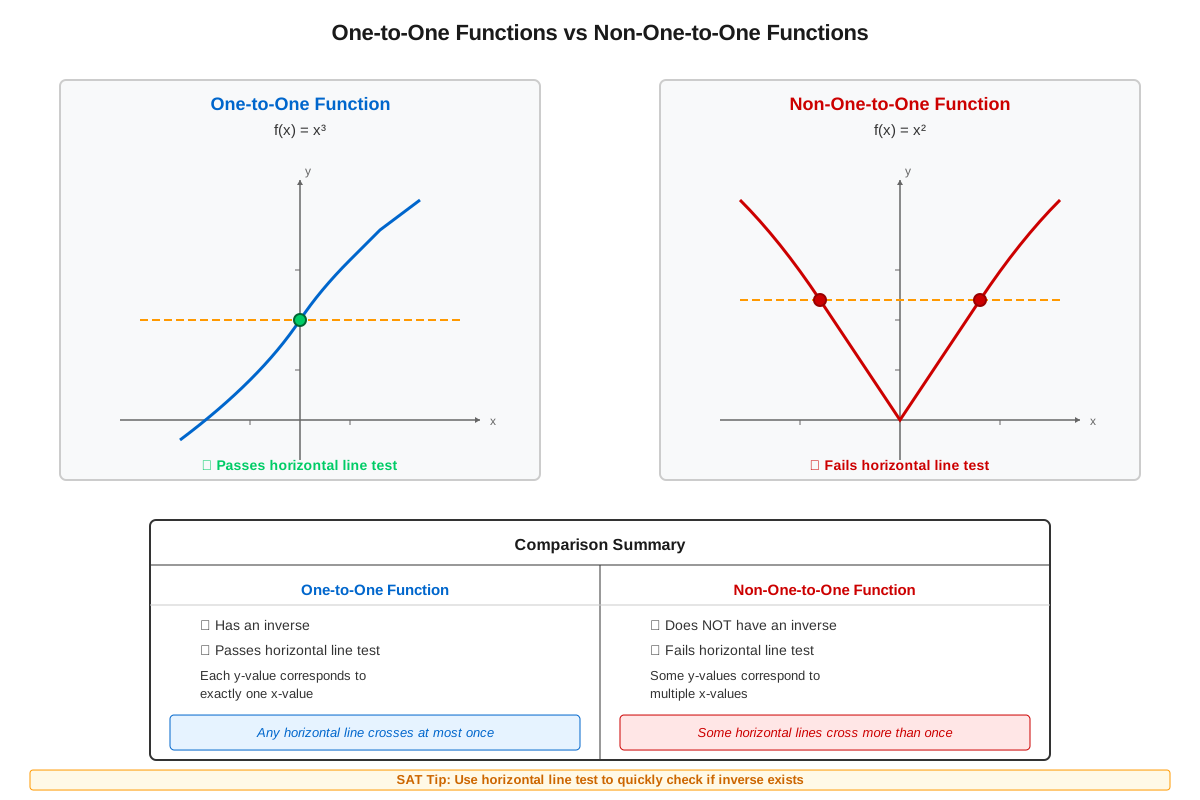
For a function to have an inverse, it must be one-to-one (also called injective), meaning each output corresponds to exactly one input. Graphically, this is verified using the horizontal line test: if any horizontal line intersects the graph more than once, the function is not one-to-one and does not have an inverse function. This restriction is crucial because if two different inputs produced the same output, the inverse wouldn't know which input to return.
Finding Inverse Functions Algebraically
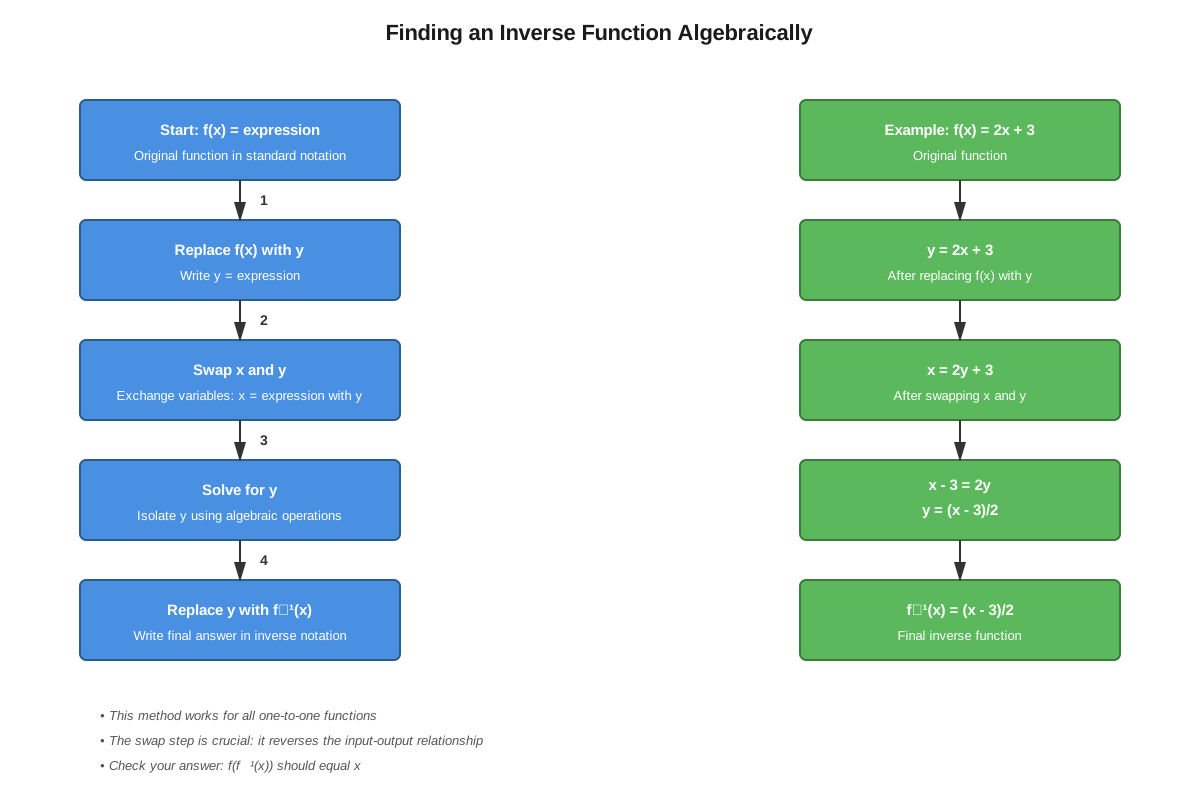
The systematic process for finding an inverse function involves four clear steps:
- Replace f(x) with y to make the equation easier to manipulate
- Swap x and y in the equation (this reflects the input-output reversal)
- Solve the resulting equation for y
- Replace y with f⁻¹(x) to express the inverse in proper notation
For example, to find the inverse of f(x) = 2x + 3:
- Write as y = 2x + 3
- Swap: x = 2y + 3
- Solve for y: x - 3 = 2y, so y = (x - 3)/2
- Therefore, f⁻¹(x) = (x - 3)/2
This algebraic method works for any invertible function, though some require more complex algebraic manipulation involving quadratics, radicals, or rational expressions.
Domain and Range Relationships
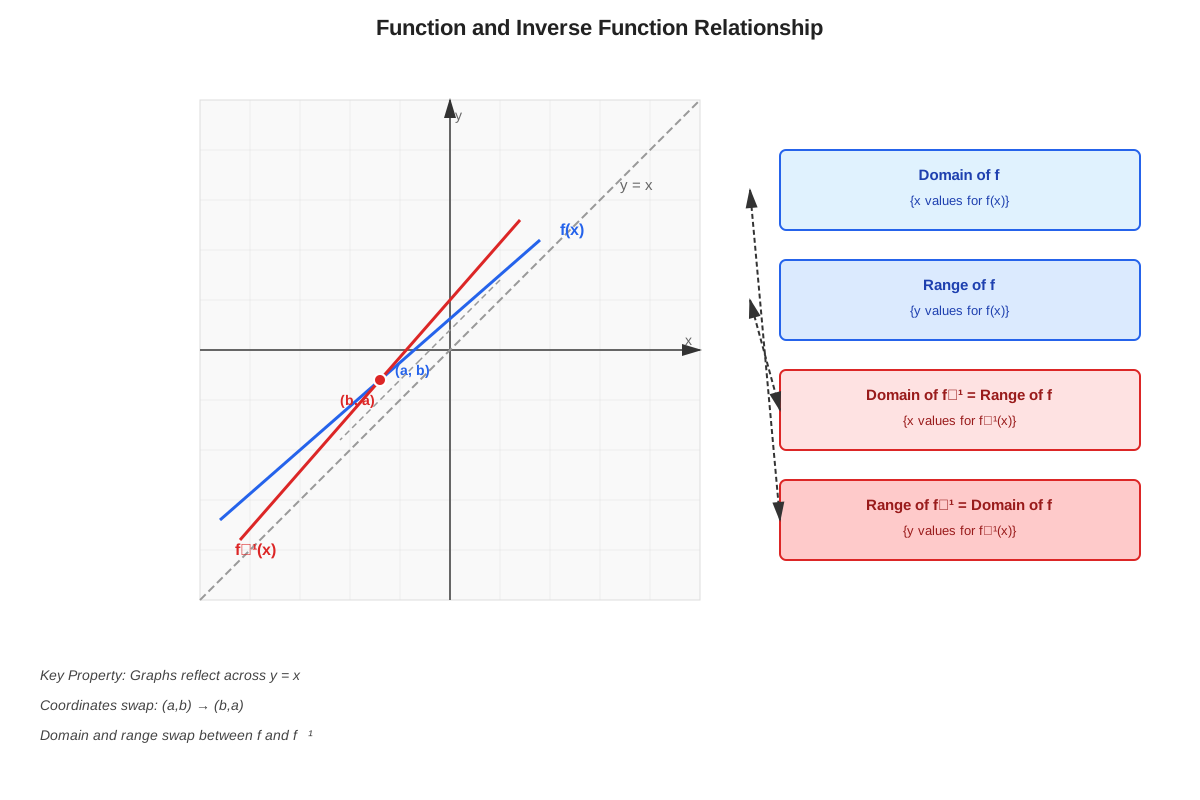
One of the most important properties of inverse functions is the domain-range swap: the domain of f becomes the range of f⁻¹, and the range of f becomes the domain of f⁻¹. This reciprocal relationship stems from the input-output reversal inherent in inverse functions.
| Property | Original Function f | Inverse Function f⁻¹ |
|---|---|---|
| Domain | Set A | Set B (range of f) |
| Range | Set B | Set A (domain of f) |
| Input-Output | f(a) = b | f⁻¹(b) = a |
When working with restricted domains (common with quadratic or other non-one-to-one functions), carefully track these restrictions. For instance, if f(x) = x² with domain x ≥ 0, then f⁻¹(x) = √x with range y ≥ 0.
Graphical Properties of Inverse Functions
The graphs of a function and its inverse exhibit perfect symmetry across the line y = x. This diagonal line acts as a mirror: every point (a, b) on the graph of f corresponds to the point (b, a) on the graph of f⁻¹. This visual relationship provides a powerful tool for identifying and verifying inverse functions on the SAT.
To graph an inverse function from the original graph, reflect each point across y = x by swapping coordinates. If (2, 5) is on f, then (5, 2) is on f⁻¹. This reflection property means that if you fold the coordinate plane along y = x, the two graphs would align perfectly.
Composition of Inverse Functions
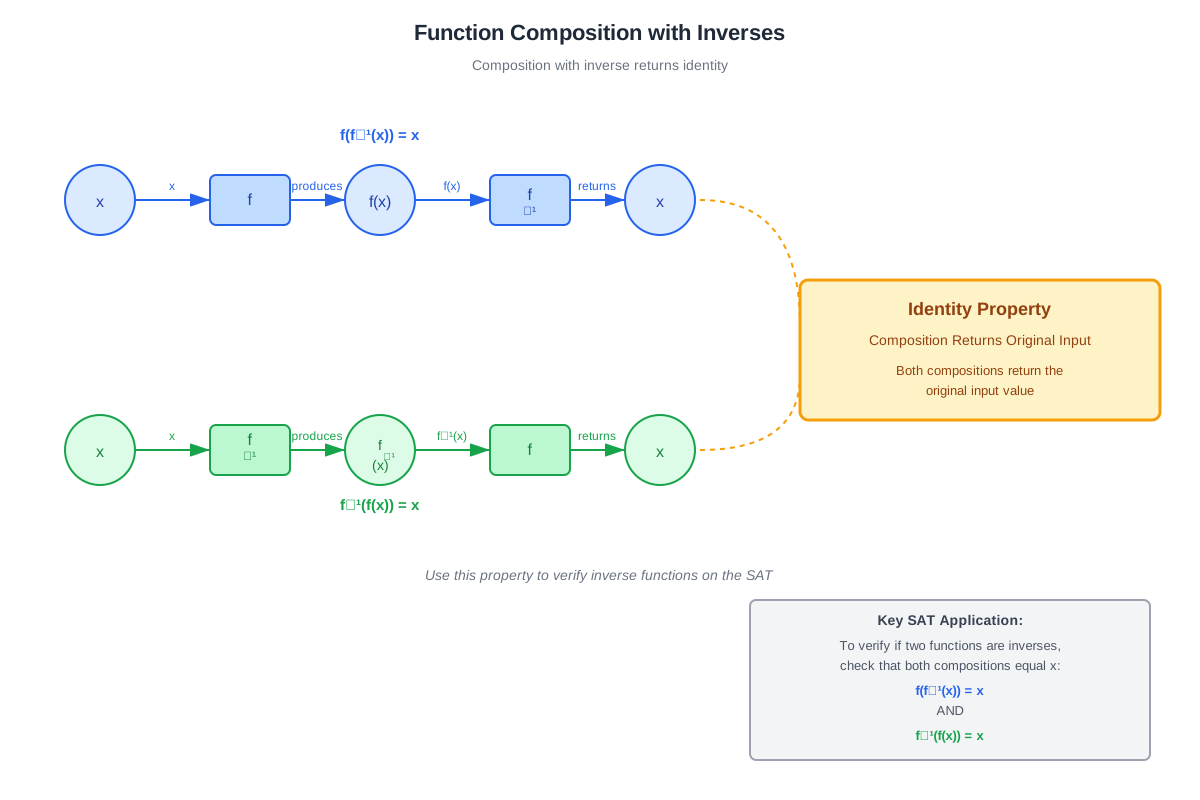
The defining property of inverse functions involves function composition: f(f⁻¹(x)) = x and f⁻¹(f(x)) = x for all x in the appropriate domains. These compositions return the identity function, confirming that the functions truly undo each other. This property serves as the ultimate verification that two functions are inverses.
When evaluating compositions involving inverses, work from the inside out. For f⁻¹(f(5)), first evaluate f(5), then apply f⁻¹ to that result—but the composition property tells us this always equals 5. This shortcut saves significant calculation time on the SAT.
Inverse Functions with Restricted Domains
Many functions that aren't naturally one-to-one can have inverses if we restrict their domain. The most common example is f(x) = x², which fails the horizontal line test over all real numbers. However, by restricting to x ≥ 0 (or x ≤ 0), we create a one-to-one function with inverse f⁻¹(x) = √x (or f⁻¹(x) = -√x).
The SAT frequently tests understanding of these restrictions. When finding the inverse of a restricted function, ensure the inverse's range matches the original function's restricted domain. This attention to detail distinguishes students who deeply understand inverse functions from those who merely follow procedures.
Concept Relationships
The concepts within inverse functions form an interconnected web of relationships. The one-to-one property serves as the foundation → determining whether an inverse exists → which enables algebraic finding of inverses → producing a new function with swapped domain and range → that exhibits graphical symmetry across y = x → and satisfies the composition property f(f⁻¹(x)) = x.
Inverse functions connect deeply to prerequisite knowledge. Function notation provides the language for expressing inverses, while equation-solving skills enable the algebraic manipulation needed to find them. Domain and range concepts become more sophisticated as students learn they swap in inverse relationships. Graphing skills extend to include reflection across y = x.
Looking forward, inverse functions enable understanding of more advanced topics. Exponential and logarithmic functions are defined as inverses of each other (log_b(x) is the inverse of b^x). Trigonometric functions and their inverses (arcsin, arccos, arctan) rely entirely on inverse function concepts. Function transformations become richer when considering how shifts and stretches affect inverse relationships.
The relationship map: Function Notation → One-to-One Property → Inverse Exists → Algebraic Method → Domain/Range Swap → Graphical Symmetry → Composition Property → Verification → Application to Exponentials/Logarithms
High-Yield Facts
⭐ The notation f⁻¹(x) means the inverse function, NOT 1/f(x) or the reciprocal
⭐ A function has an inverse if and only if it is one-to-one (passes the horizontal line test)
⭐ The domain of f equals the range of f⁻¹, and the range of f equals the domain of f⁻¹
⭐ The graphs of f and f⁻¹ are reflections of each other across the line y = x
⭐ For inverse functions, f(f⁻¹(x)) = x and f⁻¹(f(x)) = x for all x in appropriate domains
- To find an inverse algebraically: replace f(x) with y, swap x and y, solve for y, replace y with f⁻¹(x)
- If point (a, b) is on the graph of f, then point (b, a) is on the graph of f⁻¹
- Linear functions of the form f(x) = mx + b (where m ≠ 0) always have inverses
- Quadratic functions need restricted domains to have inverses
- The inverse of the inverse returns to the original function: (f⁻¹)⁻¹ = f
- Horizontal lines (f(x) = c) do not have inverses because they fail the horizontal line test
- To verify two functions are inverses, check that both f(g(x)) = x and g(f(x)) = x
- The line y = x is the axis of symmetry between a function and its inverse
- If f is increasing on its domain, then f⁻¹ is also increasing on its domain
- Inverse functions preserve the one-to-one correspondence between domain and range elements
Quick check — test yourself on Inverse functions so far.
Try Flashcards →Common Misconceptions
Misconception: The notation f⁻¹(x) means 1/f(x) or the reciprocal of the function.
Correction: The superscript -1 in f⁻¹(x) indicates the inverse function, which undoes the original function's operation. The reciprocal would be written as [f(x)]⁻¹ or 1/f(x). These are completely different concepts—for f(x) = 2x, the inverse is f⁻¹(x) = x/2, while the reciprocal is 1/(2x).
Misconception: Every function has an inverse function.
Correction: Only one-to-one functions have inverse functions. Functions that fail the horizontal line test (like f(x) = x² over all real numbers) do not have inverses unless their domain is restricted. The requirement is that each output must correspond to exactly one input.
Misconception: To find an inverse, simply flip the fraction or change the sign.
Correction: Finding an inverse requires the systematic four-step process: write as y =, swap x and y, solve for y, rewrite as f⁻¹(x). Simply manipulating the expression without swapping variables will not produce the correct inverse.
Misconception: The domain and range stay the same for a function and its inverse.
Correction: The domain and range swap between a function and its inverse. If f has domain [0, ∞) and range [3, ∞), then f⁻¹ has domain [3, ∞) and range [0, ∞). This swap is a defining characteristic of inverse functions.
Misconception: If f(f⁻¹(x)) = x, that's sufficient to prove two functions are inverses.
Correction: To fully verify that two functions are inverses, you must check BOTH f(f⁻¹(x)) = x AND f⁻¹(f(x)) = x. While these are often both true, checking only one direction is incomplete verification.
Misconception: The graph of an inverse is the same as the original graph.
Correction: The graph of f⁻¹ is the reflection of f across the line y = x, not identical to it. Unless the function is symmetric about y = x (like f(x) = x or f(x) = 1/x), the graphs will look different.
Misconception: When restricting domain to create an inverse, any restriction works.
Correction: The domain restriction must create a one-to-one function. For f(x) = x², restricting to x ≥ 0 works, but restricting to -2 ≤ x ≤ 2 does not because this still fails the horizontal line test.
Worked Examples
Example 1: Finding and Verifying an Inverse Algebraically
Problem: Find the inverse of f(x) = (3x - 5)/2 and verify that it is correct.
Solution:
Step 1: Replace f(x) with y
y = (3x - 5)/2
Step 2: Swap x and y
x = (3y - 5)/2
Step 3: Solve for y
2x = 3y - 5
2x + 5 = 3y
y = (2x + 5)/3
Step 4: Write as inverse notation
f⁻¹(x) = (2x + 5)/3
Verification: We need to check both compositions.
Check f(f⁻¹(x)) = x:
f(f⁻¹(x)) = f((2x + 5)/3)
= (3 · (2x + 5)/3 - 5)/2
= ((2x + 5) - 5)/2
= 2x/2
= x ✓
Check f⁻¹(f(x)) = x:
f⁻¹(f(x)) = f⁻¹((3x - 5)/2)
= (2 · (3x - 5)/2 + 5)/3
= ((3x - 5) + 5)/3
= 3x/3
= x ✓
Since both compositions equal x, we have verified that f⁻¹(x) = (2x + 5)/3 is indeed the inverse.
Connection to Learning Objectives: This example demonstrates the algebraic method for finding inverses and the composition property used for verification, directly addressing the objectives of applying inverse function concepts and identifying key features.
Example 2: Graphical Analysis and Domain/Range
Problem: A function f has domain [-2, 5] and range [1, 8]. The point (3, 6) lies on the graph of f.
(a) What are the domain and range of f⁻¹?
(b) Identify a point that must lie on the graph of f⁻¹.
(c) If f is one-to-one and increasing, describe the behavior of f⁻¹.
Solution:
(a) Domain and range swap for inverse functions:
- Domain of f⁻¹ = Range of f = [1, 8]
- Range of f⁻¹ = Domain of f = [-2, 5]
The inverse function takes inputs from [1, 8] and produces outputs in [-2, 5].
(b) Since (3, 6) is on the graph of f, meaning f(3) = 6, the point (6, 3) must be on the graph of f⁻¹, meaning f⁻¹(6) = 3. The coordinates swap when moving from a function to its inverse.
(c) If f is increasing on its domain, then f⁻¹ is also increasing on its domain. This is because the inverse preserves the order relationship—if f maps smaller inputs to smaller outputs, then f⁻¹ maps smaller inputs (which were outputs of f) back to smaller outputs (which were inputs of f). The increasing property is maintained through the reflection across y = x.
Connection to Learning Objectives: This example addresses identifying key features of inverse functions (domain, range, graphical properties) and demonstrates how inverse functions appear in SAT-style questions requiring conceptual understanding rather than just computation.
Exam Strategy
When approaching SAT inverse functions questions, begin by identifying what the question is truly asking. Look for trigger phrases like "inverse function," "f⁻¹(x)," "undoes the operation," or "reverses the process." Sometimes inverse relationships are implied rather than stated explicitly—watch for compositions like f(g(x)) = x, which signals that f and g are inverses.
For algebraic inverse problems, write out all four steps even if they seem obvious. The SAT rewards systematic approaches, and skipping steps leads to sign errors or algebraic mistakes. When swapping x and y, double-check that you've swapped every instance—missing one variable swap is the most common error. If the algebra becomes complex, verify your answer by testing a simple value in both the original function and your proposed inverse.
For graphical inverse problems, immediately draw or visualize the line y = x. This reference line helps you verify symmetry and identify corresponding points. Remember that if you're given a graph and asked about its inverse, you can find specific points by swapping coordinates rather than trying to visualize the entire reflected graph. If a question asks whether two graphs represent inverse functions, check if they're symmetric about y = x.
When dealing with composition problems involving inverses, use the shortcut properties: f(f⁻¹(x)) = x and f⁻¹(f(x)) = x. Don't waste time computing the full composition if you can apply these identities directly. However, be careful about domain restrictions—these properties only hold for x-values in the appropriate domains.
For process-of-elimination strategies, eliminate answer choices that violate fundamental inverse properties. If a proposed inverse doesn't swap domain and range correctly, eliminate it. If testing a point (a, b) from the original function doesn't yield point (b, a) on the proposed inverse, eliminate that choice. If the composition f(g(x)) doesn't simplify to x, then g is not the inverse of f.
Time allocation: Most inverse function questions should take 1-2 minutes. If you're spending more than 2 minutes, you may be overcomplicating the problem. Look for shortcuts using the composition property or graphical symmetry rather than performing extensive algebraic manipulation.
Memory Techniques
SWAP Method for finding inverses algebraically:
- Substitute y for f(x)
- Write x and y in opposite positions (swap them)
- Algebraically solve for y
- Put f⁻¹(x) in place of y
"Inverse = Reverse": Remember that inverse functions reverse the input-output relationship. If the original function takes you from A to B, the inverse takes you from B back to A. Visualize this as a two-way street.
"Flip Across the Flip": The line y = x can be thought of as the "flip line." To remember that graphs of inverse functions are reflections across y = x, think "flip across the flip" (since y = x is where y and x are flipped/equal).
Domain-Range Dance: Imagine domain and range as dance partners who switch positions when moving from f to f⁻¹. The domain "dances over" to become the range, and vice versa.
Composition Cancellation: Think of f and f⁻¹ as opposite operations that cancel each other out, like multiplication and division by the same number, or addition and subtraction of the same value. When composed, they return to the identity: f(f⁻¹(x)) = x.
HLT = Has Inverse Test: Horizontal Line Test = Has Inverse Test. If it passes HLT, it HIT (Has Inverse That exists).
Summary
Inverse functions represent the mathematical operation that reverses another function, taking outputs back to their original inputs. A function must be one-to-one (passing the horizontal line test) to have an inverse, ensuring each output corresponds to exactly one input. The inverse is found algebraically by replacing f(x) with y, swapping x and y, solving for y, and rewriting as f⁻¹(x). The domain and range swap between a function and its inverse, and their graphs are reflections across the line y = x. The composition property—f(f⁻¹(x)) = x and f⁻¹(f(x)) = x—serves as both the defining characteristic and verification method for inverse functions. On the SAT, inverse function questions test algebraic manipulation, graphical interpretation, domain and range analysis, and composition properties. Success requires understanding the conceptual foundation rather than just memorizing procedures, particularly recognizing when inverse relationships appear in multi-step problems and applying the domain-range swap correctly.
Key Takeaways
- Inverse functions reverse the input-output relationship: if f(a) = b, then f⁻¹(b) = a
- Only one-to-one functions (those passing the horizontal line test) have inverse functions
- The domain of f becomes the range of f⁻¹, and the range of f becomes the domain of f⁻¹
- Graphs of f and f⁻¹ are reflections of each other across the line y = x, with coordinates swapping
- The composition property f(f⁻¹(x)) = x and f⁻¹(f(x)) = x defines and verifies inverse functions
- Finding inverses algebraically requires swapping x and y, then solving for y—not just manipulating the expression
- The notation f⁻¹(x) means inverse function, never reciprocal or 1/f(x)
Related Topics
Function Composition: Understanding how to combine functions by substituting one into another builds directly on inverse function concepts, particularly since f(f⁻¹(x)) represents a special case of composition. Mastering inverse functions makes general composition problems more intuitive.
Exponential and Logarithmic Functions: These functions are defined as inverses of each other, making inverse function concepts essential for understanding logarithms. The relationship log_b(b^x) = x is simply the composition property of inverse functions applied to this specific pair.
Transformations of Functions: Studying how shifts, stretches, and reflections affect functions extends naturally to understanding how these transformations affect inverse functions. The reflection across y = x is itself a transformation.
Domain and Range Restrictions: Advanced work with piecewise functions and restricted domains builds on the foundation of understanding how domain restrictions create invertible functions from non-invertible ones.
Trigonometric Inverse Functions: The inverse trigonometric functions (arcsin, arccos, arctan) apply all the principles learned here to periodic functions, requiring careful attention to domain restrictions to ensure one-to-one behavior.
Practice CTA
Now that you've mastered the core concepts of inverse functions, it's time to solidify your understanding through practice! Work through the practice questions to apply these concepts to SAT-style problems, and use the flashcards to reinforce the key properties and procedures. Remember, inverse functions appear frequently on the SAT, and the time you invest in practicing now will pay dividends on test day. Each practice problem you solve strengthens your pattern recognition and builds the confidence you need to tackle these questions quickly and accurately. You've got this—let's put your knowledge to work!
Sign up free to keep reading
Create a free AnvayaPrep account to finish this SAT guide on Inverse functions — plus flashcards and practice questions.