Overview
The range of a function is one of the most fundamental concepts tested in the SAT math section, appearing consistently across multiple question types in the Functions and Nonlinear Models unit. Understanding range means identifying all possible output values (y-values) that a function can produce, which is essential for analyzing graphs, solving real-world problems, and interpreting mathematical relationships. While students often focus heavily on domain (input values), the range requires equally careful attention and represents a critical skill for achieving high scores on standardized tests.
On the SAT, range questions appear in various formats: identifying the range from a graph, determining the range from an equation, understanding how transformations affect range, and applying range concepts to real-world scenarios. These questions test not just computational ability but also conceptual understanding and visual-spatial reasoning. Mastering range enables students to quickly eliminate incorrect answer choices, verify solutions, and approach complex function problems with confidence.
The concept of range connects deeply to other mathematical topics including domain, function transformations, inequalities, and coordinate geometry. A solid grasp of range provides the foundation for understanding inverse functions, composite functions, and the behavior of various function families (linear, quadratic, exponential, and others). This interconnectedness makes range a high-yield topic that appears not only in dedicated function questions but also embedded within broader problem-solving contexts throughout the SAT math sections.
Learning Objectives
- [ ] Identify key features of Range
- [ ] Explain how Range appears on the SAT
- [ ] Apply Range to answer SAT-style questions
- [ ] Determine the range of a function from its graph with 100% accuracy
- [ ] Calculate the range of algebraic functions including quadratics, absolute value, and rational functions
- [ ] Analyze how function transformations (shifts, stretches, reflections) affect the range
- [ ] Distinguish between domain and range in complex problem scenarios
Prerequisites
- Function notation and evaluation: Understanding f(x) notation is essential because range represents all possible f(x) values
- Coordinate plane and graphing: Reading and interpreting graphs is necessary since many SAT range questions present visual representations
- Basic inequality notation: Range is often expressed using inequality symbols or interval notation
- Function types (linear, quadratic, absolute value): Recognizing different function families helps predict their range characteristics
- Transformations of functions: Vertical and horizontal shifts directly impact range values
Why This Topic Matters
Range concepts extend far beyond the classroom into numerous real-world applications. Engineers use range to determine the possible outputs of systems and machines. Economists analyze the range of profit functions to understand business viability. Scientists examine the range of experimental data to establish boundaries for natural phenomena. Medical professionals consider the range of healthy vital signs when diagnosing patients. Understanding range helps anyone interpret data, make predictions, and establish realistic expectations in quantitative contexts.
On the SAT, range appears in approximately 3-5 questions per test, making it a high-frequency topic that directly impacts scores. These questions typically appear in both the calculator and no-calculator sections, with point values ranging from 1 to 4 points depending on complexity. Range questions often combine multiple concepts, such as asking students to identify the range after a transformation or to determine which function has a specific range. The College Board particularly favors questions that test conceptual understanding rather than pure computation, meaning students must truly grasp what range represents rather than simply memorizing procedures.
Common SAT question formats include: identifying range from a graph with restricted domain, determining how vertical transformations affect range, selecting which equation produces a given range, analyzing piecewise functions to find overall range, and interpreting range in context of real-world scenarios (such as "What are the possible heights the projectile reaches?"). Questions may present range in various notations including set-builder notation, interval notation, or inequality statements, requiring flexibility in interpretation.
Core Concepts
Definition of Range
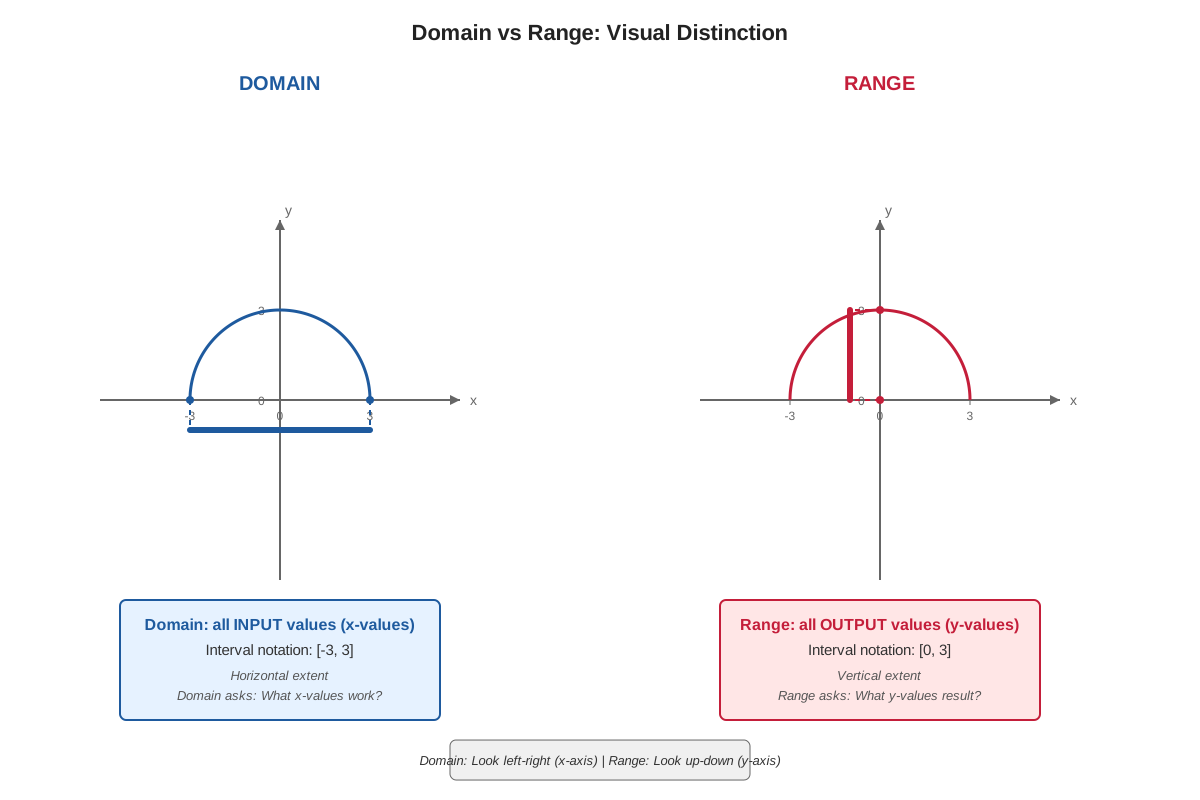
The range of a function is the complete set of all possible output values (y-values) that the function can produce. While the domain represents all allowable input values (x-values), the range represents what comes out of the function. Mathematically, if we have a function f with domain D, the range R consists of all values y such that y = f(x) for some x in D. This definition applies universally across all function types, though the method for determining range varies depending on the function's characteristics.
Visual Identification of Range from Graphs
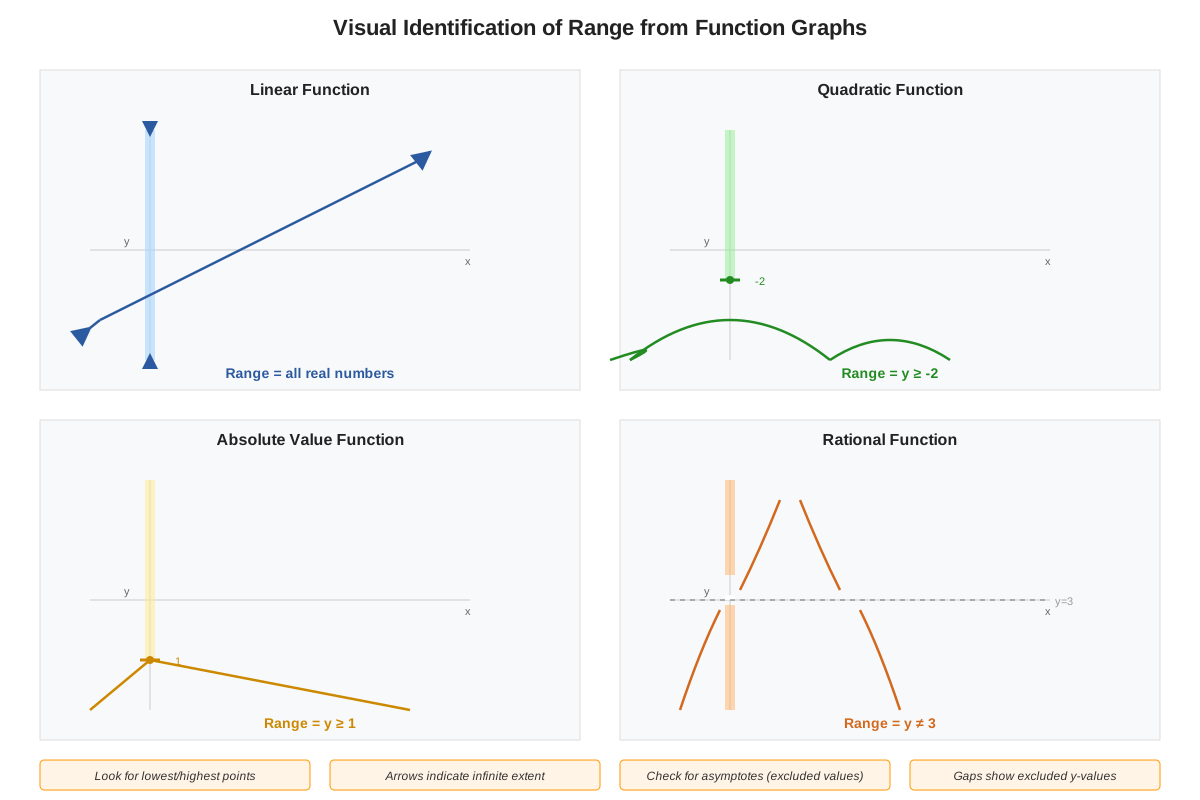
When examining a graph to determine range, focus exclusively on the vertical extent of the function. Start by identifying the lowest point the function reaches on the y-axis and the highest point it reaches. The range includes all y-values between (and including, if applicable) these extremes. For continuous functions, this creates an interval; for discrete functions, the range may be a set of individual values.
Key steps for reading range from graphs:
- Scan the graph vertically from bottom to top
- Identify the minimum y-value the function achieves (if one exists)
- Identify the maximum y-value the function achieves (if one exists)
- Determine whether endpoints are included (closed dots) or excluded (open dots)
- Express the range using appropriate notation
For example, a parabola opening upward with vertex at (2, -3) has a range of y ≥ -3 or [-3, ∞) because the function produces all y-values from -3 upward but never goes below -3.
Range of Common Function Types
Different function families have characteristic range patterns that SAT questions frequently test:
| Function Type | General Form | Typical Range | Key Feature | ||
|---|---|---|---|---|---|
| Linear | f(x) = mx + b (m ≠ 0) | All real numbers | No restrictions unless domain limited | ||
| Quadratic (opens up) | f(x) = a(x-h)² + k (a > 0) | [k, ∞) | Minimum at vertex | ||
| Quadratic (opens down) | f(x) = a(x-h)² + k (a < 0) | (-∞, k] | Maximum at vertex | ||
| Absolute Value | f(x) = a\ | x-h\ | + k (a > 0) | [k, ∞) | Minimum at vertex |
| Exponential Growth | f(x) = a·bˣ (a > 0, b > 1) | (0, ∞) | Approaches but never reaches 0 | ||
| Square Root | f(x) = √x | [0, ∞) | Only non-negative outputs |
Algebraic Determination of Range
For functions without readily available graphs, algebraic analysis determines range. The approach varies by function type:
For quadratic functions in standard form f(x) = ax² + bx + c:
- Convert to vertex form or find the vertex using x = -b/(2a)
- Calculate the y-coordinate of the vertex: f(-b/(2a))
- If a > 0, range is [vertex y-value, ∞)
- If a < 0, range is (-∞, vertex y-value]
For rational functions, identify horizontal asymptotes and any y-values that cannot be achieved. Often this requires solving y = f(x) for x and determining which y-values make the equation impossible.
For composite or complex functions, consider the range of the inner function as the effective domain of the outer function, then determine what outputs result.
Effect of Transformations on Range
Understanding how transformations affect range is crucial for SAT success:
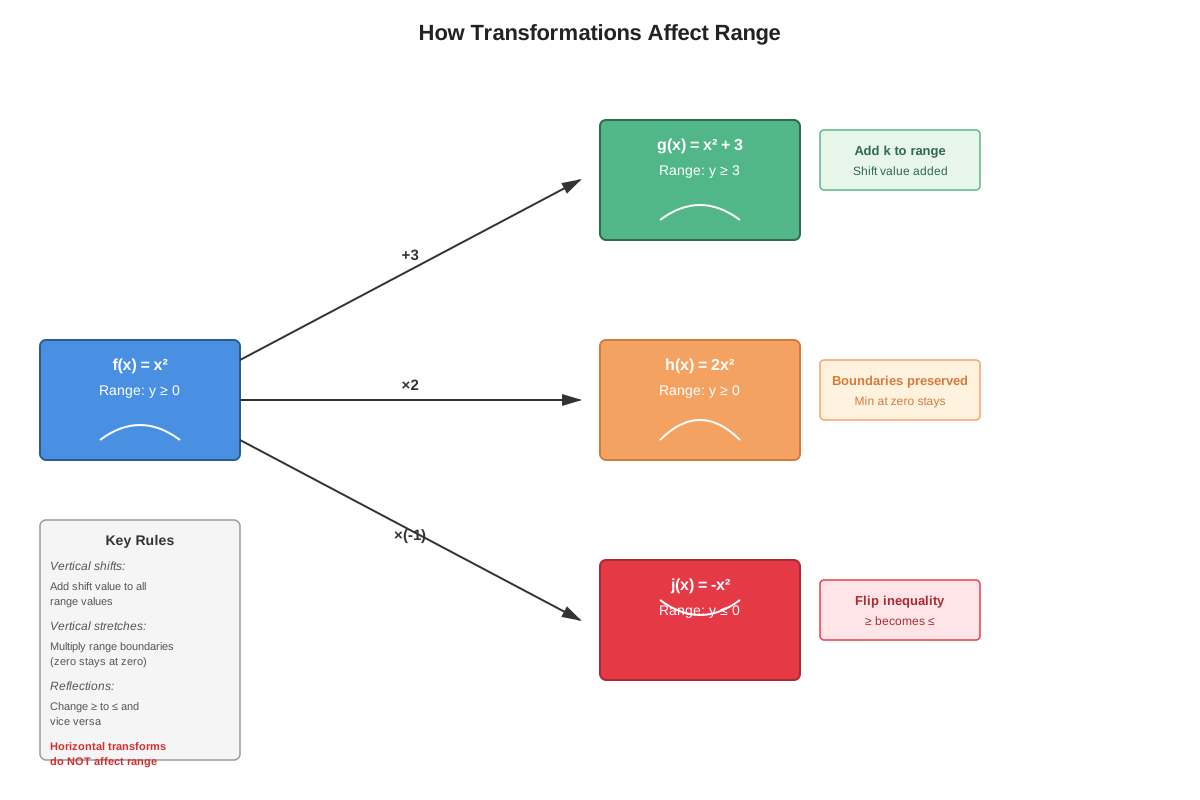
Vertical transformations (changes to the output) directly affect range:
- Vertical shift: f(x) + k shifts the entire range up by k units
- Vertical stretch: a·f(x) where |a| > 1 multiplies all range values by a
- Vertical compression: a·f(x) where 0 < |a| < 1 multiplies all range values by a
- Reflection over x-axis: -f(x) flips the range (maximum becomes minimum and vice versa)
Horizontal transformations (changes to the input) do NOT affect range:
- f(x + h) shifts the graph left/right but produces the same y-values
- f(bx) stretches/compresses horizontally but maintains the same range
- f(-x) reflects over the y-axis but keeps the same range
This distinction is frequently tested: students must recognize that only transformations affecting the output (outside the function) change the range.
Restricted Domain and Its Impact on Range
When a function's domain is restricted, the range may become more limited than the function's natural range. For example, while f(x) = x² naturally has range [0, ∞), if the domain is restricted to -2 ≤ x ≤ 1, the range becomes [0, 4] because the function only produces values between its minimum at x = 0 and its maximum at x = -2.
To find range with restricted domain:
- Identify critical points (vertices, endpoints, discontinuities) within the restricted domain
- Evaluate the function at domain endpoints
- Determine which produces the minimum and maximum y-values
- The range spans from minimum to maximum y-value achieved
Range Notation
The SAT accepts multiple notations for expressing range:
- Inequality notation: y ≥ 3 or -2 < y ≤ 5
- Interval notation: [3, ∞) or (-2, 5]
- Set-builder notation: {y | y ≥ 3} or {y ∈ ℝ | -2 < y ≤ 5}
Understanding all three forms ensures students can both interpret questions and express answers correctly. Note that square brackets [ ] indicate inclusion while parentheses ( ) indicate exclusion.
Concept Relationships
The concept of range sits at the intersection of multiple mathematical ideas, forming a web of interconnected knowledge. Range directly opposes and complements domain: while domain asks "what can go in?", range asks "what can come out?" Together, these concepts fully describe a function's behavior and limitations. This relationship becomes particularly important when working with inverse functions, where the domain and range swap roles.
Range connects to function transformations through a cause-and-effect relationship: vertical transformations → range changes, while horizontal transformations → range unchanged. This principle enables quick problem-solving on transformation questions without requiring complete re-graphing.
Inequalities and range share a fundamental relationship because range is essentially an inequality statement about y-values. Solving inequality problems often requires understanding range concepts, and expressing range requires facility with inequality notation.
The relationship map flows as follows:
Function definition → determines → Natural range → modified by → Transformations → produces → Actual range → constrained by → Domain restrictions → results in → Final range
Additionally, range connects to optimization problems (finding maximum/minimum values), real-world modeling (determining possible outcomes), and equation solving (determining which y-values have corresponding x-values).
Quick check — test yourself on Range so far.
Try Flashcards →High-Yield Facts
⭐ The range consists of all possible y-values (outputs) a function can produce
⭐ Vertical transformations change the range; horizontal transformations do not
⭐ For quadratic functions f(x) = a(x-h)² + k: if a > 0, range is [k, ∞); if a < 0, range is (-∞, k]
⭐ To find range from a graph, scan vertically and identify the lowest and highest y-values reached
⭐ Restricted domain can limit the range to a subset of the function's natural range
- Linear functions (non-horizontal) have range of all real numbers unless domain is restricted
- Absolute value functions of the form f(x) = |x| + k have range [k, ∞)
- Exponential functions of the form f(x) = bˣ (b > 0, b ≠ 1) have range (0, ∞)—never zero or negative
- The range of f(x) + c is the range of f(x) shifted up by c units
- When a function has a maximum point, the range is (-∞, maximum value]; when it has a minimum point, the range is [minimum value, ∞)
- Piecewise functions require examining each piece separately, then combining all possible y-values
- Rational functions often have "forbidden" y-values corresponding to horizontal asymptotes
- The square root function √x has range [0, ∞) because square roots are defined as non-negative
Common Misconceptions
Misconception: Range and domain are the same thing → Correction: Domain refers to input values (x-values) while range refers to output values (y-values). They are complementary but distinct concepts that describe different aspects of a function.
Misconception: Horizontal shifts change the range → Correction: Only vertical transformations affect range. Shifting a function left or right (f(x+h) or f(x-h)) changes which x-values produce which y-values, but the set of possible y-values remains identical.
Misconception: The range of f(x) = x² is all real numbers → Correction: The range of f(x) = x² is [0, ∞) because squaring any real number produces a non-negative result. The function never outputs negative values.
Misconception: If the domain is all real numbers, the range must be all real numbers → Correction: Domain and range are independent. Many functions (like quadratics, absolute value, exponentials) have unrestricted domains but restricted ranges.
Misconception: Range can be determined by plugging in a few x-values → Correction: While testing values helps, it doesn't guarantee finding the complete range. Systematic analysis of the function's behavior, including finding extrema and asymptotes, is necessary for determining the full range.
Misconception: Open and closed dots on graphs don't matter for range → Correction: Open dots indicate that specific y-value is NOT included in the range (use parentheses), while closed dots indicate inclusion (use brackets). This distinction is critical for correct notation.
Misconception: The range of a piecewise function is just the range of one piece → Correction: The range of a piecewise function is the union of all ranges from all pieces. Every y-value produced by any piece belongs to the overall range.
Worked Examples
Example 1: Finding Range from a Transformed Quadratic
Problem: The function g(x) = -2(x - 3)² + 8 represents the height of a ball over time. What is the range of this function?
Solution:
Step 1: Identify the function type and form.
This is a quadratic function in vertex form: g(x) = a(x - h)² + k, where a = -2, h = 3, and k = 8.
Step 2: Determine the direction of opening.
Since a = -2 < 0, the parabola opens downward, meaning it has a maximum point rather than a minimum.
Step 3: Identify the vertex.
The vertex is at (h, k) = (3, 8). This represents the highest point on the graph.
Step 4: Determine the range.
Because the parabola opens downward with maximum y-value of 8, the function produces all y-values from 8 downward to negative infinity. The ball reaches a maximum height of 8 units and can be at any height below that.
Step 5: Express in proper notation.
Range: (-∞, 8] or y ≤ 8
Connection to learning objectives: This example demonstrates identifying key features of range (the maximum value), applying range concepts to SAT-style questions (real-world context), and recognizing how the coefficient a affects range direction.
Example 2: Range with Restricted Domain
Problem: Consider the function f(x) = x² - 4x + 3 with domain restricted to 1 ≤ x ≤ 4. What is the range?
Solution:
Step 1: Find the vertex of the unrestricted function.
Using x = -b/(2a) = -(-4)/(2·1) = 2
The vertex is at x = 2, so f(2) = 4 - 8 + 3 = -1
The vertex (2, -1) is the natural minimum of this upward-opening parabola.
Step 2: Check if the vertex lies within the restricted domain.
Since 1 ≤ 2 ≤ 4, the vertex IS within the domain, so the minimum y-value is -1.
Step 3: Evaluate the function at domain endpoints.
f(1) = 1 - 4 + 3 = 0
f(4) = 16 - 16 + 3 = 3
Step 4: Determine minimum and maximum y-values.
Minimum: -1 (at the vertex)
Maximum: 3 (at x = 4)
Step 5: State the range.
Range: [-1, 3]
Connection to learning objectives: This example shows how to apply range concepts when domain restrictions exist, demonstrates the importance of checking critical points within the restricted domain, and illustrates the algebraic approach to finding range.
Exam Strategy
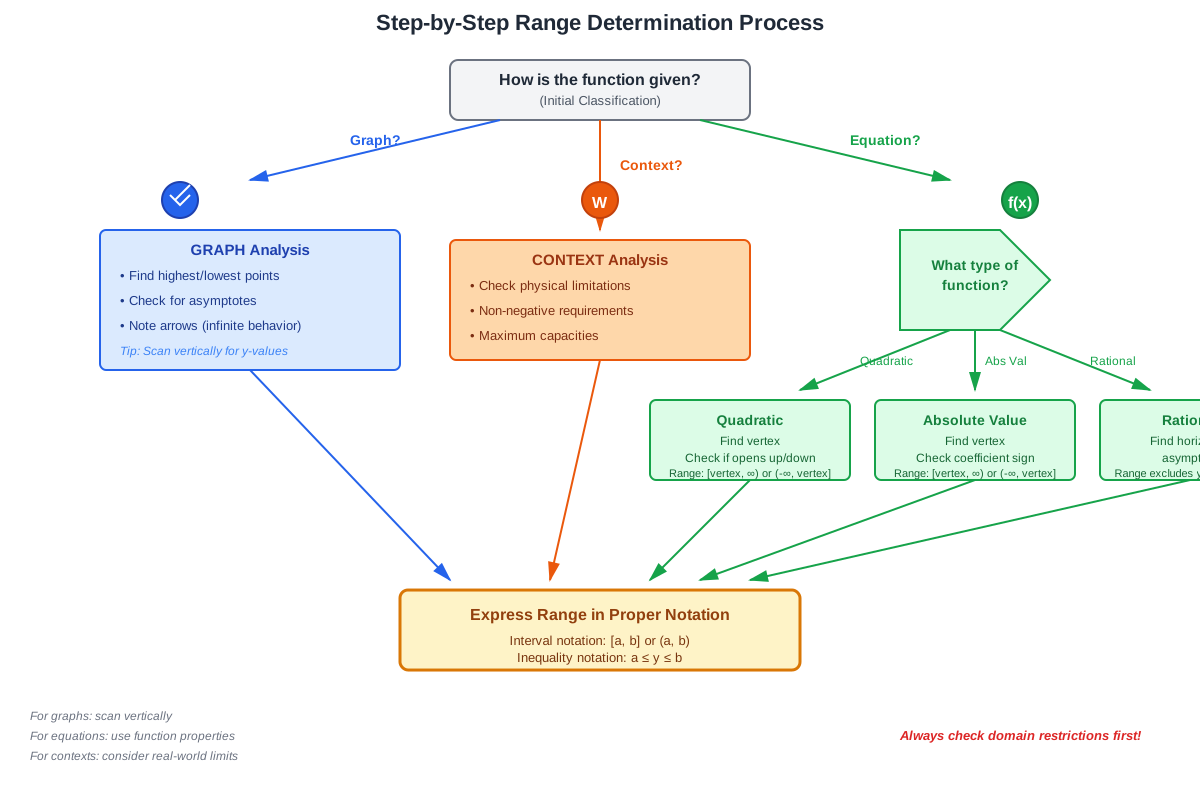
When approaching SAT range questions, begin by identifying the question format: graph-based or equation-based. For graph questions, immediately scan vertically to spot the lowest and highest points, paying careful attention to open versus closed dots. This visual approach often yields answers in 15-20 seconds, making it highly time-efficient.
Trigger words and phrases that signal range questions include:
- "What are the possible values of y..."
- "The output of the function..."
- "What values can f(x) produce..."
- "The maximum/minimum value..."
- "For what values of y does there exist..."
When equations are provided, quickly classify the function type (linear, quadratic, absolute value, exponential, etc.) because each type has predictable range characteristics. For quadratics, immediately identify the vertex and direction of opening—this alone determines the range in most cases.
Process of elimination strategies:
- Eliminate any answer choice that includes y-values clearly not on the graph
- For quadratics opening upward, eliminate choices with maximum values
- For quadratics opening downward, eliminate choices with minimum values
- If the graph shows the function reaching a specific y-value, eliminate choices that exclude it
- Check whether infinity should be included (it never is—always use parentheses with ∞)
Time allocation: Spend no more than 60-90 seconds on straightforward range questions. If a question requires extensive algebraic manipulation and you're uncertain, mark it for review and return after completing easier questions. Range questions testing basic graph reading should take 30-45 seconds maximum.
For questions involving transformations, remember the golden rule: only vertical changes affect range. If you see f(x-3) or f(2x), the range is unchanged from the original function. If you see f(x)+3 or 2f(x), the range has been modified. This single principle eliminates wrong answers instantly on transformation questions.
Memory Techniques
VORTEX mnemonic for remembering what affects range:
- Vertical shifts change range
- Outside multipliers change range
- Range = y-values (outputs)
- Transformations inside don't affect range
- Extrema (max/min) define range boundaries
- X-axis transformations leave range alone
Visual memory technique: Picture a function as a water fountain. The range represents how high and low the water can reach vertically. Moving the fountain left or right (horizontal shift) doesn't change how high the water goes—only raising/lowering the fountain base (vertical shift) or changing water pressure (vertical stretch) affects the height range.
Acronym for quadratic range: VAUD
- Vertex form reveals range
- A (coefficient) determines direction
- Upward opening: minimum at vertex
- Downward opening: maximum at vertex
Interval notation memory device: Think of brackets as "barriers" that include the endpoint (closed), while parentheses are "permeable" and exclude the endpoint (open). Infinity always gets parentheses because you can never actually reach infinity—it's always permeable.
Summary
Range represents the complete set of all possible output values (y-values) that a function can produce, making it essential for understanding function behavior on the SAT. Determining range requires different approaches depending on whether information is presented graphically or algebraically: graphs require vertical scanning to identify minimum and maximum y-values, while equations require analysis based on function type and characteristics. Quadratic functions have ranges determined by their vertex and opening direction; absolute value functions have ranges starting at their vertex; exponential functions have ranges excluding zero; and linear functions typically have unrestricted ranges. Vertical transformations (shifts, stretches, reflections) directly modify range, while horizontal transformations leave range unchanged—a critical distinction for SAT questions. Domain restrictions can limit range to a subset of the function's natural range, requiring evaluation at critical points and endpoints. Mastering range notation (inequality, interval, and set-builder forms) ensures students can both interpret questions and express answers correctly across all SAT math question formats.
Key Takeaways
- Range consists exclusively of y-values (outputs); domain consists of x-values (inputs)—never confuse these fundamental concepts
- Vertical transformations change range; horizontal transformations do not—this principle eliminates wrong answers instantly
- For quadratics in vertex form f(x) = a(x-h)² + k: range is [k, ∞) if a > 0, or (-∞, k] if a < 0
- Reading range from graphs requires scanning vertically and noting the lowest and highest points reached
- Restricted domains can limit range beyond the function's natural restrictions—always check endpoints and critical points within the restricted domain
- Different function families have characteristic range patterns: learn these patterns for quick recognition on test day
- Express range using proper notation with brackets for inclusion and parentheses for exclusion, remembering infinity always uses parentheses
Related Topics
Domain of Functions: Understanding domain (all possible input values) complements range knowledge and together these concepts provide complete function analysis. Mastering range makes domain questions more intuitive since the concepts mirror each other.
Function Transformations: Deep knowledge of how shifts, stretches, compressions, and reflections affect functions builds directly on range concepts, particularly understanding which transformations modify range versus those that don't.
Inverse Functions: The domain and range swap roles when finding inverse functions, making range mastery essential for understanding inverse relationships and solving inverse function problems.
Optimization Problems: Finding maximum and minimum values (optimization) is essentially determining range boundaries, connecting range concepts to real-world applications and calculus preview topics.
Piecewise Functions: Analyzing piecewise functions requires finding the range of each piece and combining them, extending range concepts to more complex function structures.
Practice CTA
Now that you've mastered the core concepts of range, it's time to solidify your understanding through active practice. Attempt the practice questions to test your ability to identify range from graphs, determine range algebraically, and apply range concepts to SAT-style problems. Use the flashcards to reinforce key definitions, formulas, and strategies until they become automatic. Remember: understanding range isn't just about memorizing rules—it's about developing the intuition to quickly analyze functions and eliminate wrong answers. Each practice problem you complete builds the pattern recognition and confidence needed to excel on test day. You've got this!
Sign up free to keep reading
Create a free AnvayaPrep account to finish this SAT guide on Range — plus flashcards and practice questions.