Overview
Function evaluation is one of the most fundamental and frequently tested concepts in SAT math. At its core, function evaluation involves substituting a specific input value into a function and calculating the corresponding output. This seemingly simple process forms the foundation for understanding more complex function behaviors, transformations, and compositions that appear throughout the SAT Math section.
On the SAT, sat function evaluation questions appear in multiple forms: straightforward substitution problems, nested function compositions, piecewise functions, and abstract function notation scenarios. These questions test not only computational accuracy but also conceptual understanding of what functions represent—the relationship between inputs and outputs. Mastering function evaluation is essential because it appears in approximately 10-15% of SAT Math questions, either as the primary focus or as a necessary step in solving more complex problems involving quadratic functions, exponential models, or systems of equations.
Function evaluation connects directly to algebraic manipulation, order of operations, and the broader concept of mathematical modeling. Understanding how to evaluate functions prepares students for questions involving function composition, inverse functions, and transformations—all high-yield SAT topics. Additionally, the skills developed through function evaluation practice translate directly to interpreting graphs, analyzing data relationships, and solving real-world application problems that frequently appear in both the calculator and no-calculator sections of the exam.
Learning Objectives
- [ ] Identify key features of function evaluation
- [ ] Explain how function evaluation appears on the SAT
- [ ] Apply function evaluation to answer SAT-style questions
- [ ] Evaluate functions using various types of notation including f(x), g(t), and h(n)
- [ ] Solve problems involving composition of functions such as f(g(x))
- [ ] Interpret and evaluate piecewise-defined functions based on domain restrictions
- [ ] Determine function values from graphs, tables, and algebraic expressions
Prerequisites
- Order of operations (PEMDAS): Function evaluation requires correctly applying operations in the proper sequence when substituting values
- Algebraic substitution: The ability to replace variables with numerical or algebraic expressions is the core mechanism of function evaluation
- Simplifying expressions: After substitution, students must simplify complex expressions involving exponents, fractions, and multiple operations
- Basic function notation: Understanding that f(x) represents "the output of function f when the input is x" is essential
- Solving linear and quadratic equations: Many function evaluation problems require solving for unknown inputs when given specific outputs
Why This Topic Matters
Function evaluation represents a critical bridge between abstract mathematical notation and practical problem-solving. In real-world applications, functions model countless relationships: the cost of a taxi ride based on distance traveled, the population growth of a city over time, the trajectory of a projectile, or the profit from selling a certain number of products. Evaluating these functions at specific points allows for concrete predictions and informed decision-making.
On the SAT, function evaluation questions appear with remarkable consistency. Approximately 3-5 questions per test directly assess function evaluation skills, while another 5-8 questions require function evaluation as an intermediate step. These questions appear in both multiple-choice and student-produced response formats, across both calculator and no-calculator sections. The College Board particularly favors questions that combine function evaluation with other concepts, such as evaluating a function and then using that result in an equation or inequality.
Common SAT question formats include: evaluating f(3) when given an algebraic expression for f(x); finding the value of x when f(x) equals a specific number; evaluating composite functions like f(g(2)); determining function values from graphs or tables; and working with piecewise functions where different rules apply to different input ranges. The versatility of function evaluation questions makes this topic one of the highest-yield areas for focused study, as mastery here directly translates to points across multiple question types.
Core Concepts
Basic Function Notation and Evaluation
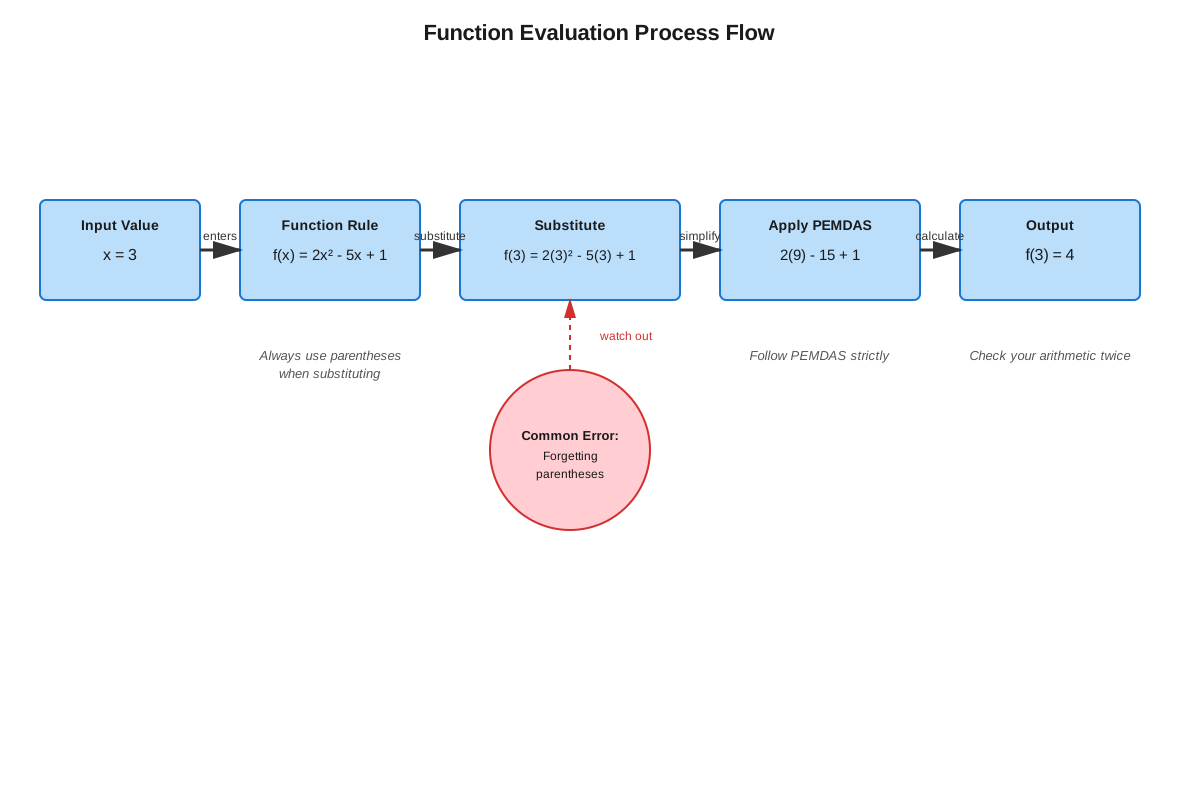
Function notation uses the format f(x), read as "f of x," where f is the function name and x represents the input variable. The expression f(x) represents the output or result when x is input into the function. To evaluate a function, substitute the given input value for every instance of the variable in the function's rule, then simplify using proper order of operations.
For example, if f(x) = 3x² - 5x + 2, then to find f(4):
- Replace every x with 4: f(4) = 3(4)² - 5(4) + 2
- Apply exponents: f(4) = 3(16) - 5(4) + 2
- Multiply: f(4) = 48 - 20 + 2
- Add and subtract from left to right: f(4) = 30
The input value can be any number (positive, negative, zero, fraction, or even an irrational number like π), and the function name can be any letter, though f, g, and h are most common on the SAT.
Evaluating Functions with Non-Numerical Inputs
Functions can be evaluated with algebraic expressions as inputs, not just numbers. If f(x) = x² + 3x and you need to find f(2a), substitute 2a for every x:
f(2a) = (2a)² + 3(2a) = 4a² + 6a
This concept frequently appears on harder SAT questions. Students must carefully apply exponent rules and distribution when the input contains variables. When evaluating f(x + h), every instance of x becomes (x + h), which often requires expanding binomials or applying the distributive property multiple times.
Function Composition
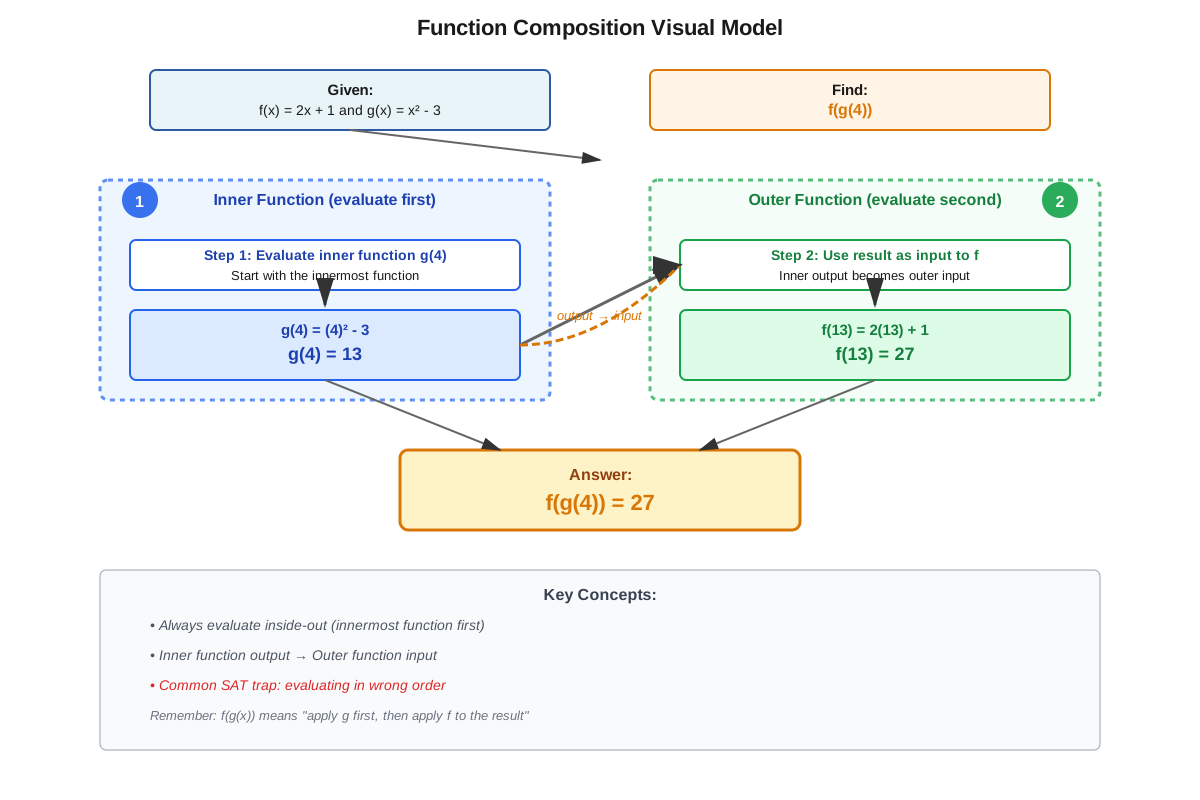
Function composition involves using the output of one function as the input for another function. The notation f(g(x)), read as "f of g of x," means: first evaluate g(x), then use that result as the input for f.
The process follows these steps:
- Evaluate the inner function first (the one closest to x)
- Use that result as the input for the outer function
- Simplify the final expression
For example, if f(x) = 2x + 1 and g(x) = x² - 3:
- To find f(g(2)): First calculate g(2) = 2² - 3 = 1, then f(1) = 2(1) + 1 = 3
- To find g(f(2)): First calculate f(2) = 2(2) + 1 = 5, then g(5) = 5² - 3 = 22
Notice that f(g(x)) and g(f(x)) typically produce different results—the order matters significantly.
Piecewise Functions
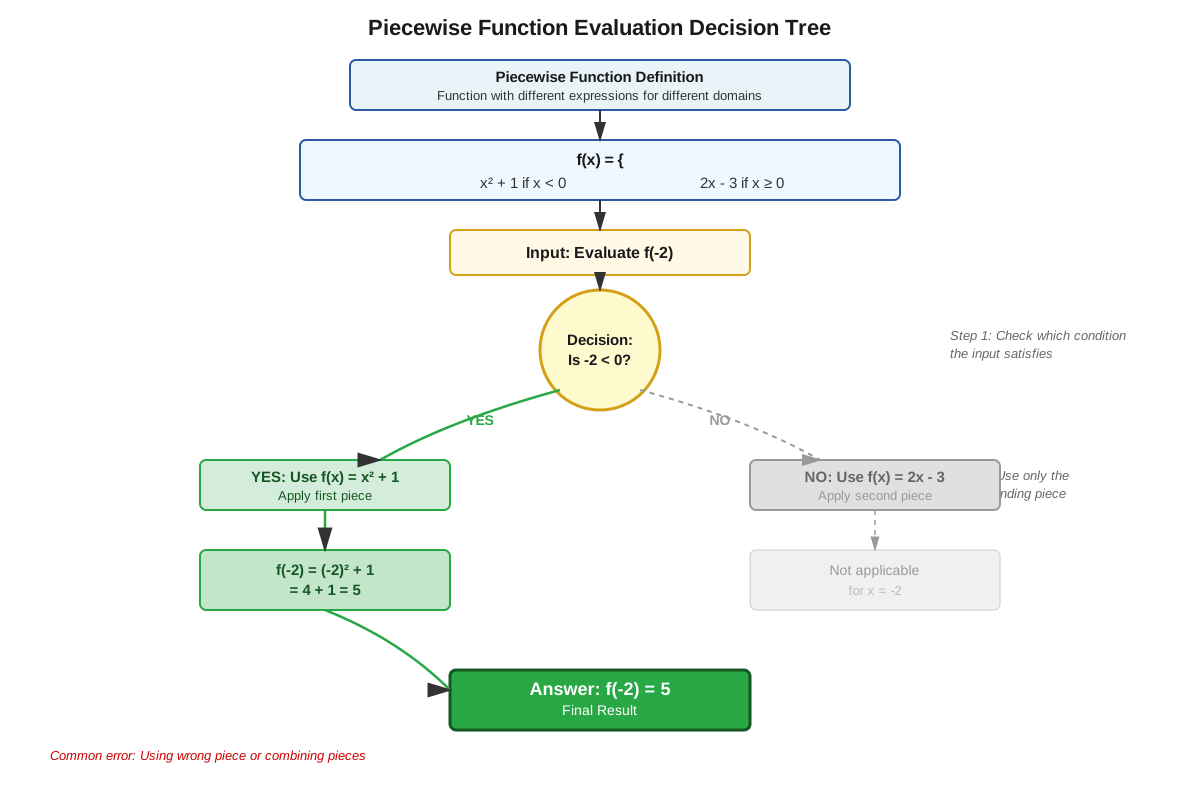
Piecewise functions use different rules for different portions of their domain. These functions are defined by multiple expressions, each applying to a specific range of input values. The SAT frequently tests whether students can identify which piece of the function to use based on the given input.
A typical piecewise function might look like:
f(x) = { x² + 1,     if x < 0
       { 2x - 3,     if 0 ≤ x < 5
       { 10,         if x ≥ 5
To evaluate a piecewise function:
- Determine which condition the input satisfies
- Use only the expression associated with that condition
- Substitute and simplify
For the function above: f(-2) = (-2)² + 1 = 5 (using the first piece because -2 < 0), f(3) = 2(3) - 3 = 3 (using the second piece because 0 ≤ 3 < 5), and f(7) = 10 (using the third piece because 7 ≥ 5).
Evaluating Functions from Graphs and Tables
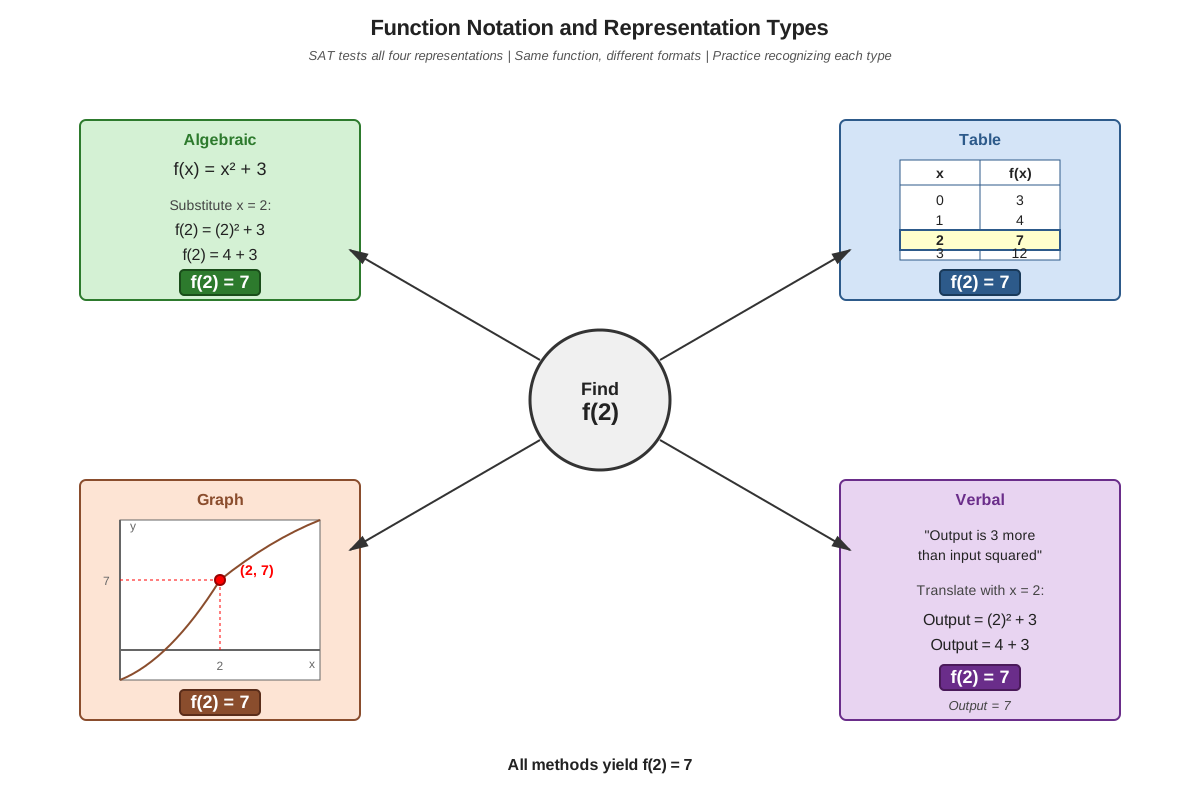
Not all functions are given as algebraic expressions. The SAT frequently presents functions as graphs or tables, requiring students to read function values visually or from organized data.
When evaluating from a graph:
- f(a) represents the y-coordinate of the point where x = a
- Locate the input value on the x-axis
- Find the corresponding point on the function
- Read the y-coordinate
When evaluating from a table:
- Find the row where the input variable equals the given value
- Read the corresponding output value from the function column
| x | f(x) |
|---|---|
| -2 | 5 |
| 0 | 3 |
| 2 | 7 |
| 4 | 1 |
From this table: f(0) = 3, f(2) = 7, and f(4) = 1.
Solving for Input Values
Some SAT questions reverse the typical process: they provide the output and ask for the input. If f(x) = 15 and f(x) = 2x - 5, solve for x:
2x - 5 = 15
2x = 20
x = 10
This requires setting up and solving an equation. For quadratic or more complex functions, this may yield multiple solutions, and students must check whether all solutions are valid within any given domain restrictions.
Concept Relationships
Function evaluation serves as the foundational skill that enables all other function-related concepts. The relationship flows as follows:
Basic Substitution → enables → Algebraic Function Evaluation → enables → Function Composition
Understanding how to substitute numerical values prepares students for substituting algebraic expressions, which in turn makes function composition manageable. Each level builds directly on the previous one.
Function Evaluation ↔ connects bidirectionally with → Solving Equations
Evaluating functions and solving for inputs when outputs are known represent inverse processes. Mastery of both creates a complete understanding of the input-output relationship.
Piecewise Functions → combines → Function Evaluation + Inequalities
Piecewise function evaluation requires first determining which domain restriction applies (an inequality skill) before performing standard function evaluation.
Graphical Evaluation → reinforces → Coordinate Plane Understanding
Reading function values from graphs strengthens the connection between algebraic and visual representations of functions, which connects to the broader unit on nonlinear models.
The prerequisite skills of algebraic substitution and order of operations directly enable function evaluation, while function evaluation itself enables progression to function transformations, inverse functions, and systems of equations—all topics that appear later in the SAT Math curriculum.
Quick check — test yourself on Function evaluation so far.
Try Flashcards →High-Yield Facts
⭐ Function notation f(x) means "the output of function f when the input is x"—it does not mean f times x
⭐ To evaluate a function, substitute the input value for every instance of the variable in the function rule
⭐ In function composition f(g(x)), always evaluate the inner function g(x) first, then use that result as input for f
⭐ For piecewise functions, first determine which domain condition the input satisfies, then use only that piece's expression
⭐ When evaluating f(x + h) or f(2a), substitute the entire expression for x, including parentheses, then expand carefully
- Function evaluation requires strict adherence to order of operations (PEMDAS) after substitution
- The same function can be evaluated at multiple inputs, producing different outputs for each
- When reading function values from graphs, f(a) corresponds to the y-coordinate when x = a
- Solving f(x) = k for x is the inverse process of evaluating f at a specific input
- Composite functions like f(f(x)) are possible—a function can be composed with itself
- Domain restrictions in piecewise functions use inequality symbols: < (less than), ≤ (less than or equal to), > (greater than), ≥ (greater than or equal to)
- Function evaluation with negative inputs requires careful attention to signs, especially with exponents
- Tables showing function values provide discrete points; the function may be defined between those points but values must be interpolated or calculated
Common Misconceptions
Misconception: f(x) means f multiplied by x → Correction: f(x) is function notation representing the output of function f when the input is x. It is not multiplication. If f(x) = x² + 3, then f(5) = 28, not "f times 5."
Misconception: f(a + b) equals f(a) + f(b) → Correction: Functions do not generally distribute over addition. If f(x) = x², then f(3 + 2) = f(5) = 25, but f(3) + f(2) = 9 + 4 = 13. These are not equal. Always substitute the entire expression first.
Misconception: In f(g(x)), evaluate f first → Correction: Always work from the inside out. Evaluate g(x) first, then use that result as the input for f. The notation f(g(x)) means "f of the quantity g(x)," so g(x) must be calculated before f can be applied.
Misconception: When evaluating f(2x), only the first x in the function rule gets replaced → Correction: Every instance of the variable must be replaced with the input expression. If f(x) = x² - 3x + 1, then f(2x) = (2x)² - 3(2x) + 1 = 4x² - 6x + 1. All three x's are replaced.
Misconception: For piecewise functions, you can use any piece regardless of the input value → Correction: Each piece of a piecewise function applies only to inputs within its specified domain. You must first check which condition the input satisfies, then use only that corresponding expression.
Misconception: f(-3)² equals f(9) → Correction: Order of operations matters. f(-3)² means [f(-3)]²—first evaluate the function at -3, then square the result. This is different from f((-3)²) = f(9), where you square -3 first, then evaluate the function at 9.
Misconception: Reading f(2) from a graph means finding where the graph crosses y = 2 → Correction: f(2) means finding the y-value when x = 2. Locate x = 2 on the horizontal axis, find the corresponding point on the graph, then read the y-coordinate. Finding where the graph crosses y = 2 would answer the question "for what x does f(x) = 2?"
Worked Examples
Example 1: Multi-Step Function Evaluation with Composition
Problem: If f(x) = 2x² - 3x + 1 and g(x) = x + 4, find the value of f(g(3)).
Solution:
Step 1: Identify that this is a composition problem. We need to evaluate g(3) first, then use that result as input for f.
Step 2: Evaluate the inner function g(3):
g(3) = 3 + 4 = 7
Step 3: Now evaluate f(7):
f(7) = 2(7)² - 3(7) + 1
Step 4: Apply order of operations:
- Exponent first: f(7) = 2(49) - 3(7) + 1
- Multiplication: f(7) = 98 - 21 + 1
- Addition and subtraction from left to right: f(7) = 78
Answer: f(g(3)) = 78
Connection to Learning Objectives: This problem demonstrates the application of function evaluation to SAT-style questions involving composition, requiring students to identify the correct order of operations and execute multiple evaluation steps accurately.
Example 2: Piecewise Function with Multiple Evaluations
Problem: Consider the piecewise function:
h(x) = { x² - 4,      if x ≤ 0
       { 3x + 2,      if 0 < x < 4
       { -2x + 18,    if x ≥ 4
Find h(-3), h(2), and h(5).
Solution:
For h(-3):
Step 1: Determine which piece applies. Since -3 ≤ 0, use the first piece: h(x) = x² - 4
Step 2: Substitute: h(-3) = (-3)² - 4 = 9 - 4 = 5
For h(2):
Step 1: Determine which piece applies. Since 0 < 2 < 4, use the second piece: h(x) = 3x + 2
Step 2: Substitute: h(2) = 3(2) + 2 = 6 + 2 = 8
For h(5):
Step 1: Determine which piece applies. Since 5 ≥ 4, use the third piece: h(x) = -2x + 18
Step 2: Substitute: h(5) = -2(5) + 18 = -10 + 18 = 8
Answers: h(-3) = 5, h(2) = 8, h(5) = 8
Key Insight: Notice that h(2) and h(5) both equal 8 even though they use different pieces of the function. This demonstrates that different inputs can produce the same output, and that the domain conditions must be checked carefully before selecting which expression to use.
Connection to Learning Objectives: This example addresses interpreting and evaluating piecewise-defined functions based on domain restrictions, a key feature of function evaluation that frequently appears on the SAT.
Exam Strategy
When approaching sat function evaluation questions, follow this systematic process:
Step 1: Identify the question type
- Is it straightforward evaluation (find f(3))?
- Is it composition (find f(g(x)))?
- Is it piecewise (check domain conditions)?
- Is it solving for input (given f(x) = 10, find x)?
Step 2: Watch for trigger words and phrases
- "Evaluate" or "find the value of" → direct substitution
- "f of g of x" or f(g(x)) → composition, work inside-out
- "If f(x) = ..." or "when f(x) equals..." → set up equation and solve
- "For x < 0" or "when x ≥ 5" → piecewise function, check conditions first
- "According to the graph/table" → visual or tabular evaluation
Step 3: Execute with precision
- Write out the substitution explicitly: f(3) = 2(3)² - 5(3) + 1
- Use parentheses around substituted values, especially negatives: f(-2) = 3(-2)² ≠ 3(-2²)
- For algebraic inputs, parenthesize the entire expression: f(x+1) = (x+1)² not x+1²
Step 4: Process of elimination tips
- If evaluating at a positive number yields a negative answer choice that seems wrong, check your signs
- For composition problems, eliminate answers that would result from evaluating in the wrong order
- For piecewise functions, eliminate answers that use the wrong piece
- If the function contains x² and you're evaluating at a negative number, the result should match evaluation at the corresponding positive number (unless other terms affect the sign)
Time allocation: Straightforward evaluation questions should take 30-45 seconds. Composition or piecewise problems may require 60-90 seconds. If a problem requires more than 2 minutes, mark it and return later—there may be a simpler approach you're missing.
Exam Tip: On the no-calculator section, SAT questions are designed so that arithmetic simplifies nicely. If you're getting unwieldy fractions or decimals, double-check your substitution and simplification steps.
Memory Techniques
SISO - "Substitute In, Simplify Out"
Remember that function evaluation is a two-step process: Substitute the input value, then Simplify using order of operations.
Inside-Out Composition
For f(g(x)), think "Inside Out" - evaluate the Inner function (g) first, then the Outer function (f).
PEMDAS After Substitution
Create a mental checkpoint: "Substitution complete? Now PEMDAS!" This prevents rushing through order of operations after substituting.
Piecewise Decision Tree
Visualize a decision tree: "Check the input → Which condition is true? → Use that piece only." This three-step mental model prevents using the wrong piece.
The Parentheses Protection Rule
When substituting anything other than a simple positive integer, mentally wrap it in "protective parentheses." This prevents sign errors and ensures proper application of exponents.
Function Notation Translation
Train yourself to mentally translate: f(5) = "the output when 5 goes in" not "f times 5." This simple translation prevents the most common notation error.
Summary
Function evaluation is the process of determining the output of a function for a given input by substituting the input value into the function's rule and simplifying. This fundamental skill appears throughout the SAT Math section in various forms: direct evaluation with numerical or algebraic inputs, function composition where one function's output becomes another's input, piecewise functions requiring domain analysis, and graphical or tabular evaluation. Mastery requires precise substitution technique, strict adherence to order of operations, and careful attention to notation. Students must recognize that f(x) represents function notation rather than multiplication, understand that composition requires inside-out evaluation, and know that piecewise functions demand checking domain conditions before selecting the appropriate expression. Success on SAT function evaluation questions depends on systematic approach, attention to detail with signs and parentheses, and the ability to connect algebraic, graphical, and numerical representations of functions.
Key Takeaways
- Function evaluation means substituting an input value for the variable and simplifying using order of operations
- In composition f(g(x)), always evaluate the inner function g(x) first, then use that result as input for f
- Piecewise functions require checking which domain condition the input satisfies before selecting the correct expression
- Every instance of the variable must be replaced when substituting, and algebraic inputs should be parenthesized
- Function notation f(x) does not mean multiplication—it represents the output of function f when the input is x
- Function values can be read from graphs (y-coordinate when x equals the input) or tables (matching input to output)
- The SAT tests function evaluation both as a standalone skill and as a component of more complex problems involving equations, inequalities, and modeling
Related Topics
Function Composition and Inverse Functions: Building on basic evaluation, these topics explore how functions can be combined and reversed, requiring deeper understanding of input-output relationships and domain/range considerations.
Function Transformations: Mastering evaluation enables analysis of how functions shift, stretch, and reflect when expressions like f(x + 2) or 2f(x) are evaluated, connecting algebraic and graphical representations.
Quadratic and Exponential Functions: These specific function types require evaluation skills as a foundation for analyzing their unique properties, including vertex form, growth rates, and modeling applications.
Systems of Equations with Functions: Function evaluation becomes a tool for solving systems where one or both equations are expressed in function notation, combining multiple algebraic skills.
Practice CTA
Now that you've mastered the core concepts of function evaluation, it's time to cement your understanding through practice. Attempt the practice questions to test your ability to evaluate functions in various formats, work with composition and piecewise functions, and apply these skills to SAT-style problems. Use the flashcards to reinforce key definitions and common question patterns. Remember: function evaluation appears on virtually every SAT, making this practice time one of your highest-yield study investments. Each problem you solve builds the pattern recognition and computational confidence that translates directly to points on test day. You've got this!
Sign up free to keep reading
Create a free AnvayaPrep account to finish this SAT guide on Function evaluation — plus flashcards and practice questions.