Overview
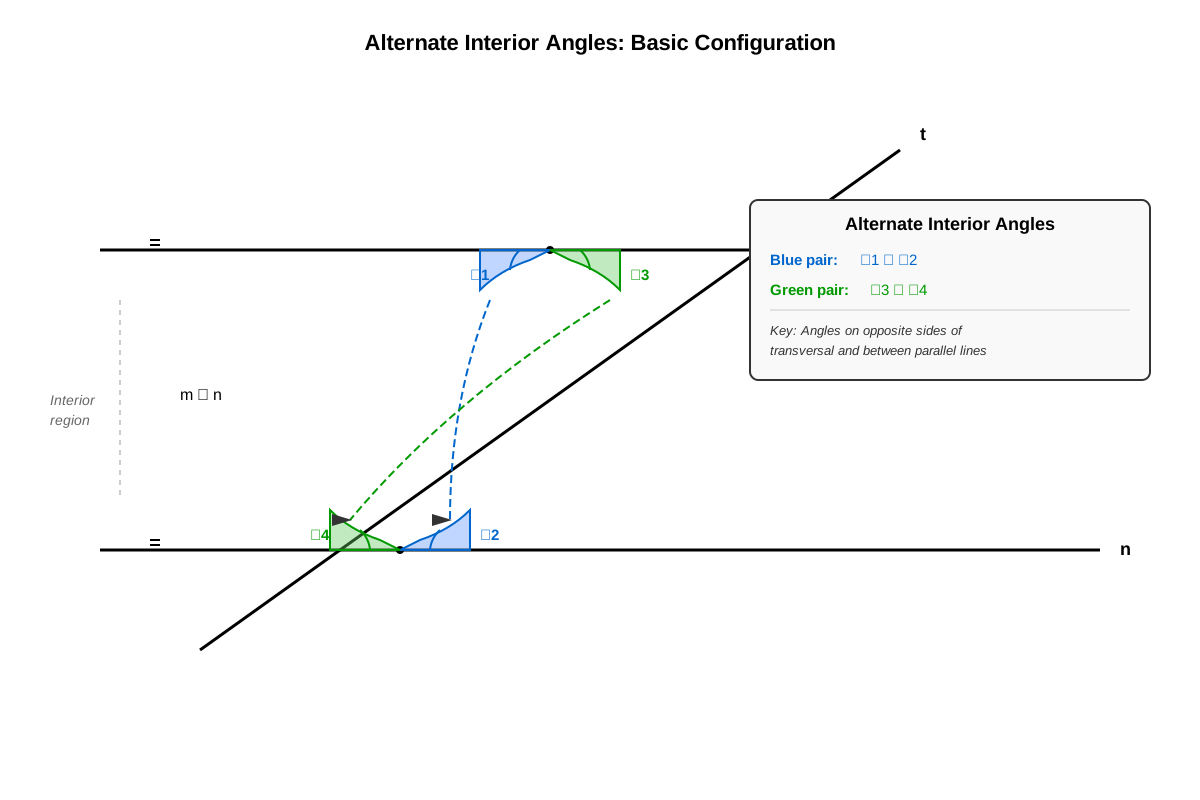
Alternate interior angles are a fundamental concept in geometry that appears frequently on the SAT and forms the foundation for solving numerous angle relationship problems. When a transversal line intersects two parallel lines, it creates eight angles at the two points of intersection. Among these angles, alternate interior angles are pairs of angles that lie on opposite sides of the transversal and between (interior to) the two parallel lines. The critical property that makes this concept so powerful is that when the lines are parallel, alternate interior angles are always congruent—they have equal measures.
Understanding alternate interior angles is essential for SAT success because this concept appears in multiple question formats throughout the math section. Students encounter these angles in pure geometry problems, coordinate geometry questions, and complex multi-step problems that combine several geometric principles. The SAT frequently tests whether students can recognize parallel line configurations, identify angle relationships, and apply the congruence property to solve for unknown angle measures. Mastery of this topic typically accounts for 2-4 questions per test, making it a high-yield area for score improvement.
This topic connects directly to broader geometric reasoning skills tested on the SAT. Alternate interior angles relate closely to corresponding angles, consecutive interior angles, and vertical angles—all of which may appear together in a single problem. Additionally, this concept integrates with algebraic thinking when students must set up and solve equations involving angle measures. The ability to recognize and apply alternate interior angle relationships also supports success in coordinate geometry, triangle problems, and polygon questions, making it a cornerstone concept that unlocks multiple problem types across the geometry domain.
Learning Objectives
- [ ] Identify key features of alternate interior angles in diagrams with parallel lines and transversals
- [ ] Explain how alternate interior angles appears on the SAT in various question formats
- [ ] Apply alternate interior angles to answer SAT-style questions involving angle calculations
- [ ] Determine whether two lines are parallel based on alternate interior angle relationships
- [ ] Solve multi-step problems that combine alternate interior angles with algebraic expressions
- [ ] Distinguish between alternate interior angles and other angle pairs formed by transversals
- [ ] Construct logical arguments using alternate interior angle properties to justify solutions
Prerequisites
- Basic angle vocabulary: Understanding terms like acute, obtuse, straight, and supplementary angles is necessary to describe and measure alternate interior angles accurately
- Linear pairs and vertical angles: These fundamental angle relationships often appear alongside alternate interior angles in SAT problems and help establish angle measures
- Basic algebraic equation solving: Many SAT questions require setting up equations when alternate interior angles are expressed as algebraic expressions
- Properties of parallel lines: Recognizing parallel line notation and understanding what it means for lines to be parallel provides the foundation for applying alternate interior angle theorems
Why This Topic Matters
In real-world applications, alternate interior angles appear in architecture, engineering, and design. When architects design buildings with parallel support beams crossed by diagonal braces, they use alternate interior angle relationships to ensure structural integrity and proper load distribution. Urban planners apply these concepts when designing street grids where roads intersect at consistent angles. Even in everyday situations like adjusting the angle of a ladder against a wall or understanding how light reflects off parallel mirrors, alternate interior angle principles govern the geometric relationships.
On the SAT, alternate interior angles appear in approximately 10-15% of geometry questions, making this a high-frequency topic. The College Board typically includes 2-4 questions per test that directly or indirectly test this concept. Questions appear in both the calculator and no-calculator sections, with difficulty levels ranging from straightforward angle identification to complex multi-step problems. The most common question formats include: finding the measure of an unknown angle when given one angle measure, solving for a variable in an algebraic expression representing angle measures, determining whether lines are parallel based on angle relationships, and combining alternate interior angles with other geometric properties in complex diagrams.
The SAT presents alternate interior angles in several characteristic ways: diagrams showing two lines cut by a transversal with some angles labeled, word problems describing parallel line scenarios, coordinate geometry questions where students must recognize parallel lines from slopes, and proof-style questions asking students to justify why certain angles are equal. The test often embeds alternate interior angle relationships within larger problems involving triangles, quadrilaterals, or coordinate planes, requiring students to recognize the pattern even when it's not explicitly stated.
Core Concepts
Definition and Basic Structure
Alternate interior angles are pairs of angles formed when a transversal (a line that intersects two or more other lines) crosses two lines. These angles are called "interior" because they lie between the two lines being crossed, and "alternate" because they are on opposite sides of the transversal. For alternate interior angles to be congruent (equal in measure), the two lines being crossed must be parallel.
Consider two parallel lines, line l and line m, crossed by a transversal line t. At each intersection point, four angles are formed, creating eight angles total. The alternate interior angles are the pairs that sit in the interior region (between the two parallel lines) but on opposite sides of the transversal. If we label the angles 1 through 8, with angles 1-4 at the upper intersection and angles 5-8 at the lower intersection, then typical alternate interior angle pairs would be angles 3 and 6, or angles 4 and 5.
The Alternate Interior Angles Theorem
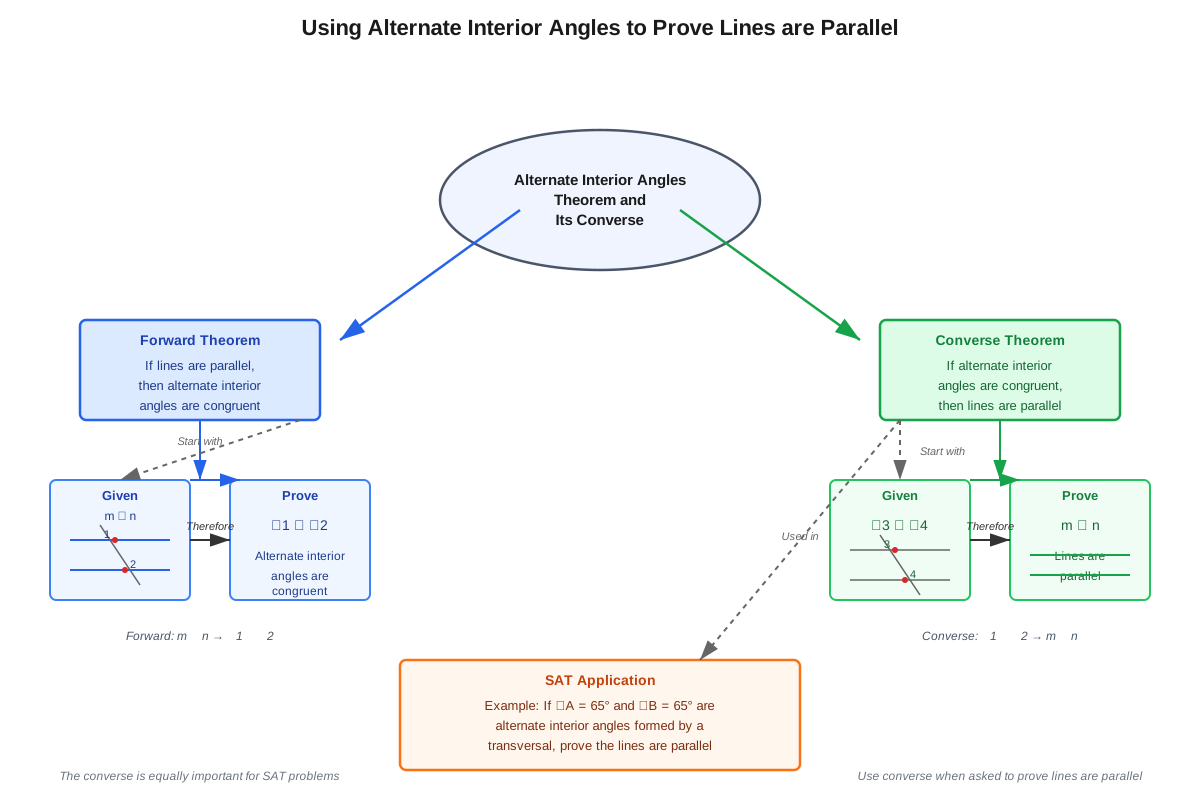
The fundamental theorem states: When two parallel lines are cut by a transversal, alternate interior angles are congruent. This is both a defining property and a powerful problem-solving tool. The converse is equally important: If two lines are cut by a transversal and the alternate interior angles are congruent, then the lines are parallel. This converse allows students to prove that lines are parallel by demonstrating that alternate interior angles have equal measures.
Mathematically, if lines l and m are parallel (written as l ∥ m), and they are cut by transversal t, then for alternate interior angle pairs, we can write: ∠3 ≅ ∠6 and ∠4 ≅ ∠5. The symbol ≅ means "is congruent to," indicating the angles have equal measures.
Identifying Alternate Interior Angles in Diagrams
To successfully identify alternate interior angles on the SAT, follow this systematic approach:
- Locate the transversal: Find the line that crosses the other two lines
- Identify the interior region: Determine which angles lie between the two lines (not outside them)
- Check for alternating positions: Look for angles on opposite sides of the transversal
- Verify the Z-pattern or reverse Z-pattern: Alternate interior angles form a distinctive "Z" or backward "Z" shape in the diagram
The Z-pattern is a reliable visual cue. When you trace from one alternate interior angle to its pair, your path creates a Z-shape: starting at one angle, moving along one of the parallel lines to the transversal, crossing the transversal, then moving along the other parallel line to reach the second angle.
Relationship to Other Angle Pairs
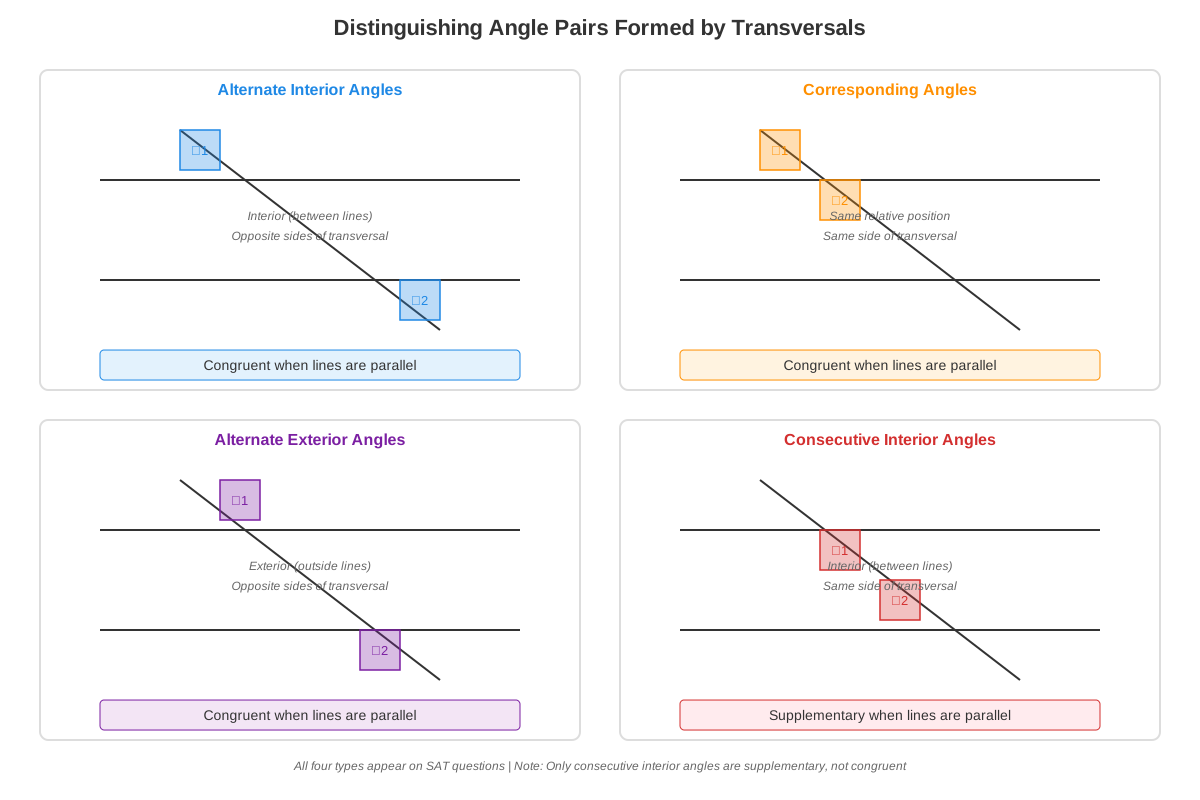
Understanding how alternate interior angles relate to other angle pairs formed by parallel lines and transversals is crucial for SAT success:
| Angle Pair Type | Location | Relationship When Lines Are Parallel |
|---|---|---|
| Alternate Interior | Opposite sides of transversal, between the lines | Congruent (equal measures) |
| Corresponding Angles | Same side of transversal, one interior and one exterior | Congruent (equal measures) |
| Consecutive Interior (Co-interior) | Same side of transversal, both between the lines | Supplementary (sum to 180°) |
| Alternate Exterior | Opposite sides of transversal, both outside the lines | Congruent (equal measures) |
Solving for Unknown Angles
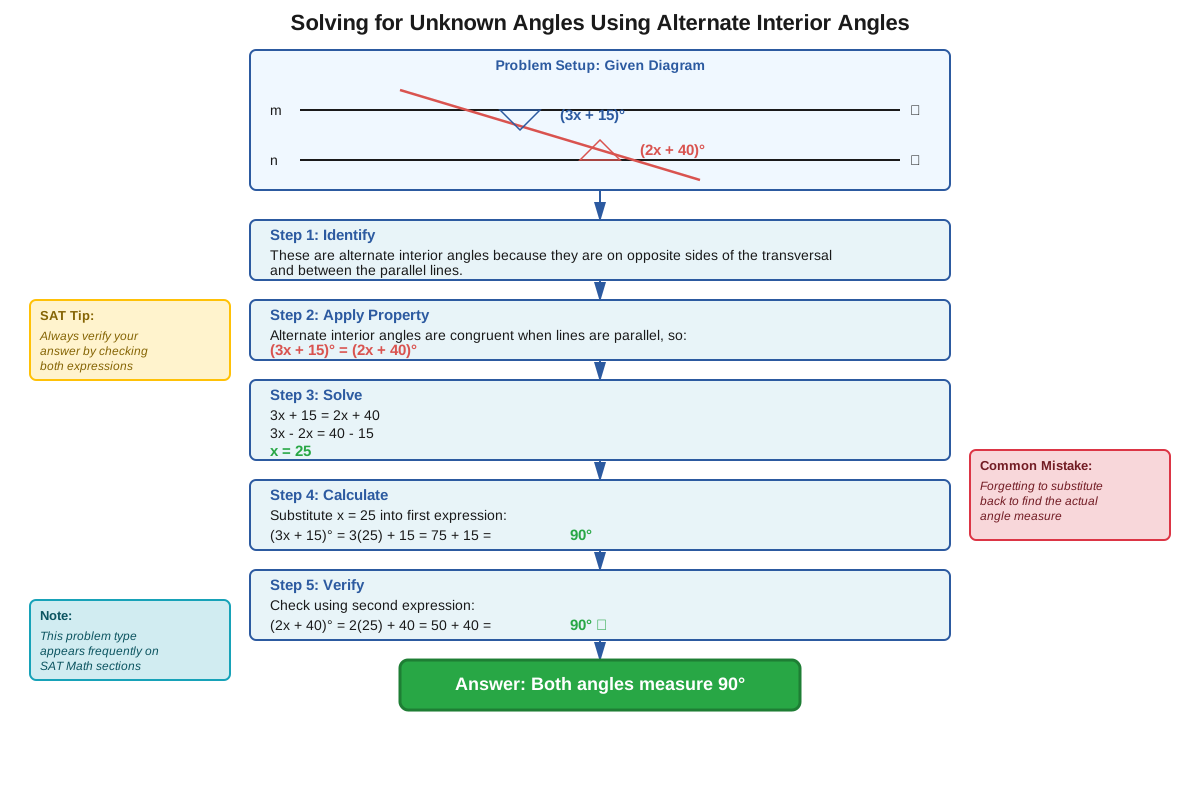
When SAT questions present alternate interior angles with algebraic expressions, follow these steps:
- Identify the alternate interior angle pair in the diagram
- Set up an equation stating that the angles are equal (if lines are parallel)
- Solve the equation for the unknown variable
- Substitute back to find the actual angle measure if requested
- Verify that your answer makes geometric sense (angles should be between 0° and 180°)
For example, if one alternate interior angle measures (2x + 15)° and its pair measures (3x - 10)°, set up the equation: 2x + 15 = 3x - 10, which solves to x = 25. The actual angle measures would then be 2(25) + 15 = 65°.
Using Alternate Interior Angles to Prove Lines Are Parallel
The converse theorem provides a method for proving parallelism. If a problem asks whether two lines are parallel, check if alternate interior angles are congruent. This technique appears frequently in SAT questions that present multiple line segments and ask which pairs are parallel, or in coordinate geometry questions where students must determine if lines with given slopes are parallel based on angle relationships.
Concept Relationships
The concepts within alternate interior angles form a logical hierarchy. The foundational understanding begins with recognizing the transversal-parallel line configuration, which leads to identifying the interior region between the two lines. This identification enables students to distinguish alternate interior angles from other angle pairs, which then allows application of the congruence theorem to solve problems. The congruence theorem connects directly to algebraic equation-solving when angles are expressed as variables, and also links to the converse theorem for proving parallelism.
Alternate interior angles connect strongly to prerequisite knowledge of vertical angles because at each intersection point, vertical angles are congruent, and this property often combines with alternate interior angle relationships in complex problems. The concept also relates to linear pairs since angles on a straight line are supplementary, allowing students to find additional angle measures once one alternate interior angle is known.
Looking at broader connections, alternate interior angles relate to corresponding angles (both are congruent when lines are parallel) and consecutive interior angles (which are supplementary when lines are parallel). These three angle relationships form the complete set of interior angle theorems for parallel lines. Additionally, alternate interior angles connect to triangle angle sum properties because when a transversal crosses parallel lines, triangles are often formed, and the alternate interior angles become angles within those triangles.
The relationship map flows as follows: Parallel Lines + Transversal → Eight Angles Formed → Interior Angles Identified → Alternate Positions Located → Congruence Applied → Unknown Angles Solved → Parallelism Verified
Quick check — test yourself on Alternate interior angles so far.
Try Flashcards →High-Yield Facts
⭐ When two parallel lines are cut by a transversal, alternate interior angles are always congruent (equal in measure)
⭐ Alternate interior angles lie on opposite sides of the transversal and between the two lines
⭐ If alternate interior angles are congruent, then the two lines cut by the transversal must be parallel (converse theorem)
⭐ Alternate interior angles form a distinctive "Z" or backward "Z" pattern in diagrams
⭐ On the SAT, alternate interior angle problems frequently require setting up and solving algebraic equations
- Alternate interior angles are different from alternate exterior angles, which lie outside the two lines
- The term "alternate" refers to the angles being on opposite sides of the transversal, not alternating in size
- When lines are NOT parallel, alternate interior angles are NOT congruent
- Consecutive interior angles (same-side interior angles) are supplementary to alternate interior angles
- Every transversal crossing two parallel lines creates exactly two pairs of alternate interior angles
- Alternate interior angles can be acute, obtuse, or right angles depending on how the transversal intersects the parallel lines
- In coordinate geometry, if two lines have the same slope, they are parallel, and alternate interior angle theorems apply
Common Misconceptions
Misconception: All angles between two lines are alternate interior angles → Correction: Only angles on opposite sides of the transversal and in the interior region qualify as alternate interior angles; angles on the same side are consecutive interior angles
Misconception: Alternate interior angles are always equal regardless of whether the lines are parallel → Correction: Alternate interior angles are only congruent when the two lines are parallel; if the lines are not parallel, these angles will have different measures
Misconception: The "alternate" in alternate interior angles means the angles alternate between large and small → Correction: "Alternate" refers to the position on opposite sides of the transversal, not to the size of the angles; when lines are parallel, these angles are actually equal
Misconception: Alternate interior angles must be acute angles → Correction: Alternate interior angles can be acute, obtuse, or right angles depending on the angle at which the transversal intersects the parallel lines; their classification depends on the specific configuration
Misconception: If two angles look equal in a diagram, they must be alternate interior angles → Correction: Many angle pairs can be congruent (vertical angles, corresponding angles, alternate exterior angles); alternate interior angles specifically must be in the interior region and on opposite sides of the transversal
Misconception: You can identify alternate interior angles without knowing which line is the transversal → Correction: The transversal must be identified first because it determines which angles are "interior" and which side is "alternate"; without identifying the transversal, you cannot correctly identify alternate interior angle pairs
Misconception: Alternate interior angles always add up to 180° → Correction: Alternate interior angles are congruent (equal), not supplementary; it is consecutive interior angles (same-side interior angles) that are supplementary and add to 180°
Worked Examples
Example 1: Basic Angle Calculation
Problem: In the diagram below, lines AB and CD are parallel, and line EF is a transversal. If ∠3 measures 65°, what is the measure of ∠6?
Line AB: ----1---2----
         \  /
       EF \/
          /\
Line CD: /--5---6----
3 4Solution:
Step 1: Identify the configuration. Lines AB and CD are parallel, and EF is the transversal crossing both lines.
Step 2: Locate the alternate interior angles. ∠3 and ∠6 are both in the interior region (between lines AB and CD) and on opposite sides of transversal EF, making them alternate interior angles.
Step 3: Apply the alternate interior angles theorem. Since AB ∥ CD, alternate interior angles are congruent.
Step 4: Set up the relationship. ∠3 ≅ ∠6, which means m∠3 = m∠6.
Step 5: Substitute the known value. Since m∠3 = 65°, we have m∠6 = 65°.
Answer: ∠6 measures 65°
This example demonstrates the direct application of the alternate interior angles theorem, which is the most common way this concept appears on the SAT. The key is recognizing the parallel lines and transversal configuration, then identifying which angles form the alternate interior pair.
Example 2: Algebraic Application
Problem: Lines l and m are parallel. A transversal intersects these lines, creating alternate interior angles with measures (4x - 20)° and (2x + 30)°. Find the value of x and the measure of each angle.
Solution:
Step 1: Recognize that since lines l and m are parallel, alternate interior angles are congruent.
Step 2: Set up an equation equating the two angle expressions:
4x - 20 = 2x + 30Step 3: Solve for x by collecting like terms:
4x - 2x = 30 + 20
2x = 50
x = 25
Step 4: Find the actual angle measures by substituting x = 25 into either expression:
First angle: 4(25) - 20 = 100 - 20 = 80°
Second angle: 2(25) + 30 = 50 + 30 = 80°
Step 5: Verify the solution. Both angles measure 80°, confirming they are congruent as required by the alternate interior angles theorem. Also verify that 80° is a reasonable angle measure (between 0° and 180°).
Answer: x = 25, and each alternate interior angle measures 80°
This example illustrates how the SAT combines geometric reasoning with algebraic skills. Students must recognize the geometric relationship (alternate interior angles are congruent), translate it into an algebraic equation, solve for the variable, and then interpret the result in the geometric context. This type of problem appears frequently on the SAT and tests multiple skills simultaneously.
Exam Strategy
When approaching sat alternate interior angles questions on the SAT, begin by carefully examining the diagram for parallel line markings (arrows or the ∥ symbol) and identifying the transversal. If parallel lines are not explicitly marked, check whether the problem states that lines are parallel in the text. Circle or highlight the angles mentioned in the question to avoid confusion with other angles in the diagram.
Trigger words and phrases to watch for include: "parallel lines," "cut by a transversal," "lines l and m are parallel," "if the lines shown are parallel," and "alternate interior angles." When you see these phrases, immediately activate your knowledge of the alternate interior angles theorem. Also watch for indirect language like "angles on opposite sides of the transversal" or "angles between the lines," which describe alternate interior angles without using the exact term.
For process of elimination, remember these key principles: If a problem asks which angles are congruent and shows parallel lines with a transversal, eliminate any answer choices that pair angles on the same side of the transversal or angles where one is interior and one is exterior. If asked whether lines are parallel, eliminate choices where alternate interior angles have different measures. When solving for variables, eliminate answer choices that result in negative angle measures or angles greater than 180°.
Time allocation for alternate interior angle questions should typically be 45-60 seconds for straightforward identification problems and 90-120 seconds for algebraic problems requiring equation setup and solving. If a problem combines alternate interior angles with other concepts (like triangle angle sums or coordinate geometry), allocate up to 2 minutes. Don't spend excessive time trying to visualize complex diagrams—if you can't identify the angle pair within 20 seconds, mark the angles mentioned in the question and work systematically through the angle relationships.
Exam Tip: When diagrams are not drawn to scale (as noted on the SAT), do not rely on visual estimation to determine if angles look equal. Always use the parallel line markings and apply the theorem logically rather than trusting what appears equal by sight.
Memory Techniques
"Z for aZternate": Remember that alternate interior angles form a Z-pattern (or backward Z) in the diagram. When you see parallel lines and a transversal, trace a Z-shape to find alternate interior angle pairs. The Z starts at one angle, follows the parallel line to the transversal, crosses the transversal, then follows the other parallel line to the second angle.
"Interior = In Between": The word "interior" means inside or between. Visualize the two parallel lines as walls of a hallway, and interior angles are those inside the hallway, not outside in the exterior space. This helps distinguish alternate interior from alternate exterior angles.
"Alternate = Opposite Sides": Create a mental association between "alternate" and "opposite." Just as alternate days are every other day (not consecutive), alternate interior angles are on opposite sides of the transversal, not the same side. This distinguishes them from consecutive interior angles.
"Parallel = Equal Alternates": Use the mnemonic P.E.A. (Parallel means Equal Alternates) to remember that when lines are parallel, alternate interior angles are equal. This three-letter acronym captures the essential theorem in an easy-to-recall format.
Visual Anchor: Picture a ladder leaning against a wall. The wall and ground are parallel (assuming level ground), and the ladder is the transversal. The angles where the ladder meets the wall and ground are alternate interior angles. Since the wall and ground are parallel, these angles are equal. This real-world image makes the abstract concept concrete and memorable.
Summary
Alternate interior angles are angle pairs formed when a transversal crosses two lines, positioned on opposite sides of the transversal and between the two lines. The fundamental theorem states that when the two lines are parallel, alternate interior angles are congruent—they have equal measures. This property is essential for SAT success because it appears in multiple question formats, from basic angle identification to complex algebraic problems. Students must be able to recognize the characteristic Z-pattern that alternate interior angles form, distinguish them from other angle pairs like corresponding or consecutive interior angles, and apply both the theorem and its converse (if alternate interior angles are congruent, the lines are parallel). Mastery requires combining geometric visualization with algebraic problem-solving skills, as SAT questions frequently present angle measures as algebraic expressions that must be set equal and solved. The concept connects to broader geometric reasoning about parallel lines, transversals, and the complete system of angle relationships that govern these configurations.
Key Takeaways
- Alternate interior angles lie on opposite sides of a transversal and between two lines, forming a distinctive Z-pattern
- When two parallel lines are cut by a transversal, alternate interior angles are always congruent (equal in measure)
- The converse is equally important: if alternate interior angles are congruent, then the lines must be parallel
- SAT questions frequently combine alternate interior angles with algebraic expressions, requiring equation setup and solving
- Distinguish alternate interior angles from consecutive interior angles (same side, supplementary) and corresponding angles (one interior, one exterior, congruent)
- Always identify the transversal first, then locate the interior region, then check for alternate positions
- This concept appears in 2-4 questions per SAT test and is essential for success in geometry problems
Related Topics
Corresponding Angles: These angle pairs are formed when a transversal crosses parallel lines, with one angle above one parallel line and the other above the second parallel line, both on the same side of the transversal. Like alternate interior angles, corresponding angles are congruent when lines are parallel, and mastering alternate interior angles provides the foundation for understanding this related concept.
Consecutive Interior Angles (Same-Side Interior): These angles are on the same side of the transversal and between the parallel lines. Unlike alternate interior angles which are congruent, consecutive interior angles are supplementary (sum to 180°). Understanding the distinction between these two interior angle types is crucial for SAT success.
Triangle Angle Sum Theorem: When a transversal crosses parallel lines, triangles are often formed, and alternate interior angles become angles within those triangles. Combining alternate interior angle properties with the fact that triangle angles sum to 180° enables solving complex multi-step problems.
Coordinate Geometry and Parallel Lines: In the coordinate plane, parallel lines have equal slopes. Alternate interior angle theorems apply when determining angle relationships in coordinate geometry problems, connecting algebraic and geometric reasoning.
Practice CTA
Now that you've mastered the core concepts of alternate interior angles, it's time to solidify your understanding through practice. Attempt the practice questions to test your ability to identify alternate interior angles in various configurations, solve algebraic problems, and apply the theorems in SAT-style scenarios. Use the flashcards to reinforce key definitions and theorems until you can recall them instantly. Remember, geometry success on the SAT comes from recognizing patterns quickly and applying theorems confidently—skills that develop through consistent practice. Each problem you solve strengthens your geometric intuition and brings you closer to your target score!
Sign up free to keep reading
Create a free AnvayaPrep account to finish this SAT guide on Alternate interior angles — plus flashcards and practice questions.