Overview
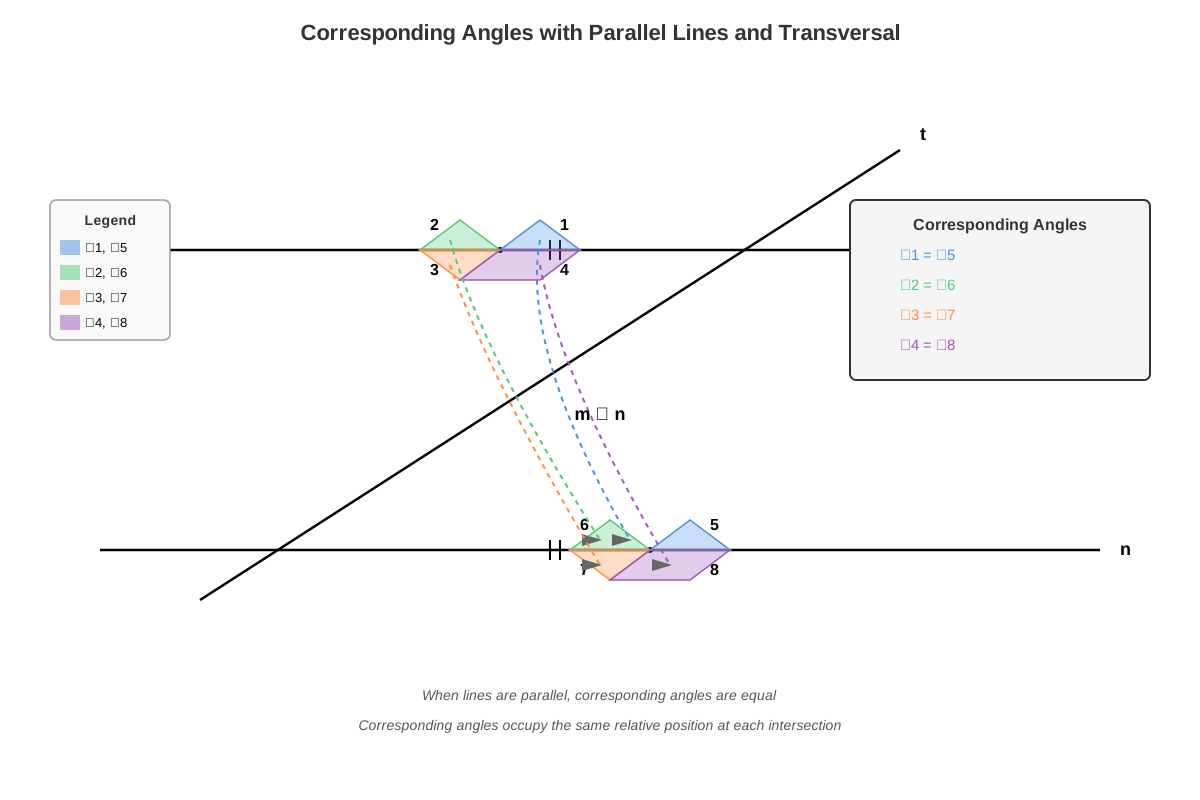
Corresponding angles represent one of the most fundamental and frequently tested concepts in the SAT Math section's geometry component. When a transversal line intersects two or more lines, it creates eight angles at the points of intersection. Among these angles, corresponding angles occupy matching positions at each intersection point—imagine them as "mirror images" in the same relative location at different intersections. Understanding this geometric relationship is crucial because corresponding angles are equal when the lines being intersected are parallel, a property that unlocks solutions to numerous SAT problems involving angle measures, parallel lines, and geometric proofs.
The SAT consistently tests corresponding angles both directly and indirectly across multiple question types. Students encounter these angles in pure geometry problems, coordinate geometry questions, and even in applied contexts involving architectural diagrams or real-world scenarios. The concept serves as a gateway to understanding more complex geometric relationships, including alternate interior angles, alternate exterior angles, and same-side interior angles. Mastery of corresponding angles enables students to quickly identify angle relationships, set up equations, and solve for unknown values—skills that directly translate to points on test day.
Beyond isolated geometry questions, corresponding angles connect to broader mathematical reasoning skills tested on the SAT. The logical structure of identifying parallel lines through angle relationships, applying the transversal properties, and drawing valid conclusions mirrors the analytical thinking required across the entire mathematics section. Students who thoroughly understand corresponding angles gain confidence in tackling multi-step problems, recognizing geometric patterns, and applying algebraic techniques to geometric contexts—all high-value skills for achieving competitive SAT scores.
Learning Objectives
- [ ] Identify key features of corresponding angles in diagrams with transversals and parallel lines
- [ ] Explain how corresponding angles appears on the SAT in various question formats
- [ ] Apply corresponding angles to answer SAT-style questions involving angle measures and algebraic expressions
- [ ] Determine whether two lines are parallel based on corresponding angle relationships
- [ ] Solve multi-step problems combining corresponding angles with algebraic equations
- [ ] Recognize corresponding angles in non-standard orientations and complex diagrams
Prerequisites
- Basic angle vocabulary: Understanding terms like acute, obtuse, right, and straight angles provides the foundation for identifying and measuring corresponding angles
- Linear pairs and vertical angles: These fundamental angle relationships often appear alongside corresponding angles in SAT problems and help verify solutions
- Basic algebraic equation solving: Many corresponding angle problems require setting up and solving equations to find unknown angle measures
- Properties of parallel lines: Recognizing parallel line notation and understanding what makes lines parallel is essential for applying corresponding angle theorems
Why This Topic Matters
Corresponding angles appear in real-world contexts ranging from architecture and construction to urban planning and design. When engineers design parallel railroad tracks, corresponding angles ensure proper alignment. When architects create buildings with parallel support beams, corresponding angles guarantee structural integrity. The mathematical principles governing these angles translate directly to practical applications in fields requiring spatial reasoning and geometric precision.
On the SAT, corresponding angles appear in approximately 2-4 questions per test, either as the primary concept or as part of multi-concept problems. These questions typically fall into several categories: direct angle calculation problems where students must find specific angle measures, algebraic problems requiring equation setup and solving, proof-based questions asking students to justify why lines are parallel, and applied problems presenting real-world scenarios. The College Board frequently combines corresponding angles with other geometric concepts, making this topic a high-yield area for study.
The SAT presents corresponding angles in various formats: traditional geometric diagrams with labeled angles, coordinate plane problems where students must identify angle relationships, word problems describing geometric situations, and complex figures where multiple transversals intersect parallel lines. Questions may ask students to find angle measures, determine relationships between variables, identify which angles are equal, or explain why certain geometric properties hold. The versatility of this topic across question types makes it essential for comprehensive SAT preparation.
Core Concepts
Definition and Identification of Corresponding Angles
Corresponding angles are pairs of angles that occupy the same relative position at each intersection when a transversal crosses two lines. To identify corresponding angles, imagine the transversal creating an "F" shape (or a backward "F") with the two lines. The angles at the same position in each "corner" of the F are corresponding angles. For example, if the transversal crosses two lines creating eight angles total (four at each intersection), the angle in the upper-right position at the first intersection corresponds to the angle in the upper-right position at the second intersection.
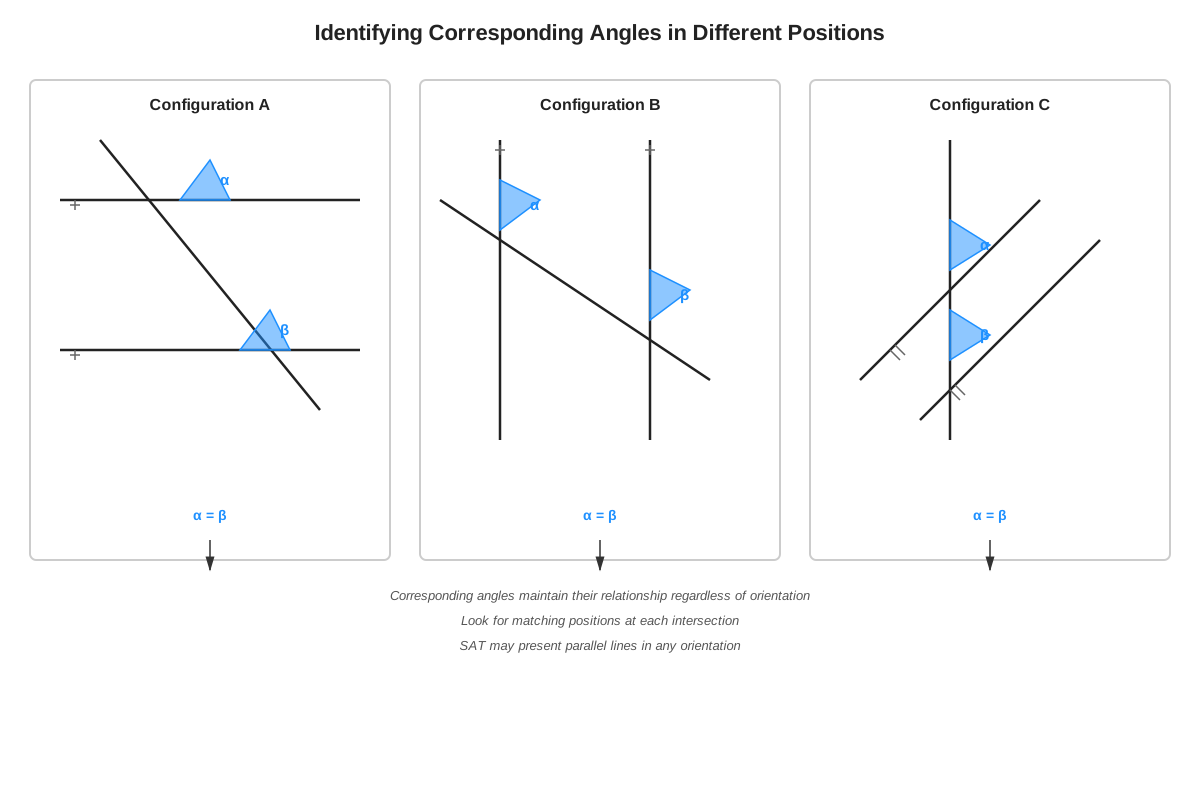
The key to identifying corresponding angles lies in recognizing their matching positions. At each intersection point, four angles form. These can be labeled based on their position: upper-left, upper-right, lower-left, and lower-right. When comparing the two intersection points, angles in identical positions are corresponding. This positional relationship remains constant regardless of the orientation of the diagram—whether the lines run horizontally, vertically, or diagonally.
The Corresponding Angles Postulate
The Corresponding Angles Postulate states that when a transversal intersects two parallel lines, corresponding angles are congruent (equal in measure). This fundamental theorem provides the mathematical foundation for solving countless SAT geometry problems. If lines l and m are parallel, and line t is a transversal, then all pairs of corresponding angles have equal measures. Conversely, if corresponding angles are congruent, the lines must be parallel—this reverse relationship serves as a test for parallelism.
The postulate works bidirectionally: it can be used both to find angle measures when parallelism is known and to prove parallelism when angle measures are known. On the SAT, students must recognize both applications. When a problem states that lines are parallel, immediately look for corresponding angles to establish equalities. When a problem provides equal angle measures, consider whether this proves the lines are parallel.
Transversal Properties and Angle Formation
A transversal is any line that intersects two or more other lines at distinct points. When a transversal crosses two lines, it creates eight angles total: four at each intersection point. These eight angles form several important relationships beyond just corresponding angles, including alternate interior angles, alternate exterior angles, and consecutive interior angles. Understanding how the transversal creates these angle families helps students navigate complex diagrams efficiently.
The angles formed by a transversal can be categorized by their position relative to the two lines being intersected. Exterior angles lie outside the region between the two lines, while interior angles lie between the two lines. At each intersection point, two angles are interior and two are exterior. Corresponding angles can be either both interior or both exterior, but they must be on the same side of the transversal (both to the right or both to the left).
Algebraic Applications with Corresponding Angles
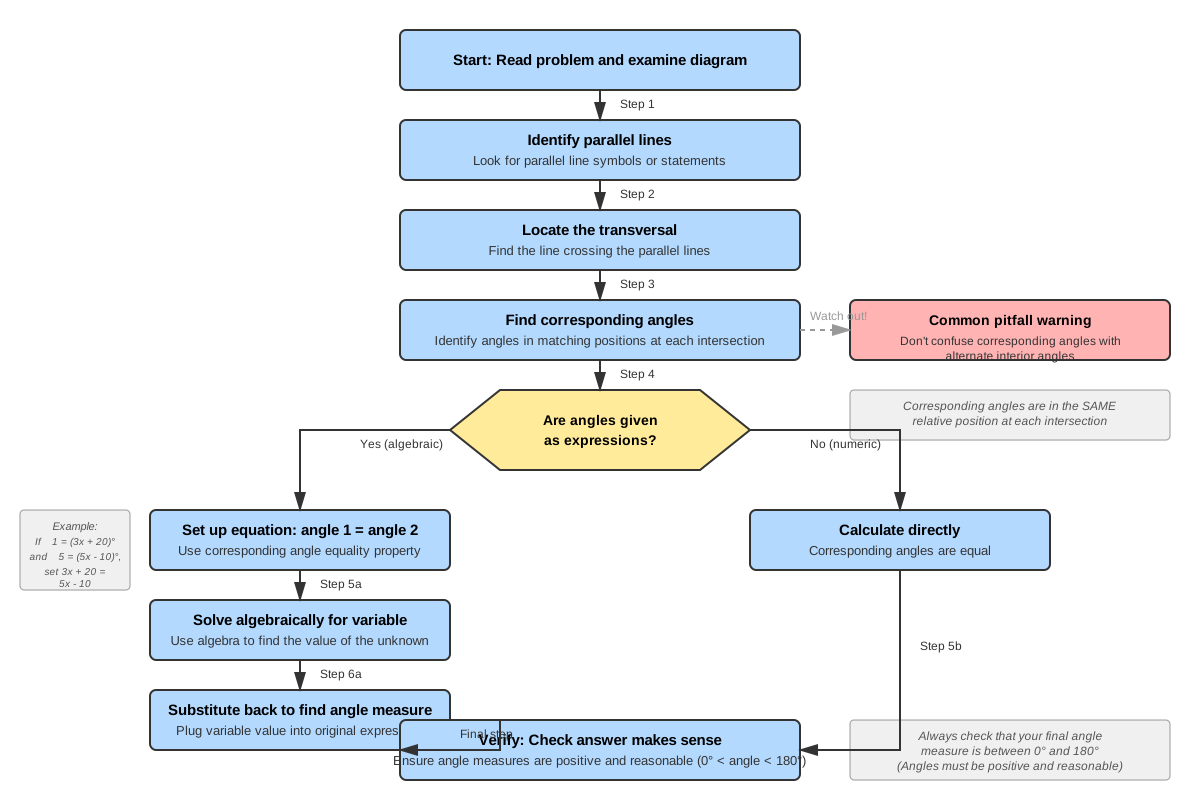
SAT problems frequently present corresponding angles using algebraic expressions rather than numerical values. For example, one angle might be labeled as (3x + 20)° while its corresponding angle is labeled as (5x - 10)°. When the lines are parallel, these expressions must be equal, allowing students to set up an equation: 3x + 20 = 5x - 10. Solving for x yields x = 15, which can then be substituted back to find the actual angle measures.
These algebraic problems test multiple skills simultaneously: recognizing the corresponding angle relationship, understanding that parallel lines make corresponding angles equal, correctly setting up an equation, solving the equation accurately, and often substituting back to find a final answer. The SAT may ask for the value of x, the measure of one specific angle, the sum of multiple angles, or the difference between angles. Reading the question carefully to identify what value is actually being requested is crucial.
Multiple Transversals and Complex Diagrams
Advanced SAT problems may feature multiple transversals intersecting the same pair of parallel lines, or a single transversal intersecting more than two parallel lines. In these complex scenarios, students must systematically identify each corresponding angle pair. When three parallel lines are cut by a transversal, there are three intersection points creating twelve angles total, with multiple corresponding angle relationships to track.
The strategy for handling complex diagrams involves working methodically: first identify all parallel lines, then identify all transversals, next mark known angle measures, and finally use corresponding angle relationships (along with other angle relationships) to find unknown measures. Breaking down complex figures into simpler components—focusing on one transversal and one pair of parallel lines at a time—prevents confusion and reduces errors.
Corresponding Angles vs. Other Angle Relationships
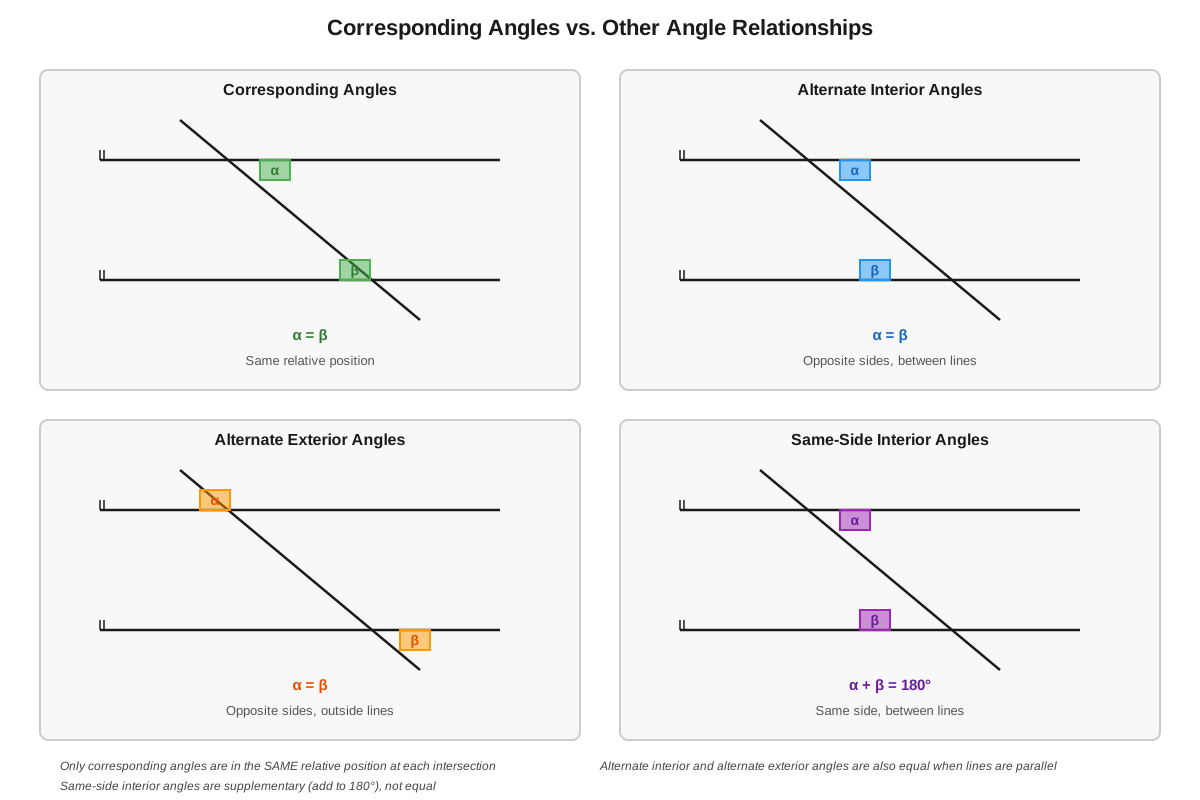
| Angle Relationship | Position Description | Equality Condition | Visual Pattern |
|---|---|---|---|
| Corresponding Angles | Same position at each intersection | Equal when lines are parallel | "F" or backward "F" shape |
| Alternate Interior Angles | Between lines, opposite sides of transversal | Equal when lines are parallel | "Z" or backward "Z" shape |
| Alternate Exterior Angles | Outside lines, opposite sides of transversal | Equal when lines are parallel | Extended "Z" shape |
| Consecutive Interior Angles | Between lines, same side of transversal | Supplementary when lines are parallel | "C" or "U" shape |
Understanding how corresponding angles differ from these related concepts prevents confusion on the SAT. While corresponding angles are equal when lines are parallel, consecutive interior angles are supplementary (sum to 180°) when lines are parallel. Recognizing which relationship applies in a given situation is essential for setting up correct equations.
Concept Relationships
The concept of corresponding angles builds directly on fundamental angle relationships. Vertical angles (angles opposite each other when two lines intersect) are always equal, and this property often works in tandem with corresponding angles to solve problems. For instance, if a corresponding angle is not directly labeled but its vertical angle is, students can use the vertical angle relationship first, then apply the corresponding angle relationship.
Linear pairs (adjacent angles that form a straight line) are supplementary, summing to 180°. In problems involving corresponding angles, linear pairs frequently provide additional equations needed to solve for unknowns. The relationship chain often flows: corresponding angles → establishes one equality → linear pairs → establishes supplementary relationships → vertical angles → confirms additional equalities → solution.
The connection between corresponding angles and parallel lines is bidirectional and fundamental. Corresponding angles → equal measures → proves lines are parallel. Conversely, parallel lines → given condition → corresponding angles must be equal. This logical flow appears repeatedly on the SAT, and students must be comfortable reasoning in both directions.
Corresponding angles also connect to coordinate geometry. When lines are graphed on a coordinate plane, their slopes determine whether they are parallel (equal slopes). If two lines have equal slopes, any transversal crossing them will create equal corresponding angles. This bridges pure geometry and algebraic representations, a connection the SAT frequently tests.
The progression of understanding flows: basic angle vocabulary → vertical angles and linear pairs → transversal and angle formation → corresponding angles identification → corresponding angles postulate → algebraic applications → complex multi-transversal problems → coordinate geometry integration.
Quick check — test yourself on Corresponding angles so far.
Try Flashcards →High-Yield Facts
⭐ When a transversal intersects two parallel lines, all corresponding angles are equal in measure
⭐ Corresponding angles occupy the same relative position at each intersection point created by a transversal
⭐ If corresponding angles are equal, the two lines cut by the transversal must be parallel (converse of the postulate)
⭐ There are four pairs of corresponding angles when one transversal crosses two lines
⭐ Corresponding angles can be used to set up algebraic equations when angle measures are expressed as variables
- Corresponding angles can be either both acute, both obtuse, or both right angles, depending on how the transversal intersects the lines
- The corresponding angles postulate works regardless of the orientation of the diagram (horizontal, vertical, or diagonal lines)
- When three or more parallel lines are cut by a transversal, corresponding angles at different intersection points along the same transversal are all equal
- Corresponding angles are always on the same side of the transversal (both left or both right)
- The sum of a corresponding angle and its adjacent angle on a straight line always equals 180° (linear pair property)
- In coordinate geometry, if two lines have the same slope, any transversal will create equal corresponding angles
- Corresponding angles can appear in three-dimensional geometry problems when dealing with parallel planes
Common Misconceptions
Misconception: All angles formed by a transversal are corresponding angles → Correction: Only angles in matching positions at different intersections are corresponding angles; a transversal crossing two lines creates four pairs of corresponding angles, not eight corresponding angles
Misconception: Corresponding angles are always equal regardless of whether lines are parallel → Correction: Corresponding angles are only guaranteed to be equal when the lines being intersected are parallel; if lines are not parallel, corresponding angles will have different measures
Misconception: Corresponding angles must be on opposite sides of the transversal → Correction: Corresponding angles are always on the same side of the transversal; angles on opposite sides are alternate angles (either alternate interior or alternate exterior)
Misconception: If two angles look equal in a diagram, they must be corresponding angles → Correction: Equal angles could be vertical angles, alternate interior angles, or other relationships; corresponding angles specifically refer to matching positions at different intersection points
Misconception: The corresponding angles postulate only works in one direction (parallel lines → equal angles) → Correction: The postulate works bidirectionally; if corresponding angles are equal, this proves the lines are parallel (converse), which is equally important for SAT problems
Misconception: Corresponding angles must both be interior or both be exterior → Correction: While corresponding angles are indeed both interior or both exterior, students sometimes confuse this with the requirement that they be on the same side of the transversal, which is the more critical identifying feature
Misconception: In algebraic problems, setting corresponding angles equal is sufficient to find the answer → Correction: After setting up and solving the equation, students must often substitute back to find the actual angle measure requested, not just the variable value
Worked Examples
Example 1: Direct Application with Algebraic Expressions
Problem: Line l is parallel to line m, and line t is a transversal intersecting both. At the intersection with line l, one angle measures (4x + 15)°. At the intersection with line m, the corresponding angle measures (6x - 25)°. Find the measure of these corresponding angles.
Solution:
Step 1: Recognize that since lines l and m are parallel, corresponding angles must be equal.
Step 2: Set up the equation:
4x + 15 = 6x - 25Step 3: Solve for x:
4x + 15 = 6x - 25
15 + 25 = 6x - 4x
40 = 2x
x = 20
Step 4: Substitute x = 20 back into either expression to find the angle measure:
4x + 15 = 4(20) + 15 = 80 + 15 = 95°Step 5: Verify using the other expression:
6x - 25 = 6(20) - 25 = 120 - 25 = 95°Answer: The corresponding angles each measure 95°.
Connection to Learning Objectives: This example demonstrates identifying corresponding angles, applying the corresponding angles postulate to parallel lines, and using algebraic techniques to solve for unknown angle measures—all core SAT skills.
Example 2: Multi-Step Problem with Multiple Angle Relationships
Problem: In the figure below, lines AB and CD are parallel, and line EF is a transversal. Angle 1 measures (2x + 30)°, and angle 2 is a corresponding angle to angle 1. Angle 3 forms a linear pair with angle 2. If angle 3 measures 110°, find the value of x.
Solution:
Step 1: Identify the relationship between angles 2 and 3. Since they form a linear pair, they are supplementary:
angle 2 + angle 3 = 180°
angle 2 + 110° = 180°
angle 2 = 70°
Step 2: Recognize that angle 1 and angle 2 are corresponding angles. Since AB and CD are parallel, corresponding angles are equal:
angle 1 = angle 2
angle 1 = 70°
Step 3: Set up an equation using the expression for angle 1:
2x + 30 = 70Step 4: Solve for x:
2x + 30 = 70
2x = 40
x = 20
Step 5: Verify the solution:
angle 1 = 2(20) + 30 = 40 + 30 = 70° ✓Answer: x = 20
Connection to Learning Objectives: This problem requires identifying corresponding angles in a complex scenario, applying multiple angle relationships (corresponding angles and linear pairs), and solving multi-step algebraic problems—exactly the type of integrated thinking the SAT demands.
Exam Strategy
When approaching SAT questions involving corresponding angles, begin by identifying all parallel lines in the diagram. The problem will either explicitly state that lines are parallel (using the symbol ∥ or words like "parallel") or provide enough information to deduce parallelism. Mark parallel lines clearly on the diagram to avoid confusion during problem-solving.
Trigger words and phrases to watch for include: "parallel lines," "transversal," "corresponding," "same position," "if lines are parallel," and "prove that lines are parallel." When a problem asks you to "find the value of x" or "determine the measure of angle," immediately look for corresponding angle relationships if parallel lines are present. Questions asking "which statement must be true" often test understanding of when corresponding angles are equal versus when they are not.
For process-of-elimination strategies, remember that corresponding angles are only equal when lines are parallel. If an answer choice assumes corresponding angles are equal but the problem does not establish parallelism, eliminate that choice. Conversely, if the problem states lines are parallel and an answer choice suggests corresponding angles might not be equal, eliminate it immediately. When multiple angle relationships are present, corresponding angles provide the most direct path to solution when parallel lines are involved.
Time allocation for corresponding angle problems should be approximately 60-90 seconds for straightforward identification and calculation problems, and 90-120 seconds for multi-step problems involving algebra or multiple angle relationships. If a problem requires more than two minutes, mark it for review and move on—these problems often have a simpler approach that becomes apparent on a second look.
Exam Tip: Always mark known angle measures directly on the diagram as you work. This visual organization prevents errors and helps identify additional relationships you might otherwise miss.
Memory Techniques
The "F-Pattern" Mnemonic: Remember that corresponding angles form an F shape (or backward F). When you see a transversal crossing two lines, trace an F with your finger: the two angles at the "corners" of the F are corresponding. This visual pattern works regardless of diagram orientation.
"Same Side, Same Spot" Rule: Corresponding angles are on the Same Side of the transversal and in the Same Spot at each intersection. This double-S reminder helps distinguish corresponding angles from alternate angles (which are on opposite sides).
"Parallel = Equal Corresponding" Acronym (PEC): Parallel lines make Equal Corresponding angles. This simple acronym captures the essential relationship and reminds students that parallelism is the condition for equality.
Visualization Strategy: When studying, practice mentally rotating diagrams. Corresponding angles remain corresponding regardless of whether the parallel lines are horizontal, vertical, or diagonal. Developing this mental flexibility prevents confusion when the SAT presents non-standard orientations.
The "Four Pairs" Reminder: One transversal crossing two lines creates exactly four pairs of corresponding angles. Remembering this number helps ensure you have identified all relationships and haven't confused corresponding angles with other angle types.
Summary
Corresponding angles represent a foundational concept in SAT geometry, appearing when a transversal line intersects two or more lines. These angles occupy matching positions at each intersection point, and when the lines being intersected are parallel, corresponding angles are always equal in measure. This property enables students to solve for unknown angle measures, set up algebraic equations, and prove that lines are parallel. The SAT tests corresponding angles through direct calculation problems, multi-step algebraic challenges, and integrated questions combining multiple geometric relationships. Success requires recognizing the visual pattern of corresponding angles (the "F" shape), understanding the bidirectional relationship between parallel lines and equal corresponding angles, and applying systematic problem-solving strategies. Students must distinguish corresponding angles from related concepts like alternate interior angles and consecutive interior angles, each of which has distinct properties. Mastery of corresponding angles provides the foundation for more advanced geometry topics and contributes significantly to achieving competitive SAT Math scores.
Key Takeaways
- Corresponding angles occupy the same relative position at each intersection when a transversal crosses two lines
- When lines are parallel, corresponding angles are always equal; when corresponding angles are equal, lines must be parallel
- One transversal crossing two lines creates exactly four pairs of corresponding angles
- SAT problems frequently combine corresponding angles with algebraic expressions, requiring equation setup and solving
- The "F-pattern" visual (or backward F) helps identify corresponding angles regardless of diagram orientation
- Corresponding angles differ from alternate interior angles (which are on opposite sides of the transversal) and consecutive interior angles (which are supplementary, not equal)
- Multi-step problems often require using corresponding angles in combination with linear pairs, vertical angles, and other geometric relationships
Related Topics
Alternate Interior Angles: These angles lie between parallel lines on opposite sides of a transversal and are equal when lines are parallel. Mastering corresponding angles makes alternate interior angles easier to understand since both involve parallel line relationships.
Alternate Exterior Angles: Similar to alternate interior angles but located outside the parallel lines, these angles are also equal when lines are parallel. Understanding corresponding angles provides the conceptual framework for this related property.
Consecutive Interior Angles: Also called same-side interior angles, these are supplementary (sum to 180°) when lines are parallel. This concept contrasts with corresponding angles and helps students understand the full range of transversal relationships.
Triangle Angle Sum Theorem: Many SAT problems combine corresponding angles with triangle properties. When parallel lines create triangles with a transversal, corresponding angles help determine triangle angle measures.
Coordinate Geometry and Slope: Parallel lines in the coordinate plane have equal slopes, connecting algebraic and geometric representations. Corresponding angles provide the geometric justification for why equal slopes indicate parallelism.
Practice CTA
Now that you have mastered the core concepts of corresponding angles, it's time to solidify your understanding through active practice. Work through the practice questions to apply these principles in SAT-style contexts, and use the flashcards to reinforce key definitions and relationships. Remember, geometry problems become intuitive with repetition—each problem you solve strengthens your pattern recognition and problem-solving speed. You have built a strong foundation in one of the SAT's most frequently tested geometry concepts. Keep practicing, and watch your confidence and accuracy soar!
Sign up free to keep reading
Create a free AnvayaPrep account to finish this SAT guide on Corresponding angles — plus flashcards and practice questions.