Overview
Understanding the relationship between slope and angle is a fundamental skill that appears frequently on the SAT Math section. Slope and angle intuition refers to the ability to visualize and interpret how the steepness of a line (its slope) relates to the angle that line makes with the horizontal axis. This connection bridges algebraic and geometric thinking, requiring students to move fluidly between numerical slope values and visual angle representations.
On the SAT, this topic appears in multiple contexts: coordinate geometry problems, linear function questions, and geometric reasoning tasks. Students must recognize that a line with a positive slope rises from left to right, creating an acute angle with the positive x-axis, while a negative slope creates an obtuse angle. The magnitude of the slope determines how steep the line appears—larger absolute values correspond to steeper lines and angles closer to vertical. This intuitive understanding allows test-takers to eliminate incorrect answer choices quickly and verify their algebraic work through visual reasoning.
Mastering sat slope and angle intuition connects directly to broader math concepts including linear functions, trigonometry, parallel and perpendicular lines, and transformations. This topic serves as a bridge between pure algebra (working with equations) and pure geometry (working with shapes and angles), making it essential for success across multiple SAT Math domains. Students who develop strong intuition in this area can solve problems more efficiently and catch calculation errors by recognizing when their numerical answers don't match the geometric reality presented in diagrams.
Learning Objectives
- [ ] Identify key features of slope and angle intuition
- [ ] Explain how slope and angle intuition appears on the SAT
- [ ] Apply slope and angle intuition to answer SAT-style questions
- [ ] Determine whether a slope value matches a given line diagram without calculation
- [ ] Compare the steepness of multiple lines by analyzing their slopes
- [ ] Predict the sign and approximate magnitude of a slope from a visual representation
- [ ] Use angle measurements to estimate slope values and vice versa
Prerequisites
- Basic slope formula (m = rise/run or m = (y₂-y₁)/(x₂-x₁)): Essential for calculating numerical slope values that correspond to visual representations
- Coordinate plane familiarity: Understanding quadrants, positive/negative directions, and how to plot points enables visualization of slope and angle relationships
- Angle measurement basics: Knowing that angles are measured in degrees, understanding acute (< 90°) versus obtuse (> 90°) angles, and recognizing right angles (90°) provides the foundation for connecting slopes to angles
- Linear equations: Familiarity with y = mx + b form helps students recognize that m represents slope and understand how it affects the line's appearance
Why This Topic Matters
In real-world applications, slope and angle intuition appears constantly in fields ranging from architecture and engineering to economics and physics. Architects use slope to design wheelchair ramps that meet accessibility standards, where a 1:12 slope (approximately 4.76° angle) is the maximum allowed. Civil engineers analyze road grades, where a 6% slope means the road rises 6 feet for every 100 feet of horizontal distance. Economists interpret the slope of supply and demand curves to understand market sensitivity, while physicists use slope to represent velocity on position-time graphs.
On the SAT, slope and angle questions appear in approximately 3-5 questions per test, making this a high-yield topic. These questions typically fall into several categories: identifying which line has the greatest or least slope from a graph, determining whether a slope is positive or negative from a diagram, matching equations to their graphical representations, and solving word problems where slope represents a rate of change. The College Board frequently tests whether students can move between algebraic and geometric representations without getting confused.
Common SAT question formats include: presenting four lines on a coordinate plane and asking which has the greatest slope; showing a line and asking which equation could represent it based on the sign and magnitude of the slope; providing a real-world scenario (like a hiking trail) and asking students to identify the correct graph based on described steepness; and presenting angle measurements to determine relationships between lines (such as parallel or perpendicular lines).
Core Concepts
Understanding Slope as a Measure of Steepness
Slope represents the ratio of vertical change to horizontal change between any two points on a line. Mathematically expressed as m = Δy/Δx, slope quantifies how much a line rises or falls as you move from left to right. A slope of 2 means that for every 1 unit moved horizontally to the right, the line rises 2 units vertically. This numerical value directly corresponds to the line's visual steepness.
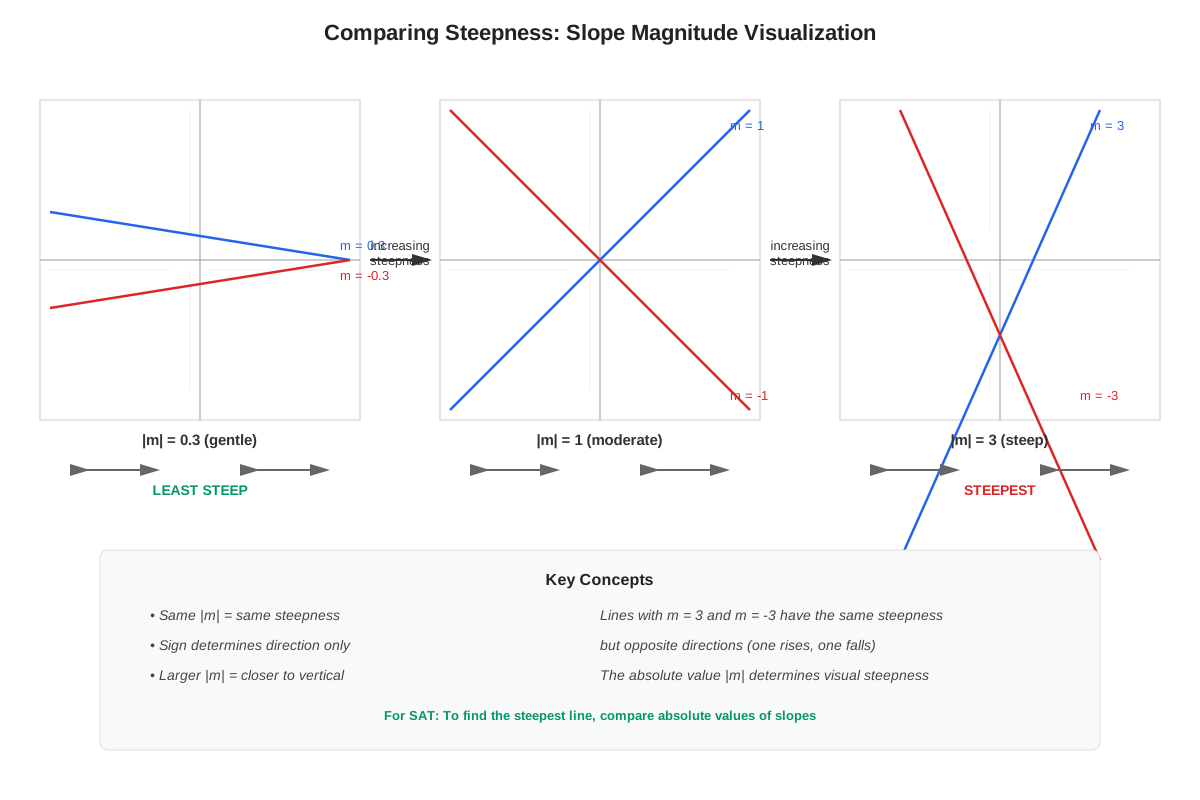
The magnitude (absolute value) of the slope determines steepness: larger absolute values create steeper lines. A line with slope 5 is steeper than a line with slope 2, and a line with slope -3 is steeper than a line with slope -1. When comparing steepness regardless of direction, consider |m|. A horizontal line has slope 0 (no steepness), while a vertical line has undefined slope (infinite steepness).
Positive Versus Negative Slopes
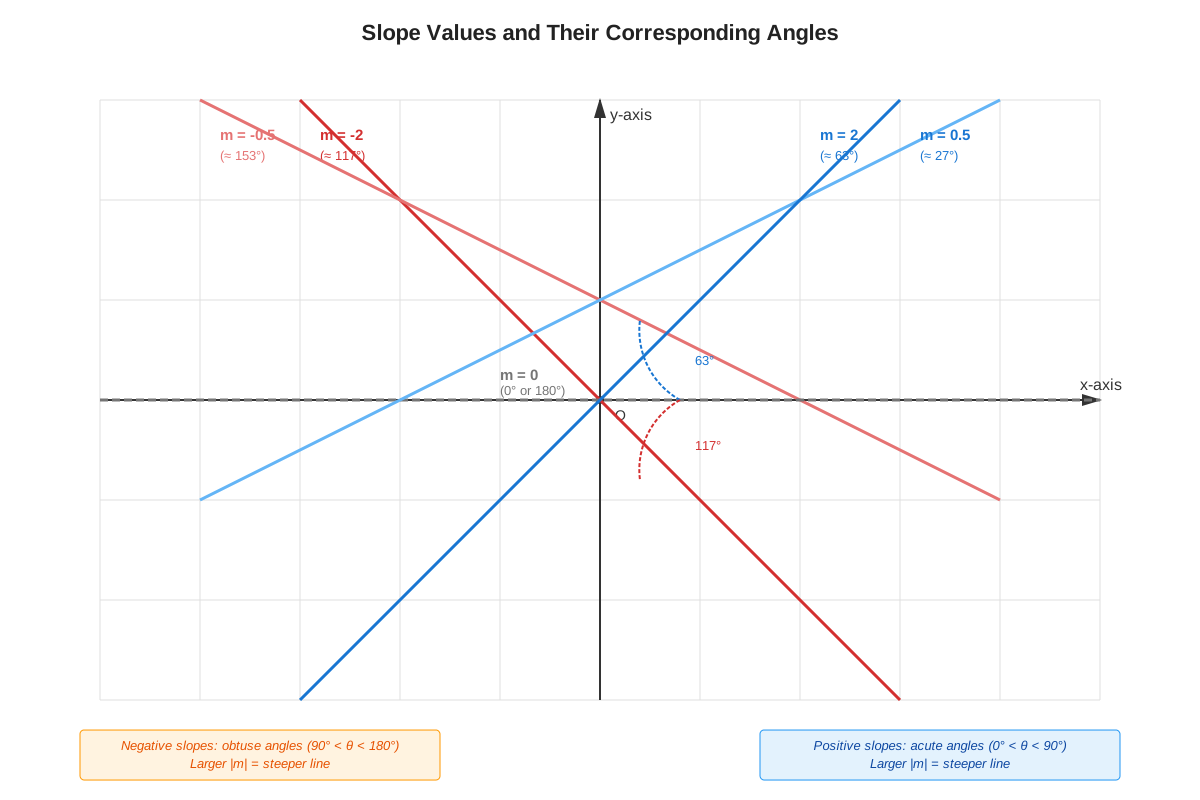
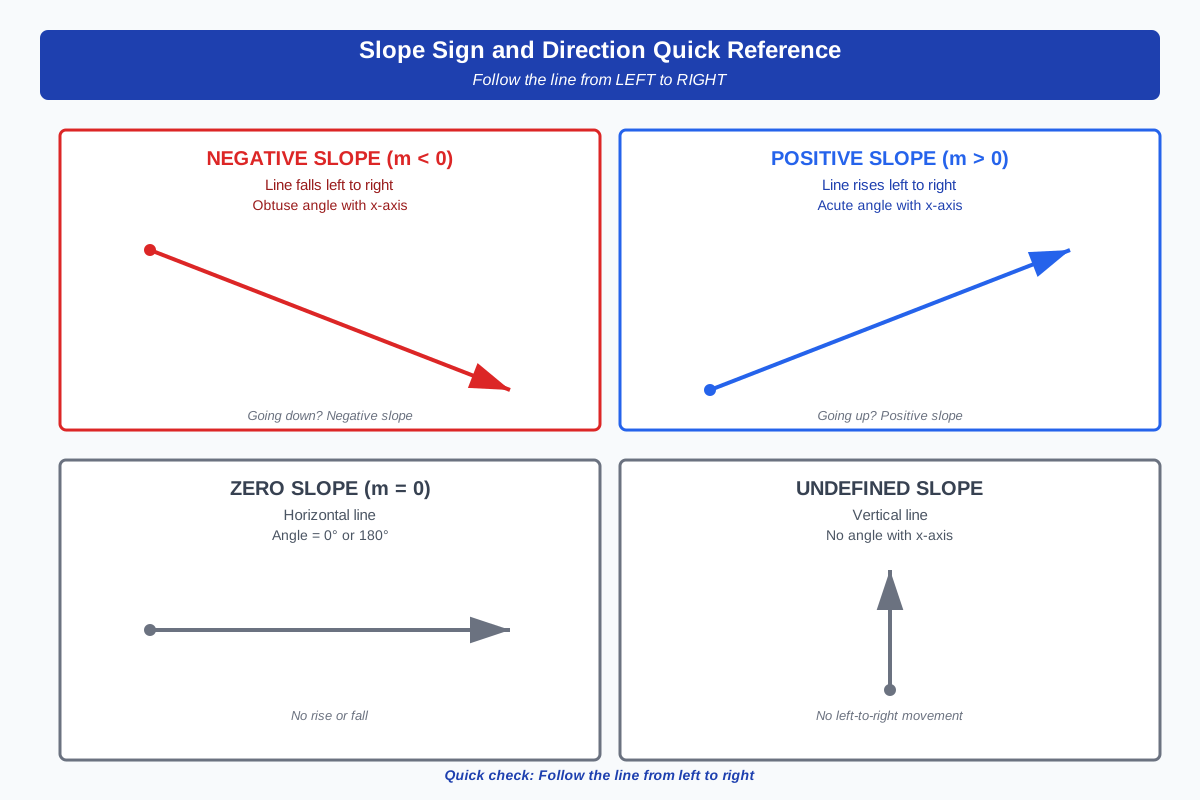
The sign of the slope indicates the line's direction. A positive slope means the line rises as you move from left to right, creating an upward trend. Visually, this line moves from the lower-left toward the upper-right. Examples include m = 1, m = 0.5, and m = 100. All positive slopes create acute angles (less than 90°) with the positive x-axis when measured counterclockwise.
A negative slope means the line falls as you move from left to right, creating a downward trend. Visually, this line moves from the upper-left toward the lower-right. Examples include m = -1, m = -0.5, and m = -100. All negative slopes create obtuse angles (greater than 90° but less than 180°) with the positive x-axis when measured counterclockwise.
The Slope-Angle Connection
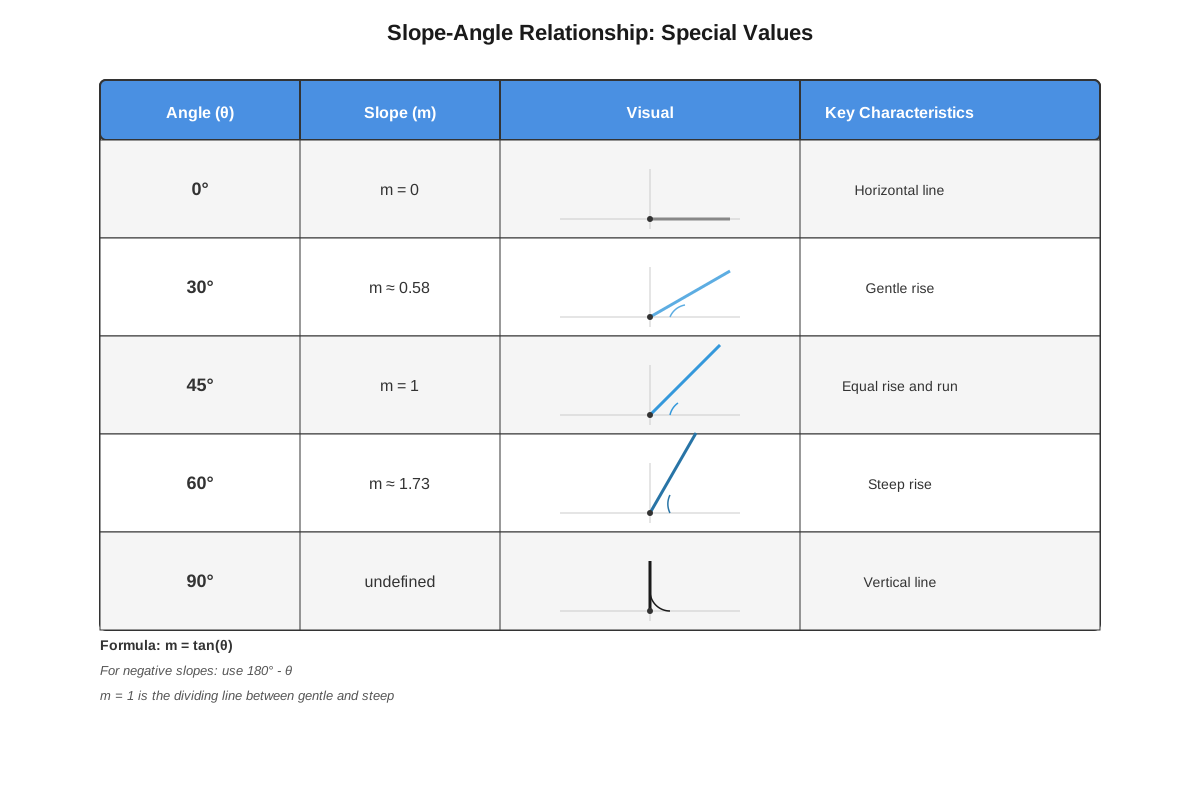
The relationship between slope and angle follows from trigonometry: slope equals the tangent of the angle the line makes with the positive x-axis. Mathematically, m = tan(θ), where θ is measured counterclockwise from the positive x-axis. This connection allows conversion between algebraic and geometric representations.
| Angle (θ) | Slope (m = tan θ) | Line Orientation |
|---|---|---|
| 0° | 0 | Horizontal |
| 30° | ≈ 0.577 | Gentle rise |
| 45° | 1 | Equal rise and run |
| 60° | ≈ 1.732 | Steep rise |
| 90° | Undefined | Vertical |
| 135° | -1 | Equal fall and run |
| 150° | ≈ -0.577 | Gentle fall |
For SAT purposes, memorizing the exact tangent values isn't necessary, but understanding the pattern is crucial: as angles increase from 0° to 90°, slopes increase from 0 to infinity; as angles increase from 90° to 180°, slopes increase from negative infinity to 0.
Special Slope Values
Certain slope values have special geometric significance:
- m = 0: Horizontal line, parallel to the x-axis, angle of 0° or 180°
- m = undefined: Vertical line, parallel to the y-axis, angle of 90°
- m = 1: Line rises at 45°, creating equal rise and run (moves diagonally upward)
- m = -1: Line falls at 45° from horizontal (or 135° from positive x-axis), creating equal fall and run
- m = positive fraction less than 1: Gentle upward slope, angle between 0° and 45°
- m = positive integer greater than 1: Steep upward slope, angle between 45° and 90°
Comparing Multiple Slopes Visually
When multiple lines appear on the same coordinate plane, comparing their slopes requires systematic observation:
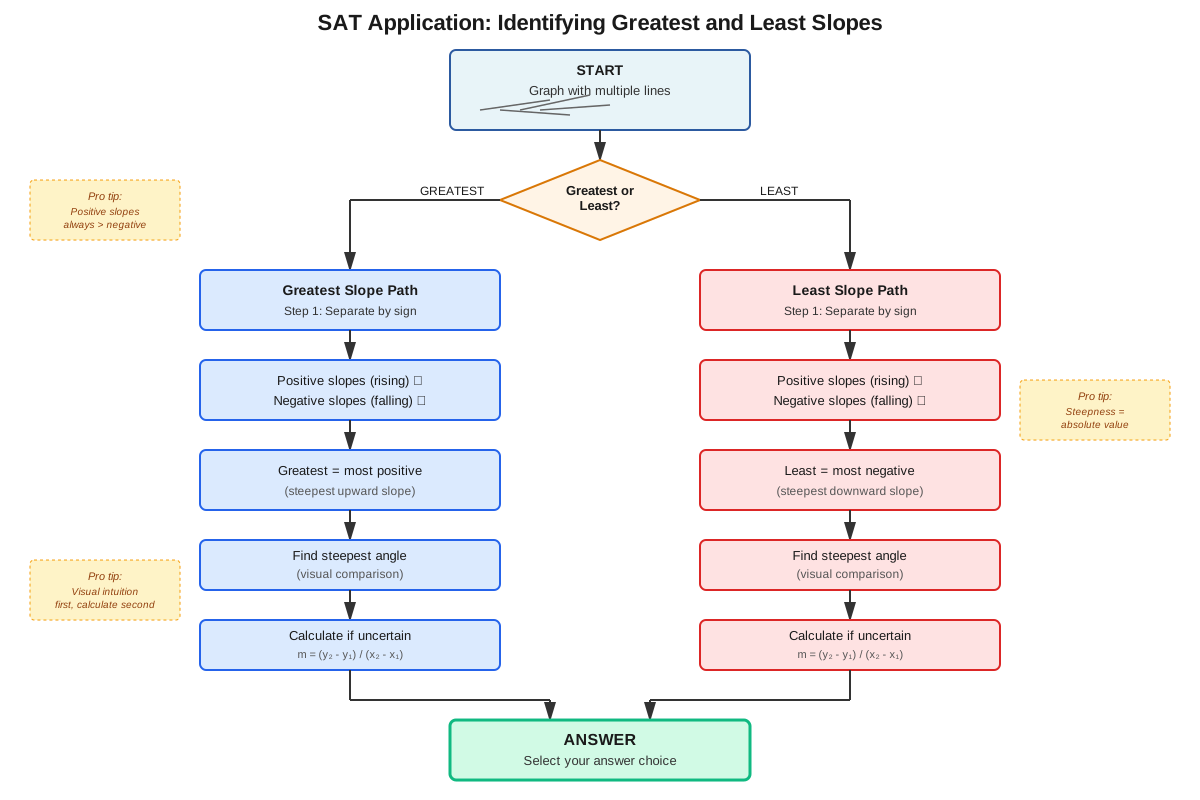
- Identify direction first: Separate lines into positive slopes (rising left to right) and negative slopes (falling left to right)
- Compare steepness within each group: Among positive slopes, the steepest line has the greatest slope; among negative slopes, the steepest line has the most negative (smallest) slope
- Consider the zero slope: Horizontal lines have slope 0, which is greater than any negative slope but less than any positive slope
A common SAT trap involves lines that appear similar in steepness but have different signs. Always check direction before comparing magnitude.
Slope Intuition in Context
Real-world problems often describe slope without using the term explicitly. Phrases like "rate of change," "speed," "grade," "pitch," or "incline" all refer to slope. A road with a "6% grade" has a slope of 0.06 (it rises 6 feet per 100 feet horizontally). A roof with a "4:12 pitch" has a slope of 4/12 = 1/3.
When interpreting graphs representing real situations, the slope's meaning depends on the axes. On a distance-time graph, slope represents speed. On a cost-quantity graph, slope represents unit price. On a temperature-time graph, slope represents the rate of temperature change. Understanding that slope always represents "how much y changes per unit change in x" provides universal intuition across contexts.
Concept Relationships
The core concepts within slope and angle intuition build upon each other hierarchically. Understanding slope as steepness forms the foundation, which then branches into recognizing positive versus negative slopes based on direction. These two concepts merge in the slope-angle connection, where numerical values correspond to geometric angles. Special slope values serve as reference points for estimating other slopes, while comparing multiple slopes applies all previous concepts simultaneously.
This topic connects backward to prerequisite knowledge: the slope formula provides the calculation method that generates the values being interpreted intuitively, while coordinate plane familiarity enables visualization of these slopes. The connection to angle measurement becomes explicit through the tangent function relationship.
Looking forward, slope and angle intuition enables mastery of parallel and perpendicular lines (parallel lines have equal slopes; perpendicular lines have negative reciprocal slopes), linear function transformations (changing slope affects the steepness of the graph), and systems of equations (intersection points depend on different slopes). The relationship map flows: Slope Formula → Slope Value → Visual Steepness → Angle Measurement → Line Relationships → Advanced Applications.
High-Yield Facts
⭐ A positive slope creates a line that rises from left to right; a negative slope creates a line that falls from left to right
⭐ The greater the absolute value of the slope, the steeper the line appears
⭐ A slope of 1 corresponds to a 45° angle with the horizontal; slopes greater than 1 create angles greater than 45°
⭐ Horizontal lines have slope 0; vertical lines have undefined slope
⭐ Among positive slopes, larger numbers mean steeper lines; among negative slopes, more negative numbers (like -5 versus -2) mean steeper lines
- A slope between 0 and 1 creates a gentle rise (angle less than 45°)
- A slope less than -1 creates a steep fall (angle of fall greater than 45° from horizontal)
- Lines with the same slope are parallel and never intersect
- The slope of a line remains constant between any two points on that line
- When a line passes through the origin with positive slope, it travels through quadrants I and III; with negative slope, it travels through quadrants II and IV
Quick check — test yourself on Slope and angle intuition so far.
Try Flashcards →Common Misconceptions
Misconception: A steeper-looking line always has a greater slope value than a less steep line.
Correction: Steepness relates to the absolute value of slope. A line with slope -5 is steeper than a line with slope 2, but -5 < 2. When comparing steepness regardless of direction, compare |m| values; when comparing slope values themselves, remember that negative numbers are less than positive numbers.
Misconception: A line that goes "up" has a positive slope, regardless of viewing direction.
Correction: Slope direction is always determined by moving from left to right along the x-axis. A line may appear to go "up" when traced from right to left, but if it falls when traced left to right, it has a negative slope.
Misconception: The angle a line makes with the x-axis is the same as the slope value.
Correction: Slope equals the tangent of the angle, not the angle itself. A 30° angle corresponds to a slope of approximately 0.577, not 30. However, a 45° angle does correspond to a slope of 1 because tan(45°) = 1.
Misconception: A line with slope 2 is twice as steep as a line with slope 1.
Correction: While slope 2 is indeed twice the value of slope 1, the visual steepness doesn't scale linearly. A slope of 1 creates a 45° angle, while a slope of 2 creates approximately a 63.4° angle—not 90°. The relationship is nonlinear because slope relates to the tangent function.
Misconception: Vertical lines have a slope of 0.
Correction: Vertical lines have undefined slope (or "no slope"), not zero slope. Horizontal lines have slope 0. The confusion arises because vertical lines have zero horizontal change (Δx = 0), making the slope formula m = Δy/Δx involve division by zero, which is undefined.
Misconception: If two lines look similar in steepness on a graph, they have similar slopes.
Correction: The apparent steepness depends on the scale of the axes. If the x-axis and y-axis have different scales, visual appearance can be misleading. Always calculate or compare numerical slope values rather than relying solely on visual estimation when axes have different scales.
Worked Examples
Example 1: Identifying Slopes from a Graph
Problem: Four lines are graphed on the same coordinate plane. Line A passes through points (-2, 1) and (2, 5). Line B passes through points (-1, 4) and (3, 2). Line C is horizontal passing through y = 3. Line D passes through points (0, 0) and (1, 3). Without calculating exact slopes, order the lines from least to greatest slope.
Solution:
Step 1: Identify the direction of each line.
- Line A: Moving left to right from (-2, 1) to (2, 5), the line rises → positive slope
- Line B: Moving left to right from (-1, 4) to (3, 2), the line falls → negative slope
- Line C: Horizontal line → slope = 0
- Line D: Moving left to right from (0, 0) to (1, 3), the line rises → positive slope
Step 2: Order by sign first.
Negative slopes < zero slope < positive slopes
So Line B < Line C < (Line A or Line D)
Step 3: Compare the positive slopes.
- Line A rises 4 units (from y = 1 to y = 5) over 4 horizontal units (from x = -2 to x = 2), suggesting slope ≈ 1
- Line D rises 3 units (from y = 0 to y = 3) over 1 horizontal unit (from x = 0 to x = 1), suggesting slope = 3
Since 3 > 1, Line D is steeper than Line A.
Step 4: Final ordering.
Line B < Line C < Line A < Line D
Connection to Learning Objectives: This example demonstrates applying slope and angle intuition to compare multiple lines without detailed calculations, using visual direction and steepness to order slopes—a common SAT task.
Example 2: Matching Slopes to Real-World Scenarios
Problem: A hiking trail map shows elevation versus horizontal distance. Four trail segments are described:
- Segment P: Rises 300 feet over 1,000 feet of horizontal distance
- Segment Q: Descends 150 feet over 500 feet of horizontal distance
- Segment R: Remains at constant elevation for 800 feet
- Segment S: Rises 400 feet over 500 feet of horizontal distance
Which segment would appear steepest on the graph, and which would have the greatest slope value?
Solution:
Step 1: Calculate or estimate the slope for each segment.
- Segment P: slope = 300/1000 = 0.3 (positive, gentle rise)
- Segment Q: slope = -150/500 = -0.3 (negative, gentle descent)
- Segment R: slope = 0/800 = 0 (horizontal, no slope)
- Segment S: slope = 400/500 = 0.8 (positive, moderate rise)
Step 2: Identify the steepest segment (greatest absolute value).
|0.3| = 0.3, |-0.3| = 0.3, |0| = 0, |0.8| = 0.8
Segment S has the greatest absolute value, so it appears steepest.
Step 3: Identify the greatest slope value (considering sign).
Ordering: -0.3 < 0 < 0.3 < 0.8
Segment S has the greatest slope value (0.8).
Step 4: Verify intuition.
Segment S rises 400 feet in only 500 feet of horizontal distance—a rise of 0.8 feet per horizontal foot. This is steeper than Segment P (0.3 feet per horizontal foot). Segment Q descends, so despite having the same steepness magnitude as P, its slope value is negative and therefore less than all positive slopes.
Answer: Segment S appears steepest and has the greatest slope value.
Connection to Learning Objectives: This example shows how slope and angle intuition applies to real-world contexts where slope represents rate of change (elevation change per horizontal distance), requiring students to interpret slope both as steepness and as a numerical value with sign.
Exam Strategy
When approaching SAT questions involving slope and angle intuition, begin by quickly sketching or visualizing the scenario if no diagram is provided. If a diagram exists, mark it up: draw arrows showing the direction of each line (rising or falling), and label lines with "steep" or "gentle" based on visual appearance.
Trigger words and phrases that signal slope and angle intuition questions include: "steepest," "greatest slope," "which line rises/falls fastest," "rate of change," "incline," "grade," "pitch," "which equation matches the graph," and "which graph matches the description." When you see these phrases, immediately think about both the sign and magnitude of slopes.
For process of elimination, use these strategies:
- Eliminate answer choices with the wrong sign first (if a line clearly rises, eliminate negative slope options)
- Eliminate extreme values that don't match visual steepness (if a line is gentle, eliminate slopes like 10 or -8)
- Use special values as benchmarks (if a line is steeper than 45°, its slope must be greater than 1 or less than -1)
- Check endpoints: if a line passes through given points, verify that answer choices produce the correct y-values at those x-values
Time allocation: These questions typically require 30-60 seconds. Spend 10-15 seconds analyzing the visual or scenario, 20-30 seconds applying intuition to eliminate wrong answers, and 10-15 seconds verifying your choice. Avoid lengthy calculations—if you find yourself doing complex arithmetic, you're likely missing an intuitive shortcut.
Exam Tip: When comparing slopes of multiple lines on a graph, use your pencil as a reference line. Hold it horizontally (slope 0), then rotate it to match each line. The more you rotate toward vertical, the greater the absolute value of the slope.
Memory Techniques
Mnemonic for slope sign: "Positive slopes Point to the Penthouse" (upper right), while "Negative slopes Nosedive" (toward lower right). Visualize a penthouse at the top-right of a building and an airplane nosediving downward.
Visualization for slope magnitude: Picture a ski slope. A gentle slope (small |m|) is the bunny hill where beginners ski—you can almost walk up it. A steep slope (large |m|) is the black diamond run—nearly vertical and terrifying. The steeper the ski slope, the larger the absolute value of its mathematical slope.
Acronym for special slopes: HUVO - Horizontal is Unchanging (slope 0), Vertical is Off-limits (undefined slope). This reminds you that horizontal lines have zero slope and vertical lines have undefined slope.
45-degree reference: Remember "One-for-One at Forty-Five"—a slope of 1 (or -1) means you rise (or fall) one unit for every one unit you move horizontally, creating a 45° angle. Any slope with absolute value greater than 1 is steeper than 45°; any slope with absolute value less than 1 is gentler than 45°.
Tangent connection: "Slope is Tan-gible"—slope equals the tangent of the angle. While you won't calculate tangent values on the SAT, remembering this connection helps you understand why slope and angle are related and why the relationship isn't linear.
Summary
Slope and angle intuition represents the critical bridge between algebraic representations of lines and their geometric appearances. Mastering this topic requires understanding that slope quantifies steepness through the ratio of vertical to horizontal change, with positive slopes creating rising lines and negative slopes creating falling lines. The magnitude of the slope determines how steep the line appears, with larger absolute values corresponding to steeper lines and angles closer to vertical. Special values like slope 0 (horizontal), undefined slope (vertical), and slope ±1 (45° angles) serve as reference points for estimating other slopes. On the SAT, this intuition enables rapid elimination of incorrect answer choices, verification of algebraic calculations through visual reasoning, and interpretation of real-world scenarios where slope represents rates of change. Success requires moving fluidly between numerical slope values and visual representations, recognizing that the sign indicates direction while the magnitude indicates steepness, and applying these principles to compare multiple lines or match equations to graphs.
Key Takeaways
- Positive slopes rise from left to right; negative slopes fall from left to right; horizontal lines have slope 0; vertical lines have undefined slope
- Greater absolute value of slope means steeper line: |m| = 5 is steeper than |m| = 2, regardless of sign
- A slope of 1 or -1 corresponds to a 45° angle; slopes with |m| > 1 are steeper than 45°, while slopes with |m| < 1 are gentler than 45°
- When comparing slopes numerically, remember that negative values are less than positive values: -5 < -2 < 0 < 2 < 5
- Visual steepness relates to absolute value, but slope value includes sign—always consider both when analyzing lines
- Slope represents rate of change in context problems: rise per run, elevation change per distance, cost per item, or speed on distance-time graphs
- Use visual intuition to eliminate wrong answers quickly, then verify with calculation only if necessary
Related Topics
Parallel and Perpendicular Lines: Building on slope intuition, this topic explores how parallel lines share identical slopes while perpendicular lines have slopes that are negative reciprocals (m₁ × m₂ = -1). Mastering slope and angle intuition makes recognizing these relationships immediate.
Linear Functions and Transformations: Understanding how changing the slope parameter m in y = mx + b affects the graph's steepness and direction connects directly to slope and angle intuition, enabling prediction of transformation effects.
Systems of Linear Equations: The number and location of solutions to systems depends on whether lines have different slopes (one solution), the same slope with different y-intercepts (no solution), or identical slopes and y-intercepts (infinite solutions).
Trigonometric Functions: The formal connection between slope and angle through m = tan(θ) becomes central in trigonometry, where angle measures and ratios are studied systematically.
Rate of Change and Derivatives: In precalculus and calculus, slope intuition extends to instantaneous rates of change, where the derivative represents the slope of a tangent line at a point.
Practice CTA
Now that you've developed a strong foundation in slope and angle intuition, it's time to reinforce your understanding through active practice. Attempt the practice questions designed specifically for this topic—they'll challenge you to apply your intuition in various SAT-style contexts, from pure coordinate geometry to real-world applications. Use the flashcards to drill the high-yield facts until recognizing slope relationships becomes automatic. Remember, the SAT rewards both accuracy and speed, and building strong intuition through practice is what transforms this topic from challenging to straightforward. Every practice problem you solve strengthens the neural pathways that will help you recognize patterns instantly on test day. You've got this!
Sign up free to keep reading
Create a free AnvayaPrep account to finish this SAT guide on Slope and angle intuition — plus flashcards and practice questions.