Overview
Complementary angles are pairs of angles whose measures sum to exactly 90 degrees. This fundamental geometric relationship appears frequently on the SAT and serves as a building block for more complex angle problems involving triangles, polygons, and coordinate geometry. Understanding complementary angles is not merely about memorizing a definition—it requires recognizing these relationships in diverse contexts, from simple two-angle diagrams to multi-step problems involving algebraic expressions and geometric proofs.
The SAT tests complementary angles both directly and indirectly. Direct questions might present two angles and ask students to find missing measures, while indirect applications embed complementary angle relationships within larger geometry problems involving right triangles, perpendicular lines, or coordinate plane scenarios. Mastery of this topic enables students to quickly identify angle relationships, set up equations efficiently, and eliminate incorrect answer choices through logical reasoning about angle constraints.
Within the broader landscape of math concepts tested on the SAT, complementary angles connect intimately with supplementary angles (which sum to 180°), right triangle properties, perpendicular line relationships, and algebraic equation-solving. This topic typically appears in 2-4 questions per SAT administration, making it a high-yield area for focused study. Students who master complementary angles gain both quick points on straightforward problems and the foundational knowledge needed to tackle complex multi-concept geometry questions.
Learning Objectives
- [ ] Identify key features of complementary angles in various geometric configurations
- [ ] Explain how complementary angles appears on the SAT in both isolated and integrated contexts
- [ ] Apply complementary angles to answer SAT-style questions efficiently and accurately
- [ ] Construct algebraic equations from complementary angle relationships involving variables
- [ ] Distinguish between complementary and supplementary angle relationships in complex diagrams
- [ ] Solve multi-step problems that combine complementary angles with other geometric properties
- [ ] Recognize complementary angle relationships in right triangles and perpendicular line intersections
Prerequisites
- Basic angle measurement: Understanding that angles are measured in degrees and that a full rotation equals 360° is essential for comprehending why complementary angles sum to 90°
- Algebraic equation solving: The ability to solve linear equations (e.g., x + 35 = 90) is necessary since most SAT complementary angle problems require setting up and solving equations
- Right angle recognition: Knowing that a right angle measures exactly 90° provides the conceptual foundation for understanding why complementary angles are defined by this specific sum
- Variable manipulation: Comfort with expressions like (2x + 5) and (3x - 10) enables students to handle the algebraic representations of angle measures commonly found in SAT problems
Why This Topic Matters
Complementary angles represent one of the most practical geometric concepts in both real-world applications and standardized testing. Architects and engineers use complementary angle relationships when designing structures with perpendicular supports, while carpenters rely on these principles when creating precise right-angle joints. In navigation and surveying, complementary angles help determine bearings and elevations. The concept also appears in physics when analyzing force vectors and in computer graphics when calculating rotations and transformations.
On the SAT, complementary angles appear with remarkable consistency. Statistical analysis of recent SAT administrations reveals that approximately 15-20% of geometry questions involve angle relationships, with complementary angles featured in roughly 2-4 questions per test. These questions typically appear in both the calculator and no-calculator sections, with difficulty levels ranging from straightforward identification problems (worth 1 point each) to complex multi-step problems that may involve algebraic expressions, geometric diagrams, or word problems requiring translation from verbal descriptions to mathematical equations.
The SAT presents complementary angles in several characteristic formats: diagrams showing two angles forming a right angle with one or both measures expressed algebraically; word problems describing complementary relationships without visual aids; questions embedded within right triangle problems where students must recognize that the two acute angles are complementary; and coordinate geometry problems where perpendicular lines create complementary angles. The College Board particularly favors questions that combine complementary angles with algebraic reasoning, requiring students to set up equations like (3x + 10) + (2x + 5) = 90 and solve for x before finding specific angle measures.
Core Concepts
Definition and Fundamental Properties
Complementary angles are two angles whose measures add up to exactly 90 degrees. The term "complementary" derives from the Latin "complementum," meaning "that which completes," reflecting how these angles complete a right angle. This relationship is purely numerical—complementary angles need not be adjacent (touching) or even appear in the same diagram. The defining characteristic is simply that their sum equals 90°.
Key properties of complementary angles include:
- The sum is always exactly 90° (one right angle)
- Each angle in a complementary pair must be acute (less than 90°)
- If one angle measures x degrees, its complement measures (90 - x) degrees
- Complementary angles can be adjacent (sharing a common side) or non-adjacent
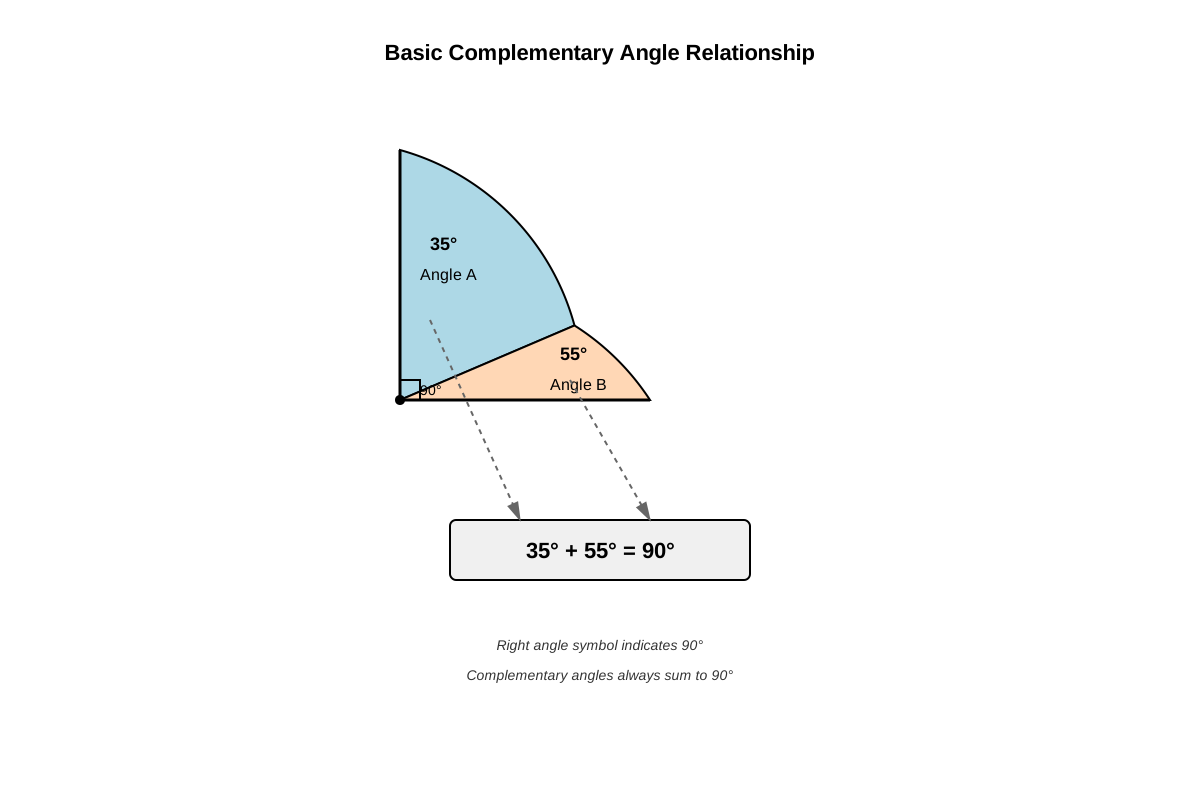
- When complementary angles are adjacent and share a vertex, they form a right angle
Mathematical Representation
The complementary angle relationship can be expressed algebraically in several ways:
Angle A + Angle B = 90°If one angle measures x degrees, its complement can be expressed as:
Complement = 90° - xFor problems involving algebraic expressions, the equation takes the form:
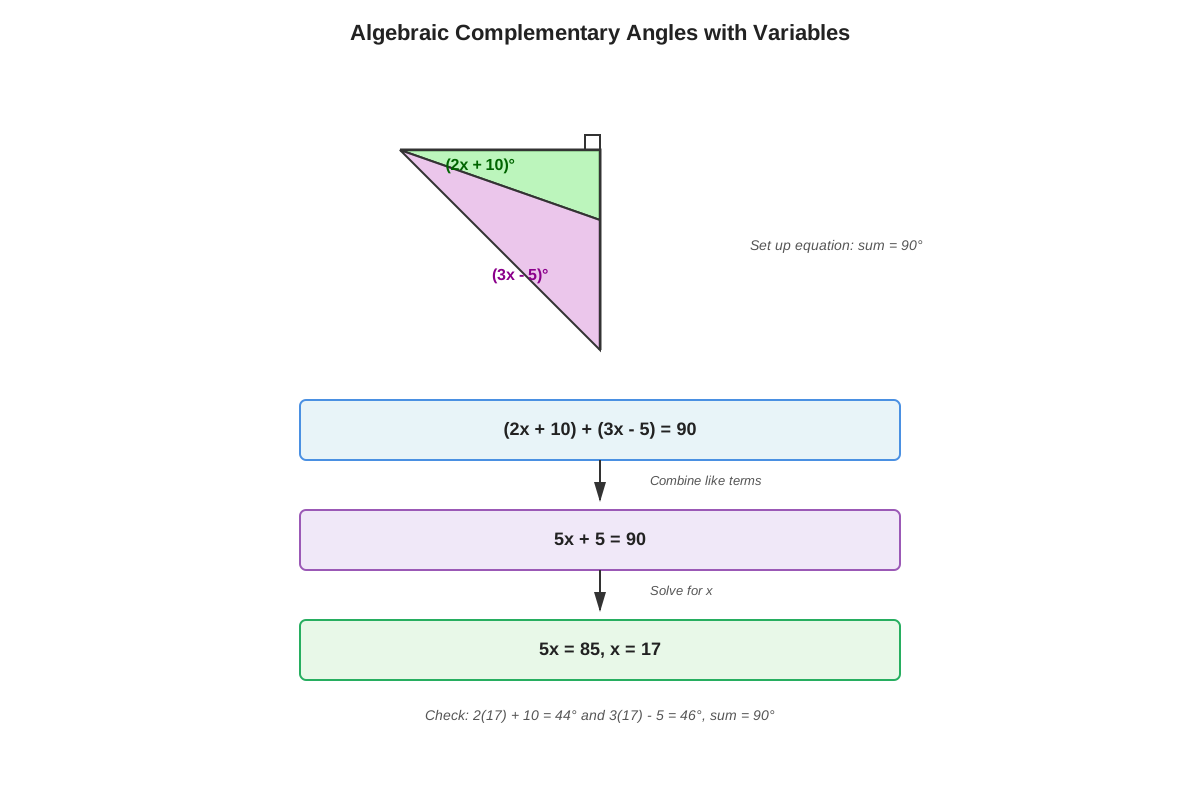
(expression₁) + (expression₂) = 90°For example, if one angle measures (2x + 15)° and another measures (3x - 5)°, and they are complementary:
(2x + 15) + (3x - 5) = 90
5x + 10 = 90
5x = 80
x = 16
Visual Recognition in Diagrams
On the SAT, complementary angles appear in several standard configurations:
Adjacent Complementary Angles: Two angles sharing a common vertex and side, together forming a right angle. These are often marked with a small square symbol (⊏) indicating the 90° angle they create together.
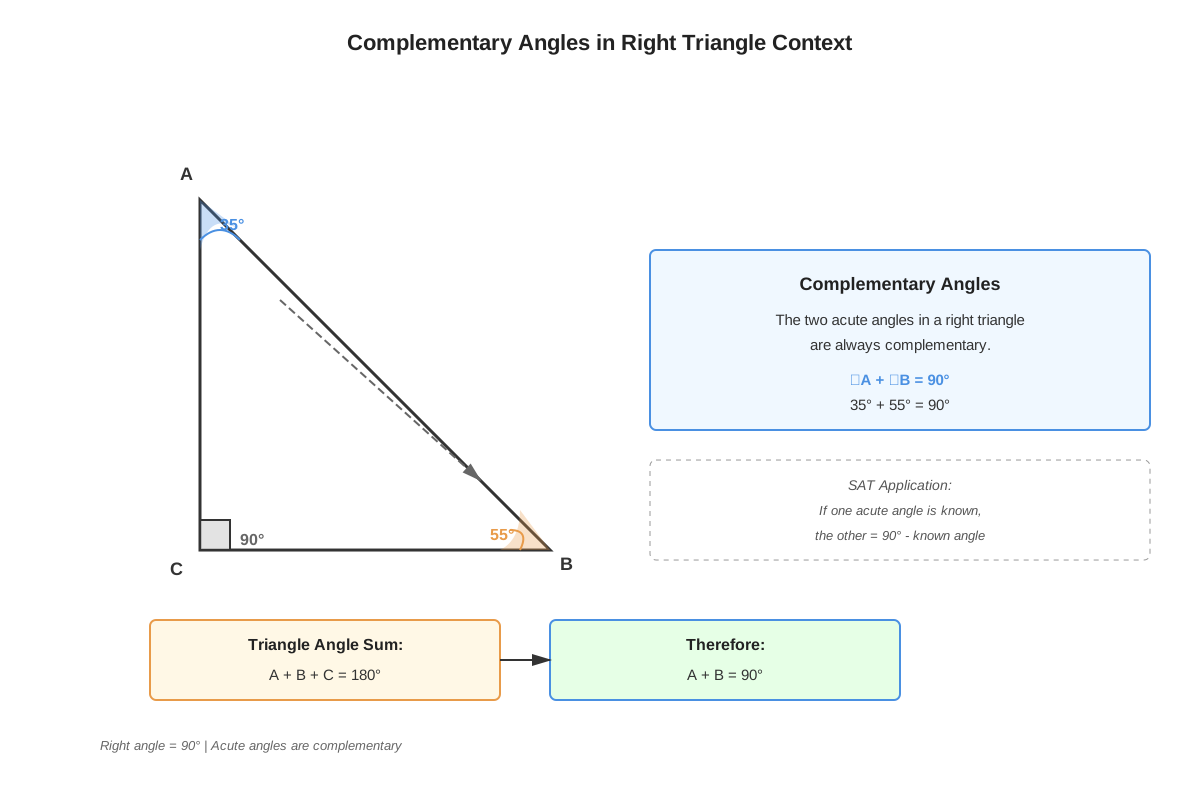
Angles in Right Triangles: The two acute angles in any right triangle are always complementary because the three angles of a triangle sum to 180°, and one angle is already 90°, leaving 90° to be distributed between the other two angles.
Perpendicular Line Intersections: When a line intersects two perpendicular lines, various complementary angle pairs are created. Recognizing these relationships quickly is crucial for SAT success.
Complementary vs. Supplementary Angles
Understanding the distinction between these two fundamental angle relationships prevents common errors:
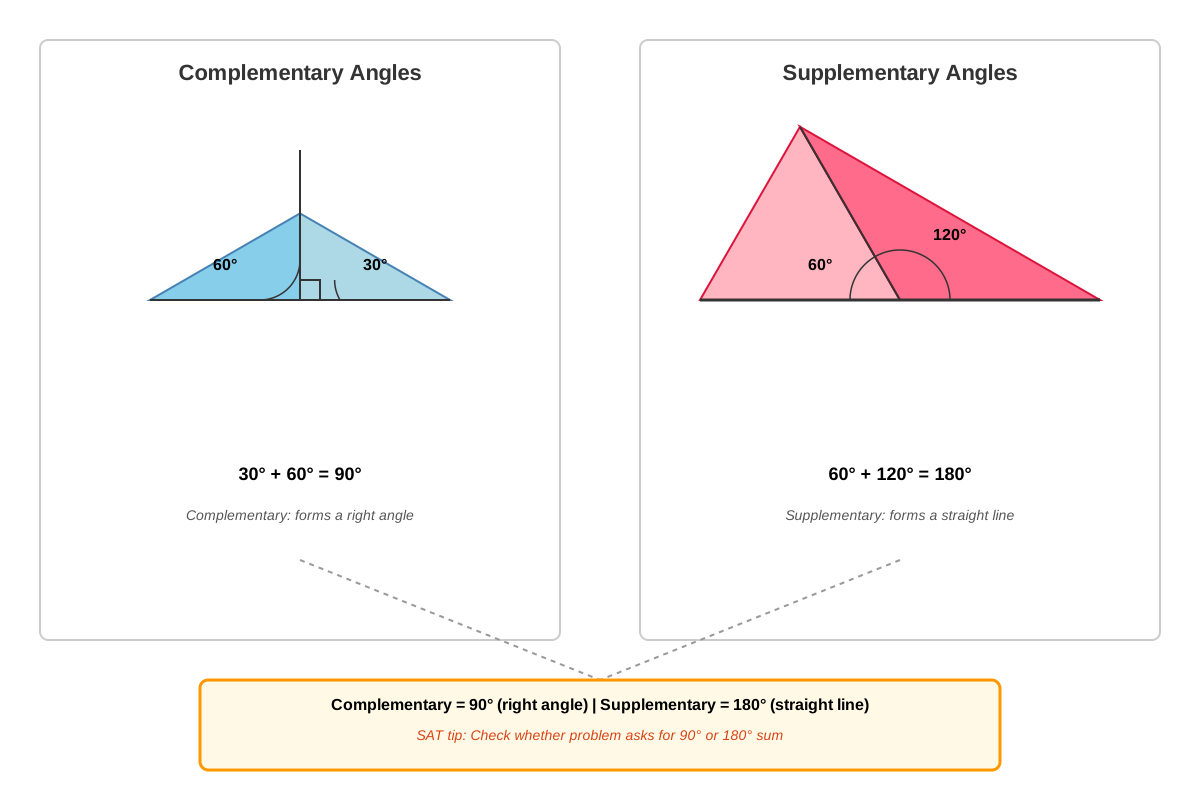
| Feature | Complementary Angles | Supplementary Angles |
|---|---|---|
| Sum | 90° | 180° |
| Individual angle range | 0° < angle < 90° (acute) | 0° < angle < 180° |
| Visual association | Right angle | Straight line |
| Memory aid | "C" for Corner (right angle) | "S" for Straight line |
Application in Right Triangles
In any right triangle, the two non-right angles (acute angles) are always complementary. This property provides a powerful problem-solving tool:
- If one acute angle in a right triangle measures 35°, the other must measure 55°
- If one acute angle is represented as (4x + 10)°, the other can be expressed as (90 - 4x - 10)° or (80 - 4x)°
- This relationship enables quick angle calculations without requiring trigonometric functions
Multi-Step Problem Solving
SAT complementary angles questions frequently require multiple steps:
- Identify the relationship: Recognize that two angles are complementary from context clues (right angle symbol, perpendicular lines, right triangle, or explicit statement)
- Set up the equation: Write the sum equation with any algebraic expressions
- Solve for variables: Use algebraic techniques to find unknown values
- Calculate specific measures: Substitute values back to find the actual angle measures
- Verify the answer: Check that the sum equals 90° and that the answer makes geometric sense
Word Problem Translation
SAT word problems involving complementary angles require translating verbal descriptions into mathematical equations. Common phrasings include:
- "Two angles are complementary" → A + B = 90°
- "One angle is 15° more than its complement" → x + (x + 15) = 90°
- "The ratio of two complementary angles is 2:3" → 2x + 3x = 90°
- "An angle is twice its complement" → x + 2x = 90°
Concept Relationships
Complementary angles serve as a foundational concept that connects to numerous other geometric principles. The relationship flows as follows:
Right Angles → define → Complementary Angles → appear in → Right Triangles → connect to → Pythagorean Theorem
Additionally, complementary angles relate to perpendicular lines: Perpendicular Lines → create → Right Angles → contain → Complementary Angle Pairs
The concept also bridges to algebraic thinking: Algebraic Expressions → represent → Angle Measures → combine in → Complementary Relationships → require → Equation Solving
Understanding complementary angles enables progression to more advanced topics including trigonometric ratios (where complementary angles have reciprocal relationships: sin(x) = cos(90° - x)), coordinate geometry involving perpendicular slopes, and polygon angle sum problems. The distinction between complementary and supplementary angles creates a parallel structure that helps students organize their geometric knowledge systematically.
Within the topic itself, the concepts connect hierarchically: basic definition → algebraic representation → visual recognition → application in specific contexts (right triangles, perpendicular lines) → multi-step problem solving. Each level builds upon the previous, requiring both conceptual understanding and procedural fluency.
High-Yield Facts
⭐ Complementary angles always sum to exactly 90 degrees, regardless of whether they are adjacent or separated in a diagram
⭐ In any right triangle, the two acute angles are complementary because they must sum to 90° (since the triangle's angles total 180° and one angle is already 90°)
⭐ If one angle measures x degrees, its complement measures (90 - x) degrees—this formula is essential for setting up equations
⭐ Both angles in a complementary pair must be acute (less than 90°); if one angle is 90° or greater, no complement exists
⭐ When two complementary angles are adjacent and share a vertex, they form a right angle, often marked with a small square symbol
- Complementary angles can be represented algebraically, requiring equation-solving skills to find unknown measures
- The term "complementary" relates to "completing" a right angle, while "supplementary" relates to completing a straight line (180°)
- Perpendicular lines create multiple complementary angle pairs at their intersection point
- Word problems often describe complementary relationships without using the term "complementary," requiring students to recognize phrases like "two angles form a right angle"
- The SAT frequently combines complementary angle problems with other concepts like linear equations, ratios, or geometric diagrams
- Complementary angle problems may appear in both multiple-choice and grid-in formats, with grid-in questions typically requiring calculation of specific angle measures
- When angles are expressed as algebraic expressions (like 2x + 5 and 3x - 10), students must combine like terms and solve before finding individual angle measures
Quick check — test yourself on Complementary angles so far.
Try Flashcards →Common Misconceptions
Misconception: Complementary angles must be adjacent (next to each other) to be complementary.
Correction: Complementary angles are defined solely by their sum equaling 90°. They can be anywhere in a diagram or even in separate diagrams entirely. The relationship is numerical, not positional.
Misconception: Confusing complementary (90°) with supplementary (180°) angles, especially under time pressure.
Correction: Use memory aids: "C" in complementary stands for "Corner" (right angle = 90°), while "S" in supplementary stands for "Straight" (straight line = 180°). Always double-check which relationship the problem describes.
Misconception: Believing that if two angles are complementary, each must measure 45°.
Correction: While 45° + 45° = 90° is one example of complementary angles, any two positive angle measures that sum to 90° are complementary. For instance, 30° and 60°, or 17° and 73°, are equally valid complementary pairs.
Misconception: Thinking that complementary angles must both be shown in the diagram.
Correction: SAT problems may describe one angle and ask for its complement without showing the complement in the figure. Students must calculate the complement using the formula (90° - given angle).
Misconception: When solving algebraic complementary angle problems, finding the value of x and stopping without calculating the actual angle measures.
Correction: Most SAT questions ask for specific angle measures, not just the variable value. After solving for x, substitute back into the expressions to find the actual angles, then verify they sum to 90°.
Misconception: Assuming that all angles in a right triangle are complementary to each other.
Correction: Only the two acute angles in a right triangle are complementary to each other. Neither acute angle is complementary to the 90° angle (since 90° + any positive angle exceeds 90°).
Misconception: Believing complementary angles must have different measures.
Correction: Two 45° angles are complementary to each other (45° + 45° = 90°). Complementary angles can be equal, though they need not be.
Worked Examples
Example 1: Algebraic Complementary Angles
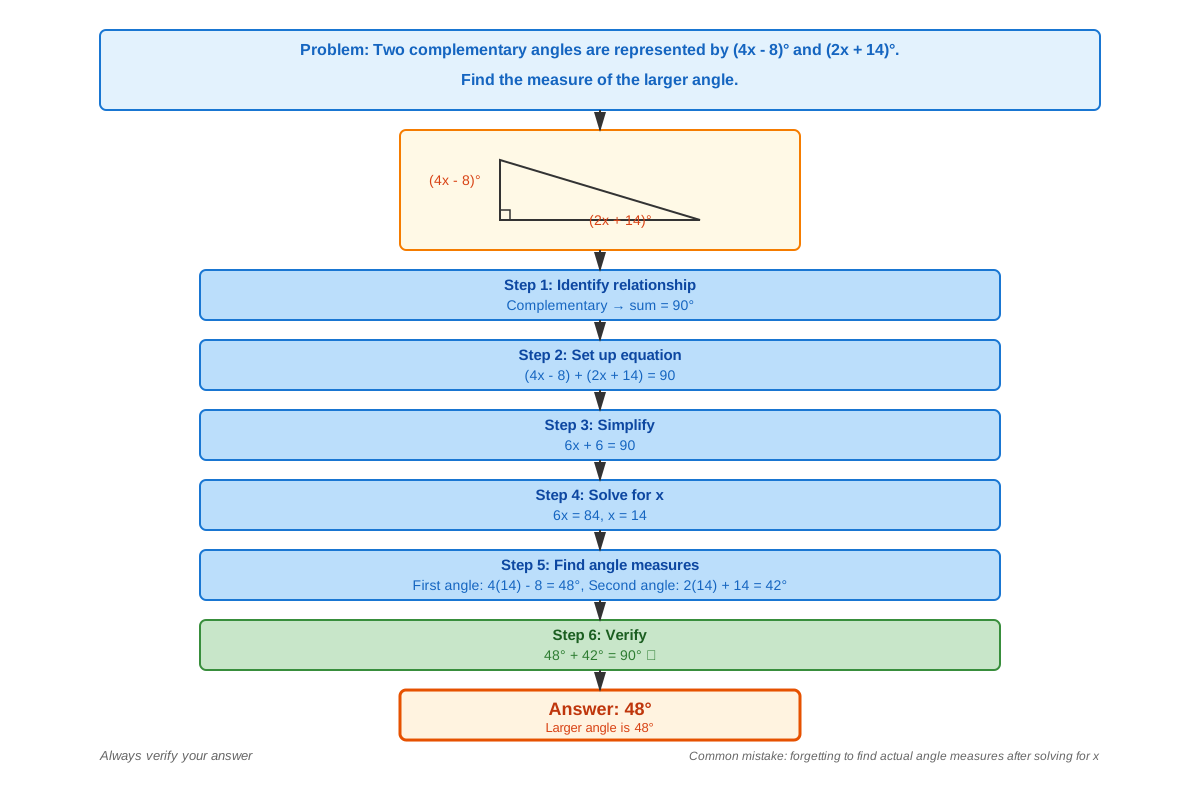
Problem: Two complementary angles are represented by the expressions (3x + 12)° and (2x + 18)°. What is the measure of the larger angle?
Solution:
Step 1: Set up the equation using the complementary angle relationship.
(3x + 12) + (2x + 18) = 90Step 2: Combine like terms.
5x + 30 = 90Step 3: Solve for x.
5x = 60
x = 12
Step 4: Calculate each angle measure by substituting x = 12.
- First angle: 3(12) + 12 = 36 + 12 = 48°
- Second angle: 2(12) + 18 = 24 + 18 = 42°
Step 5: Verify the angles are complementary.
48° + 42° = 90° ✓Step 6: Identify the larger angle.
The larger angle measures 48°.
Connection to Learning Objectives: This problem demonstrates the application of complementary angles to SAT-style questions by requiring algebraic setup, equation solving, and careful attention to what the question asks (the larger angle, not just x).
Example 2: Right Triangle Application
Problem: In right triangle ABC, angle A is the right angle. If angle B measures (5x - 10)° and angle C measures (3x + 20)°, what is the measure of angle B?
Solution:
Step 1: Recognize that in a right triangle, the two acute angles are complementary.
Since angle A = 90°, angles B and C must sum to 90°.
Step 2: Set up the equation.
(5x - 10) + (3x + 20) = 90Step 3: Simplify and solve.
8x + 10 = 90
8x = 80
x = 10
Step 4: Calculate angle B specifically (since that's what the question asks).
Angle B = 5(10) - 10 = 50 - 10 = 40°Step 5: Verify by calculating angle C.
Angle C = 3(10) + 20 = 30 + 20 = 50°
40° + 50° = 90° ✓Answer: Angle B measures 40°.
Connection to Learning Objectives: This example shows how complementary angles appear in the specific context of right triangles, a common SAT scenario. It requires recognizing the complementary relationship without explicit statement and applying algebraic problem-solving skills.
Example 3: Word Problem Translation
Problem: One angle is 18° less than twice its complement. What is the measure of the smaller angle?
Solution:
Step 1: Define variables. Let x = the measure of one angle.
Then (90 - x) = the measure of its complement.
Step 2: Translate the word problem into an equation.
"One angle is 18° less than twice its complement" means:
x = 2(90 - x) - 18Step 3: Solve the equation.
x = 180 - 2x - 18
x = 162 - 2x
3x = 162
x = 54
Step 4: Find both angles.
- First angle: 54°
- Complement: 90 - 54 = 36°
Step 5: Verify the relationship described in the problem.
"One angle is 18° less than twice its complement"
54 = 2(36) - 18
54 = 72 - 18
54 = 54 ✓
Step 6: Identify the smaller angle.
The smaller angle measures 36°.
Connection to Learning Objectives: This problem requires translating verbal descriptions into mathematical equations, a critical SAT skill. It demonstrates how complementary angle problems can be disguised in word problems without geometric diagrams.
Exam Strategy
When approaching sat complementary angles questions, employ these strategic techniques:
Trigger Word Recognition: Watch for phrases like "complementary," "form a right angle," "perpendicular," "right triangle," or "sum to 90 degrees." These signal complementary angle relationships even when not explicitly stated.
Step-by-Step Approach:
- Identify the relationship: Determine whether angles are complementary from visual cues (right angle symbol, perpendicular lines) or verbal descriptions
- Write the equation: Set up the sum equation immediately, even before attempting to solve
- Solve systematically: Use algebraic techniques carefully, showing work to avoid calculation errors
- Answer the actual question: Many students solve for x but forget to calculate the specific angle measure requested
- Verify when possible: If time permits, check that your angles sum to 90°
Process of Elimination Tips:
- Eliminate any answer choice that would make one angle 90° or greater (both angles must be acute)
- If the problem involves algebraic expressions, eliminate choices that don't result from valid algebraic solutions
- For word problems, eliminate answers that don't satisfy the described relationship when checked
- If two angles are described as complementary and one is given as 35°, immediately eliminate any answer choice other than 55° for the complement
Time Allocation:
- Simple identification problems (given one angle, find complement): 30-45 seconds
- Algebraic problems (solve for x, then find angle): 1-2 minutes
- Multi-step word problems: 2-3 minutes
- If a problem takes longer than 3 minutes, mark it for review and move on
Common SAT Tricks to Watch For:
- Questions that ask for the value of x when you need the angle measure (or vice versa)
- Problems where angles are complementary but not adjacent, testing whether you understand the definition
- Diagrams that show multiple angle pairs, requiring you to identify which specific pair is complementary
- Word problems that describe complementary relationships indirectly ("two angles form a right angle")
Memory Techniques
Mnemonic for Complementary vs. Supplementary:
- Complementary = Corner (right angle = 90°)
- Supplementary = Straight line (180°)
The "Complete the Corner" Visualization:
Picture a right angle as a corner of a room. Complementary angles "complete" this corner. Visualize one angle as a door partially opened from the wall—the remaining space to make a right angle is its complement.
The 90-x Formula Chant:
"Ninety minus x gives the complement" - repeat this phrase to internalize the complement formula: 90° - x
Right Triangle Rule:
"Right triangle's acute angles always add to ninety" - This rhythmic phrase helps remember that the two acute angles in any right triangle are complementary.
Algebraic Setup Acronym - WISE:
- Write the relationship (A + B = 90)
- Insert the expressions
- Solve for the variable
- Evaluate the specific angles
Visual Memory Aid:
Draw a large "L" shape (representing a right angle). Label one part "x" and the other part "90 - x". This simple visual reinforces that complementary angles complete a right angle and their relationship is expressed as 90 - x.
Summary
Complementary angles are pairs of angles that sum to exactly 90 degrees, forming one of the most fundamental relationships in geometry tested on the SAT. These angles need not be adjacent; their defining characteristic is purely their numerical sum. On the SAT, complementary angles appear in multiple contexts: as direct calculation problems, embedded within right triangles (where the two acute angles are always complementary), in diagrams involving perpendicular lines, and in word problems requiring translation from verbal descriptions to mathematical equations. Success with complementary angle problems requires three core competencies: recognizing complementary relationships from visual or verbal cues, setting up and solving algebraic equations when angle measures are expressed as variables, and carefully answering the specific question asked (whether for a variable value, a specific angle measure, or a relationship). The complement of any angle x is calculated as (90 - x), and both angles in a complementary pair must be acute. Distinguishing complementary (90°) from supplementary (180°) angles prevents common errors, as does remembering to verify that calculated angles actually sum to 90 degrees.
Key Takeaways
- Complementary angles always sum to exactly 90°, regardless of their position or adjacency in a diagram
- The two acute angles in any right triangle are complementary—a high-yield fact for SAT geometry questions
- If one angle measures x degrees, its complement is (90 - x) degrees
- Both angles in a complementary pair must be acute (less than 90°); neither can be right, obtuse, or reflex
- SAT problems frequently require setting up equations like (expression₁) + (expression₂) = 90 and solving for variables before calculating specific angle measures
- Watch for trigger words: "complementary," "form a right angle," "perpendicular," and "right triangle" all signal complementary angle relationships
- Always answer the specific question asked—many problems require the angle measure, not just the variable value
Related Topics
Supplementary Angles: These angle pairs sum to 180° rather than 90°, appearing frequently alongside complementary angles on the SAT. Mastering complementary angles provides the foundation for understanding supplementary relationships, as both involve angle sum properties and algebraic equation-solving.
Linear Pairs and Vertical Angles: When two lines intersect, they create angle relationships including linear pairs (supplementary) and vertical angles (equal). Understanding complementary angles helps distinguish these relationships and solve complex multi-angle problems.
Right Triangle Properties: Complementary angles are intrinsic to right triangles, where the two acute angles always sum to 90°. This topic extends to the Pythagorean theorem, special right triangles (30-60-90 and 45-45-90), and trigonometric ratios.
Angle Relationships in Parallel Lines: When parallel lines are cut by a transversal, various angle relationships emerge. The foundational understanding of complementary and supplementary angles enables efficient problem-solving with corresponding, alternate interior, and alternate exterior angles.
Coordinate Geometry and Perpendicular Lines: Perpendicular lines in the coordinate plane have slopes that are negative reciprocals and create right angles (and thus complementary angle pairs) at their intersection. This connects geometric angle concepts to algebraic slope relationships.
Practice CTA
Now that you've mastered the core concepts of complementary angles, it's time to solidify your understanding through active practice. Work through the practice questions to apply these principles to authentic SAT-style problems, and use the flashcards to reinforce key definitions and formulas. Remember, complementary angles appear in 2-4 questions per SAT administration—your investment in mastering this topic will yield concrete points on test day. Focus especially on problems that combine algebraic expressions with geometric relationships, as these represent the highest-yield question types. You've built a strong foundation; now transform that knowledge into test-taking confidence through deliberate practice!
Sign up free to keep reading
Create a free AnvayaPrep account to finish this SAT guide on Complementary angles — plus flashcards and practice questions.