Overview
Clearing denominators is a fundamental algebraic technique used to simplify equations containing fractions by eliminating all denominators in a single strategic step. This method transforms complex fractional equations into simpler linear equations that are easier to solve. On the SAT, this skill appears frequently in the math section, particularly in questions involving linear equations with fractional coefficients or rational expressions. Students who master this technique can solve problems more quickly and with fewer computational errors, making it an essential tool for achieving a competitive score.
The process of clearing denominators involves multiplying every term in an equation by the least common denominator (LCD) or least common multiple (LCM) of all denominators present. This operation preserves the equality of the equation while simultaneously eliminating fractions, converting the problem into a standard linear equation that can be solved using familiar algebraic methods. The SAT frequently tests this concept both directly—by presenting equations with multiple fractions—and indirectly—by embedding fractional equations within word problems or multi-step scenarios.
Understanding SAT clearing denominators connects to broader mathematical concepts including fraction operations, equation solving, and algebraic manipulation. This topic serves as a bridge between basic fraction arithmetic and more advanced algebraic problem-solving. Mastery of clearing denominators not only improves performance on direct equation-solving questions but also enhances efficiency when working with proportions, rates, mixture problems, and other real-world applications that appear throughout the SAT math section.
Learning Objectives
- [ ] Identify key features of clearing denominators in linear equations
- [ ] Explain how clearing denominators appears on the SAT
- [ ] Apply clearing denominators to answer SAT-style questions
- [ ] Determine the least common denominator for equations with multiple fractions
- [ ] Execute the complete process of clearing denominators and solving the resulting equation
- [ ] Verify solutions by substituting back into the original equation with fractions
- [ ] Recognize when clearing denominators is the most efficient solution strategy
Prerequisites
- Fraction operations (multiplication, division, addition, subtraction): Essential for understanding how multiplying by the LCD affects each term and for verifying solutions
- Basic equation solving: Required to solve the simplified equation after denominators have been cleared
- Least common multiple (LCM) and least common denominator (LCD): Necessary to identify the appropriate multiplier for clearing all denominators efficiently
- Distributive property: Critical for correctly applying the LCD to every term in the equation, including those within parentheses
- Order of operations: Ensures proper execution of multiplication and simplification steps when clearing denominators
Why This Topic Matters
Clearing denominators represents one of the most practical algebraic techniques students encounter in both academic and real-world contexts. In everyday life, this skill applies to situations involving proportions, recipe scaling, financial calculations with interest rates, and unit conversions—all scenarios where fractional relationships must be simplified to find solutions. The ability to transform complex fractional equations into manageable linear equations demonstrates mathematical maturity and problem-solving efficiency.
On the SAT, clearing denominators appears in approximately 3-5 questions per test, accounting for roughly 5-8% of the math section. These questions typically appear in both the calculator and no-calculator portions, with varying difficulty levels. The College Board frequently embeds this concept within multi-step problems, word problems involving rates or proportions, and questions requiring algebraic manipulation before solving. Questions may present equations with two or more fractions, mixed numbers, or decimal coefficients that benefit from denominator clearing.
Common SAT question formats include: direct equation-solving problems with fractional coefficients; word problems that translate into fractional equations; questions asking for the value of an expression rather than a single variable; and problems requiring students to identify equivalent forms of equations. The SAT also tests this concept indirectly through questions about proportional relationships, mixture problems, and work-rate scenarios where setting up and solving fractional equations becomes necessary. Students who can quickly recognize when to clear denominators gain significant time advantages and reduce calculation errors.
Core Concepts
The Fundamental Principle of Clearing Denominators
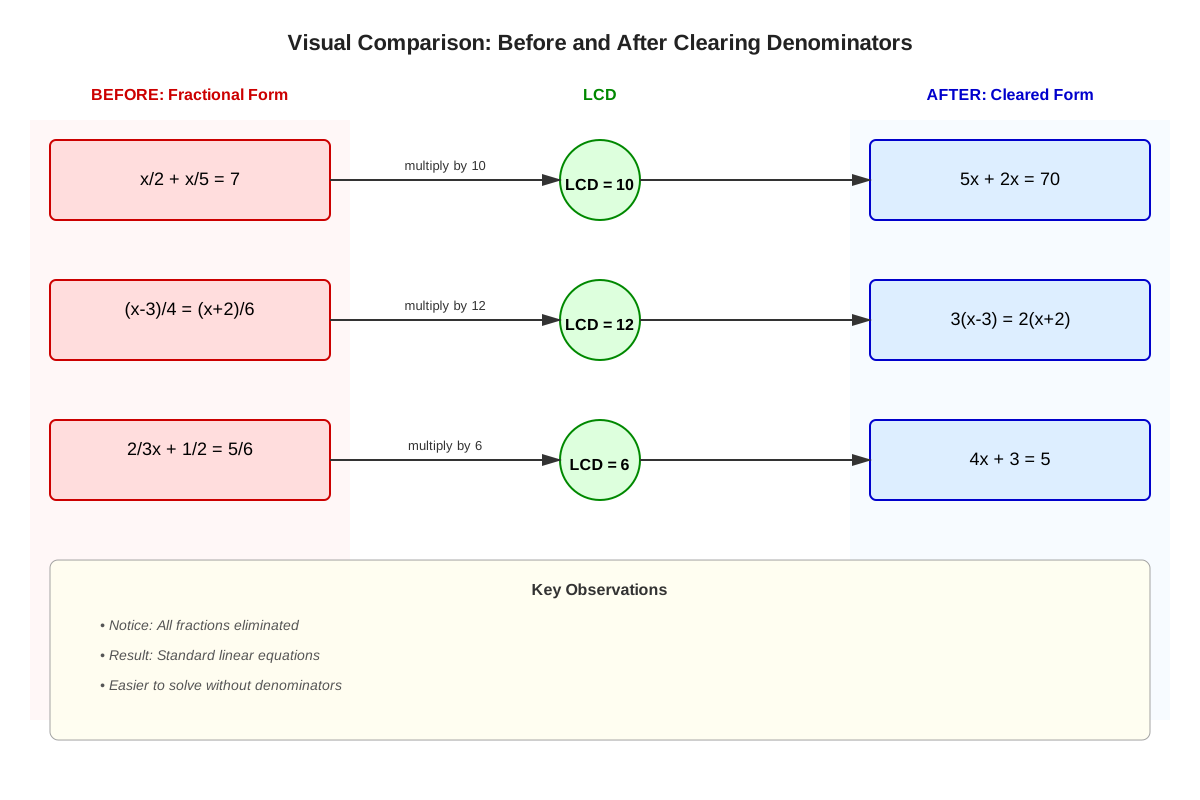
The core principle behind clearing denominators relies on the multiplication property of equality: multiplying both sides of an equation by the same non-zero value preserves the equality. When an equation contains fractions, multiplying every term by the least common denominator (LCD) of all fractions eliminates denominators simultaneously. This transformation converts a fractional equation into an equivalent equation without fractions, which is typically easier to solve.
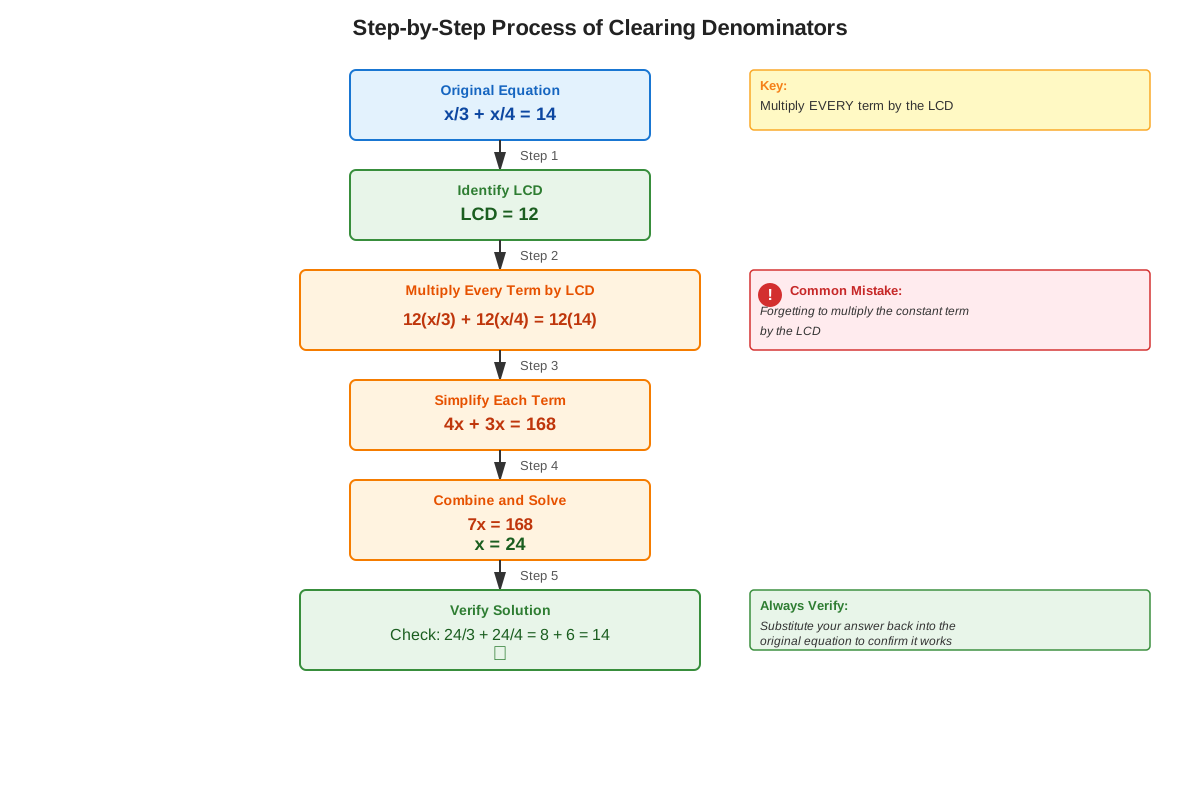
For example, consider the equation: (x/3) + (x/4) = 14
The denominators are 3 and 4, so the LCD is 12. Multiplying every term by 12:
12 · (x/3) + 12 · (x/4) = 12 · 144x + 3x = 1687x = 168x = 24
The key insight is that multiplying by the LCD causes each denominator to divide evenly into the LCD, leaving only whole number coefficients.
Identifying the Least Common Denominator
The least common denominator is the smallest positive integer that is divisible by all denominators in the equation. Finding the LCD efficiently requires understanding prime factorization and multiples. For simple denominators, the LCD can often be identified by inspection; for more complex cases, systematic methods are necessary.
Methods for finding the LCD:
- Listing multiples method: List multiples of the largest denominator until finding one divisible by all other denominators
- Prime factorization method: Express each denominator as a product of prime factors, then take the highest power of each prime that appears
- Product method: When denominators share no common factors, the LCD is simply their product
| Denominators | LCD | Method Used |
|---|---|---|
| 2, 3 | 6 | Product (no common factors) |
| 4, 6 | 12 | Prime factorization (2² × 3) |
| 5, 10, 15 | 30 | Listing multiples of 15 |
| 3, 9, 12 | 36 | Prime factorization (2² × 3²) |
Step-by-Step Process for Clearing Denominators
The systematic approach to clearing denominators ensures accuracy and completeness:
- Identify all denominators in the equation, including those in constants and variable terms
- Determine the LCD of all denominators using an appropriate method
- Multiply every term on both sides of the equation by the LCD (not just the fractional terms)
- Simplify each term by canceling the denominators with factors in the LCD
- Solve the resulting equation using standard algebraic techniques
- Check the solution by substituting back into the original equation
Critical consideration: Every term must be multiplied by the LCD, including whole numbers and constants. A common error is forgetting to multiply non-fractional terms, which violates the equality principle.
Handling Complex Fractional Equations
Some SAT problems present equations with multiple layers of complexity, including:
Equations with variables in denominators: While less common on the SAT, these require identifying restrictions (values that make denominators zero) before clearing denominators.
Equations with mixed numbers: Convert mixed numbers to improper fractions before identifying the LCD.
Equations with decimal coefficients: Convert decimals to fractions, then proceed with clearing denominators, or multiply by powers of 10 to eliminate decimals first.
Equations with parentheses: Apply the distributive property carefully when multiplying by the LCD, ensuring every term inside parentheses is multiplied.
Example with parentheses:
(x/2) + 3(x/5 - 2) = 7
Multiply every term by LCD = 10:
10 · (x/2) + 10 · 3(x/5 - 2) = 10 · 75x + 30(x/5 - 2) = 705x + 30(x/5) - 30(2) = 705x + 6x - 60 = 7011x = 130x = 130/11
When to Use Clearing Denominators
Not every equation with fractions requires clearing denominators. Strategic decision-making improves efficiency:
Best scenarios for clearing denominators:
- Multiple fractions with different denominators
- Fractions on both sides of the equation
- Complex fractional coefficients that would be cumbersome to work with directly
- When the LCD is a manageable number (not excessively large)
Alternative approaches may be better when:
- Only one fraction appears in the equation (isolate the fraction directly)
- Denominators are very large or complex
- The equation can be solved more quickly by cross-multiplication (for proportions)
- Fractions have the same denominator (combine directly)
Concept Relationships
The technique of clearing denominators builds directly upon foundational fraction operations and the multiplication property of equality. Understanding how to find the least common denominator (prerequisite knowledge) enables the identification of the appropriate multiplier. Once denominators are cleared, the problem reduces to solving basic linear equations (prerequisite skill), demonstrating how this technique serves as a bridge between fraction arithmetic and equation solving.
Within the topic itself, concepts flow logically: Identifying denominators → Finding the LCD → Multiplying all terms by the LCD → Simplifying the resulting equation → Solving for the variable → Verifying the solution. Each step depends on the previous one, and skipping or incorrectly executing any step compromises the entire solution.
Clearing denominators connects to broader SAT math topics including proportions (which can be solved by cross-multiplication, a special case of clearing denominators), rational expressions (where the technique extends to more complex algebraic fractions), and systems of equations (where one or both equations may contain fractions). The skill also supports work-rate problems, mixture problems, and distance-rate-time problems, all of which frequently generate fractional equations. Mastery of this topic enables progression to solving rational equations, working with complex fractions, and manipulating algebraic expressions efficiently—skills tested in higher-difficulty SAT questions and essential for success in advanced mathematics courses.
Quick check — test yourself on Clearing denominators so far.
Try Flashcards →High-Yield Facts
⭐ The LCD must be multiplied by every term in the equation, including whole numbers and constants, not just the fractional terms
⭐ The least common denominator is the smallest number divisible by all denominators in the equation
⭐ Clearing denominators transforms a fractional equation into an equivalent equation without fractions
⭐ After clearing denominators, always simplify before attempting to solve for the variable
⭐ Solutions should be verified by substituting back into the original equation to check for arithmetic errors
- When denominators share no common factors, the LCD is simply their product
- Multiplying both sides of an equation by the same non-zero value preserves equality
- Mixed numbers should be converted to improper fractions before clearing denominators
- If a variable appears in a denominator, identify restrictions (values that make the denominator zero) before solving
- Clearing denominators is most efficient when multiple fractions with different denominators appear in the equation
- The distributive property must be applied correctly when the LCD multiplies terms inside parentheses
- On the SAT, clearing denominators typically appears in 3-5 questions per test
- Decimal coefficients can be eliminated by multiplying by powers of 10 before or instead of clearing denominators
- Cross-multiplication is a special case of clearing denominators used specifically for proportions (equations with one fraction on each side)
- The technique works for equations with any number of fractions, though SAT questions typically involve 2-4 fractional terms
Common Misconceptions
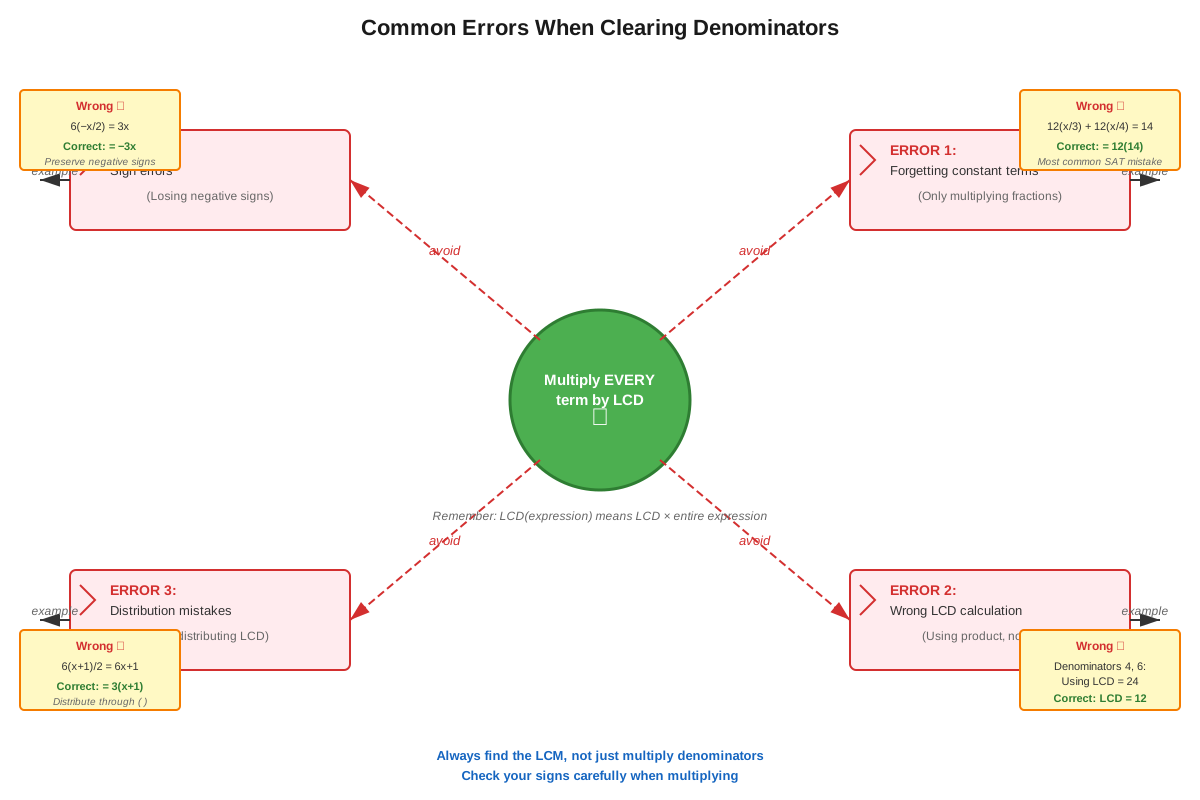
Misconception: Only the fractional terms need to be multiplied by the LCD, not the whole numbers or constants.
Correction: Every single term on both sides of the equation must be multiplied by the LCD to maintain equality. Failing to multiply all terms violates the multiplication property of equality and produces an incorrect equation.
Misconception: The LCD is always the product of all denominators.
Correction: The LCD is the smallest number divisible by all denominators, which is often less than their product when denominators share common factors. For example, with denominators 4 and 6, the LCD is 12, not 24.
Misconception: After multiplying by the LCD, the denominators simply disappear without any other changes to the terms.
Correction: When multiplying by the LCD, each denominator cancels with factors in the LCD, but the numerators remain and must be multiplied by the remaining factors. For example, multiplying (x/3) by 12 gives 4x, not just x.
Misconception: Clearing denominators changes the solution to the equation.
Correction: Clearing denominators produces an equivalent equation with the same solution as the original. The multiplication property of equality guarantees that if both sides are multiplied by the same non-zero value, the solution set remains unchanged.
Misconception: If one side of the equation has no fractions, nothing needs to be done to that side.
Correction: Both sides of the equation must be multiplied by the LCD, even if one side contains only whole numbers. This maintains the balance of the equation and is essential for preserving equality.
Misconception: The solution is complete once the variable is isolated; checking is unnecessary.
Correction: Verification by substituting the solution back into the original equation is crucial for catching arithmetic errors, especially when working with fractions. The SAT occasionally includes answer choices that result from common calculation mistakes.
Worked Examples
Example 1: Standard Fractional Equation
Problem: Solve for x: (x/4) + (x/6) = 15
Solution:
Step 1: Identify all denominators.
The denominators are 4 and 6.
Step 2: Find the LCD.
Multiples of 4: 4, 8, 12, 16, 20...
Multiples of 6: 6, 12, 18, 24...
The LCD is 12.
Step 3: Multiply every term by the LCD (12).
12 · (x/4) + 12 · (x/6) = 12 · 15Step 4: Simplify each term.
(12/4) · x + (12/6) · x = 180
3x + 2x = 180
Step 5: Solve the resulting equation.
5x = 180
x = 36
Step 6: Verify the solution.
Substitute x = 36 into the original equation:
(36/4) + (36/6) = 9 + 6 = 15 ✓Connection to learning objectives: This example demonstrates the complete process of clearing denominators, from identifying the LCD through verification, addressing the application objective.
Example 2: Equation with Parentheses and Multiple Fractions
Problem: Solve for y: (2y/3) - (y/5) = 4(y/15 + 1)
Solution:
Step 1: Identify all denominators.
The denominators are 3, 5, and 15.
Step 2: Find the LCD.
Since 15 is divisible by both 3 and 5, the LCD is 15.
Step 3: Multiply every term by the LCD (15), applying the distributive property.
15 · (2y/3) - 15 · (y/5) = 15 · 4(y/15 + 1)Step 4: Simplify each term carefully.
(15/3) · 2y - (15/5) · y = 60(y/15 + 1)
5 · 2y - 3y = 60 · (y/15) + 60 · 1
10y - 3y = 4y + 60
Step 5: Solve the resulting equation.
7y = 4y + 60
7y - 4y = 60
3y = 60
y = 20
Step 6: Verify the solution.
Substitute y = 20 into the original equation:
Left side: (2·20/3) - (20/5) = 40/3 - 4 = 40/3 - 12/3 = 28/3
Right side: 4(20/15 + 1) = 4(4/3 + 3/3) = 4(7/3) = 28/3 ✓
Connection to learning objectives: This example shows how clearing denominators handles more complex equations with parentheses and demonstrates the importance of applying the distributive property correctly, addressing both identification and application objectives.
Exam Strategy
Primary Strategy: When encountering an equation with two or more fractions with different denominators, immediately consider clearing denominators as your solution method. This approach is almost always faster and less error-prone than attempting to combine fractions or isolate terms individually.
Trigger words and phrases to watch for:
- "Solve for x" or "Find the value of..." followed by an equation with fractions
- "Which value of x satisfies the equation..." with fractional coefficients
- Word problems involving rates, proportions, or parts that translate to fractional equations
- "If (fraction) + (fraction) = (value), then x = ?"
Step-by-step approach for SAT questions:
- Scan the equation to count fractions and identify denominators (5 seconds)
- Decide on strategy: If 2+ fractions with different denominators, clear them; if only one fraction or same denominators, use alternative methods (5 seconds)
- Find the LCD quickly using the most efficient method for the given denominators (10-15 seconds)
- Execute the clearing process systematically, writing out each step to avoid errors (30-45 seconds)
- Solve the simplified equation using standard algebra (15-20 seconds)
- Quick verification: Substitute your answer into the original equation or check against answer choices (10-15 seconds)
Process-of-elimination tips:
- If answer choices are given, eliminate any that would create undefined expressions (denominators equal to zero)
- Plug in answer choices when the equation is complex; clearing denominators may not be necessary if testing answers is faster
- Eliminate answers that don't match the expected magnitude (if fractions are small and positive, the solution should reflect that)
- Watch for answer choices that represent common errors (forgetting to multiply all terms, incorrect LCD, arithmetic mistakes)
Time allocation advice:
- Budget 60-90 seconds for straightforward clearing denominators problems
- Allow up to 2 minutes for complex problems with parentheses or multiple steps
- If you're spending more than 2 minutes, mark the question and return to it later
- On no-calculator sections, choose denominators that clear easily; if the LCD is very large, reconsider your approach
Calculator Tip: Even on calculator-allowed sections, clearing denominators first often reduces the number of calculations needed and minimizes rounding errors from decimal conversions.
Memory Techniques
Mnemonic for the clearing denominators process - "I MUST Clear":
- Identify all denominators
- Multiply to find the LCD
- Use the LCD on every term
- Simplify the resulting equation
- Test your solution by substituting back
- Clear those fractions!
Visualization strategy: Picture fractions as obstacles on a path to the solution. The LCD is a "universal key" that unlocks all the obstacles simultaneously, clearing the path. Each denominator is a lock, and multiplying by the LCD turns all the locks at once.
Acronym for when to clear denominators - "MUD":
- Multiple fractions present
- Unlike denominators
- Different on both sides
If a problem has MUD, clear those denominators!
Memory aid for avoiding the most common error: "ALL terms get the LCD treatment" - emphasize the word ALL to remember that every single term, including whole numbers and constants, must be multiplied by the LCD.
Rhyme for LCD identification: "When denominators share no factor in sight, multiply them all—that's your LCD right!"
Summary
Clearing denominators is an essential algebraic technique that transforms equations containing fractions into simpler linear equations by multiplying every term by the least common denominator. This method leverages the multiplication property of equality to eliminate all denominators simultaneously, making equations easier to solve while preserving the solution. The process requires identifying all denominators, determining the LCD through methods such as listing multiples or prime factorization, multiplying every term (not just fractional ones) by the LCD, simplifying the resulting equation, and verifying the solution. On the SAT, this skill appears in approximately 3-5 questions per test, embedded in direct equation-solving problems, word problems, and multi-step scenarios. Success requires recognizing when clearing denominators is the most efficient strategy, executing the process systematically to avoid common errors like forgetting to multiply all terms, and verifying solutions to catch arithmetic mistakes. Mastery of clearing denominators not only improves performance on direct algebra questions but also enhances efficiency across various SAT math topics including proportions, rates, and mixture problems.
Key Takeaways
- Clearing denominators eliminates all fractions from an equation by multiplying every term by the least common denominator (LCD)
- The LCD must be applied to every single term in the equation, including whole numbers and constants, to maintain equality
- Finding the LCD efficiently requires understanding multiples and prime factorization; when denominators share no factors, the LCD is their product
- The systematic process—identify denominators, find LCD, multiply all terms, simplify, solve, verify—ensures accuracy and completeness
- On the SAT, clearing denominators is most efficient when equations contain multiple fractions with different denominators
- Common errors include forgetting to multiply all terms, using the wrong LCD, and failing to apply the distributive property correctly with parentheses
- Always verify solutions by substituting back into the original equation to catch calculation errors and ensure the answer makes sense
Related Topics
Solving Proportions and Cross-Multiplication: Cross-multiplication is a special case of clearing denominators used when an equation has exactly one fraction on each side. Mastering clearing denominators provides the foundation for understanding why cross-multiplication works and when to use it.
Rational Expressions and Complex Fractions: The technique of clearing denominators extends to more advanced problems involving algebraic fractions with polynomial numerators and denominators. This topic builds directly on the skills developed here.
Systems of Equations with Fractions: When solving systems where one or both equations contain fractions, clearing denominators simplifies the system before applying substitution or elimination methods.
Literal Equations: Solving equations for a specific variable when other variables are present often involves clearing denominators as an intermediate step, particularly in formulas involving rates, ratios, or proportions.
Word Problems Involving Rates and Work: Many SAT word problems translate into fractional equations. Mastering clearing denominators enables efficient solution of these real-world application problems.
Practice CTA
Now that you've mastered the concept of clearing denominators, it's time to solidify your understanding through practice! The techniques you've learned here will serve you well across numerous SAT math questions, saving you time and reducing errors. Challenge yourself with the practice questions designed specifically for this topic—they'll help you recognize when to clear denominators, execute the process flawlessly, and avoid common pitfalls. Use the flashcards to reinforce key facts and procedures until they become second nature. Remember, confidence comes from practice, and every problem you solve brings you closer to your target SAT score. You've got this!
Sign up free to keep reading
Create a free AnvayaPrep account to finish this SAT guide on Clearing denominators — plus flashcards and practice questions.