Overview
Equations with fractions represent one of the most frequently tested algebraic concepts on the SAT Math section. These problems require students to solve linear equations where one or more terms contain fractional coefficients or where the variable appears in a denominator. Mastering this skill is essential because fraction-based equations appear in approximately 15-20% of SAT algebra questions, often integrated into word problems, systems of equations, and real-world application scenarios.
The ability to manipulate and solve sat equations with fractions efficiently separates high-scoring students from those who struggle with time management. These problems test not only computational accuracy but also strategic thinking—knowing when to clear denominators by multiplying, when to work with fractions directly, and how to avoid common algebraic errors that lead to incorrect answers. The SAT deliberately designs these questions to reward students who can recognize patterns and apply systematic approaches rather than relying on trial-and-error methods.
Understanding equations with fractions builds directly upon foundational math skills including fraction operations, the distributive property, and inverse operations. This topic serves as a critical bridge between basic algebraic manipulation and more complex concepts like rational expressions, proportional relationships, and systems of equations. Students who develop fluency with fractional equations gain confidence across multiple SAT Math domains, as these skills transfer to geometry problems involving ratios, data analysis questions with rates, and advanced algebra scenarios involving polynomial division.
Learning Objectives
- [ ] Identify key features of equations with fractions, including fractional coefficients and variables in denominators
- [ ] Explain how equations with fractions appears on the SAT, including question formats and common contexts
- [ ] Apply equations with fractions to answer SAT-style questions with accuracy and efficiency
- [ ] Determine the most efficient method for solving a given fractional equation (clearing denominators vs. direct manipulation)
- [ ] Recognize and avoid common algebraic errors when working with fractional equations
- [ ] Verify solutions by substitution and identify extraneous solutions when variables appear in denominators
Prerequisites
- Fraction operations (addition, subtraction, multiplication, division): Essential for combining like terms and performing operations on both sides of equations
- Finding least common multiples (LCM): Required to determine the appropriate multiplier when clearing denominators
- Basic equation-solving techniques: Understanding inverse operations and maintaining equation balance forms the foundation for all algebraic manipulation
- The distributive property: Necessary for correctly multiplying through equations and expanding expressions containing fractions
- Order of operations: Critical for evaluating expressions and performing multi-step solutions in the correct sequence
Why This Topic Matters
Equations with fractions appear throughout real-world applications, from calculating medication dosages based on body weight to determining cooking recipe adjustments, splitting costs among groups, and analyzing rates of work or travel. Engineers use fractional equations to model resistance in electrical circuits, while economists apply them to marginal cost analysis and resource allocation problems. The SAT recognizes this practical importance by embedding fractional equations in contexts that mirror authentic problem-solving scenarios.
On the SAT Math section, equations with fractions appear in approximately 3-5 questions per test, distributed across both the calculator and no-calculator portions. These questions typically manifest in three primary formats: pure algebraic equations requiring direct solution, word problems that translate to fractional equations, and multi-step problems where solving a fractional equation represents one component of a larger solution pathway. The College Board frequently combines fractional equations with other concepts like systems of equations, linear functions, or data interpretation to assess integrated mathematical reasoning.
Common SAT presentations include rate problems (distance/time relationships), work problems (combined rates of completion), mixture problems (concentrations and proportions), and geometric relationships involving ratios. Questions may ask students to solve for a specific variable, identify the value of an expression containing the variable, or determine which equation correctly models a described situation. The test writers deliberately include answer choices that represent common errors—such as forgetting to distribute a multiplier or incorrectly combining fractions—making strategic problem-solving and verification essential skills.
Core Concepts
Understanding Fractional Coefficients
Fractional coefficients are constants expressed as fractions that multiply variables in an equation. For example, in the equation (2/3)x + 5 = 11, the coefficient 2/3 multiplies the variable x. These coefficients function identically to whole number coefficients but require careful attention to fraction arithmetic when isolating variables.
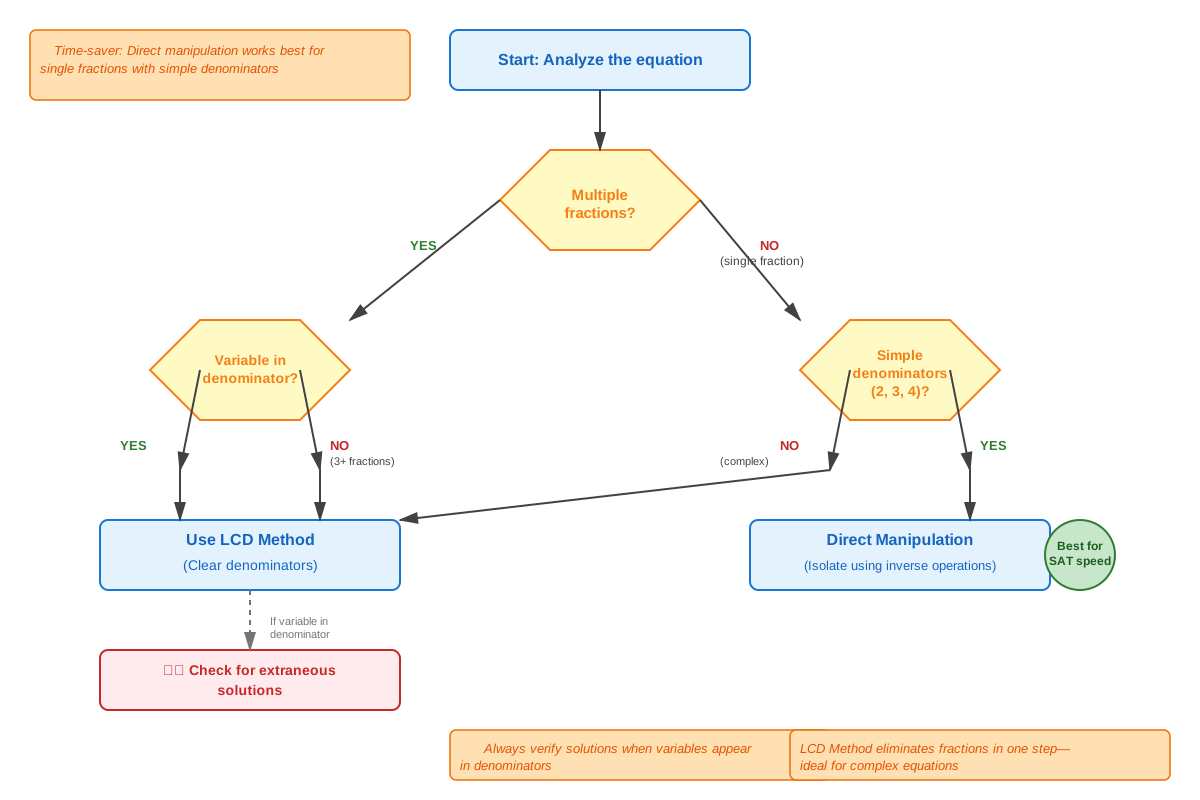
When solving equations with fractional coefficients, students have two primary strategic approaches:
- Working directly with fractions: Perform operations while maintaining fractional form
- Clearing denominators: Multiply all terms by the least common denominator (LCD) to eliminate fractions
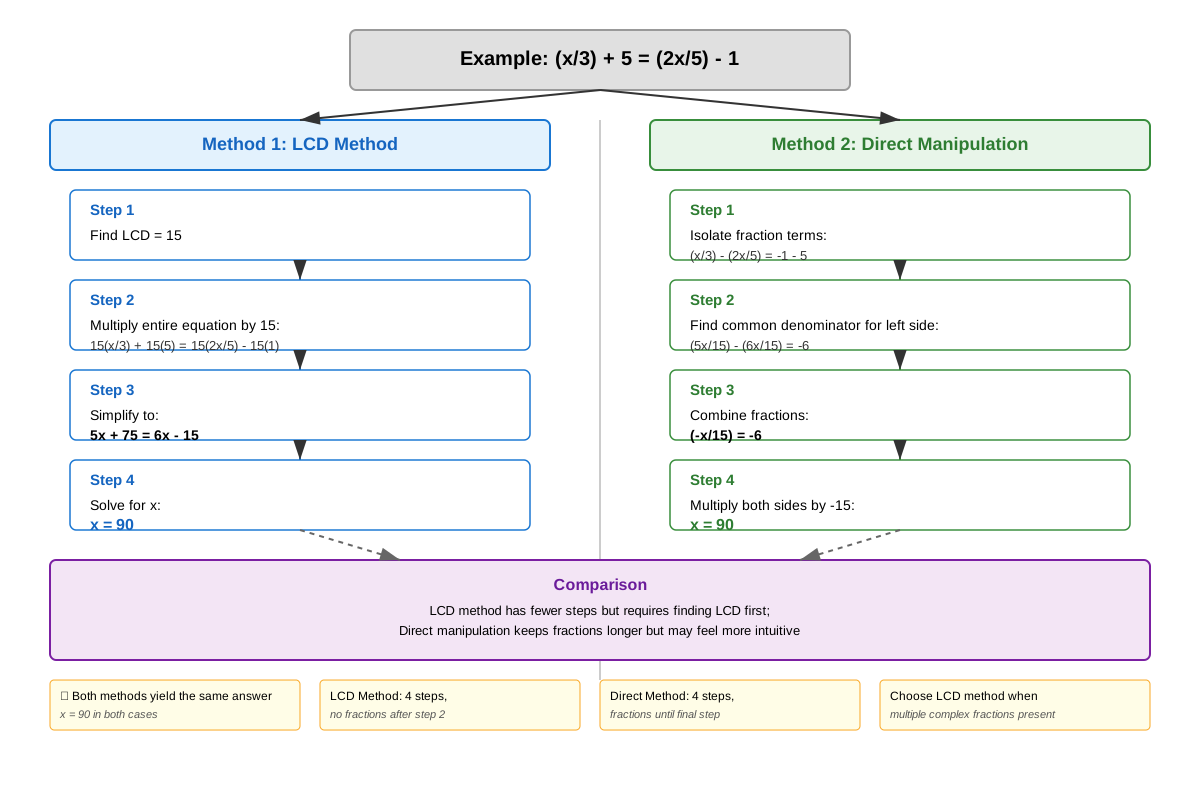
The choice between these methods depends on the equation's complexity and personal preference, though clearing denominators often reduces computational errors on multi-step problems.
The Denominator-Clearing Method
The denominator-clearing method involves multiplying every term in an equation by the LCD of all denominators present. This technique transforms a fractional equation into an equivalent equation with integer coefficients, simplifying subsequent algebraic manipulation.
Step-by-step process:
- Identify all denominators in the equation
- Determine the LCD of these denominators
- Multiply every term (both sides of the equation) by the LCD
- Simplify the resulting equation
- Solve using standard algebraic techniques
- Verify the solution in the original equation
For example, consider the equation: x/4 + x/6 = 5
The denominators are 4 and 6, with LCD = 12. Multiplying every term by 12:
12(x/4) + 12(x/6) = 12(5)
3x + 2x = 60
5x = 60
x = 12
Equations with Variables in Denominators
When variables appear in denominators, the equation becomes a rational equation. These require special attention because certain values may create undefined expressions (division by zero). The solution process remains similar to other fractional equations, but verification becomes critical to identify extraneous solutions—values that emerge algebraically but don't satisfy the original equation.
Critical considerations:
- Identify restricted values (values that make any denominator zero) before solving
- After finding algebraic solutions, check each against restricted values
- Reject any solution that equals a restricted value
- Always substitute final answers into the original equation to verify validity
Example: 3/(x-2) = 5/x
Restricted values: x ≠ 0, x ≠ 2 (these would create division by zero)
Complex Fractional Equations
Complex fractional equations contain multiple fractional terms, nested fractions, or combinations of fractional and whole number terms. These problems test organizational skills and systematic thinking.
| Equation Type | Example | Best Strategy |
|---|---|---|
| Multiple simple fractions | x/3 + x/5 = 8 | Clear denominators using LCD |
| Fractions on both sides | (x+1)/4 = (x-3)/6 | Cross-multiply or clear denominators |
| Mixed terms | 2x + x/3 = 10 | Clear denominators or isolate fractional term |
| Nested fractions | (x/2)/3 = 4 | Simplify from innermost fraction outward |
Cross-Multiplication Technique
When an equation has the form a/b = c/d, the cross-multiplication technique provides an efficient shortcut. This method states that if two fractions are equal, then the product of the numerator of the first fraction and the denominator of the second equals the product of the denominator of the first and the numerator of the second: ad = bc.
This technique works because it's equivalent to multiplying both sides by both denominators simultaneously. Cross-multiplication proves particularly efficient on SAT questions with proportion-based structures or when comparing two fractional expressions.
Distributing Across Fractions
When a fractional coefficient multiplies a binomial or polynomial expression, the distributive property requires multiplying the fraction by each term inside the parentheses. This operation frequently appears in SAT equations and represents a common error source.
Correct distribution: (2/3)(x + 6) = (2/3)x + (2/3)(6) = (2/3)x + 4
The SAT often includes incorrect answer choices that reflect incomplete distribution, such as (2/3)x + 6, testing whether students properly apply the distributive property to fractional coefficients.
Concept Relationships
The core concepts within equations with fractions build upon each other in a logical progression. Understanding fractional coefficients provides the foundation for recognizing when the denominator-clearing method offers advantages over direct manipulation. This method, in turn, prepares students for equations with variables in denominators, where the same multiplication technique applies but with added complexity of identifying restricted values.
Complex fractional equations integrate all previous concepts, requiring students to choose appropriate strategies based on equation structure. Cross-multiplication emerges as a specialized application of denominator-clearing for proportion-type equations, while distributing across fractions represents a critical skill that applies across all fractional equation types.
Relationship map:
Basic fraction operations → Fractional coefficients → Denominator-clearing method → Variables in denominators → Complex fractional equations
This topic connects to prerequisite knowledge of fraction arithmetic and LCM calculation, which provide the computational tools necessary for all fractional equation work. Looking forward, mastery of equations with fractions enables progression to rational expressions, inverse variation, and systems of equations involving fractions—all topics that appear on the SAT Math section.
The relationship between equations with fractions and linear functions becomes apparent when students recognize that solving (2/3)x + 4 = 10 is equivalent to finding the x-intercept of y = (2/3)x + 4 - 10. This connection reinforces the broader understanding of equations as representations of relationships between quantities.
Quick check — test yourself on Equations with fractions so far.
Try Flashcards →High-Yield Facts
⭐ The LCD method eliminates all fractions in one step, reducing arithmetic errors on complex problems
⭐ When variables appear in denominators, always identify restricted values before solving
⭐ Cross-multiplication works only when the equation has exactly one fraction on each side of the equals sign
⭐ Multiplying or dividing both sides of an equation by the same non-zero number maintains equality
⭐ Extraneous solutions can only occur when variables appear in denominators, not with fractional coefficients
- Distributing a fractional coefficient requires multiplying the fraction by every term inside parentheses
- The LCD of denominators a and b equals their product (ab) when a and b share no common factors
- Clearing denominators transforms rational equations into linear or polynomial equations
- Verification by substitution catches both arithmetic errors and extraneous solutions
- Fractional equations with no solution occur when algebraic manipulation leads to a false statement like 0 = 5
Common Misconceptions
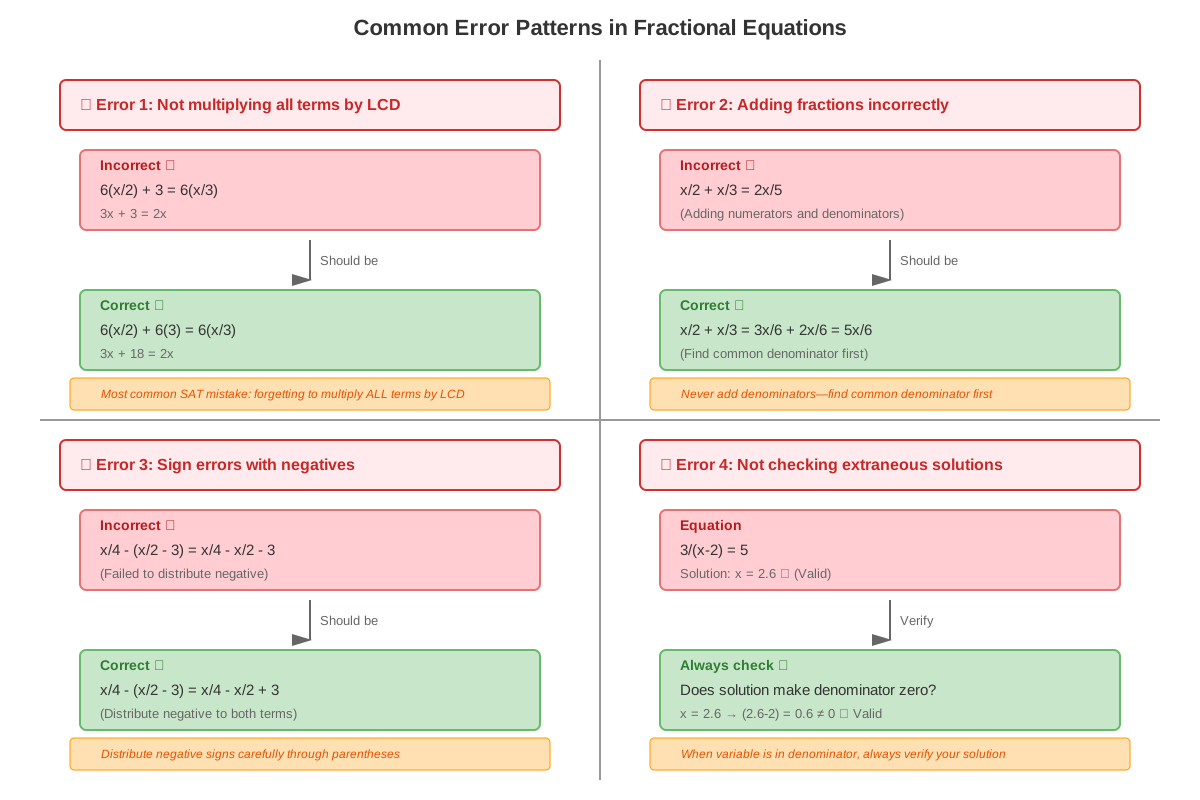
Misconception: When solving x/3 + 2 = 5, multiply only the fractional term by 3 to get x + 2 = 5
Correction: When clearing denominators, multiply every term in the equation by the LCD, including constants: 3(x/3) + 3(2) = 3(5) gives x + 6 = 15, so x = 9
Misconception: The equation (2/3)(x + 6) = 10 simplifies to (2/3)x + 6 = 10
Correction: The distributive property requires multiplying the fraction by both terms: (2/3)(x + 6) = (2/3)x + 4 = 10
Misconception: Cross-multiplication can be used on any equation containing fractions
Correction: Cross-multiplication applies only when the equation has the form a/b = c/d (single fraction on each side). For equations like x/3 + x/5 = 8, use the LCD method instead
Misconception: After finding x = 2 as a solution, the work is complete
Correction: Always verify solutions by substituting back into the original equation, especially when variables appear in denominators, as algebraically correct solutions may be extraneous
Misconception: The LCD of 4, 6, and 8 is 4 × 6 × 8 = 192
Correction: The LCD is the smallest number divisible by all denominators. For 4, 6, and 8, the LCD is 24, not their product. Finding the LCD requires identifying the least common multiple, not simply multiplying all denominators
Misconception: Equations with fractions are always harder than equations with whole numbers
Correction: After clearing denominators, fractional equations become standard linear equations. The initial presence of fractions doesn't determine difficulty—the complexity of the resulting equation does
Worked Examples
Example 1: Multi-Step Equation with Fractional Coefficients
Problem: Solve for x: (3/4)x - 2 = (1/2)x + 5
Solution:
Step 1: Identify the LCD of denominators 4 and 2, which is 4.
Step 2: Multiply every term by 4 to clear denominators:
4[(3/4)x] - 4(2) = 4[(1/2)x] + 4(5)
3x - 8 = 2x + 20
Step 3: Collect variable terms on one side by subtracting 2x from both sides:
3x - 2x - 8 = 20
x - 8 = 20
Step 4: Isolate x by adding 8 to both sides:
x = 28Step 5: Verify by substituting x = 28 into the original equation:
Left side: (3/4)(28) - 2 = 21 - 2 = 19
Right side: (1/2)(28) + 5 = 14 + 5 = 19 ✓
Connection to learning objectives: This example demonstrates the denominator-clearing method and shows how to systematically solve equations with fractional coefficients, addressing the application objective.
Example 2: Equation with Variable in Denominator
Problem: Solve for x: 5/(x-1) = 3/(x+2)
Solution:
Step 1: Identify restricted values where denominators equal zero:
- x - 1 = 0 → x ≠ 1
- x + 2 = 0 → x ≠ -2
Step 2: Since the equation has one fraction on each side, use cross-multiplication:
5(x + 2) = 3(x - 1)Step 3: Apply the distributive property:
5x + 10 = 3x - 3Step 4: Collect variable terms:
5x - 3x = -3 - 10
2x = -13
x = -13/2 or -6.5
Step 5: Check against restricted values: x = -6.5 is neither 1 nor -2, so it's valid.
Step 6: Verify by substitution:
Left side: 5/(-6.5-1) = 5/(-7.5) = -2/3
Right side: 3/(-6.5+2) = 3/(-4.5) = -2/3 ✓
Connection to learning objectives: This example illustrates identifying restricted values, applying cross-multiplication, and verifying solutions—critical skills for avoiding extraneous solutions on SAT questions.
Exam Strategy
When approaching SAT questions involving equations with fractions, begin by quickly scanning the equation structure to determine the most efficient solution method. If the equation contains only fractional coefficients (no variables in denominators), the denominator-clearing method typically provides the fastest path. For equations with one fraction on each side, consider cross-multiplication as a time-saving shortcut.
Trigger words and phrases to recognize:
- "Solve for x" or "What is the value of x?" → Direct solution required
- "Which equation represents..." → Translation problem requiring equation setup
- "If the equation has no solution..." → Look for contradictions or restricted values
- "What is the value of 2x + 3?" → Solve for x first, then evaluate the expression
Process-of-elimination strategies:
- Eliminate answer choices that would make any denominator zero
- For multiple-choice questions, substitute answer choices into the original equation when algebraic solution seems complex
- Recognize that incorrect answers often represent common errors: forgetting to distribute, arithmetic mistakes when clearing denominators, or solutions that are extraneous
- If two answer choices differ only in sign, double-check arithmetic carefully
Time allocation advice:
Budget approximately 1-2 minutes for straightforward fractional equations and up to 3 minutes for complex multi-step problems. If an algebraic approach isn't immediately clear within 30 seconds, consider the substitution method with answer choices. On no-calculator section questions, the test writers design problems to have "nice" numbers after clearing denominators, so if calculations become unwieldy, review your setup for errors.
SAT Tip: The College Board frequently places the correct answer in position C or D for fractional equation problems, with positions A and B containing common error results. Don't assume your first answer is wrong, but do verify if you selected A or B.
Memory Techniques
LCD Mnemonic: "Locate Common Denominators" reminds students of the three-step process: Locate all denominators, find the Common multiple, then Distribute the multiplication.
CLEAR Method for solving fractional equations:
- Check for variables in denominators (identify restrictions)
- Locate the LCD of all denominators
- Eliminate fractions by multiplying through
- Apply standard solving techniques
- Review solution by substitution
Visualization strategy: Picture an equation as a balanced scale. When clearing denominators, imagine multiplying the weight on both sides of the scale by the same amount—the scale remains balanced. This mental image reinforces why multiplying both sides by the LCD maintains equality.
Cross-multiplication acronym: "OPEN" - Opposite terms Products are Equal in Numerator-denominator pairs. In a/b = c/d, the opposite pairs (a with d, and c with b) multiply to equal products: ad = bc.
Restricted values reminder: "ZERO HERO" - ZERO in a denominator makes the expression undefined, so identify these values and be a HERO by checking your solution against them.
Summary
Equations with fractions represent a high-yield SAT Math topic that tests algebraic manipulation, strategic thinking, and computational accuracy. The fundamental approach involves either working directly with fractions or clearing denominators by multiplying all terms by the LCD—a technique that transforms fractional equations into standard linear equations. When variables appear in denominators, students must identify restricted values before solving and verify solutions to eliminate extraneous results. Cross-multiplication provides an efficient shortcut for proportion-type equations with one fraction on each side. Success requires mastery of the distributive property when fractional coefficients multiply expressions, careful attention to arithmetic when combining fractions, and systematic verification of solutions. The SAT tests these skills through direct algebraic problems, word problems requiring equation setup, and multi-step scenarios where fractional equations represent one component of a larger solution. Students who develop fluency with multiple solution strategies and maintain organized work can efficiently handle these problems within the time constraints of the exam.
Key Takeaways
- Clearing denominators by multiplying all terms by the LCD eliminates fractions and reduces arithmetic errors
- Cross-multiplication works only for equations with exactly one fraction on each side:
a/b = c/dbecomesad = bc - Variables in denominators require identifying restricted values and checking for extraneous solutions
- The distributive property must be applied to every term when a fractional coefficient multiplies an expression
- Verification by substitution catches both computational errors and extraneous solutions
- Strategic method selection (clearing denominators vs. direct manipulation vs. cross-multiplication) improves efficiency
- SAT answer choices often include common error results, making verification essential for high scores
Related Topics
Rational Expressions: Building on equations with fractions, rational expressions involve more complex algebraic fractions that require factoring, simplification, and operations. Mastering fractional equations provides the foundation for manipulating these advanced expressions.
Systems of Equations with Fractions: Many SAT problems combine fractional equations with systems of two or more equations. The techniques learned here apply directly to solving these systems using substitution or elimination methods.
Proportional Relationships and Ratios: Fractional equations frequently model proportional relationships. Understanding how to solve these equations enables analysis of direct and inverse variation problems.
Linear Functions with Fractional Slopes: The connection between solving (2/3)x + 4 = 10 and analyzing the function f(x) = (2/3)x + 4 reinforces the relationship between equations and functions.
Rate Problems: Work rates, speed-distance-time relationships, and combined rate problems all translate to fractional equations, making this topic essential for word problem success.
Practice CTA
Now that you've mastered the core concepts, strategies, and common pitfalls of equations with fractions, it's time to solidify your understanding through active practice. Work through the practice questions to apply these techniques under test-like conditions, and use the flashcards to reinforce key facts and procedures. Remember that proficiency with fractional equations doesn't just help with direct algebra questions—it enhances your ability to tackle word problems, systems of equations, and function analysis across the entire SAT Math section. Each practice problem you solve builds the pattern recognition and computational fluency that translates directly to points on test day. You've got this!
Sign up free to keep reading
Create a free AnvayaPrep account to finish this SAT guide on Equations with fractions — plus flashcards and practice questions.