Overview
Equations with decimals represent a critical subset of linear equations that frequently appear on the SAT math section. These equations require students to manipulate and solve for unknown variables when coefficients, constants, or both contain decimal values. While the underlying algebraic principles remain identical to those used with whole numbers, the presence of decimals introduces additional computational complexity and opportunities for careless errors that can cost valuable points on test day.
Mastering sat equations with decimals is essential because the College Board regularly incorporates decimal values into both calculator and no-calculator sections to test numerical fluency alongside algebraic reasoning. Students who can confidently handle decimal coefficients demonstrate mathematical maturity and computational accuracy—two qualities that distinguish high scorers. These equations often appear in real-world contexts involving money, measurements, percentages converted to decimals, and scientific data, making them particularly relevant for both the exam and practical applications.
Within the broader landscape of linear equations in one variable, equations with decimals serve as a bridge between basic integer-based algebra and more complex rational expressions. They reinforce fundamental equation-solving techniques while requiring enhanced attention to decimal place values, rounding considerations, and strategic decision-making about when to eliminate decimals through multiplication. Students who master this topic build confidence that transfers to more advanced algebraic manipulations and strengthens their overall mathematical problem-solving toolkit.
Learning Objectives
- [ ] Identify key features of equations with decimals
- [ ] Explain how equations with decimals appears on the SAT
- [ ] Apply equations with decimals to answer SAT-style questions
- [ ] Convert equations with decimals to equivalent equations with integers through strategic multiplication
- [ ] Recognize when to maintain decimal form versus converting to fractions or integers
- [ ] Execute multi-step solutions involving decimal coefficients with precision and accuracy
- [ ] Verify solutions by substitution and identify common computational errors
Prerequisites
- Basic decimal operations: Addition, subtraction, multiplication, and division with decimal numbers form the computational foundation for manipulating these equations
- One-step and two-step linear equations: Understanding isolation of variables and inverse operations provides the structural framework for solving more complex decimal equations
- Order of operations: Proper sequencing of mathematical operations ensures accurate simplification when multiple decimal terms appear
- Place value understanding: Recognizing the value of digits in decimal positions prevents errors when multiplying or dividing to eliminate decimals
- Distributive property: Applying distribution correctly with decimal coefficients is essential for equations involving parentheses
Why This Topic Matters
Equations with decimals appear in approximately 8-12% of SAT math questions, making them a high-frequency topic that directly impacts scores. The College Board strategically includes decimal coefficients to assess both algebraic competency and numerical precision—two skills that correlate strongly with college readiness. Students who struggle with decimal equations often lose points not due to conceptual misunderstanding but through computational errors, making this topic particularly high-yield for score improvement.
In real-world applications, decimal equations model countless practical scenarios: calculating sales tax and discounts, determining medication dosages based on body weight, analyzing financial investments with interest rates, converting between measurement systems, and interpreting scientific data. The SAT frequently embeds decimal equations within word problems involving these contexts, requiring students to both construct and solve equations from verbal descriptions.
On the exam, decimal equations typically appear in three formats: straightforward algebraic equations requiring solution for a variable, word problems that must be translated into decimal equations, and systems of equations where at least one equation contains decimals. They may appear in both multiple-choice and student-produced response (grid-in) questions, with grid-in questions particularly testing computational accuracy since partial credit is not available. The no-calculator section occasionally includes decimal equations with values specifically chosen to allow mental math or strategic simplification, testing mathematical reasoning beyond mere computation.
Core Concepts
Understanding Decimal Coefficients and Constants
Decimal coefficients are the numerical multipliers of variables that contain decimal points, such as the 0.5 in 0.5x or the 2.75 in 2.75y. Constants are standalone decimal values without variables, like 3.6 or 0.08. In the equation 0.4x + 2.5 = 6.1, the coefficient 0.4 multiplies the variable x, while 2.5 and 6.1 are constants. Understanding the role of each component is crucial for applying inverse operations correctly.
When solving equations with decimal coefficients, the same algebraic principles apply as with integer coefficients: isolate the variable through inverse operations while maintaining equation balance. The key difference lies in the arithmetic—multiplying or dividing by decimals requires careful attention to decimal point placement. For example, to solve 0.6x = 12, divide both sides by 0.6, yielding x = 20. The division 12 ÷ 0.6 can be computed directly or by recognizing that dividing by 0.6 is equivalent to multiplying by 10/6 or 5/3.
The Multiplication Strategy for Eliminating Decimals
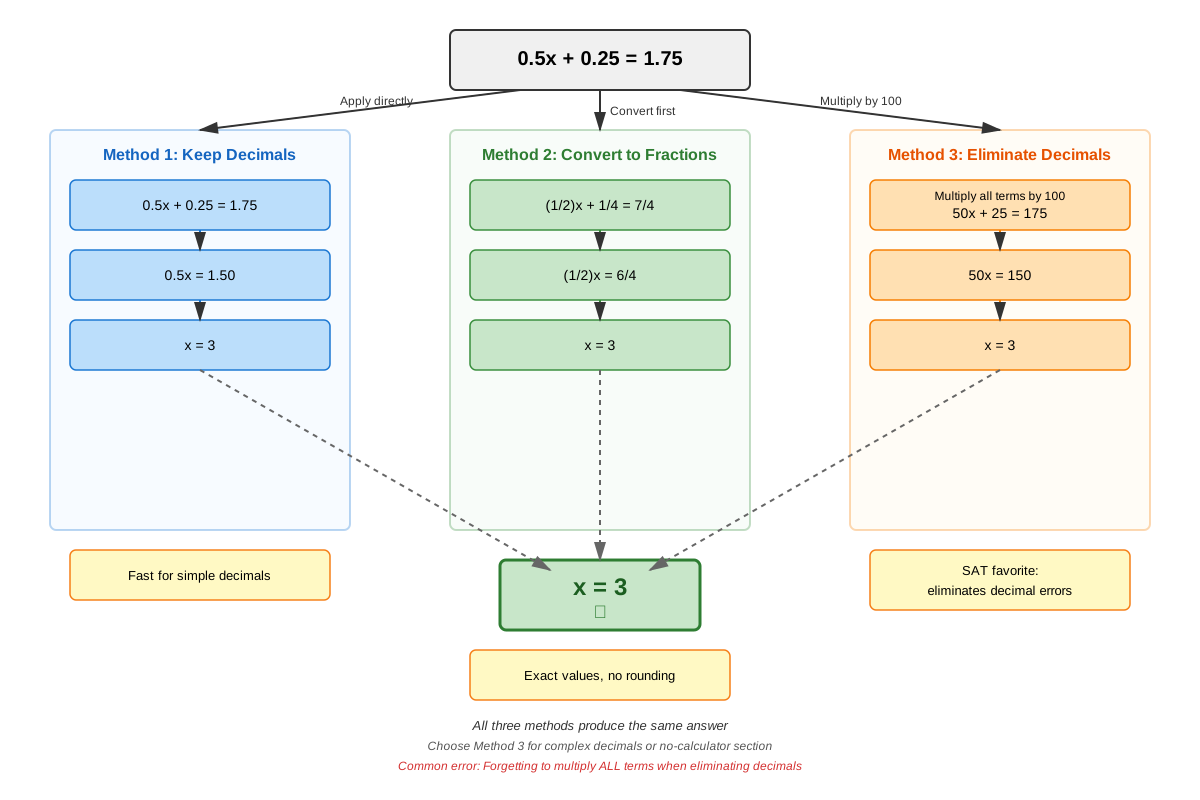
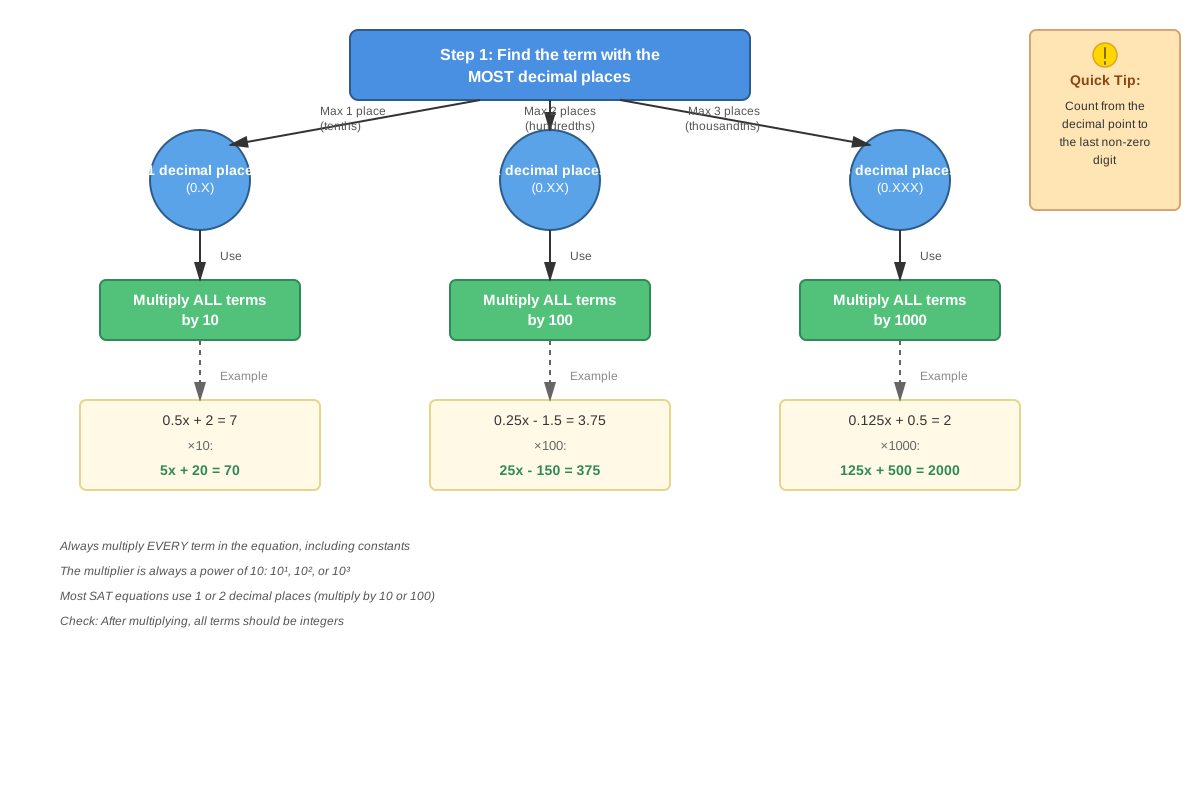
One of the most powerful techniques for handling equations with decimals involves multiplying every term by an appropriate power of 10 to convert all decimals to integers. This strategy reduces computational complexity and minimizes errors. The key is identifying the decimal with the most places after the decimal point, then multiplying by 10, 100, 1000, or whatever power eliminates all decimal points.
Consider the equation 0.3x + 0.45 = 1.2. The decimal 0.45 has two places after the decimal point (the maximum in this equation), so multiply every term by 100:
100(0.3x) + 100(0.45) = 100(1.2)
30x + 45 = 120
Now the equation contains only integers, making subsequent steps more straightforward. This technique is particularly valuable on the no-calculator section where mental math becomes essential.
Step-by-Step Solution Process
The systematic approach to solving decimal equations follows this sequence:
- Simplify both sides: Combine like terms and apply the distributive property if parentheses are present
- Decide on strategy: Determine whether to work with decimals directly or eliminate them through multiplication
- Isolate the variable term: Use addition or subtraction to move constant terms to one side
- Solve for the variable: Use multiplication or division to isolate the variable completely
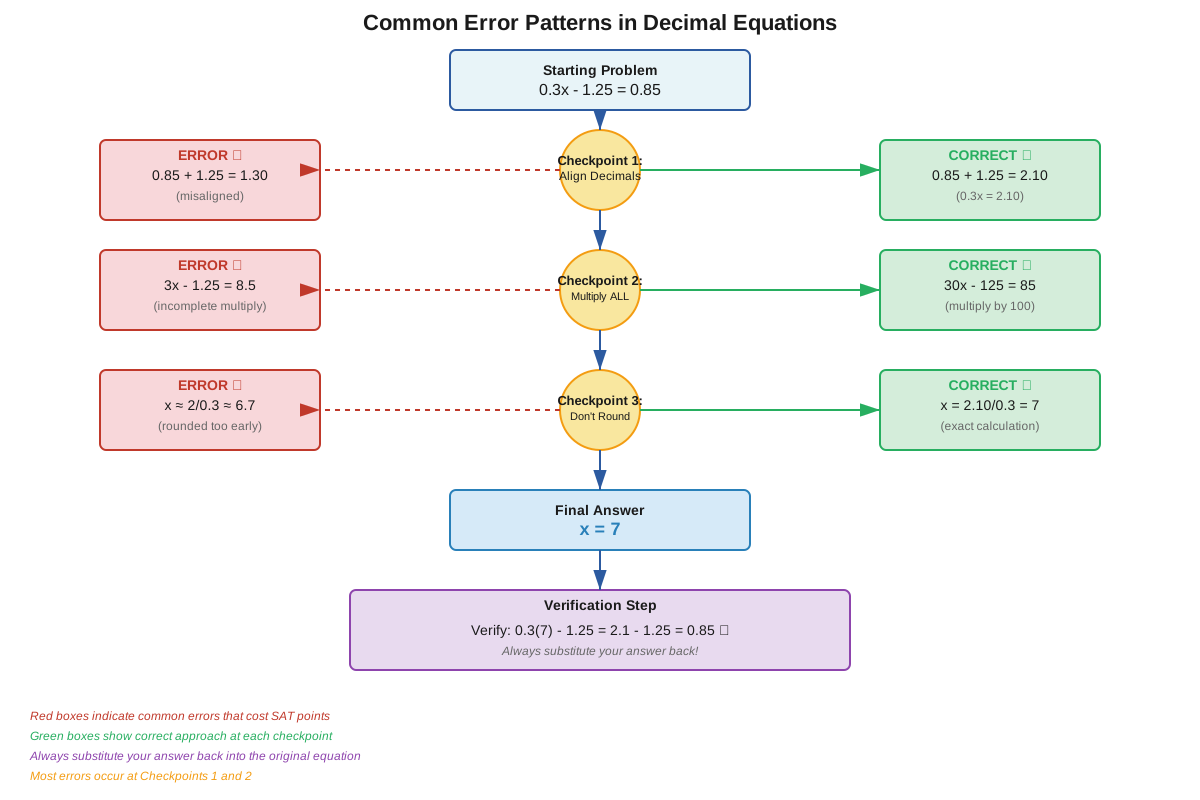
- Verify the solution: Substitute the answer back into the original equation to confirm accuracy
For example, solving 1.5x - 0.8 = 2.2:
1.5x - 0.8 = 2.2
1.5x = 2.2 + 0.8    (add 0.8 to both sides)
1.5x = 3.0          (simplify)
x = 3.0 ÷ 1.5       (divide both sides by 1.5)
x = 2               (solution)
Verification: 1.5(2) - 0.8 = 3.0 - 0.8 = 2.2 ✓
Equations with Decimal Fractions
Some SAT questions present decimals that represent common fractions: 0.5 = 1/2, 0.25 = 1/4, 0.75 = 3/4, 0.2 = 1/5, 0.125 = 1/8. Recognizing these equivalencies allows for strategic conversion that may simplify calculations. The equation 0.25x + 3 = 7 can be rewritten as (1/4)x + 3 = 7, which some students find more intuitive.
However, converting between decimals and fractions mid-solution can introduce errors if not done carefully. The SAT rewards consistency—choose one representation and maintain it throughout the problem unless a clear advantage exists for switching. On calculator-permitted sections, working directly with decimals is often most efficient.
Multi-Step Equations with Decimals
Complex decimal equations may involve the distributive property, variables on both sides, or nested operations. Consider: 0.4(x + 5) = 0.6x - 1.2
0.4x + 2 = 0.6x - 1.2           (distribute 0.4)
0.4x + 2 - 0.6x = -1.2          (subtract 0.6x from both sides)
-0.2x + 2 = -1.2                (combine like terms)
-0.2x = -3.2                    (subtract 2 from both sides)
x = -3.2 ÷ (-0.2)               (divide by -0.2)
x = 16                          (solution)
Alternatively, multiply the original equation by 10 to eliminate decimals:
4(x + 5) = 6x - 12
4x + 20 = 6x - 12
20 + 12 = 6x - 4x
32 = 2x
x = 16
Both methods yield the same answer, but the second approach reduces the risk of decimal arithmetic errors.
Decimal Equations in Word Problems
The SAT frequently embeds decimal equations within real-world contexts. Key phrases signal the need to construct equations:
| Phrase | Mathematical Operation |
|---|---|
| "costs $0.75 per item" | 0.75x (multiplication) |
| "decreased by 0.3" | - 0.3 (subtraction) |
| "2.5 times as much" | 2.5x (multiplication) |
| "increased by 15%" | + 0.15x (percentage as decimal) |
| "0.08 of the total" | 0.08x (decimal multiplication) |
For example: "A gym charges a $25.50 monthly fee plus $0.75 for each class attended. If Maria's total bill was $40.50, how many classes did she attend?"
Equation: 25.50 + 0.75c = 40.50, where c represents classes attended.
Concept Relationships
The core concepts within equations with decimals build upon each other in a logical progression. Understanding decimal coefficients and constants forms the foundation, enabling recognition of equation structure. This understanding leads directly to the multiplication strategy for eliminating decimals, which provides an alternative solution pathway. Both concepts feed into the step-by-step solution process, which serves as the universal framework for approaching any decimal equation.
Multi-step equations with decimals represent an integration of the solution process with more complex algebraic structures, requiring mastery of the distributive property and combining like terms. Decimal equations in word problems synthesize all previous concepts with translation skills, demanding both equation construction and solution execution.
These concepts connect to prerequisite knowledge of basic linear equations by adding the layer of decimal arithmetic. They also relate forward to systems of equations (where decimal coefficients may appear in multiple equations simultaneously), literal equations (solving for one variable in terms of others when decimals are present), and quadratic equations (where decimal coefficients increase computational complexity significantly).
The relationship map: Decimal Recognition → Strategic Choice (eliminate or maintain decimals) → Systematic Solution Process → Verification → Application to Complex Problems
Quick check — test yourself on Equations with decimals so far.
Try Flashcards →High-Yield Facts
⭐ Multiplying every term by the same power of 10 maintains equation balance and eliminates decimals without changing the solution
⭐ The most common SAT decimal coefficients are 0.5, 0.25, 0.75, 0.2, 0.1, and their multiples
⭐ When dividing by a decimal, the result is larger than the dividend if the divisor is less than 1
⭐ Decimal equations appear in approximately 8-12% of SAT math questions across both calculator and no-calculator sections
⭐ Verification by substitution catches approximately 90% of computational errors before submitting answers
- Converting 0.5 to 1/2, 0.25 to 1/4, and 0.75 to 3/4 can simplify mental calculations on no-calculator sections
- Decimal coefficients less than 1 indicate fractional relationships, while those greater than 1 indicate multiplicative relationships
- The SAT never requires rounding in the middle of a problem—if rounding seems necessary, an error has occurred
- Grid-in questions with decimal answers accept equivalent forms (2.5 = 5/2) but require careful bubbling
- Negative decimal coefficients require extra attention to sign changes during multiplication and division
- Calculator errors with decimals often stem from incorrect parentheses placement or order of operations
- Word problems involving money, percentages, and measurements most frequently generate decimal equations
Common Misconceptions
Misconception: When multiplying an equation by 10 to eliminate decimals, only the terms with decimals need to be multiplied.
Correction: Every single term on both sides of the equation must be multiplied by the same value to maintain balance. Selective multiplication destroys equation equality and produces incorrect solutions.
Misconception: Dividing by 0.5 is the same as dividing by 2.
Correction: Dividing by 0.5 is equivalent to multiplying by 2, not dividing by 2. Since 0.5 = 1/2, dividing by 1/2 means multiplying by its reciprocal, which is 2. This confusion leads to solutions that are off by a factor of 4.
Misconception: Decimal equations are fundamentally different from integer equations and require special rules.
Correction: The algebraic principles are identical—only the arithmetic differs. The same inverse operations, order of operations, and balancing principles apply regardless of whether numbers are integers, decimals, or fractions.
Misconception: It's always better to eliminate decimals before solving.
Correction: On calculator sections, working directly with decimals is often faster and equally accurate. The elimination strategy is most valuable on no-calculator sections or when decimals have many places, making mental math difficult.
Misconception: If a decimal equation yields a decimal answer, it should be rounded to a whole number.
Correction: SAT answers are exact unless the question explicitly requests rounding or approximation. Decimal solutions are perfectly valid and should be reported as calculated.
Misconception: The decimal point can be ignored during calculations and added back at the end.
Correction: Decimal point placement is integral to the value of numbers. Ignoring it during calculations guarantees incorrect results. Each operation must account for decimal positions precisely.
Worked Examples
Example 1: Multi-Step Equation with Distribution
Problem: Solve for x: 0.6(x - 4) = 0.9x + 1.2
Solution:
Step 1: Distribute 0.6 to both terms inside the parentheses
0.6x - 2.4 = 0.9x + 1.2Step 2: Collect variable terms on one side by subtracting 0.6x from both sides
-2.4 = 0.3x + 1.2Step 3: Isolate the variable term by subtracting 1.2 from both sides
-3.6 = 0.3xStep 4: Solve for x by dividing both sides by 0.3
x = -3.6 ÷ 0.3 = -12Step 5: Verify by substituting x = -12 into the original equation
Left side: 0.6(-12 - 4) = 0.6(-16) = -9.6
Right side: 0.9(-12) + 1.2 = -10.8 + 1.2 = -9.6 ✓
Alternative approach using decimal elimination:
Multiply the original equation by 10:
6(x - 4) = 9x + 12
6x - 24 = 9x + 12
-24 - 12 = 9x - 6x
-36 = 3x
x = -12
This example demonstrates both solution strategies and reinforces that verification is essential for catching errors.
Example 2: Word Problem Application
Problem: A coffee shop charges $2.75 for a small coffee and $0.50 for each flavor shot added. If Jasmine paid $4.25 for her coffee, how many flavor shots did she order?
Solution:
Step 1: Define the variable
Let f = number of flavor shots
Step 2: Construct the equation from the word problem
Base price + (cost per shot × number of shots) = total cost
2.75 + 0.50f = 4.25Step 3: Isolate the variable term by subtracting 2.75 from both sides
0.50f = 1.50Step 4: Solve for f by dividing both sides by 0.50
f = 1.50 ÷ 0.50 = 3Step 5: Verify the answer makes sense in context
Base coffee ($2.75) + 3 shots ($0.50 × 3 = $1.50) = $4.25 ✓
Answer: Jasmine ordered 3 flavor shots.
This example illustrates the complete process from word problem translation through equation construction, solution, and contextual verification—a sequence that appears frequently on the SAT.
Exam Strategy
When approaching SAT questions involving equations with decimals, begin by quickly scanning for the decimal with the most places after the decimal point. This assessment determines whether the multiplication strategy will significantly simplify calculations. On calculator sections, consider working directly with decimals unless the numbers are unwieldy (three or more decimal places).
Trigger words and phrases that signal decimal equations include: "costs $X.XX," "rate of 0.X," "decreased by X%," "X.X times as much," and any measurement involving tenths or hundredths. When these appear in word problems, immediately prepare to construct an equation with decimal coefficients.
For process of elimination on multiple-choice questions, substitute answer choices back into the original equation rather than solving algebraically if the equation appears complex. This strategy is particularly effective when decimal arithmetic might introduce errors. Start with choice (C) since SAT answers are typically ordered numerically—if (C) is too large, eliminate (D) and (E) as well.
Time allocation for decimal equation questions should average 45-60 seconds for straightforward algebraic equations and 90-120 seconds for word problems requiring equation construction. If a problem exceeds these timeframes, mark it for review and move forward—the SAT rewards completed questions, not perfect execution on every item.
On no-calculator sections, prioritize the multiplication strategy to convert decimals to integers, enabling mental math. Recognize common decimal-fraction equivalencies (0.5 = 1/2, 0.25 = 1/4) to simplify calculations. If a problem seems to require complex decimal division without a calculator, recheck the setup—the College Board designs no-calculator questions to be solvable through strategic thinking rather than tedious computation.
Memory Techniques
DIMES mnemonic for solving decimal equations:
- Decide strategy (eliminate decimals or work directly)
- Isolate variable terms on one side
- Multiply or divide to solve for the variable
- Evaluate by substituting back into the original
- Simplify and state the final answer
Power of 10 Rule: Count the maximum decimal places in the equation, then multiply by 10 raised to that power. One decimal place → ×10, two places → ×100, three places → ×1000.
Visualization strategy: Picture a balance scale where each side must remain equal. When multiplying to eliminate decimals, visualize adding the same weight to both sides simultaneously—the scale stays balanced.
Common decimal equivalencies (memorize these):
- 0.5 = 1/2 (half)
- 0.25 = 1/4 (quarter)
- 0.75 = 3/4 (three quarters)
- 0.2 = 1/5 (fifth)
- 0.1 = 1/10 (tenth)
"Divide by decimal, multiply instead": When dividing by a decimal less than 1, remember the result will be larger than the original number. Dividing by 0.5 doubles the value; dividing by 0.25 quadruples it.
Summary
Equations with decimals represent a high-frequency SAT math topic that tests both algebraic reasoning and computational precision. The fundamental principle remains unchanged from integer equations: maintain balance while isolating the variable through inverse operations. However, decimal coefficients and constants introduce arithmetic complexity that demands careful attention to decimal point placement and strategic decision-making about solution approaches. The multiplication strategy—multiplying every term by an appropriate power of 10—converts decimal equations to integer equations, reducing computational errors especially on no-calculator sections. Alternatively, working directly with decimals using a calculator is often efficient when technology is permitted. Success requires mastery of the systematic solution process: simplify, choose strategy, isolate the variable term, solve, and verify. Word problems frequently embed decimal equations in real-world contexts involving money, measurements, and percentages, requiring translation skills alongside algebraic manipulation. Verification through substitution catches the majority of errors before submission, making it an essential final step that separates high scorers from average performers.
Key Takeaways
- Decimal equations follow identical algebraic principles to integer equations—only the arithmetic differs
- Multiplying every term by a power of 10 eliminates decimals and simplifies calculations, especially valuable on no-calculator sections
- The systematic solution process (simplify, isolate, solve, verify) applies universally regardless of decimal complexity
- Common decimal-fraction equivalencies (0.5 = 1/2, 0.25 = 1/4) enable strategic simplification and mental math
- Verification by substitution is non-negotiable—it catches computational errors before they cost points
- Word problems with money, measurements, and percentages frequently generate decimal equations requiring translation skills
- On calculator sections, working directly with decimals is often faster than converting to fractions or integers
Related Topics
Systems of Linear Equations with Decimals: Extends single-equation techniques to solving two or more equations simultaneously, where decimal coefficients may appear in multiple equations. Mastering single-variable decimal equations provides the foundation for substitution and elimination methods.
Literal Equations with Decimal Coefficients: Involves solving for one variable in terms of others when decimal coefficients are present, such as scientific formulas or geometric relationships. The algebraic manipulation skills developed here transfer directly.
Percent Problems as Decimal Equations: Converts percentage relationships into decimal form (15% = 0.15) to construct and solve equations. Understanding decimal equations makes percent problems significantly more accessible.
Quadratic Equations with Decimal Coefficients: Applies factoring, completing the square, or the quadratic formula when decimal coefficients appear in second-degree equations. Linear decimal equation mastery builds confidence for this more advanced topic.
Rational Expressions with Decimals: Combines decimal arithmetic with fraction operations in algebraic expressions. The precision developed through decimal equations prevents errors in these complex manipulations.
Practice CTA
Now that you've mastered the core concepts, strategies, and common pitfalls of equations with decimals, it's time to solidify your understanding through active practice. The practice questions and flashcards are specifically designed to mirror SAT question formats and difficulty levels, giving you authentic test preparation. Each problem you solve strengthens your pattern recognition and builds the automaticity that leads to faster, more confident performance on test day. Remember: understanding concepts is the first step, but applying them under timed conditions is what translates knowledge into points. Challenge yourself with the practice materials—your future SAT score will thank you!
Sign up free to keep reading
Create a free AnvayaPrep account to finish this SAT guide on Equations with decimals — plus flashcards and practice questions.