Overview
Equations with parentheses represent one of the most frequently tested algebraic concepts on the SAT math section. These equations require students to apply the distributive property and systematic algebraic manipulation to isolate variables and find solutions. Mastering this skill is essential because parentheses appear in approximately 15-20% of all algebra questions on the SAT, making it a high-yield topic that directly impacts test scores.
The ability to solve equations with parentheses efficiently demonstrates mathematical maturity and algebraic fluency—two qualities the SAT specifically assesses. These problems test whether students can recognize when to distribute, combine like terms, and apply inverse operations in the correct sequence. Beyond simple distribution, the SAT often embeds these equations within word problems, systems of equations, and function notation, making this foundational skill critical for success across multiple question types.
Understanding equations with parentheses connects directly to broader mathematical concepts including linear functions, inequalities, and systems of equations. The distributive property—the core mechanism for handling parentheses—serves as a bridge between arithmetic and algebra, and proficiency with this topic enables students to tackle more complex problems involving quadratic expressions, factoring, and algebraic modeling. Students who master this topic gain confidence and speed, allowing them to allocate more time to challenging geometry and data analysis questions.
Learning Objectives
- [ ] Identify key features of equations with parentheses
- [ ] Explain how equations with parentheses appears on the SAT
- [ ] Apply equations with parentheses to answer SAT-style questions
- [ ] Execute the distributive property correctly with positive and negative coefficients
- [ ] Solve multi-step equations involving nested parentheses and multiple sets of grouping symbols
- [ ] Recognize and avoid common algebraic errors when manipulating equations with parentheses
- [ ] Translate word problems into equations with parentheses and solve them efficiently
Prerequisites
- Basic arithmetic operations: Addition, subtraction, multiplication, and division form the foundation for all algebraic manipulation required when working with parentheses
- Order of operations (PEMDAS): Understanding the hierarchy of operations ensures correct sequencing when simplifying expressions with multiple grouping symbols
- Combining like terms: This skill is essential after distributing, as students must consolidate variable terms and constants to isolate the variable
- Inverse operations: Solving equations requires systematically undoing operations to isolate variables, which depends on understanding additive and multiplicative inverses
- Integer operations: Working with negative numbers and signed coefficients is unavoidable when distributing negative values across parentheses
Why This Topic Matters
Equations with parentheses appear throughout real-world applications including financial calculations (profit margins, discounts, tax computations), physics formulas (kinematic equations, force calculations), and business modeling (revenue projections, cost analysis). The distributive property enables professionals to simplify complex expressions and solve for unknown quantities in practical scenarios ranging from engineering design to economic forecasting.
On the SAT, equations with parentheses appear in multiple contexts across both the calculator and no-calculator sections. Statistical analysis of recent SAT administrations reveals that 3-5 questions per test directly involve solving equations with parentheses, while an additional 5-8 questions incorporate this skill as a component of more complex problems. These questions typically appear as:
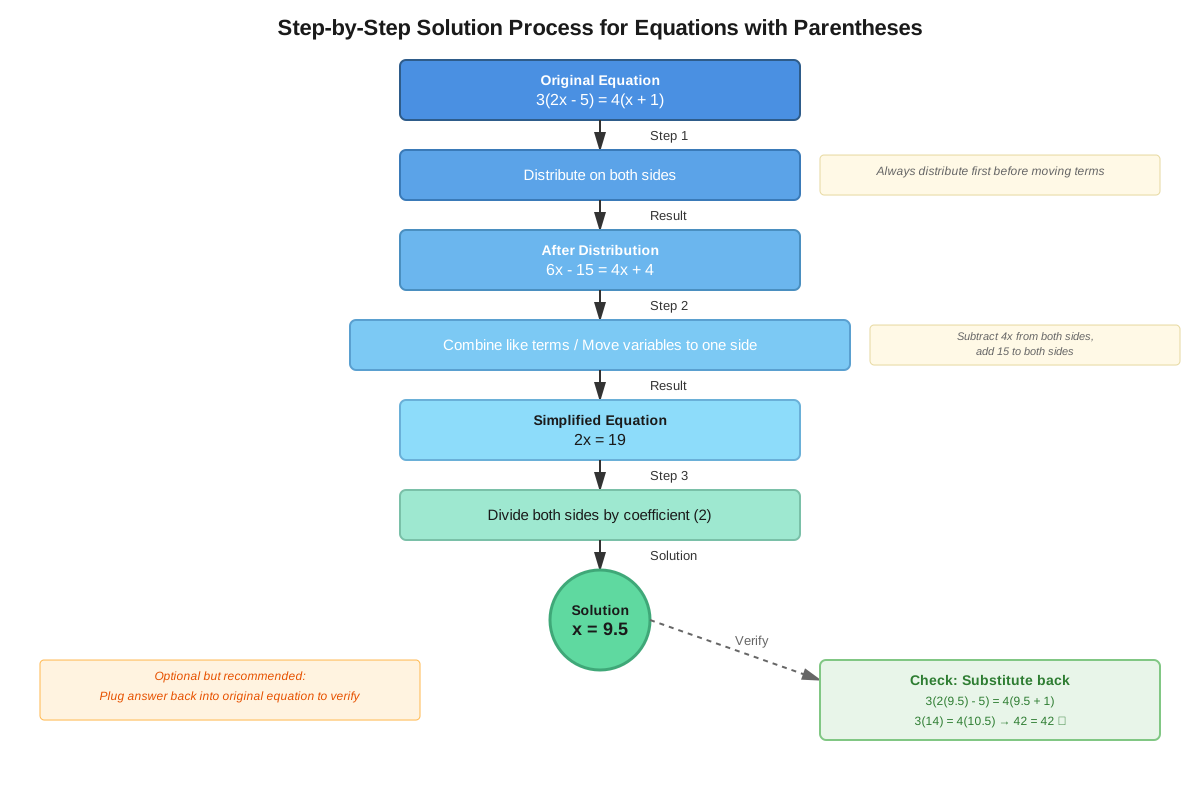
- Direct algebraic equations: "Solve for x: 3(2x - 5) = 4(x + 1)"
- Word problems requiring translation: "The cost of renting a car is $40 plus $0.25 per mile. If Sarah's total cost was $65, how many miles did she drive?"
- Function notation problems: "If f(x) = 2(3x - 7) + 5, find the value of x when f(x) = 15"
- Systems of equations: Where one or both equations contain parentheses
- Inequality problems: Applying the same distributive principles to solve inequalities
The College Board specifically designs these questions to test procedural fluency, conceptual understanding, and problem-solving ability. Questions range from straightforward one-step distribution problems (easier questions) to complex multi-step equations with nested parentheses and variables on both sides (harder questions). Understanding this topic is non-negotiable for students targeting scores above 600 on the math section.
Core Concepts
The Distributive Property
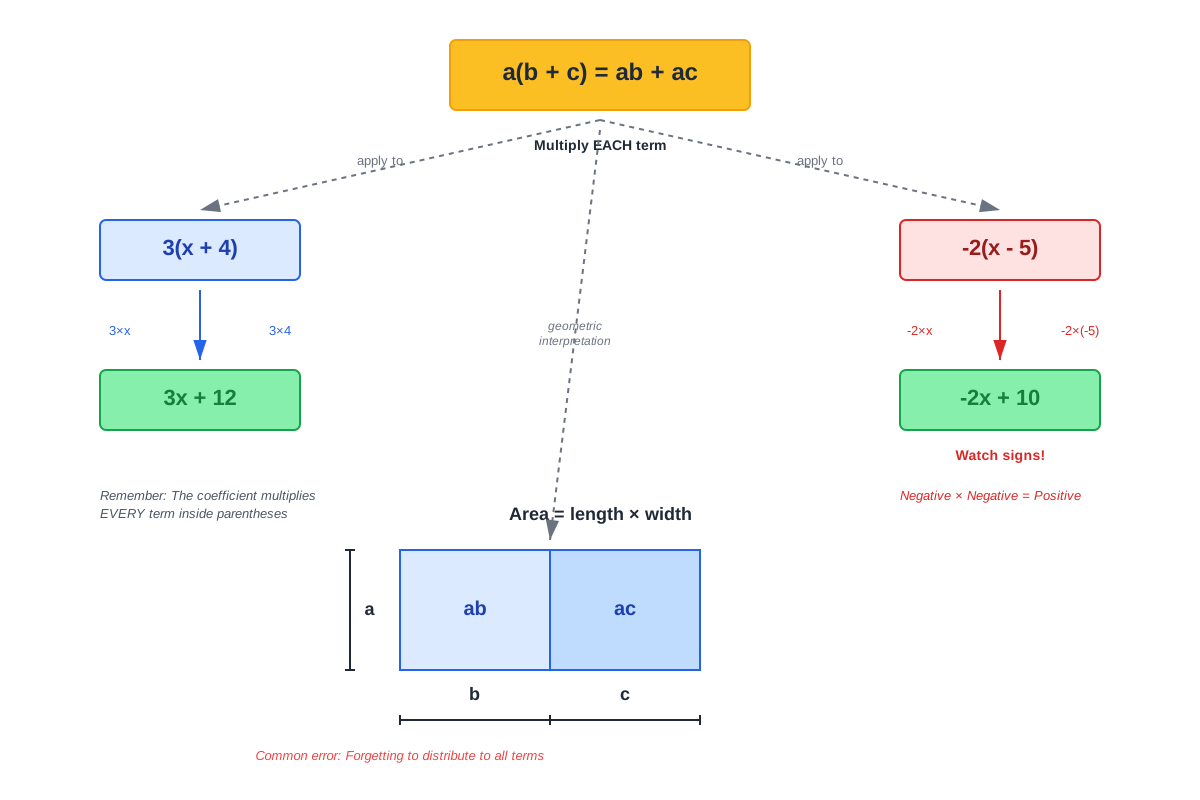
The distributive property is the fundamental principle underlying all work with equations with parentheses. This property states that for any numbers a, b, and c:
a(b + c) = ab + acThis means that when a number or variable multiplies a sum (or difference) in parentheses, that multiplier must be distributed to each term inside the parentheses. The distributive property works with both addition and subtraction:
a(b - c) = ab - acCritical insight: The sign in front of the parentheses affects every term inside. When distributing a negative number, students must change the sign of each term within the parentheses.
Basic Distribution with Positive Coefficients
When solving equations with a positive coefficient outside parentheses, multiply that coefficient by each term inside:
Example: Solve 4(x + 3) = 28
- Distribute the 4: 4x + 12 = 28
- Subtract 12 from both sides: 4x = 16
- Divide both sides by 4: x = 4
The key steps involve: distribute → combine like terms → isolate the variable.
Distribution with Negative Coefficients
Negative coefficients require extra attention because students must apply the negative sign to every term:
Example: Solve -3(2x - 5) = 9
- Distribute the -3: -6x + 15 = 9
- Subtract 15 from both sides: -6x = -6
- Divide both sides by -6: x = 1
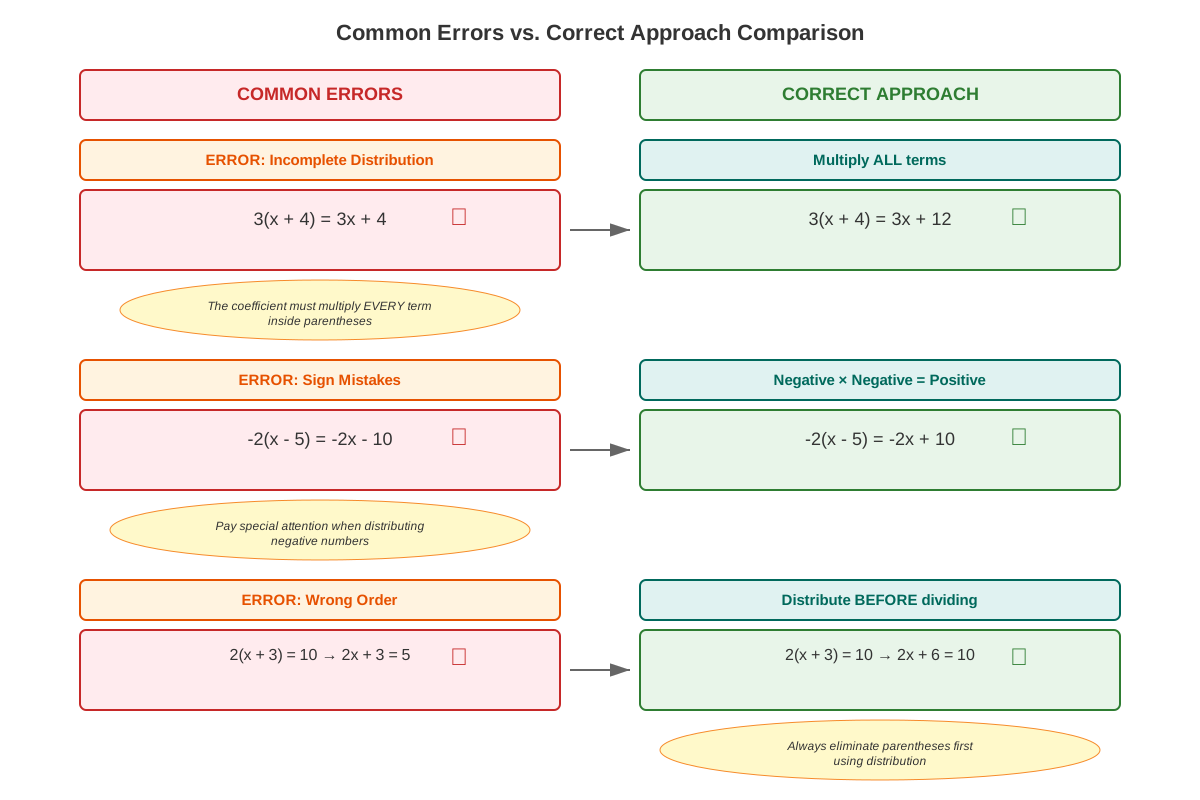
Common error alert: When distributing -3 across (2x - 5), students often correctly get -6x but incorrectly write -15 instead of +15. Remember: negative times negative equals positive.
Equations with Parentheses on Both Sides
Many SAT equations with parentheses feature grouping symbols on both sides of the equation. The solution process requires distributing on both sides before consolidating terms:
Example: Solve 2(x + 4) = 3(x - 1)
- Distribute on left side: 2x + 8
- Distribute on right side: 3x - 3
- Write the equation: 2x + 8 = 3x - 3
- Subtract 2x from both sides: 8 = x - 3
- Add 3 to both sides: 11 = x
Multiple Sets of Parentheses
Some equations contain multiple separate sets of parentheses that must each be distributed:
Example: Solve 2(x - 3) + 4(x + 1) = 18
- Distribute the 2: 2x - 6
- Distribute the 4: 4x + 4
- Combine: 2x - 6 + 4x + 4 = 18
- Combine like terms: 6x - 2 = 18
- Add 2 to both sides: 6x = 20
- Divide by 6: x = 20/6 = 10/3
Nested Parentheses
Advanced SAT questions occasionally feature nested parentheses—parentheses within parentheses. These require working from the inside out or carefully distributing multiple times:
Example: Solve 2[3(x - 1) + 4] = 22
Method 1 (inside-out):
- Distribute the 3: 2[3x - 3 + 4] = 22
- Simplify inside brackets: 2[3x + 1] = 22
- Distribute the 2: 6x + 2 = 22
- Subtract 2: 6x = 20
- Divide by 6: x = 10/3
Fractional Coefficients with Parentheses
When fractions appear as coefficients, students can either distribute the fraction or multiply both sides by the denominator first:
Example: Solve (1/2)(4x - 6) = 7
Method 1 (distribute):
- Distribute 1/2: 2x - 3 = 7
- Add 3: 2x = 10
- Divide by 2: x = 5
Method 2 (clear fraction first):
- Multiply both sides by 2: 4x - 6 = 14
- Add 6: 4x = 20
- Divide by 4: x = 5
Variables on Both Sides with Parentheses
The most challenging standard form involves parentheses with variables appearing on both sides after distribution:
Example: Solve 5(2x - 3) = 3(x + 2) + 4x
- Distribute left: 10x - 15
- Distribute right: 3x + 6 + 4x
- Equation becomes: 10x - 15 = 7x + 6
- Subtract 7x from both sides: 3x - 15 = 6
- Add 15 to both sides: 3x = 21
- Divide by 3: x = 7
Systematic Solution Process
For any equation with parentheses, follow this systematic approach:
| Step | Action | Purpose |
|---|---|---|
| 1 | Distribute all coefficients | Eliminate parentheses |
| 2 | Combine like terms on each side | Simplify the equation |
| 3 | Move variable terms to one side | Consolidate variables |
| 4 | Move constant terms to opposite side | Isolate variable terms |
| 5 | Divide by the variable coefficient | Solve for the variable |
| 6 | Check solution in original equation | Verify accuracy |
Concept Relationships
The distributive property serves as the foundation for equations with parentheses, which directly connects to the broader concept of algebraic manipulation. Distributive property → Equations with parentheses → Multi-step equations → Systems of equations.
Understanding how to handle parentheses builds upon prerequisite knowledge of combining like terms and order of operations. When students distribute coefficients, they apply multiplication (a prerequisite skill), then must combine like terms (another prerequisite) to simplify the resulting expression. The inverse operations used to isolate variables represent the final application of prerequisite knowledge.
Equations with parentheses connect forward to multiple advanced topics. Systems of equations frequently involve parentheses when using substitution or elimination methods. Quadratic equations require distributing when expanding factored forms or applying the quadratic formula. Function notation problems often present functions defined with parenthetical expressions that must be manipulated algebraically.
The relationship between equations with parentheses and inequalities is particularly strong—the same distributive techniques apply, with the additional consideration of reversing inequality signs when multiplying or dividing by negative numbers. Similarly, literal equations (formulas with multiple variables) require the same distribution skills when solving for a specific variable.
Word problems represent the applied context where equations with parentheses most frequently appear. The translation process converts verbal descriptions into algebraic expressions, often naturally producing parentheses to represent grouped quantities or repeated operations.
High-Yield Facts
⭐ The distributive property states a(b + c) = ab + ac and must be applied to every term inside parentheses
⭐ When distributing a negative coefficient, the sign of every term inside the parentheses changes
⭐ After distributing, always combine like terms before attempting to isolate the variable
⭐ Equations with parentheses on both sides require distributing on both sides before consolidating terms
⭐ The most common error is forgetting to distribute to all terms or incorrectly handling negative signs
- Nested parentheses should be simplified from the inside out, or by distributing multiple times carefully
- Fractional coefficients can be distributed directly or eliminated by multiplying both sides by the denominator
- Variables may appear on both sides after distribution; collect all variable terms on one side
- The solution process always follows: distribute → combine → isolate → solve
- Checking solutions by substituting back into the original equation catches distribution errors
- Parentheses in word problems often indicate multiplication or grouped operations
- The SAT tests equations with parentheses in pure algebraic form, word problems, and function notation
- Distribution applies identically to inequalities, with the additional rule about reversing signs when multiplying/dividing by negatives
- Multiple sets of parentheses require distributing each coefficient separately before combining terms
- Understanding the distributive property conceptually (as repeated addition) helps prevent mechanical errors
Quick check — test yourself on Equations with parentheses so far.
Try Flashcards →Common Misconceptions
Misconception: Only the first term inside parentheses needs to be multiplied by the outside coefficient.
Correction: The distributive property requires multiplying the outside coefficient by every term inside the parentheses. For 3(x + 5), both x and 5 must be multiplied by 3, yielding 3x + 15, not 3x + 5.
Misconception: When distributing a negative sign, -1(x - 3) equals -x - 3.
Correction: Distributing -1 across (x - 3) gives -x + 3, not -x - 3. The negative times the negative 3 produces positive 3. A helpful check: -(x - 3) means "the opposite of x minus 3," which is -x + 3.
Misconception: In equations like 2(x + 3) = 10, students can divide both sides by 2 first to get x + 3 = 5.
Correction: While this approach works and is actually efficient, students must understand they're applying the division to the entire left side, not just the coefficient. Both distributing first (2x + 6 = 10) and dividing first are valid strategies.
Misconception: When solving 5 - 2(x + 1) = 7, students distribute the 5 to get 5x + 5 - 2x - 2 = 7.
Correction: The 5 is not being multiplied by the parentheses; only the -2 is. The correct distribution is 5 - 2x - 2 = 7, which simplifies to 3 - 2x = 7.
Misconception: Parentheses can be ignored if they only contain one term, so 3(x) = 3x is different from 3x.
Correction: While 3(x) and 3x are mathematically identical, parentheses around a single term don't change the value. However, in expressions like 3(x + 0) versus 3x + 0, the parentheses indicate what the 3 multiplies.
Misconception: In nested parentheses like 2[3(x - 1)], students can distribute the 2 first to get 6(x - 1).
Correction: This actually works! Multiplying the outer coefficients (2 × 3 = 6) is mathematically valid. However, students should understand why: they're applying the associative property of multiplication. The standard approach of working inside-out is safer for avoiding errors.
Misconception: After distributing in 4(x - 2) = 3(x + 1), students write 4x - 8 = 3x + 1, then incorrectly subtract 3x from the left and 4x from the right.
Correction: When moving variable terms, subtract the same term from both sides. To collect variables on the left, subtract 3x from both sides: 4x - 3x - 8 = 3x - 3x + 1, giving x - 8 = 1.
Misconception: Equations with parentheses always have exactly one solution.
Correction: While most SAT problems yield one solution, equations can have no solution (contradictions like 2(x + 1) = 2x + 5) or infinitely many solutions (identities like 2(x + 1) = 2x + 2). The SAT occasionally tests recognition of these special cases.
Worked Examples
Example 1: Multi-Step Equation with Parentheses on Both Sides
Problem: Solve for x: 3(2x - 4) = 2(x + 5) + 8
Solution:
Step 1: Distribute the 3 on the left side
- 3 × 2x = 6x
- 3 × (-4) = -12
- Left side becomes: 6x - 12
Step 2: Distribute the 2 on the right side
- 2 × x = 2x
- 2 × 5 = 10
- Right side becomes: 2x + 10 + 8
Step 3: Simplify the right side by combining constants
- 2x + 10 + 8 = 2x + 18
Step 4: Write the simplified equation
- 6x - 12 = 2x + 18
Step 5: Collect variable terms on the left by subtracting 2x from both sides
- 6x - 2x - 12 = 2x - 2x + 18
- 4x - 12 = 18
Step 6: Isolate the variable term by adding 12 to both sides
- 4x - 12 + 12 = 18 + 12
- 4x = 30
Step 7: Solve for x by dividing both sides by 4
- x = 30/4 = 15/2 or 7.5
Step 8: Check the solution by substituting x = 7.5 into the original equation
- Left side: 3(2(7.5) - 4) = 3(15 - 4) = 3(11) = 33
- Right side: 2(7.5 + 5) + 8 = 2(12.5) + 8 = 25 + 8 = 33 ✓
Connection to learning objectives: This example demonstrates the complete process of identifying key features (parentheses on both sides, variables on both sides), applying systematic distribution, and solving efficiently—all critical skills for SAT success.
Example 2: Word Problem Requiring Equation with Parentheses
Problem: A gym charges a monthly membership fee of $25 plus $3 for each fitness class attended. Last month, Maria paid a total of $61. If she attended the same number of classes each week for 4 weeks, how many classes did she attend per week?
Solution:
Step 1: Define the variable
- Let x = number of classes attended per week
Step 2: Translate the problem into an equation
- Total classes in 4 weeks: 4x
- Cost of classes: 3(4x) or 3 × 4x
- Total cost: membership fee + class costs
- Equation: 25 + 3(4x) = 61
Step 3: Distribute the 3
- 3 × 4x = 12x
- Equation becomes: 25 + 12x = 61
Step 4: Isolate the variable term by subtracting 25 from both sides
- 12x = 61 - 25
- 12x = 36
Step 5: Solve for x by dividing both sides by 12
- x = 36/12
- x = 3
Step 6: Interpret the answer in context
- Maria attended 3 classes per week
Step 7: Verify the solution
- Classes per month: 3 × 4 = 12 classes
- Cost of classes: $3 × 12 = $36
- Total cost: $25 + $36 = $61 ✓
Connection to learning objectives: This example shows how equations with parentheses appear in SAT word problems, requiring translation from verbal description to algebraic form. The parentheses naturally arise from the grouped quantity (classes per week × 4 weeks), demonstrating real-world application of this mathematical concept.
Exam Strategy
When approaching SAT equations with parentheses, implement these strategic techniques to maximize accuracy and efficiency:
Initial Assessment (5-10 seconds): Before writing anything, scan the equation to identify:
- How many sets of parentheses exist
- Whether parentheses appear on one or both sides
- The signs (positive/negative) of coefficients outside parentheses
- Whether the equation is presented algebraically or embedded in a word problem
Trigger Words and Phrases: Watch for these indicators that signal equations with parentheses:
- "Distribute" or "expand"
- "Simplify the expression"
- "Solve for x" with visible parentheses
- Word problems with phrases like "each," "per," or "times the sum of"
- Function notation: f(x) = [expression with parentheses]
Distribution Checklist: Before moving to the next step, verify:
- ✓ Every term inside parentheses was multiplied by the outside coefficient
- ✓ Signs were handled correctly (especially with negative coefficients)
- ✓ Like terms were combined after distribution
- ✓ Both sides were distributed if parentheses appeared on both sides
Process-of-Elimination Tips:
- If answer choices are numbers, substitute each back into the original equation (work backwards)
- Eliminate answers that produce different values on left and right sides
- For word problems, eliminate answers that don't make logical sense in context (negative distances, fractional people, etc.)
- If two answer choices are very close, double-check your arithmetic—you likely made a sign error
Time Allocation:
- Simple distribution problems (one set of parentheses, one side): 30-45 seconds
- Moderate problems (parentheses on both sides): 60-90 seconds
- Complex problems (nested parentheses or word problems): 90-120 seconds
- If a problem exceeds these times, mark it and return later
Calculator Usage: For calculator-permitted sections:
- Use the calculator to check arithmetic after distributing
- Verify your final answer by substituting back into the original equation
- Be cautious: calculators don't help with distribution itself—that's a manual algebraic skill
Common Trap Avoidance:
- The SAT often includes answer choices that result from common errors (forgetting to distribute to all terms, sign errors)
- If your answer appears as choice A or B and seemed too easy, double-check your work
- Watch for problems where the variable coefficient becomes negative—students often forget to divide by a negative number
Strategic Guessing: If time is running out:
- Eliminate answers that are clearly unreasonable
- Favor answers that are integers or simple fractions over complex decimals
- Remember that SAT answers are distributed relatively evenly across A, B, C, D
Memory Techniques
DICES Mnemonic for solving equations with parentheses:
- Distribute coefficients to all terms
- Identify and combine like terms
- Collect variable terms on one side
- Eliminate constants from the variable side
- Solve by dividing by the coefficient
Visualization Strategy: Picture parentheses as a "container" that must be "unpacked." The coefficient outside is the "multiplier" that must touch every item inside the container. Visualize drawing arrows from the outside coefficient to each term inside.
Sign Song (rhythm helps memory): "Positive times positive, positive it stays / Positive times negative, negative always / Negative times positive, negative we write / Negative times negative, positive and bright"
The "Every Term" Reminder: When you see parentheses, immediately write "EVERY TERM" above them as a reminder that distribution applies to all terms inside, not just the first one.
Acronym for Checking Work - SODA:
- Substitute your answer back into the original equation
- Operate on both sides separately
- Determine if both sides equal the same value
- Accept the answer if they match, or revise if they don't
Negative Distribution Trick: When distributing a negative, imagine the negative sign as a "sign flipper" that changes every sign inside the parentheses. Positive becomes negative, negative becomes positive.
Nested Parentheses Visualization: Think of nested parentheses like Russian nesting dolls—work from the innermost doll (parentheses) outward, or multiply the outer layers together first.
Summary
Equations with parentheses represent a fundamental algebraic skill that appears frequently throughout the SAT math section. Mastery requires understanding and applying the distributive property—multiplying the coefficient outside parentheses by every term inside—while carefully managing positive and negative signs. The systematic solution process involves distributing all coefficients, combining like terms, collecting variables on one side, isolating the variable term, and solving through inverse operations. Students must recognize that parentheses can appear on one or both sides of equations, may be nested, and frequently emerge in word problems where grouped quantities require algebraic representation. Common errors include failing to distribute to all terms, incorrectly handling negative coefficients, and making sign mistakes when combining terms. Success on SAT questions requires both procedural fluency (executing the steps accurately) and strategic thinking (recognizing when to distribute versus when to use alternative approaches like dividing both sides by a common factor). The ability to solve equations with parentheses efficiently creates a foundation for more advanced topics including systems of equations, quadratic expressions, and function manipulation.
Key Takeaways
- The distributive property a(b + c) = ab + ac is the essential mechanism for eliminating parentheses from equations
- Always distribute the outside coefficient to every term inside the parentheses, paying special attention to negative signs
- Follow the systematic DICES process: Distribute, Identify like terms, Collect variables, Eliminate constants, Solve
- Equations with parentheses appear in multiple SAT contexts: pure algebra, word problems, function notation, and systems
- Check solutions by substituting back into the original equation to catch distribution and sign errors
- The most common mistakes involve incomplete distribution and sign errors with negative coefficients
- Efficient problem-solving requires recognizing patterns and choosing between distributing first versus simplifying first
Related Topics
Linear Inequalities with Parentheses: Extends the same distributive techniques to inequality problems, with the additional consideration of reversing inequality signs when multiplying or dividing by negative numbers. Mastering equations with parentheses makes this transition seamless.
Systems of Equations: Many systems involve equations with parentheses, particularly when using the substitution method or when equations are presented in non-standard form. The distribution skills learned here apply directly to system-solving techniques.
Quadratic Equations and Factoring: Distributing binomials (FOIL method) and expanding factored forms of quadratics builds directly on the distributive property. Understanding how to distribute prepares students for reverse-engineering through factoring.
Function Notation and Composition: Functions defined with parenthetical expressions require distribution when evaluating or solving. For example, finding x when f(x) = 2(3x - 5) + 7 = 20 requires the same skills practiced in this topic.
Literal Equations: Solving formulas for specific variables often involves distributing when the desired variable appears inside parentheses. The techniques learned here transfer directly to manipulating scientific and geometric formulas.
Practice CTA
Now that you've mastered the core concepts of equations with parentheses, it's time to solidify your understanding through active practice. Complete the practice questions to test your ability to distribute correctly, handle negative coefficients, and solve multi-step equations efficiently. Use the flashcards to reinforce key concepts and build automatic recall of the distributive property and common error patterns. Remember: the SAT rewards both accuracy and speed, and both improve dramatically with deliberate practice. Each problem you solve strengthens your algebraic intuition and builds confidence for test day. You've learned the strategies—now apply them!
Sign up free to keep reading
Create a free AnvayaPrep account to finish this SAT guide on Equations with parentheses — plus flashcards and practice questions.