Overview
Linear equation word problems represent one of the most frequently tested concepts on the SAT math section, appearing in approximately 15-20% of all algebra questions. These problems require students to translate real-world scenarios into mathematical expressions and solve for unknown variables using algebraic techniques. Unlike straightforward computational problems, word problems demand critical reading skills, logical reasoning, and the ability to identify relevant information while filtering out extraneous details. Mastery of this topic is essential not only for achieving a competitive SAT score but also for developing problem-solving skills applicable across all STEM disciplines.
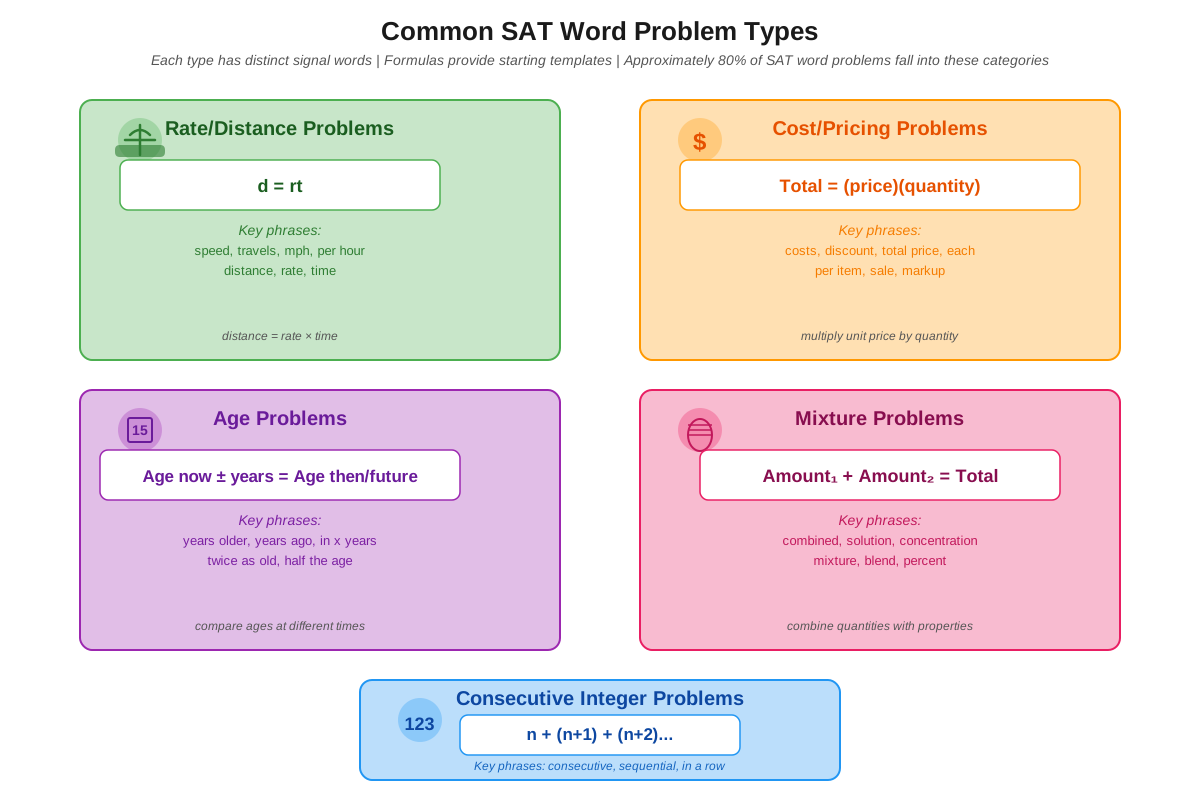
The SAT consistently presents sat linear equation word problems in various contexts including rate problems, mixture problems, cost analysis, age relationships, and geometric applications. These questions test whether students can move fluidly between verbal descriptions and mathematical representations—a skill that distinguishes high-scoring test-takers from average performers. The College Board deliberately designs these problems to assess mathematical reasoning rather than mere computational ability, making them excellent predictors of college readiness.
Understanding linear equation word problems serves as a foundation for more advanced mathematical concepts tested on the SAT, including systems of equations, quadratic applications, and data interpretation. The skills developed through mastering this topic—identifying variables, establishing relationships, and systematic problem-solving—transfer directly to other areas of the exam, including the reading and writing sections where analytical thinking proves equally valuable. Students who excel at translating words into equations demonstrate the kind of flexible thinking that colleges seek in applicants.
Learning Objectives
- [ ] Identify key features of linear equation word problems
- [ ] Explain how linear equation word problems appears on the SAT
- [ ] Apply linear equation word problems to answer SAT-style questions
- [ ] Translate verbal descriptions into algebraic expressions with 95% accuracy
- [ ] Distinguish between relevant and irrelevant information in complex word problems
- [ ] Verify solutions by substituting back into the original problem context
- [ ] Recognize common word problem patterns and select appropriate solution strategies
Prerequisites
- Basic algebraic manipulation: Students must solve equations involving addition, subtraction, multiplication, and division to isolate variables—this forms the computational foundation for all word problems
- Order of operations (PEMDAS): Correct sequencing of mathematical operations ensures accurate equation setup and solution—errors here cascade through the entire problem
- Understanding of variables: Recognizing that letters represent unknown quantities allows translation from words to mathematical symbols—the core skill in word problem solving
- Unit awareness: Distinguishing between different measurement units (hours vs. minutes, dollars vs. cents) prevents common calculation errors and ensures meaningful answers
- Fraction and decimal operations: Many word problems involve non-integer values, requiring fluency with rational number arithmetic
Why This Topic Matters
Linear equation word problems appear in everyday life far more frequently than abstract mathematical exercises. Calculating travel time based on distance and speed, determining sale prices after discounts, budgeting expenses, and analyzing payment plans all require the same skills tested in SAT word problems. Professionals in business, engineering, healthcare, and social sciences regularly translate real-world situations into mathematical models—exactly what these problems train students to do.
On the SAT, linear equation word problems typically constitute 4-6 questions per test, representing approximately 10-15% of the total math score. These questions appear in both the calculator and no-calculator sections, with varying difficulty levels. The College Board reports that word problems have the highest discrimination index among algebra questions, meaning they effectively separate students at different skill levels. High-performing students (scoring 700+) answer these questions correctly 85-90% of the time, while average performers (scoring 500-600) succeed only 45-55% of the time.
Common SAT presentations include: rate-time-distance problems (a car travels at 60 mph for x hours), percent increase/decrease scenarios (a store marks up prices by 25% then offers a 20% discount), age relationship puzzles (John is twice as old as Mary was three years ago), work rate problems (two workers complete a job at different rates), and mixture problems (combining solutions of different concentrations). The exam frequently embeds these within realistic contexts like business decisions, scientific experiments, or everyday planning scenarios, requiring students to extract mathematical relationships from narrative descriptions.
Core Concepts
Understanding Linear Equations
A linear equation is an algebraic equation in which the highest power of the variable is one, producing a straight line when graphed. In word problems, these equations model relationships where quantities change at constant rates. The standard form is ax + b = c, where a, b, and c are constants and x represents the unknown variable. The defining characteristic is that the variable appears without exponents, roots, or in denominators—ensuring a single, straightforward solution.
Linear equations in word problems always represent proportional or additive relationships. For example, "total cost equals price per item times quantity plus shipping fee" translates to C = px + s, where each additional item increases cost by a fixed amount (p). Recognizing this pattern helps students identify when linear modeling applies versus when more complex mathematics is needed.
The Translation Process
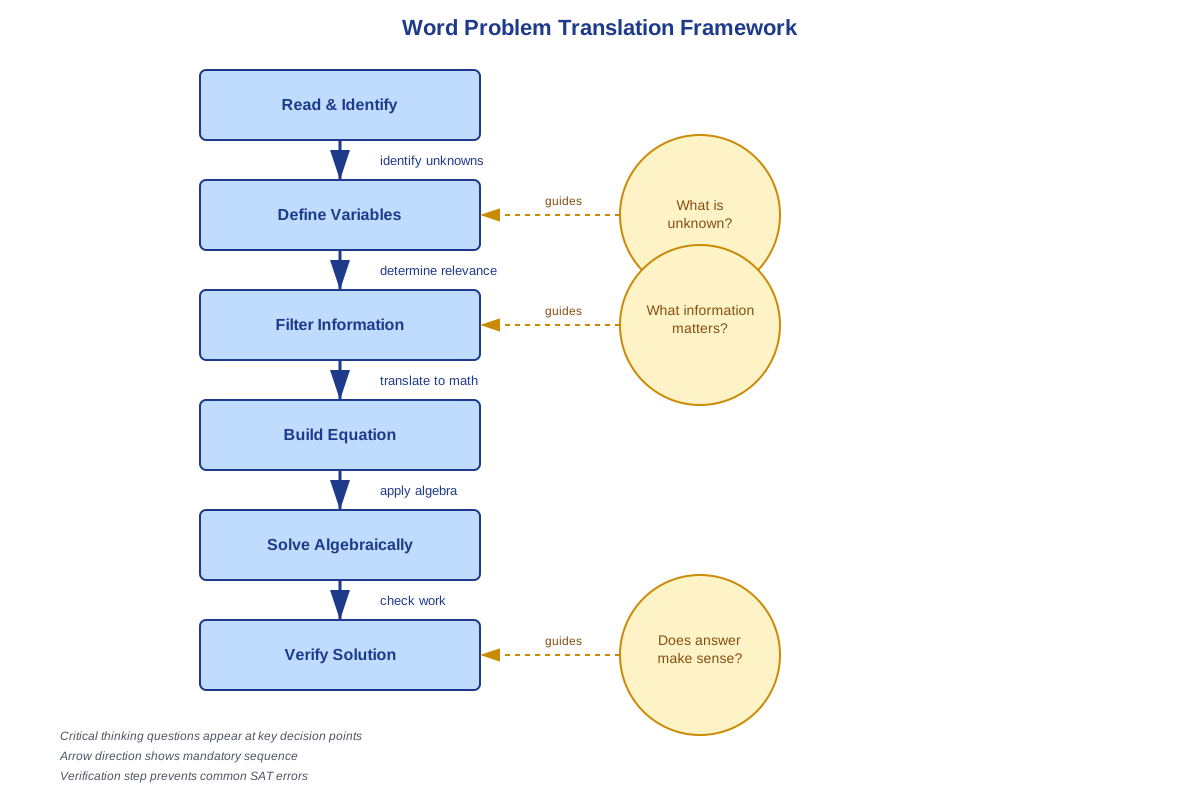
Converting words to equations follows a systematic four-step process:
- Identify the unknown quantity and assign it a variable (usually x, but any letter works)
- Locate the relationship described in the problem (equals, is, totals, results in)
- Translate phrases into mathematical operations using standard conventions
- Write the complete equation ensuring both sides represent equivalent quantities
Common translation patterns include:
| Verbal Phrase | Mathematical Operation | Example |
|---|---|---|
| "more than," "increased by," "sum of" | Addition (+) | "5 more than x" → x + 5 |
| "less than," "decreased by," "difference" | Subtraction (−) | "7 less than x" → x − 7 |
| "times," "product of," "multiplied by" | Multiplication (×) | "3 times x" → 3x |
| "divided by," "quotient of," "per" | Division (÷) | "x divided by 4" → x/4 |
| "is," "equals," "results in," "totals" | Equals (=) | "x is 10" → x = 10 |
Critical distinction: "5 less than x" means x − 5, NOT 5 − x. The quantity mentioned first in "less than" phrases comes second in the mathematical expression—a frequent source of errors.
Rate-Time-Distance Problems
The fundamental formula Distance = Rate × Time (D = RT) underlies numerous SAT word problems. This relationship states that the distance traveled equals the speed multiplied by the duration of travel. Variations include solving for rate (R = D/T) or time (T = D/R).
Example scenario: "A train travels 180 miles in 3 hours. What is its average speed?"
- Given: D = 180 miles, T = 3 hours
- Find: R
- Equation: 180 = R × 3
- Solution: R = 60 mph
More complex versions involve two objects moving toward or away from each other, requiring students to set up equations where distances add or subtract. If two cars start 300 miles apart and drive toward each other at 50 mph and 70 mph respectively, they meet when 50t + 70t = 300, where t represents time in hours.
Percent Problems
Percent word problems require converting percentage language into decimal multipliers. "30% of x" translates to 0.30x or (30/100)x. The SAT frequently tests successive percent changes, where students must recognize that a 20% increase followed by a 20% decrease does NOT return to the original value.
Markup and discount problems follow the pattern:
- Original price × (1 + markup rate) = marked price
- Marked price × (1 − discount rate) = final price
For example, if a $50 item is marked up 40% then discounted 25%:
- Marked price: 50 × 1.40 = $70
- Final price: 70 × 0.75 = $52.50
Age Problems
Age relationship problems involve comparing ages at different time points. The key insight is that everyone ages at the same rate—if John is 5 years older than Mary now, he will always be 5 years older than Mary.
Standard setup pattern:
- Let x = current age of one person
- Express other ages in terms of x
- Set up equation based on the given relationship
Example: "Maria is twice as old as her brother. In 5 years, she will be 1.5 times as old as her brother. How old is Maria now?"
- Let x = brother's current age
- Maria's current age = 2x
- In 5 years: brother = x + 5, Maria = 2x + 5
- Equation: 2x + 5 = 1.5(x + 5)
- Solution: 2x + 5 = 1.5x + 7.5 → 0.5x = 2.5 → x = 5
- Maria is currently 2(5) = 10 years old
Work Rate Problems
Work rate problems use the principle that Rate × Time = Work completed. If a person completes a job in n hours, their work rate is 1/n of the job per hour. When multiple workers collaborate, their rates add together.
Formula: If person A completes a job in a hours and person B completes it in b hours, working together they complete it in time t where:
(1/a + 1/b) × t = 1Example: "Pump A fills a pool in 4 hours. Pump B fills it in 6 hours. How long to fill it together?"
- Rate A = 1/4 pool per hour
- Rate B = 1/6 pool per hour
- Combined rate = 1/4 + 1/6 = 3/12 + 2/12 = 5/12 pool per hour
- Time = 1 ÷ (5/12) = 12/5 = 2.4 hours
Mixture Problems
Mixture problems involve combining substances with different properties (concentration, value, etc.). The key principle is that the total amount of the pure substance equals the sum of pure substances in each component.
Standard formula: (Concentration₁)(Amount₁) + (Concentration₂)(Amount₂) = (Final Concentration)(Total Amount)
Example: "How many liters of 20% acid solution must be added to 5 liters of 50% acid solution to create a 30% solution?"
- Let x = liters of 20% solution
- Pure acid from 20% solution: 0.20x
- Pure acid from 50% solution: 0.50(5) = 2.5
- Total pure acid: 0.20x + 2.5
- Total solution: x + 5
- Equation: 0.20x + 2.5 = 0.30(x + 5)
- Solution: 0.20x + 2.5 = 0.30x + 1.5 → 1 = 0.10x → x = 10 liters
Concept Relationships
The translation process serves as the gateway skill that enables all other word problem solving. Without accurately converting verbal descriptions into mathematical expressions, students cannot access their algebraic manipulation abilities. This translation skill → equation setup → algebraic solution → answer verification represents the universal workflow for all linear equation word problems.
Rate-time-distance problems connect directly to unit conversion and proportional reasoning from prerequisite knowledge. These problems also relate to systems of equations (a future topic) when multiple objects or trips are involved. The D = RT formula extends to work rate problems by substituting "work completed" for distance and "work rate" for speed, demonstrating how a single conceptual framework applies across seemingly different contexts.
Percent problems build upon fraction and decimal operations while connecting forward to exponential growth (compound interest) and data analysis (percent change in graphs). The successive percent change concept particularly bridges to more advanced topics where students must recognize that operations don't always commute or reverse simply.
Age problems and mixture problems both exemplify constraint-based reasoning, where multiple conditions must simultaneously be satisfied. This logical structure appears throughout SAT math, including in geometry (multiple angle relationships) and functions (domain/range restrictions). Mastering the systematic approach in these contexts develops transferable problem-solving strategies.
All word problem types share the common thread of dimensional analysis—ensuring units match on both sides of equations. This connects to scientific notation, unit conversion, and data interpretation questions elsewhere on the SAT, making it a high-leverage skill that pays dividends across the entire math section.
Quick check — test yourself on Linear equation word problems so far.
Try Flashcards →High-Yield Facts
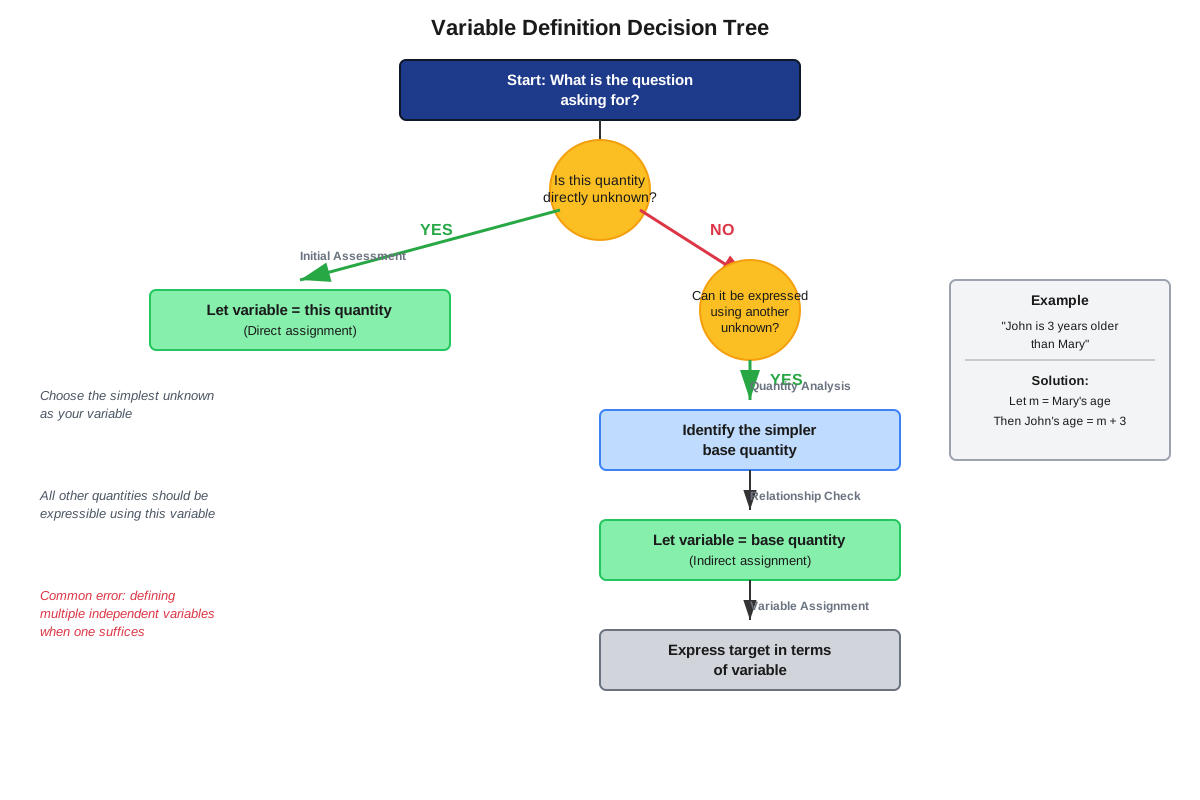
⭐ The variable should represent the simplest unknown quantity, not necessarily what the question asks for—often requiring a final calculation step after solving
⭐ "Less than" and "fewer than" reverse the order: "5 less than x" means x − 5, not 5 − x
⭐ Percent changes multiply, they don't add: A 20% increase followed by 20% decrease results in 0.96 times the original (not 1.00)
⭐ In rate problems, all units must be consistent: If rate is in mph and time in minutes, convert one before calculating
⭐ Work rates add when people work together: If A works at rate 1/a and B at rate 1/b, combined rate is 1/a + 1/b
- The equation must balance dimensionally—both sides should represent the same type of quantity (dollars, hours, miles, etc.)
- Age problems maintain constant age differences—if A is 5 years older than B now, A will always be 5 years older
- In mixture problems, track the pure substance amount, not total volume
- "Per" always indicates division: "dollars per hour" means dollars ÷ hours
- The word "is" almost always translates to an equals sign in equations
- When a problem states "x more than y," the result is y + x (the base comes first)
- Consecutive integers can be represented as x, x+1, x+2, etc., while consecutive even/odd integers use x, x+2, x+4
- Distance problems involving opposite directions add the distances; same direction problems subtract them
- The phrase "what percent" requires multiplying the final answer by 100
- Always check if the answer makes sense in the original context—negative ages or speeds exceeding light speed indicate errors
Common Misconceptions
Misconception: The variable must represent what the question asks for.
Correction: The variable should represent the most convenient unknown, often requiring additional calculation to answer the actual question. If asked "How old is Maria?" but the equation is easier with x = brother's age, use that and calculate Maria's age as 2x afterward.
Misconception: "5 less than x" means 5 − x.
Correction: "Less than" reverses the order, so "5 less than x" means x − 5. The quantity mentioned second (x) comes first in the expression. Think of it as "x with 5 subtracted from it."
Misconception: A 25% discount on an item already marked up 25% returns to the original price.
Correction: Percent changes apply to different bases. If original price is $100, markup gives $125, then 25% discount applies to $125: 0.75 × 125 = $93.75, not $100. The operations don't cancel because they operate on different amounts.
Misconception: In work problems, if A takes 3 hours and B takes 5 hours, together they take 8 hours.
Correction: Rates add, not times. Combined rate = 1/3 + 1/5 = 8/15 jobs per hour, so time = 1 ÷ (8/15) = 15/8 = 1.875 hours. Working together is always faster than either person alone.
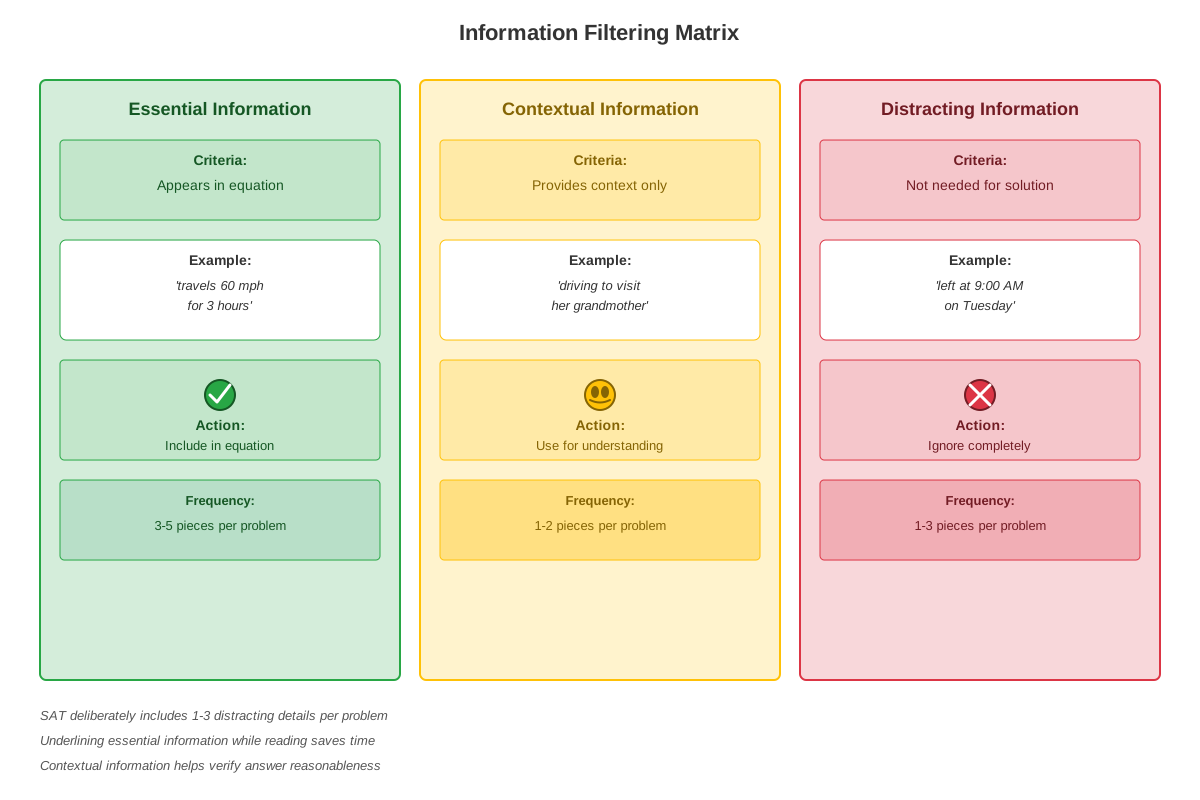
Misconception: All information in a word problem must be used.
Correction: SAT word problems often include extraneous information to test reading comprehension. Students must identify which quantities are relevant to the specific question asked and ignore distractors.
Misconception: The first number mentioned should be the variable.
Correction: Choose the variable strategically based on what makes the equation simplest. Sometimes defining x as the smaller quantity, the rate, or even the final answer (then working backward) creates easier algebra.
Misconception: "Twice as old as" and "two years older than" mean the same thing.
Correction: "Twice as old" indicates multiplication (2x), while "two years older" indicates addition (x + 2). These create fundamentally different relationships and equations.
Worked Examples
Example 1: Rate-Time-Distance with Multiple Legs
Problem: Sarah drives from City A to City B at an average speed of 50 mph. On the return trip, due to traffic, she averages only 30 mph. If the total driving time for the round trip is 8 hours, what is the distance between City A and City B?
Solution Process:
Step 1 - Identify the unknown: Let d = distance between cities (in miles)
Step 2 - Set up relationships:
- Time to City B: t₁ = d/50 (using T = D/R)
- Time returning: t₂ = d/30
- Total time: t₁ + t₂ = 8
Step 3 - Write the equation:
d/50 + d/30 = 8Step 4 - Solve algebraically:
Find common denominator (150):
3d/150 + 5d/150 = 8
8d/150 = 8
8d = 1200
d = 150
Step 5 - Verify:
- Time to B: 150/50 = 3 hours
- Time returning: 150/30 = 5 hours
- Total: 3 + 5 = 8 hours ✓
Answer: The distance between cities is 150 miles.
Key Learning Points: This problem demonstrates that average speed for a round trip is NOT the arithmetic mean of the two speeds. Students must work with time = distance/rate for each leg separately. The problem also shows how choosing the right variable (distance, not time) simplifies the setup.
Example 2: Complex Percent Problem
Problem: A store marks up all items by 60% above wholesale cost. During a sale, the store offers 25% off the marked price. If a customer pays $72 for an item during the sale, what was the wholesale cost?
Solution Process:
Step 1 - Identify the unknown: Let w = wholesale cost (in dollars)
Step 2 - Trace the price changes:
- After 60% markup: marked price = w + 0.60w = 1.60w
- After 25% discount: sale price = 1.60w − 0.25(1.60w) = 0.75(1.60w)
Step 3 - Write the equation:
0.75(1.60w) = 72Step 4 - Solve:
1.20w = 72
w = 72/1.20
w = 60
Step 5 - Verify:
- Marked price: 60 × 1.60 = $96
- Sale price: 96 × 0.75 = $72 ✓
Answer: The wholesale cost was $60.
Key Learning Points: This problem illustrates successive percent changes and the importance of tracking which base each percentage applies to. The markup applies to wholesale cost, while the discount applies to marked price. Students often incorrectly try to combine the percentages (60% − 25% = 35%) which fails because the percentages operate on different amounts. The problem also reinforces that "25% off" means paying 75% of the price, represented as multiplication by 0.75.
Exam Strategy
Initial Reading Strategy: Read the entire problem once without attempting to solve, identifying: (1) what the question asks for, (2) what information is given, and (3) what relationships are described. Circle or underline the actual question—SAT problems often bury the question in the middle or provide information after asking the question.
Variable Selection: Choose the variable to represent the quantity that appears most frequently in the problem or creates the simplest equation, not necessarily what the question asks for. If the problem asks for "Maria's age" but all relationships are stated in terms of her brother's age, let x = brother's age and calculate Maria's age afterward.
Trigger Words to Watch:
- "More than," "increased by," "sum" → addition
- "Less than," "decreased by," "difference" → subtraction (watch order!)
- "Of" in percent contexts → multiplication (30% of x = 0.30x)
- "Per" → division (miles per hour = miles ÷ hours)
- "Is," "equals," "results in" → equals sign
- "Twice," "double," "triple" → multiplication by 2, 2, 3
Process of Elimination Tips:
- Check units: Eliminate answers with wrong units (if asking for hours, eliminate answers in minutes)
- Reasonableness test: If a car travels 2 hours at 60 mph, distance must be near 120 miles—eliminate 12 or 1200
- Positive/negative logic: Ages, distances, and counts must be positive—eliminate negative answers
- Relative magnitude: If John is older than Mary, eliminate answers where John's age is less than Mary's
Time Allocation: Spend 30-45 seconds reading and setting up the equation, 30-60 seconds solving, and 15-30 seconds checking. If setup takes longer than 1 minute, the approach may be wrong—consider redefining the variable or looking for a different relationship. Budget approximately 1.5-2 minutes total per word problem.
Verification Strategy: Always substitute the answer back into the original context, not just the equation. If x = 5 represents hours and the question asks for minutes, verify that 300 minutes makes sense in the problem's scenario. Check that all conditions stated in the problem are satisfied by the solution.
Calculator Usage: On calculator-permitted sections, use the calculator for arithmetic but set up equations by hand. Avoid trying to solve word problems entirely on the calculator—the translation step requires careful written work. Use the calculator to check arithmetic after solving algebraically.
Memory Techniques
DIRT Mnemonic for rate problems: Distance Is Rate Times time (D = RT). Visualize a dirt road where distance depends on how fast you go and how long you travel.
PEMDAS Reminder for translation order: Please Excuse My Dear Aunt Sally ensures correct operation order when setting up complex expressions with multiple operations.
"Less Than" Reversal Rule: Visualize "less than" as a backwards arrow ← pointing from the second term to the first. "5 less than x" has the arrow pointing from x back to 5, giving x − 5.
Percent Change Visualization: Picture a number line where 100% is the original value. Increases move right (multiply by 1 + rate), decreases move left (multiply by 1 − rate). A 20% increase means multiplying by 1.20, not adding 20.
Work Rate Fraction Flip: If someone completes a job in n hours, their rate is 1/n jobs per hour—flip the time to get the rate. Visualize flipping a fraction card.
Age Problem Timeline: Draw a simple timeline with "Now" and "Then" (past or future) as columns, listing each person's age in both columns. The constant difference between ages becomes visually obvious.
Mixture Table Method: Create a three-column table with headers "Amount," "Concentration," and "Pure Substance." Fill in known values and use the relationship: Amount × Concentration = Pure Substance for each row.
Summary
Linear equation word problems require students to translate real-world scenarios into algebraic equations and solve for unknown quantities—a skill that appears on 4-6 SAT questions per test. Success depends on systematic translation of verbal phrases into mathematical operations, strategic variable selection, and careful attention to units and context. The five major problem types—rate-time-distance, percent change, age relationships, work rates, and mixtures—each follow predictable patterns that students can master through practice. Critical skills include recognizing that "less than" reverses order (x − 5, not 5 − x), understanding that percent changes multiply rather than add, and knowing that work rates add when people collaborate. The solution process always follows the same structure: identify the unknown, establish relationships, write the equation, solve algebraically, and verify the answer in the original context. Students who master these patterns and avoid common misconceptions consistently score well on this high-yield topic.
Key Takeaways
- Translation accuracy determines success: The most common errors occur when converting words to equations, particularly with "less than" phrases and percent operations
- Strategic variable selection simplifies algebra: Choose the variable to represent the quantity that makes the equation simplest, not necessarily what the question asks for
- Percent changes multiply, never add: A 20% increase followed by 20% decrease yields 0.96× the original, not 1.00×
- Units must be consistent throughout: Convert all quantities to matching units before setting up equations (hours with hours, miles with miles)
- Verification catches errors: Always substitute the solution back into the original problem context to ensure it satisfies all stated conditions
- Pattern recognition accelerates solving: The five major problem types (rate, percent, age, work, mixture) follow predictable formulas that become automatic with practice
- Extraneous information tests reading comprehension: Not all given information is relevant—identify what the question actually asks and use only necessary data
Related Topics
Systems of Linear Equations: Many word problems involve two unknowns requiring two equations, extending single-variable techniques to simultaneous equation solving—mastering linear equation word problems provides the foundation for setting up these more complex systems.
Linear Inequalities: Word problems involving "at least," "at most," or "no more than" require inequality notation rather than equations—the translation skills learned here transfer directly with only the equals sign changing to <, >, ≤, or ≥.
Quadratic Word Problems: More complex scenarios involving area, projectile motion, or optimization require quadratic equations—the systematic translation and verification processes remain identical to linear problems.
Exponential Growth and Decay: Problems involving compound interest, population growth, or radioactive decay use exponential functions—understanding percent change in linear contexts prepares students for these more advanced applications.
Function Notation and Modeling: Word problems can be reframed as function definitions where the equation represents a general relationship—this abstraction appears frequently in SAT questions asking students to interpret function meaning in context.
Practice CTA
Now that you've mastered the core concepts and strategies for linear equation word problems, it's time to put your knowledge into action! Work through the practice questions to reinforce these skills and build the speed and confidence you need for test day. Each problem you solve strengthens your pattern recognition and translation abilities, making the next one easier. Remember, the SAT rewards systematic thinking and careful setup more than computational speed—focus on the process, and the correct answers will follow. You've got this!
Sign up free to keep reading
Create a free AnvayaPrep account to finish this SAT guide on Linear equation word problems — plus flashcards and practice questions.